Our destination is about 10 kilometers (6 miles) from downtown Hangzhou.
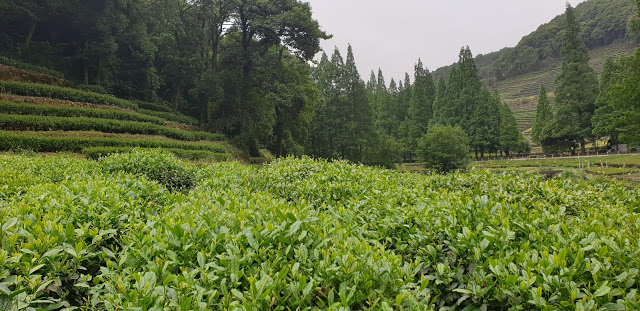
Meijiawu Tea Village is located in the west of the world-known West Lake and hailed as “ten miles Meiwu” for its vast area along the Meiling Road, is an ancient village with a history of 600 years. It is the main production base and a protected area of the fragrant West Lake Dragon Well Tea.
The tea leaves from Meijiawu are beautiful in green color, graceful in shape, strong in fragrance and rich in flavor.
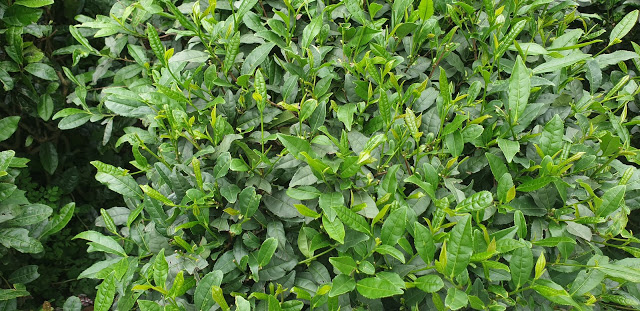
So, first, we get to look at the tea bushes, which are much larger than the bushes we’ve seen on the side of the road. I’m not up for becoming a tea picker any time soon, so I’ll leave it to the professionals.
All tea leaves are picked by women. It takes about 8 hours to pick two kilos of leaves.
Tea leaves are still picked by hand three times a year, the first spring, by young girls about 15 or 16, the second, summer tea, picked by girls about 20 years old, and the autumn tea, called grandma tea, picked by older women.
Next, we go to the drying demonstration, three tubs with tea leaves, that have to be stirred by hand for a number of hours.
We then get the sales pitch, which extols the benefits of the green tea, which apparently good for everything. So, now we have tea and supplement pills.
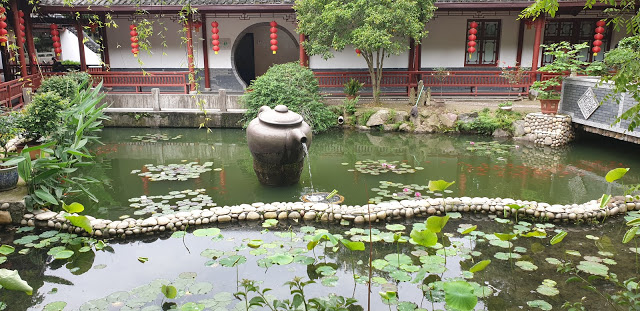
The teapot fountain in the gardens is a nice touch.
Still, we had a cup or two of tea discovered the right way to make it and had a stroll about the grounds. And for that hour in the morning, it was very pleasant.
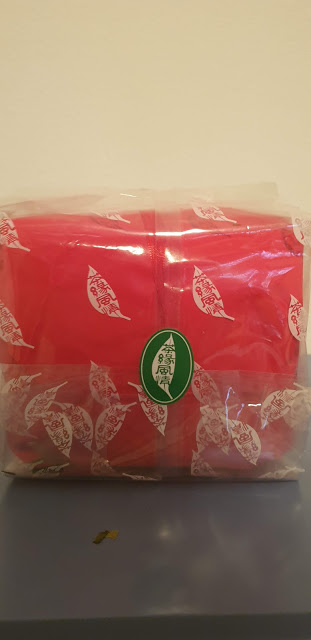
This is a about 1kg package of tea leaves. Don’t ask me how many cups of tea that will make!
West Lake is a freshwater lake in Hangzhou, China. It is divided into five sections by three causeways. There are numerous temples, pagodas, gardens, and artificial islands within the lake.
Measuring 3.2 kilometers (2 miles) in length, 2.8 kilometers (1.7 miles) in width, and 2.3 meters (7.5 feet) in average depth, the lake spreads itself in an area totaling 6.5 square kilometers (2.5 square miles).
The earliest recorded name for West Lake was the “Wu Forest River”, but over time it changed to two distinct names. One is “Qiantang Lake”, due to the fact that Hangzhou was called “Qiantang” in ancient times. The other, “West Lake”, due to the lake being west of the city
It’s about to get busy, with a number of activities planned, and the warmth of the day is starting to make an impact.
The tour starts in the car park about a kilometer away, but the moment we left the car park we were getting a taste of the park walking along a tree-lined avenue.
When we cross the road, once again dicing with death with the silent assassins on motor scooters.
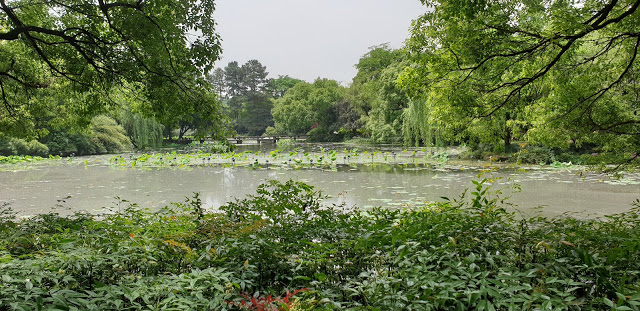
We are in the park proper, and it is magnificent, with flowers, mostly at the start hydrangeas and then any number of other trees and shrubs, some carved into other flower shapes like a lotus.
Then there was the lake and the backdrop of bridges and walkways.
.
And if you can tune out the background white noise the place would be great for serenity and relaxation.
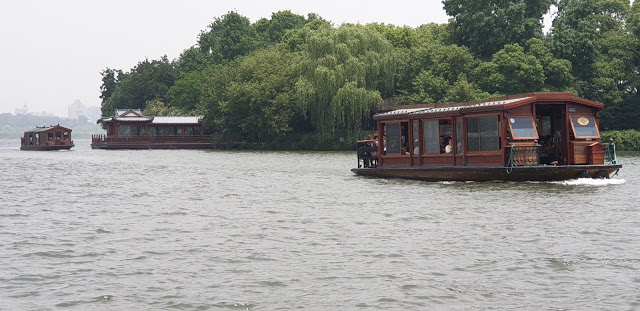
That, in fact, was how the boat ride panned out, about half an hour or more gliding across the lake in an almost silent boat, by an open window, with the air and the majestic scenery.
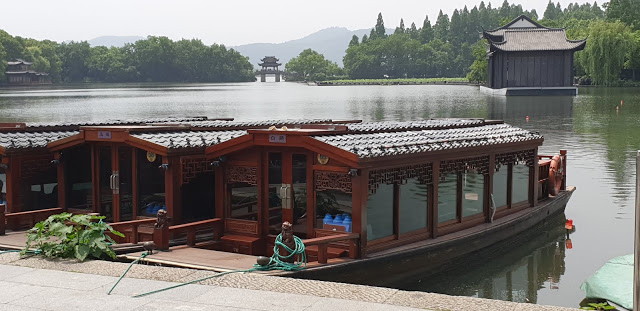
No, not that boat, which would be great to have lunch on while cruising, but the boat below:
Not quite in the same class, but all the same, very easy to tune out and soak it in.
It was peaceful, amazingly quiet, on a summery day
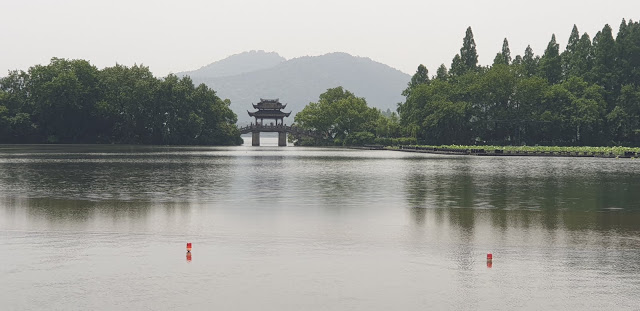
A pagoda in the hazy distance, an island we were about to circumnavigate.
Of all the legends, the most touching one is the love story between Bai Suzhen and Xu Xi’an. Bai Suzhen was a white snake spirit and Xu Xi’an was a mortal man.
They fell in love when they first met on a boat on the West Lake, and got married very soon after.
However, the evil monk Fa Hai attempted to separate the couple by imprisoning Xu Xi’an. Bai Suzhen fought against Fa Hai and tried her best to rescue her husband, but she failed and was imprisoned under the Leifeng Pagoda by the lake.
Years later the couple was rescued by Xiao Qing, the sister of Baisuzhen, and from then on, Bai Suzhen and Xu Xi’an lived together happily.
The retelling of the story varied between tour guides, and on the cruise boat, we had two. Our guide kept to the legend, the other tour guide had a different ending.
Suffice to say it had relevance to the two pagodas on the far side of the lake.
There was a cafe or restaurant on the island, but that was not our lunch destination.
Nor were the buildings further along from where we disembarked.
All in all the whole cruise took about 45 minutes and was an interesting break from the hectic nature of the tour.
Oh yes, and the boat captain had postcards for sale. We didn’t buy any.
Lunch
At the disembarkation point there was a mall that sold souvenirs and had a few ‘fast food’ shops, and a KFC, not exactly what we came to China for, but it seemed like the only place in town a food cautious Australian could eat at.
And when tried to get in the door, that’s where at least 3 busloads were, if they were not in the local Starbucks. Apparently, these were the places of first choice wherever we went.
The chicken supply by the time we got to the head of the line amounted to pieces at 22.5 RMB a piece and nuggets. Everything else had run out, and for me, there were only 5 pieces left. Good thing there were chips.
And Starbucks with coffee and cheesecake.
At least the setting for what could have been a picnic lunch was idyllic.
It is located in Dengfeng Ave, Dengfeng, Zhengzhou, Henan, China, at the southern foot of Mount Song, 13 km northwest of Dengfeng City, Zhengzhou City, Henan Province.
A map of the Temple grounds, which would come in handy before you enter the grounds, so that you have some idea of what there is to see:
A bit of history:
The Shaolin Temple was originally built in 495 during the Northern Wei Dynasty (368-534). For over 1500 years, Shaolin Temple has developed through good and bad times. The temple was firstly destroyed in the Northern Zhou Dynasty (557-581), then rebuilt much later as the Zhihu Temple. In the Sui Dynasty (581-618) the temple was renamed Shaolin and became one of the largest Buddhism monasteries in North China.
Good fortune in the early Tang Dynasty (618-907) was followed by bad fortune in the later of Tang Dynasty, it improved during the Song Dynasty (960-1279) until 1312 in Yuan Dynasty (1271-1368) where it returned to its former glory. The Ming Dynasty (1368-1644) also made contributions to the development of Shaolin Temple.
Due to the wars of the modern era much of the Temple was destroyed.
The Shaolin Temple, nestled in the forested mountains of Henan, its the birthplace of Kung Fu and Zen Buddhism. The Shaolin Temple embraces many exciting attractions, such as the Hall of Heavenly Kings (Tianwangdian), and the Mahavira Hall (Daxiongbaodian)
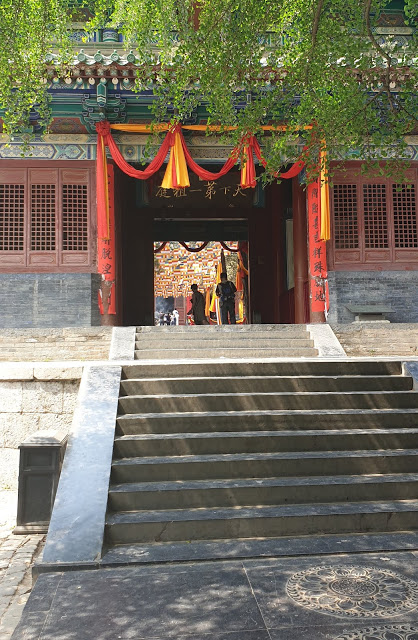
This is not a single building, that’s not how the Chinese work. It’s a whole host of buildings, the first of which is up some steps, through a gate, then along a tree-lined avenue with monument stones to some more steps, past a cauldron burning incense, and then to the temple. There are several monks inside.
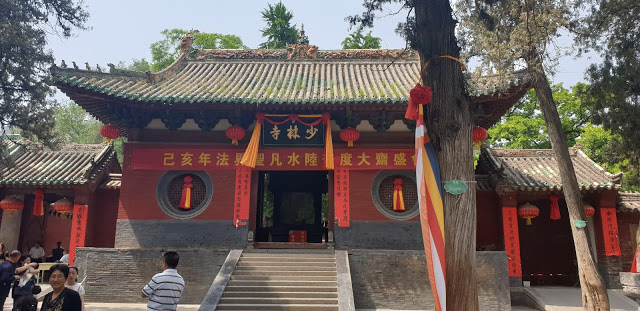
The front entrance:
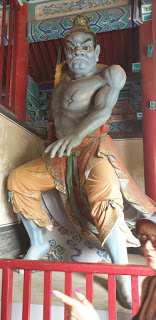
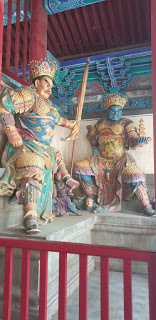
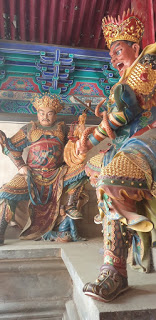
Inside the entrance building, there are some large statues that I’m guessing are there to scare away the wrong sort of people
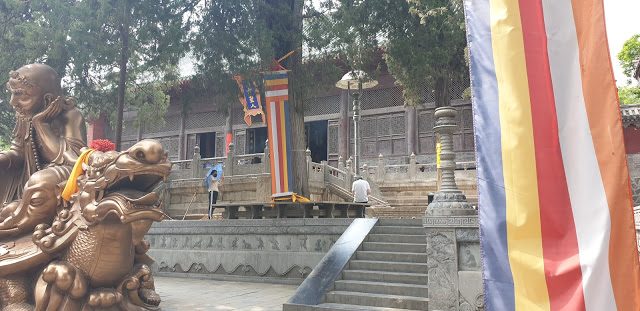
Once past these characters, you are on a walkway between pagodas where there are trees, and sculptures
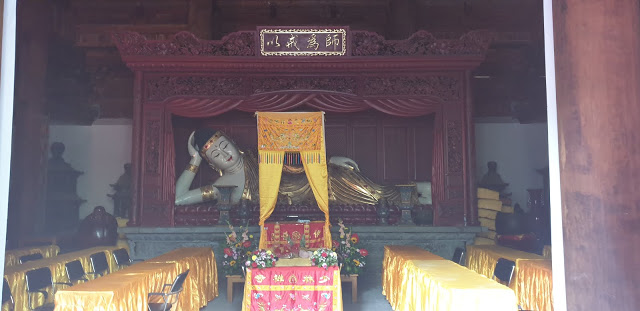
and through the next pagoda brings you to the first of the temples. There are three doors and three buddas. This is through the middle door
And no you can’t go inside, you just stand on the outside looking in.
In one part of the temple there were three monks, and, believe it or not, they were all on their mobile phones.
This is certainly not ancient times, so what did the monks do before mobile communications?
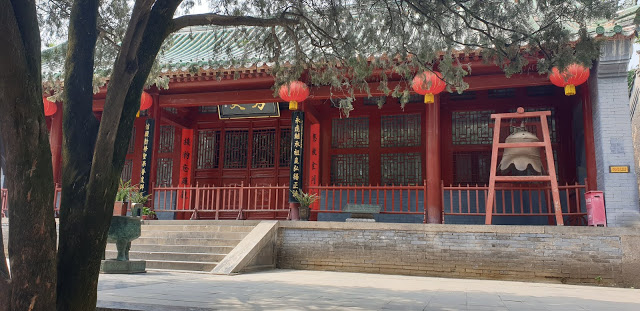
Up some more stairs to the next building,
And so on till we reach the one at the top. Outside each is a cauldron burning incense, and that aroma hangs on the air everywhere you go in the compound.
Then it’s a case of what goes up must come down, and strangely enough, it doesn’t take as long to go back down, and in doing so we got to see and hear a bit of singing by the monks.
There was a story to go with the various buildings and other aspects but I didn’t hear half of it, and couldn’t understand our guide for the rest.
All in all, it was an interesting place, but still not worth the money we paid.
West Lake is a freshwater lake in Hangzhou, China. It is divided into five sections by three causeways. There are numerous temples, pagodas, gardens, and artificial islands within the lake.
Measuring 3.2 kilometers (2 miles) in length, 2.8 kilometers (1.7 miles) in width, and 2.3 meters (7.5 feet) in average depth, the lake spreads itself in an area totaling 6.5 square kilometers (2.5 square miles).
The earliest recorded name for West Lake was the “Wu Forest River”, but over time it changed to two distinct names. One is “Qiantang Lake”, due to the fact that Hangzhou was called “Qiantang” in ancient times. The other, “West Lake”, due to the lake being west of the city
It’s about to get busy, with a number of activities planned, and the warmth of the day is starting to make an impact.
The tour starts in the car park about a kilometer away, but the moment we left the car park we were getting a taste of the park walking along a tree-lined avenue.
When we cross the road, once again dicing with death with the silent assassins on motor scooters.
We are in the park proper, and it is magnificent, with flowers, mostly at the start hydrangeas and then any number of other trees and shrubs, some carved into other flower shapes like a lotus.
Then there was the lake and the backdrop of bridges and walkways.
And if you can tune out the background white noise the place would be great for serenity and relaxation.
That, in fact, was how the boat ride panned out, about half an hour or more gliding across the lake in an almost silent boat, by an open window, with the air and the majestic scenery.
No, not that boat, which would be great to have lunch on while cruising, but the boat below:
Not quite in the same class, but all the same, very easy to tune out and soak it in.
It was peaceful, amazingly quiet, on a summery day
A pagoda in the hazy distance, an island we were about to circumnavigate.
Of all the legends, the most touching one is the love story between Bai Suzhen and Xu Xi’an. Bai Suzhen was a white snake spirit and Xu Xi’an was a mortal man.
They fell in love when they first met on a boat on the West Lake, and got married very soon after.
However, the evil monk Fa Hai attempted to separate the couple by imprisoning Xu Xi’an. Bai Suzhen fought against Fa Hai and tried her best to rescue her husband, but she failed and was imprisoned under the Leifeng Pagoda by the lake.
Years later the couple was rescued by Xiao Qing, the sister of Baisuzhen, and from then on, Bai Suzhen and Xu Xi’an lived together happily.
The retelling of the story varied between tour guides, and on the cruise boat, we had two. Our guide kept to the legend, the other tour guide had a different ending.
Suffice to say it had relevance to the two pagodas on the far side of the lake.
There was a cafe or restaurant on the island, but that was not our lunch destination.
Nor were the buildings further along from where we disembarked.
All in all the whole cruise took about 45 minutes and was an interesting break from the hectic nature of the tour.
Oh yes, and the boat captain had postcards for sale. We didn’t buy any.
Lunch
At the disembarkation point there was a mall that sold souvenirs and had a few ‘fast food’ shops, and a KFC, not exactly what we came to China for, but it seemed like the only place in town a food cautious Australian could eat at.
And when tried to get in the door, that’s where at least 3 busloads were, if they were not in the local Starbucks. Apparently, these were the places of first choice wherever we went.
The chicken supply by the time we got to the head of the line amounted to pieces at 22.5 RMB a piece and nuggets. Everything else had run out, and for me, there were only 5 pieces left. Good thing there were chips.
And Starbucks with coffee and cheesecake.
At least the setting for what could have been a picnic lunch was idyllic.











 Thrills, Spills, and just a dash of Romance