Searching for locations: From X’ian to Zhengzhou dong by bullet train, China

Lunch and then off on another high-speed train

We walked another umpteen miles from the exhibition to a Chinese restaurant that is going to serve us Chinese food again with a beer and a rather potent pomegranate wine that has a real kick.  It was definitely value for money at 60 yuan per person.

But perhaps the biggest thrill, if it could be called that, was discovering downstairs, the man who discovered the original pieces of a terracotta soldier when digging a well.  He was signing books bought in the souvenir store, but not those that had been bought elsewhere.

Some of is even got photographed with him.  Fifteen minutes of fame moment?  Maybe.

After lunch, it was off to the station for another high-speed train ride, this time for about two and a half hours, from X’ian to Zhangzhou dong.

It’s the standard high-speed train ride and the usual seat switching because of weird allocation issues, so a little confusion reigns until the train departs at 5:59.

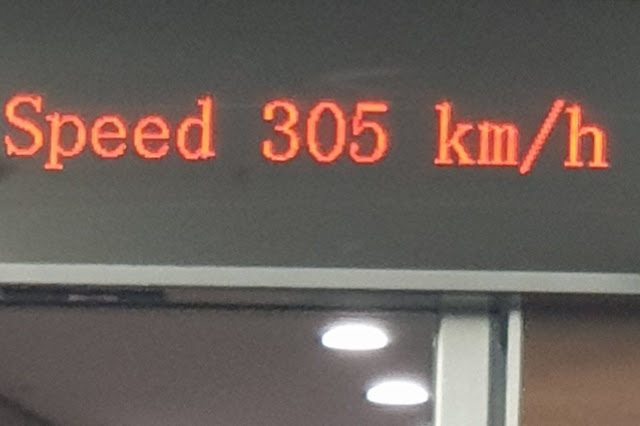
Once we were underway it didn’t take long before we hit the maximum speed
Twenty minutes before arrival, and knowing we only have three minutes to get off everyone is heading for the exit clogging up the passageway.  It wasn’t panic but with the three-minute limit, perhaps organized panic would be a better description.

As it turned out, with all the cases near the door, the moment to door opened one of our group got off, and the other just started putting cases on the platform, and in doing so we were all off in 42 seconds with time to spare.

And this was despite the fact there were about twenty passengers just about up against the door trying to get in.  I don’t think they expected to have cases flying off the train in their direction.

We find our way to the exit and our tour guide Dannie.  It was another long walk to the bus, somewhat shabbier from the previous day, no leg room, no pocket, no USB charging point like the day before.  Disappointing.

On the way from the station to the hotel, the tour guide usually gives us a short spiel on the next day’s activities, but instead, I think we got her life history and a song, delivered in high pitched and rapid Chinglish that was hard to understand.

Not at this hour of the night to an almost exhausted busload of people who’d had enough from the train.  Oh, did I forgot the singing, no, it was an interesting rendition of ‘you are my sunshine’.

The drive was interesting in that it mostly in the dark.  There was no street lighting and in comparison to X’ian which was very bright and cheerful, this was dark and gloomy.

Then close to the hotel our guide said that if we had any problems with the room, she would be in the lobby for half an hour.

That spoke volumes about the hotel they put us in.

Searching for locations: West Lake, Hangzhou, China

West Lake is a freshwater lake in Hangzhou, China. It is divided into five sections by three causeways. There are numerous temples, pagodas, gardens, and artificial islands within the lake.

Measuring 3.2 kilometers (2 miles) in length, 2.8 kilometers (1.7 miles) in width, and 2.3 meters (7.5 feet) in average depth, the lake spreads itself in an area totaling 6.5 square kilometers (2.5 square miles).

The earliest recorded name for West Lake was the “Wu Forest River”, but over time it changed to two distinct names.  One is “Qiantang Lake”, due to the fact that Hangzhou was called “Qiantang” in ancient times.  The other, “West Lake”, due to the lake being west of the city

It’s about to get busy, with a number of activities planned, and the warmth of the day is starting to make an impact.

The tour starts in the car park about a kilometer away, but the moment we left the car park we were getting a taste of the park walking along a tree-lined avenue.

When we cross the road, once again dicing with death with the silent assassins on motor scooters.

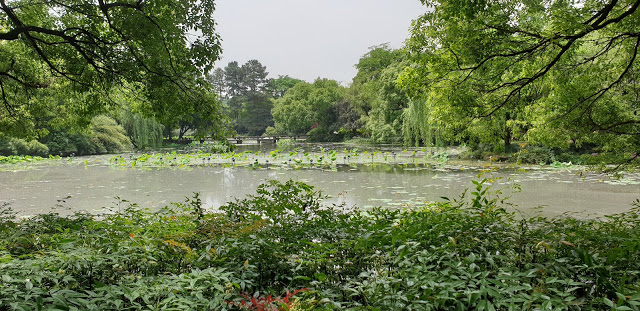
We are in the park proper, and it is magnificent, with flowers, mostly at the start hydrangeas and then any number of other trees and shrubs, some carved into other flower shapes like a lotus.

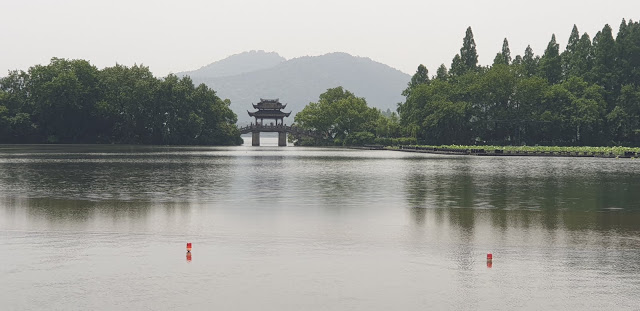
Then there was the lake and the backdrop of bridges and walkways.

.

And if you can tune out the background white noise the place would be great for serenity and relaxation.

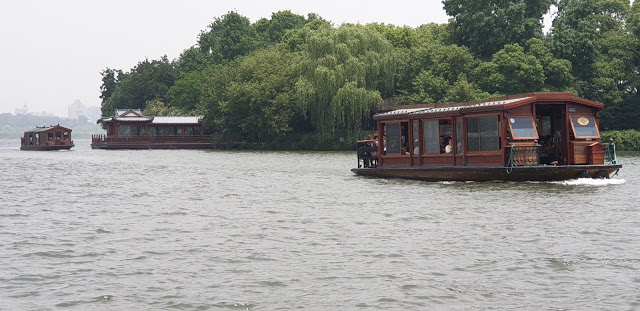
That, in fact, was how the boat ride panned out, about half an hour or more gliding across the lake in an almost silent boat, by an open window, with the air and the majestic scenery.

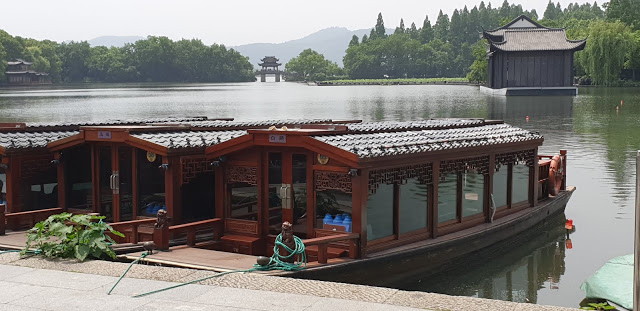
No, not that boat, which would be great to have lunch on while cruising, but the boat below:

Not quite in the same class, but all the same, very easy to tune out and soak it in.

It was peaceful, amazingly quiet, on a summery day

A pagoda in the hazy distance, an island we were about to circumnavigate.

Of all the legends, the most touching one is the love story between Bai Suzhen and Xu Xi’an. Bai Suzhen was a white snake spirit and Xu Xi’an was a mortal man.

They fell in love when they first met on a boat on the West Lake, and got married very soon after.

However, the evil monk Fa Hai attempted to separate the couple by imprisoning Xu Xi’an. Bai Suzhen fought against Fa Hai and tried her best to rescue her husband, but she failed and was imprisoned under the Leifeng Pagoda by the lake.

Years later the couple was rescued by Xiao Qing, the sister of Baisuzhen, and from then on, Bai Suzhen and Xu Xi’an lived together happily.

The retelling of the story varied between tour guides, and on the cruise boat, we had two.  Our guide kept to the legend, the other tour guide had a different ending.

Suffice to say it had relevance to the two pagodas on the far side of the lake.

There was a cafe or restaurant on the island, but that was not our lunch destination.

Nor were the buildings further along from where we disembarked.

All in all the whole cruise took about 45 minutes and was an interesting break from the hectic nature of the tour.

Oh yes, and the boat captain had postcards for sale.  We didn’t buy any.

Lunch

At the disembarkation point there was a mall that sold souvenirs and had a few ‘fast food’ shops, and a KFC, not exactly what we came to China for, but it seemed like the only place in town a food cautious Australian could eat at.

And when tried to get in the door, that’s where at least 3 busloads were, if they were not in the local Starbucks.  Apparently, these were the places of first choice wherever we went.

The chicken supply by the time we got to the head of the line amounted to pieces at 22.5 RMB a piece and nuggets.  Everything else had run out, and for me, there were only 5 pieces left.  Good thing there were chips.

And Starbucks with coffee and cheesecake.

At least the setting for what could have been a picnic lunch was idyllic.

Searching for locations: Hutongs, Beijing, China

What are Hutongs?

In Beijing Hutongs are formed by lines of traditional courtyard residences, called siheyuan.  Neighborhoods were formed by joining many hutongs together. These siheyuan are the traditional residences, usually occupied by a single or extended family, signifying wealth, and prosperity. 

Over 500 of these still exist.Many of these hutongs have been demolished, but recently they have become protected places as a means of preserving some Chinese cultural history.  They were first established in the Yuan Dynasty (1279-1368)Many of these Hutongs had their main buildings and gates built facing south, and lanes connecting them to other hutongs also ran north to south.

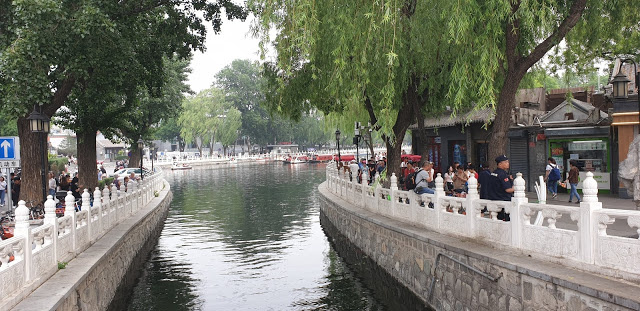
Many hutongs, some several hundred years old, in the vicinity of the Bell Tower and Drum Tower and Shichahai Lake are preserved and abound with tourists, many of which tour the quarter in pedicabs.

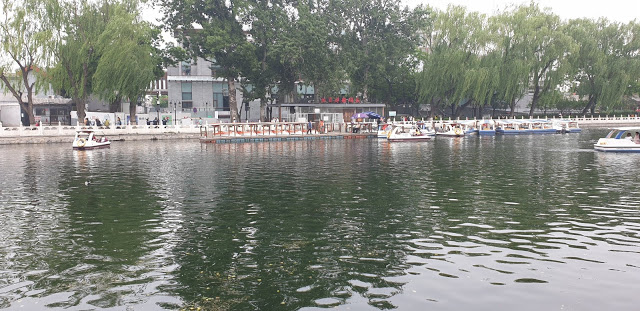
The optional tour also includes a visit to Shichahai, a historic scenic area consisting of three lakes (Qianhai, meaning Front Sea; Houhai, meaning Back Sea and Xihai, meaning West Sea), surrounding places of historic interest and scenic beauty and remnants of old-style local residences, Hutong and Courtyard.  

First, we had a short walk through the more modern part of the Hutong area and given some free time for shopping, but we prefer just to meander by the canal.  

There is a lake, and if we had the time, there were boats you could take.

With some time to spare, we take a quick walk down one of the alleyways where on the ground level are small shops, and above, living quarters.

Then we go to the bell and drum towers before walking through some more alleys was to where the rickshaws were waiting.
The Bell tower

And the Drum tower. Both still working today.

The rickshaw ride took us through some more back streets where it was clear renovations were being made so that the area could apply for world heritage listing.  Seeing inside some of the houses shows that they may look dumpy outside but that’s not the case inside.

The rickshaw ride ends outside the house where dinner will be served, and is a not so typical hose but does have all the elements of how the Chinese live, the boy’s room, the girl’s room, the parent’s room, the living area, and the North-south feng shui.

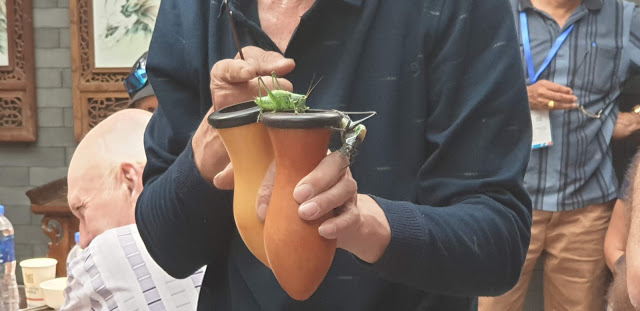
Shortly after we arrive, the cricket man, apparently someone quite famous in Beijing arrives and tells us all about crickets and then grasshoppers, then about cricket racing.  He is animated and clearly enjoys entertaining us westerners.

I’m sorry but the cricket stuff just didn’t interest me.  Or the grasshoppers.

As for dinner, it was finally a treat to eat what the typical Chinese family eats, and everything was delicious, and the endless beer was a nice touch.

And the last surprise, the food was cooked by a man.

Searching for locations: Terracotta Warriors and Horses Museum, X’ian, China

Terracotta Warriors and Horses Museum

A little history, and anecdotal advice first:

In 1974 a 26-year-old farmer, Yang Jide, was drilling a well and found fragments of the terracotta soldiers and bronze weapons.

What was discovered later was one of the biggest attended burial pits of China’s first feudal Emperor, Qin Shi Huang.  In the following years remains had been found in 3 pits, yielding at least 8,000 soldiers and horses, and over 100 chariots.  The soldiers were infantry, cavalry, and others.

Emperor Qin was born in 259 BC and died in 210 BC.  He began building a mausoleum for himself at the foot of Mount Li when he was 13.  Construction took 38 years, from 247 BC to 208 BC.  It was divided into 3 stages and involved 720,000 conscripts.

The pits of pottery figures are 1.5 km east of Emperor Qin’s mausoleum.  Pit 1 has about 6,000 terracotta armored warriors and horses and 40 wooden chariots.  Pit 2 is estimated to have over 900 terracotta warriors and 350 terracotta horses with about 90 wooden chariots.  Pit 3 had so far yielded only 66 pottery figures and one chariot drawn by four horses.

Official records say it was discovered later that it was likely Xiang Yu, a rebel, intentionally damaged the Mausoleum and the soldiers in the pits, by setting fire to the wooden roof rafters, and these fell on and broke the warriors into pieces.

However, we were told that after the terracotta warriors were completed, the Emperor ordered the builders to be killed so that they would not tell anyone about the warriors, and then of those that remained alive deliberately smashed all of the artifacts.

The thing is, all of the terracotta figures that have been found are in pieces, and they need computers to piece them back together again.

The visit:
The first impression is the size of the car park and the number of buses parked in the lot, and a hell of a lot more outside up the road an off on side streets.  Obviously, it costs money to park in the parking lot.

The other first impressions; the numbers waiting to get in were not as many as yesterday outside the forbidden city, in fact, a lot less.

Be warned there’s a long walk from the entrance gate where your bags are scanned and a body scan as well, before admittance.  This walk is through a landscaped area which it is expect might sometime in the future reveal more soldiers, or other artifacts.

At the end of the walk that takes about ten minutes, you can get a one-way ride to the second checkpoint, but we opted not to as no one else in our group did.

That walk is the warm-up exercise to an organized viewing of the exhibits after going through a second ticket checkpoint.  On the other side, we had to hand our tickets back to the tour guide which was disappointing not to end up with a memento of actually having been there.

So, on the other side in the courtyard, the guide told us the most important parts of the exhibition, that we should spend most of the time looking at pit 1, and then spent a little time in 2 which is only there in the first stages of excavation.  Then move onto the museum if only to see the replica chariots.
We do.

The chariots were small but interesting

The horses were better and intricately detailed

These are soldiers, perhaps complete examples of those types found in the end pit.

This is one of the archers.  You can tell by the way he wears his hair.

Pit 2

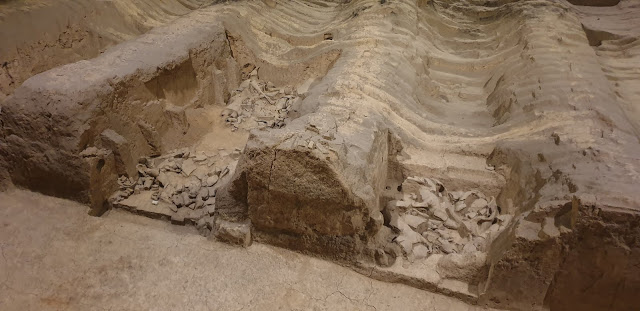
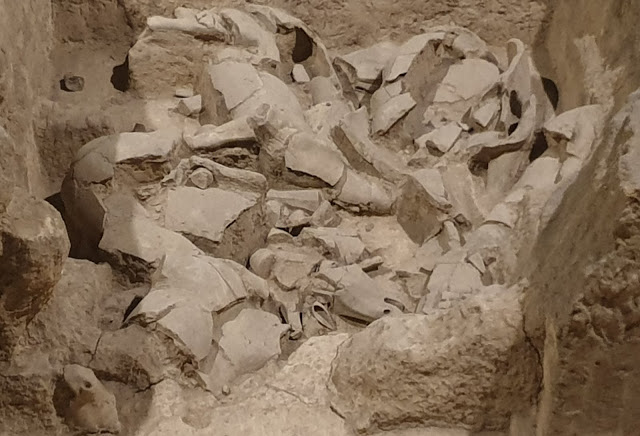
The excavation of this pit has only just begun, so it is possible to see where they have carefully removed the top cover, and you can see the broken parts of the warriors lying in a heap.

Some parts of the warriors are more discernible closer up

These parts are carefully extracted and taken to the ‘hospital’ where they are digitised and the computer will match each part with the warrior it belongs to.

Pit 1

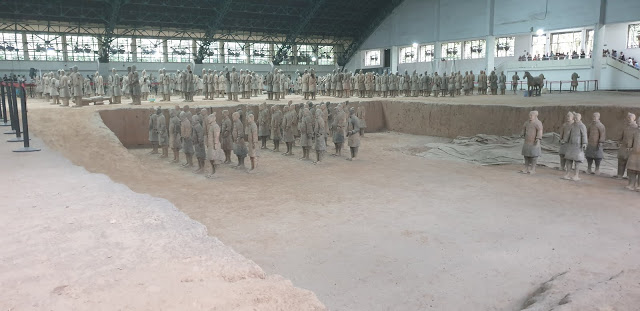
This has quite a number of standing soldiers that have been glued back together, but not necessarily complete and I notice a number if the statues were incomplete. And if they cannot find the missing pieces, then they are not added to or filled in.

The scale of the pit is enormous, and they have hardly scratched the surface in the restoration process.

What is there is a number of horses as well.

That’s at the front of the pit, a long line of statues, and what is clear is the location of the well where the first fragments were found by a farmer.

There are about eight lines of soldiers, and some lining the sides.

Midway down there is a large area currently under excavation

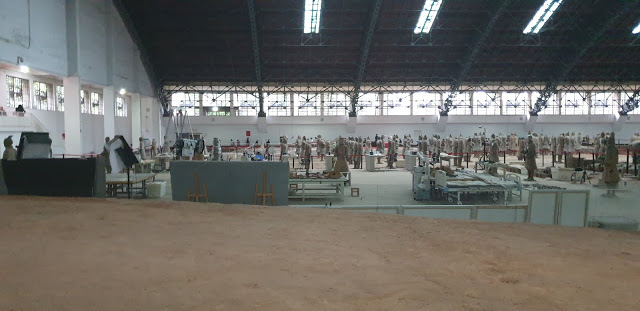
At the back is the hospital where the soldiers are reassembled.  There’s nearly a hundred in the various stages of rebuilding.  These days the soldiers are rebuilt using computer imaging.

The hospital area is where they are put back together

And these are some of the statues in various stages of reconstruction

Another two views of the size and scale of the reconstruction project

The coffee shop is also a sales centre, but there are too many people waiting for coffee and too few places to sit down.

Searching for locations: The Golden Mask Dynasty Show, Beijing, China

The Golden Mask Dynasty Show was located at the OCT Theatre in Beijing’s Happy Valley. 

The theatre was quite full and the seats we had were directly behind the VIP area; as our guide told us, we had the best seats in the house. 

The play has 20 different dance scenes that depict war, royal banquets, and romance.  There are eight chapters and over 200 actors, and throughout the performance we were entertained by dancers, acrobats, costumes, lighting, and acoustics.

The story:

It is of romantic legend and historical memories, the Golden Mask Queen leads her army in defeating the invading Blue Mask King’s army, and afterwards the lands return to a leisurely pastoral life until the Queen forges a ‘mysterious tree’.  When the tree has grown, the Queen has a grand celebration, and releases the captured Blue soldiers, much to the admiration of the Blue Mask King.
This is followed by monstrous floods, and to save her people, and on the advice from the ‘mysterious tree’, the Queen sacrifices herself to save her people.  The Queen then turns into a golden sunbird flying in the sky blessing the people and that of the dynasty.

Billed as the best live show in China, described as a large scale dramatic musical, “The Golden Mask Dynasty” it lived up to its reputation and was thoroughly enjoyed by all.

It was not just singing dancing and acrobatics, it had a story and it was told so that language and cultural issues aside, it worked.  There was a narration of the story running beside the stage, but it was hard to divide attention between what was happening, and what was being related.

Then came the peacock dance, with live peacocks

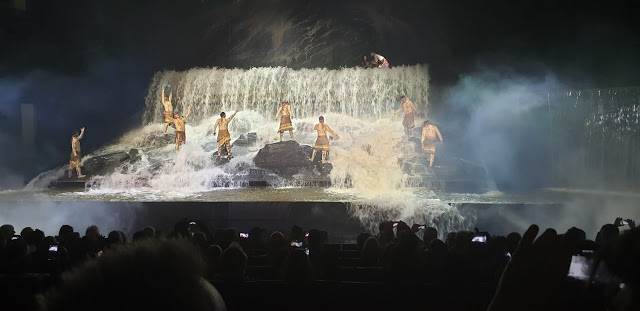
And this was followed by a waterfall, well, I don’t think anyone in that audience could believe what they were seeing.

I know I was both astonished and in awe of the performance.

What a way to finish off our first day in Beijing.

Oh, sorry, that high was dented slightly when we had to go back to our room.

Searching for locations: The Yu Gardens, Shanghai, China

The Yu Gardens or Yuyuan Gardens

The Yu Gardens (or Yuyuan Gardens) are located at No. 137, Anren Street, Huangpu District, very close to the Old City God Temple, in the northeast of the Old City of Shanghai at Huangpu.

Yu Garden was first built in 1559 during the Ming Dynasty by Pan Yunduan and finished approximately 1577, created specifically as a private garden of the Pan family for Pan Yunduan’s parents to enjoy in their old age.

Yu Garden occupies an area of 5 acres, and is divided into six general areas:

  -Sansui Hall which includes the Grand Rockery was originally used to entertain guests,

  -Wanhua Chamber is a delicate building surrounded by derious cloisters,

  -Dianchun Hall, built in 1820, includes Treasury Hall and the Hall of Harmony,

  -Huijing Hall which includes Jade Water Corridor.

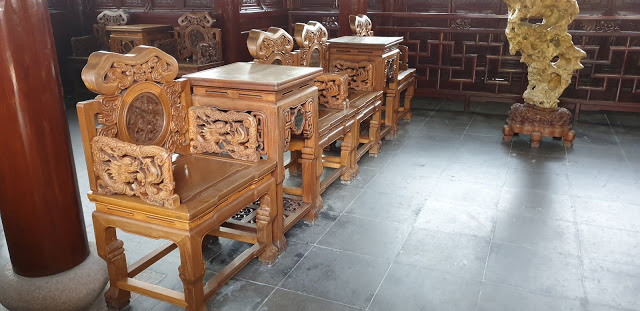
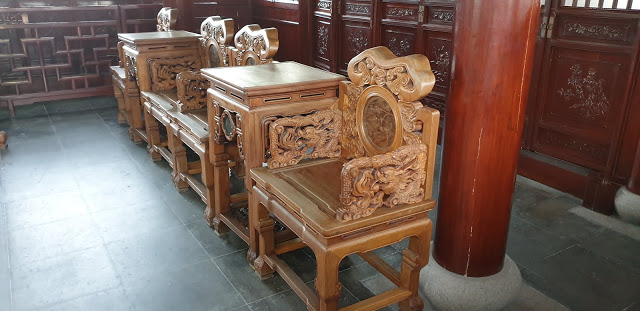
  -Yuhua Hall which is furnished with rosewood pieces from the Ming Dynasty, and,

  -The Inner Garden with rockeries, ponds, pavilions, and towers; first laid out in 1709.  As the quietest part of Yu Gardens, it includes the Hall of Serenity and the Acting and Singing Stage.

The Mid-Lake Pavilion Teahouse, within the gardens, is the oldest teahouse in Shanghai.

A centerpiece of the gardens is the Exquisite Jade Rock, a 5-ton boulder that was originally meant for the Huizong Emperor (Northern Song Dynasty from 1100-1126 AD) but was salvaged from the Huangpu River after the boat carrying it had sunk.

These gardens house a lot of buildings that seemed to be a perfect blend of the old and the new, and if it was up to me, I’d keep the old.  Both the building and the gardens they are set in are like an oasis in the middle of an industrial complex, and perhaps impractical for the number of people living in Shanghai.

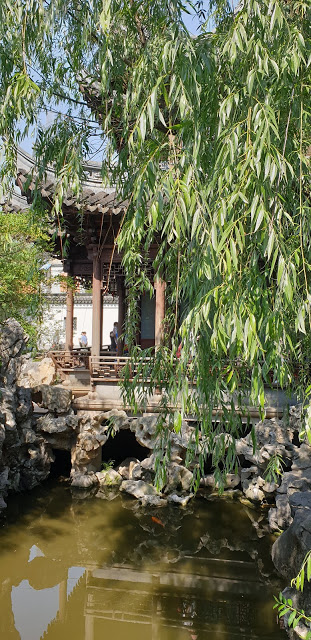
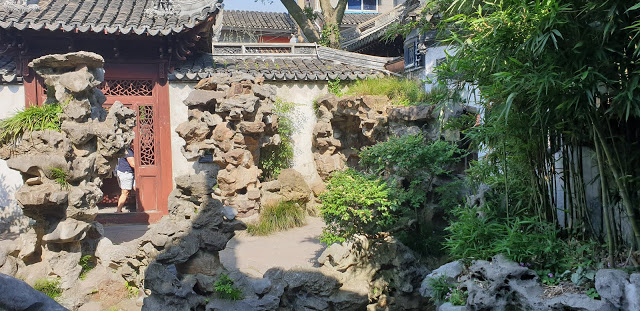
All of the ponds had a lot of fish in them

It was a pleasant afternoon, for both a stroll through the gardens

In and out of the rockery on narrow pathways

And to look inside the buildings that were sparsely furnished

There was even an area set aside for entertainment.

Searching for locations: The Bund, Shanghai, China

The Bund

The architecture along the Bund or Waitan is a living museum of the colonial history of the 1800s.  The area centers on a section of Zhongshan Road within the former Shanghai International Settlement.

The word bund means an embankment or an embanked quay.   It was initially a British settlement; later the British and American settlements were combined in the International Settlement.

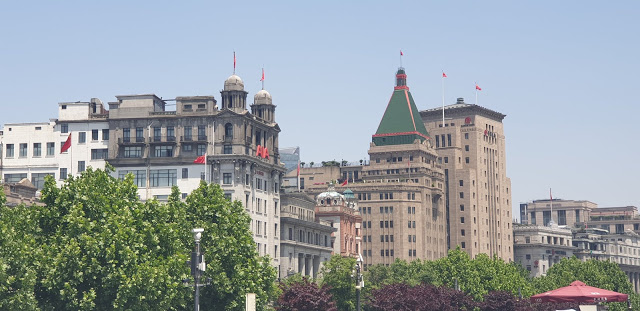
The Bund is a mile-long stretch of waterfront promenade along the Huangpu River. There are 52 buildings of various architectural styles, including Gothic, baroque, and neoclassical styles. The area is often referred to as “the museum of buildings”.

Building styles include Romanesque Revival, Gothic Revival, Renaissance Revival, Baroque Revival, Neo-Classical or Beaux-Arts, as well as a number in Art Deco style.

Having seen these buildings initially the night before, mostly lit up, our viewing this morning was from the land side, and particularly interesting in that the colonial architecture was really fascinating considering their location, but not surprising given Shanghai’s history.  A lot of these buildings would be more at home in London, that out in the far east.

The Bund waterfront is about two kilometers long and impossible to cover in the time allowed for this part of the tour.

There was just enough time to get photos of the waterfront and the old buildings.

Some of these buildings had odd shapes, like one on the far right that looks like a bottle opener.

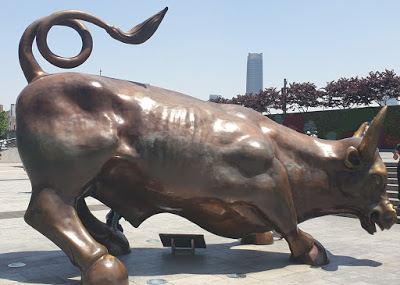
And, for some odd reason, a bull.

On the other side of the water, the sights that had been quite colorful the night before, were equally impressive though somewhat diminished by the haze.

Searching for locations: The Silk Factory, Suzhou, China

China is renowned for its exquisite silk, so naturally, a visit to the Silk Spinning Factory is part of today’s tour.

After that, we will be heading downtown to an unspecified location where we’re getting a boat ride, walk through a typical Chinese shopping experience, and coffee at a coffee shop that is doubling as the meeting place, after we soak up the local atmosphere.

The problem with that is that if the entire collective trip a deal tourists take this route then the savvy shopkeepers will jack up their prices tenfold because we’re tourists with money.  It’ll be interesting to see how expensive everything is.

So…

Before we reach the silk factory, we are told that Suzhou is the main silk area of China, and we will be visiting a nearly 100 years old, Suzhou No 1 Silk Mill, established in 1926.  Suzhou has a 4,700-year history of making silk products.  It is located at No. 94, Nanmen Road, Suzhou, Jiangsu, China.

Then we arrive at the Silk Factory, another government-owned establishment with a castiron guarantee of quality and satisfaction.

The look and feel of the doona cover certainly backs up that claim

And the colors and variety is amazing (as is the cost of those exquisite sets)

We get to see the silk cocoon stretched beyond imagination, and see how the silk thread is extracted, then off to the showroom for the sales pitch.

It isn’t a hard sell, and the sheets, doonas, pillows, and pillowcases, are reasonably priced, and come with their own suitcase (for free) so you can take them with you, or free shipping, by slow boat, if you prefer not to take the goods with you.

We opt for the second choice, as there’s no room left in our baggage after packing the Chinese Medicine.

Searching for locations: The Henan Museum, Zhengzhou, Henan Province, China

The Henan Museum is one of the oldest museums in China.  In June 1927, General Feng Yuxiang proposed that a museum be built, and it was completed the next year.  n 1961, along with the move of the provincial capital, Henan Museum moved from Kaifeng to Zhengzhou.

It currently holds about 130,000 individual pieces, more of which are mostly cultural relics, bronze vessels of the Shang and Zhou Dynasties, and pottery and porcelain wares of the various dynasties.

Eventually, we arrive at the museum and get off the bus adjacent to a scooter track and despite the efforts of the guide, there’s no stopping them from nearly running us over.

We arrive to find the museum has been moved to a different and somewhat smaller building nearby as the existing, and rather distinctively designed, building is being renovated.

While we are waiting for the tickets to enter, we are given another view of industrial life in that there is nothing that resembles proper health and safety on worksites in this country, and the workers are basically standing on what looks to be a flimsy bamboo ladder with nothing to stop them from falling off.

The museum itself has exhibits dating back a few thousand years and consist of bronze and ceramic items.  One of the highlights was a tortoiseshell with reportedly the oldest know writing ever found.

Other than that it was a series of cooking utensils, a table, and ceramic pots, some in very good condition considering their age.


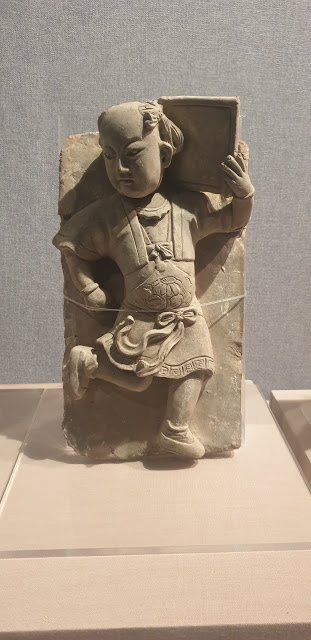
There were also small sculptures

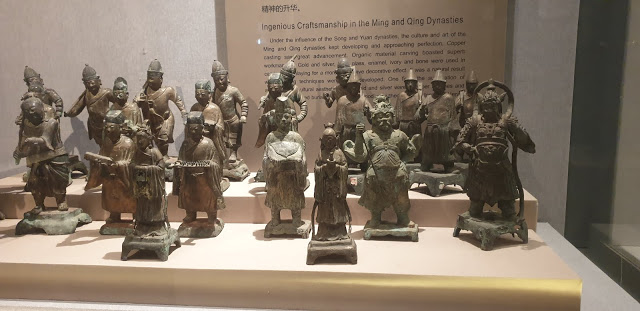
an array of small figures

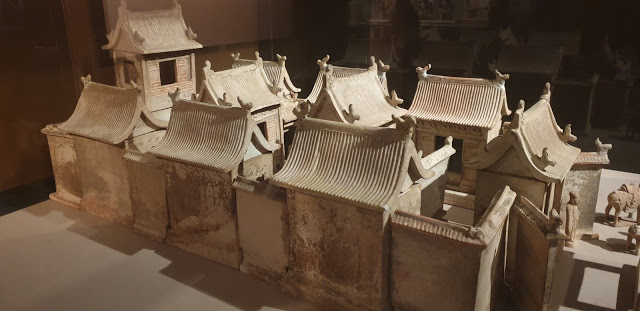
and a model of a settlement

20 minutes was long enough.

Searching for locations: Shaolin Kung Fu, near Zhengzhou City, Henan Province, China

After leaving the hotel in Zhengzhou, what was once one of the eight ancient capitals of China, we are going to Dengfeng city, and the home of China’s most famous martial art – Shaolin Kung Fu.

The Shaolin Temple nearby is the origin of Chinese Zen Buddhism, and the Songyang Academy, called “the Centre of Heaven and Earth” is located 87 Km from Zhengzhou, or, as we were advised, a 2 hour drive.  It will be scenic because we are heading towards the mountains.

As one of the four ancient Song Dynasty Academies, Songyang Academy is one of many schools in the province.  It is both on a large-scale, is quite spectacular, and is a comprehensive Wushu training base where students are trained to spread the Shaolin Wushu Kung fu style at home and abroad.

There is a 500 seat demonstration hall where you are able to observe 30 minutes of various martial arts in shows starting on the hour.

Outside there is a specific area that generally has about 600 trainees learning kung fu elements during the day, but can hold 5,000 [ep[;e when outdoor performances are required.

The kung fu school

The thing you notice most about the kung fu school is it’s size and then the number of buses which tells you that it is a popular tourist stop.

And with that size comes long distances between the car park and the venues we need to go to, the first of which is about half a km, and that’s just to get to the ticket plaza.

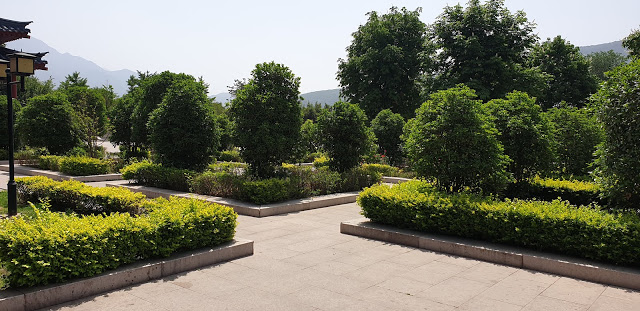
But, it is pleasantly set out and is quite a large number of shops for both souvenirs and food

We pass by some of the students going through their paces

From there it’s another long, long walk to the show arena, where we’re supposed to see various kung fu elements on display.  We watched this for a few minutes, then headed off towards the hall for a more intense demonstration of kung fu, and because there is limited seating we have to start lining at the head of the queue to get a seat.

But…

Everyone else has the same idea and we join the throng which then becomes a ride, and true to the Chinese they start finding ways to push in, even using the imaginary friend somewhere ahead in the queue.

The doors open and then it’s open slather, with the hoards pushing from behind and sliding up the side to get in first.  We go with the tide, and manage to get in and find a seat though we were separated from three of our group.

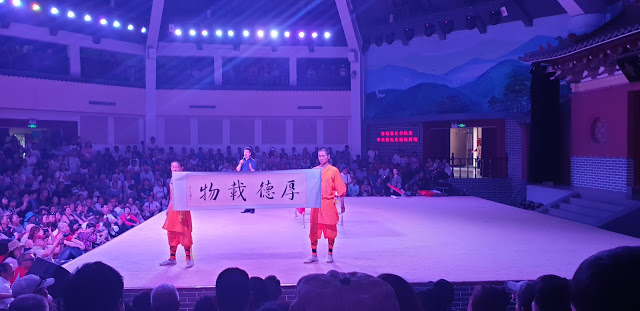
It was an interesting show even though not one word of English was spoken, which from our point of view was a disappointment because we had no idea what was going on.

However…

It wasn’t hard to follow

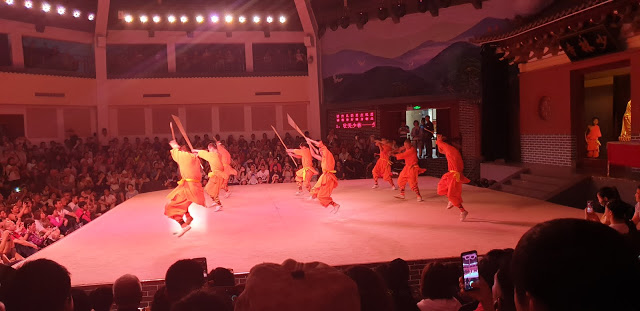
What the performers were doing was relatively self-explanatory, and quite fascinating especially the guy who broke a sword over his head, and the guy who stopped two spears penetrating the neck, both examples of very disciplined men.

Boys gave a demonstration of kung fu moves, and intensity and age increased as this progressed to the end.

Next, we were taken in hand by an instructor in Tai chi or an equivalent, I was not quite sure what it was called, and went through the twelve or maybe more moves that constituted a morning or afternoon exercise session or it could be just for relaxation.  I lasted the first session but it was a little difficult to do with my sore limbs and a bad back.

Not that I could remember any of it now other than hands overhead, hands in front, bent knees, and a few gentle kung fu hand moves.

Perhaps when I get home I might seek out someone to show me the moves.

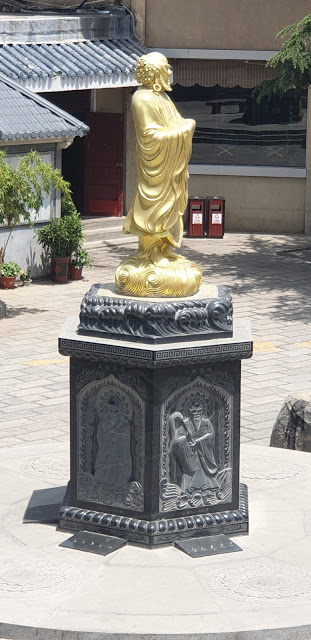
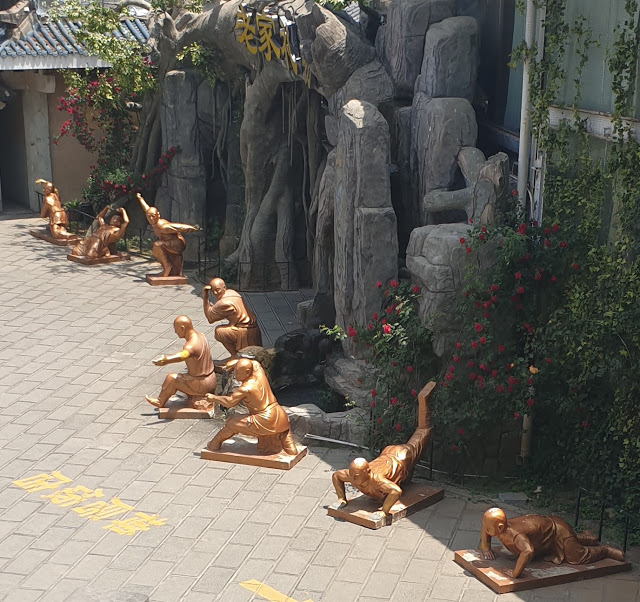
Whilst the others were following their training instructor, I wandered about, finding a large statue


And some smaller statues

Lunch in the Zen Restaurant

After all that exercise it was time to have the lunch purportedly the same food as the king fu masters.
It’s in the Zen restaurant, aptly named, and the food when it came, came thick and fast, but some of it wasn’t very nice, meat with bones, tofu, a tasteless soup, but some good dishes like the vegetables and noodles with meat, without bones.

The only problem, nothing to drink except a pot of hot water.  No tea, no cold water, and if you wanted a cold drink you had to pay for it.  After paying 550 yuan why should we have to pay more for a drink when we have not had to so far.

But no cold water?  That was just not on, and when we brought this to that attention of the tour guide she just simply ignored us.  We just didn’t get anything.

That basically tainted the whole experience.

After lunch,  we had the Shaolin Temple, and the Pogoda Forest to visit.