Searching for locations: Sydney to Beijing, China – Every flight is different

Sydney to Beijing – Qantas A330-200
Boarding 11:45, everyone on board by 12:02, for a 12:10 departure. Pushing back 12:12 Take off 12:27

Lunch
Airline food is getting better but the fact they serve it up to you in a metal tray with a thick aluminum lid does nothing for the quality of the food inside.  I get what the chef is trying to do but often there is too little of one thing and too much of another and what you finish up with is slop in a tray.  Sometimes it’s edible sometimes it’s not.  Sometimes the meat is tender and other times it’s like boot leather.  As it is today. I think it’s pork, I should have had the chicken.  Or perhaps it was chicken.  I hate it when you can’t tell what it is that you’re eating. But, the drinks were good.

Rest or Sleep, maybe
It’s going to take 11 hours and 20 minutes from Sydney to Beijing, a long time to sit in a plane with nothing much to do other than crosswords, read a book or newspaper or magazine, listen to music on your own device, or the in-flight entertainment, watch a movie again by the in-flight entertainment – if it works – or try to get some sleep. I started with the crosswords but got bored quickly. I fiddled with the in-flight entertainment, looked at the movies and tv shows but none really interested me, not then at least, so I set it to the flight path. Not exactly stellar entertainment, but it’s always interesting to know where the plane is. Or is it? If we crash, what good would it do me to know it’s somewhere over the ocean, not far from Manila, or somewhere else.  It’s not as if I could phone someone up, on the way down, to let them know where we are. But, just after dinner, we still haven’t left Australia
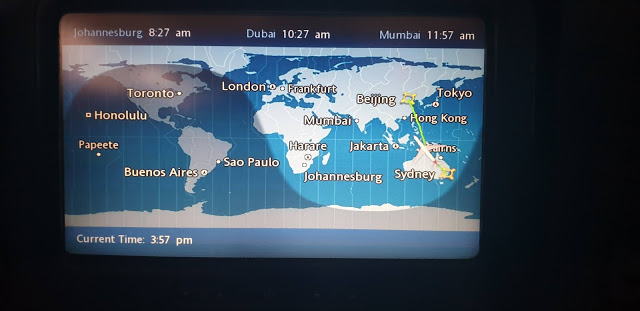
However, by the time I’ve finished fiddling with and dismissing all of the entertainment alternatives, it’s back to the flight path and now we are…

Somewhere approaching the Sulu Sea, which I’ve never heard of before, so it looks like I’ll have to study up on my geography when I get home.
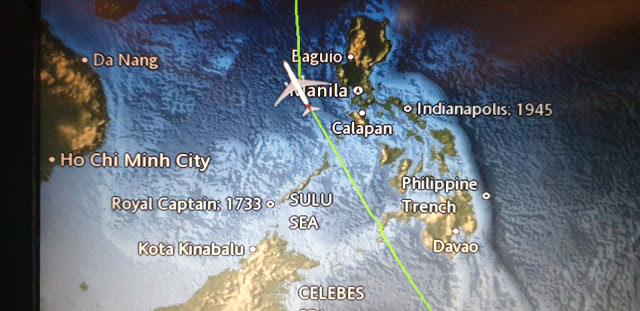
OK, Manila looks like somewhere I’ve heard of, so we have to be flying over the Philippines.  Not far left of that is Vietnam.  Neither of those places is on my travel bucket list, so I’ll just look from up here and be satisfied with that.

Working, or not
Chronic boredom is setting in by the time we are just past halfway to our destination. We are over 6 hours into the flight and there no possible way I’m going to get any sleep. I brought my Galaxy Tab loaded with a few of my novel outlines, and planning for missing chapters, thinking I might get a little thinking time in.  Plane rides, I find, are excellent for getting an opportunity to write virtually unhindered by outside interruptions, if, of course, you discount the number of times people brush past, knocking your seat, the person in front lowering the seat into your face, or people around you continually asking you to turn off your light because they’re trying to sleep. Sorry, I say, but you can suffer my pain with me.  It’s one of the joys of flying with over two hundred others in a claustrophobic environment.  Besides, aren’t the lights supposed to be slanted so only I get the rays of light?  Except, I guess when the fixed light doesn’t line up with where the airline has fixed the seat (usually so they can squash more people in).So, sorry, not sorry, take it up with the airline.

Back to work, and I put in some quality time on a part of the story that had been eluding me for a while.  I knew what I wanted to write, but not how I was going to approach it, so that blissfully quiet and intense time worked in my favor, something that would not have happened back hope. I won’t bore you with the synopsis, just suffice to say it’s finally down on paper, digitally that is, and it’s a huge step forward towards finishing it. There is, of course, the end play, the reading of the will but not before there’s a few thrusts and parry’s by some of the players, but all in all the objective was to showcase a group of people with their strengths and weaknesses pushing their characters in various directions, some at odds with what is expected of them. But enough of that.   A quick check of our position shows we’re still over water but closer to our destination, so much so, we might start the pre-landing rituals, starting with food.

Dinner
7:00 – Dinner is served, well, the lights go on and a lot of tired people try to shake the sleep, and sleeplessness, out of their systems. Then flight attendants that are far too cheerful, and must have beamed in from somewhere else, serve another interesting concoction that says what’s in it but you can’t really be sure of the ingredients.  It comes and it goes.

9:10 – We begin our descent into Beijing, you know, that moment when the engines almost stop and there’s a sickening lurch and the plane heads downward. 9:56 – We touch down on the runway, in the dark and apparently it has been raining though from inside the plane you’d never know. 10:10 – the plane arrives at the gate,  the usual few minutes to open the door, and, being closer to the front of the plane this time, it doesn’t take that long before the queue is moving.

Early or late, it doesn’t matter.  After clearing customs and immigration, we have to go in search of our tour guide, waiting for us somewhere outside the arrivals terminal.

Searching for locations: The Silk Factory, Suzhou, China

China is renowned for its exquisite silk, so naturally, a visit to the Silk Spinning Factory is part of today’s tour.

After that, we will be heading downtown to an unspecified location where we’re getting a boat ride, walk through a typical Chinese shopping experience, and coffee at a coffee shop that is doubling as the meeting place, after we soak up the local atmosphere.

The problem with that is that if the entire collective trip a deal tourists take this route then the savvy shopkeepers will jack up their prices tenfold because we’re tourists with money.  It’ll be interesting to see how expensive everything is.

So…

Before we reach the silk factory, we are told that Suzhou is the main silk area of China, and we will be visiting a nearly 100 years old, Suzhou No 1 Silk Mill, established in 1926.  Suzhou has a 4,700-year history of making silk products.  It is located at No. 94, Nanmen Road, Suzhou, Jiangsu, China.

Then we arrive at the Silk Factory, another government-owned establishment with a castiron guarantee of quality and satisfaction.

The look and feel of the doona cover certainly backs up that claim

And the colors and variety is amazing (as is the cost of those exquisite sets)

We get to see the silk cocoon stretched beyond imagination, and see how the silk thread is extracted, then off to the showroom for the sales pitch.

It isn’t a hard sell, and the sheets, doonas, pillows, and pillowcases, are reasonably priced, and come with their own suitcase (for free) so you can take them with you, or free shipping, by slow boat, if you prefer not to take the goods with you.

We opt for the second choice, as there’s no room left in our baggage after packing the Chinese Medicine.

Searching for locations: The Henan Museum, Zhengzhou, Henan Province, China

The Henan Museum is one of the oldest museums in China.  In June 1927, General Feng Yuxiang proposed that a museum be built, and it was completed the next year.  n 1961, along with the move of the provincial capital, Henan Museum moved from Kaifeng to Zhengzhou.

It currently holds about 130,000 individual pieces, more of which are mostly cultural relics, bronze vessels of the Shang and Zhou Dynasties, and pottery and porcelain wares of the various dynasties.

Eventually, we arrive at the museum and get off the bus adjacent to a scooter track and despite the efforts of the guide, there’s no stopping them from nearly running us over.

We arrive to find the museum has been moved to a different and somewhat smaller building nearby as the existing, and rather distinctively designed, building is being renovated.

While we are waiting for the tickets to enter, we are given another view of industrial life in that there is nothing that resembles proper health and safety on worksites in this country, and the workers are basically standing on what looks to be a flimsy bamboo ladder with nothing to stop them from falling off.

The museum itself has exhibits dating back a few thousand years and consist of bronze and ceramic items.  One of the highlights was a tortoiseshell with reportedly the oldest know writing ever found.

Other than that it was a series of cooking utensils, a table, and ceramic pots, some in very good condition considering their age.


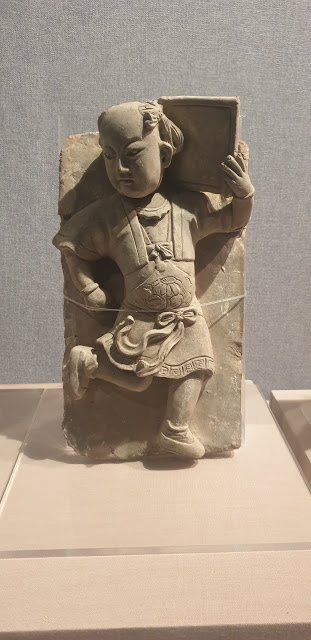
There were also small sculptures

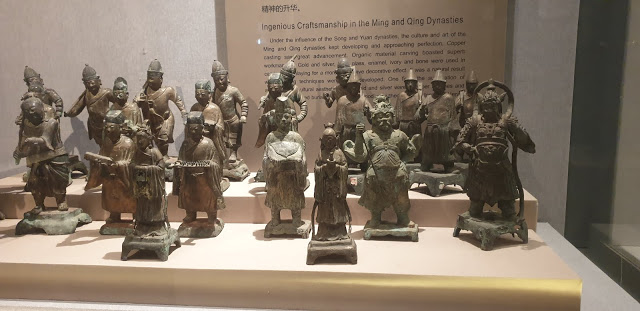
an array of small figures

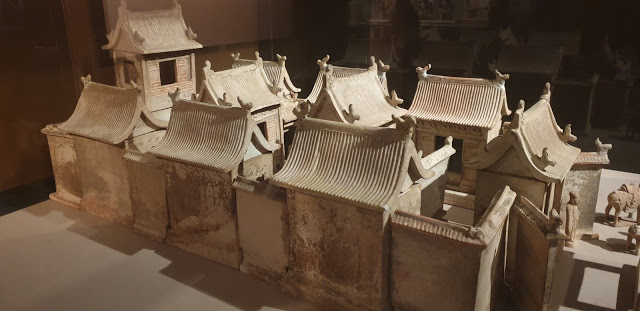
and a model of a settlement

20 minutes was long enough.

Searching for locations: The Longjing Pearl Factory, Beijing, China

The Longjing Pearl Factory is located at:
No.2 Zuoan Gate Inner Street, ChongWen District, Beijing 100061 China.

This Pearl Center specializes in both freshwater and seawater pearls, with a reputation backed by the government of China, with a big selection and of the highest quality.  There were all kinds of jewelry made of pearls in different colors, shapes, and sizes.

They also had, as an interesting sideline, famous Chinese traditional cosmetics such as pearl cream and pearl powder, reputed to make your skin smoother, tendered and most importantly, younger.

We were advised of all of this well before we arrived at the factory, and of course, one suspected the glowing review, with emphasis on the fact it was a government operation and therefore trustworthy, suggested we should buy, meant the tour guide would receive a commission on each sale.

This is nothing new, it’s the same the world over, so it’s up to the visitor to buy or not to buy.

As soon as you get in the door you are taken to the group’s guide for the tour (and afterward, available for help on making purchases). who gives you a rundown on the different types and colors of pearls.  This briefly is,

Pearls come in two main categories: freshwater cultured pearls and saltwater cultured pearls. Various types of pearls are the result of the environment in which they live, and different cultivation techniques used by the pearl farmers. 

Freshwater cultured pearls are grown in lakes and rivers, whereas saltwater cultured pearls are grown in bodies of saltwater such as bays.  The most commonly used pearls are Freshwater pearls. 

Freshwater Pearls come in various pastel shades of white, pink, peach, lavender, plum, purple, and tangerine.  
South Sea cultured pearls come in shades of lustrous white, often with silver or rose overtones. 

Black pearls are known as Tahitian pearls and come most often in shades of black and gray. While a Tahitian pearl has a black body color, it will vary in its overtones, which most often will be green or pink.

Then there’s a demonstration, where one of the tour group is selected to pick an oyster out of the tank, and then there’s the guessing game as to how many pearls are in the shell, with the winner getting a pearl.

Guesses ranged from 1 to 23 and the answer was 26.  Nearest wins, and one for the person who picked the oyster out of the tank.  After this demonstration, we move on to the ways we can tell the difference between real and fake pearls.

It seems strange that they would, but we were guaranteed by both the tour guide and the lady delivering the lecture that the pearls we were about to buy were real, so how could we suspect there was anything dodgy about them?  Besides, now we could tell real from fake!

We then move onto the showroom floor where there are casements of pearl products, in the form of necklaces, earrings, and any number of variations and uses.  And, just to let you know, the prices are very, very expensive, even if they say they have a special.

Perhaps the best products, and those that found favor with many of the women on the tour, was the pearl cremes and powders.  These were not expensive, and, as we discovered later, actually worked as described.

Searching for locations: We’ve just arrived in Beijing International Airport, China

Instead of making a grand entrance, arriving in style and being greeted by important dignitaries, we are slinking in via an airplane, late at night.

It’s hardly the entrance I’d envisaged. At 9:56 the plane touches down on the runway.  Outside the plane, it is dark and gloomy and from what I could see, it had been raining.  That could, of course, simply be condensation.

Once on the ground, everyone was frantically gathering together everything from seat pockets and sending pillows and blankets to the floor.  A few were turning their mobile phones back on, and checking for a signal, and, perhaps, looking for messages sent to them during the last 12 hours. Or perhaps they were just suffering from mobile phone deprivation.

It took 10 minutes for the plane to arrive at the gate.

That’s when everyone moves into overdrive, unbuckling belts, some before the seatbelt sign goes off, and are first out of their seats and into the overhead lockers.  Most are not taking care that their luggage may have moved, but fortunately, no bags fall out onto someone’s head.

The flight had been relatively turbulent free.

When as many people and bags have squeezed into that impossibly small aisle space, we wait for the door to open, and then the privileged few business and first-class passengers to depart before we can begin to leave.

As we are somewhere near the middle of the plane, our wait will not be as long as it usually is.  This time we avoided being at the back of the plane.  Perhaps that privilege awaits us on the return trip.

Once off the plane, it is a matter of following the signs, some of which are not as clear as they could be.  It’s why it took another 30 odd minutes to get through immigration, but that was not necessarily without a few hiccups along the way. We got sidetracked at the fingerprint machines, which seemed to have a problem if your fingers were not straight, not in the center of the glass, and then if it was generally cranky, which ours were, continue to tell you to try again, and again, and again, and again…That took 10 to 15 minutes before we joined an incredibly long queue of other arrivals,

A glance at the time, and suddenly it’s nearly an hour from the moment we left the plane.

And…

That’s when we got to the immigration officer, and it became apparent we were going to have to do the fingerprints yet again.  Fortunately this time, it didn’t take as long.  Once that done, we collected our bags, cleared customs by putting our bags through a huge x-ray machine, and it was off to find our tour guide.

We found several tour guides with their trip-a-deal flags waiting for us to come out of the arrivals hall.  It wasn’t a difficult process in the end.  We were in the blue group.  Other people we had met on the plane were in the red group or the yellow group.  The tour guide found, or as it turned out she found us, it was simply a matter of waiting for the rest of the group, of which there were eventually 28.Gathered together we were told we would be taking the bags to one place and then ourselves to the bus in another.  A glance in the direction of the bus park, there were a lot of busses.

Here’s a thought, imagine being told your bus is the white one with blue writing on the side.

Yes, yours is, and 25 others because all of the tourist coaches are the same.  An early reminder, so that you do not get lost, or, God forbid, get on the wrong bus, for the three days in Beijing, is to get the last five numbers of the bus registration plate and commit them to memory.  It’s important.  Failing that, the guide’s name is in the front passenger window.

Also, don’t be alarmed if your baggage goes in one direction, and you go in another. In a rather peculiar set up the bags are taken to the hotel by what the guide called the baggage porter.  It is an opportunity to see how baggage handlers treat your luggage; much better than the airlines it appears.

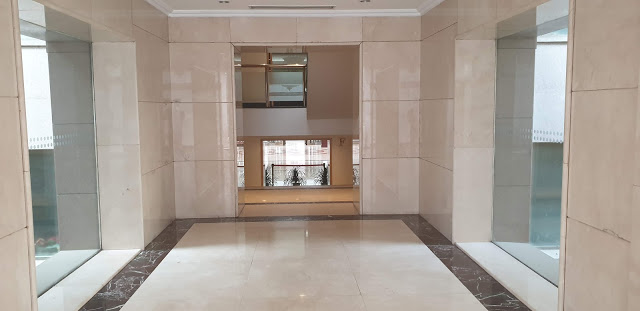
That said, if you’re staying at the Beijing Friendship Hotel, be prepared for a long drive from the airport.  It took us nearly an hour, and bear in mind that it was very late on a Sunday night. Climbing out of the bus after what seemed a convoluted drive through a park with buildings, we arrive at the building that will be our hotel for the next three days.  From the outside, it looks quite good, and once inside the foyer, that first impression is good.  Lots of space, marble, and glass.  If you are not already exhausted by the time you arrive, the next task is to get your room key, find your bags, get to your room, and try to get to be ready the next morning at a reasonable hour.

Sorry, that boat has sailed. We were lucky, we were told, that our plane arrived on time, and we still arrived at the hotel at 12:52.  Imagine if the incoming plane is late.

This was taken the following morning.  It didn’t look half as bland late at night.

This is the back entrance to Building No 4 but is quite representative of the whole foyer, made completely of marble and glass.  It all looked very impressive under the artificial lights, but not so much in the cold hard light of early morning.

This the foyer of the floor our room was on.  Marble with interesting carpet designs.  Those first impressions of it being a plush hotel were slowly dissipating as we got nearer and nearer to the room.  From the elevator, it was a long, long walk.

So…

Did I tell you about the bathroom in our room? The shower and the toilet both share the same space with no divide and the shower curtain doesn’t reach to the floor.  Water pressure is phenomenal.  Having a shower floods the whole shower plus toilet area so when you go to the toilet you’re basically underwater. Don’t leave your book or magazine on the floor or it will end up a watery mess. And the water pressure is so hard that it could cut you in half.  Only a small turn of the tap is required to get that tingling sensation going. It’s after 1:30 before we finally get to sleep.
As for the bed, well, that’s a whole other story.

Searching for locations: The remnants of the wall that surrounded Beijing, China

The fortification walls, both an inner wall and an outer wall, surrounding Beijing city were built from the early 1400s to 1553.

The dimensions of the Inner city wall are:
          Length: 24 kilometers or 15 miles
          Height: 25 meters or 49 feet high
          Thickness, at ground level: 20 meters or 66 feet
                            at the top: 12 meters or 29 feet

It had nine gates.  The fortifications included gate towers, archways, watchtowers, barbicans, barbican towers, sluice gates, sluice gate towers, enemy sighting towers, corner guard towers, and a moat system.

The outer city wall had a length of 28 kilometers or 17 miles.

From 1911, after the collapse of the Qing Dynasty, the dismantling of the fortifications began.

In 1965, major deconstruction of the fortifications was commenced to allow for the construction of the 2nd wrong road, and Line 2 or the Beijing underground railway.

 In 1979, the government called off the demolition of the remaining city walls and named them cultural heritage sites. By this time, the only intact sections were the gate tower and watchtower at Zhengyangmen, the watchtower at Deshengmen, the guard tower at the southeast corner, the northern moats of the Inner city, the section of the Inner city wall south of the Beijing railway station, and a small section of Inner-city wall near Xibianmen.

For more reading, go to: https://en.wikipedia.org/wiki/Beijing_city_fortifications

As for our guide’s explanation of the fortifications: Leaving the Square to go to the Golden Mask Dynasty Show, we pass remnants of the wall that used to surround Beijing.

This wall was built in the early 15th century and was about 24 km long, up to 15 meters high and about 20 meters thick, and had nine gates, one of which still exists today.  In 1965 most of it was removed so that the second ring road and an underground railway line could be built.

Searching for locations: On the road to Tiananmen Square, Beijing, China

One the first things you notice when driving around Beijing, other than the roads are congested with traffic, is the number of trees and flowers that have been planted, in the median strip as well as along the edges of the road.

What you also notice is the large number of multi-story apartment blocks, which are needed to house the millions of Beijing residents.  What we have, so far, rarely seen, is single-story houses.
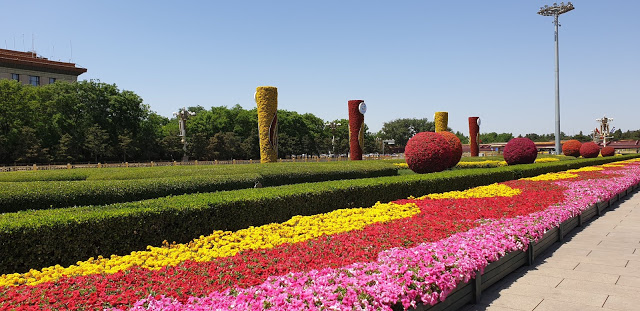
These continuous areas of trees and rose bushes are, every now and then, broken up by very colorful garden beds:

Nearer to the square we are able to get up close to the flowers.  These, we are told, are a variation on the rose, one that flowers for nine months of the year.

They come in a variety of colors.

And they are literally everywhere you go, on the side of the roadway, often blotting out the concrete jungle behind them.

Searching for locations: Tiananmen Square, Beijing, China

Tiananmen Square

Some interesting facts before we get out of the bus…

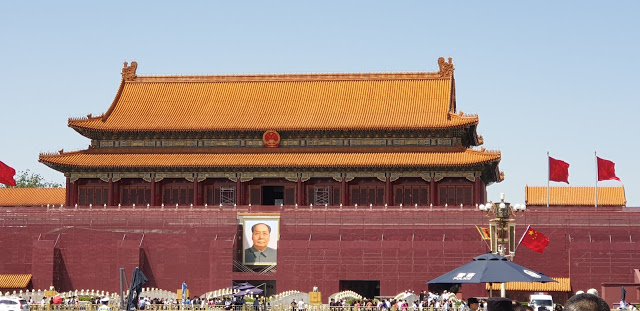
Tiananmen Square or Tian’anmen Square is in the centre of Beijing name after the Gate of Heavenly Peace, a gate that one separated the square from the Forbidden City.

The Square contains,

   the Monument to the People’s Heroes
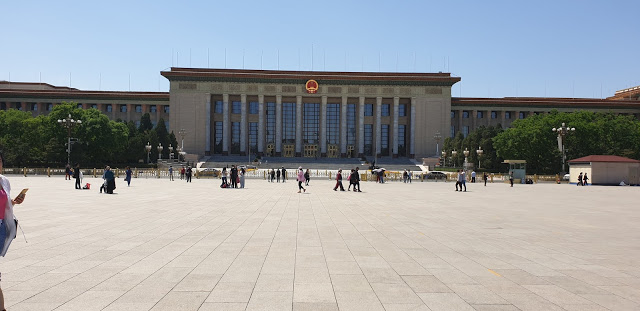
   the Great Hall of the People
   the National Museum of China
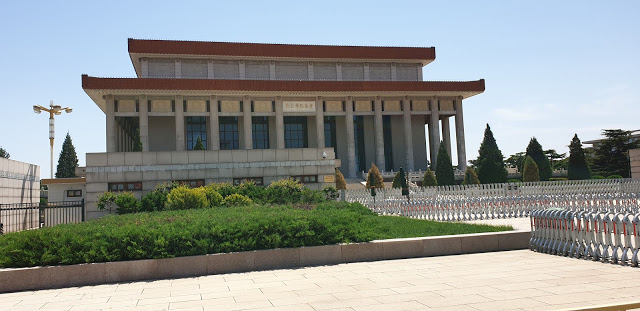
   the Mausoleum of Mao Zedong.

The square is about 109 acres and was designed and built in 1651, and since then been enlarged four times since, the most recent upgrade in the 1950s.

The Monument to the People’s Heroes

This is a ten-story obelisk built to commemorate the matters of the revolutions.  It was built between August 1952 and May 1958.  On the pedestal are reliefs depicting the eight major revolutionary episodes.

The Great Hall of the People

This was opened in September 1959, and covers 171809 square meters.  The Great Hall is the largest auditorium in China and can seat up to 10,000 people.  The State Banquet Hall can seat up to 5,000 diners.

The National Museum of China

This is one of the largest museums in the world and the second most visited museum in the world after the Louvre in Paris.   It was completed in 1959, and sits on 65 hectares, and rises four floors.  It has a permanent collection of over 1,000,000 items.

The Mauseloum of Mao Zedong

This was built shortly after his death, and completed on May 24th, 1977.  The embalmed body of the Chairman is preserved and on display in the center hall.
My own observations
This is huge; one of the largest public squares in the world, and if you’re going to walk it, like we did, make sure you’ve been exercising before you go.  It covers 44 hectares, borders on the Forbidden City, and has a memorial to Chairman Mao in the center of it.  But you cannot go near it, it’s fenced off, and it is guarded.

That’s both the statue and the square as there are random guards marching in random directions all the while watching us to see that we don’t misbehave.No one wants to find out what would happen if you jumped the fence around the statue, but I’m guessing you’ll have a few years to contemplate the stupidity of your actions with some very unhappy government officials.

 Around the edges of the square are huge buildings, on one side is the museum 

 and on the other is the Chinese equivalent of parliament.

Around the sides are also large gardens

At one end, where the Forbidden City borders on the square, there’s a huge flag pole flying the Chinese flag, and this too like the monument is fenced off, and guarded by members of all of their armed services.  No tanks rolled out during our visit much to our disappointment.  There is no entrance to the Forbidden City from the square

 At the other end is the Mausoleum of Mao Zedong, which was closed the day we were there, as was the museum. 

 There are four sculptural groups installed outside the mausoleum.

Other than that, it’s just another square, albeit probably one of the largest in the world.  It can, we were told, hold about a million people.

Searching for locations: From X’ian to Zhengzhou dong by bullet train, China

Lunch and then off on another high-speed train

We walked another umpteen miles from the exhibition to a Chinese restaurant that is going to serve us Chinese food again with a beer and a rather potent pomegranate wine that has a real kick.  It was definitely value for money at 60 yuan per person.

But perhaps the biggest thrill, if it could be called that, was discovering downstairs, the man who discovered the original pieces of a terracotta soldier when digging a well.  He was signing books bought in the souvenir store, but not those that had been bought elsewhere.

Some of is even got photographed with him.  Fifteen minutes of fame moment?  Maybe.

After lunch, it was off to the station for another high-speed train ride, this time for about two and a half hours, from X’ian to Zhangzhou dong.

It’s the standard high-speed train ride and the usual seat switching because of weird allocation issues, so a little confusion reigns until the train departs at 5:59.

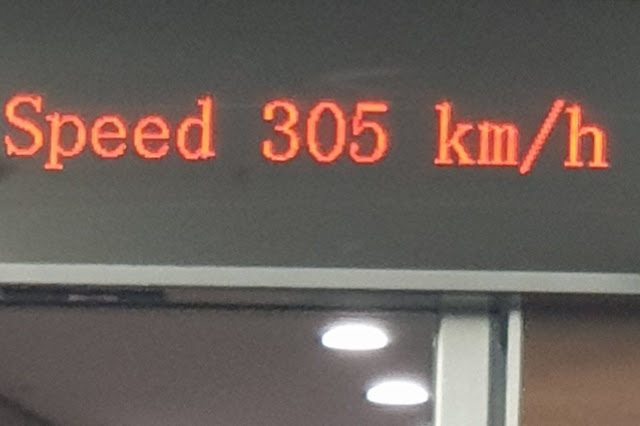
Once we were underway it didn’t take long before we hit the maximum speed

Twenty minutes before arrival, and knowing we only have three minutes to get off everyone is heading for the exit clogging up the passageway.  It wasn’t panic but with the three-minute limit, perhaps organized panic would be a better description.

As it turned out, with all the cases near the door, the moment to door opened one of our group got off, and the other just started putting cases on the platform, and in doing so we were all off in 42 seconds with time to spare.

And this was despite the fact there were about twenty passengers just about up against the door trying to get in.  I don’t think they expected to have cases flying off the train in their direction.

We find our way to the exit and our tour guide Dannie.  It was another long walk to the bus, somewhat shabbier from the previous day, no leg room, no pocket, no USB charging point like the day before.  Disappointing.

On the way from the station to the hotel, the tour guide usually gives us a short spiel on the next day’s activities, but instead, I think we got her life history and a song, delivered in high pitched and rapid Chinglish that was hard to understand.

Not at this hour of the night to an almost exhausted busload of people who’d had enough from the train.  Oh, did I forgot the singing, no, it was an interesting rendition of ‘you are my sunshine’.

The drive was interesting in that it mostly in the dark.  There was no street lighting and in comparison to X’ian which was very bright and cheerful, this was dark and gloomy.

Then close to the hotel our guide said that if we had any problems with the room, she would be in the lobby for half an hour.

That spoke volumes about the hotel they put us in.

Searching for locations: West Lake, Hangzhou, China

West Lake is a freshwater lake in Hangzhou, China. It is divided into five sections by three causeways. There are numerous temples, pagodas, gardens, and artificial islands within the lake.

Measuring 3.2 kilometers (2 miles) in length, 2.8 kilometers (1.7 miles) in width, and 2.3 meters (7.5 feet) in average depth, the lake spreads itself in an area totaling 6.5 square kilometers (2.5 square miles).

The earliest recorded name for West Lake was the “Wu Forest River”, but over time it changed to two distinct names.  One is “Qiantang Lake”, due to the fact that Hangzhou was called “Qiantang” in ancient times.  The other, “West Lake”, due to the lake being west of the city

It’s about to get busy, with a number of activities planned, and the warmth of the day is starting to make an impact.

The tour starts in the car park about a kilometer away, but the moment we left the car park we were getting a taste of the park walking along a tree-lined avenue.

When we cross the road, once again dicing with death with the silent assassins on motor scooters.

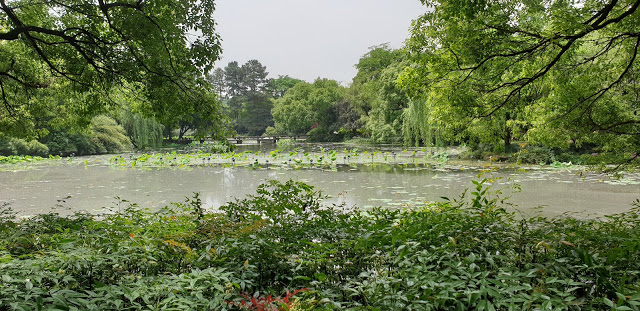
We are in the park proper, and it is magnificent, with flowers, mostly at the start hydrangeas and then any number of other trees and shrubs, some carved into other flower shapes like a lotus.

Then there was the lake and the backdrop of bridges and walkways.

.

And if you can tune out the background white noise the place would be great for serenity and relaxation.

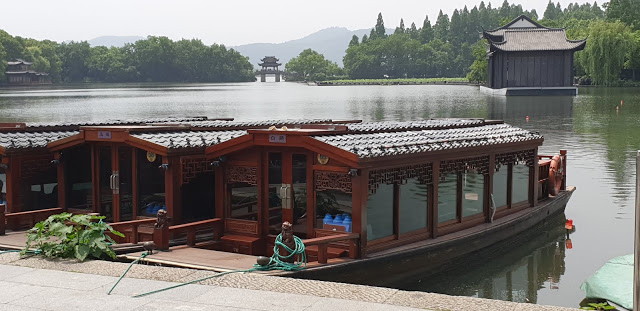
That, in fact, was how the boat ride panned out, about half an hour or more gliding across the lake in an almost silent boat, by an open window, with the air and the majestic scenery.

No, not that boat, which would be great to have lunch on while cruising, but the boat below:

Not quite in the same class, but all the same, very easy to tune out and soak it in.

It was peaceful, amazingly quiet, on a summery day

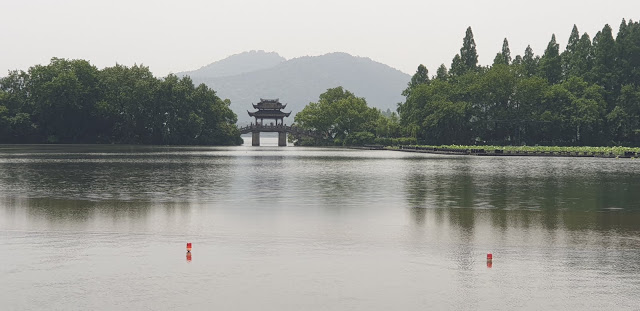
A pagoda in the hazy distance, an island we were about to circumnavigate.

Of all the legends, the most touching one is the love story between Bai Suzhen and Xu Xi’an. Bai Suzhen was a white snake spirit and Xu Xi’an was a mortal man.

They fell in love when they first met on a boat on the West Lake, and got married very soon after.

However, the evil monk Fa Hai attempted to separate the couple by imprisoning Xu Xi’an. Bai Suzhen fought against Fa Hai and tried her best to rescue her husband, but she failed and was imprisoned under the Leifeng Pagoda by the lake.

Years later the couple was rescued by Xiao Qing, the sister of Baisuzhen, and from then on, Bai Suzhen and Xu Xi’an lived together happily.

The retelling of the story varied between tour guides, and on the cruise boat, we had two.  Our guide kept to the legend, the other tour guide had a different ending.

Suffice to say it had relevance to the two pagodas on the far side of the lake.

There was a cafe or restaurant on the island, but that was not our lunch destination.

Nor were the buildings further along from where we disembarked.

All in all the whole cruise took about 45 minutes and was an interesting break from the hectic nature of the tour.

Oh yes, and the boat captain had postcards for sale.  We didn’t buy any.

Lunch

At the disembarkation point there was a mall that sold souvenirs and had a few ‘fast food’ shops, and a KFC, not exactly what we came to China for, but it seemed like the only place in town a food cautious Australian could eat at.

And when tried to get in the door, that’s where at least 3 busloads were, if they were not in the local Starbucks.  Apparently, these were the places of first choice wherever we went.

The chicken supply by the time we got to the head of the line amounted to pieces at 22.5 RMB a piece and nuggets.  Everything else had run out, and for me, there were only 5 pieces left.  Good thing there were chips.

And Starbucks with coffee and cheesecake.

At least the setting for what could have been a picnic lunch was idyllic.