NaNoWriMo – April 2022 – Day 2

First Dig Two Graves, the second Zoe thriller.

…

Just when you think you’ve got a good start, it all comes crashing down.

Here’s the thing…

I’ve been planning the sequel for quite some time, and from time to time, I’ve been jotting down notes about how the story will go. I thought I had filed them all in the same place, and because I thought I had all of them, I missed a part.

This was confirmed when I found a synopsis, something I rarely make before writing a story, with details of several sections I obviously added when the thought came to me. Perhaps the idea of the synopsis was to consolidate all the ideas, at a time when I thought I was going to sit down and write the story.

Dated a month or so before covid came along, I suspect it all got set aside for the two-odd year’s hiatus.

Now, the time has come, and today, I went n a detailed search of three computers, four phones, cloud storage, and the boxes that hold all the handwritten notes.

I have a reference to the section, several chapters, but no writing. In the back of my mind, I have a feeling I’d written the chapters, but the evidence says otherwise.

Damn!

I’ll move on, and come back to it later. At the moment it doesn’t have relevance.

Oh, and Zoe has now become Mary-Anne. What is John going to think when he finally finds her.

…

Todays writing, introducing Mary Anne, 1,501 words, for a total of 3,610.

The cinema of my dreams – I never wanted to go to Africa – Episode 22

Our hero knows he’s in serious trouble.

The problem is, there are familiar faces and a question of who is a friend and who is foe made all the more difficult because of the enemy, if it was the enemy, simply because it didn’t look or sound or act like the enemy.

Now, it appears, his problems stem from another operation he participated in.

Lallo was gone ten minutes, perhaps a specific amount of time that was supposed to make me sweat.  It was warm in the ward so it wasn’t his presence or the questions that made me feel uncomfortable.

It was fear of the unknown.

If anything, it was more likely I’d be going to a black site rather than rest and recuperation in Germany.  And apparently over an operation, I had little or no knowledge of its inception or execution beyond being used for target practice.

Unless the army in its infinite wisdom was looking for a scapegoat, they’d tried pinning it on Treen, but he didn’t play ball, so now it was my turn.  However, just to complicate that thought, why didn’t they just kill me on the ground when they had the chance?

Because they needed me alive.

My mind went back to that fateful operation.

I went over as many of the crew as I could remember.  Ledgeman, Sergeant, explosives expert, he was with me until he was shot, caught in the crossfire, which now made me consider my first assessment of what has happened to him, that it might have been one of us who shot him, was the likely outcome.

Willies, Corporal, also explosives expert, sent with Mason, Gunnery Sergeant like me, who was providing cover for Willies.

Breen, Lieutenant, Leader, although it didn’t exactly appear to be the case, the more I thought about it, there seemed an undertone of indifference from the team towards its leader, one I should have picked up on.  Informal command never worked when push came to shove.

Andrews, Cathcar, Edwards and Sycamore, regular soldiers with combat experience along for protection, Andrews and Sycamore were with us and had worked together before, their camaraderie didn’t extend to me, but they were professional soldiers.

Of all the people in that entire group, why did Treen survive?  In putting the pieces together now in my mind, and if what I remembered was right, he should have been the first to die.

I mean, drugs and paranoia aside, that was the one single damning conclusion I could draw from events.  If he had, then a lot of the others might have survived.

But time was up; Lallo was back, squirming in his seat, and armed with a different coloured notebook.

First question, “What was your opinion of Treen?”

Relevance?  “Competent, but perhaps not truly in charge of his men.”

“How so?”

“I got the impression it was a case of familiarity breeds contempt.”

“You question his ability to command?”

“Just his style.”

Groups who worked together in close combat as a unit, from the top to the bottom, acquired a level of camaraderie that transcended rank.  It was not supposed to, but it did.  It was built on mutual respect and got to a point where everyone knew what they were doing without being asked, or ordered.  I got the impression that had been the case for Treen and his team up till that operation.  Perhaps the loss of one of the team had changed the dynamic.

“He’s there to lead, not be liked.”

“Then why ask me what I thought?  You’d know what I meant by that if you were out on the front line and your life depended on your team.  Something was not right.”

“How did you fit in,” he asked, with an emphasis on the word ‘fit’.

I didn’t, but I was not going to tell him that.  In the end, I just didn’t trust them.  You can get a measure of a man in that first meeting with or speaking with them, and they closed me out from the start.

“I had a job to do and I did it.”

And, it was probably the reason why I walked away.

© Charles Heath 2019-2021

Car parks are like watching dodgem cars

Many years ago I always wanted to drive a dodgem car but for some reason my parents would never let me.

It would have been fun, deliberately crashing into other drivers, or bouncing of the side walls. Not so much, I suppose, if everyone decided you were the target.

Many years later I got the chance. Grown up and having had a license to drive for some years I thought the practical experience would help.

It didn’t.

Nor did I realise just how painful it was when someone else crashed into you, especially if you were not expecting it.

I was reminded of this experience recently when having to try and find a parking space at a hospital car park at the wrong time if the day.

There were no spaces available.

This meant I had to keep moving while my wife went in for her appointment.

Thus begun an hour and a half of ducking and weaving, dodging reversing cars, and witnessing the very worse of mankind, stealing parking spaces from those who had been patiently waiting.

It happened to me three times, being caught on the wrong side of the car reversing out, only to watch another slip in.

They knew I was waiting, but ignored etiquette.

Calling them out got me a stream in foul language that brought my heritage into question, some doubt about whether my parents were married at the time of my conception, and words that I wouldn’t use myself, even under my breath.

And these from people driving very expensive cars and for all intents and purposes, people my father would say were my betters.

They were not.

Having money and displayable wealth, I have learned, does not make you a better person.

But, sadly, in this car park, there seems to be an extraordinary large concentration of them.

By the third occurrence, I did the unthinkable. I drove strait at the offending car and blocked its way, almost getting crashed into, dodgem style.

I was banking on the fact that posh person didn’t want to dent their lovely posh car and I was right.

Parking space secure, but at the cost of having my heritage and birth status impugned yet again, I felt an odd sense of victory.

Writing about writing a book – Day 21 continues

I’m still working on Bill’s backstory, and how he got mixed up in the war, and as a general background to his situation, and life before Davenport.

This is still in his own words:


But whether we were stupid or naive, or completely mad, we were all eager to get into battle, filled with the sort of hate only Army propaganda films could fill you with.  They were our enemy, and they deserved to concede or die.

A fresh face in a hardened platoon, I was eager to get on with it.  They looked knowingly, having seen it all before.  No idea of the reality, and no time to tell us.  Have a few beers to celebrate, and then, the next morning, go out on patrol.  No problem.

There was camaraderie, but it was subdued.  We walked single file, the seasoned campaigners in front and at the rear, treading carefully, demanding quiet, and a general cautiousness.  In the middle of nowhere, where only the sound of rain, or the animals and birds for company, we were naive enough to think this was going to be a doddle.

Then it happened, six hours out, and just before we reached a small clearing.  I thought to myself it was odd there should be such a clear space with jungle all around it.  There must be a reason.

There was.

We had walked into an ambush, and everyone hit the ground.  I was bringing up the rear with another soldier, a veteran not much older than myself whose name was Scotty, a little farther back from the main group.  Bullets sprayed the undergrowth, pinging off trees and leaves.  I buried my face in the dirt, praying I would not die on my first patrol.

We became separated from the others, lying in a hollow, with no idea how far away help was.  He was muttering to himself.  “God, I hate this.  You can never see the bastards.  They’re out there, but you can never bloody well see them.”  Then he crawled up the embankment, gun first.

He let off a few rounds, causing a return of machine-gun fire, spattering the dirt at the top.  Next thing I knew he was sliding down the hill with half his face shot away.  Dead.  I threw up there and then.  What an initiation.

Then one of the enemy soldiers came over the hill to check on his ‘kill’.  I saw him at the same time he saw me and aimed my gun and shot.  It was instinct more than anything else, and I hadn’t stopped to think of the consequences.  He fell down, finishing up next to me, staring at me from black, lifeless eyes. 

Dead. 

I’ll never forget those lifeless eyes.  I just got up and ran, making it back to the rest of the group without getting hit.  No one could explain how I made it safely through the hail of gunfire, from our side and theirs.

Back in the camp later, the veterans remarked on how unlucky Scotty was and how lucky I was to shoot one of the enemies, and not be killed myself.  They all thought it was worth a celebration.

Before we went out the next day to do it all again.

I spent the night vomiting, unable to sleep, haunted look on his face, one I finally realized that reflected complete astonishment.


There will be more, as the story develops.


© Charles Heath 2016-2020

Searching for locations: Driving in ice and snow, Canada

This morning started with a visit to the car rental place in Vancouver.  It reinforced the notion that you can be given the address and still not find the place.  It happened in Washington where it was hiding in the back of the main railway station, and it happened again in Vancouver when it was hidden inside a hotel.

We simply walked straight past it.  Pity there wasn’t a sign to let people know.

However…

We went in expecting a Grand Jeep Cherokee and walked out with a Ford Flex, suitable for three people and four large suitcases.  It actually seats 7, but forget the baggage, you’d be lucky to get two large suitcases in that configuration.

It is more than adequate for our requirements.

Things to note, it was delivered with just over a quarter of a tank of gas, and it had only done about 11,000 km, so it’s relatively new.  It’s reasonably spacious, and when the extra seats are folded down, there is plenty of baggage space.

So far, so good.

We finally leave the hotel at about half-past ten, and it is raining.  It is a simple task to get on Highway 1, the TransCanada Highway, initially, and then onto Highway 5, the Coquihalla Highway for the trip to Kamloops.

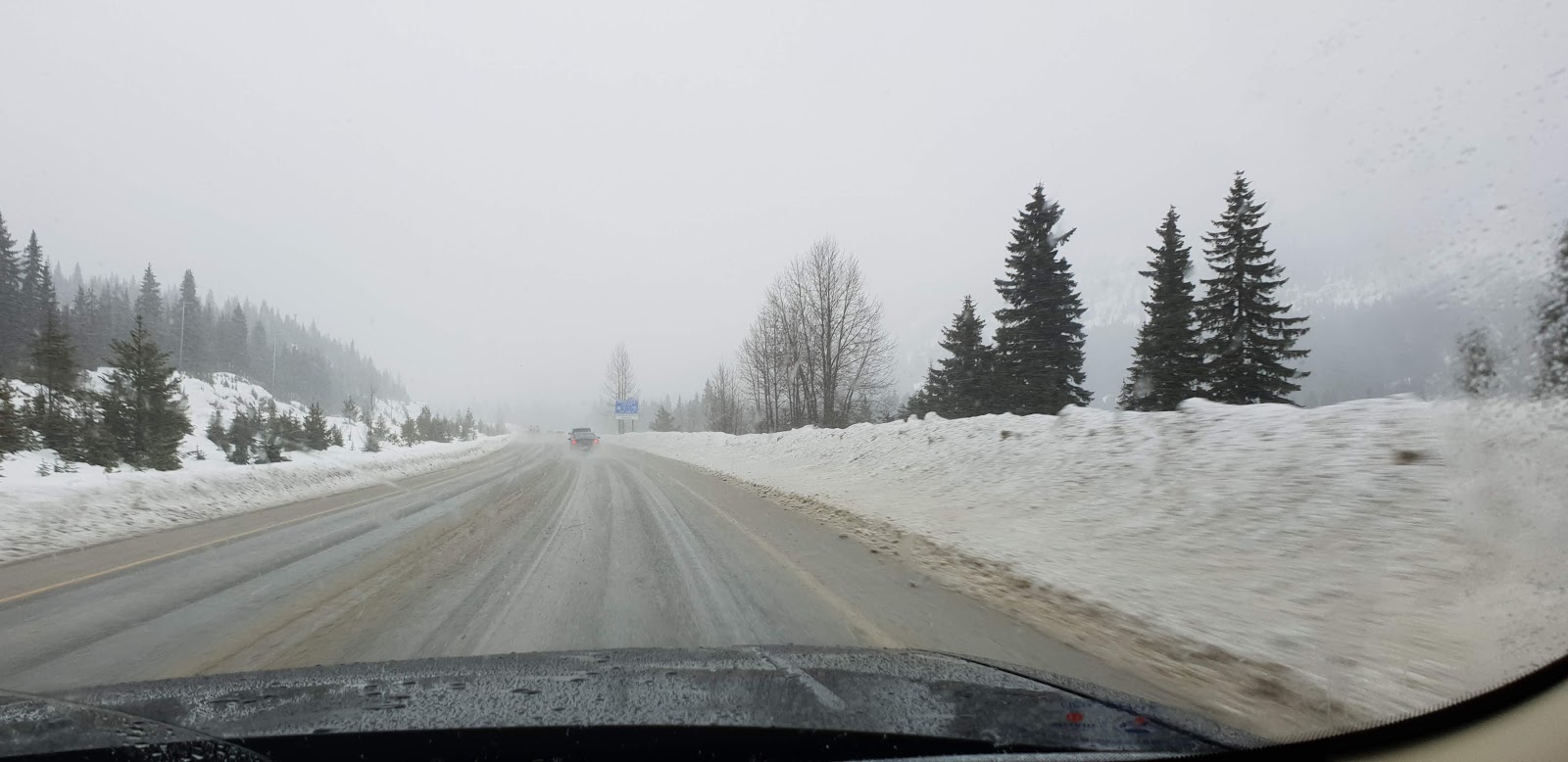
It rains all the way to the top of the mountain, progress hampered from time to time by water sprays from both vehicles and trucks.  The rain is relentless.  At the top of the mountain, the rain turns into snow and the road surface to slush.  It’s 0 degrees, but being the afternoon, I was not expecting it to turn to ice very quickly.

On the other side of the mountain, closer to Kamloops, there was sleet, then rain, then nothing, the last 100kms or so, in reasonably dry conditions.

Outside Kamloops, and in the town itself, there was evidence of snow recently cleared, and slushy roads.  Cars in various places were covered in snow, indicating the most recent falls had been the night before.

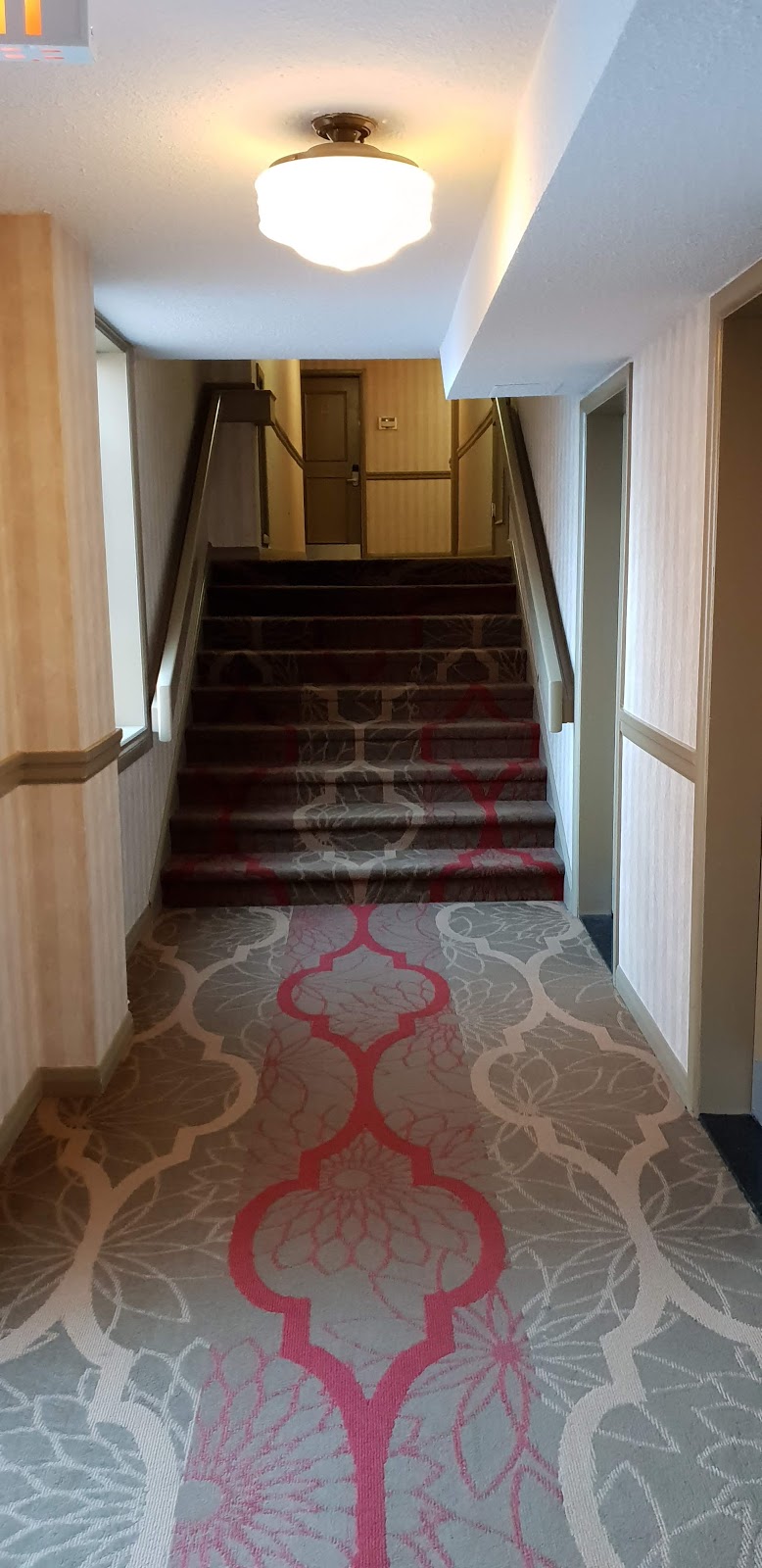
We’re staying at the Park Hotel, a heritage building, apparently built in the later 1920s.  In the style of the time, it is a little like a rabbit warren with passages turning off in a number of directions, and showing it is spread across a number of different buildings.

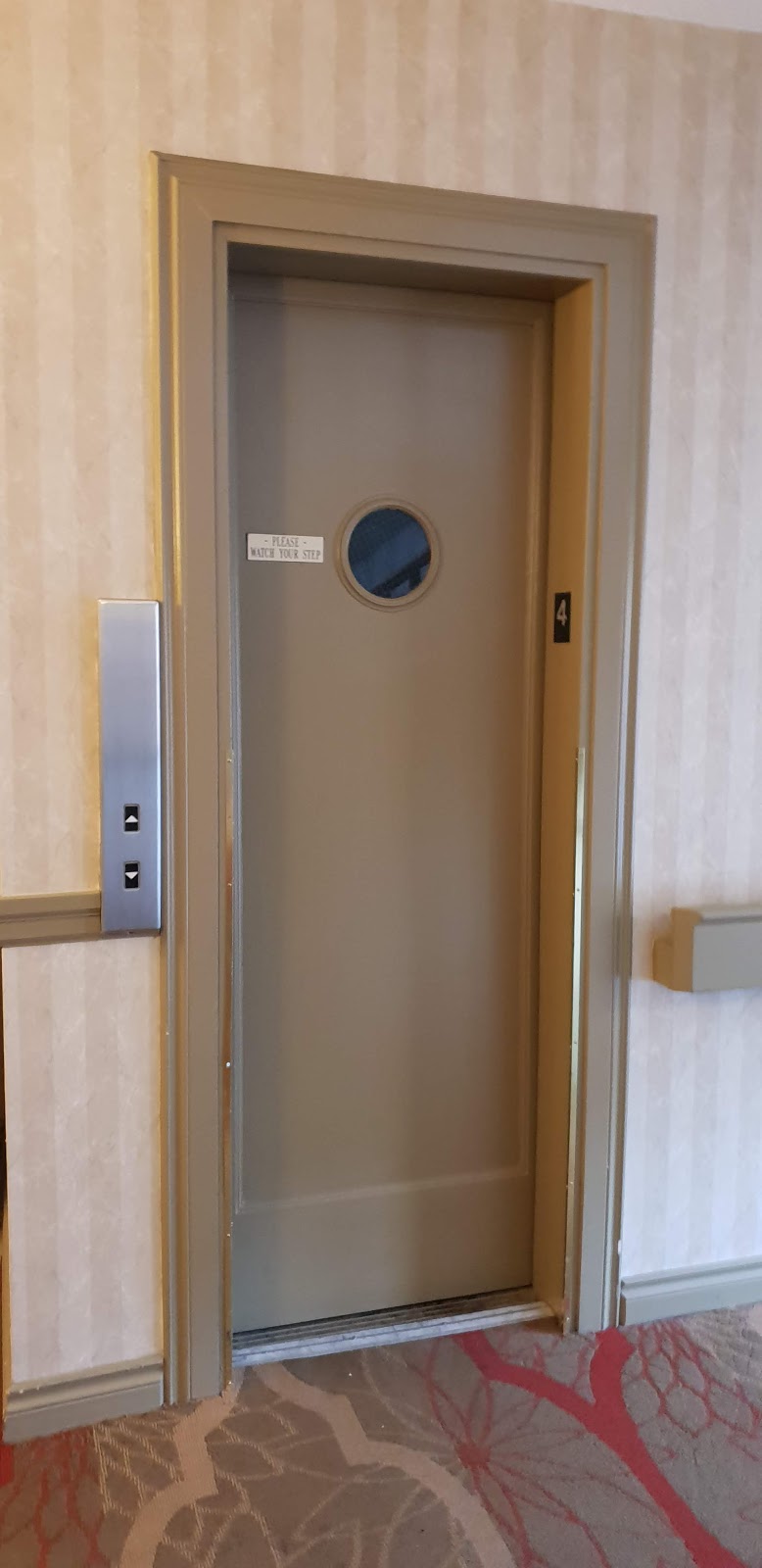
It has the original Otis elevator that can take a maximum of four passengers, and a sign on the wall that says “no horseplay inside the elevator” which is a rather interesting expression that only someone of my vintage would understand.  And, for those without a sense of humor, you definitely couldn’t fit a horse in it to play with.

The thing is, how do you find a balance between keeping the old world charm with modern-day expectations.  You can’t.  Some hotels try valiantly to get that balance.  Here, it is simply old world charm, which I guess we should be grateful for because sooner rather than later it’s going to disappear forever.

In my writer’s mind, given the importance of the railways, this was probably a thriving place for travelers, and once upon a time, there were a lot more hotels like this one.

The cinema of my dreams – I never wanted to go to Africa – Episode 22

Our hero knows he’s in serious trouble.

The problem is, there are familiar faces and a question of who is a friend and who is foe made all the more difficult because of the enemy, if it was the enemy, simply because it didn’t look or sound or act like the enemy.

Now, it appears, his problems stem from another operation he participated in.

Lallo was gone ten minutes, perhaps a specific amount of time that was supposed to make me sweat.  It was warm in the ward so it wasn’t his presence or the questions that made me feel uncomfortable.

It was fear of the unknown.

If anything, it was more likely I’d be going to a black site rather than rest and recuperation in Germany.  And apparently over an operation, I had little or no knowledge of its inception or execution beyond being used for target practice.

Unless the army in its infinite wisdom was looking for a scapegoat, they’d tried pinning it on Treen, but he didn’t play ball, so now it was my turn.  However, just to complicate that thought, why didn’t they just kill me on the ground when they had the chance?

Because they needed me alive.

My mind went back to that fateful operation.

I went over as many of the crew as I could remember.  Ledgeman, Sergeant, explosives expert, he was with me until he was shot, caught in the crossfire, which now made me consider my first assessment of what has happened to him, that it might have been one of us who shot him, was the likely outcome.

Willies, Corporal, also explosives expert, sent with Mason, Gunnery Sergeant like me, who was providing cover for Willies.

Breen, Lieutenant, Leader, although it didn’t exactly appear to be the case, the more I thought about it, there seemed an undertone of indifference from the team towards its leader, one I should have picked up on.  Informal command never worked when push came to shove.

Andrews, Cathcar, Edwards and Sycamore, regular soldiers with combat experience along for protection, Andrews and Sycamore were with us and had worked together before, their camaraderie didn’t extend to me, but they were professional soldiers.

Of all the people in that entire group, why did Treen survive?  In putting the pieces together now in my mind, and if what I remembered was right, he should have been the first to die.

I mean, drugs and paranoia aside, that was the one single damning conclusion I could draw from events.  If he had, then a lot of the others might have survived.

But time was up; Lallo was back, squirming in his seat, and armed with a different coloured notebook.

First question, “What was your opinion of Treen?”

Relevance?  “Competent, but perhaps not truly in charge of his men.”

“How so?”

“I got the impression it was a case of familiarity breeds contempt.”

“You question his ability to command?”

“Just his style.”

Groups who worked together in close combat as a unit, from the top to the bottom, acquired a level of camaraderie that transcended rank.  It was not supposed to, but it did.  It was built on mutual respect and got to a point where everyone knew what they were doing without being asked, or ordered.  I got the impression that had been the case for Treen and his team up till that operation.  Perhaps the loss of one of the team had changed the dynamic.

“He’s there to lead, not be liked.”

“Then why ask me what I thought?  You’d know what I meant by that if you were out on the front line and your life depended on your team.  Something was not right.”

“How did you fit in,” he asked, with an emphasis on the word ‘fit’.

I didn’t, but I was not going to tell him that.  In the end, I just didn’t trust them.  You can get a measure of a man in that first meeting with or speaking with them, and they closed me out from the start.

“I had a job to do and I did it.”

And, it was probably the reason why I walked away.

© Charles Heath 2019-2021
Car parks are like watching dodgem cars

Many years ago I always wanted to drive a dodgem car but for some reason my parents would never let me.

It would have been fun, deliberately crashing into other drivers, or bouncing of the side walls. Not so much, I suppose, if everyone decided you were the target.

Many years later I got the chance. Grown up and having had a license to drive for some years I thought the practical experience would help.

It didn’t.

Nor did I realise just how painful it was when someone else crashed into you, especially if you were not expecting it.

I was reminded of this experience recently when having to try and find a parking space at a hospital car park at the wrong time if the day.

There were no spaces available.

This meant I had to keep moving while my wife went in for her appointment.

Thus begun an hour and a half of ducking and weaving, dodging reversing cars, and witnessing the very worse of mankind, stealing parking spaces from those who had been patiently waiting.

It happened to me three times, being caught on the wrong side of the car reversing out, only to watch another slip in.

They knew I was waiting, but ignored etiquette.

Calling them out got me a stream in foul language that brought my heritage into question, some doubt about whether my parents were married at the time of my conception, and words that I wouldn’t use myself, even under my breath.

And these from people driving very expensive cars and for all intents and purposes, people my father would say were my betters.

They were not.

Having money and displayable wealth, I have learned, does not make you a better person.

But, sadly, in this car park, there seems to be an extraordinary large concentration of them.

By the third occurrence, I did the unthinkable. I drove strait at the offending car and blocked its way, almost getting crashed into, dodgem style.

I was banking on the fact that posh person didn’t want to dent their lovely posh car and I was right.

Parking space secure, but at the cost of having my heritage and birth status impugned yet again, I felt an odd sense of victory.

Writing about writing a book – Day 21 continues

I’m still working on Bill’s backstory, and how he got mixed up in the war, and as a general background to his situation, and life before Davenport.

This is still in his own words:


But whether we were stupid or naive, or completely mad, we were all eager to get into battle, filled with the sort of hate only Army propaganda films could fill you with.  They were our enemy, and they deserved to concede or die.

A fresh face in a hardened platoon, I was eager to get on with it.  They looked knowingly, having seen it all before.  No idea of the reality, and no time to tell us.  Have a few beers to celebrate, and then, the next morning, go out on patrol.  No problem.

There was camaraderie, but it was subdued.  We walked single file, the seasoned campaigners in front and at the rear, treading carefully, demanding quiet, and a general cautiousness.  In the middle of nowhere, where only the sound of rain, or the animals and birds for company, we were naive enough to think this was going to be a doddle.

Then it happened, six hours out, and just before we reached a small clearing.  I thought to myself it was odd there should be such a clear space with jungle all around it.  There must be a reason.

There was.

We had walked into an ambush, and everyone hit the ground.  I was bringing up the rear with another soldier, a veteran not much older than myself whose name was Scotty, a little farther back from the main group.  Bullets sprayed the undergrowth, pinging off trees and leaves.  I buried my face in the dirt, praying I would not die on my first patrol.

We became separated from the others, lying in a hollow, with no idea how far away help was.  He was muttering to himself.  “God, I hate this.  You can never see the bastards.  They’re out there, but you can never bloody well see them.”  Then he crawled up the embankment, gun first.

He let off a few rounds, causing a return of machine-gun fire, spattering the dirt at the top.  Next thing I knew he was sliding down the hill with half his face shot away.  Dead.  I threw up there and then.  What an initiation.

Then one of the enemy soldiers came over the hill to check on his ‘kill’.  I saw him at the same time he saw me and aimed my gun and shot.  It was instinct more than anything else, and I hadn’t stopped to think of the consequences.  He fell down, finishing up next to me, staring at me from black, lifeless eyes. 

Dead. 

I’ll never forget those lifeless eyes.  I just got up and ran, making it back to the rest of the group without getting hit.  No one could explain how I made it safely through the hail of gunfire, from our side and theirs.

Back in the camp later, the veterans remarked on how unlucky Scotty was and how lucky I was to shoot one of the enemies, and not be killed myself.  They all thought it was worth a celebration.

Before we went out the next day to do it all again.

I spent the night vomiting, unable to sleep, haunted look on his face, one I finally realized that reflected complete astonishment.


There will be more, as the story develops.


© Charles Heath 2016-2020

Searching for locations: Driving in ice and snow, Canada

This morning started with a visit to the car rental place in Vancouver.  It reinforced the notion that you can be given the address and still not find the place.  It happened in Washington where it was hiding in the back of the main railway station, and it happened again in Vancouver when it was hidden inside a hotel.

We simply walked straight past it.  Pity there wasn’t a sign to let people know.

However…

We went in expecting a Grand Jeep Cherokee and walked out with a Ford Flex, suitable for three people and four large suitcases.  It actually seats 7, but forget the baggage, you’d be lucky to get two large suitcases in that configuration.

It is more than adequate for our requirements.

Things to note, it was delivered with just over a quarter of a tank of gas, and it had only done about 11,000 km, so it’s relatively new.  It’s reasonably spacious, and when the extra seats are folded down, there is plenty of baggage space.

So far, so good.

We finally leave the hotel at about half-past ten, and it is raining.  It is a simple task to get on Highway 1, the TransCanada Highway, initially, and then onto Highway 5, the Coquihalla Highway for the trip to Kamloops.

It rains all the way to the top of the mountain, progress hampered from time to time by water sprays from both vehicles and trucks.  The rain is relentless.  At the top of the mountain, the rain turns into snow and the road surface to slush.  It’s 0 degrees, but being the afternoon, I was not expecting it to turn to ice very quickly.

On the other side of the mountain, closer to Kamloops, there was sleet, then rain, then nothing, the last 100kms or so, in reasonably dry conditions.

Outside Kamloops, and in the town itself, there was evidence of snow recently cleared, and slushy roads.  Cars in various places were covered in snow, indicating the most recent falls had been the night before.

We’re staying at the Park Hotel, a heritage building, apparently built in the later 1920s.  In the style of the time, it is a little like a rabbit warren with passages turning off in a number of directions, and showing it is spread across a number of different buildings.

It has the original Otis elevator that can take a maximum of four passengers, and a sign on the wall that says “no horseplay inside the elevator” which is a rather interesting expression that only someone of my vintage would understand.  And, for those without a sense of humor, you definitely couldn’t fit a horse in it to play with.

The thing is, how do you find a balance between keeping the old world charm with modern-day expectations.  You can’t.  Some hotels try valiantly to get that balance.  Here, it is simply old world charm, which I guess we should be grateful for because sooner rather than later it’s going to disappear forever.

In my writer’s mind, given the importance of the railways, this was probably a thriving place for travelers, and once upon a time, there were a lot more hotels like this one.

“Sunday in New York”, a romantic adventure that’s not a walk in the park!

“Sunday in New York” is ultimately a story about trust, and what happens when a marriage is stretched to its limits.

When Harry Steele attends a lunch with his manager, Barclay, to discuss a promotion that any junior executive would accept in a heartbeat, it is the fact his wife, Alison, who previously professed her reservations about Barclay, also agreed to attend, that casts a small element of doubt in his mind.

From that moment, his life, in the company, in deciding what to do, his marriage, his very life, spirals out of control.

There is no one big factor that can prove Harry’s worst fears, that his marriage is over, just a number of small, interconnecting events, when piled on top of each other, points to a cataclysmic end to everything he had believed in.

Trust is lost firstly in his best friend and mentor, Andy, who only hints of impending disaster, Sasha, a woman whom he saved, and who appears to have motives of her own, and then in his wife, Alison, as he discovered piece by piece damning evidence she is about to leave him for another man.

Can we trust what we see with our eyes or trust what we hear?

Haven’t we all jumped to conclusions at least once in our lives?

Can Alison, a woman whose self-belief and confidence is about to be put to the ultimate test, find a way of proving their relationship is as strong as it has ever been?

As they say in the classics, read on!

Purchase:

http://tinyurl.com/Amazon-SundayInNewYork