For the first time on this trip, we encounter problems with Chinese officialdom at the railway station, though we were warned that this might occur.
We had a major problem with the security staff when they pulled everyone over with aerosols and confiscated them. We lost styling mousse, others lost hair spray, and the men, their shaving cream. But, to her credit, the tour guide did warn us they were stricter here, but her suggestion to be angry they were taking our stuff was probably not the right thing to do.
As with previous train bookings, the Chinese method of placing people in seats didn’t quite manage to keep couples traveling together, together on the train. It was an odd peculiarity which few of the passengers understood, nor did they conform, swapping seat allocations.
This train ride did not seem the same as the last two and I don’t think we had the same type of high-speed train type that we had for the last two. The carriages were different, there was only one toilet per carriage, and I don’t think we were going as fast.
But aside from that, we had 753 kilometers to travel with six stops before ours, two of which were very large cities, and then our stop, about four and a half hours later. With two minutes this time, to get the baggage off the team managed it in 40 seconds, a new record.
After slight disorientation getting off the train, we locate our guide, easily found by looking for the Trip-A-Deal flag. From there it’s a matter of getting into our respective groups and finding the bus.
As usual, the trip to the hotel was a long one, but we were traveling through a much brighter, and well lit, city.
As for our guide, we have him from now until the end of the tour. There are no more train rides, we will be taking the bus from city to city until we reach Shanghai. Good thing then that the bus is brand new, with that new car smell. Only issue, no USB charging point.
The Snowy Sea hotel.
It is finally a joy to get a room that is nothing short of great. It has a bathroom and thus privacy.
Everyone had to go find a supermarket to purchase replacements for the confiscated items. Luckily there was a huge supermarket just up from the hotel that had everything but the kitchen sink.
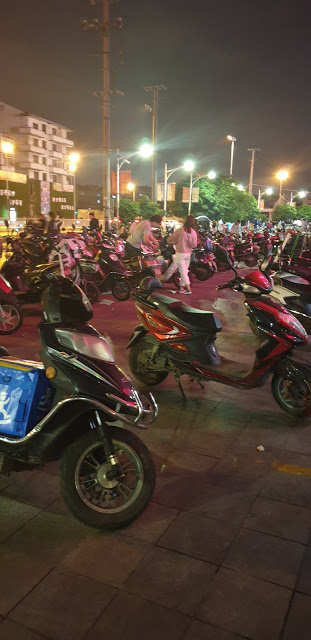
But, unlike where we live, the carpark is more of a scooter park!
It is also a small microcosm of Chinese life for the new more capitalistic oriented Chinese.
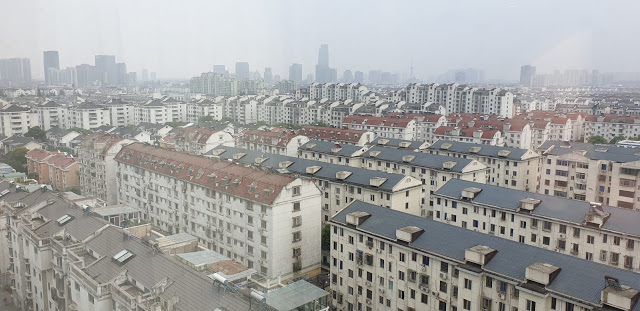
The next morning we get some idea of the scope of high-density living, though here, the buildings are not 30 stories tall, but still just as impressive.
These look like the medium density houses, but to the right of these are much larger buildings
The remarkable thing about this is those buildings stretch as far as the eye can see.
This book has been written for some time and the manuscript was sitting in a box with half a dozen others gathering dust and not quite as complete, so this month it is going to get the makeover, a first draft for the editor.
And so it begins…
…
Sanity, if nothing else, returns
…
Got the 50,000 words, 51,540 to be exact, but the story is not done yet.
Hasty revisions, adding more words, taking out some others, it’s a long and difficult day, with the yellow post-it note collection growing exponentially.
Where would we be without them, endless scraps of paper strewn over an already cluttered desk?
All it would take was one enthusiastic cleaning lady, and it would become an ‘oh-my-god’ moment.
The end, however, is becoming clearer, and I’m working towards it from three different angles.
This book has been written for some time and the manuscript was sitting in a box with half a dozen others gathering dust and not quite as complete, so this month it is going to get the makeover, a first draft for the editor.
And so it begins…
…
Sanity, if nothing else, returns
…
Got the 50,000 words, 51,540 to be exact, but the story is not done yet.
Hasty revisions, adding more words, taking out some others, it’s a long and difficult day, with the yellow post-it note collection growing exponentially.
Where would we be without them, endless scraps of paper strewn over an already cluttered desk?
All it would take was one enthusiastic cleaning lady, and it would become an ‘oh-my-god’ moment.
The end, however, is becoming clearer, and I’m working towards it from three different angles.
For the first time on this trip, we encounter problems with Chinese officialdom at the railway station, though we were warned that this might occur.
We had a major problem with the security staff when they pulled everyone over with aerosols and confiscated them. We lost styling mousse, others lost hair spray, and the men, their shaving cream. But, to her credit, the tour guide did warn us they were stricter here, but her suggestion to be angry they were taking our stuff was probably not the right thing to do.
As with previous train bookings, the Chinese method of placing people in seats didn’t quite manage to keep couples traveling together, together on the train. It was an odd peculiarity which few of the passengers understood, nor did they conform, swapping seat allocations.
This train ride did not seem the same as the last two and I don’t think we had the same type of high-speed train type that we had for the last two. The carriages were different, there was only one toilet per carriage, and I don’t think we were going as fast.
But aside from that, we had 753 kilometers to travel with six stops before ours, two of which were very large cities, and then our stop, about four and a half hours later. With two minutes this time, to get the baggage off the team managed it in 40 seconds, a new record.
After slight disorientation getting off the train, we locate our guide, easily found by looking for the Trip-A-Deal flag. From there it’s a matter of getting into our respective groups and finding the bus.
As usual, the trip to the hotel was a long one, but we were traveling through a much brighter, and well lit, city.
As for our guide, we have him from now until the end of the tour. There are no more train rides, we will be taking the bus from city to city until we reach Shanghai. Good thing then that the bus is brand new, with that new car smell. Only issue, no USB charging point.
The Snowy Sea hotel.
It is finally a joy to get a room that is nothing short of great. It has a bathroom and thus privacy.
Everyone had to go find a supermarket to purchase replacements for the confiscated items. Luckily there was a huge supermarket just up from the hotel that had everything but the kitchen sink.
But, unlike where we live, the carpark is more of a scooter park!
It is also a small microcosm of Chinese life for the new more capitalistic oriented Chinese.
The next morning we get some idea of the scope of high-density living, though here, the buildings are not 30 stories tall, but still just as impressive.
These look like the medium density houses, but to the right of these are much larger buildings
The remarkable thing about this is those buildings stretch as far as the eye can see.
50 photographs, 50 stories, of which there is one of the 50 below.
They all start with –
A picture paints … well, as many words as you like. For instance:
And, the story:
Have you ever watched your hopes and dreams simply just fly away?
Everything I thought I wanted and needed had just left in an aeroplane, and although I said I was not going to, i came to the airport to see the plane leave. Not the person on it, that would have been far too difficult and emotional, but perhaps it was symbolic, the end of one life and the start of another.
But no matter what I thought or felt, we had both come to the right decision. She needed the opportunity to spread her wings. It was probably not the best idea for her to apply for the job without telling me, but I understood her reasons.
She was in a rut. Though her job was a very good one, it was not as demanding as she had expected, particularly after the last promotion, but with it came resentment from others on her level, that she, the youngest of the group would get the position.
It was something that had been weighing down of her for the last three months, and if noticed it, the late nights, the moodiness, sometimes a flash of temper. I knew she had one, no one could have such red hair and not, but she had always kept it in check.
And, then there was us, together, and after seven years, it felt like we were going nowhere. Perhaps that was down to my lack of ambition, and though she never said it, lack of sophistication. It hadn’t been an issue, well, not until her last promotion, and the fact she had to entertain more, and frankly I felt like an embarrassment to her.
So, there it was, three days ago, the beginning of the weekend, and we had planned to go away for a few days and take stock. We both acknowledged we needed to talk, but it never seemed the right time.
It was then she said she had quit her job and found a new one. Starting the following Monday.
Ok, that took me by surprise, not so much that it something I sort of guessed might happen, but that she would just blurt it out.
I think that right then, at that moment, I could feel her frustration with everything around her.
What surprised her was my reaction. None.
I simply asked where who, and when.
A world-class newspaper, in New York, and she had to be there in a week.
A week.
It was all the time I had left with her.
I remember I just shrugged and asked if the planned weekend away was off.
She stood on the other side of the kitchen counter, hands around a cup of coffee she had just poured, and that one thing I remembered was the lone tear that ran down her cheek.
Is that all you want to know?
I did, yes, but we had lost that intimacy we used to have when she would have told me what was happening, and we would have brainstormed solutions. I might be a cabinet maker but I still had a brain, was what I overheard her tell a friend once.
There’s not much to ask, I said. You’ve been desperately unhappy and haven’t been able to hide it all that well, you have been under a lot of pressure trying to deal with a group of troglodytes, and you’ve been leaning on Bentley’s shoulder instead of mine, and I get it, he’s got more experience in that place, and the politics that go with it, and is still an ally.
Her immediate superior and instrumental in her getting the position, but unlike some men in his position he had not taken advantage of a situation like some men would. And even if she had made a move, which I doubted, that was not the sort of woman she was, he would have politely declined.
One of the very few happily married men in that organisation, so I heard.
So, she said, you’re not just a pretty face.
Par for the course for a cabinet maker whose university degree is in psychology. It doesn’t take rocket science to see what was happening to you. I just didn’t think it was my place to jump in unless you asked me, and when you didn’t, well, that told me everything I needed to know.
Yes, our relationship had a use by date, and it was in the next few days.
I was thinking, she said, that you might come with me, you can make cabinets anywhere.
I could, but I think the real problem wasn’t just the job. It was everything around her and going with her, that would just be a constant reminder of what had been holding her back. I didn’t want that for her and said so.
Then the only question left was, what do we do now?
Go shopping for suitcases. Bags to pack, and places to go.
Getting on the roller coaster is easy. On the beginning, it’s a slow easy ride, followed by the slow climb to the top. It’s much like some relationships, they start out easy, they require a little work to get to the next level, follows by the adrenaline rush when it all comes together.
What most people forget is that what comes down must go back up, and life is pretty much a roller coaster with highs and lows.
Our roller coaster had just come or of the final turn and we were braking so that it stops at the station.
There was no question of going with her to New York. Yes, I promised I’d come over and visit her, but that was a promise with crossed fingers behind my back. After a few months in t the new job the last thing shed want was a reminder of what she left behind. New friends new life.
We packed her bags, three out everything she didn’t want, a free trips to the op shop with stiff she knew others would like to have, and basically, by the time she was ready to go, there was nothing left of her in the apartment, or anywhere.
Her friends would be seeing her off at the airport, and that’s when I told her I was not coming, that moment the taxi arrived to take her away forever. I remember standing there, watching the taxi go. It was going to be, and was, as hard as it was to watch the plane leave.
So, there I was, finally staring at the blank sky, around me a dozen other plane spotters, a rather motley crew of plane enthusiasts.
Already that morning there’s been 6 different types of plane depart, and I could hear another winding up its engines for take-off.
People coming, people going.
Maybe I would go to New York in a couple of months, not to see her, but just see what the attraction was. Or maybe I would drop in, just to see how she was.
As one of my friends told me when I gave him the news, the future is never written in stone, and it’s about time you broadened your horizons.
A convoluted explanation on the reasons for this memorial came down to it being about the deaths of those involved in the 1923 Erqi strike, though we’re not really sure what the strike was about.
So, after a little research, this is what I found:
The current Erqi Tower was built in 1971 and was, historically, the tallest building in the city. It is a memorial to the Erqi strike and in memory of Lin Xiangqian and other railway workers who went on strike for their rights, which happened on February 7, 1923.
It has 14 floors and is 63 meters high. One of the features of this building is the view from the top, accessed by a spiral staircase, or an elevator, when it’s working (it was not at the time of our visit).
There seems to be an affinity with the number 27 with this building, in that
It’s the 27th memorial to be built
to commemorate the 27th workers’ strike
located in the 27th plaza of Zhengzhou City.
We drive to the middle of the city where we once again find traveling in kamikaze traffic more entertaining than the tourist points
When we get to the drop-off spot, it’s a 10-minute walk to the center square where the tower is located on one side. Getting there we had to pass a choke point of blaring music and people hawking goods, each echoing off the opposite wall to the point where it was deafening. Too much of it would be torture.
But, back to the tower…
It has 14 levels, but no one seemed interested in climbing the 14 or 16 levels to get to the top. The elevator was broken, and after the great wall episode, most of us are heartily sick of stairs.
The center square was quite large but paved in places with white tiles that oddly reflected the heat rather than absorb it. In the sun it was very warm.
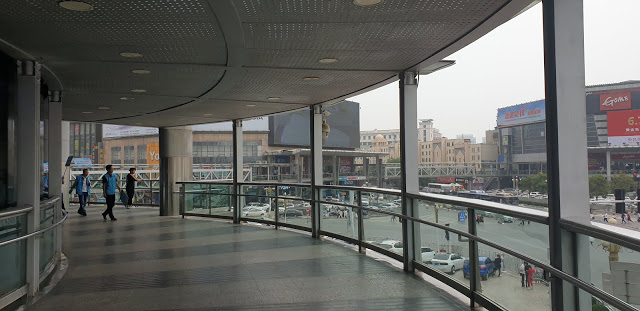
Around the outside of two-thirds of the square, and crossing the roads, was an elevated walkway, which if you go from the first shops and around to the other end, you finish up, on the ground level, at Starbucks.
This is the Chinese version and once you get past the language barrier, the mixology range of cold fruity drinks are to die for, especially after all that walking. Mine was a predominantly peach flavor, with some jelly and apricot at the bottom. I was expecting sliced peaches but I prefer and liked the apricot half.
A drink and fruit together was a surprise.
Then it was the walk back to the meeting point and then into the hotel to use the happy house before rejoining the kamikaze traffic.
We are taken then to the train station for the 2:29 to our next destination, Suzhou, the Venice of the East.
This book has been written for some time and the manuscript was sitting in a box with half a dozen others gathering dust and not quite as complete, so this month it is going to get the makeover, a first draft for the editor.
And so it begins…
…
No, no, no, no, no No.
…
You know how it is when a brilliant plot line comes to you in the middle of the night, when you’re half asleep, after a long day of writing.
A long day maybe, but not much writing, because the current plot line heading towards the end doesn’t gel.
I write a page or three, toss it. Another page, toss it. Another two pages, toss it.
Damn, damn, damn, damn, damn.
Another secondary character wants to come out and play a bigger part, except that to do this I have to go back and seed a few pointers so that the revelation doesn’t seem skewed, or worse, coming out of nowhere.
No sleep tonight, have to sow the seeds while it’s fresh in my mind.
Seriously, with only seven days to go and this pops into my head?
This book has been written for some time and the manuscript was sitting in a box with half a dozen others gathering dust and not quite as complete, so this month it is going to get the makeover, a first draft for the editor.
And so it begins…
…
No, no, no, no, no No.
…
You know how it is when a brilliant plot line comes to you in the middle of the night, when you’re half asleep, after a long day of writing.
A long day maybe, but not much writing, because the current plot line heading towards the end doesn’t gel.
I write a page or three, toss it. Another page, toss it. Another two pages, toss it.
Damn, damn, damn, damn, damn.
Another secondary character wants to come out and play a bigger part, except that to do this I have to go back and seed a few pointers so that the revelation doesn’t seem skewed, or worse, coming out of nowhere.
No sleep tonight, have to sow the seeds while it’s fresh in my mind.
Seriously, with only seven days to go and this pops into my head?
A convoluted explanation on the reasons for this memorial came down to it being about the deaths of those involved in the 1923 Erqi strike, though we’re not really sure what the strike was about.
So, after a little research, this is what I found:
The current Erqi Tower was built in 1971 and was, historically, the tallest building in the city. It is a memorial to the Erqi strike and in memory of Lin Xiangqian and other railway workers who went on strike for their rights, which happened on February 7, 1923.
It has 14 floors and is 63 meters high. One of the features of this building is the view from the top, accessed by a spiral staircase, or an elevator, when it’s working (it was not at the time of our visit).
There seems to be an affinity with the number 27 with this building, in that
It’s the 27th memorial to be built
to commemorate the 27th workers’ strike
located in the 27th plaza of Zhengzhou City.
We drive to the middle of the city where we once again find traveling in kamikaze traffic more entertaining than the tourist points
When we get to the drop-off spot, it’s a 10-minute walk to the center square where the tower is located on one side. Getting there we had to pass a choke point of blaring music and people hawking goods, each echoing off the opposite wall to the point where it was deafening. Too much of it would be torture.
But, back to the tower…
It has 14 levels, but no one seemed interested in climbing the 14 or 16 levels to get to the top. The elevator was broken, and after the great wall episode, most of us are heartily sick of stairs.
The center square was quite large but paved in places with white tiles that oddly reflected the heat rather than absorb it. In the sun it was very warm.
Around the outside of two-thirds of the square, and crossing the roads, was an elevated walkway, which if you go from the first shops and around to the other end, you finish up, on the ground level, at Starbucks.
This is the Chinese version and once you get past the language barrier, the mixology range of cold fruity drinks are to die for, especially after all that walking. Mine was a predominantly peach flavor, with some jelly and apricot at the bottom. I was expecting sliced peaches but I prefer and liked the apricot half.
A drink and fruit together was a surprise.
Then it was the walk back to the meeting point and then into the hotel to use the happy house before rejoining the kamikaze traffic.
We are taken then to the train station for the 2:29 to our next destination, Suzhou, the Venice of the East.
The Henan Museum is one of the oldest museums in China. In June 1927, General Feng Yuxiang proposed that a museum be built, and it was completed the next year. n 1961, along with the move of the provincial capital, Henan Museum moved from Kaifeng to Zhengzhou.
It currently holds about 130,000 individual pieces, more of which are mostly cultural relics, bronze vessels of the Shang and Zhou Dynasties, and pottery and porcelain wares of the various dynasties.
Eventually, we arrive at the museum and get off the bus adjacent to a scooter track and despite the efforts of the guide, there’s no stopping them from nearly running us over.
We arrive to find the museum has been moved to a different and somewhat smaller building nearby as the existing, and rather distinctively designed, building is being renovated.
While we are waiting for the tickets to enter, we are given another view of industrial life in that there is nothing that resembles proper health and safety on worksites in this country, and the workers are basically standing on what looks to be a flimsy bamboo ladder with nothing to stop them from falling off.
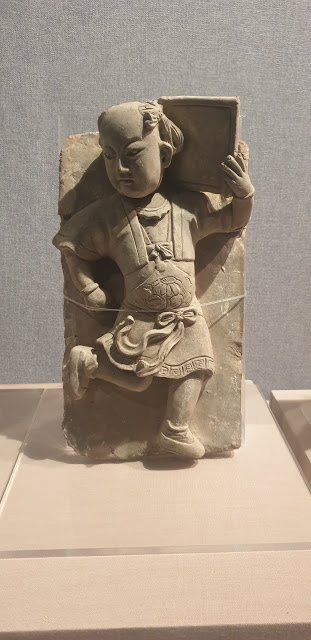
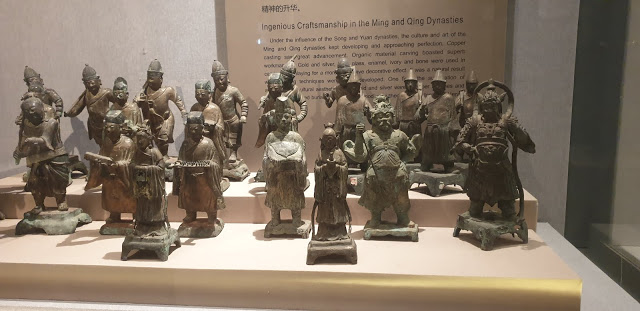
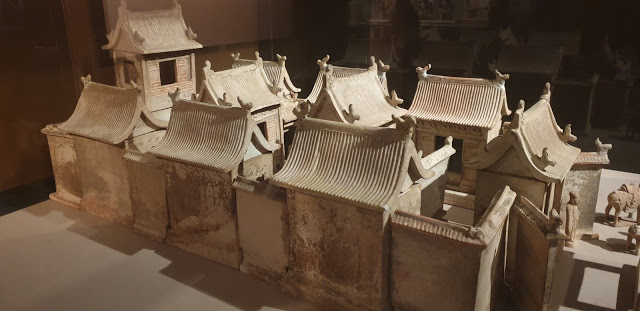
The museum itself has exhibits dating back a few thousand years and consist of bronze and ceramic items. One of the highlights was a tortoiseshell with reportedly the oldest know writing ever found.
Other than that it was a series of cooking utensils, a table, and ceramic pots, some in very good condition considering their age.





 Thrills, Spills, and just a dash of Romance