In a word: Order

I gave the order to my assistant to order the supplies we needed in order to maintain stock levels.

Oh, yes, the word order is one of my favourites, because it can confuse the hell out of many people in its simplicity and yet complexity.

I gave the order, it’s what happens in the armed forces, and a lot of other places, but mostly we would associate it with organisations that have hierarchical authority.

The military, for one, cut orders, the means of sending one of its minions to another place, or to do a specific job.

Order supplies, well, just about anyone can order something from somewhere, usually on the internet, and sometimes require or are given an order number so it can be tracked.

In order to maintain, in order to get what I want, in order to get elected, this is just another way of using the word, with the aim of achieving something, though I’m sure there’s probably a better way of expressing these sentiments.

Law and order, well, doesn’t everyone want this, and doesn’t it always turn up in an election campaign, and seems to be the first thing sacrificed after the election.  The thing is, no one can guarantee law and order.

There is the law and there is administering it.  There is no order that comes with it, we just hope that order is maintained, and deplore the situation when it isn’t.

Perhaps in order to maintain law and order, we might need more police.

Then, of course, there is alphabetical order, and numerical order, where things can be designated from A to Z, like this challenge, or from 1 to 10, or more.  We can sort words alphabetically, numbers numerically and data items by keys or an index.

This is naturally called a sort order.

Then there is my car, or bike, or washing machine, or mixmaster.  They are currently in good working order, though that might not last.

And lastly, in deference to all those out there who are thinking of becoming dictators, it’s always possible, one day, there will be a new world order.  They might actually be in their own particular order, whose intellect might be (?) of the highest order.

Surely that is one order too many.
In a word: Rabbit

Have you ever heard of someone rabbiting on, you know, endlessly rattling on about nothing?

That’s just one use of the word rabbit.

The most obvious is the animal, a rabbit.  You know, that burrowing, plant-eating, long-eared, short-tailed animal that goes by the name of Bugs Bunny, maybe.

Nearly every child has a stuffed, cuddly one.

Of course, it’s of some significance at the moment because its Easter, and that there are countless chocolate versions of the so-called Easter bunny.

Then there is that 6-foot high invisible rabbit called Harvey, or not necessarily a rabbit, but a pookah.

We use the expression rabbit ears to describe those old interior television antennas.

There’s rabbit stew, rabbit pie, and white rabbit beer.

But my favourite is when the magician pulls the proverbial rabbit out of a hat.  It’s an expression we also use for someone who pulls off an impossible task.

Searching for locations: Auckland, New Zealand, a rare day for the port

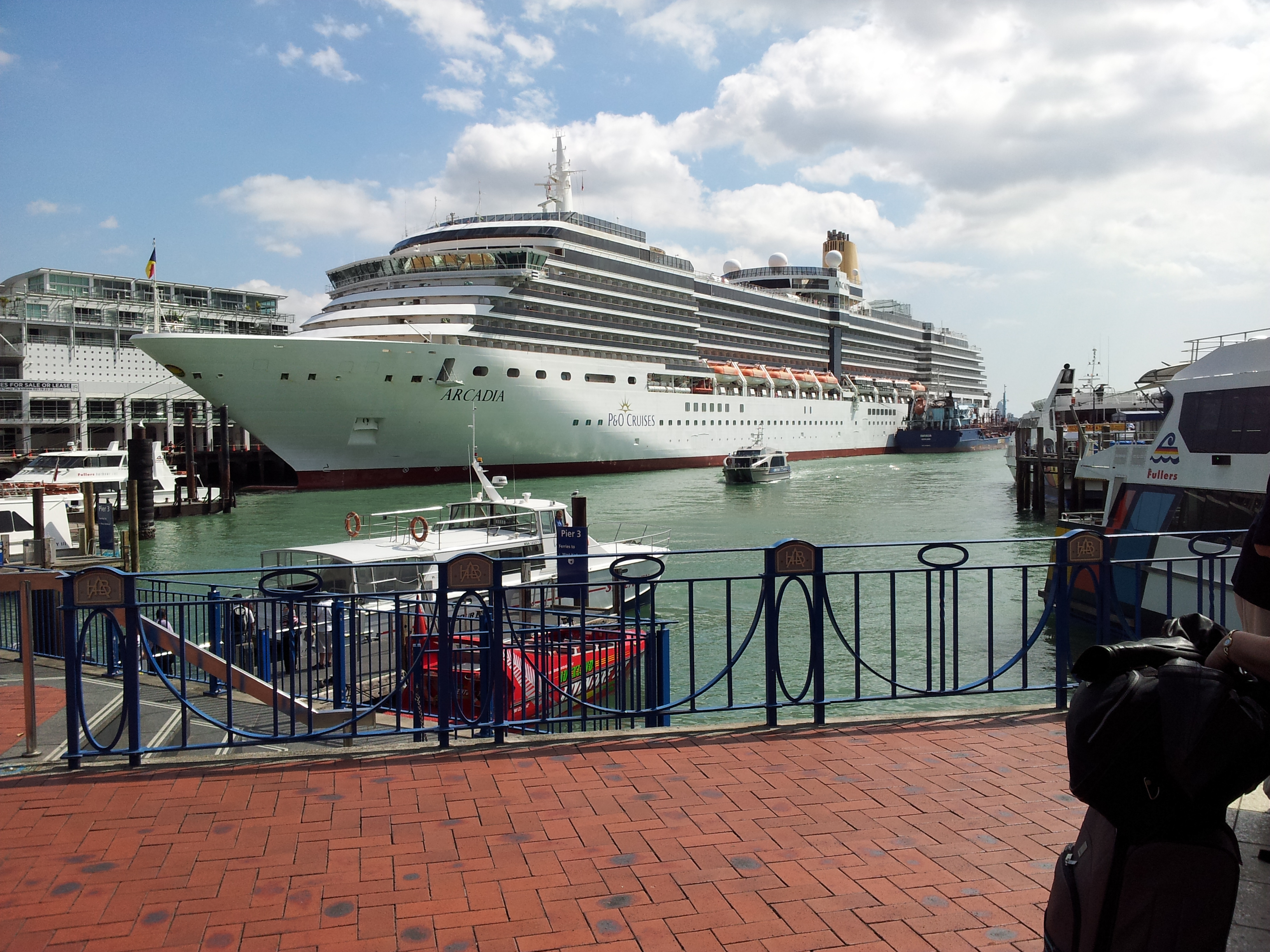
We were staying at the Hilton and advised there would be a large cruise liner berthing next to the hotel.  There was the Arcadia.

2013-03-08 11.51.48

This is the view from the other side of the hotel.  Where our room was, we could almost walk onto the aft end of the ship.

We were also told this was a rather extraordinary day because there were two cruise ships in the port. particularly because it was near the end of the cruising season.

The other ship was two berths along, the Sun Princess.

2013-03-08 11.56.17

Not as big as the Arcadia, up close it was still very impressive.

Searching for locations: The Mary Valley Rattler, Gympie, Queensland, Australia

I have a passion for visiting transport museums, to see old trains, planes, buses, cars, even ships if it’s possible.

This has led to taking a number of voyages on the TSS Earnslaw in Queenstown, New Zealand.

Many, many, many years ago on Puffing Billy, a steam train in the Dandenongs, Victoria, Australia.

The steam train in Kingston, New Zealand, before it was closed down, but hopefully it will reopen sometime in the future.

The London Transport Museum in London England, which had a lot of buses.

The Workshops Railway Museum in Ipswich, Queensland, where once the many steam engines were built and maintained, and now had only a handful of engines remaining.

However, in the quest for finding and experiencing old transportation methods, we came across the Mary Valley Rattler, which runs out of Gympie, Queensland, Australia.

The ride begins in Gympie at the old Gympie Railway station, and as can be seen below, is one of the relics of the past, and, nothing like the new more modern stations.  Thankfully.

If you’re going to have a vintage train, then you have to have a vintage station.

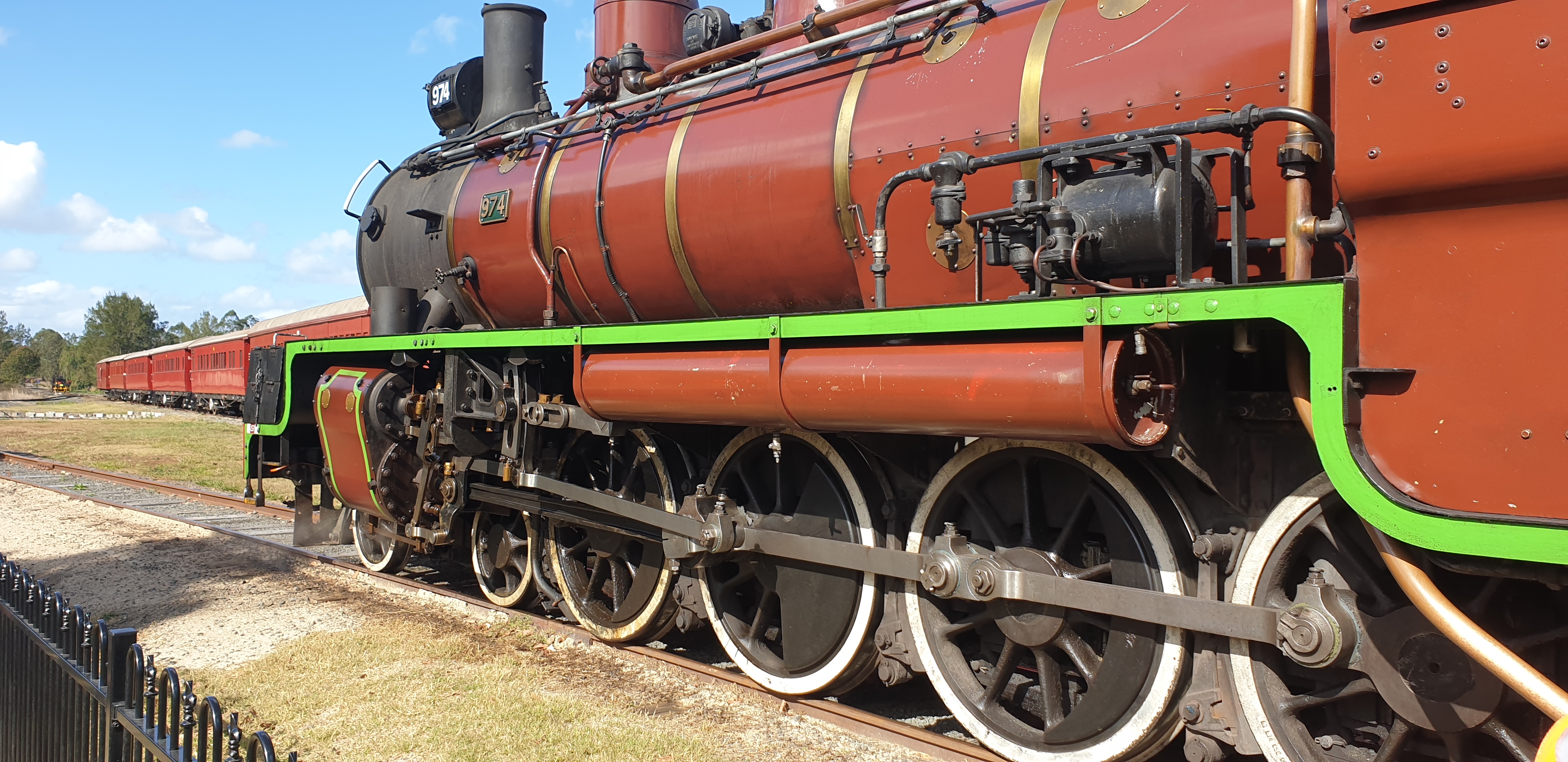
The Class of engine, seen below, is the C17, a superheated upgrade to the C16 it was based on, and first run in 1903.  This particular engine was built in 1951, although the first of its type was seen in  1920 and the last of 227 made in 1953.  It was the most popular of the steam engines used by Queensland Railways.

The C designation meant it had four driving axels and 17 was the diameter of the cylinder, 17 inches.  It is also known as a 4-8-0 steam locomotive
 and nicknamed one of the “Brown Bombers” because of its livery, brown with green and red trimming.

Also, this engine was built in Maryborough, not far from Gympie by Walkers Limited, one of 138.

This photo was taken as the train returned from Amamoor, a trip that takes up to an hour.

The locomotive is detached from the carriages, then driven to the huge turntable to turn around for the return journey to Amamoor.

This is the locomotive heading down to the water station, and then taking on water.  After that, it will switch lines, and reverse back to reconnect the carriages for the trip to Amamoor.

The carriages are completely restored and are extremely comfortable.  It brings back, for me, many memories of riding in older trains in Melbourne when I was a child.

The trains, then, were called Red Rattlers.

This is the locomotive climbing one of the hilly parts of the line before crossing over the Mary River on a trestle bridge.

This is the engine at Amamoor near the picnic area where young children and excited parents and grandparents can get on the locomotive itself and look inside where the driver sits.

And, no, I didn’t volunteer to shovel coal.

This particular locomotive spent most of its working life between Townsville and Mount Isa and was based in Cloncurry, Charters Towers, and Townsville, before being sent, at the end of its useful days in the late 1960s, to the Ipswich Railway Workshops.

In a word: well

At first, you would think this word has something to do with your health.

You’d be right.  “Are you well?” or “Are you well enough?”

Of course, it can cause some confusion, because how do you measure degrees of wellness.

Reasonably well, very well, not well, or just well.  Not a good descriptive word for the state of your health, maybe.

How about what if the team played well.  Not health this time, but a standard.

There’s ordinary, mediocre, as a team, brilliantly, and then there’s well.

It seems it can be used to describe an outcome.

Well, well.

Hang on, that’s something else again.

What about, then, we use the word to describe a hole in the ground with water at the bottom.

Or not if it is a drought.

A lot of people get water from a well, in fact in the olden days that was a common sight in a village.

What about those environment destroyers, oilmen.  They have oil wells, don’t they?

And when I went to school, there were ink wells on every desk.

Messy too, because I was once the ink monitor.

But if the well’s dried up?

It becomes a metaphor for a whole new bunch of stuff.

OR what about a stairwell?

And at the complexity of it all, for such a small word, tears well up in my eyes.

In a word: Choice

We are often told that it’s the choices we make that shape our lives.

It’s true.

What distinguishes the basis of those choices is the circumstances of the individual.

What a lot of people don’t realize is the diversity of backgrounds of everyone, and that in a minority of cases, the few that really have no choices at all.

Yes, there are those who have no control over their circumstances, and therefore no choice whatsoever.

Inevitably, the people who are first to criticize those who apparently made the wrong choice, are those that have never found themselves in similar circumstances.

And probably never will.

This perhaps is the biggest problem with governments who are staffed with advisors who do not understand the plight of the common man.

I never had the same opportunities as those who could afford a university education.  My family were working class and were relatively poor.  Had I not hot a scholarship who knows what sort of education I would have got, if any.

Certainly, my father never got an opportunity to get a good education, but, at the time, during the great depression, his choices were limited, whereas those with any sort of wealth it was a different story.

And his lack of choices reflected on us, and that lack of opportunity haunted all of us as time passed.

It was always a case of the haves and the have not’s.

Yes, we all have choices, but sometimes it really is the lesser of two evils, and not whether we will have the fillet or the rib eye steak.

In a word: Choice

We are often told that it’s the choices we make that shape our lives.

It’s true.

What distinguishes the basis of those choices is the circumstances of the individual.

What a lot of people don’t realize is the diversity of backgrounds of everyone, and that in a minority of cases, the few that really have no choices at all.

Yes, there are those who have no control over their circumstances, and therefore no choice whatsoever.

Inevitably, the people who are first to criticize those who apparently made the wrong choice, are those that have never found themselves in similar circumstances.

And probably never will.

This perhaps is the biggest problem with governments who are staffed with advisors who do not understand the plight of the common man.

I never had the same opportunities as those who could afford a university education.  My family were working class and were relatively poor.  Had I not hot a scholarship who knows what sort of education I would have got, if any.

Certainly, my father never got an opportunity to get a good education, but, at the time, during the great depression, his choices were limited, whereas those with any sort of wealth it was a different story.

And his lack of choices reflected on us, and that lack of opportunity haunted all of us as time passed.

It was always a case of the haves and the have not’s.

Yes, we all have choices, but sometimes it really is the lesser of two evils, and not whether we will have the fillet or the rib eye steak.

Is social media useful for advertising?

Of course, if I had I might be saying that it was luck

But…

There’s no such thing as luck, there’s simply good management or being in the right place at the right time.

Or you’ve just put a lot of research and hard work into an idea that pays off.

That’s not luck, that’s something else.

I say this because I have never been on the receiving end of good fortune very often, except, as you would expect, as the result of hard work.  And yes, everything appears to conspire against me some days, but I would not call that bad luck.

Timing, quite often, is everything.

So…

I’ve been researching the internet and the world of social media. So many people make claims about how good it is, how bad it is, how they made a fortune, and how, for others, it’s a dud.

Again, it’s about good management, hard work, or being in the right place, etc.

And viral stuff on YouTube, well, if it goes viral with a million hits in fifteen minutes, it means everybody, in that fifteen minutes, was looking for something interesting at that particular moment, and there it was.

It was not luck.

However…

Using either of Facebook or Twitter as a means to advertise, without parting with your hard earned, or more likely, non-existent cash, is not all it’s cracked up to be.

You have 17,000 followers, that means you have at least 17,000 people who are going to see your post.  Or someone else’s if you are thinking of getting people to market their product on the back of your followers, hang on, targeted followers.  If, say, for instance, you’re followers are book orientated, doesn’t that mean…

You get my point.

Wrong.

You’re lucky if 5% of those followers see anything, and that doesn’t increase by putting a lot of different tags on the post.  Twitter itself is restrictive in the number of people it will distribute the post to.

Five per cent, that’s 850 of your followers who may see any one of your posts at the one time.  other people have done vari0ous tests to check just who gets a post and who doesn’t, so it’s not just me who had noted what’s happening.

Then there’s the take-up rate, which Twitter does tell you, in my case, it’s about 2% at it’s lowest, which means the effective number of real peal people looking at my posts with any interest, is about 17.

It can be more, though I’m not sure how the Twitter algorithm for distributing posts works.  I’ve seen other people get thousands of likes and re-tweets.

And, yes, I get it, their posts might be more interesting than mine, and I accept that, but the numbers I’ve been tracking don’t lie.  If more people saw the tweet, the curiosity factor would be higher, and at the very least, the click-through rate would be higher.

That it isn’t can be verified from checking with the number of clicks on the bitly web site for the day, even over a number of days, in the basic statistics they provide their users.

I’m just saying…

All of those people who say they have thousands, sometimes tens of thousands, of followers just waiting for you to advertise with them, cannot deliver any sort of mass advertising you need, and even if they were to pay to advertise with Twitter, they would have to charge very exorbitant prices.

You can do it yourself, but there’s no guarantee your tweet will read by the people you need to buy your book.

It’s what I would call a shot in the dark.

So…

What do we do?

Anyone else done this exercise and come up with different results?  If you have I’d be interested to know what sort of responses you are getting from Twitter, or Facebook, or any other social media platform.

Preferably before I pull all my hair out in frustration!


Searching for locations: West Lake, Hangzhou, China

West Lake is a freshwater lake in Hangzhou, China. It is divided into five sections by three causeways. There are numerous temples, pagodas, gardens, and artificial islands within the lake.

Measuring 3.2 kilometers (2 miles) in length, 2.8 kilometers (1.7 miles) in width, and 2.3 meters (7.5 feet) in average depth, the lake spreads itself in an area totaling 6.5 square kilometers (2.5 square miles).

The earliest recorded name for West Lake was the “Wu Forest River”, but over time it changed to two distinct names.  One is “Qiantang Lake”, due to the fact that Hangzhou was called “Qiantang” in ancient times.  The other, “West Lake”, due to the lake being west of the city

It’s about to get busy, with a number of activities planned, and the warmth of the day is starting to make an impact.

The tour starts in the car park about a kilometer away, but the moment we left the car park we were getting a taste of the park walking along a tree-lined avenue.

When we cross the road, once again dicing with death with the silent assassins on motor scooters.

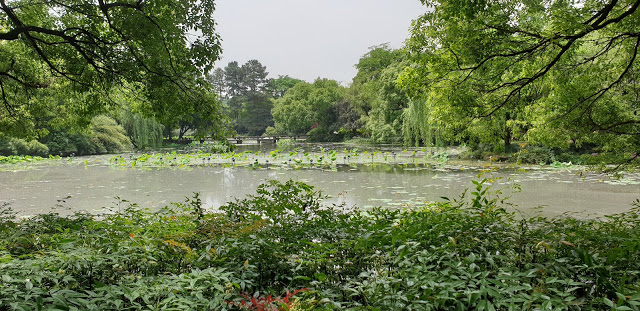
We are in the park proper, and it is magnificent, with flowers, mostly at the start hydrangeas and then any number of other trees and shrubs, some carved into other flower shapes like a lotus.

Then there was the lake and the backdrop of bridges and walkways.

.

And if you can tune out the background white noise the place would be great for serenity and relaxation.

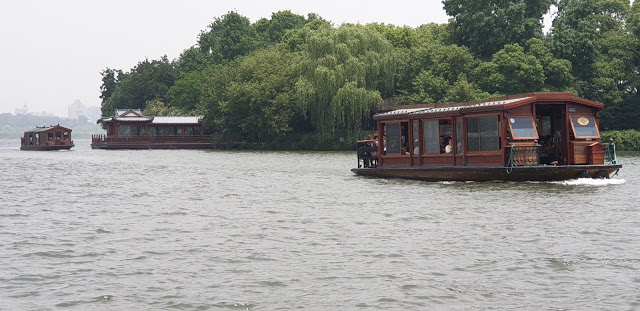
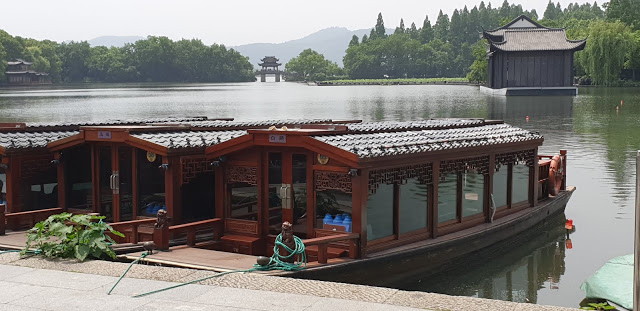
That, in fact, was how the boat ride panned out, about half an hour or more gliding across the lake in an almost silent boat, by an open window, with the air and the majestic scenery.

No, not that boat, which would be great to have lunch on while cruising, but the boat below:

Not quite in the same class, but all the same, very easy to tune out and soak it in.

It was peaceful, amazingly quiet, on a summery day

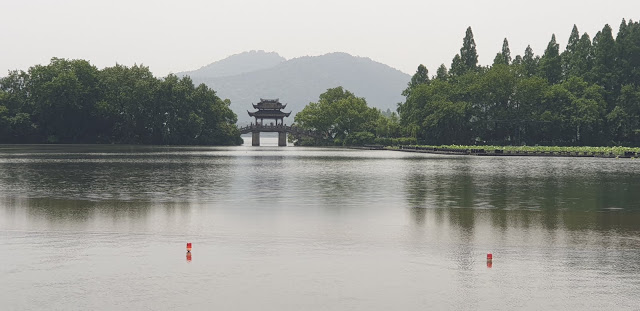
A pagoda in the hazy distance, an island we were about to circumnavigate.

Of all the legends, the most touching one is the love story between Bai Suzhen and Xu Xi’an. Bai Suzhen was a white snake spirit and Xu Xi’an was a mortal man.

They fell in love when they first met on a boat on the West Lake, and got married very soon after.

However, the evil monk Fa Hai attempted to separate the couple by imprisoning Xu Xi’an. Bai Suzhen fought against Fa Hai and tried her best to rescue her husband, but she failed and was imprisoned under the Leifeng Pagoda by the lake.

Years later the couple was rescued by Xiao Qing, the sister of Baisuzhen, and from then on, Bai Suzhen and Xu Xi’an lived together happily.

The retelling of the story varied between tour guides, and on the cruise boat, we had two.  Our guide kept to the legend, the other tour guide had a different ending.

Suffice to say it had relevance to the two pagodas on the far side of the lake.

There was a cafe or restaurant on the island, but that was not our lunch destination.

Nor were the buildings further along from where we disembarked.

All in all the whole cruise took about 45 minutes and was an interesting break from the hectic nature of the tour.

Oh yes, and the boat captain had postcards for sale.  We didn’t buy any.

Lunch

At the disembarkation point there was a mall that sold souvenirs and had a few ‘fast food’ shops, and a KFC, not exactly what we came to China for, but it seemed like the only place in town a food cautious Australian could eat at.

And when tried to get in the door, that’s where at least 3 busloads were, if they were not in the local Starbucks.  Apparently, these were the places of first choice wherever we went.

The chicken supply by the time we got to the head of the line amounted to pieces at 22.5 RMB a piece and nuggets.  Everything else had run out, and for me, there were only 5 pieces left.  Good thing there were chips.

And Starbucks with coffee and cheesecake.

At least the setting for what could have been a picnic lunch was idyllic.

Is social media useful for advertising?

Of course, if I had I might be saying that it was luck

But…

There’s no such thing as luck, there’s simply good management or being in the right place at the right time.

Or you’ve just put a lot of research and hard work into an idea that pays off.

That’s not luck, that’s something else.

I say this because I have never been on the receiving end of good fortune very often, except, as you would expect, as the result of hard work.  And yes, everything appears to conspire against me some days, but I would not call that bad luck.

Timing, quite often, is everything.

So…

I’ve been researching the internet and the world of social media. So many people make claims about how good it is, how bad it is, how they made a fortune, and how, for others, it’s a dud.

Again, it’s about good management, hard work, or being in the right place, etc.

And viral stuff on YouTube, well, if it goes viral with a million hits in fifteen minutes, it means everybody, in that fifteen minutes, was looking for something interesting at that particular moment, and there it was.

It was not luck.

However…

Using either of Facebook or Twitter as a means to advertise, without parting with your hard earned, or more likely, non-existent cash, is not all it’s cracked up to be.

You have 17,000 followers, that means you have at least 17,000 people who are going to see your post.  Or someone else’s if you are thinking of getting people to market their product on the back of your followers, hang on, targeted followers.  If, say, for instance, you’re followers are book orientated, doesn’t that mean…

You get my point.

Wrong.

You’re lucky if 5% of those followers see anything, and that doesn’t increase by putting a lot of different tags on the post.  Twitter itself is restrictive in the number of people it will distribute the post to.

Five per cent, that’s 850 of your followers who may see any one of your posts at the one time.  other people have done vari0ous tests to check just who gets a post and who doesn’t, so it’s not just me who had noted what’s happening.

Then there’s the take-up rate, which Twitter does tell you, in my case, it’s about 2% at it’s lowest, which means the effective number of real peal people looking at my posts with any interest, is about 17.

It can be more, though I’m not sure how the Twitter algorithm for distributing posts works.  I’ve seen other people get thousands of likes and re-tweets.

And, yes, I get it, their posts might be more interesting than mine, and I accept that, but the numbers I’ve been tracking don’t lie.  If more people saw the tweet, the curiosity factor would be higher, and at the very least, the click-through rate would be higher.

That it isn’t can be verified from checking with the number of clicks on the bitly web site for the day, even over a number of days, in the basic statistics they provide their users.

I’m just saying…

All of those people who say they have thousands, sometimes tens of thousands, of followers just waiting for you to advertise with them, cannot deliver any sort of mass advertising you need, and even if they were to pay to advertise with Twitter, they would have to charge very exorbitant prices.

You can do it yourself, but there’s no guarantee your tweet will read by the people you need to buy your book.

It’s what I would call a shot in the dark.

So…

What do we do?

Anyone else done this exercise and come up with different results?  If you have I’d be interested to know what sort of responses you are getting from Twitter, or Facebook, or any other social media platform.

Preferably before I pull all my hair out in frustration!