The Yu Gardens (or Yuyuan Gardens) are located at No. 137, Anren Street, Huangpu District, very close to the Old City God Temple, in the northeast of the Old City of Shanghai at Huangpu.
Yu Garden was first built in 1559 during the Ming Dynasty by Pan Yunduan and finished approximately 1577, created specifically as a private garden of the Pan family for Pan Yunduan’s parents to enjoy in their old age.
Yu Garden occupies an area of 5 acres, and is divided into six general areas:
-Sansui Hall which includes the Grand Rockery was originally used to entertain guests,
-Wanhua Chamber is a delicate building surrounded by derious cloisters,
-Dianchun Hall, built in 1820, includes Treasury Hall and the Hall of Harmony,
-Huijing Hall which includes Jade Water Corridor.
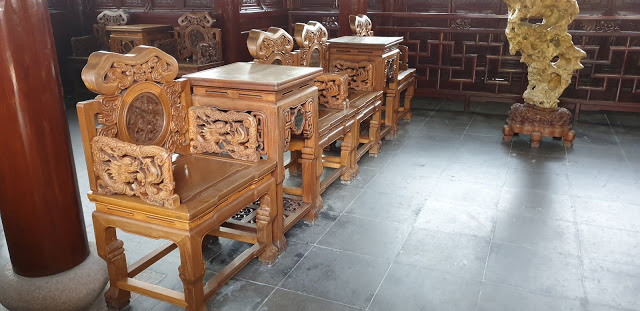
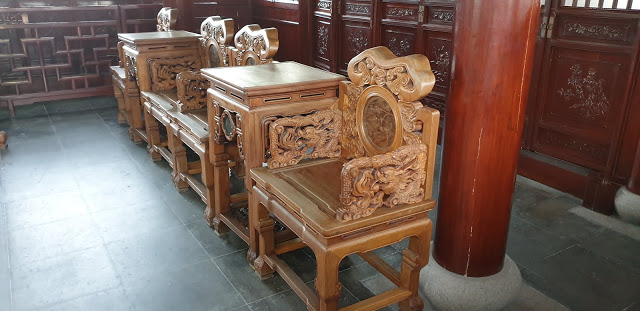
-Yuhua Hall which is furnished with rosewood pieces from the Ming Dynasty, and,
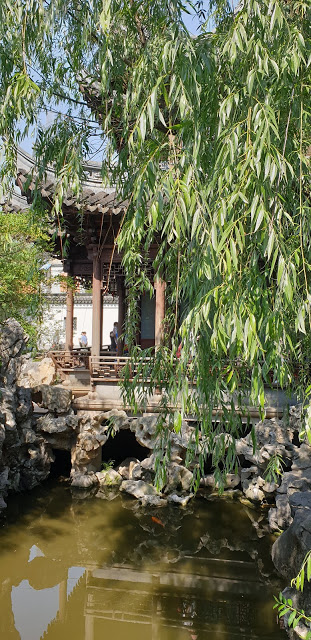
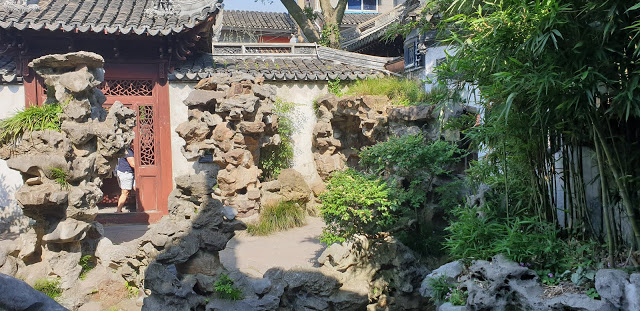
-The Inner Garden with rockeries, ponds, pavilions, and towers; first laid out in 1709. As the quietest part of Yu Gardens, it includes the Hall of Serenity and the Acting and Singing Stage.
The Mid-Lake Pavilion Teahouse, within the gardens, is the oldest teahouse in Shanghai.
A centerpiece of the gardens is the Exquisite Jade Rock, a 5-ton boulder that was originally meant for the Huizong Emperor (Northern Song Dynasty from 1100-1126 AD) but was salvaged from the Huangpu River after the boat carrying it had sunk.
These gardens house a lot of buildings that seemed to be a perfect blend of the old and the new, and if it was up to me, I’d keep the old. Both the building and the gardens they are set in are like an oasis in the middle of an industrial complex, and perhaps impractical for the number of people living in Shanghai.
All of the ponds had a lot of fish in them
It was a pleasant afternoon, for both a stroll through the gardens
In and out of the rockery on narrow pathways
And to look inside the buildings that were sparsely furnished
There was even an area set aside for entertainment.
**Please don’t assume that you have to, nor would I ever expect you to, read any or all of these books. You don’t.**
Everyone, it seems, will publish what they call the top 100 books that you should read. Some are voted on, some belong to the opinion of the editor of the book review section of a newspaper, and, as you know, there are a lot of newspapers, a lot of editors, and a lot of opinions.
I’m not a newspaper, I’m not an editor, but I have a list, based on personal experience, and many, many years of reading.
It’s in no particular order.
41. The Hound of the Baskervilles by Sir Arthur Conan Doyle, as well as a host of other Sherlock Holmes stories
42. The Secret Agent by Joseph Conrad, one of Conrad’s later political novels, set in London in 1886 and deals with anarchism and espionage. In those days spies were called anarchists.
43. The Ipcress File by Len Deighton, introducing us to Harry Palmer, who was personified by Michael Caine and led to Horse Under Water, and Funeral in Berlin. More of Len Deighton later on in the list
44. The Remorseful Day by Colin Dexter introducing the somewhat enigmatic detective, Morse, his first name not revealed for a long time but oddly, Endeavour. John Thaw brought him to life
45. Crime and Punishment by Fyodor Dostoevsky, hard to pronounce and even harder to read, but perhaps worth it in the end. By the time I read this I was wishing for a Russian writer had could use an economy of words
46. Dr. Zhivago by Boris Pasternak wasn’t it. A vast and lengthy dissertation on lost love, I felt very sad for Zhivago in the end. I saw a stage play of the same name, and I’m sorry, but it’s a few hours of my life I will never get back
47. Casino Royale, the first of the James Bond novels by Ian Fleming. I have to say these are among my favorite spy books. I must say I preferred the new James Bond in Casino Royale, though Sean Connery still rules!
48. The Day of the Jackal by Frederick Forsythe, a fascinating story about an assassin
49. Anything written by John Le Carre, but in particular, the George Smiley collection. Finally unmasking his nemesis the Russian spymaster made it all so satisfying.
50. The Bourne Identity by Robert Ludlam, inspiring a long series by both Ludlam and Eric Lustbader makes entertaining reading, but the first, the man who did not know who or what he really was, was excellent. Matt Damon didn’t harm his persona either.
51. Murder Must Advertise by Dorothy Sayers, whose detective is Lord Peter Whimsey, a 1933 mystery novel that’s eighth in the series
52. Gorky Park by Martin Cruz Smith. You have to admit that his Russian detective Arkady Renko is up against it when his investigation goes in a direction that uncovers corruption and dishonest in his superiors
53. The Way of All Flesh by Samuel Butler, a semi-autobiographical novel written between 1987 and 1884, and published in 1903. The story of the Pontifex family.
54. Howards End by E. M. Forster, first published in 1910, is an interesting insight into the behavior of the, and between the classes, with the Schlegels acting as the catalyst.
55. Washington Square by Henry James, originally published as a serial, and covers the conflict between daughter and father. I must say I prefer The Ambassadors to Washington Square.
56. Ulysses by James Joyce, a day in the life of an ordinary man, Leopold Bloom, why could it not be the 7th June rather than the 16th, for obvious reasons
57. The Go-Between by L. P. Hartley is a view of society at the end of the Victorian period through the eyes of a young boy. I read this while still at school and had no clue why, but later, when I read it again, I understood the meaning
58. Atonement by Ian McEwan, I saw the film and then read the book. Never a good idea. Basically, a young girl makes a bad mistake and tries to atone for it.
59. Gone With The Wind by Margaret Mitchell, the War and Peace of Americal novels, and as long by comparison. The only book written by Mitchell, and the second most read book by Americans. The film was interesting but awfully long.
60. The English Patient by Michael Ondaatje, with a man with severe burns and the effect he had on three others. Colin Firth is villain one day and hero the next, this time in the cinematic version, an out and out cad.
To start with, we first joined this tour at stop number 6.
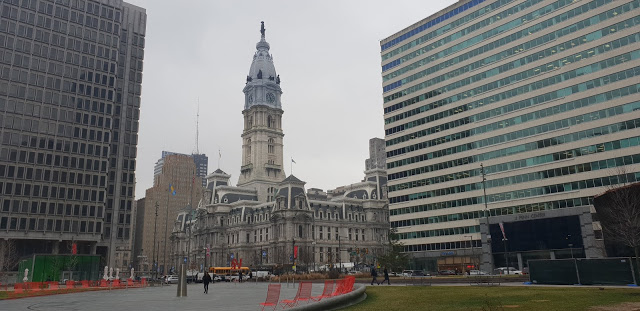
We had to find it first and that meant some pedestrian navigation, which took us first to the City Hall, a rather imposing structure, which we found later had a profound effect on Philadelphia sports teams.
According to the map, stop number 6 is Reading Terminal Market, Convention Centre, on 12th street on Filbert. This was where we bought the tickets and boarded the bus that had a rather interesting guide aboard.
His favorite says was “And we’re good to go.”
Soon we would discover that his commentary was more orientated towards a younger audience, not that it bothered us.
Given the time restraints, we had, this was always going to be about looking and learning.
Stop number 7
City hall, Love Park.
This we had seen on our walk from where we left the car at the Free Library, near the Swann Memorial Fountain in Logan Park, the landmark that Rebecca had remembered from her last visit to Philadelphia. Of course, then, it was not quite so frozen.
Love park, of course, was only notable to us in that it had a sculpture in place with the word Love rather stylized. Apart from that, you’d hardly know it as a park
The city hall, well, that was something else, and when we looked at it, before going on the tour, it was a rather magnificent stone edifice.
After, well the guide filled us in, tallest building, highest and largest monument on William Penn, you get the gist. 37 feet tall, when eclipsed, the Philly sports teams all suffered slumps of one kind or another, until the problem was rectified. Interesting story.
Stop number 8
18th Street and the Benjamin Franklin Parkway, or Logan Circle
This is the location of the Cathedral Basilica of Saints Peter and Paul. A place where the Pope decided to give an audience and sent the city into a spin.
The same church has very high windows for the reason in the early days there was a problem with people wanting to throw Molotov cocktails through the windows. A bit hard when they’re so high up.
Benjamin Franklin Parkway, of course, is interesting in itself as an avenue, not only for all of the flags of many nations of those who chose to live in Philadelphia. We found ours, the one for Australia
This was also the stop where we needed to get off once the tour was finished, and time to head to the car, and go home, but that’s another story.
Stop number 10
Is that the stature of the Thinker, made famous, at least for me, from the old Dobie Gillis episodes, of God knows how many years ago?
Or, maybe it’s just the Rodin Museum on Benjamin Franklin Parkway.
There’s a whole story to go with that Statue and the fact it is one of many all over the world.
This one was made in France, cast in 1919 in Bronze, and is approximately 200cm x 130 cm by 140cm.
Stop number 11
Eastern State Penitentiary. NW corner of 22nd Street and Fairmont Avenue.
This had a rather interesting story attached to it and had something to do with ghosts, but I wasn’t listening properly to the guide’s monologue.
But, later research shows, the fact it was once the most famous and expensive prison in the world. Many also think it is haunted and is a favorite for visiting paranormal visitors.
Built around 1829, it was the first prison to have separate cells for prisoners. It held, at various times, the likes of Al Capone and Willie Sutt
Stop number 18
The Philadelphia Museum of art, where we stop for a few minutes and look at the steps which were immortalized in the movie Rocky, yes he ran god knows how far to end up on the top of these steps.
Sorry, but I’m not that fit that I would attempt walking up them. The view is just fine from inside the bus. Of course, they might consider cleaning the windows a little so the view was clearer, but because it’s basically Perspex and scratched so that might not be possible.
Stop number 17
Back at Logan Circle, or Square if you prefer, but on the other side, closer to the Franklin Institute. Benjamin Franklin’s name is used a lot in this city.
After that, it’s a blur, the Academy of Music, the University of the Arts, Pennsylvania Hospital, South Street, Vietnam Veterans Memorial, the USS Olympia, Penn’s Landing, and past the National Liberty Museum. I’m sure somewhere in that blur was the intention of seeing the Liberty Bell, but I think I heard that it was not on show, and only a replica could be seen.
So much for the getting as an opportunity to see the real liberty bell, crack and all..
We get off and stop number 27, or Number 1, I was not quite sure.
What were we after? The definitive Philly Cheese Steak.
Simply because I want you to wait here while I go down the shops.
How long will that be?
I don’t know. A while. Anything from half an hour to a lifetime.
Then there’s another way of using the word: While I do this can you do that.
This is more definite but still ambiguous. How long will that be?
As long as it takes. Anything from half an hour to a lifetime.
it is by definition, a period of time.
Then it gets more ambiguous, in that the arrangements say in place while he is alive.
Being a murder mystery writer and reader, it becomes a sufficient reason to kill a wealthy relative to get their inheritance. But, if murder is not in mind, then it can be anything from a half-hour to a lifetime!
Less of an enigma is this use of the word: I’m going the while away the time playing computer games.
At least you know how long that’s going to be, i.e. till you get bored.
This is not to be confused with the word wile, which means to use a cunning or devious means to get someone to do your bidding.
We’ve all heard of feminine wiles. Granddaughters are experts in using them, I can personally attest to that.
There are other meanings but these are no longer used in modern English.
The architecture along the Bund or Waitan is a living museum of the colonial history of the 1800s. The area centers on a section of Zhongshan Road within the former Shanghai International Settlement.
The word bund means an embankment or an embanked quay. It was initially a British settlement; later the British and American settlements were combined in the International Settlement.
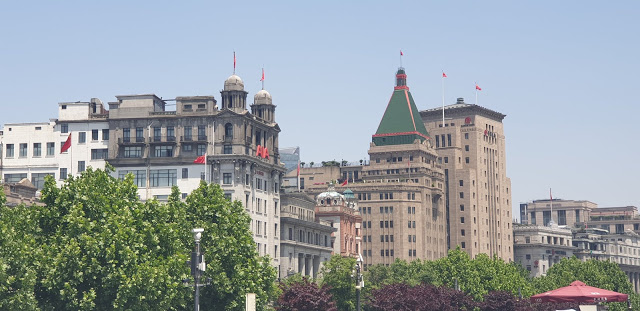
The Bund is a mile-long stretch of waterfront promenade along the Huangpu River. There are 52 buildings of various architectural styles, including Gothic, baroque, and neoclassical styles. The area is often referred to as “the museum of buildings”.
Building styles include Romanesque Revival, Gothic Revival, Renaissance Revival, Baroque Revival, Neo-Classical or Beaux-Arts, as well as a number in Art Deco style.
Having seen these buildings initially the night before, mostly lit up, our viewing this morning was from the land side, and particularly interesting in that the colonial architecture was really fascinating considering their location, but not surprising given Shanghai’s history. A lot of these buildings would be more at home in London, that out in the far east.
The Bund waterfront is about two kilometers long and impossible to cover in the time allowed for this part of the tour.
There was just enough time to get photos of the waterfront and the old buildings.
Some of these buildings had odd shapes, like one on the far right that looks like a bottle opener.
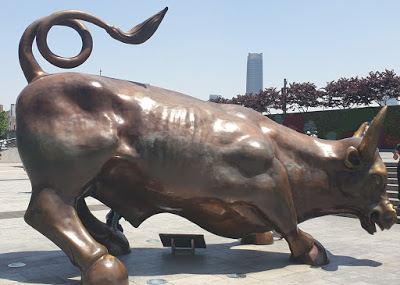
And, for some odd reason, a bull.
On the other side of the water, the sights that had been quite colorful the night before, were equally impressive though somewhat diminished by the haze.
So, the first treat for the day is the high-speed magnetic train, something we only learned about after arriving in China and was not on any of the pre-tour documentation.
The train line connects Shanghai Pudong International Airport and Longyang Road Station (in the outskirts of central Pudong). It is the oldest commercial maglev still in operation, and the first commercial high-speed maglev with cruising speed of 431 km/h (268 mph). At full speed, the journey takes 7 minutes and 20 seconds to complete the distance of about 30 km.
Construction of the line began on March 1, 2001 and public services commenced on 1 January 2004. It was built by a joint venture of Siemens and ThyssenKrupp from Kassel, Germany.
But, like visiting anything from a hotel, first we have to drive to the station and because we are leaving at 8, its peak hour traffic, and it takes 1 hour 10 minutes to get there.
The train also has a practical use and that is to take passengers from Shanghai to Pudong international airport as well as for those train enthusiasts, which is what we are.
On the train, it has the same sleek look as the bullet trains, but it is completely different, and you are able to see from the front of the train to the back.
Reputed to travel at 431 kph we take a seat and it is not long before the doors shut, and a loud humming noise is soon replaced by what sounds like an engine, then we start moving. It sounds just like a normal train, and is a lot noisier than a normal bullet train.
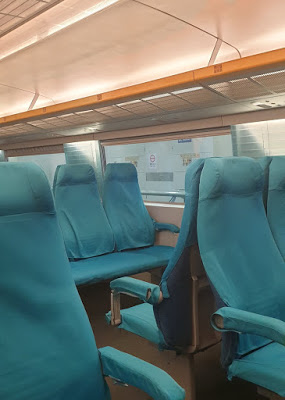
Seating on the train was nothing special, as one might expect
It didn’t take long before it hits the advertised speed of 431 kph. This is not sustained for very long, because the distance is on 40 odd kilometers, and the whole trip takes about 7 minutes.
We go to the airport, and then we come back. Is it worth the price, yes. If you are a train enthusiast.
China is renowned for its exquisite silk, so naturally, a visit to the Silk Spinning Factory is part of today’s tour.
After that, we will be heading downtown to an unspecified location where we’re getting a boat ride, walk through a typical Chinese shopping experience, and coffee at a coffee shop that is doubling as the meeting place, after we soak up the local atmosphere.
The problem with that is that if the entire collective trip a deal tourists take this route then the savvy shopkeepers will jack up their prices tenfold because we’re tourists with money. It’ll be interesting to see how expensive everything is.
So…
Before we reach the silk factory, we are told that Suzhou is the main silk area of China, and we will be visiting a nearly 100 years old, Suzhou No 1 Silk Mill, established in 1926. Suzhou has a 4,700-year history of making silk products. It is located at No. 94, Nanmen Road, Suzhou, Jiangsu, China.
Then we arrive at the Silk Factory, another government-owned establishment with a castiron guarantee of quality and satisfaction.
The look and feel of the doona cover certainly backs up that claim
And the colors and variety is amazing (as is the cost of those exquisite sets)
We get to see the silk cocoon stretched beyond imagination, and see how the silk thread is extracted, then off to the showroom for the sales pitch.
It isn’t a hard sell, and the sheets, doonas, pillows, and pillowcases, are reasonably priced, and come with their own suitcase (for free) so you can take them with you, or free shipping, by slow boat, if you prefer not to take the goods with you.
We opt for the second choice, as there’s no room left in our baggage after packing the Chinese Medicine.
The Henan Museum is one of the oldest museums in China. In June 1927, General Feng Yuxiang proposed that a museum be built, and it was completed the next year. n 1961, along with the move of the provincial capital, Henan Museum moved from Kaifeng to Zhengzhou.
It currently holds about 130,000 individual pieces, more of which are mostly cultural relics, bronze vessels of the Shang and Zhou Dynasties, and pottery and porcelain wares of the various dynasties.
Eventually, we arrive at the museum and get off the bus adjacent to a scooter track and despite the efforts of the guide, there’s no stopping them from nearly running us over.
We arrive to find the museum has been moved to a different and somewhat smaller building nearby as the existing, and rather distinctively designed, building is being renovated.
While we are waiting for the tickets to enter, we are given another view of industrial life in that there is nothing that resembles proper health and safety on worksites in this country, and the workers are basically standing on what looks to be a flimsy bamboo ladder with nothing to stop them from falling off.
The museum itself has exhibits dating back a few thousand years and consist of bronze and ceramic items. One of the highlights was a tortoiseshell with reportedly the oldest know writing ever found.
Other than that it was a series of cooking utensils, a table, and ceramic pots, some in very good condition considering their age.
After leaving the hotel in Zhengzhou, what was once one of the eight ancient capitals of China, we are going to Dengfeng city, and the home of China’s most famous martial art – Shaolin Kung Fu.
The Shaolin Temple nearby is the origin of Chinese Zen Buddhism, and the Songyang Academy, called “the Centre of Heaven and Earth” is located 87 Km from Zhengzhou, or, as we were advised, a 2 hour drive. It will be scenic because we are heading towards the mountains.
As one of the four ancient Song Dynasty Academies, Songyang Academy is one of many schools in the province. It is both on a large-scale, is quite spectacular, and is a comprehensive Wushu training base where students are trained to spread the Shaolin Wushu Kung fu style at home and abroad.
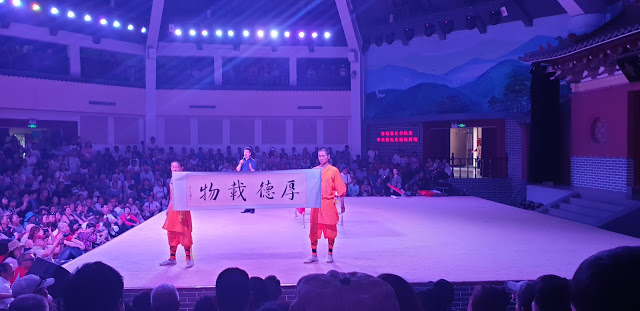
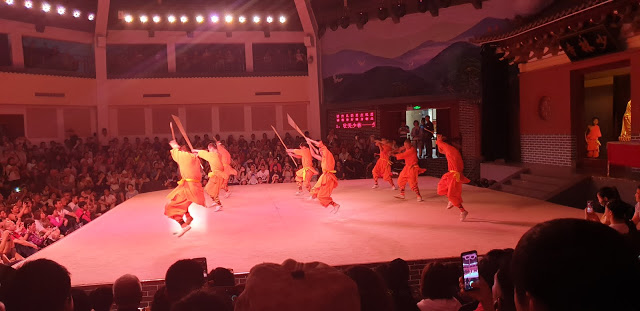
There is a 500 seat demonstration hall where you are able to observe 30 minutes of various martial arts in shows starting on the hour.
Outside there is a specific area that generally has about 600 trainees learning kung fu elements during the day, but can hold 5,000 [ep[;e when outdoor performances are required.
The kung fu school
The thing you notice most about the kung fu school is it’s size and then the number of buses which tells you that it is a popular tourist stop.
And with that size comes long distances between the car park and the venues we need to go to, the first of which is about half a km, and that’s just to get to the ticket plaza.
But, it is pleasantly set out and is quite a large number of shops for both souvenirs and food
We pass by some of the students going through their paces
From there it’s another long, long walk to the show arena, where we’re supposed to see various kung fu elements on display. We watched this for a few minutes, then headed off towards the hall for a more intense demonstration of kung fu, and because there is limited seating we have to start lining at the head of the queue to get a seat.
But…
Everyone else has the same idea and we join the throng which then becomes a ride, and true to the Chinese they start finding ways to push in, even using the imaginary friend somewhere ahead in the queue.
The doors open and then it’s open slather, with the hoards pushing from behind and sliding up the side to get in first. We go with the tide, and manage to get in and find a seat though we were separated from three of our group.
It was an interesting show even though not one word of English was spoken, which from our point of view was a disappointment because we had no idea what was going on.
However…
It wasn’t hard to follow
What the performers were doing was relatively self-explanatory, and quite fascinating especially the guy who broke a sword over his head, and the guy who stopped two spears penetrating the neck, both examples of very disciplined men.
Boys gave a demonstration of kung fu moves, and intensity and age increased as this progressed to the end.
Next, we were taken in hand by an instructor in Tai chi or an equivalent, I was not quite sure what it was called, and went through the twelve or maybe more moves that constituted a morning or afternoon exercise session or it could be just for relaxation. I lasted the first session but it was a little difficult to do with my sore limbs and a bad back.
Not that I could remember any of it now other than hands overhead, hands in front, bent knees, and a few gentle kung fu hand moves.
Perhaps when I get home I might seek out someone to show me the moves.
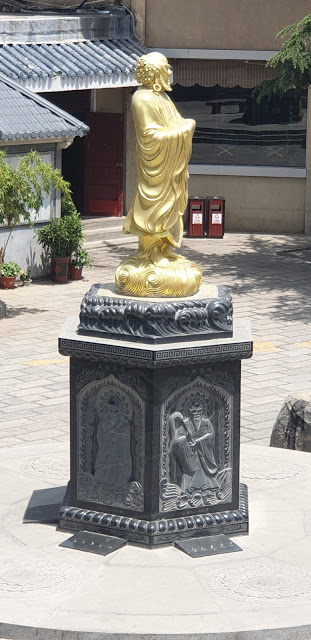
Whilst the others were following their training instructor, I wandered about, finding a large statue
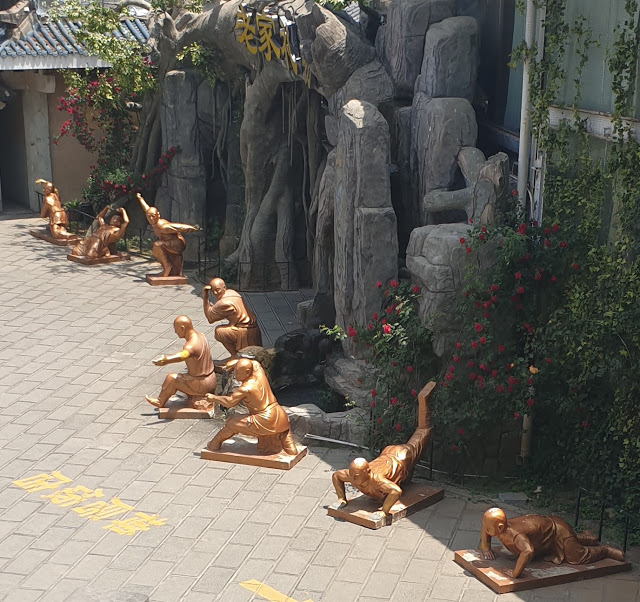
And some smaller statues
Lunch in the Zen Restaurant
After all that exercise it was time to have the lunch purportedly the same food as the king fu masters. It’s in the Zen restaurant, aptly named, and the food when it came, came thick and fast, but some of it wasn’t very nice, meat with bones, tofu, a tasteless soup, but some good dishes like the vegetables and noodles with meat, without bones.
The only problem, nothing to drink except a pot of hot water. No tea, no cold water, and if you wanted a cold drink you had to pay for it. After paying 550 yuan why should we have to pay more for a drink when we have not had to so far.
But no cold water? That was just not on, and when we brought this to that attention of the tour guide she just simply ignored us. We just didn’t get anything.
That basically tainted the whole experience.
After lunch, we had the Shaolin Temple, and the Pogoda Forest to visit.
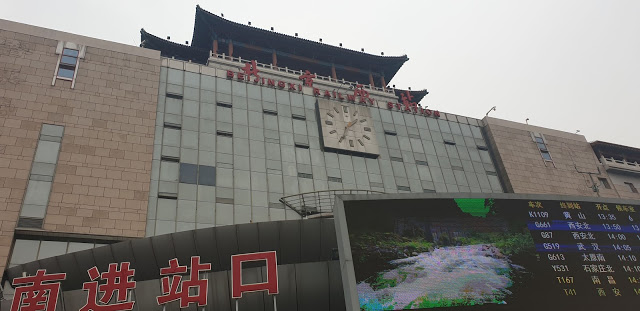
Beijing west railway station is about eight kilometers from the Forbidden City, located at East Lianhuachi Road, Fengtai District. Most trains traveling between south central, southwest, northwest, and south China are boarded here.
This place is huge and there are so many people here, perhaps the other half of Beijing’s population that wasn’t in the forbidden city.
Getting into the station looked like it was going to be fraught with danger but the tour guide got us into the right queue and then arranged for a separate scanner for the group to help keep us all together
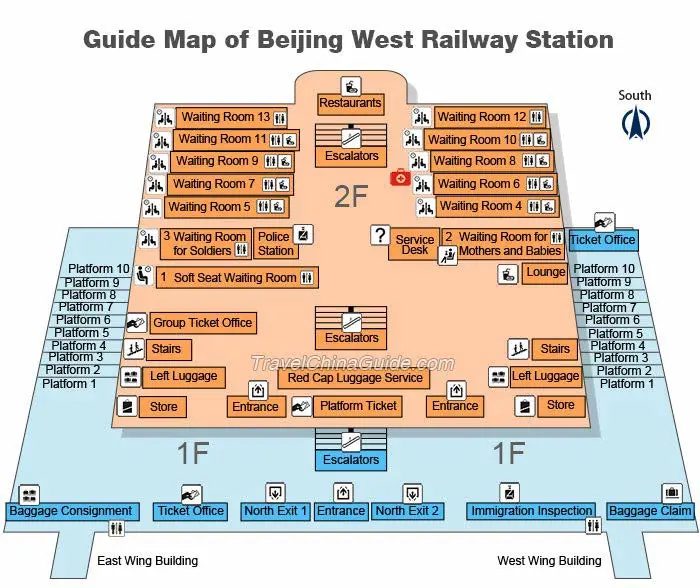
Then we decided to take the VIP service and got to waiting room no 13, the VIP service waiting room which was full to overflowing. Everyone today was a VIP. We got the red hat guy to lead us to a special area away from the crowd.
Actually, it was on the other side of the gate, away from the hoards sitting or standing patiently in the waiting room. It gave us a chance to get something to eat before the long train ride.
The departure is at 4 pm, the train number was G655, and we were told the trains leave on time. As it is a high-speed train, stops are far and few between, but we’re lucky, this time, in that we don’t have to count stations to know where to get off.
We’re going to the end of the line.
However, it was interesting to note the stops which, in each case, were brief, and you had to be ready to get off in a hurry.
These stops were Shijiazhuang, Zhengzhou East, Luoyang Longmen, Huashan North, and Weinan North. At night, you could see the lights of these cities from a distance and were like oases in the middle of a desert. During the day, the most prominent features were high rise apartment blocks and power stations.
A train ride with a difference
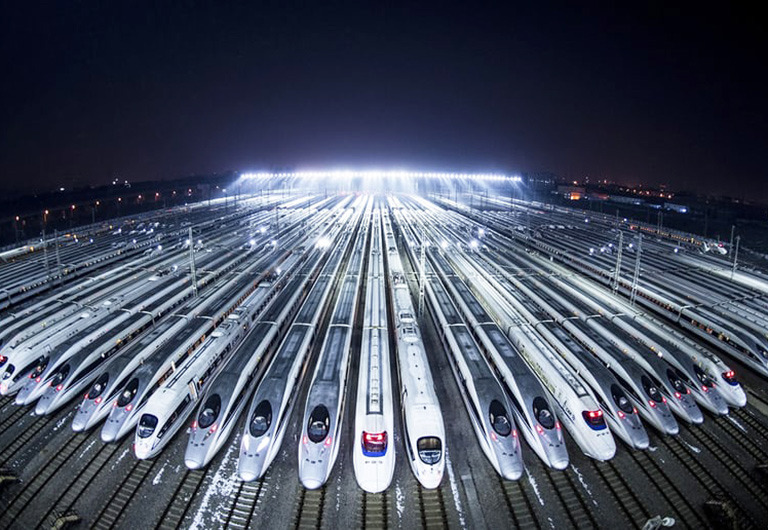
China’s high-speed trains, also known as bullet or fast trains, can reach a top speed of 350 km/h (217 mph).
Over 2,800 pairs of bullet trains numbered by G, D or C run daily connecting over 550 cities in China and covering 33 of the country’s 34 provinces. Beijing-Shanghai high-speed train link the two megacities 1,318 km (819 mi) away in just 4.5 hours.
By 2019, China keeps the world’s largest high-speed rail (HSR) network with a length totaling over 35,000 km (21,750 mi).
To make the five and a half hours go quicker we keep an eye on the speed which hovers between 290 and 305 kph, and sitting there with our camera waiting for the speed to hit 305 which is a rare occurrence, and then, for 306 and then for 307, which happened when we all took a stroll up to the restaurant car to find there had nothing to eat.
I got a strange flavored drink for 20 yuan.
There was a lady manning a trolley that had some food, and fresh, maybe, fruit on it, and she had a sense of humor if not much English.
We didn’t but anything but the barrel of caramel popcorn looked good.
The good thing was, after hovering around 298, and 299 kph, it finally hit 300.
We get to the end of the line, and there is an announcement in Chinese that we don’t understand and attempts to find out if it is the last station fall on deaf ears, probably more to do with the language barrier than anything else.
Then, suddenly the train conductor, the lady with the red hat, comes and tells us it is, and we have fifteen minutes, so we’re now hurrying to get off.
As the group was are scattered up and down the platform, we all come together and we go down the escalator, and, at the bottom, we see the trip-a-deal flags.
X’ian,and the Xi’an North Railway Station
Xi’an North Railway Station is one of the most important transportation hubs of the Chinese high-speed rail network. It is about 8.7 miles (14 km) from Bell Tower (city center) and is located at the intersection of the Weiyang Road and Wenjing Road in Weiyang District.
This time we have a male guide, Sam, who meets us at the end of the platform after we have disembarked. We have a few hiccups before we head to the bus. Some of our travelers are not on his list, but with the other group. Apparently a trip-a-deal mix-up or miscommunication perhaps.
Then it’s another long walk with bags to the bus. Good thing its a nicely air-conditioned newish bus, and there’s water, and beer for 10 yuan. How could you pass up a tsing tao for that price?
Xi’an is a very brightly lit up city at night with wide roads. It is very welcoming, and a surprise for a city of 10 million out in the middle of China.
As with all hotels, it’s about a 50-minute drive from the railway station and we are all tired by the time we get there.
Tomorrow’s program will be up at 6, on the bus 8.40 and off to the soldiers, 2.00 late lunch, then train station to catch the 4.00 train, that will arrive 2 hours later at the next stop. A not so late night this time.
The Grand Noble Hotel
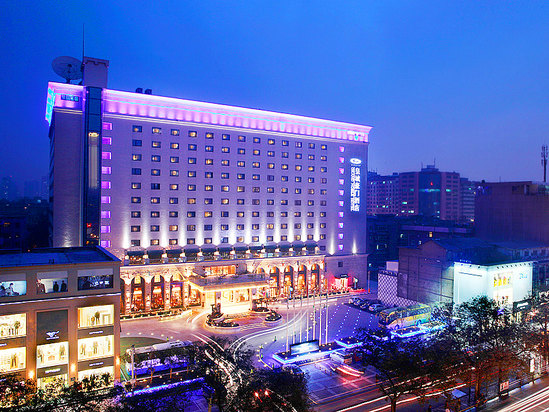
Grand Noble Hotel Xi’an is located in the most prosperous business district within the ancient city wall in the center of Xi’an.
The Grand Noble Hotel, like the Friendship Hotel, had a very flash foyer with tons of polished marble. It sent out warning signals, but when we got to our room, we found it to be absolutely stunning. More room, a large bathroom, air conditioning the works.
Only one small problem, as in Beijing the lighting is inadequate. Other than that it’s what I would call a five-star hotel. This one is definitely better than the Friendship Hotel.
In the center of the city, very close to the bell tower, one of the few ancient buildings left in Xi’an. It is also in the middle of a larger roundabout and had a guard with a machine gun.
Sadly there was no time for city center sightseeing.

















 Thrills, Spills, and just a dash of Romance