Whilst I found this tree house to be interesting, it seems to be far from practical because there was little to keep the wind and rain out, though I suppose, in the book, that might not be such a problem.
Be that as it may, and if it was relatively waterproof, then the furnishings would probably survive, and one had to also assume that much of the furnishings, such as the writing desk below, would have washed up as debris from the shipwreck.
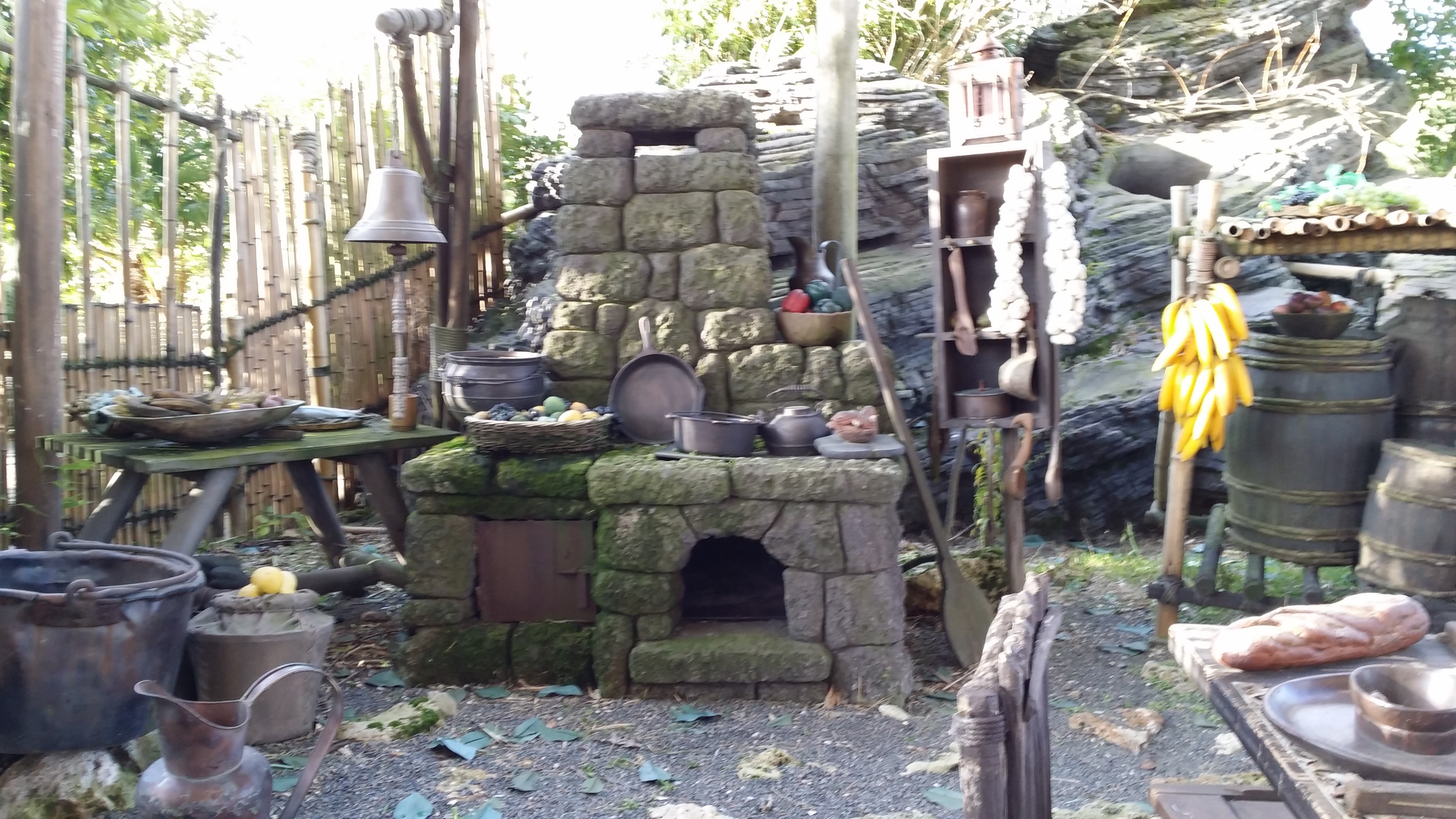
The stove and oven would have to be built by hand, and it is ‘remarkable’ such well-fitting stones were available. It doesn’t look like it’s been used for a while judging by the amount of gree on it. Perhaps it is not in a waterproof area.
The dining table and the shelf in the background have that rough-hewn look about them
A bit of man-made equipment here for drawing water from the stream
And though not made in the era of electricity, there is an opportunity to use the water wheel to do more than it appears to be doing
And tucked away in a corner the all-important study where one can read, or play a little music on the organ. One could say, for the period, one had all the comforts of home.
It is sometimes quite trashy and that’s saying something!
Having been a journalist in a previous lifetime, and one that always believed that the truth mattered, it didn’t take long to realise that journalists should never let the truth get in the way of a good story.
Newspapers, and all other forms of media, will only write what they believe will sell, or what they think the public wants to read. The truth, sadly, is not the first thing on the readers mind, only that someone is to blame for something they have no control over, and it doesn’t matter who.
And the more outlandish the situation, the more the public will buy into it.
This, I guess, is why we like reading about celebrities and royalty, not for the good they might do, but the fact they stumble and make mistakes, and that somehow makes us feel better about ourselves.
Similarly, if the media can beat up a subject, like the corona-virus, and make it worse that it is, then people will lap up the continuing saga, as it relates to them, and will take one of two stances, that they believe the horror of it, and do as they’re asked, or disbelieve it because nothing can be that bad, and ignore it and the consequences of disobedience. knowing the government will not press too hard against the non compliers simply because of domocracy issues it will stir up.
That is, then the media will get a hold of this angle and push it, and people will start to think disobedience is a good thing not a bad.
So, our problems of trying to get a fair and balanced look at what the coronavirus is all about is nigh on impossible. We are continuously bombarded with both right and wrong information, and the trouble is, both sides are very plausibly supported by facts.
And that’s the next problem we have in reporting. We can get facts to prove anything we want. It;s called the use and abuse of statistics, and was an interest part of the journalism degree I studied for. We were told all about statistics, good and bad, and using them to prove the veracity of our piece.
I remember writing a piece for the tutor extolling the virtues of a particular person who was probably the worst human since Vlad the Impaler, using only the facts that suited my narrative. I also remember the bollocking he gave me for doing so, but had to acknowledge that sometimes that would happen.
Integrity of reporting only went as far as the editor, and if the editor hated something, you had to hate it too. This is infamously covered in various texts where newspaper publishers pick sides, and can influence elections, and governments. It still happens.
So, the bottom line is, when I;m reading an article in the media, I always take it with a grain of salt, and do my own fact checking, remembering, of course, not just to fact check to prove the bias one way of the other, but the get a sense of balance.
We have state elections coming up where I live, but it does not sink to the personal sniping level as it does in the US, we haven’t sunk that low yet, but we haven;t got past the sniping about all the wrongs and failed promises of the govern,ment of the day, or the endless tirade against the opposition and how bad a job they did whenb they were previously in government.
You can see, no one is talking about what they’re going to do for us, no one is telling us what their policies are. It’s simply schoolyard tit for tat garbage speak. What happened to the town hall meeting, a long and winding speech encompassing the policies, what the government plans to do for its people in the next three years, and then genuinely answer questions?
Perhaps we should ban campaigning, and just get each party to write a book about what they intend to do, and keep them away from the papers, the TV, and any other form of media, in other words, don’t let them speak!
And don’t get me started about the drivel they speak in the parliament. Five year olds could do a better job.
And, yes, the simple description for this word is that area of the earth that isn’t covered by water.
It could also describe that little patch that my house is built on, and is generally covered by the expression, house and land as a package.
After all, a piece of land is not much used to you unless there’s a dwelling on it, or, on rare occasions, under it. Does that mean then that land in this instance only as what you can see?
OK, now it’s getting confusing.
What if I wanted to live off the land. A small patch will not do, in this case, is need a large area, perhaps thousands if hectares.
It is said that the Australian aborigines have lived off the land for thousands of years, with a nomadic lifestyle.
No small patch of land for them.
Now, what if I come down out of the sky. Oddly enough this means I have to land, even if I come back to earth over later. It’s still a landing.
Now it’s getting interesting.
So what if you wanted to refer to where you live? That would be your homeland or motherland, and it describes a country.
So it’s my patch, my country, any area where there isn’t water. What about describing a country, say the land of the long white cloud, or the land of the rising sun?
And just to add to the confusion
I can land a fish
Make land, after being all at sea, and,
Best of all, land that much desired job.
Wow.
I’m beginning to think it’s another one of those ‘four-letter words’
We have been to Paris a number of times over the years.
The last time we visited Paris we brought the two eldest grandchildren. We took the Eurostar train from St Pancras station direct to Disneyland, then took the free bus from the station to the hotel. The train station was directly outside Disneyland.
We stayed at the Dream Castle Hotel, rather than Disneyland itself as it was a cheaper option and we had a family room that was quite large and breakfast was included every morning. Then it was a matter of getting the free bus to Disneyland.
We spent three days, time which seem to pass far too quickly, and we didn’t get to see everything. They did, however, find the time to buy two princess dresses, and then spent the rest of the time playing dress-ups whenever they could.
In Paris, we stayed at the Crown Plaza at Republique Square.
We took the children to the Eiffel Tower where the fries, and the carousel at the bottom of the tower, seemed to be more memorable than the tower itself. The day we visited, the third level was closed. The day was cold and windy so that probably accounted for the less than memorable visit. To give you some idea of conditions, it was the shortest queue to get in I’ve ever seen.
We traveled on the Metro where it was pointed out to me that the trains actually ran on rubber tires, something I had not noticed before. It was a first for both children to travel on a double-decker train.
The same day, we went to the Louvre.
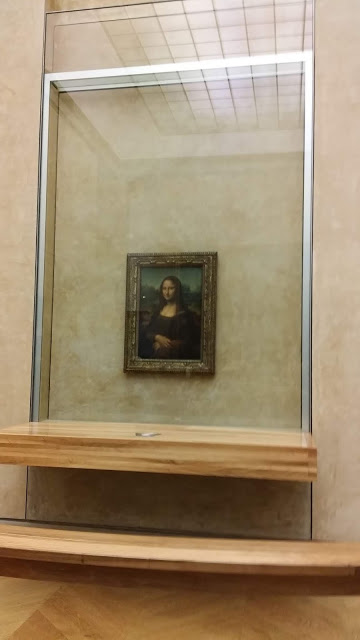
Here, it was cold, wet and windy while we waited, Once inside we took the girls to the Mona Lisa, and after a walk up and down a considerable numkber of stairs, one said, “and we walked all this way to see this small painting”.
It quickly became obvious their idea of paintings were the much larger ones hanging in other galleries.
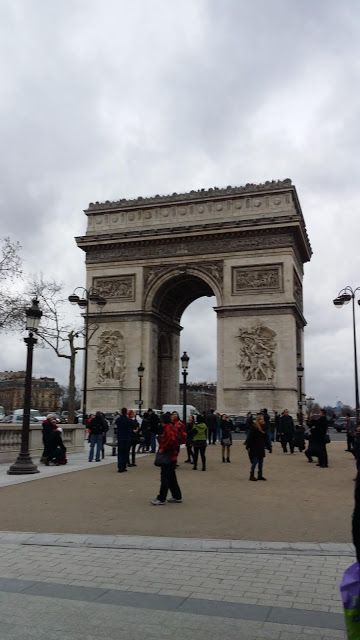
We also took them to the Arc de Triomphe.
We passed, and for some reason had to go into, the Disney shop, which I’m still wondering why after spending a small fortune at Disneyland itself.
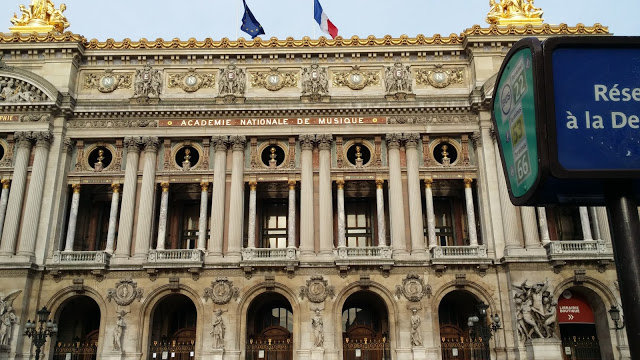
Next on the tour list was the Opera House.
where one of the children thought she saw the ghost and refused to travel in one of the elevators. At least it was quite amazing inside with the marble, staircases, and paintings on the roof.
Sadly, I don’t think they were all that interested in architecture, but at the Opera House, they did actually get to see some ballet stars from the Russian Bolshoi ballet company practicing. As we were leaving the next day we could not go and see a performance.
Last but not least was Notre Dame with its gargoyles and imp[osing architecture.
All in all, traveling with children and experiencing Paris through their eyes made it a more memorable experience.
The first we visited Paris was at the end of a whirlwind bus tour, seven countries in seven days or something like that. It was a relief to get to Paris and stay two nights if only to catch our breath.
I remember three events from that tour, the visit to the Eiffel Tower, the tour of the night lights, not that we were able to take much in from the inside of the bus, and the farewell dinner in one of the tour guides specially selected restaurants. The food and atmosphere were incredible. It was also notable for introducing us to a crepe restaurant in Montmartre, another of the tour guide’s favorite places.
On that trip to Paris, we also spent an afternoon exploring the Palace of Versailles.
The next time we visited Paris we flew in from London. OK, it was a short flight, but it took all day. From the hotel to the airport, the wait at the airport, departure, flying through time zones, arrival at Charles De Gaulle airport, now there’s an experience, and waiting for a transfer that never arrived, but that’s another story.
I can’t remember where we stayed the first time, it was somewhere out in the suburbs, but the second time we stayed at the Hilton near both the Eiffel Tower and the Australian Embassy, notable only because the concierge was dating an Australian girl working in the Embassy. That was our ticket for special treatment, which at times you need to get around in Paris.
It was the year before 2000 and the Eiffel Tower was covered in lights, and every hour or so it looked like a bubbling bottle of champagne. It was the first time we went to Level 3 of the Tower, and it was well worth it. The previous tour only included Level 2. This time we were acquainted with the fries available on the second level, and down below under the tower.
This time we acquainted ourselves with the Metro, the underground railway system, to navigate our way around to the various tourist spots, such as Notre Dame de Paris, The Louvre, Sacre-Coeur Basilica, and Les Invalides, and, of course, the trip to the crepe restaurant.
We also went to the Louvre for the express purpose of seeing the Mona Lisa, and I came away slightly disappointed. I had thought it to be a much larger painting. We then went to see the statue of Venus de Milo and spent some time trying to get a photo of it without stray visitors walking in front of us. Aside from that, we spent the rest of the day looking at the vast number of paintings, and Egyptian artifacts in the Museum.
We also visited the Opera House which was architecturally magnificent.
The third time we visited Paris we took our daughter, who was on her first international holiday. This time we stayed in a quaint Parisian hotel called Hotel Claude Bernard Saint Germain, (43 Rue Des Ecoles, Paris, 75005, France), recommended to us by a relation who’d stayed there the year before. It was small, and the elevator could only fit two people or one person and a suitcase. Our rooms were on the 4th floor, so climbing the stairs with luggage was out of the question.
It included breakfast and wifi, and it was quite reasonable for the four days we stayed there.
It was close to everything you could want, down the hill to the railway station, and a square where on some days there was a market, and for those days when we were hungry after a day’s exploring, a baguette shop where rolls and salad were very inexpensive and very delicious.
To our daughter we appeared to be experienced travelers, going on the Metro, visiting the Louvre, going, yes once again, to the crepe restaurant and the Basilica at Montmartre, Notre Dame, and this time by boat to the Eiffel Tower. We were going to do a boat rode on the Seine the last time but ran out of time.
We have some magnificent photos of the Tower from the boat.
Lunch on one of the days was at a restaurant not far from the Arc de Triomphe, where our daughter had a bucket of mussels. I was not as daring and had a hamburger and fries. Then we went to the center of the Arch and watched the traffic.
Our first time in Paris the bus driver got into the roundabout just to show us the dangers of driving in an unpredictable situation where drivers seem to take huge risks to get out at their exit. Needless to say, we survived that experience, though we did make a number of circuits.
You know, the sort of day where you have the best of intentions, you get up ready to start attacking the agenda you’ve told yourself you’re finsally going to sit down and get on with.
The same set of words you’ve been using to fire up the enthusiam you really don’t feel much of the time, but this time, having worked yourself into a high degree of positivity just before going to bed.
Everything is set up. All you have to do is’ bound out of bed, bright eyed and bushy tailed, ready to go.
That was the first mistake. You went to be very late, around 2 am, and when you wake up, it’s feels like death warmed up. No bright eyes, and definitely no bushy tail.
But, there’s work to be done.
Before that, there’s other stuff, and as each succeeding chore is down, the less the enthusiasm feels. I have to clean up the dining room, which, at the moment, is the go to for all the tools, paint, tile glue, tiles, everything that’s being used in the latest round of renovations.
Frankly, the room is a mess. I can move a lot of the tools out to the shed now that I’ve finished with them, and the rest, a few pain brushes and the tiling equipment, we be used over the next week.
An hour and a half later, the room is now clean.
I go out to the writing room and look at the list. Good thing I’d didn’t put a time against anything, because if I have, I was now looking at being at least four hours behind.
A phone call made that timeline worse. People always call when you don;t need any calls to dstract you. It’s one of the reasons why I have seriously considered getting the land line cut off. And if it wasn’t for the grandchildren, who know they can call on that line, with a number that’s easier to remember than a mobile, I would.
But that of course leaves me open to the half dozen scam calls a day, trying to sell cladding, solar panels, defend myself form a car crash that I never had, fend off illicit charges from Telcos, and now Amazon. Not forgetting my friend from the NBN who rings once, sometimes twice a day telling me my internet is about to be cut off.
To be honest I wish they would, but as much as I tell them to cut it off they never do, perhaps knowing that if they do, they can’t scam call me anymore.
By the time I get back to my office, it’s time for a cup of tea.
Or something stronger.
The morning has gone, and the afternoon is half over, and all I’ve done is look at the list.
And since blog posts are on the list, this is why I’m writing this whinge.
How is your day going? I hope it’s better than mine.
What happened yesterday is history, but that’s not necessarily how we view what is history and what isn’t.
Similarly what is and what isn’t history is usually decided on by academics, because history texts that are used in schools are not written by ‘the man in the street’ authors. They’re usually university types who specialise in a particular field, or specialise section of history.
Even then one doubts that what is written is not a consensus of a panel.
So, when we talk about re-writing history, that takes a very brave bunch of people who want to buck the norm.
Our history, that which was taught when I went to school,. about our own country, Australia, started in 1770. Some brave soul tried to say it began earlier than that, before Captain Cook and the British arrived, out up a flag pole, and declared it belonged to Britain, like in 1606 when the Dutch explorer Willem Janszoon landed on the Cape York peninsula, only it wasn’t called that then.
And he might have been as surprised as Captain Cook that there were people here to observe their arrival. Yes, people had been living in this country for tens of thousands of years before the Europeans arrived.
But that was not what we were taught. No, Captain Cook, 1770, the a fleet of ships in 1788, and off we run as a new country, and a dumping ground for Britain’s convicts. Our history starts there, and then meanders through time, dividing the country up into states, having famous explorers like Burke and Wills, and Blaxland, Wentworth, and Lawson, Hume and Hovell.
And we commemorate all these people and those who were in charge over the years, with names of states, cities, rivers, mountains, everything under the sun. You’ve only got to glance at the list of hundreds of these forefathers and explorers to see just how many places in this country were named after them.
No heed was taken of what they may have been called before because no one really understood the languages of the first people who lived here. And they never seem to rate as a matter of study for us children back then.
Now, as people have begun to realise our history goes way, way back, and that there should be a nod to those inhabitants, they are considering re-writing some of our history to incorporate these people. And change the names of places to their original. A famous instance of recent renaming is of Ayers Rock, now called Uluru.
Even then, Australian History didn’t rate very highly, and I have to say, as a child at school 50 odd years ago, I learned more about the British Empire/Commonwealth, and about the English kings and queens, than we did about our own Governor Generals, Prime Ministers and State Premiers.
Could I tell you the name of our first Prime Minister? No. I can say when Australia became Australia, yes. 1901. Can I tell you the first King of England? Yes, William the Conqueror in 1066. There were kings before that but they only ruled of parts of England.
But over the years since I have read the odd book of Australian History but for some reason it never quite seems as colourful or as interesting as that of England or Scotland, or even some of the European countries.
Now, since I’ve been reading about what’s happening in the United States I have begin to take an interest in American history, and it, too, seems to suffer the same problems we have with ours, a bunch of academics decided what it was, and what it would not include, and then there is this thing called the 1619 project.
Wow, that seems to have stirred up a hornet’s nest.
I’ve stayed in a few places where ghosts were purported to be roaming the passages at night, but apparently not the night I was staying.
And that’s something else that I have a problem with, why is it ghosts only come out at night, or is that just the perception I have hot from reading up on the subject.
Maybe my view of ghosts is somewhat stilted, after all, I think my first introduction to ghosts was watching The Centerville Ghost, a movie I saw on t.v. when I was very young.
You have to admit Hollywood’s perception of ghosts is quite interesting.
But…
Do you think they are real? Do I think they are real?
I think I would have to be presented with some fairly solid evidence they exist, but perhaps not to the point of meeting one.
There are, it seems countless examples of ethereal forces, you know, wind blowing where there’s no wind or draught outside, room temperatures dropping for no apparent reason, knocking, rattling of chains, strange noises like low moaning.
And yet…
There are hotels you can stay in such as the Chelsea Hotel in New York, where it’s possible to run into Sid Vicious.
Sorry, not staying there any time soon.
Then there’s the Hollywood Roosevelt Hotel in Los Angeles where it’s possible to run into Marylin Monroe, who lived in room 229.
That could be an interesting encounter.
Another is the Westin St Francis in San Francisco where the actress Virginia Rappe died while attending a party held in Fatty Arbuckle’s room, Arbuckle’s room, who was later accused of assaulting and murdering her, and whose career tanked after the incident.
Her ghost is seen moving about the hotel tearing her hair out. It seems all of the spectral activity occurs on the 12th floor.
Good to know if I decide to stay there. I wonder if they have a 13th floor?
Perhaps in too old to be running the gamut of paranormal experiences, the old heart is not as strong as it used to be.
Now, brevity is something that I have not been able to fully wrap my head around.
The dictionary explains Brevity as
‘concise and exact use of words in writing and speech’
So…
I remember working with a writer a long time ago who explained certain authors styles, and for James A Michener of Hawaii fame, he said Michener wrote sentences instead of words, paragraphs instead of sentences, pages instead of paragraphs and chapters instead of pages.
It was a little harsh considering I’d just read the book and had liked it, despite its length and the time it took.
But some time later I realized he was not criticizing Michener, but trying to tell me, in his, what I came to discover, interesting way, that I should strive to write more compactly.
I then came across a book by Brian Callison which was exactly that, the concise version, a story that fitted into about 200 pages.
That too was a good book and it took me a day to read it, and by his use of that economy of words, it read quickly.
Of course, I have tried over the years to emulate both styles, and to a certain degree, failing, because I think I have created my own style which is somewhere in between.
Still, when editing, it is always in the back of my mind that I should be
Using words instead of sentences
Using sentences instead of paragraphs
Using paragraphs instead of pages, and
Using pages instead of chapters.
The chapters, he said, with an air of amusement, will always take care of themselves.
You would think it is a relatively simple thing to get to the snow.
Of course, there are a few necessities like skis, boots, poles, and warm dry clothing, but that can all be bought or rented when you get there, or if you are an enthusiast, you already have the gear.
So, you get in the car, set the navigator, and off you go. Till you get within 20 k of the ski field, it’s all plain sailing, everyone is excited, and mentally preparing.
Then it all starts to go sideways.
Those last few kilometers to the top are going to be arduous particularly if it’s been snowing and the roads are icy, but the weather is fine with blue skies and no recent snow falls. Were expecting a slow drive and a parking spot.
The road is open.
But…
So late in the morning, a sign at the bottom of the mountain warns all the car parks at the ski field are full, but we venture on anyway.
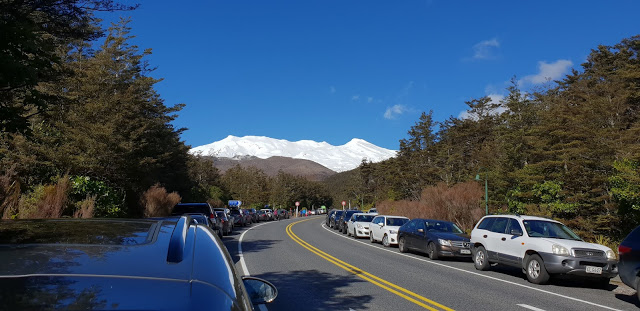
As you can see, the cars are parked so far away from the ski fields, the prospective skiers have to almost run a marathon before they get there!
And for some odd reason, we picked the very day everyone in New Zealand also wanted to go up to the ski fields so parking, even near the Chateau Tongariro was gone and there were endless cars looking for parking spots and traffic wardens had their hands full trying to keep traffic moving So, for us and everyone else, everything stops at Chateau Tongariro, and from there the only vehicles allowed up are buses.
It’s about 10:30 and we are advised the only way we were getting to see snow was to take a bus
Now, there are two types of busses. You can go up on a local bus, from Whakapapa Village that costs $20 a person which in the context of the cost of skiing not very much, but if you’re not, it’s quite expensive.
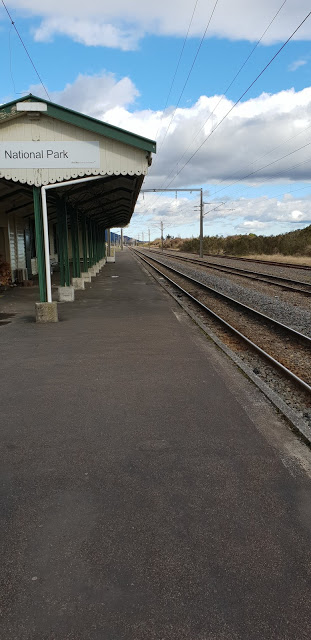
The second, one we were advised to use, operates from a place called National Park, about 9 km away, a snow shuttle that costs $6 each. The trouble is by the time we were ready to go there, to catch a shuttle, there were no more shuttles.
We did not know what to expect when we got to ‘National Park’, but being a railway station makes sense. It’s the only place with a very large carpark!
I write about spies, washed out, worn out, or thrown out.
It’s always in the back of my mind, sometimes fuelled by a piece in the paper that has a sense of conspiracy about it, and from there, an idea starts turning into words that need to find their way to paper.
Then, if that’s the extent of the first draft, sometimes it goes into the ‘I will come back to this later’ folder and, sometimes, it’s gone and forgotten.
Until I wake up suddenly in the middle of the night, an old story with a new idea fills my head, and I have to get it down.
Then, it will bother me over the next few days, until I give it the attention it’s calling out for. This will often lead to more writing, but planning leading to a synopsis.
The first sentence of a novel is always the hardest. Like I guess many others, I sit and ponder what I’m going to write, whether it will be relevant, whether it will pull the reader into my world, and cause them to read on.
And that’s the objective, to capture the reader’s imagination and want to see what’s going to happen next.
The problem is, we have to set the scene.
Or do we?
Do we need to cover the who, what, where, and when criteria in that first sentence? Can we just start with the edge of the seat suspense, like,
The first bullet hit the concrete wall about six inches above my head with a resounding thwack that scared the living daylights out of me. The second, sent on its way within a fraction of a second of the first found its mark, the edge of my shoulder, slicing through the material, and creasing skin and flesh. There was blood and then panic.
Milliseconds later my brain registered the near-miss and sent the instruction: get down you idiot.
I hit the ground just as another bullet slammed into the concrete where my head had just been.
It can use some more work, less commas, perhaps shorter, sharper sentences to convey the urgency and danger.
Perhaps we could paint a picture of the main character.
He tentatively has the name of Jackson Galworthy. He has always aspired to be a ‘secret agent’ or ‘spy’ and but through luck more than anything else, he was given his opportunity. The problem is he failed his first test and failure means washing out of the program.
What had ‘they’ said? When the shit hits the fan, you need to be calm, cool, and collected. He’d been anything but.
Maybe we’ll flesh the character out as we go along.
OK, I just had another thought for an opening,
Light snow was still falling, past the stage where each flake dissolved as it hit the ground, and now starting to gather in white patches.
It was cold, very cold, and even with the three layers I still shivered.
What surprised me was the silence, but, of course, it was a graveyard beside an ancient church, and everyone who had attended the funeral service had left.
It was a short service for the few that came, and a shorter burial. No one seemed keen to hang around, not with the evening darkness and the snow setting in.
I stood, not far from the filled grave looking at it, but not looking at it. Was I expecting it’s occupant to rise again? Was I expecting forgiveness? I certainly didn’t deserve it.
The truth is, I was responsible for this person’s death, making a mistake a more seasoned professional might not, and the reason why I was shown the door. I had been given very simple instructions; protect this man at all costs.
It was going to be a simple extraction, go in, get the target, and get out before anyone noticed.
A pity then I was the only one who got that memo.
It’s a start, but with the TV going on in the background, Chester complaining about something, and the weeds in the yard are getting higher, there’s too much else going to consider this even a start.