And what was the inspiration behind the story “[Any title you’ve written]”

As accomplished as we can be at putting words on paper, what is it that makes it so difficult to sit in a chair with a camera on you, and saying words rather than writing them?

Er and um seem to crop up a lot in verbal speech.

OK, it was a simple question; “What motivates you to write?”

Damn.

My brain just turned to mush, and the words come out sounding like a drunken sailor after a night out on the town.

The written answer to the question is simple; “The idea that someone will read what I have written, and quite possibly enjoy it; that is motivation enough.”

It highlights the difficulties of the novice author.

Not only are there the constant demands of creating a ‘brand’ and building a ‘following’, there is also the need to market oneself, and the interview is one of the more effective ways of doing this.

If only I can settle the nerves.

I mean, really, it is only my granddaughter who is conducting the interview, and the questions are relatively simple.

The trouble is, I’ve never had to do it before, well, perhaps in an interview for a job, but that is less daunting.  That usually sticks to a predefined format.

Here the narrative can go in any direction.  There are set questions, but the interviewer, in her inimitable manner, can sometimes slide a question in out of left field.

For instance, “Your character Zoe the assassin, is she based on someone you know, or an amalgam of other characters you’ve read about or seen in movies?”

That was an interesting question, and one that has several answers, but the one most relevant was; “It was the secret alter ego of one of the women I used to work with.  I asked her one day if she wasn’t doing what she was, what she would like to do.  It fascinated me that other people had a desire to be something more exotic in an alter ego.”

Of course, the next question was about what I wanted to be in an alter ego.

Maybe I’ll tell you next time.

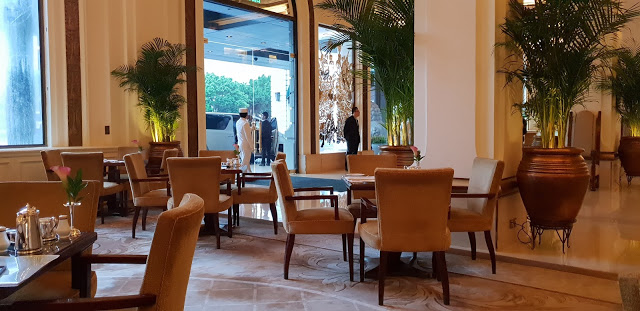
Searching for locations: Eating In, Peninsula Hotel, Hong Kong

Hotel dining can be a very expensive experience, but if you are there as one of those bucket list fulfillments like we were, then it’s not unusual to go the whole nine yards.

Since the stay coincided with my birthday, the first day was set aside to have dinner at the Chinese restaurant upstairs and was one of those sublime experiences.  Of course, it had to be Peking Duck, expensive champagne, and several cocktails.

Oddly enough, breakfast wasn’t included in the room rate, but that seems to be normal for a lot of hotels.  It can be if you want to pay upfront, but we don’t always have breakfast, particularly if we have dinner the night before.

Or can be bothered getting out of bed the next morning because quite often the breakfast hours do go with staying in bed.

During this stay, we decided to have breakfast one morning, cereal, bacon and eggs, coffee, toast, you know, the usual stuff.

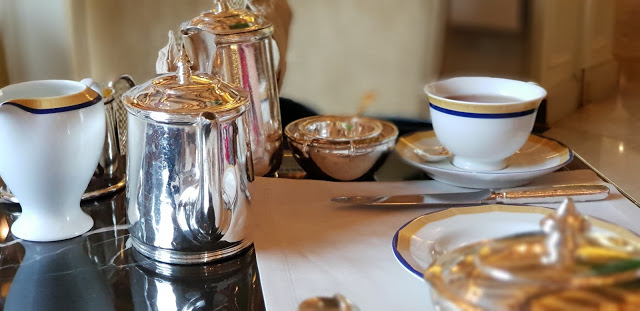
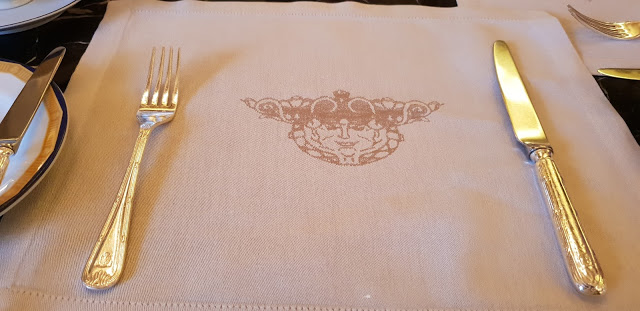
No paper placemats here and the silverware was just that, silverware.  This was going to be full on old world charm.

Coffee served from a silver coffee pot, fine bone china from Staffordshire, not Thailand, tea service for milk and sugar, condiments all in a row.
The only disappointment, I don’t think the eggs were free-range.

And, when the conversation dries up, there’s always a steady stream of people coming and going through the front door, and the doorman is always at the ready to open the door.

WE went once for lunch, and yes, we had to go to the famous Afternoon Tea, for which you had to book or stand in a very long line.  We booked and discovered preference was given to those who were staying at the hotel.

Out came the silver tea service, and one could imagine that this was the same as what it had been a hundred years ago.  I had tea, after all, it was afternoon tea!

The cakes were interesting, there were quarter sandwiches rather than finger sandwiches, and though I’m not a fan of fruit scones, I’m always up for something different.
After it, it’s probably not a good idea to go out for dinner too.

Overall, the experience was worth it.

Searching for locations: Harbour Grand Hotel, Kowloon, Hong Kong

The Harbour Grand Hotel, Kowloon, Hong Kong, is a modern, but luxurious hotel, one that our travel agent found for us.

I was initially worried that it might be too far away from central Hong Kong, but a free shuttle bus that runs at convenient times took us to and from the hotel to the Star Ferry terminal.

The luxuriousness of the hotel starts the moment you walk in the front entrance with a magnificent staircase that I assumed led up to the convention center (or perhaps where weddings are catered for) and a staircase where one could make a grand entrance or exit.  Oh, and there’s a chandelier too.

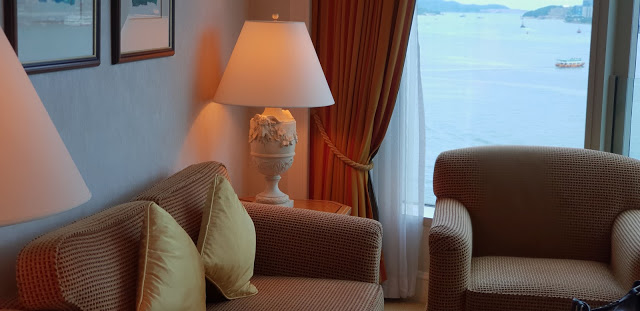
We booked into a Harbourview suite, and it was not only spacious but had that air of luxury about it that made it an experience every time you walked into it.

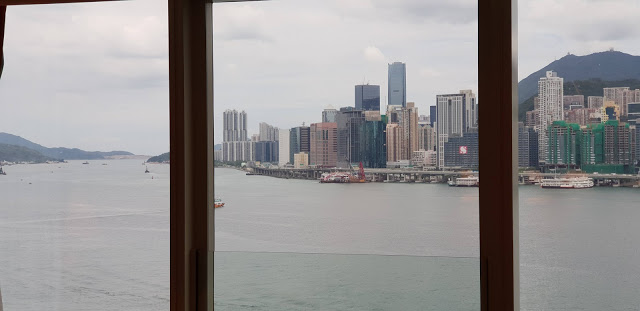
But the view of Hong Kong Harbour, that was the ‘piece de resistance’

I spent a lot of time staring out that window, and it was more interesting than watching the television, which we didn’t do much of.   Most of the time, when we travel, TV is limited to International English speaking news channels.

This time we had several movies included with the room, but I still preferred to watch the endless water traffic on the harbor.

The lounge area had several comfortable chairs, an area for the bar fridge and tea or coffee making facilities and on the opposite side the usual table and chairs for those who came to conduct business

The bedroom was separate to the entrance and lounge.  Notable was the fact the room had two bathrooms, one in the bedroom, and one out in the lounge, perhaps for the guests who were having friends in.

We dined in one of the restaurants, Hoi Yat Heen, where we experienced Guandong cuisine.  I tried the roasted goose for the first time, and it was interesting to say the least.

There’s no doubt where we will be staying the next time we go to Hong Kong.

It’s still a strange world

I’m getting to the point where I don’t want to turn on the tv anymore.

I get it. We’re still in the middle of a pandemic, and everyone wants to get back to work, but is it worth the cost of lives?

It raises the question, how much is a single life worth?

Apparently, to some, nothing. We see various countries rebelling against the so-called notion we should be social distancing, staying at home, and stopping the spread of the coronavirus.

It seems some countries, and a section of their population, just don’t care.

And the pity of it is, all those that do the right thing will inevitably forgive those that break the rules, even if they spread the disease because of their foolhardiness.

Our citizens will die, but we will be reluctant to call them murderers. They will find some way to hold the more sensible nations to ransom, simply because they have something we all need, something we turned over to them because we were naive. In a sense we still are.

Consumerism and capitalism, and dare I say it, greed, at its very worst.

But, the alternatives, fascism, communism, and dictatorships is unpalatable.

Something else we have discovered because of this world pandemic is our own stupidity in considering that a global economy was the way to go. All of a sudden everything we had moved to China, and elsewhere offshore, has come back to bite us. No whitegoods, no clothes, everything but food. At least we haven’t sold all of that down the river. Yet.

This is one hell of a wake-up call.

We need to address that self-sufficiency we no longer have. We need to bring back manufacturing, we need, in other words, to become self-sufficient again. No matter what the cost. It seems ems that in sending away everything meant that we sent away out national pride as well.

Made in Australia is something of a hollow joke. Now we get labels that no longer say, Made in Australia, it’s now what percentage is made in this country, and that isn’t a lot.

I suspect it’s the same for a lot of so-called western countries, including the United States.

This isn’t going to be the first or the last time this sort of problem will happen. ln fact, it’s only going to get worse. The thing is, are we going to learn from it?

Yes, we need to fit into the rest of the world but, no, we don’t need to sell our souls to do it.

We need to do something about it, now, while we can. This pandemic might just have a silver lining, if only we recognize the opportunity for what it is.

So where is hell?

When we are taught about religion, we are inevitably introduced to heaven and hell.

Heaven is the place we all aspire to go up to, though I’ve never really understood why it is up. Of course, all the pictures of heaven are in the clouds, with a set of pearly gates (just why are they called the pearly gates anyway?) and St Peter waiting to ask us the 20 questions that decides whether we pass through, or get the elevator down.

Yes, hell is down. Why? And, for that matter why is it always depicted a dark and full of fire and hot embers?

Now, just taking a step back and thinking about hell, there is a saying, “it is hell on earth’.

Was this saying coined by someone who had actually been to hell and been sent back? Imagine being a reject from hell … that would take some doing.

For those who saw ‘The Good Place’ which ended recently, the notion of hell takes on something of a different meaning.

But, we often say, when at the very bottom of despair that we are in hell. I gather this means that life couldn’t get any worse, which is quite possible on of the universal definitions of what it might be like in the ‘real’ hell.

Or was hell invented by some clergy a long time ago to frighten the parishioners into being good, because the ‘prize’ if you didn’t was a one way trip to, you guessed it, hell.

Come to think of it, a lot of the religious ‘stuff’ is to keep us penitent parishioners on the straight and narrow, though we are allowed to stray every now and then so we have a reason to go to the confessional, where, after straying, we a forgiven for the price of a few hail Mary’s.

And perhaps the unforgiving stare of the parish priest.

So, when we tell someone to ‘go to hell’, what is it we are really wishing upon that person. A fiery end? A meeting with the devil?

Let’s hope that ‘hell’ is just an invention, and that when were finally make it to the afterlife (which is a whole other question that I take issue with) our lives have been such that we know the answers to the 20 questions St Peter puts to us, and we get the magic ticket into heaven.

And hopefully there will be a Red Lobster up there.

In a word: cue

Another small and sometimes confusing word.

The first meaning that comes to mind is a cue is a prompt, often from someone standing behind the camera in a television studio.

That is to say that a cue is some form of signal, a wave, a nod, or verbal.

A cue can also be where a tape or recording is set to a certain place, ready to play.  One could assume, if playing tracks off an album of songs, and you wanted to play the fourth track, then you would cue it up, ready to go on, of course, the moment you got a, yes, cue to play it.

Then there is a cue used in a game of pool or snooker, that is a long thin tapered piece of wood with a felt tip.  

Not exactly my favourite game, but it’s always the cues fault, not mine.

This is not to be considered with Que which is a shortened form for Quebec, in Canada.

Or que, which for some reason, only in California, is short for barbecue.

Or Queue, as in a long line, or a short one, of people waiting to get on a bus, or waiting to get tickets  

In my experience every queue I get in is always a long one, and then suffer the frustration of waiting hours only to be told the tickets have all been sold.

Almost as bad as being stuck in a traffic jam, which is technically a queue of cars, never to get through the first set of lights, and sometimes not the second.

And don’t get me started on phone queues.  

Queues are for people who have a lot of time on the hands.

In a word: Prize

What you win, first prize in a raffle, though I don’t think I’ve ever won first prize.  Second maybe.  But, aren’t all raffles rigged?  

But despite my unfortunate run of luck, a prize is generally give to someone who works hard, or wins a race

Or I could have been a prize fighter but lacked the size and the strength, and out of curiosity how many prize fighters didn’t win a prize?

And if I had been a pirate, I could have sailed the seven seas to find a prize, namely a ship to attack and take as my own.

And as a prime example, a Chelsea supporter walking into a bar full of Manchester United fans could be called a prize idiot.

This is not to be confused with the word prise

Don’t relatives prise the last dollar out of a dying man’s hand?

Or prise the truth out of a witness, or a perpetrator

Or prise a window open like thieves do when we forget to lock them properly?

We have this sport called Australian Rules Football

In Melbourne, it’s an institution even a religion.  Traditionally it is played on a Saturday afternoon and luckily for us, we were attending such a game.

Of course, this was before last year.  Last year, with the COVID 19 virus everything, including football has been called off.

Now, we’re subject to the off outbreak that sees games transferred to other states, and sometimes without crowds. We just stick to watching it on TV these days.

Except now we have ‘flattened the curve’ football can start again, sometimes with sometimes without the spectators.  Social distancing means we can’t pack the stadium, or rarely even go to a game.  For a while, it was just to be from our lounge rooms, watching it on the TV.

But, as some of the states began to get on top of the virus, football teams moved from Victoria, and played in Sydney, Adelaide, Perth, and the Northern Territory.

And as the Victorian situation got worse, the decision was made to move the grand final, which had never left the MCG in Victoria, to Brisbane. It was like America never losing the Americas Cup, until they did.

But, below, is the atmosphere that we have been missing, and has returned in a limited sense as coronavirus restrictions eased (but not completely), a game we attended last year:

The stadium is the MSG, one of the biggest and best in Australia.  Shortly after the start, I’d estimate there are about 40,000, but eventually, we were told there was 53,000, spectators here for a clash between the two Melbourne based teams.  It is not unheard of to have in closer to 90,000 spectators, and the atmosphere is at times electric.

For the die-hards like me who can remember the days when there were only Victorian-based teams,  in the modern-day form of the game, to have two such teams is something of a rarity.

However, it’s not so much about the antics on the field as it is the spectators.  They are divided into three groups, the members, the private boxes, and the general public.

But in the end, there is no distinction between any of them because they all know the rules, well, their version of them, and it doesn’t matter who you are, If there is something that goes against your team, it is brings a huge roar of disapproval.

Then there are ebbs and flows in the crowd noise and reactions to events like holding the ball attracting a unified shout ‘ball, or a large collective groan when a free kick should have been paid or by the opposite team’s followers if it should have been.

It is this crowd reaction which makes going to a live game so much better than watching it televised live.  The times when players take marks, get the ball out of congestion, and when goals are scored when your team is behind and when one is needed to get in front.

This is particularly so when one of the stars goes near the ball and pulls off a miracle 1 percent movement of the ball.  These are what we come to see, the high flying marks, the handball threaded through a needle, a kick that reaches one of our players that looked like it would never get there, an intercept mark or steal that throws momentum the opposite way.

This game is not supposed to be a game of inches but fast yards, a kick, a mark, a handball, a run, and bounce.  You need to get the ball to your goal as quickly as possible.

That’s the objective.

But in this modern game, much to the dismay of spectators and commentators alike, there is this thing called flooding where all 36 players are basically in a clump around the ball and it moves basically in inches, not yards.

It is slow and it is ugly.

It is not the game envisioned by those who created it and there is a debate right now about fixing it.

Here, it is an example of the worst sort.  This game is played in four quarters and for the first two, it is ugly scrappy play with little skill on display.  The third shows improvement and it seems the respective coaches had told their players to open it up

They have and it becomes better to look at.

But this is the point where one team usually gets away with a handy lead, a third-quarter effort that almost puts the game out of reach.  The fourth quarter is where the losing team stages a comeback, and sometimes it works sometimes it does not.

The opposition gives it a red hot try but is unsuccessful.  Three goals in a row, it gave their fans a sniff of hope but as the commentators call it, a kick against the flow and my team prevails.

It is the moment to stay for when they play the winning teams song over the stadium’s loudspeaker system, and at least half the spectators sing along.  It is one of that hair raising on the back of your neck moments which for some can be far too few in a season

We have great hopes for our team this year, and it was worth the trek from Brisbane to Melbourne to see it live rather than on the TV

Leaving the ground with thousands of others heading towards the train station for the journey home there is a mixture of feelings, some lamenting their teams, and others jubilant their team won.  There is no rancor, everyone shuffles in an orderly manner, bearing the slow entry to the station, and the long lines to get on the train.

Others who perhaps came by car, or who have decided to wait for a later train or other transport, let their children kick the football around on the leaf-covered parkland surrounding the stadium.

It is an integral part of this game that children experience the football effect.  Kicking a ball with your father, brothers, and sisters, or friends on that late autumn afternoon is a memory that will be cherished for a long long time.

It’s where you pretend you are your favorite player and are every bit as good.  I know that’s what I used to do with my father, and that is what I did with my sons.

But no matter what the state of the game, it is the weekend the football fans look forward to and who turn out in their hundreds of thousands.  It is a game that ignites passions, it brings highs and it brings incredible lows.

And, through thick and thin, we never stop supporting them.
Are we still in the midst of an apocalypse?

I never thought I’d be sitting down and thinking about mortality.

It comes up, of course, every time you go to a funeral, but it’s not like this, not when anyone you know can get a disease that has no cure, and it can kill you.

I’m looking at a continuous update of the destruction it’s doing to human life all over the planet, millions of people have contracted the virus, and far too many people have died.  And it shows no sign of abating, even in the face of a vaccine.

As a proportion of the earth’s population, it’s probably nothing, but to each and every family member of those who contract it and who eventually die, they are not a statistic, they are someone loved and cherished.

It horrifies me that some people can make light of it.

If doubly horrifies me when they start talking about acceptable losses, or worse, it didn’t kill as many people we thought it would.

The thing is, this virus hasn’t finished with us yet.  It’s still out there, there are people with it, and don’t know they’ve got it and they can spread it as easily as spreading soft butter on a slice of bread.

And yet, there are people out there who claim their freedom is more important than dying,  Tell that to those who have lost loved ones.  Tell that to a child who has lost a father, a mother, a bother, a sister, a friend, or as the virus is more selective, a grandparent, or someone whose health was tenuous for a variety of reasons.

They just don’t get it.

I’m guessing that in some countries where guns are a way of life, and the population is inured to the countless deaths caused by those guns, a virus doesn’t impact them.  They say they are more likely to be killed by the flu, or a cow falling out of the sky on them.

Perhaps the saner of us could pray for a rainstorm of cows when they gather to protest against gun control.  It would make a better headline that we see each morning, the ever-increasing infections, and worse, deaths.

There is no cure, despite what some people will say.  There won’t be a cure, because it’s not the virus we have to remove, it’s the practices that cause those viruses.  We have to find and remove the cause, whether it’s bats, exotic animals, of countries creating biological warfare weapons.

And here’s a tip from a thriller writer who’s been trying to wrap his head around all of the available conspiracy theories, the one I like the most is; the country that magically finding a cure in less than the accepted time-frame is more than likely the country was the one who created it.

This is beginning to sound a lot like…

It’s odd how art sometimes imitates life, but it’s much, much worse when life imitates art.

I mean, in a sense, it’s good that life imitates Star Trek because we need lasers to ward off unfriendly aliens when they finally arrive, as well as having intergalactic warp speed vessels.

But it’s very, very bad when a contagion like COVID 19 pops up, and the scenario that follows is right out of the script for the movie Contagion.

Or Outbreak, not that any President would ever nuke a US City, which was the premise in that film.

Or follow along the lines of The Omega Man, where a virus turns everyone into a zombie-like creature, with the last surviving human finally running out of luck.

There’s been quite a few doomsday scenario films, the most interesting one involving walking plants (The Day of the Triffids) but scary as they might be, what’s happening now is equally scary.

And it had been predicted.

But, that’s not the worst of it.  Half the population wants to believe its no worse than a cold, that despite the ease in which it is transmitted, they will get it, and then it will magically disappear.

You know the drill, you get the disease once, you beat it, and you don’t get it again.

Maybe.  There are factual accounts of people getting it again, but they don’t know they have it, and of course, those people happily transmit it to a new group of people.  It doesn’t go away, you don’t beat it, it just lurks in cold dark corners, waiting to pounce.

It’s an insidious virus.

And if you recover, you might think you’ve recovered, but…

Lung scarring, loss of smell, migraines, memory loss, blood clots are just a few of the side effects.  Doctors are only just discovering this because someone is finally getting down to charting the course of the disease, and what happens after recovery.

Up till now, there hasn’t been time, everyone is too busy fighting it.

Perhaps, when I apply my thriller writing mind to all that I have read over the last few months, the real aim of the virus hasn’t materialized yet, that the aim of whoever invented it, if indeed it was invented, was not to seriously affect the 15 to 40-year-olds in this iteration, but the devil is in the future, say 30 years from now when a whole generation that had been consistently bombarded with conflicting information about the virus not being dangerous and that young people had no worries about getting it, suddenly find themselves dying of lung-related respiratory problems, blood clot induced heart attacks and aneurysms, or just forgotten who they are.

A whole generation!

It’s why you can speak to one person and they’ll tell you that you need masks, you need to isolate.  Of course, this is true, if that person is over 60, overweight and suffering from diabetes, or another debilitating disease.  These people make up a large percentage of the population.

It’s why if you speak to another person, under 50, they’ll tell you it’s nothing to worry about, and they will believe the misleading information that masks are un-necessary, if you get it, it’ll go away, some quack medicine with defeat it, even if the scientific tests say otherwise.  They’ve got better things to do than to worry about a silly invisible virus, like going to COVID 19 parties to see who the first person who contracts it is.

Can you see how good a novel this would make?

You would read it, and then put it down and think it could never happen here.

Like Contagion.

Like the Outbreak.

Like The Omega Man.

It couldn’t.

Could it?