Writing about writing a book – Day 13

Life impinges on the idyllic

There’s the expectation and then there’s reality.

My idea of shutting myself away in my lonely garret and writing, coming out into the fresh air every now and then, just to make sure neither North Korea or the United States haven’t turned the world into a nuclear holocaust, was simply a pipe dream.

Being single again doesn’t abrogate you of the same responsibilities you have before you became single.  You still had children, and those children have children, and, yes, you can see where this is going.

The mobile phone, so silent for the past few days, makes the unusual sound it makes when a message arrives.

Thank heaven for tech-savvy granddaughters!

And before you say, quite casually, that I would be better off without technology, after all, all Hemingway had was a typewriter, I’m afraid to say there is no Luddite in me.

In fact, do Luddites still exist?

So, as I said, the phone dings, and as I’m not expecting anything, I try to ignore it.  Three minutes later it dings again, and it’s a warning.  The Gods are getting impatient.

It’s a message to pick up the grandchildren from school and deliver them home.  It’s something I haven’t done in a while, but it’s an opportunity to see them, and they always have words of wisdom as only a thirteen and ten-year-old can.

It’s a while since I have.  I suspect my involvement had been curtailed somewhat because their nanna had been available, and the more preferred option.

Or maybe they had just asked their mother to get me to pick them up so I could see them.  I had said, a while back, I was relatively reluctant to go around to see them because of how awkward it might be, and to give them time to adjust to the new arrangement the divorce had brought about.

And since I’ve been spending all my time recently immersed in conspiracies, was this one perpetrated by my daughter in law?

I’ll soon find out.

Searching for locations: From Beijing to X’ian by bullet train

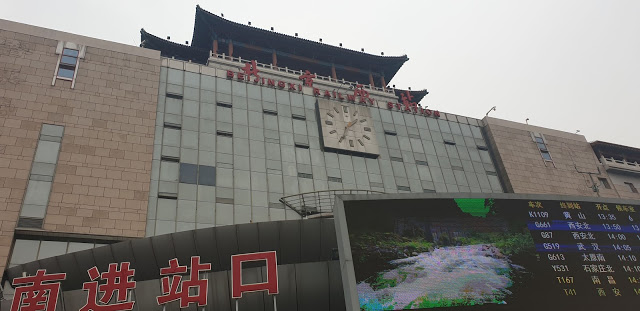
Beijing West train station.

Beijing west railway station is about eight kilometers from the Forbidden City, located at East Lianhuachi Road, Fengtai District.  Most trains traveling between south central, southwest, northwest, and south China are boarded here.

This place is huge and there are so many people here, perhaps the other half of Beijing’s population that wasn’t in the forbidden city.

Getting into the station looked like it was going to be fraught with danger but the tour guide got us into the right queue and then arranged for a separate scanner for the group to help keep us all together

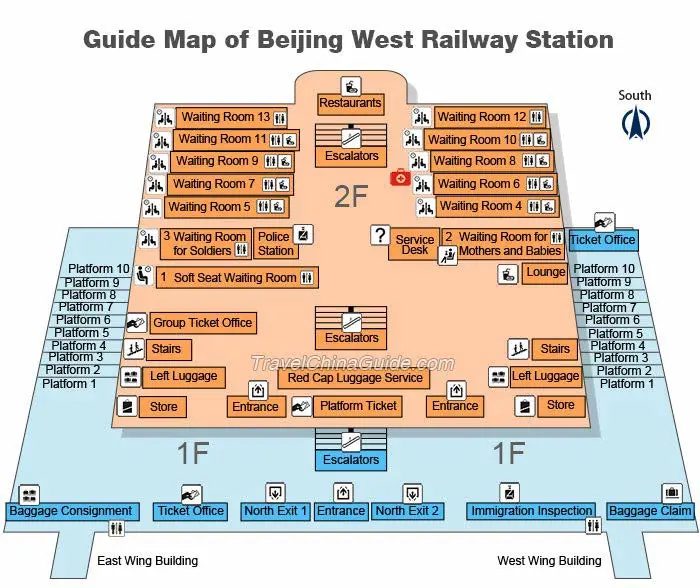
Then we decided to take the VIP service and got to waiting room no 13, the VIP service waiting room which was full to overflowing.  Everyone today was a VIP.  We got the red hat guy to lead us to a special area away from the crowd.

Actually, it was on the other side of the gate, away from the hoards sitting or standing patiently in the waiting room.  It gave us a chance to get something to eat before the long train ride.

The departure is at 4 pm, the train number was G655, and we were told the trains leave on time.  As it is a high-speed train, stops are far and few between, but we’re lucky, this time, in that we don’t have to count stations to know where to get off.

We’re going to the end of the line.

However, it was interesting to note the stops which, in each case, were brief, and you had to be ready to get off in a hurry.

These stops were Shijiazhuang, Zhengzhou East, Luoyang Longmen, Huashan North, and Weinan North.  At night, you could see the lights of these cities from a distance and were like oases in the middle of a desert.  During the day, the most prominent features were high rise apartment blocks and power stations.

A train ride with a difference

G Trains at Wuhan Railway Station

China’s high-speed trains, also known as bullet or fast trains, can reach a top speed of 350 km/h (217 mph).

Over 2,800 pairs of bullet trains numbered by G, D or C run daily connecting over 550 cities in China and covering 33 of the country’s 34 provinces. Beijing-Shanghai high-speed train link the two megacities 1,318 km (819 mi) away in just 4.5 hours.

By 2019, China keeps the world’s largest high-speed rail (HSR) network with a length totaling over 35,000 km (21,750 mi).

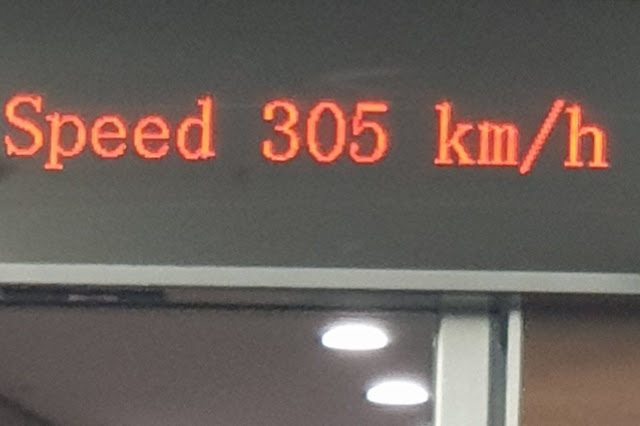
To make the five and a half hours go quicker we keep an eye on the speed which hovers between 290 and 305 kph, and sitting there with our camera waiting for the speed to hit 305 which is a rare occurrence, and then, for 306 and then for 307, which happened when we all took a stroll up to the restaurant car to find there had nothing to eat.

I got a strange flavored drink for 20 yuan.

There was a lady manning a trolley that had some food, and fresh, maybe, fruit on it, and she had a sense of humor if not much English.

We didn’t but anything but the barrel of caramel popcorn looked good.

The good thing was, after hovering around 298, and 299 kph, it finally hit 300.

We get to the end of the line, and there is an announcement in Chinese that we don’t understand and attempts to find out if it is the last station fall on deaf ears, probably more to do with the language barrier than anything else.

Then, suddenly the train conductor, the lady with the red hat, comes and tells us it is, and we have fifteen minutes, so we’re now hurrying to get off.

As the group was are scattered up and down the platform, we all come together and we go down the escalator, and, at the bottom, we see the trip-a-deal flags.

X’ian,and the Xi’an North Railway Station

Xi’an North Railway Station is one of the most important transportation hubs of the Chinese high-speed rail network. It is about 8.7 miles (14 km) from Bell Tower (city center) and is located at the intersection of the Weiyang Road and Wenjing Road in Weiyang District.

This time we have a male guide, Sam, who meets us at the end of the platform after we have disembarked.  We have a few hiccups before we head to the bus.  Some of our travelers are not on his list, but with the other group.  Apparently a trip-a-deal mix-up or miscommunication perhaps.

Then it’s another long walk with bags to the bus.  Good thing its a nicely air-conditioned newish bus, and there’s water, and beer for 10 yuan.  How could you pass up a tsing tao for that price?

Xi’an is a very brightly lit up city at night with wide roads.  It is very welcoming, and a surprise for a city of 10 million out in the middle of China.

As with all hotels, it’s about a 50-minute drive from the railway station and we are all tired by the time we get there.

Tomorrow’s program will be up at 6, on the bus 8.40 and off to the soldiers, 2.00 late lunch, then train station to catch the 4.00 train, that will arrive 2 hours later at the next stop.  A not so late night this time.

The Grand Noble Hotel

Outdoor scene

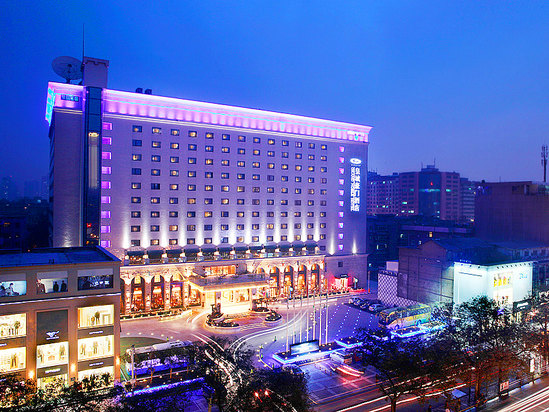
Grand Noble Hotel Xi’an is located in the most prosperous business district within the ancient city wall in the center of Xi’an.

The Grand Noble Hotel, like the Friendship Hotel, had a very flash foyer with tons of polished marble.  It sent out warning signals, but when we got to our room, we found it to be absolutely stunning.  More room, a large bathroom, air conditioning the works.

Only one small problem, as in Beijing the lighting is inadequate.  Other than that it’s what I would call a five-star hotel.  This one is definitely better than the Friendship Hotel.

In the center of the city, very close to the bell tower, one of the few ancient buildings left in Xi’an.  It is also in the middle of a larger roundabout and had a guard with a machine gun.

Sadly there was no time for city center sightseeing.

Searching for locations: From Beijing to X’ian by bullet train

Beijing West train station.

Beijing west railway station is about eight kilometers from the Forbidden City, located at East Lianhuachi Road, Fengtai District.  Most trains traveling between south central, southwest, northwest, and south China are boarded here.

This place is huge and there are so many people here, perhaps the other half of Beijing’s population that wasn’t in the forbidden city.

Getting into the station looked like it was going to be fraught with danger but the tour guide got us into the right queue and then arranged for a separate scanner for the group to help keep us all together

Then we decided to take the VIP service and got to waiting room no 13, the VIP service waiting room which was full to overflowing.  Everyone today was a VIP.  We got the red hat guy to lead us to a special area away from the crowd.

Actually, it was on the other side of the gate, away from the hoards sitting or standing patiently in the waiting room.  It gave us a chance to get something to eat before the long train ride.

The departure is at 4 pm, the train number was G655, and we were told the trains leave on time.  As it is a high-speed train, stops are far and few between, but we’re lucky, this time, in that we don’t have to count stations to know where to get off.

We’re going to the end of the line.

However, it was interesting to note the stops which, in each case, were brief, and you had to be ready to get off in a hurry.

These stops were Shijiazhuang, Zhengzhou East, Luoyang Longmen, Huashan North, and Weinan North.  At night, you could see the lights of these cities from a distance and were like oases in the middle of a desert.  During the day, the most prominent features were high rise apartment blocks and power stations.

A train ride with a difference

G Trains at Wuhan Railway Station

China’s high-speed trains, also known as bullet or fast trains, can reach a top speed of 350 km/h (217 mph).

Over 2,800 pairs of bullet trains numbered by G, D or C run daily connecting over 550 cities in China and covering 33 of the country’s 34 provinces. Beijing-Shanghai high-speed train link the two megacities 1,318 km (819 mi) away in just 4.5 hours.

By 2019, China keeps the world’s largest high-speed rail (HSR) network with a length totaling over 35,000 km (21,750 mi).

To make the five and a half hours go quicker we keep an eye on the speed which hovers between 290 and 305 kph, and sitting there with our camera waiting for the speed to hit 305 which is a rare occurrence, and then, for 306 and then for 307, which happened when we all took a stroll up to the restaurant car to find there had nothing to eat.

I got a strange flavored drink for 20 yuan.

There was a lady manning a trolley that had some food, and fresh, maybe, fruit on it, and she had a sense of humor if not much English.

We didn’t but anything but the barrel of caramel popcorn looked good.

The good thing was, after hovering around 298, and 299 kph, it finally hit 300.

We get to the end of the line, and there is an announcement in Chinese that we don’t understand and attempts to find out if it is the last station fall on deaf ears, probably more to do with the language barrier than anything else.

Then, suddenly the train conductor, the lady with the red hat, comes and tells us it is, and we have fifteen minutes, so we’re now hurrying to get off.

As the group was are scattered up and down the platform, we all come together and we go down the escalator, and, at the bottom, we see the trip-a-deal flags.

X’ian,and the Xi’an North Railway Station

Xi’an North Railway Station is one of the most important transportation hubs of the Chinese high-speed rail network. It is about 8.7 miles (14 km) from Bell Tower (city center) and is located at the intersection of the Weiyang Road and Wenjing Road in Weiyang District.

This time we have a male guide, Sam, who meets us at the end of the platform after we have disembarked.  We have a few hiccups before we head to the bus.  Some of our travelers are not on his list, but with the other group.  Apparently a trip-a-deal mix-up or miscommunication perhaps.

Then it’s another long walk with bags to the bus.  Good thing its a nicely air-conditioned newish bus, and there’s water, and beer for 10 yuan.  How could you pass up a tsing tao for that price?

Xi’an is a very brightly lit up city at night with wide roads.  It is very welcoming, and a surprise for a city of 10 million out in the middle of China.

As with all hotels, it’s about a 50-minute drive from the railway station and we are all tired by the time we get there.

Tomorrow’s program will be up at 6, on the bus 8.40 and off to the soldiers, 2.00 late lunch, then train station to catch the 4.00 train, that will arrive 2 hours later at the next stop.  A not so late night this time.

The Grand Noble Hotel

Outdoor scene

Grand Noble Hotel Xi’an is located in the most prosperous business district within the ancient city wall in the center of Xi’an.

The Grand Noble Hotel, like the Friendship Hotel, had a very flash foyer with tons of polished marble.  It sent out warning signals, but when we got to our room, we found it to be absolutely stunning.  More room, a large bathroom, air conditioning the works.

Only one small problem, as in Beijing the lighting is inadequate.  Other than that it’s what I would call a five-star hotel.  This one is definitely better than the Friendship Hotel.

In the center of the city, very close to the bell tower, one of the few ancient buildings left in Xi’an.  It is also in the middle of a larger roundabout and had a guard with a machine gun.

Sadly there was no time for city center sightseeing.

Writing about writing a book – Day 12

Today, I’ve decided on doing a little research, and this means giving the internet and Google a good workout.

I need some information about the Vietnam War.

So, as a start, I type in the words ‘Vietnam War’ into Google.

This returns: About 699,000,000 results (0.83 seconds)

Wikipedia says “The Vietnam War, also known as the Second Indochina War, and in Vietnam as the Resistance War Against America or simply the American War, was a conflict that occurred in Vietnam, Laos, and Cambodia from 1 November 1955 to the fall of Saigon on 30 April 1975”

OK, so this gives me the broadest outline.  What I need is details, so it’s a matter of where to start.  This means to start with, when did troops get sent from both Australia and the United States for service.  It seems the US sent troops from 1964 to 1969, and Australia between August 1965 and March 1966.  This gives me a starting point, because our main character is Australian, and somehow gets seconded to the Americans.

January 1972, the war ends.

Now we need to know

  •  where the bases were
  • where the battle zones were
  • methods of transportation
  • what happened to prisoners of war
  • rest and recreation points
  • CIA involvement (which will no doubt be impossible to find evidence)
  • what happened to soldiers injured in battle

It’s a list that will get longer and may require a reading list, and first-hand accounts.

It looks like it’s going to be a long day.

Writing about writing a book – Day 12

Today, I’ve decided on doing a little research, and this means giving the internet and Google a good workout.

I need some information about the Vietnam War.

So, as a start, I type in the words ‘Vietnam War’ into Google.

This returns: About 699,000,000 results (0.83 seconds)

Wikipedia says “The Vietnam War, also known as the Second Indochina War, and in Vietnam as the Resistance War Against America or simply the American War, was a conflict that occurred in Vietnam, Laos, and Cambodia from 1 November 1955 to the fall of Saigon on 30 April 1975”

OK, so this gives me the broadest outline.  What I need is details, so it’s a matter of where to start.  This means to start with, when did troops get sent from both Australia and the United States for service.  It seems the US sent troops from 1964 to 1969, and Australia between August 1965 and March 1966.  This gives me a starting point, because our main character is Australian, and somehow gets seconded to the Americans.

January 1972, the war ends.

Now we need to know

  •  where the bases were
  • where the battle zones were
  • methods of transportation
  • what happened to prisoners of war
  • rest and recreation points
  • CIA involvement (which will no doubt be impossible to find evidence)
  • what happened to soldiers injured in battle

It’s a list that will get longer and may require a reading list, and first-hand accounts.

It looks like it’s going to be a long day.

“Trouble in Store” – Short stories my way:  Editing becomes re-writing (3)

I have reworked the first part of the story with a few new elements about the characters and changed a few of the details of how the characters finish up in the shop before the policewoman makes her entrance.

This is part of the new first section is the one that involves the shopkeeper`:


This wasn’t the shopkeeper’s first hold up.  In fact, over the years there had been a dozen.  But only one got reported to the police, and that was only because the robber was shot and killed.

He’d taken a bullet that night, too, which, from the police point of view, made him a concerned citizen simply defending himself.

The rest had been scared off by the double-barrel shotgun he kept under the counter for just such emergencies.

The young punk who came into the shop with his girlfriend had pulled out the pistol and told him if he reached for the shotgun he’d shoot him.  The kid looked unstable and he’d backed away.

When the kid collapsed, he should have gone for the shotgun, but instead, he thought he could get to the gun before the girl realized what was happened.  She wasn’t an addict and clearly looked like she was only along for the ride.  Her expression, when the kid pulled out the gun told him she’d known nothing about her partner’s true intentions.

But, he wasn’t fast enough, and she had the gun pointing at him before he’d got past the counter.

From one pair of unpredictable hands to another.

Like the girl, he was just as surprised when the customer burst in the door, just before closing time.

The situation might have been salvageable before the customer came in the door, getting the girl to go along with the robbery being about money, but there was no denying what the kid on the floor’s problem was.

Damn.

He had to try and salvage the situation simply because there was a lot of money involved, and other people depending on him.  He looked at the boy, on the floor, then the girl.

“Listen to me, young lady, you would be well advised to let this man go as he suggests.  And, please put the gun down before someone gets hurt.  Your friend needs medical help and I can call an ambulance.”

The girl switched her attention back to him.  “No one’s going anywhere, so just shut the hell up and let me think.”

The storekeeper glanced over at the customer. 

He’d seen him come into the shop once or twice, probably lived in the neighborhood, the sort who’d make a reliable witness, either a lawyer or an accountant.  Not like most of the residents just beyond the fringe of respectability.

If only he hadn’t burst into the shop when he did.


© Charles Heath 2016-2020

“Trouble in Store” – Short stories my way:  Editing becomes re-writing (3)

I have reworked the first part of the story with a few new elements about the characters and changed a few of the details of how the characters finish up in the shop before the policewoman makes her entrance.

This is part of the new first section is the one that involves the shopkeeper`:


This wasn’t the shopkeeper’s first hold up.  In fact, over the years there had been a dozen.  But only one got reported to the police, and that was only because the robber was shot and killed.

He’d taken a bullet that night, too, which, from the police point of view, made him a concerned citizen simply defending himself.

The rest had been scared off by the double-barrel shotgun he kept under the counter for just such emergencies.

The young punk who came into the shop with his girlfriend had pulled out the pistol and told him if he reached for the shotgun he’d shoot him.  The kid looked unstable and he’d backed away.

When the kid collapsed, he should have gone for the shotgun, but instead, he thought he could get to the gun before the girl realized what was happened.  She wasn’t an addict and clearly looked like she was only along for the ride.  Her expression, when the kid pulled out the gun told him she’d known nothing about her partner’s true intentions.

But, he wasn’t fast enough, and she had the gun pointing at him before he’d got past the counter.

From one pair of unpredictable hands to another.

Like the girl, he was just as surprised when the customer burst in the door, just before closing time.

The situation might have been salvageable before the customer came in the door, getting the girl to go along with the robbery being about money, but there was no denying what the kid on the floor’s problem was.

Damn.

He had to try and salvage the situation simply because there was a lot of money involved, and other people depending on him.  He looked at the boy, on the floor, then the girl.

“Listen to me, young lady, you would be well advised to let this man go as he suggests.  And, please put the gun down before someone gets hurt.  Your friend needs medical help and I can call an ambulance.”

The girl switched her attention back to him.  “No one’s going anywhere, so just shut the hell up and let me think.”

The storekeeper glanced over at the customer. 

He’d seen him come into the shop once or twice, probably lived in the neighborhood, the sort who’d make a reliable witness, either a lawyer or an accountant.  Not like most of the residents just beyond the fringe of respectability.

If only he hadn’t burst into the shop when he did.


© Charles Heath 2016-2020

How could that possibly happen… – A short story

I had hoped by the time I was promoted to assistant manager it might mean something other than long hours and an increase in pay.

It didn’t.

But unlike others who had taken the job, and eventually become jaded and left, I stayed. Something I realized that others seemed to either ignore or just didn’t understand, this was a company that rewarded loyalty.

It was why there were quite a few who had served 30 years or more. They might not reach the top job, but they certainly well looked after.

I had a long way to go, having been there only 8 years, and according to some, on a fast track. I was not sure how I would describe this so-called ‘fast track’ other than being in the right place at the right time and making a judicial selection.

When it was my turn to be promoted, I had a choice of a plum department, or one most of my contemporaries had passed over. At the time, the words of my previous manager sprang to mind, that being a manager for the most sought after department or the least sought after, came with exactly the same privileges.

And, he was right. I took the least sought after, much to their disdain and disapproval. One year on, that disapproval had turned almost to envy; that was when the Assistant Managers were granted a new privilege, tea, and lunch in the executive dining room.

“So, what’s it like?” John asked, when our group met on a Friday night, this the first after the privilege was granted.

He had been one of the three, including me, who had the opportunity to take the role. Both he and Alistair had both declined, prepared to wait for a more prestigious department. It hadn’t happened to them yet.

“The same as the staff dining room, only smaller. Except, I guess, the waitstaff and butler. They come and serve you when you have to go to them in the staff room. They’re the same staff, by the way, except for the butler.”

I could see the awe, or was it envy, in their eyes. “but it’s not that great. The Assistant Managers all sit at one end of the table, and we’re not part of the main group, so no sharing of information I’m afraid. And the meals are the same, just served on fancier crockery.”

“Then nothing to write home about?” Will was one of those who they also thought to be on a ‘fast track’. I was still trying to see how my ‘fast track’ was actually that fast.

“Put it this way, the extra pay doesn’t offset the long hours because you get overtime, I don’t, so on a good week, you’d all be earning more than me. Without responsibility, if anything goes wrong. I think that’s why Assistant Managers were created, to take the blame when anything goes wrong.”

That had been the hardest pill to swallow. Until I got the role, I hadn’t realized what it really involved. Nor had the others, and it was not something we could whinge about. My first-day introductory speech from Tomkins, my Manager, was all about taking responsibility, and how I was there to make his life easier. It was a speech he made a few times because he’d been Manager for the last 16 years, much the same as the others, and promotion if ever, would come when they died.

And Manager’s rarely died, because of their Assistant Managers.

“How old is Tomkins now?” Bert, a relative newcomer to our group, asked. He was still in the ‘in awe’ phase.

“About the same as Father Time,” I said. “But the reality is, no one knows, except perhaps for the personnel manager.” O looked over at Wally, the Personnel Department’s Assistant Manager. “Any chance of you telling us?”

“No. You know I can’t.”

“But you know?” I asked.

“Of course, but you know the rules. That’s confidential information. Not like what you are the custodian of, information everyone needs.”

Which, of course, was true. Communication and Secretarial Services had no secrets, except for twice a year when the company Bord of Directors met, and we were responsible for all the documents used at their meetings. Then, and only then, was I privy to all the secrets, including promotions. And be asked ‘What’s happening?’.

“Just be content to know that he’s as old as the hills, as most of them. It seems to me that one of the pre-requisites for managership is that you have been employed here for 30 years.”

Not all, though, I’d noticed, but there wasn’t one under the age of fifty.

And so it would go, the Friday night lament, those ‘in’ the executive, and those who were not quite there yet.
It seemed prophetic, in a sense, that we had been talking about Mangers and their ages. By a quirk of fate, some weeks before, that I learned of Tomkins’s currents state of health via a call on his office phone. At the time he was out, where, he had not told me, but by his the I believed it was something serious, so serious he didn’t want me, or anyone else, to know about it.

That phone call was from his wife, Eleanor, whom I’d met on a number of occasions when she came to take him home from work. I liked her, and couldn’t help but notice she was his exact opposite, Tomkins, silent and at times morose, and Eleanor, the life of the party. I could imagine her being a handful in her younger days, and it was a stark reminder of that old saying ‘opposites attract’.

She was concerned and asked me if he had returned from the specialist. I simply said he had but was elsewhere, and promised to get him to call her when he returned. Then I made a quick call around to see where he was and found that he was in Personnel. I left an innocuous message on his desk, and then let my imagination run wild.

At least for a day or so, the time it took for me to realize that it was probably nothing, the lethargy he’d been showing, gone.

I’d put it out of my mind until my cell phone rang, and it was from the Personnel Manager. On a Sunday, no less. In the few seconds before I answered it, I’d made the assumption that Tomkins’s secretive visits to the specialist meant he needed time off for a routine operation.

Greetings over, O’Reilly, the Personnel Manager, cut straight to the chase, “For your personal information, and not to be repeated, Tomkins will be out of action for about two months, and as that is longer than the standard period, you will become Acting Manager. We’ll talk more about this Tuesday morning.” Monday was a holiday.

All Assistant Managers knew the rules. Any absence of a manager for longer than a month, promotion to Acting Manager. Anything less, you sat in the office, but no change in title. There was one more rule, that in the event of the death of a manager, the assistant manager was immediately promoted to Manager. This had only happened once before. 70 years ago. If a manager retired, then the position of Manager was thrown open to anyone in the organization.

It was an intriguing moment in time.

Tuesday came, and as usual, I went into the office, with only one thought in mind, let the staff in the department know what was happening, of course, the moment I was given the approval to do so by Personnel.

Not a minute after I sat down, the phone rang. I picked it up, gave my name and greeting. It was met with a rather excitable voice of the Assistant Manager, Personnel, “I just got word from on high, you’ve been promoted to manager. How could that possibly happen…”

Then a moment later, as realization set in, “Unless…”

—-

© Charles Heath 2020-2021

“Trouble in Store” – Short stories my way:  Editing becomes re-writing (2)

I have reworked the first part of the story with a few new elements about the characters and changed a few of the details of how the characters finish up in the shop before the policewoman makes her entrance.

This is part of the new first section is the one that involves Annalisa, and her boyfriend, Simmo:


Annalisa looked at the two men facing her.

Simmo, the boy on the floor, had told her that the shopkeeper would be a pushover, he was an old man who’d just hand over the drugs, rather than cause trouble for himself.

Where Simmo had discovered what the shopkeeper’s true vocation, dispensing drugs to the neighborhood addicts, she didn’t know, but it was not the first place like this they had visited.

She had always known Simmo had a problem, but he had assured her he had it under control.  Until a month ago, when he had tried something new.

It had changed him.

The breaking point came earlier that day when, seeing how sick he was, she threatened to leave.  It brought out the monster within him, and he threatened to kill her.  Not long after he had changed into a whimpering child pleading with her to stay, that he hadn’t meant anything he’d said before.

All he needed was one more ‘score’ to get his ‘shit’ together, and he would do as she asked, and find help.

She believed him.

He said he knew a place not far from the apartment, a small shop where what he needed was available, and said he had the money.

That should have been the first sign he was not telling the truth because she had been funding his habit until her parents cut off the money supply.  She suspected her father had put a private detective on to find her, had, and reported back, and rather than make a scene, just cut her off so she would have to come home or starve.  Her father was no better than Simmo.

And, as soon as they stepped into the shop, Simmo pulled out the gun,

Instead of the shopkeeper cowered like Simmo said he would, he had laughed at them and told them to get out.  Simmo started ranting and waving the gun around, then all of a sudden collapsed. 

There was a race for the gun which spilled out of Simmo’s hand, and she won. 

That was just before the customer burst into the shop.

It had been shortly before closing time.  Simmo had said there would be no one else around.

Wrong again.

Now she had another problem to deal with, a man who was clearly as scared shitless as she was.

This was worse than any bad hair day, or getting out of the wrong side of bed day, this was, she was convinced, the last day of her life.

She heard a strange sound come from beside her and looked down.  There was a trickle of blood coming out of his mouth and Simmo was making strange sounds like he was choking.

Any other time she might have been concerned, but the hard reality of it was, Simmo was never going to change.  She was only surprised at the fact it took so long for her to realize it.

As for the man standing in front of her, she was safe from the shopkeeper with him around, so he would have to stay.

“No.  Stay.”

Another glance at the shopkeeper told her she had made the right decision, his expression said it all.  Gun or no gun, the moment she was alone with him, he would kill her.


© Charles Heath 2016-2020

Writing about writing a book – Day 10

I’m back to writing, sitting at the desk, pad in front of me, pen in hand.
The only thing lacking, an idea

It’s 9:03 am, too early to start on a six-pack.

I need to try and concentrate on the job at hand, but it isn’t working.

Blogging, websites, Twitter and Facebook, all of these social media problems are swirling around in my mind.

The more I read the more it bothers me that if I don’t have the right social media presence if I do not start to build an email list, all of my efforts in writing a book will come to naught.  And especially so, if I don’t hire a professional to do my cover.  Another problem to add to the ever-growing list.

Then I start trawling the internet for information on marketing and found a plethora of people offering any amount of advice for anything between a ‘small amount’ to a rather large amount that gives comprehensive coverage of most social media platforms for periods of a day, a week or a month.  I don’t have a book so it’s a bit early to be worrying about that.

I move onto the people who offer advice for a cost on how to build a following, how to build a web presence, how to get a thousand Twitter followers, how to get thousands of email followers before the launch.

The trouble is I’m writing a novel, not a nonfiction book, or have some marvelous 30-page ebook on how to do something, for free just to drive people to my site.  I’m a novelist, not a handyman so those ideas while good is not going to help me.  And there are enough people out there telling the rest of us how to be a writer, how to be a marketer and then some.  The problem is, most of them are one long advertisement, offering the ‘real’ answers’ for money.

I’m not sure how many people have my email address, but I’m getting over a hundred emails a day, all asking me to buy some sort of guaranteed service.

Yet another problem to wrestle with along with actually creating a product to sell in the first place.

Except I’m supposed to be writing for the love of it without the premeditated idea of writing for gain or getting rich quick.

What am I missing here?

So should l be writing short stories and offering them for free to drive people to my site?  These would have to be genre-specific so it needs time and effort and fit into a convenient size story that will highlight or showcase my talent.

Or should I create a website for the novel and set up pages for the characters and get some interaction going that way?  It will be difficult without giving the whole plot away so if I do it will have to be carefully managed.  And, in doing so, it will be taking me away from what I’m supposed to be doing, writing.

Of course, I could get someone else to set all this up for me, but I haven’t got fifty dollars, let along the $5,000 they are asking.   Yes, I can create a free site, yes, I can find a cheaper option if I looked hard enough, but, again, it takes me away from my primary objective.

I don’t think I will have a good night’s sleep again with all of these social media problems I’m going to have.

Oh well, back to the book.  It’s time to have a nightmare of a different sort!


When I opened my eyes I was in a room, not immediately recognizable, because it looked like my room, in my parent’s house where I grew up, when I was a young boy.

The curtains fluttered on the other side of the room, around the edges a muted light that could have been the moon or street lighting.

It was warm, the breeze pushing pas the curtain material and washing over me in gentle waves.  I was hot and could feel the sweat on my brow.

It reminded me of the long summer days, the warmth stretching into the night, and the cool breezes that made the endless heat bearable, where the only covering you needed was a sheet, and then sometimes not.

There was movement, also, on the other side of the room, a figure curled up in a chair, the form of which was framed as a silhouette against the indistinct light, now a little brighter.  My eyes were rapidly adjusting, and shapes were becoming clearer.

I turned my head slightly and saw a door with a window in it, slightly ajar.  My bedroom door had never had a window,

I tried to speak but couldn’t, my throat dry, and made swallowing difficult.  It felt like something was stuck in my throat.

I tried to think, but it made my head hurt, and, then, a thousand images flashed before my eyes, or what seemed like a thousand, of a time I’d never known about.

Not until now.

Of a past that I’d known was lurking somewhere in my mind.  Of a missing period of my life that had been, up till now, locked away, and beyond my grasp.

And for a good reason.

It was awful.

No.  It was horrendous.

No.  It was worse than that.  Words could not describe the images, the feelings, the despair, the hopelessness.

And then I screamed.  Bound, in pain, feeling a charge of electric current run through me, trying to beg them to stop, only to find my mouth stuffed with a filthy, horrible tasting rag, making me gag.

Then it stopped, and I slumped back, easing the muscles that had tensed in pain, opening my eyes to see a man, Chinese, holding a knife over me, saying, “You will tell me what I want to know” over and over, then slowly pushing the knife near my shoulder, the pain unbearable as I screamed and begged for him to stop.

And as suddenly it started, it stopped.

It had to be a dream.  It had to be.

Then nothing.


I’m not sure about the knife wound, what impact or damage it may have or cause so some investigation is needed.

And that’s not where it ends.  More of the nightmare tomorrow!


© Charles Heath 2018-2020