Writing about writing a book – Day 20

It is a day of rest although writers are ready and able to work on any given day at any hour of the day or night when an idea or thought comes to them.

I’m trying not to think, but that’s not working.

I’ve been going over the reasons for writing the first draft of the book 30 odd years ago and it had something to do with the fact I was working with personal computers and local area networking when both were in their infancy, and I wanted to blend this knowledge into a story.

Of course, I’d always wanted to write thrillers, and this presented the opportunity to use computers as a basis for a worldwide conspiracy.  How easy it is these days to do just that, but back in those days, it was a lot of hard work.

I remember sitting in a meeting when the company I was working for at the time had just implemented a network and personal computer to replace the mainframe and dumb terminals, also looking to leverage the new technologies of spreadsheets and word-processing, effectively making accounts staff more productive, and removing typists and moving into the world of centralized word processing.  It was not a new idea with Wangwriter, but using PC’s was.

One of the departmental managers got up to give his take on the new technology, this about six months after implementation, and after a lot of teething troubles caused mainly by people who were vehemently resisting change, and his message was, it should not be called ‘networking’, but ‘not working’, in reference to the number of times the network went down.

But this is a digression.  Computers are only a part of the story.

The story also goes back to a time when there was a clear demarcation between the management levels.  Management offices were oasis’s whereas the staff worked in a stark desert-like environment.  When one came to work for such an organization, it was with the belief that you start at the bottom, and over time, you work your way up the ladder.  There was, very definitely, class distinction, and the various management levels never mixed, at work or socially, except within their own level.

There were Managers, Assistant Managers, and Manager’s Assistants, a typing pool, a secretary, that young, or old, lady who did so many jobs for their boss, that these days it would be considered demeaning.  They were dedicated to their jobs and irreplaceable.  There was no such person as a Personal Assistant.

Nor was such a thing as sexual harassment.  One company I worked in where one of the Assistant Managers was sexually abusing an office girl, her complaints didn’t get a prosecution as it would now, it just had him transferred to another branch.  Reprehensible, yes, and thankfully no longer a problem, except of course, in Fifty Shades of Grey which apparently condones such behavior.

There were department heads, General Managers, and Board Members.  The upper management level and participants were in a world of their own, one few could ever aspire to.  This is the world in which Transworld, my fictitious (but based on a very real) company lives.

I have to work on my company structure to make sure it is right.

Now I have two charts.  A timeline, for both Bill, and the story, and a hierarchy for the office management and staff.

This is beginning to be more complicated than I thought.


© Charles Heath 2016-2020

Writing about writing a book – Day 19

I’m still working on the sequence of flashbacks for the story, filling out the back story to how Bill became associated with a man called Colonel Davenport.

It is important to remember that while Davenport may have begun with good intentions, it was not difficult to go slowly mad given the conditions.  This character, Davenport, runs a multitude of operations within the war zone, turning a huge profit and setting up a business for when the war ended.

Bill meets his Davenport’s cronies and then the man himself.  Life is not what it seems, and working for him is not a guarantee of safety, so Bill not only has to watch out for the enemy but also those with whom he also works.


Part 3 – In the Service of Davenport

Davenport and punishment

Busted mission, the first threat to Davenport

Manilow’s death – and how he got there

More on Manilow, the night before his death

Taken to rendezvous with Davenport’s boss

Identify Davenport by ‘sniveling morons’

Sniper – killing Ellen’s father – set up

Sniper – Killing Ellen’s father, execution

Planes and death


Bill gets to meet an interesting cast of characters, not the least of which is Davenport’s right-hand men, and a very unlucky lad who was supposed to see through his tour in the command station far from the war zone, and who is connected to a person close to him.

He was also unwittingly involved in a murder, one set up by Davenport, and one designed to keep his silence.


Part 4 – The Lead up to Capture, and in a POW camp

The object that Davenport is seeking

After R & R revoked, retrieved by Davenport for the last mission

Capture by Cho’s forces, delivered by Davenport’s men

In the POW Camp, and the arrival of Cho

Day of Rescue from Cho

Ellen and Jacobson after rescue in the hospital


Bill’s safety may have been assured had he simply toed the line, but, while on a secret mission with Davenport’s men, he sees an opportunity to take some evidence of Davenport’s activities, as an act of self-preservation.

Of course, he doesn’t reckon with the ruthlessness of Davenport and ends up in a camp where Bill is handed over to the chief interrogator, a friend of Davenport’s.  There is no doubt what Cho’s mission is.

But, like all seemingly simple plans, it doesn’t go the way Davenport wants, Bill does not talk, and is eventually rescued.


Part 5 – Post Rescue and Transworld

Employment at Transworld, then first interrogation via Collins

In hospital immediately after being shot

Davenport in my hospital room, post being shot

Recognize Jorgenson


Davenport discovers Bill was rescued, and that is has lost his memory of all the time in his service, so just in case Bill does, one day, remember, he will be there to get the answers, and the missing information.

It is almost a story within a story, and maybe one day will be published as such.

At least now I have some idea of how to work the much larger story into the flashbacks, as a prelude to what happens to Bill once he realizes who is behind everything that is happening at Transworld.


© Charles Heath 2015-2020

Writing about writing a book – Day 19

I’m still working on the sequence of flashbacks for the story, filling out the back story to how Bill became associated with a man called Colonel Davenport.

It is important to remember that while Davenport may have begun with good intentions, it was not difficult to go slowly mad given the conditions.  This character, Davenport, runs a multitude of operations within the war zone, turning a huge profit and setting up a business for when the war ended.

Bill meets his Davenport’s cronies and then the man himself.  Life is not what it seems, and working for him is not a guarantee of safety, so Bill not only has to watch out for the enemy but also those with whom he also works.


Part 3 – In the Service of Davenport

Davenport and punishment

Busted mission, the first threat to Davenport

Manilow’s death – and how he got there

More on Manilow, the night before his death

Taken to rendezvous with Davenport’s boss

Identify Davenport by ‘sniveling morons’

Sniper – killing Ellen’s father – set up

Sniper – Killing Ellen’s father, execution

Planes and death


Bill gets to meet an interesting cast of characters, not the least of which is Davenport’s right-hand men, and a very unlucky lad who was supposed to see through his tour in the command station far from the war zone, and who is connected to a person close to him.

He was also unwittingly involved in a murder, one set up by Davenport, and one designed to keep his silence.


Part 4 – The Lead up to Capture, and in a POW camp

The object that Davenport is seeking

After R & R revoked, retrieved by Davenport for the last mission

Capture by Cho’s forces, delivered by Davenport’s men

In the POW Camp, and the arrival of Cho

Day of Rescue from Cho

Ellen and Jacobson after rescue in the hospital


Bill’s safety may have been assured had he simply toed the line, but, while on a secret mission with Davenport’s men, he sees an opportunity to take some evidence of Davenport’s activities, as an act of self-preservation.

Of course, he doesn’t reckon with the ruthlessness of Davenport and ends up in a camp where Bill is handed over to the chief interrogator, a friend of Davenport’s.  There is no doubt what Cho’s mission is.

But, like all seemingly simple plans, it doesn’t go the way Davenport wants, Bill does not talk, and is eventually rescued.


Part 5 – Post Rescue and Transworld

Employment at Transworld, then first interrogation via Collins

In hospital immediately after being shot

Davenport in my hospital room, post being shot

Recognize Jorgenson


Davenport discovers Bill was rescued, and that is has lost his memory of all the time in his service, so just in case Bill does, one day, remember, he will be there to get the answers, and the missing information.

It is almost a story within a story, and maybe one day will be published as such.

At least now I have some idea of how to work the much larger story into the flashbacks, as a prelude to what happens to Bill once he realizes who is behind everything that is happening at Transworld.


© Charles Heath 2015-2020

Writing about writing a book – Day 18

It’s time to go back to working on Bill’s backstory now that we’ve filled in some of the gaps.

Like some TV shows and books, some of the action sometimes takes the form of flashbacks.

In Starburst, Bill has a complete backstory, of a time that he had mainly forced into the deep dark part of his memory, waiting for something or someone to trigger it.

This whole back story, from the moment he entered the war zone, to the moment his war ended, and those that participated throughout that time, will be in the form of flashbacks, the first of which is triggered by the painkiller Bill is given after being shot in the Aitcheson incident.

These flashbacks will not necessarily be in any sort of order, but I have been thinking about this part of the story and produced an outline of the sequences I will require, give or take.  There may be more, or less, depending on how the story progresses.

Part 1 – From arrival in the war zone to being assigned to Davenport’s squad

Being sent to, and the first patrol in Vietnam

Death and mayhem some months after sent to Vietnam

First meeting Barry in army mobile hospital

R and R in Saigon, with the first of the Vietnamese girls

Psychiatric help, time in the stockade

No soldier who trains for war, nor can they have a real idea what war is like, and certainly a war in the jungle, on the enemy’s terms.  Bill is like any other soldier, happy to go into service, but soon the reality, and death becomes apparent.

Endless rain, endless heat, endless and sometimes needless death, and a deep mistrust of those whom you are supposed to protect, start to work on the mind of a person young enough not to understand what is going on.

Then, when trying to blot out the memories of death, enemy and friend alike, something has to give.  Of course, the last place you want to end up in the stockade.

Part 2 – A lifeline, and a pass into the so-called Davenport Operation

Training as a spy?

Colonel, calling Bill into a briefing on the Davenport operation

Talking to the Commanding officer in Stockade, as a preliminary to Davenport service

Was Bill sent to the stockade because he committed an act of folly, or his incarceration a part of a much larger plan, a plan to have an inside man to report on Davenport?

It’s not the first time someone higher up the chain of command has had ideas of trying to find out what Davenport is doing, and where only rumors abound of his ‘interests’.  Agents had been sent in before, and those agents had disappeared.

Was Bill about to be the next, or was he just in the wrong place at the wrong time?

There is more, but I’m still working on it.

© Charles Heath 2015-2021

Searching for locations: The Erqi Memorial Tower, Zhengzhou, China

A convoluted explanation on the reasons for this memorial came down to it being about the deaths of those involved in the 1923 Erqi strike, though we’re not really sure what the strike was about.

So, after a little research, this is what I found:

The current Erqi Tower was built in 1971 and was, historically, the tallest building in the city. It is a memorial to the Erqi strike and in memory of Lin Xiangqian and other railway workers who went on strike for their rights, which happened on February 7, 1923.

It has 14 floors and is 63 meters high. One of the features of this building is the view from the top, accessed by a spiral staircase, or an elevator, when it’s working (it was not at the time of our visit).

There seems to be an affinity with the number 27 with this building, in that

  • It’s the 27th memorial to be built
  • to commemorate the 27th workers’ strike
  • located in the 27th plaza of Zhengzhou City.

We drive to the middle of the city where we once again find traveling in kamikaze traffic more entertaining than the tourist points

When we get to the drop-off spot, it’s a 10-minute walk to the center square where the tower is located on one side. Getting there we had to pass a choke point of blaring music and people hawking goods, each echoing off the opposite wall to the point where it was deafening. Too much of it would be torture.

But, back to the tower…

It has 14 levels, but no one seemed interested in climbing the 14 or 16 levels to get to the top. The elevator was broken, and after the great wall episode, most of us are heartily sick of stairs.

The center square was quite large but paved in places with white tiles that oddly reflected the heat rather than absorb it. In the sun it was very warm.

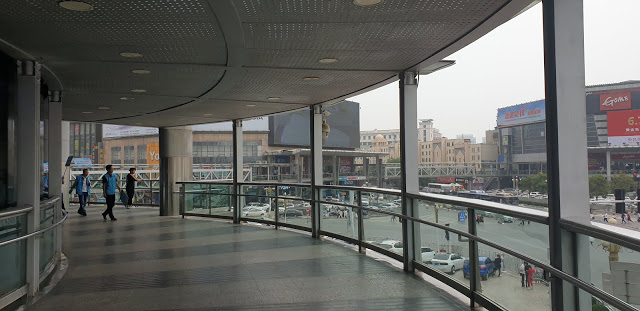
Around the outside of two-thirds of the square, and crossing the roads, was an elevated walkway, which if you go from the first shops and around to the other end, you finish up, on the ground level, at Starbucks.

This is the Chinese version and once you get past the language barrier, the mixology range of cold fruity drinks are to die for, especially after all that walking. Mine was a predominantly peach flavor, with some jelly and apricot at the bottom. I was expecting sliced peaches but I prefer and liked the apricot half.

A drink and fruit together was a surprise.

Then it was the walk back to the meeting point and then into the hotel to use the happy house before rejoining the kamikaze traffic.

We are taken then to the train station for the 2:29 to our next destination, Suzhou, the Venice of the East.

Writing about writing a book – Day 17

There is more, and it has been forming in my mind overnight after I read, and re-read yesterday’s work.


This operation was led by two ex American army lieutenants who had served in the Vietnam war and afterward searching for lost comrades.  The Colonel told me they had spent a few years looking for lost POW’s held in camps just over the border in Cambodia or Laos and had a good track record in the jungle.  He trusted them and said I could too.

I thought it odd he felt the need to reassure me.

He said they’d had marginal success, but my own impression was that they were ex CIA, gone rogue, and were part of the burgeoning drug trade that had sprung up during and after the war had ended.   For all that, I had also begun to suspect the Colonel had sold out and we were more about protecting the criminals rather than trying to catch them, and for me, that unquestioning obedience he demanded was beginning to slip.

They also had the look of men who had spent their time sampling the product, and as such were treading a fine line between sanity and insanity.  Still, at first, they didn’t seem all that different to us.

Thoroughly soaked, we made the camp on schedule, planned the attack, and carried it out.  Only there was no one there, it was empty, and had been for some time.  I turned to question the two ‘experts’.

Pity then I hadn’t noticed his partner coming up from behind.  If I had, my situation may have been very, very, different.


When I woke up, it was not in a nice warm or comfortable bed.  It was a dirt floor.  I looked up and realized I was in a hut.  Daytime, very hot, with sharp, bright shards of light leaking through the cracks in the wall and around the doorway.

My head was hurting, as was just about every other part of me, but a cursory examination showed nothing was broken.  Yet.

It took only a moment for clarity to return, and the realization we were prisoners.  Survivors from the group, the only survivors.

The other occupant, a soldier whom I only knew by his first name, Barry, stirred, and then rolled over.

“Where are we?” he asked.

‘In a hut.”

“Where?”

“Your guess is as good as mine.”

He groaned, and then tried to sit up, only to slowly sink back down again.  Perhaps he had tried harder to escape and paid a heavier price.

“This is not looking good,” he said.

“No.”  An understatement, I thought, but to my knowledge, this was the first time I’d heard they took prisoners.  Usually, everyone was summarily executed, and the bodies set up as an example to others.

I heard the sound of boots on gravel coming towards the hut, then, in an instant, the harsh light coming in, temporarily blinding me as the door was yanked open.

When my eyes adjusted I saw two bulky men holding machine guns standing behind another, a short Chinese, with a very familiar face.

Where?  When?

Then I remembered.  A week ago, in Hong Kong, at a hastily arranged meeting between Davenport and the police who were supposed to be helping us with information on a smuggling group known to be operating in the Vietnam/Cambodia/Laos area.  He was the Chinese liaison, connected with the Government.

Apparently not.

This was bad.  Very, very bad.

“Mr. Chandler.  So nice of you to join us.  Colonel Davenport and I are so disappointed in you.”

© Charles Heath 2015-2021

Writing about writing a book – Day 17

There is more, and it has been forming in my mind overnight after I read, and re-read yesterday’s work.


This operation was led by two ex American army lieutenants who had served in the Vietnam war and afterward searching for lost comrades.  The Colonel told me they had spent a few years looking for lost POW’s held in camps just over the border in Cambodia or Laos and had a good track record in the jungle.  He trusted them and said I could too.

I thought it odd he felt the need to reassure me.

He said they’d had marginal success, but my own impression was that they were ex CIA, gone rogue, and were part of the burgeoning drug trade that had sprung up during and after the war had ended.   For all that, I had also begun to suspect the Colonel had sold out and we were more about protecting the criminals rather than trying to catch them, and for me, that unquestioning obedience he demanded was beginning to slip.

They also had the look of men who had spent their time sampling the product, and as such were treading a fine line between sanity and insanity.  Still, at first, they didn’t seem all that different to us.

Thoroughly soaked, we made the camp on schedule, planned the attack, and carried it out.  Only there was no one there, it was empty, and had been for some time.  I turned to question the two ‘experts’.

Pity then I hadn’t noticed his partner coming up from behind.  If I had, my situation may have been very, very, different.


When I woke up, it was not in a nice warm or comfortable bed.  It was a dirt floor.  I looked up and realized I was in a hut.  Daytime, very hot, with sharp, bright shards of light leaking through the cracks in the wall and around the doorway.

My head was hurting, as was just about every other part of me, but a cursory examination showed nothing was broken.  Yet.

It took only a moment for clarity to return, and the realization we were prisoners.  Survivors from the group, the only survivors.

The other occupant, a soldier whom I only knew by his first name, Barry, stirred, and then rolled over.

“Where are we?” he asked.

‘In a hut.”

“Where?”

“Your guess is as good as mine.”

He groaned, and then tried to sit up, only to slowly sink back down again.  Perhaps he had tried harder to escape and paid a heavier price.

“This is not looking good,” he said.

“No.”  An understatement, I thought, but to my knowledge, this was the first time I’d heard they took prisoners.  Usually, everyone was summarily executed, and the bodies set up as an example to others.

I heard the sound of boots on gravel coming towards the hut, then, in an instant, the harsh light coming in, temporarily blinding me as the door was yanked open.

When my eyes adjusted I saw two bulky men holding machine guns standing behind another, a short Chinese, with a very familiar face.

Where?  When?

Then I remembered.  A week ago, in Hong Kong, at a hastily arranged meeting between Davenport and the police who were supposed to be helping us with information on a smuggling group known to be operating in the Vietnam/Cambodia/Laos area.  He was the Chinese liaison, connected with the Government.

Apparently not.

This was bad.  Very, very bad.

“Mr. Chandler.  So nice of you to join us.  Colonel Davenport and I are so disappointed in you.”

© Charles Heath 2015-2021

Searching for locations: From Zhengzhou to Suzhou by train, and the Snowy Sea Hotel, Suzhou, China

For the first time on this trip, we encounter problems with Chinese officialdom at the railway station, though we were warned that this might occur.

We had a major problem with the security staff when they pulled everyone over with aerosols and confiscated them. We lost styling mousse, others lost hair spray, and the men, their shaving cream.  But, to her credit, the tour guide did warn us they were stricter here, but her suggestion to be angry they were taking our stuff was probably not the right thing to do.

As with previous train bookings, the Chinese method of placing people in seats didn’t quite manage to keep couples traveling together, together on the train.  It was an odd peculiarity which few of the passengers understood, nor did they conform, swapping seat allocations.

This train ride did not seem the same as the last two and I don’t think we had the same type of high-speed train type that we had for the last two.  The carriages were different, there was only one toilet per carriage, and I don’t think we were going as fast.

But aside from that, we had 753 kilometers to travel with six stops before ours, two of which were very large cities, and then our stop, about four and a half hours later.  With two minutes this time, to get the baggage off the team managed it in 40 seconds, a new record.

After slight disorientation getting off the train, we locate our guide, easily ground by looking for the Trip-A-Deal flag.  From there it’s a matter of getting into our respective groups and finding the bus.

As usual, the trip to the hotel was a long one, but we were traveling through a much brighter, and well lit, city.

As for our guide, we have him from now until the end of the tour.  There are no more train rides, we will be taking the bus from city to city until we reach Shanghai.  Good thing then that the bus is brand new, with that new car smell.  Only issue, no USB charging point.

The Snowy Sea hotel.  

It is finally a joy to get a room that is nothing short of great.  It has a bathroom and thus privacy.

Everyone had to go find a supermarket to purchase replacements for the confiscated items.  Luckily there was a huge supermarket just up from the hotel that had everything but the kitchen sink.

But, unlike where we live, the carpark is more of a scooter park!

It is also a small microcosm of Chinese life for the new more capitalistic oriented Chinese.

The next morning we get some idea of the scope of high-density living, though here, the buildings are not 30 stories tall, but still just as impressive.

These look like the medium density houses, but to the right of these are much larger buildings

The remarkable thing about this is those buildings stretch as far as the eye can see.

Searching for locations: From Zhengzhou to Suzhou by train, and the Snowy Sea Hotel, Suzhou, China

For the first time on this trip, we encounter problems with Chinese officialdom at the railway station, though we were warned that this might occur.

We had a major problem with the security staff when they pulled everyone over with aerosols and confiscated them. We lost styling mousse, others lost hair spray, and the men, their shaving cream.  But, to her credit, the tour guide did warn us they were stricter here, but her suggestion to be angry they were taking our stuff was probably not the right thing to do.

As with previous train bookings, the Chinese method of placing people in seats didn’t quite manage to keep couples traveling together, together on the train.  It was an odd peculiarity which few of the passengers understood, nor did they conform, swapping seat allocations.

This train ride did not seem the same as the last two and I don’t think we had the same type of high-speed train type that we had for the last two.  The carriages were different, there was only one toilet per carriage, and I don’t think we were going as fast.

But aside from that, we had 753 kilometers to travel with six stops before ours, two of which were very large cities, and then our stop, about four and a half hours later.  With two minutes this time, to get the baggage off the team managed it in 40 seconds, a new record.

After slight disorientation getting off the train, we locate our guide, easily ground by looking for the Trip-A-Deal flag.  From there it’s a matter of getting into our respective groups and finding the bus.

As usual, the trip to the hotel was a long one, but we were traveling through a much brighter, and well lit, city.

As for our guide, we have him from now until the end of the tour.  There are no more train rides, we will be taking the bus from city to city until we reach Shanghai.  Good thing then that the bus is brand new, with that new car smell.  Only issue, no USB charging point.

The Snowy Sea hotel.  

It is finally a joy to get a room that is nothing short of great.  It has a bathroom and thus privacy.

Everyone had to go find a supermarket to purchase replacements for the confiscated items.  Luckily there was a huge supermarket just up from the hotel that had everything but the kitchen sink.

But, unlike where we live, the carpark is more of a scooter park!

It is also a small microcosm of Chinese life for the new more capitalistic oriented Chinese.

The next morning we get some idea of the scope of high-density living, though here, the buildings are not 30 stories tall, but still just as impressive.

These look like the medium density houses, but to the right of these are much larger buildings

The remarkable thing about this is those buildings stretch as far as the eye can see.

Searching for locations: The Pagoda Forest, near Zhengzhou City, Henan Province, China

The pagoda forest

After another exhausting walk, by now the heat was beginning to take its toll on everyone, we arrived at the pagoda forest.

A little history first:

The pagoda forest is located west of the Shaolin Temple and the foot of a hill.  As the largest pagoda forest in China, it covers approximately 20,000 square meters and has about 230 pagodas build from the Tang Dynasty (618-907) to the Qing Dynasty (1644-1911).

Each pagoda is the tomb of an eminent monk from the Shaolin Temple.  Graceful and exquisite, they belong to different eras and constructed in different styles.  The first pagoda was thought to be built in 791.

It is now a world heritage site.

No, it’s not a forest with trees it’s a collection of over 200 pagodas, each a tribute to a head monk at the temple and it goes back a long time.  The tribute can have one, three, five, or a maximum of seven layers.  The ashes of the individual are buried under the base of the pagoda.

The size, height, and story of the pagoda indicate its accomplishments, prestige, merits, and virtues. Each pagoda was carved with the exact date of construction and brief inscriptions and has its own style with various shapes such as a polygonal, cylindrical, vase, conical and monolithic.

This is one of the more recently constructed pagodas

There are pagodas for eminent foreign monks also in the forest.

From there we get a ride back on the back of a large electric wagon

to the front entrance courtyard where drinks and ice creams can be bought, and a visit to the all-important happy place.

Then it’s back to the hotel.