A photograph from the inspirational bin – 22

I found this…


So near and yet so far.

What I found was the moon out in the late afternoon, a phenomenon that might happen on a regular basis, but this one of the few times I’ve seen it.

And it reminds me of something I was told a long time ago. Shoot for the moon. I never quite understood what the person meant, not until a long time later when I realised that I was being told nothing was impossible.

Had I ever achieved the impossible?

The thing is, each of us define what is possible and what is impossible ourselves, and is therefore different for every person. If you tell yourself it is impossible, then it requires a mind shift to get past that barrier.

But, the question still remains the same, did I achieve the impossible?

I never thought I’d write a book, or have it published. Some would say I still haven’t achieved that goal because I self published it on Amazon.

I think I achieved what I set out to do.

I never thought I’d get a university degree, but people had faith in me, and yes, I got it in the end.

I never thought, when I was younger, I would be a father, and sometimes I wonder whether it was worth it, but having grandchildren dispelled any perceived disappointment.

And what is on the impossible list now?

Not a lot. At my age, I don’t think it’s possible I will travel to the moon, nor afford to skirt the edge of space, as much as it would be amazing to look back at the planet.

I don’t think I’ll ever become a CEO, but then I don’t want to. Too much responsibility.

What’s left that is achievable?

Tracing my family history, and going back to where my ancestors came from, and, hopefully finding someone who was ‘famous’.

The thing about ‘must read’ lists

And that is, you don’t have to read any of the books on it.

Who really cares if you do or if you don’t?

It’s just a list of books that a particular writer, journalist, or editor puts together simply because they liked them and think you might also.

And sometimes weight of sales numbers will dictate popularity, and therefore some basis to any particular list.

Of course, this doesn’t work if all you read is comics or romance books like Mills and Boon.  Hey, that’s fine.  You’re reading and this is one of the most important aspects of life, to read, and sometimes, to learn.

I know that my life changed dramatically when I read books, lots of different sorts of books.  I’ve never recommended anyone read the dry, dusty tomes about neurosis for psychiatry, or a history of the Roman Empire simply because of it something I was interested in after I saw the film, Ben Hur.

In a similar manner when we go to school, the curriculum sometimes dictates we read certain books, whether this is to give us an understanding of life centuries before, or that there is some deeper, more sinister, meaning to it all, but some of those books I had to read, back then, the meaning was lost on me.

But should I not read them?  I know most of the kids in the class didn’t because they considered reading a waste of time.  There were more important things to do like chase girls and play a sport.  And torment the teachers.  From what I hear, little has changed.

But the point here is, in my case, I’m just giving you the drum on what I read to improve my literary understanding, of life, and of the world, and perhaps in a small way, help with my writing.  After all, writers must read, particularly in their genre so they have some idea of what readers want.

But again that two-word phrase ‘Must read’ is an unfortunate and often misused heading.  We do it all the time.  Ten films you ‘must-see’, ten things you ‘must-have’, ten places you ‘must go’ usually before you die.

It amuses me to see books with a 1000 somethings you must do before you die.  I will no doubt be well and truly dead before I get halfway through even one of those lists, that is, if I actually took any notice of them.

But, what’s more interesting is that I like to see how many I haven’t done, which is probably the reason why we buy the book, usually off the sale table.

The thing about ‘must read’ lists

And that is, you don’t have to read any of the books on it.

Who really cares if you do or if you don’t?

It’s just a list of books that a particular writer, journalist, or editor puts together simply because they liked them and think you might also.

And sometimes weight of sales numbers will dictate popularity, and therefore some basis to any particular list.

Of course, this doesn’t work if all you read is comics or romance books like Mills and Boon.  Hey, that’s fine.  You’re reading and this is one of the most important aspects of life, to read, and sometimes, to learn.

I know that my life changed dramatically when I read books, lots of different sorts of books.  I’ve never recommended anyone read the dry, dusty tomes about neurosis for psychiatry, or a history of the Roman Empire simply because of it something I was interested in after I saw the film, Ben Hur.

In a similar manner when we go to school, the curriculum sometimes dictates we read certain books, whether this is to give us an understanding of life centuries before, or that there is some deeper, more sinister, meaning to it all, but some of those books I had to read, back then, the meaning was lost on me.

But should I not read them?  I know most of the kids in the class didn’t because they considered reading a waste of time.  There were more important things to do like chase girls and play a sport.  And torment the teachers.  From what I hear, little has changed.

But the point here is, in my case, I’m just giving you the drum on what I read to improve my literary understanding, of life, and of the world, and perhaps in a small way, help with my writing.  After all, writers must read, particularly in their genre so they have some idea of what readers want.

But again that two-word phrase ‘Must read’ is an unfortunate and often misused heading.  We do it all the time.  Ten films you ‘must-see’, ten things you ‘must-have’, ten places you ‘must go’ usually before you die.

It amuses me to see books with a 1000 somethings you must do before you die.  I will no doubt be well and truly dead before I get halfway through even one of those lists, that is, if I actually took any notice of them.

But, what’s more interesting is that I like to see how many I haven’t done, which is probably the reason why we buy the book, usually off the sale table.

Just one of many reading lists – part 3

**Please don’t assume that you have to, nor would I ever expect you to,  read any or all of these books.  You don’t.**

Everyone, it seems, will publish what they call the top 100 books that you should read. Some are voted on, some belong to the opinion of the editor of the book review section of a newspaper, and, as you know, there are a lot of newspapers, a lot of editors, and a lot of opinions.

I’m not a newspaper, I’m not an editor, but I have a list, based on personal experience, and many, many years of reading.

It’s in no particular order.

41.  The Hound of the Baskervilles by Sir Arthur Conan Doyle, as well as a host of other Sherlock Holmes stories

42.  The Secret Agent by Joseph Conrad, one of Conrad’s later political novels, set in London in 1886 and deals with anarchism and espionage.  In those days spies were called anarchists.

43.  The Ipcress File by Len Deighton, introducing us to Harry Palmer, who was personified by Michael Caine and led to Horse Under Water, and Funeral in Berlin.  More of Len Deighton later on in the list

44.  The Remorseful Day by Colin Dexter introducing the somewhat enigmatic detective, Morse, his first name not revealed for a long time but oddly, Endeavour.  John Thaw brought him to life

45.  Crime and Punishment by Fyodor Dostoevsky, hard to pronounce and even harder to read, but perhaps worth it in the end.  By the time I read this I was wishing for a Russian writer had could use an economy of words

46.  Dr. Zhivago by Boris Pasternak wasn’t it.  A vast and lengthy dissertation on lost love, I felt very sad for Zhivago in the end.  I saw a stage play of the same name, and I’m sorry, but it’s a few hours of my life I will never get back

47.  Casino Royale, the first of the James Bond novels by Ian Fleming.  I have to say these are among my favorite spy books.  I must say I preferred the new James Bond in Casino Royale, though Sean Connery still rules!

48.  The Day of the Jackal by Frederick Forsythe, a fascinating story about an assassin

49.  Anything written by John Le Carre, but in particular, the George Smiley collection.  Finally unmasking his nemesis the Russian spymaster made it all so satisfying.

50.  The Bourne Identity by Robert Ludlam, inspiring a long series by both Ludlam and Eric Lustbader makes entertaining reading, but the first, the man who did not know who or what he really was, was excellent.  Matt Damon didn’t harm his persona either.

51.  Murder Must Advertise by Dorothy Sayers, whose detective is Lord Peter Whimsey, a 1933 mystery novel that’s eighth in the series

52.  Gorky Park by Martin Cruz Smith.  You have to admit that his Russian detective Arkady Renko is up against it when his investigation goes in a direction that uncovers corruption and dishonest in his superiors

53.  The Way of All Flesh by Samuel Butler, a semi-autobiographical novel written between 1987 and 1884, and published in 1903.  The story of the Pontifex family.

54.  Howards End by E. M. Forster, first published in 1910, is an interesting insight into the behavior of the, and between the classes, with the Schlegels acting as the catalyst.

55.  Washington Square by Henry James, originally published as a serial, and covers the conflict between daughter and father.  I must say I prefer The Ambassadors to Washington Square.

56.  Ulysses by James Joyce, a day in the life of an ordinary man, Leopold Bloom, why could it not be the 7th June rather than the 16th, for obvious reasons

57.  The Go-Between by L. P. Hartley is a view of society at the end of the Victorian period through the eyes of a young boy.  I read this while still at school and had no clue why, but later, when I read it again, I understood the meaning

58.  Atonement by Ian McEwan, I saw the film and then read the book.  Never a good idea.  Basically, a young girl makes a bad mistake and tries to atone for it.

59.  Gone With The Wind by Margaret Mitchell, the War and Peace of Americal novels, and as long by comparison.  The only book written by Mitchell, and the second most read book by Americans.  The film was interesting but awfully long.

60.  The English Patient by Michael Ondaatje, with a man with severe burns and the effect he had on three others.  Colin Firth is villain one day and hero the next, this time in the cinematic version, an out and out cad.

More to come…


Just one of many reading lists – part 3

**Please don’t assume that you have to, nor would I ever expect you to,  read any or all of these books.  You don’t.**

Everyone, it seems, will publish what they call the top 100 books that you should read. Some are voted on, some belong to the opinion of the editor of the book review section of a newspaper, and, as you know, there are a lot of newspapers, a lot of editors, and a lot of opinions.

I’m not a newspaper, I’m not an editor, but I have a list, based on personal experience, and many, many years of reading.

It’s in no particular order.

41.  The Hound of the Baskervilles by Sir Arthur Conan Doyle, as well as a host of other Sherlock Holmes stories

42.  The Secret Agent by Joseph Conrad, one of Conrad’s later political novels, set in London in 1886 and deals with anarchism and espionage.  In those days spies were called anarchists.

43.  The Ipcress File by Len Deighton, introducing us to Harry Palmer, who was personified by Michael Caine and led to Horse Under Water, and Funeral in Berlin.  More of Len Deighton later on in the list

44.  The Remorseful Day by Colin Dexter introducing the somewhat enigmatic detective, Morse, his first name not revealed for a long time but oddly, Endeavour.  John Thaw brought him to life

45.  Crime and Punishment by Fyodor Dostoevsky, hard to pronounce and even harder to read, but perhaps worth it in the end.  By the time I read this I was wishing for a Russian writer had could use an economy of words

46.  Dr. Zhivago by Boris Pasternak wasn’t it.  A vast and lengthy dissertation on lost love, I felt very sad for Zhivago in the end.  I saw a stage play of the same name, and I’m sorry, but it’s a few hours of my life I will never get back

47.  Casino Royale, the first of the James Bond novels by Ian Fleming.  I have to say these are among my favorite spy books.  I must say I preferred the new James Bond in Casino Royale, though Sean Connery still rules!

48.  The Day of the Jackal by Frederick Forsythe, a fascinating story about an assassin

49.  Anything written by John Le Carre, but in particular, the George Smiley collection.  Finally unmasking his nemesis the Russian spymaster made it all so satisfying.

50.  The Bourne Identity by Robert Ludlam, inspiring a long series by both Ludlam and Eric Lustbader makes entertaining reading, but the first, the man who did not know who or what he really was, was excellent.  Matt Damon didn’t harm his persona either.

51.  Murder Must Advertise by Dorothy Sayers, whose detective is Lord Peter Whimsey, a 1933 mystery novel that’s eighth in the series

52.  Gorky Park by Martin Cruz Smith.  You have to admit that his Russian detective Arkady Renko is up against it when his investigation goes in a direction that uncovers corruption and dishonest in his superiors

53.  The Way of All Flesh by Samuel Butler, a semi-autobiographical novel written between 1987 and 1884, and published in 1903.  The story of the Pontifex family.

54.  Howards End by E. M. Forster, first published in 1910, is an interesting insight into the behavior of the, and between the classes, with the Schlegels acting as the catalyst.

55.  Washington Square by Henry James, originally published as a serial, and covers the conflict between daughter and father.  I must say I prefer The Ambassadors to Washington Square.

56.  Ulysses by James Joyce, a day in the life of an ordinary man, Leopold Bloom, why could it not be the 7th June rather than the 16th, for obvious reasons

57.  The Go-Between by L. P. Hartley is a view of society at the end of the Victorian period through the eyes of a young boy.  I read this while still at school and had no clue why, but later, when I read it again, I understood the meaning

58.  Atonement by Ian McEwan, I saw the film and then read the book.  Never a good idea.  Basically, a young girl makes a bad mistake and tries to atone for it.

59.  Gone With The Wind by Margaret Mitchell, the War and Peace of Americal novels, and as long by comparison.  The only book written by Mitchell, and the second most read book by Americans.  The film was interesting but awfully long.

60.  The English Patient by Michael Ondaatje, with a man with severe burns and the effect he had on three others.  Colin Firth is villain one day and hero the next, this time in the cinematic version, an out and out cad.

More to come…
 

I have to stop thinking…

Have you ever wondered what you might have been back in the 1700s, or the 1800s in England, or whatever country you reside.

I live in Australia, so I suspect I would be a convict or the descendant of a convict. Certainly in those past years, there is nothing to suggest that I would have been much else, based on the fact I used to be a tradesman, and later a computer programmer, only one of which existed back then.

In England I have often imagined what it would be like for the underclasses, and very definitely where I;pd finish up. A servant maybe, like a stable boy or footman, or an agricultural worker before the industrial resolution, or a coal miner after it. Poor people it seemed had no prospects.

In the 1900s, my time on earth, and before the computer era, I trained in a trade school, doing woodwork, machine shop practise, and sheet metal. There was also farming. For the select few there was Accounting and business studies, but to be a clerk you had to go to a different school.

My family couldn’t afford it.

When I left school, as soon as I could, and therefore without the benefit of a good education, my prospects for work didn’t amount to much, and among my first jobs was mail sorter, telegram delivery boy, a packer for a book wholesaler, an odd job boy in an abattoir, and later a clerk.

Perhaps then I formed an idea that one day I might be a writer. I certainly had a go, but never did anything with it. I guess, even then, I knew my limitations borne from what I perceived was my station in life.

What did I want to do though? It didn’t matter. People from our social strata couldn’t afford university fees so I was never going to get a tertiary education. That just about ruled out everything.

So what happpened to change all that?

Reading.

From as young as I could, I read. Not only stories about people who lived so very different lives to me, but reference books about everything. It gave me an understanding of what it might be like to be something else, then gave me the impetus to actually apply for what I would call ‘a real job’.

Whether I could do it or not was irrelevant. I just wanted the chance.

It took a wile but then someone gave me that chance. That door was prised open just a little, enugh for me to get a foot in.

I had several tenets to abide by, don’t speak unless your spoken to, respect your elders, and don’t say anything unless it’s relevant.

First job was mail boy under a very crotchety old man who thought I was a waste of space. I learned everything he knew, listened to everything he said, and did everything I was told, better than everyone else.

I moved up to shipping clerk, creating manifests for ships cargo. It was the golden age just before computers, the days of the mainframes that had the computing power of an IBM XT.

They fascinated me.

My next job was for a new company, working for a mining and shipping company, as a distribution clerk maintaining a shipping timetable. That led to a role in communications, the days of telexes and internal couriers and memos, and memorandums for board meetings.

It wasn’t heady stuff, but I was in management, learned communications, and understood accounting.

When I left there, I became a computer programmers. It was dumb luck, my brother in law was an insurance salesman, created listings of investment outcomes using insurance products, and his individualised reports used to take in a week or so, restricting the number of clients he had.

This was the days of the first Apples, and IBM’s. I had a small personal computer, and told him I could create a program to work out his calculations in seconds not days, and he gave me the opportunity.

The rest is history.

So, it makes me wonder had I been back in those 1700s and 1800s, whether or not I may have started small, and made something of myself. A lord of the manor I would not be, but perhaps something more comfortable than a coal miner maybe.

I guess I’ll never know.

Did somebody say they wanted a book?

Books, books and more books

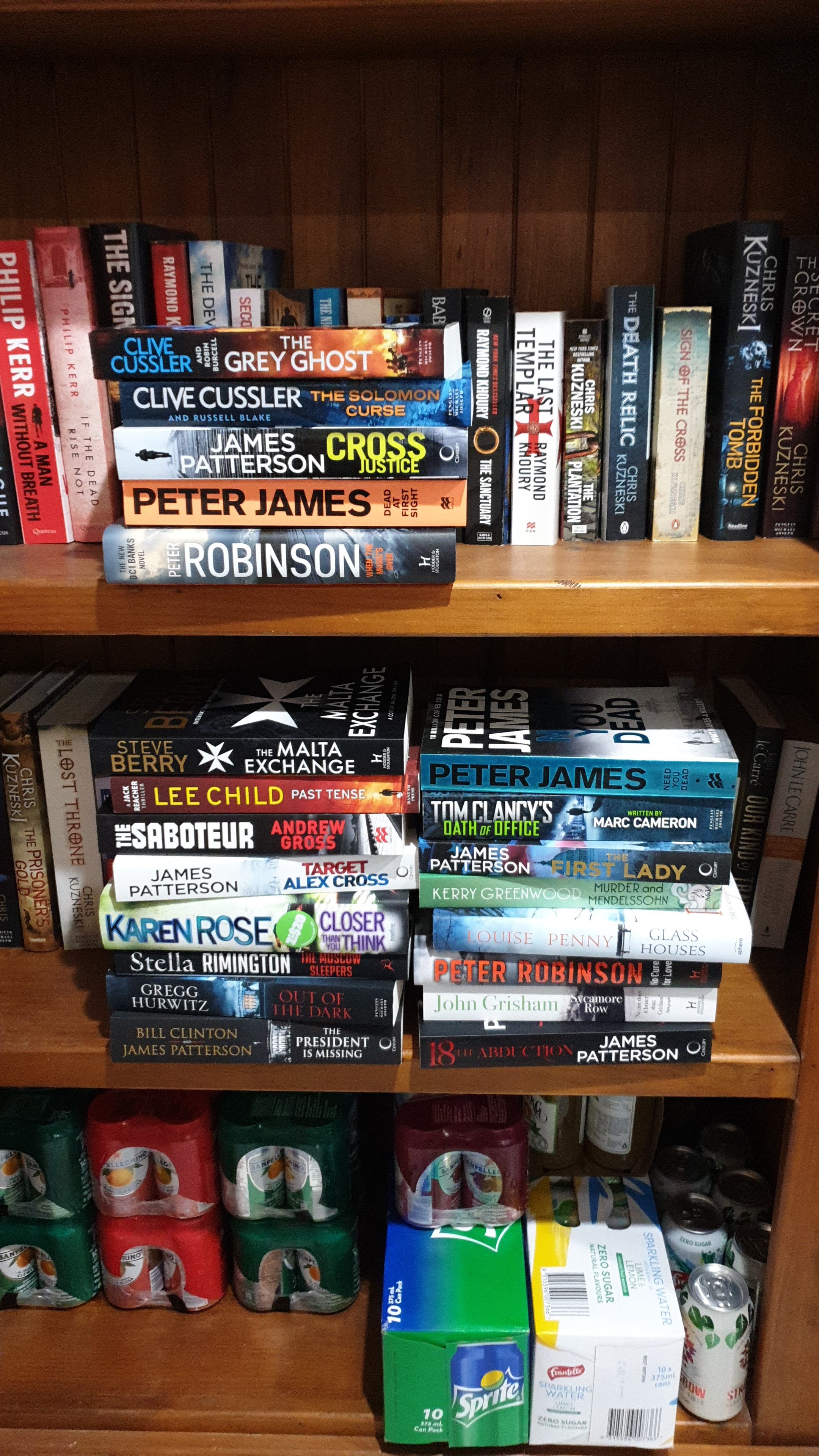
img_20190724_151849

As you can see the shelves are multi-purpose, but that’s all about to change.

The problem?

I have been buying books and I am now running out of shelf space, so the drinks will have to go.

There have been quite a few that have been reduced in price, and this is the time when I buy up big.

The problem is that I have so many, and no more space for shelving, that sometimes I have to ‘recycle’, but a friend of mine doesn’t mind because those recycled books find a good home elsewhere.

Even so, I don’t think I’ll stop buying books.

They’ll just have to lie around on the floor is stacks.

I’m not perfect…

I was told a long time ago I wasn’t perfect, and it didn’t bother me. Then.

But it’s true. I don’t always get it right, sometimes I get annoyed and say things in the heat of the moment that perhaps shouldn’t be said, and sometimes I can be ‘difficult’.

I’ll be the first in line to say my blog isn’t perfect, in fact sometimes it bothers me some of the bits and pieces that go up because I doubt if they’re interesting, at the time, to anyone but me.

Perhaps it’s because I chose to be a writer.

It’s a hard slog at the best of times. Getting ideas, carving out time to write, having to live a normal life as distinct from that of living in a garret, on your own, writing that next great Nobel prize for literature, or is it a Pulitzer?

I don’t get that, I don’t have that, and I don’t want that.

For those of us living on that ‘edge’ of finding time to write, maintain a blog, keep up with social media, do the daily chores and watch some television, something has to give.

So, I’m not getting any writing done if I’m working on the blog, or I’m on social media. If I’m doing the blog, something else has to be sacrificed.

Mostly it’s my blog. My blog is about writing stuff, visiting places that have been or will be used in stories, and once, a recalcitrant cat who sadly has passed on. It also has running episodic stories, usually four different at a time.

It also had about 2,000 past posts. When I don’t get the time to do my blog, which has been mostly for the last three months off and on, I sometimes repackage or repeat past posts, just to keep it ticking over, much like a scoreboard.

It is also a tool for advertising my books and stories, and what’s coming (if only I stopped using social media) and these are repeated every four or five days. It’d the equivalent of advertising because I can’t afford other advertising. If this is an annoyance, I’m sorry.

And just so everyone knows, I will always keep writing, not because I want to become the next James Patterson, though it would be nice, I write because I want to, and it pleases me when someone reads something I write, and they like it. It is the greatest compliment of all, and I believe in encouragement. It’s why I spend a lot of that social media time highlighting other writers so they can build a following.

After all, we are all in the same boat, it would just be nice if we were all rowing in the same direction.

Did somebody say they wanted a book?

Books, books and more books

img_20190724_151849

As you can see the shelves are multi-purpose, but that’s all about to change.

The problem?

I have been buying books and I am now running out of shelf space, so the drinks will have to go.

There have been quite a few that have been reduced in price, and this is the time when I buy up big.

The problem is that I have so many, and no more space for shelving, that sometimes I have to ‘recycle’, but a friend of mine doesn’t mind because those recycled books find a good home elsewhere.

Even so, I don’t think I’ll stop buying books.

They’ll just have to lie around on the floor is stacks.

I’m not perfect…

I was told a long time ago I wasn’t perfect, and it didn’t bother me. Then.

But it’s true. I don’t always get it right, sometimes I get annoyed and say things in the heat of the moment that perhaps shouldn’t be said, and sometimes I can be ‘difficult’.

I’ll be the first in line to say my blog isn’t perfect, in fact sometimes it bothers me some of the bits and pieces that go up because I doubt if they’re interesting, at the time, to anyone but me.

Perhaps it’s because I chose to be a writer.

It’s a hard slog at the best of times. Getting ideas, carving out time to write, having to live a normal life as distinct from that of living in a garret, on your own, writing that next great Nobel prize for literature, or is it a Pulitzer?

I don’t get that, I don’t have that, and I don’t want that.

For those of us living on that ‘edge’ of finding time to write, maintain a blog, keep up with social media, do the daily chores and watch some television, something has to give.

So, I’m not getting any writing done if I’m working on the blog, or I’m on social media. If I’m doing the blog, something else has to be sacrificed.

Mostly it’s my blog. My blog is about writing stuff, visiting places that have been or will be used in stories, and once, a recalcitrant cat who sadly has passed on. It also has running episodic stories, usually four different at a time.

It also had about 2,000 past posts. When I don’t get the time to do my blog, which has been mostly for the last three months off and on, I sometimes repackage or repeat past posts, just to keep it ticking over, much like a scoreboard.

It is also a tool for advertising my books and stories, and what’s coming (if only I stopped using social media) and these are repeated every four or five days. It’d the equivalent of advertising because I can’t afford other advertising. If this is an annoyance, I’m sorry.

And just so everyone knows, I will always keep writing, not because I want to become the next James Patterson, though it would be nice, I write because I want to, and it pleases me when someone reads something I write, and they like it. It is the greatest compliment of all, and I believe in encouragement. It’s why I spend a lot of that social media time highlighting other writers so they can build a following.

After all, we are all in the same boat, it would just be nice if we were all rowing in the same direction.