How could that possibly happen… – A short story

I had hoped by the time I was promoted to assistant manager it might mean something other than long hours and an increase in pay.

It didn’t.

But unlike others who had taken the job, and eventually become jaded and left, I stayed. Something I realized that others seemed to either ignore or just didn’t understand, this was a company that rewarded loyalty.

It was why there were quite a few who had served 30 years or more. They might not reach the top job, but they certainly well looked after.

I had a long way to go, having been there only 8 years, and according to some, on a fast track. I was not sure how I would describe this so-called ‘fast track’ other than being in the right place at the right time and making a judicial selection.

When it was my turn to be promoted, I had a choice of a plum department, or one most of my contemporaries had passed over. At the time, the words of my previous manager sprang to mind, that being a manager for the most sought after department or the least sought after, came with exactly the same privileges.

And, he was right. I took the least sought after, much to their disdain and disapproval. One year on, that disapproval had turned almost to envy; that was when the Assistant Managers were granted a new privilege, tea, and lunch in the executive dining room.

“So, what’s it like?” John asked, when our group met on a Friday night, this the first after the privilege was granted.

He had been one of the three, including me, who had the opportunity to take the role. Both he and Alistair had both declined, prepared to wait for a more prestigious department. It hadn’t happened to them yet.

“The same as the staff dining room, only smaller. Except, I guess, the waitstaff and butler. They come and serve you when you have to go to them in the staff room. They’re the same staff, by the way, except for the butler.”

I could see the awe, or was it envy, in their eyes. “but it’s not that great. The Assistant Managers all sit at one end of the table, and we’re not part of the main group, so no sharing of information I’m afraid. And the meals are the same, just served on fancier crockery.”

“Then nothing to write home about?” Will was one of those who they also thought to be on a ‘fast track’. I was still trying to see how my ‘fast track’ was actually that fast.

“Put it this way, the extra pay doesn’t offset the long hours because you get overtime, I don’t, so on a good week, you’d all be earning more than me. Without responsibility, if anything goes wrong. I think that’s why Assistant Managers were created, to take the blame when anything goes wrong.”

That had been the hardest pill to swallow. Until I got the role, I hadn’t realized what it really involved. Nor had the others, and it was not something we could whinge about. My first-day introductory speech from Tomkins, my Manager, was all about taking responsibility, and how I was there to make his life easier. It was a speech he made a few times because he’d been Manager for the last 16 years, much the same as the others, and promotion if ever, would come when they died.

And Manager’s rarely died, because of their Assistant Managers.

“How old is Tomkins now?” Bert, a relative newcomer to our group, asked. He was still in the ‘in awe’ phase.

“About the same as Father Time,” I said. “But the reality is, no one knows, except perhaps for the personnel manager.” O looked over at Wally, the Personnel Department’s Assistant Manager. “Any chance of you telling us?”

“No. You know I can’t.”

“But you know?” I asked.

“Of course, but you know the rules. That’s confidential information. Not like what you are the custodian of, information everyone needs.”

Which, of course, was true. Communication and Secretarial Services had no secrets, except for twice a year when the company Bord of Directors met, and we were responsible for all the documents used at their meetings. Then, and only then, was I privy to all the secrets, including promotions. And be asked ‘What’s happening?’.

“Just be content to know that he’s as old as the hills, as most of them. It seems to me that one of the pre-requisites for managership is that you have been employed here for 30 years.”

Not all, though, I’d noticed, but there wasn’t one under the age of fifty.

And so it would go, the Friday night lament, those ‘in’ the executive, and those who were not quite there yet.
It seemed prophetic, in a sense, that we had been talking about Mangers and their ages. By a quirk of fate, some weeks before, that I learned of Tomkins’s currents state of health via a call on his office phone. At the time he was out, where, he had not told me, but by his the I believed it was something serious, so serious he didn’t want me, or anyone else, to know about it.

That phone call was from his wife, Eleanor, whom I’d met on a number of occasions when she came to take him home from work. I liked her, and couldn’t help but notice she was his exact opposite, Tomkins, silent and at times morose, and Eleanor, the life of the party. I could imagine her being a handful in her younger days, and it was a stark reminder of that old saying ‘opposites attract’.

She was concerned and asked me if he had returned from the specialist. I simply said he had but was elsewhere, and promised to get him to call her when he returned. Then I made a quick call around to see where he was and found that he was in Personnel. I left an innocuous message on his desk, and then let my imagination run wild.

At least for a day or so, the time it took for me to realize that it was probably nothing, the lethargy he’d been showing, gone.

I’d put it out of my mind until my cell phone rang, and it was from the Personnel Manager. On a Sunday, no less. In the few seconds before I answered it, I’d made the assumption that Tomkins’s secretive visits to the specialist meant he needed time off for a routine operation.

Greetings over, O’Reilly, the Personnel Manager, cut straight to the chase, “For your personal information, and not to be repeated, Tomkins will be out of action for about two months, and as that is longer than the standard period, you will become Acting Manager. We’ll talk more about this Tuesday morning.” Monday was a holiday.

All Assistant Managers knew the rules. Any absence of a manager for longer than a month, promotion to Acting Manager. Anything less, you sat in the office, but no change in title. There was one more rule, that in the event of the death of a manager, the assistant manager was immediately promoted to Manager. This had only happened once before. 70 years ago. If a manager retired, then the position of Manager was thrown open to anyone in the organization.

It was an intriguing moment in time.

Tuesday came, and as usual, I went into the office, with only one thought in mind, let the staff in the department know what was happening, of course, the moment I was given the approval to do so by Personnel.

Not a minute after I sat down, the phone rang. I picked it up, gave my name and greeting. It was met with a rather excitable voice of the Assistant Manager, Personnel, “I just got word from on high, you’ve been promoted to manager. How could that possibly happen…”

Then a moment later, as realization set in, “Unless…”

—-

© Charles Heath 2020-2021

The refinement of an old idea

I write about spies, washed out, worn out, or thrown out.

It’s always in the back of my mind, sometimes fuelled by a piece in the paper that has a sense of conspiracy about it, and from there, an idea starts turning into words that need to find their way to paper.

Then, if that’s the extent of the first draft, sometimes it goes into the ‘I will come back to this later’ folder and, sometimes, it’s gone and forgotten.

Until I wake up suddenly in the middle of the night, an old story with a new idea fills my head, and I have to get it down.

Then, it will bother me over the next few days, until I give it the attention it’s calling out for.  This will often lead to more writing, but planning leading to a synopsis.

The first sentence of a novel is always the hardest. Like I guess many others, I sit and ponder what I’m going to write, whether it will be relevant, whether it will pull the reader into my world, and cause them to read on.

And that’s the objective, to capture the reader’s imagination and want to see what’s going to happen next.

The problem is, we have to set the scene.

Or do we?

Do we need to cover the who, what, where, and when criteria in that first sentence? Can we just start with the edge of the seat suspense, like,


The first bullet hit the concrete wall about six inches above my head with a resounding thwack that scared the living daylights out of me. The second, sent on its way within a fraction of a second of the first found its mark, the edge of my shoulder, slicing through the material, and creasing skin and flesh. There was blood and then panic.

Milliseconds later my brain registered the near-miss and sent the instruction: get down you idiot.

I hit the ground just as another bullet slammed into the concrete where my head had just been.


It can use some more work, less commas, perhaps shorter, sharper sentences to convey the urgency and danger.

Perhaps we could paint a picture of the main character.

He tentatively has the name of Jackson Galworthy. He has always aspired to be a ‘secret agent’ or ‘spy’ and but through luck more than anything else, he was given his opportunity. The problem is he failed his first test and failure means washing out of the program.

What had ‘they’ said? When the shit hits the fan, you need to be calm, cool, and collected. He’d been anything but.

Maybe we’ll flesh the character out as we go along.

OK, I just had another thought for an opening,


Light snow was still falling, past the stage where each flake dissolved as it hit the ground, and now starting to gather in white patches.

It was cold, very cold, and even with the three layers I still shivered.

What surprised me was the silence, but, of course, it was a graveyard beside an ancient church, and everyone who had attended the funeral service had left.

It was a short service for the few that came, and a shorter burial. No one seemed keen to hang around, not with the evening darkness and the snow setting in.

I stood, not far from the filled grave looking at it, but not looking at it. Was I expecting it’s occupant to rise again? Was I expecting forgiveness? I certainly didn’t deserve it.

The truth is, I was responsible for this person’s death, making a mistake a more seasoned professional might not, and the reason why I was shown the door. I had been given very simple instructions; protect this man at all costs.

It was going to be a simple extraction, go in, get the target, and get out before anyone noticed.

A pity then I was the only one who got that memo.


It’s a start, but with the TV going on in the background, Chester complaining about something, and the weeds in the yard are getting higher, there’s too much else going to consider this even a start.

It’s an idea.  Perhaps I can expand on it later.


© Charles Heath 2020


Writing about writing a book – Day 21 continues

I’m still working on Bill’s backstory, and how he got mixed up in the war, and as a general background to his situation, and life before Davenport.

This is still in his own words:


But whether we were stupid or naive, or completely mad, we were all eager to get into battle, filled with the sort of hate only Army propaganda films could fill you with.  They were our enemy, and they deserved to concede or die.

A fresh face in a hardened platoon, I was eager to get on with it.  They looked knowingly, having seen it all before.  No idea of the reality, and no time to tell us.  Have a few beers to celebrate, and then, the next morning, go out on patrol.  No problem.

There was camaraderie, but it was subdued.  We walked single file, the seasoned campaigners in front and at the rear, treading carefully, demanding quiet, and a general cautiousness.  In the middle of nowhere, where only the sound of rain, or the animals and birds for company, we were naive enough to think this was going to be a doddle.

Then it happened, six hours out, and just before we reached a small clearing.  I thought to myself it was odd there should be such a clear space with jungle all around it.  There must be a reason.

There was.

We had walked into an ambush, and everyone hit the ground.  I was bringing up the rear with another soldier, a veteran not much older than myself whose name was Scotty, a little farther back from the main group.  Bullets sprayed the undergrowth, pinging off trees and leaves.  I buried my face in the dirt, praying I would not die on my first patrol.

We became separated from the others, lying in a hollow, with no idea how far away help was.  He was muttering to himself.  “God, I hate this.  You can never see the bastards.  They’re out there, but you can never bloody well see them.”  Then he crawled up the embankment, gun first.

He let off a few rounds, causing a return of machine-gun fire, spattering the dirt at the top.  Next thing I knew he was sliding down the hill with half his face shot away.  Dead.  I threw up there and then.  What an initiation.

Then one of the enemy soldiers came over the hill to check on his ‘kill’.  I saw him at the same time he saw me and aimed my gun and shot.  It was instinct more than anything else, and I hadn’t stopped to think of the consequences.  He fell down, finishing up next to me, staring at me from black, lifeless eyes. 

Dead. 

I’ll never forget those lifeless eyes.  I just got up and ran, making it back to the rest of the group without getting hit.  No one could explain how I made it safely through the hail of gunfire, from our side and theirs.

Back in the camp later, the veterans remarked on how unlucky Scotty was and how lucky I was to shoot one of the enemies, and not be killed myself.  They all thought it was worth a celebration.

Before we went out the next day to do it all again.

I spent the night vomiting, unable to sleep, haunted look on his face, one I finally realized that reflected complete astonishment.


There will be more, as the story develops.


© Charles Heath 2016-2020

Writing about writing a book – Day 20

It is a day of rest although writers are ready and able to work on any given day at any hour of the day or night when an idea or thought comes to them.

I’m trying not to think, but that’s not working.

I’ve been going over the reasons for writing the first draft of the book 30 odd years ago and it had something to do with the fact I was working with personal computers and local area networking when both were in their infancy, and I wanted to blend this knowledge into a story.

Of course, I’d always wanted to write thrillers, and this presented the opportunity to use computers as a basis for a worldwide conspiracy.  How easy it is these days to do just that, but back in those days, it was a lot of hard work.

I remember sitting in a meeting when the company I was working for at the time had just implemented a network and personal computer to replace the mainframe and dumb terminals, also looking to leverage the new technologies of spreadsheets and word-processing, effectively making accounts staff more productive, and removing typists and moving into the world of centralized word processing.  It was not a new idea with Wangwriter, but using PC’s was.

One of the departmental managers got up to give his take on the new technology, this about six months after implementation, and after a lot of teething troubles caused mainly by people who were vehemently resisting change, and his message was, it should not be called ‘networking’, but ‘not working’, in reference to the number of times the network went down.

But this is a digression.  Computers are only a part of the story.

The story also goes back to a time when there was a clear demarcation between the management levels.  Management offices were oasis’s whereas the staff worked in a stark desert-like environment.  When one came to work for such an organization, it was with the belief that you start at the bottom, and over time, you work your way up the ladder.  There was, very definitely, class distinction, and the various management levels never mixed, at work or socially, except within their own level.

There were Managers, Assistant Managers, and Manager’s Assistants, a typing pool, a secretary, that young, or old, lady who did so many jobs for their boss, that these days it would be considered demeaning.  They were dedicated to their jobs and irreplaceable.  There was no such person as a Personal Assistant.

Nor was such a thing as sexual harassment.  One company I worked in where one of the Assistant Managers was sexually abusing an office girl, her complaints didn’t get a prosecution as it would now, it just had him transferred to another branch.  Reprehensible, yes, and thankfully no longer a problem, except of course, in Fifty Shades of Grey which apparently condones such behavior.

There were department heads, General Managers, and Board Members.  The upper management level and participants were in a world of their own, one few could ever aspire to.  This is the world in which Transworld, my fictitious (but based on a very real) company lives.

I have to work on my company structure to make sure it is right.

Now I have two charts.  A timeline, for both Bill, and the story, and a hierarchy for the office management and staff.

This is beginning to be more complicated than I thought.


© Charles Heath 2016-2020

The bane of our existence: social media

I’m back to writing, sitting at the desk, pad in front of me, pen in hand.

The only thing lacking is an idea.

It’s 9:03 am, too early to start on a six-pack.

I need a distraction.

Blogging, websites, Twitter, and Facebook, all of these social media problems are swirling around in my mind.

The more I read the more it bothers me that if I don’t have the right social media presence if I do not start to build an email list, all of my efforts in writing a book will come to naught.

Then I start trawling the internet for information on marketing and found a plethora of people offering any amount of advice for anything between a ‘small amount’ to a rather large amount that gives comprehensive coverage of most social media platforms for periods of a day, a week or a month.  I don’t have a book so it’s a bit early to be worrying about that.

I move on to the people who offer advice for a cost on how to build a following, how to build a web presence, how to get a thousand Twitter followers, and how to get thousands of email followers before the launch.

The trouble is I’m writing a novel, not a nonfiction book, or have some marvellous 30 page ebook on how to do something, for free just to drive people to my site.

I’m a novelist, not a handyman so those ideas while good are not going to help me.

Yet another problem to wrestle with along with actually creating a product to sell in the first place.

Except I’m supposed to be writing for the love of it without the premeditated idea of writing for gain or getting rich quick.

What am I missing here?

So should l be writing short stories and offering them for free to drive people to my site?  These would have to be genre-specific so it needs time and effort and fit into a convenient size story that will highlight or showcase my talent.

Or should I create a website for the novel and set up pages for the characters and get some interaction going that way?

It will be difficult without giving the whole plot away so if I do it will have to be carefully managed.

I don’t think I will have a good night’s sleep again with all of these social media problems I’m going to have.

Oh well, back to the book.  It’s time to have a nightmare of a different sort!

The bane of our existence: social media

I’m back to writing, sitting at the desk, pad in front of me, pen in hand.

The only thing lacking is an idea.

It’s 9:03 am, too early to start on a six-pack.

I need a distraction.

Blogging, websites, Twitter, and Facebook, all of these social media problems are swirling around in my mind.

The more I read the more it bothers me that if I don’t have the right social media presence if I do not start to build an email list, all of my efforts in writing a book will come to naught.

Then I start trawling the internet for information on marketing and found a plethora of people offering any amount of advice for anything between a ‘small amount’ to a rather large amount that gives comprehensive coverage of most social media platforms for periods of a day, a week or a month.  I don’t have a book so it’s a bit early to be worrying about that.

I move on to the people who offer advice for a cost on how to build a following, how to build a web presence, how to get a thousand Twitter followers, and how to get thousands of email followers before the launch.

The trouble is I’m writing a novel, not a nonfiction book, or have some marvellous 30 page ebook on how to do something, for free just to drive people to my site.

I’m a novelist, not a handyman so those ideas while good are not going to help me.

Yet another problem to wrestle with along with actually creating a product to sell in the first place.

Except I’m supposed to be writing for the love of it without the premeditated idea of writing for gain or getting rich quick.

What am I missing here?

So should l be writing short stories and offering them for free to drive people to my site?  These would have to be genre-specific so it needs time and effort and fit into a convenient size story that will highlight or showcase my talent.

Or should I create a website for the novel and set up pages for the characters and get some interaction going that way?

It will be difficult without giving the whole plot away so if I do it will have to be carefully managed.

I don’t think I will have a good night’s sleep again with all of these social media problems I’m going to have.

Oh well, back to the book.  It’s time to have a nightmare of a different sort!

Writing about writing a book – Day 19

I’m still working on the sequence of flashbacks for the story, filling out the back story to how Bill became associated with a man called Colonel Davenport.

It is important to remember that while Davenport may have begun with good intentions, it was not difficult to go slowly mad given the conditions.  This character, Davenport, runs a multitude of operations within the war zone, turning a huge profit and setting up a business for when the war ended.

Bill meets his Davenport’s cronies and then the man himself.  Life is not what it seems, and working for him is not a guarantee of safety, so Bill not only has to watch out for the enemy but also those with whom he also works.


Part 3 – In the Service of Davenport

Davenport and punishment

Busted mission, the first threat to Davenport

Manilow’s death – and how he got there

More on Manilow, the night before his death

Taken to rendezvous with Davenport’s boss

Identify Davenport by ‘sniveling morons’

Sniper – killing Ellen’s father – set up

Sniper – Killing Ellen’s father, execution

Planes and death


Bill gets to meet an interesting cast of characters, not the least of which is Davenport’s right-hand men, and a very unlucky lad who was supposed to see through his tour in the command station far from the war zone, and who is connected to a person close to him.

He was also unwittingly involved in a murder, one set up by Davenport, and one designed to keep his silence.


Part 4 – The Lead up to Capture, and in a POW camp

The object that Davenport is seeking

After R & R revoked, retrieved by Davenport for the last mission

Capture by Cho’s forces, delivered by Davenport’s men

In the POW Camp, and the arrival of Cho

Day of Rescue from Cho

Ellen and Jacobson after rescue in the hospital


Bill’s safety may have been assured had he simply toed the line, but, while on a secret mission with Davenport’s men, he sees an opportunity to take some evidence of Davenport’s activities, as an act of self-preservation.

Of course, he doesn’t reckon with the ruthlessness of Davenport and ends up in a camp where Bill is handed over to the chief interrogator, a friend of Davenport’s.  There is no doubt what Cho’s mission is.

But, like all seemingly simple plans, it doesn’t go the way Davenport wants, Bill does not talk, and is eventually rescued.


Part 5 – Post Rescue and Transworld

Employment at Transworld, then first interrogation via Collins

In hospital immediately after being shot

Davenport in my hospital room, post being shot

Recognize Jorgenson


Davenport discovers Bill was rescued, and that is has lost his memory of all the time in his service, so just in case Bill does, one day, remember, he will be there to get the answers, and the missing information.

It is almost a story within a story, and maybe one day will be published as such.

At least now I have some idea of how to work the much larger story into the flashbacks, as a prelude to what happens to Bill once he realizes who is behind everything that is happening at Transworld.


© Charles Heath 2015-2020

That notion that I could be organised…

Well, toss that baby out with the bathwater.

It’s something that I have never been able to get a handle on, and I seem to stagger from one day to the next without getting anything done.  I guess I’m one of those freeform sorts of people and I guess it goes with the star sign, Gemini.

Over the years many people tried, some with limited success, others completely failing.

I’ve created outlines and created chapters as sections, and scenes within chapters, as best I could.   Once upon a time, I used to teach Microsoft Project, and having this application on hand, I used this to create a timeline, using ‘slack’ time to make up for my inability to keep to a schedule.

This is like taking a sledgehammer to a tack.

Just the time to set it up took longer than it would to just sit down and write the blasted novel.

But, I’m a fly by the seat of my pants writer.  The book starts, often with a start and a finish, and the rest fills itself in, not necessarily in the order of final events.  Of course, this means some backwards revision from time to time, but I get there in the end.

Perhaps a little longer than it should but at least I don’t get halfway and suddenly decide on going in a different direction because I’ve suddenly got writers’ block.  That doesn’t happen.  It usually plays out as the start of another story, and then I mull over the changes necessary to get the original story back on track.

Yes, I’ve been to those time management courses with the books and diaries to seem to want you to time manage your life.  it works to a certain extent, but you live your like inside another type of book.

Nor do I work well with deadlines.

But oddly enough most of the jobs I’ve had over the years have involved time management of one sort or another and I have survived.

Now, in retirement, I really need something to organize my days so something gets done.  As a writer allocating 12 midnight to 2am for writing doesn’t seem to be a good idea.

Unfortunately, it is the best time for me to write.

Anyone else out there with the same problem, and if so what was your answer to the getting stuff done?

Writing about writing a book – Day 14 Continues

Whilst Davenport’s backstory is now coming together, I’m back with the main character, and working on a bit of his backstory too, mainly what he is about to remember of his past, locked away for many years, most likely caused by the trauma he suffered at the hands of the enemy, though the definition of ‘enemy’ here will have a number of different meanings.

These first dreams are disjointed but point to one certainty, Bill was, for a time, a prisoner, whether it was as a prisoner of war, or something else, he is yet to discover.

Another certainty he will learn in time is that he holds a secret, a secret several people would like to find out about, and who will go to extreme lengths to get it from him.

This memory fragment confirms he was a prisoner, despite the assurances to the contrary:


I woke suddenly, tense, eyes open, and alert.  I could feel the fear coursing through my veins, every nerve end tingling.

I had only one thought in mind.

Escape.

Now.

Before it started again.

I moved my hand and found it strapped down as was my other hand and my legs.  I was barely able to move.

A sudden jolt of pain went through me, starting at my shoulder where the knife had been dug in and twisted, the memory of which was very clear in my mind.  It increased as I struggled against the restraints, the fear of it happening again stirring me to try harder.

I’d been here before and the result was bad.

Very bad.

I struggled harder.

I looked around and saw no one or anything else.  The room seemed different from the one I last remembered, more closed in, claustrophobic.  The light came on, bright neon lights, blinding me.  The flash I got before I closed my eyes, it was a hospital room.  I was captive, and it was after the torture session, where the doctors put me back together just enough to last the next session.

Torture, recovery, torture, recovery, over and over, night, day, light, dark, warm, cold.  I had no idea where I was, what day, week, month, or year it was, when I’d last eaten, or eaten at all.

And I didn’t know why.

Why they didn’t kill me and get it over with.  I didn’t know anything.

The door opened and I opened my eyes, now a little more adjusted to the bright light.  He came over and looked down at me.

Chinese.

The enemy.

One of the insidious men keeping me alive.

I kept my eyes on him as he looked at the folder beside the bed, and checked my vital signs.

“How are we this morning?”

English, with only a trace of a Chinese accent.  They all spoke nearly perfect English, confusing me, making me think I was safe.  That I would talk to them.  Confide in them.

I didn’t feel safe and I had nothing to say.

“You had a very bad night.”

Tell me something I didn’t know.  I struggled against the restraints.

“They’re for your own protection.  You tried to get out of bed and reopened your wound.  I’m sorry, but we have had to restrain you.”

“Let me go,” I hissed, “or kill me.”

“I assure you no one wants to kill you.”

I didn’t believe him.  He was trying to trick me.  Trying to allay my fears.  I knew all of their tricks now.

I had to escape.  I had to get away or die trying.  I could not take another session.  Not in that dark, dank, evil room.

I tried harder to escape, felt the restraining hands of his friends, holding me down as he administered another injection, silence, and darkness closing in once again.


Still not sure where this is going, but it’s defining the past of our main character, and will become a lot clearer as the story progresses.

I am intending for these dreams, if extracted and put in order, will be the basis of the missing past the main character has not been able to remember, and given how horrific some of them are, it’s no surprise they’ve been buried very deep in his subconscious.


© Charles Heath 2015-2020

Searching for locations: Driving in ice and snow, Canada

This morning started with a visit to the car rental place in Vancouver.  It reinforced the notion that you can be given the address and still not find the place.  It happened in Washington where it was hiding in the back of the main railway station, and it happened again in Vancouver when it was hidden inside a hotel.

We simply walked straight past it.  Pity there wasn’t a sign to let people know.

However…

We went in expecting a Grand Jeep Cherokee and walked out with a Ford Flex, suitable for three people and four large suitcases.  It actually seats 7, but forget the baggage, you’d be lucky to get two large suitcases in that configuration.

It is more than adequate for our requirements.

Things to note, it was delivered with just over a quarter of a tank of gas, and it had only done about 11,000 km, so it’s relatively new.  It’s reasonably spacious, and when the extra seats are folded down, there is plenty of baggage space.

So far, so good.

We finally leave the hotel at about half-past ten, and it is raining.  It is a simple task to get on Highway 1, the TransCanada Highway, initially, and then onto Highway 5, the Coquihalla Highway for the trip to Kamloops.

It rains all the way to the top of the mountain, progress hampered from time to time by water sprays from both vehicles and trucks.  The rain is relentless.  At the top of the mountain, the rain turns into snow and the road surface to slush.  It’s 0 degrees, but being the afternoon, I was not expecting it to turn to ice very quickly.

On the other side of the mountain, closer to Kamloops, there was sleet, then rain, then nothing, the last 100kms or so, in reasonably dry conditions.

Outside Kamloops, and in the town itself, there was evidence of snow recently cleared, and slushy roads.  Cars in various places were covered in snow, indicating the most recent falls had been the night before.

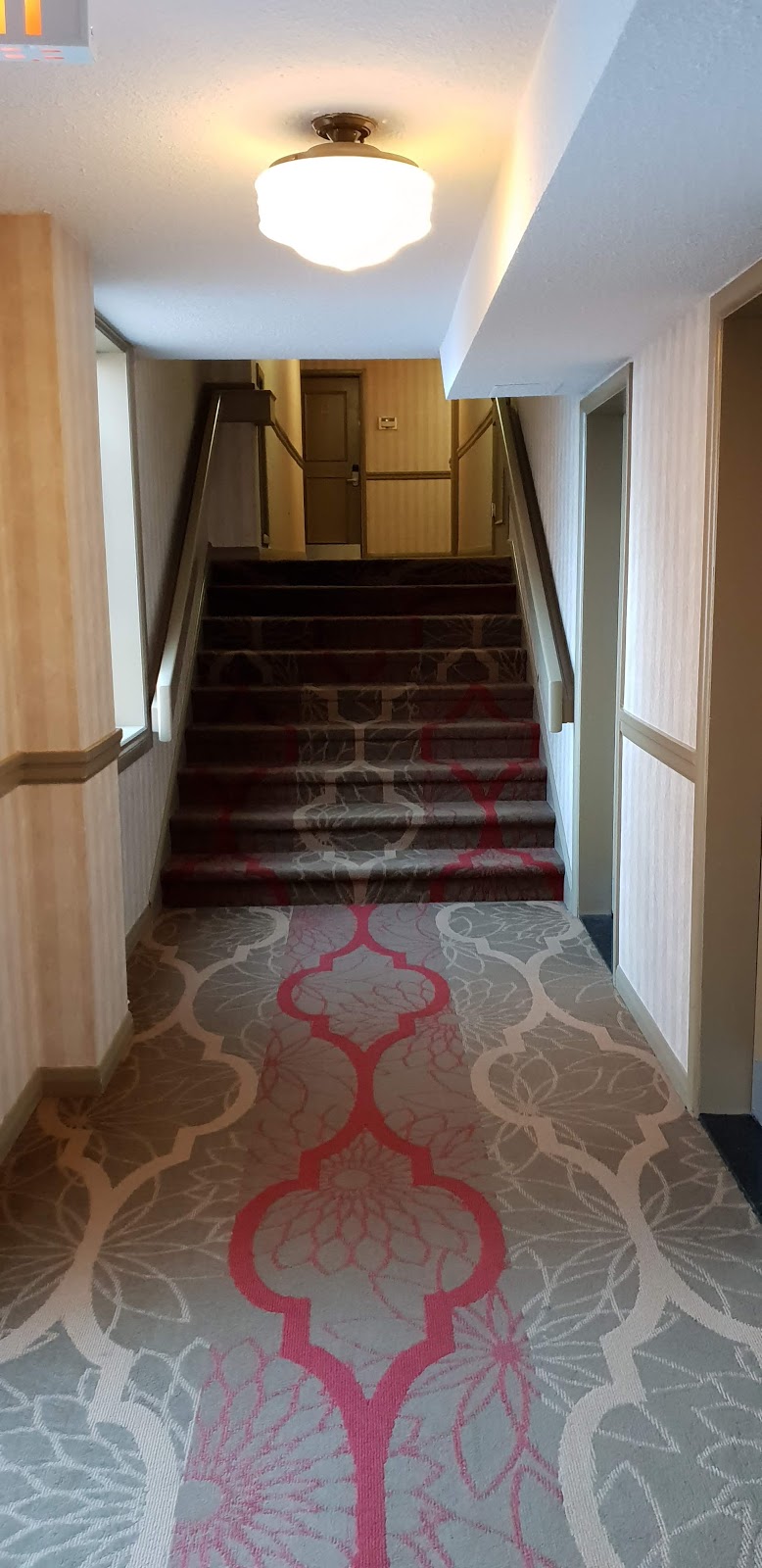
We’re staying at the Park Hotel, a heritage building, apparently built in the later 1920s.  In the style of the time, it is a little like a rabbit warren with passages turning off in a number of directions, and showing it is spread across a number of different buildings.

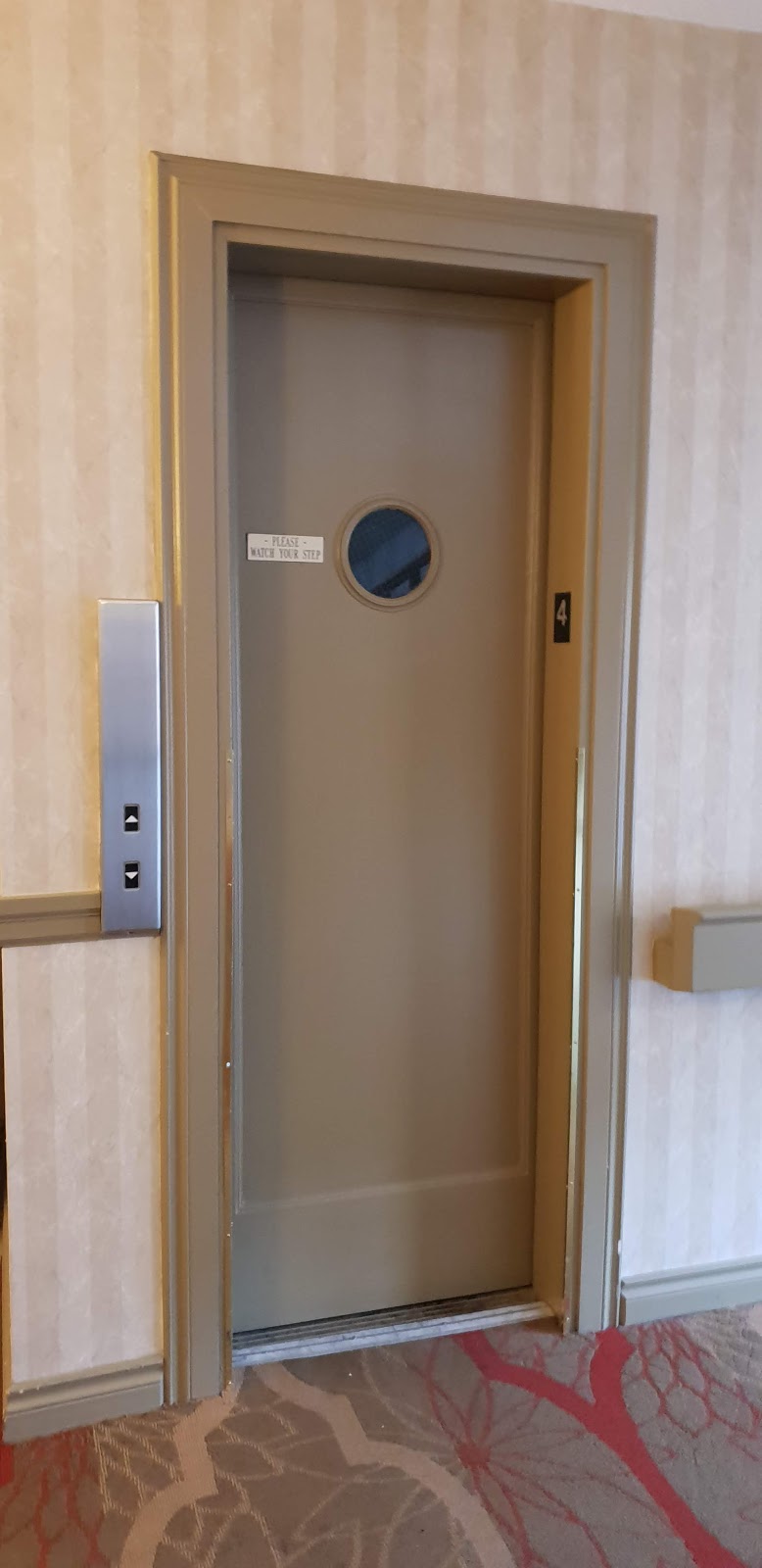
It has the original Otis elevator that can take a maximum of four passengers, and a sign on the wall that says “no horseplay inside the elevator” which is a rather interesting expression that only someone of my vintage would understand.  And, for those without a sense of humor, you definitely couldn’t fit a horse in it to play with.

The thing is, how do you find a balance between keeping the old world charm with modern-day expectations.  You can’t.  Some hotels try valiantly to get that balance.  Here, it is simply old world charm, which I guess we should be grateful for because sooner rather than later it’s going to disappear forever.

In my writer’s mind, given the importance of the railways, this was probably a thriving place for travelers, and once upon a time, there were a lot more hotels like this one.