Writing about writing a book – Day 5 continues – Those annoying people called characters

Whilst it is always an idea to sit down and write and keep going, not worrying too much about the narrative, there’s always the problem of ideas about characters, and relationships that come back and need to be addressed.

I have issues with Jennifer in that we will need to know something about her, and need a little backstory.

Jennifer is the second most important character in this novel and one that has more talents than what my main character, or anyone else for that matter, thinks she has.  Of course, that is deliberate on her part for a number of reasons that will be introduced at the appropriate time.

But, at the start, all we will have to work with, is the introduction provided by the narrator.

It may go something like this:


Jennifer Pennington Smythe was, as you might expect, very English, very reserved, and very private.  She was the definitive ‘don’t judge a book by its cover’, and I was guilty, at first, of suspecting she had once been a schoolmistress due to the severity of dress, demeanor, and expression.

HR had sent her to me when I’d requested an IT Specialist, though of what particular discipline it was never divulged, neither by HR nor by her.  She arrived one morning, told me she was to ‘help resolve our technical difficulties’, moved into an office that had been used as a storeroom, and worked hard to prove her worthiness in the role.

My first attempt at conversation was rebuffed, the second met with a very cold stare.  Everyone, including me, learned very quickly that any other topic of conversation than work would be ignored.  At the time it suited me, there was trouble in paradise and I didn’t want anything more on my plate to deal with.


So, what is this trouble?

There are three distinct stages of this relationship between the two most important characters, and it is the actions of one of the protagonists that brings them together.  This particular protagonist, of course, is the main character’s wife, a woman that is on the periphery for the period the novel covers, but a little background will be needed at some point before we reach this part of the narrative.

This now means that I will have to put together a back story for Bill and his ex-wife Ellen, not too much yet but enough to explain the next part of the evolving relationship between Bill and Jennifer.


I’m sure this topic is going to raise it’s head again and again…

What’s it like from the other side of the desk?

I’ve been sitting at the desk staring at the screen thinking of what to write that might interest other people.

Seems I’m not too good at it.

So, I moved seats, to sit opposite the writer’s chair and took a good long hard look at the person, the so-called writer, conjuring up in my mind, if I was someone I’d just dragged in off the street, what would I ask?

Would I bother?

I mean most of of walk down the street trying to avoid everyone else, and anything bad that might happen.

But I’m here now, so for a free cup of tea and a Doubletree cookie, I consider myself bribed.

Question 1:  Why on earth would you want to write when there’s a billion other books out there?  Seems a complete waste of time to me.

[Answer] Good point, most days when I get out of bed, or rather stare at the ceiling from under the covers, I wonder why I bother to get up.

OK that’s the borderline manic depressive speaking, and most likely suffering from a hangover, trying to get those last 1,000 words for the day done.

Question 2: You write when you’re drunk?  That must make a lot of sense, not!

This person has found me out in two questions.

[Answer] No, a little Scotch helps oil the wheels on the mind.

Question 3:  What do you do for inspiration?

[Answer] Thinking up new and novel ways of killing off people I drag in off the street to ask me questions about myself.  No, sorry, didn’t mean that.  I haven’t a mean bone in my body.  Inspiration you say?

Look around.

The inquisitor does.  There are seven floor to ceiling bookcases full of my favorite authors, about 4,000 or so books, aside from the reference library that is mostly in e-book format which run to about 10,000.

Question 4:  You read all of these?

[Picks up a copy of ‘Kill Me If You Can’ by James Patterson]  This one.

I nod yes.  I have read most of them.  I tell him writers must read.  Someone told me that a long time ago.  Not only thrillers and crime, but the classics.  I found War and Peace heavy going, but not so much as Madame Bovary, or Vanity Fair.

You can ask one more question.

Question 5:  Can I borrow this book [James Patterson]

As always the answer is yes.  I encourage people to read.  It doesn’t have to be my work.  It would be nice but I;m realistic enough to know there’s a billion other books out there I have to compete with.

Maybe tomorrow.

In a word: Drink

Everyone loves a drink, and that interesting expression, ‘what’s your poison’ often resonates at a bar when among friends.

The thing is, we are supposed to know what our friends drink, me, for instance, I like beer, preferably in a bottle and not local mass-produced brew if I can avoid it.

But, some like white wine, no preference to type, some like cocktails like a Manhattan, or a Long Island Iced Tea, very dangerous if made correctly which quite often it isn’t, or champagne, the real thing not just leftover wine carbonated and given a name like ‘sparkling …’ something.

Every now and then we need to have more than one drink, and that desire is fuelled by our emotions.  A celebration, it’s two or three, just enough to allow the euphoria to seep in.  A tragedy of any sort means more than a few, usually prefixed with a statement like, ‘I need to get hammered’, but not literally.

Perhaps that’s why it’s called drowning our sorrows.

Of course, there are other meanings for the word ‘drink’ and often poets, and romance novelists will refer to a phrase such as ‘drink in…’ where it may refer to a loving gaze or a look of adulation.  You could also, at a stretch, drink in the sight of a magnificent landscape.

Then, at the end of that drinking session, good or bad, where you may have had the opportunity to drink in looks or locations, you might, if you didn’t play your cards right, get thrown in the drink.

Not in the glass, that’s a bit small, but it means a much larger body of water such as a pool, a lake, or the ocean.

And lastly, but probably not the only context for the word ‘drink’, it could be said you were ‘driven to drink’, and I don’t mean by another drinker to the hotel, bar, restaurant or party.

Driven to drink means you blame someone else for your recently acquired desire to drink as much as you can so that it blots out something or someone.

I’m officially blaming my dog for my drinking problem.  He drove me to drink.

And that’s all I have to say about it.

Pour me another drink, will you?

In a word: Holiday

Some call time off from work whether it is for a day, a few days, and a couple of weeks, or maybe longer,  a holiday.

Or leave, leave of absence, annual leave, or long service leave.

Others may call it a vacation.

It depends on what part of the world you live in.

But the end result is the same, you do not go to work, so you stay home and do all those things that have mounted up, you drive up, and for some reason it is always up, to the cabin, for a little hunting shooting a fishing, or you get on a plane or a ship and try to get as far away from home and work as possible.

That’s called going overseas.  It seems if there is an ocean between w there you go and where you live, no one will be able to disturb you.

Sorry, I bet you didn’t leave that mobile phone or iPad home did you?

But, of course, there are a few other obscure references to the word holiday.

For instance,

It can be a day set aside to commemorate an event or a person, a day when you are not expected to work, e.g. Memorial Day, Christmas Day, Good Friday.   In Britain, they used to be called Bank Holidays.

It can be a specified period that you may be excused from completing a task or doing something such as getting a one-year tax exemption, which might also be called a one year tax holiday.

Yes, now that is an obscure reference, particularly when no tax department would ever grant anyone an exemption of any sort.


Light at the end of the tunnel

It’s a long-standing joke that the light at the end of the tunnel is the headlight of an express train coming right at you.

Metaphorically speaking this is quite often true if you are a pessimist, but since I’ve converted to being an optimist, a bit like changing religions, l think I’ve seen the ‘light’.

It’s a lot like coming up from the bottom of a deep pool, breaking the surface and taking that first long gulp of air.

Along with that elated feeling that you’re not going to drown.

What’s this got to do with anything, you ask?

Perhaps nothing.

As an allegory, it represents, to me, a time when l finally got over a period of self-doubt, a period where a series of events started to make me question why l wanted to be a writer.

I mean, why put yourself through rejections, sometimes scathing criticism, and then have the people whom you thought were your friends suddenly start questioning your choices after initially wholeheartedly supporting them.

Are we only successful or supportable if we are earning a sufficient wage?

Or sold a million copies?

Is this why so many people don’t give up their day job and then find themselves plying the ‘other’ trade into the dark hours of the night, only to find themselves being criticized for other but no less disparaging reasons?

It seems like a no-win situation, but these are the times when your mettle is tested severely.  But, in the end, it is worth it when the book is finished and published, even if it is only on Amazon.

You can sit back and say with pride; l did that.

That metaphorical light, you may ask.

When you make that first sale.

In a word: Brevity

Now, brevity is something that I have not been able to fully wrap my head around.

The dictionary explains Brevity as

‘concise and exact use of words in writing and speech’

So…

I remember working with a writer a long time ago who explained certain authors styles, and for James A Michener of Hawaii fame, he said Michener wrote sentences instead of words, paragraphs instead of sentences, pages instead of paragraphs and chapters instead of pages.

It was a little harsh considering I’d just read the book and had liked it, despite its length and the time it took.

But some time later I realized he was not criticizing Michener, but trying to tell me, in his, what I came to discover, interesting way, that I should strive to write more compactly.

I then came across a book by Brian Callison which was exactly that, the concise version, a story that fitted into about 200 pages.

That too was a good book and it took me a day to read it, and by his use of that economy of words, it read quickly.

Of course, I have tried over the years to emulate both styles, and to a certain degree, failing, because I think I have created my own style which is somewhere in between.

Still, when editing, it is always in the back of my mind that I should be

Using words instead of sentences

Using sentences instead of paragraphs

Using paragraphs instead of pages, and

Using pages instead of chapters.

The chapters, he said, with an air of amusement, will always take care of themselves.


And what was the inspiration behind the story “[Any title you’ve written]”

As accomplished as we can be at putting words on paper, what is it that makes it so difficult to sit in a chair with a camera on you, and saying words rather than writing them?

Er and um seem to crop up a lot in verbal speech.

OK, it was a simple question; “What motivates you to write?”

Damn.

My brain just turned to mush, and the words come out sounding like a drunken sailor after a night out on the town.

The written answer to the question is simple; “The idea that someone will read what I have written, and quite possibly enjoy it; that is motivation enough.”

It highlights the difficulties of the novice author.

Not only are there the constant demands of creating a ‘brand’ and building a ‘following’, there is also the need to market oneself, and the interview is one of the more effective ways of doing this.

If only I can settle the nerves.

I mean, really, it is only my granddaughter who is conducting the interview, and the questions are relatively simple.

The trouble is, I’ve never had to do it before, well, perhaps in an interview for a job, but that is less daunting.  That usually sticks to a predefined format.

Here the narrative can go in any direction.  There are set questions, but the interviewer, in her inimitable manner, can sometimes slide a question in out of left field.

For instance, “Your character Zoe the assassin, is she based on someone you know, or an amalgam of other characters you’ve read about or seen in movies?”

That was an interesting question, and one that has several answers, but the one most relevant was; “It was the secret alter ego of one of the women I used to work with.  I asked her one day if she wasn’t doing what she was, what she would like to do.  It fascinated me that other people had a desire to be something more exotic in an alter ego.”

Of course, the next question was about what I wanted to be in an alter ego.

Maybe I’ll tell you next time.

And just when you begin to think it’s all not worth it…

Self-published authors are fully aware that perhaps the easiest part of the writing journey is the actual writing.  Well, compared to the marketing aspect I believe it is.

I have read a lot of articles, suggestions and tips and tricks to market the book to the reading public.  It is, to say the least, a lot harder to market eBooks than perhaps their hard or paper-covered relatives.  This is despite the millions of eReaders out there.

Then there is that other fickle part of the publishing cycle, the need for reviews.  Good reviews of course.  Amazon is very clear about how these reviews and reviewers will be allowed to post to their website, and that just adds to the difficulty of a first-time publisher.

All the advice I have seen and read tells me that reviews should not be paid for, that reviews will come with sales.  It might be a difficult cycle, more reviews means more sales, etc.  And getting those first sales …

Therein lies the conundrum.  It is a question of paying for advertising or working it out for ourselves.  I guess if I were to get more sales, I could afford the advertising … yes, back on the merry-go-round!

And yet, the harder the road, the more I enjoy what I do.  It is exhilarating while writing, it is a joy to finish the first draft, it is an accomplishment when it is published, but when you sell that first book, well, there is no other feeling like it.

I am inspired.

Especially now, when I check my KDP page.  Yes, another sale!

Is the grass greener …

On the other side ….

20151024_104248

As to what side I’m referring to, I’ll let you make up your own mind …

But…

We’re in the grip of a drought, and finding some green grass is very hard.

Rain is not predicted for quite some time, so I expect in a few months time the question will be, is the grass browner on the other side?

Somehow, it just doesn’t have the same ring about it, does it?

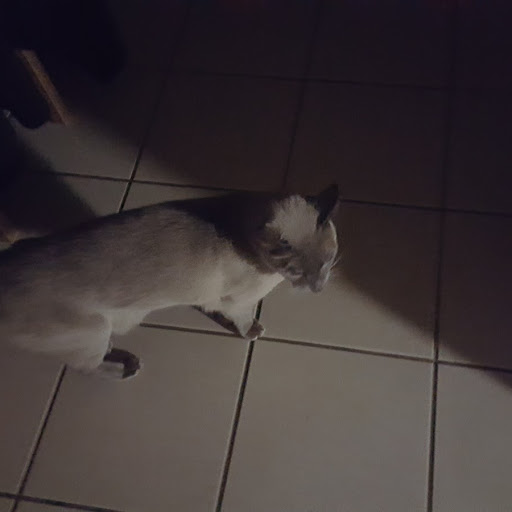
Conversations with my cat – 69

This is Chester. He’s looking for a cool spot to lie down.

We’ve been having something of a heat wave for the last few days, temperatures soaring above the mid-thirties, and nearly as high as forty degrees centigrade.

So, this morning we watched the ice hockey, and even Chester stayed the distance, not so he could smirk when the Maple Leafs lost, but to channel the idea it was cold somewhere else in the world.

And it worked for a while. Having been to the ice hockey in Toronto in person, I know just how cold it was.

After that, it was a matter of leaving the doors opens to let what breeze there was flow through the house, so Chester first sat by the front door, then the back door, then came out to see me.

Time for the air conditioner.

Yes, we have air conditioning, and yes, the cost of electricity in this country is horrendous.  It was why we had solar panels put in.

I just leave it as long as possible before turning it on.

I thought about toying with him, but he’s sitting on the keyboard looking angry.

Now was the right time.