Writing about writing a book – Day 29

Still working on Chapter One.

It requires re-reading the previous writing and making sure there’s continuity.


It was my responsibility since I’d recommended it and then won the support of management over his objections, and following that it had become a point of continual contention, a petty war neither of us was going to win.

I tried to keep the joy out of my voice.  He’d also vetoed my recommendation for a full-time network engineer as my alternative, making my job become single point sensitive.  There was no one to replace me if anything went wrong.

“Sounds like you’re having fun.”  I had to work hard to keep the amusement out of my tone.

“Fun nothing.”  His tone was reaching that exasperation point.  “There is no one else.”

“Why did you approve my holiday if I can’t have one?” I’d stretch his patience just a little more.

“You promised me the network was stable.”

“It is, and has been for the last six months.  I’ve said so in my last six-monthly reports.  You have been reading them, haven’t you?”

Silence.  It said all I needed to know.

I had a choice sentence to deliver, but an ignominious thought popped into my head.  He could probably use this against me, and would if I gave him the opportunity.  Perhaps I should shelve my differences with him for this morning.

Aside from that, there was a shooting, and we didn’t get one of those every day.  Not that it would probably amount to very much.  During the previous week, the office grapevine had been working overtime on the rumor Richardson was having a relationship with one of the ladies in the Accounts department.  It was just the sort of scandal the data entry staff thrived on.

A shooting and a network failure.  I didn’t know which was worse.  Perhaps if it was Benton they’d shot, there might be some justice…

I decided not to argue with him.  “Give me an hour.”

“Half.  Aitchison wants to see you.”

Werner Aitchison was head of Internal Security and a man who took his job seriously.  Enough, that is, to annoy my staff, and me.  He was ex-military intelligence, so ‘they’ said, but he appeared to me like a man out of his depth in this new age of communications.  Computers had proliferated in our company over the last few years, and the technology to go with them spiraling out of control.

We dealt in billions via financial transactions processed on computers, computers which, we were told often enough, was insecure, and easily taken control of outside their environment.  Aitchison was paranoid, and rightly so, but he had a strange way of going about his business.  He and I had butted heads on many occasions, and we may have had our disagreements, but we were good friends and colleagues outside work.

Just in case Benton was accusing me, I said, as sincerely as I could, “I didn’t do it.”

“Of that, I have no doubt.  He has requested a meeting with you at 10 am.  You will be there.”

“I said I would come in to look at the problem.  I didn’t say I was staying.”

“Let me know when you get in.”  That was it.  No ifs.  No buts.  Just a simple, ‘Let me know…’

I seriously considered ignoring him, but somewhere within me, there was that odd sense of loyalty.  Not to Benton, not to the Company, but to someone else, the man who had given me the job in the first place, who had given me every opportunity.

I was doing it for him and would tell him.

When I found out who it was!


© Charles Heath 2016-2020
“Trouble in Store” – Short stories my way: Editing becomes re-writing (1)

I have reworked the first part of the story with a few new elements about the characters and changed a few of the details of how the characters finish up in the shop before the policewoman makes her entrance.

This is part of the new first section that involves Jack:


Jack was staring down the barrel of a gun.

He had gone down to the corner shop to get a pack of cigarettes.

He had to hustle because he knew the shopkeeper, Alphonse, liked to close at 11:00 pm sharp.  His momentum propelled him through the door, causing the customer warning bell to ring loudly as the door bashed into it, and before the sound had died away, he knew he was in trouble.

It took a second, perhaps three, to sum up the situation. 

A young girl, about 16 or 17, scared, looking sideways at a man on the ground, then Alphonse, and then Jack.  He recognized the gun, a Luger, German, relic of WW2, perhaps her father’s souvenir, or more likely a stolen weapon, now pointing at him then Alphonse, then back to him.

Jack took another second or two to consider if he could disarm her.  No, the distance was too great.  He put his hands out where she could see them.  No sudden movements, try to remain calm, his heart rate up to the point of cardiac arrest.  No point making a bad situation worse.

Pointing with the gun, she said, “Move closer to the counter where I can see you better.”

Everything but her hand steady as a rock.  Only telltale sign of stress, the bead of perspiration on her brow.  It was 40 degrees Fahrenheit in the shop.

Jack shivered and then did as he was told. 

A few seconds more for him to decide she was in an unpredictable category.

“What’s wrong with your friend?”  Jack tried the friendly approach after he’d taken the three steps sideways necessary to reach the counter.

The shopkeeper, Alphonse, who, Jack noted seemed to have aged another ten years in the last few months, spoke instead; “I suspect he’s an addict, looking for a score.  At the end of his tether, my guess, and her to get some money.”

A simple hold up that had gone wrong.  Wrong time, wrong place, in more ways than one Jack thought, now realizing he had walked into a very dangerous situation.  She didn’t look like a user.  The boy on the ground, he did, and he looked like he was going through the beginnings of withdrawal.

Oddly, though, Jack had noticed a look pass between the shopkeeper and the girl.

 “All you had to go was give us the money, and we wouldn’t be here, now.”  She was glaring back at Alphonse.  “You can still make this right.”

A flicker of memory jumped out of the depths on Jack’s mind, something discussed at the dinner table with their neighbors, something about the shop as a pick-up point for drugs.

The boy on the floor, he was not here for the money.

Jack thought he’d try another approach.  “Look, I don’t want trouble, and you don’t want trouble.  I’ll go, forget this ever happened.  You might want to do the same.”

The girl looked like she was thinking.  The gun, though, still moved between him and the shopkeeper.

Another assessment of the girl; this was not her real home.  She was from a better class of people, a different part of town.  Caught up in a downward spiral because of her friend on the floor.

Caught in a situation she was not equipped to deal with.

That didn’t bode well for his, or anyone else in that shop right then, health.


© Charles Heath 2016-2020

In a word: Drink

Everyone loves a drink, and that interesting expression, ‘what’s your poison’ often resonates at a bar when among friends.

The thing is, we are supposed to know what our friends drink, me, for instance, I like beer, preferably in a bottle and not local mass-produced brew if I can avoid it.

But, some like white wine, no preference to type, some like cocktails like a Manhattan, or a Long Island Iced Tea, very dangerous if made correctly which quite often it isn’t, or champagne, the real thing not just leftover wine carbonated and given a name like ‘sparkling …’ something.

Every now and then we need to have more than one drink, and that desire is fuelled by our emotions.  A celebration, it’s two or three, just enough to allow the euphoria to seep in.  A tragedy of any sort means more than a few, usually prefixed with a statement like, ‘I need to get hammered’, but not literally.

Perhaps that’s why it’s called drowning our sorrows.

Of course, there are other meanings for the word ‘drink’ and often poets, and romance novelists will refer to a phrase such as ‘drink in…’ where it may refer to a loving gaze or a look of adulation.  You could also, at a stretch, drink in the sight of a magnificent landscape.

Then, at the end of that drinking session, good or bad, where you may have had the opportunity to drink in looks or locations, you might, if you didn’t play your cards right, get thrown in the drink.

Not in the glass, that’s a bit small, but it means a much larger body of water such as a pool, a lake, or the ocean.

And lastly, but probably not the only context for the word ‘drink’, it could be said you were ‘driven to drink’, and I don’t mean by another drinker to the hotel, bar, restaurant or party.

Driven to drink means you blame someone else for your recently acquired desire to drink as much as you can so that it blots out something or someone.

I’m officially blaming my dog for my drinking problem.  He drove me to drink.

And that’s all I have to say about it.

Pour me another drink, will you?

In a word: Nobody

This is sometimes how we must feel when overlooked or ignored, like a nobody.

And some people will treat you like a nobody, i.e someone who is just not important.

That’s just one use of the word.

Another might be…

Who did that to your room?

‘Nobody’ is the plaintiff reply.  The infamous Mr. Nobody.  We’ve never met him, but he’s always there.  And, what’s more, he seems to be able to be in more than one place at a time.

Then there’s that time when there’s nobody in the room, nobody agreed with me, hell, that happens all the time, and when I rang your phone nobody answered.

Nobody?  Was I expecting Mr. Nobody to answer?  Surely the response should have been, ‘and you didn’t answer’.

Of course, let’s not delve too deep here, lest we might find out something we didn’t want to know.

I went to your house last night, but nobody was home.

How is it we refer to the people whom we know live in that house as ‘nobody’.  Shouldn’t we be saying, ‘none of you was at home’?

It seems nobody is one of those words we often use in vain.

“Trouble in Store” – Short stories my way: More editing

The story fleshed out for the second section, discussed in Point of View


Annalisa looked at the two men facing her, a shopkeeper who, despite his protestations, was a dealer, and the other man, a customer scared shitless.

The poor bastard was not the only one scared. 

It was meant to be simple, arrive at the shop just before closing, force the shopkeeper to hand over the shit, and leave.

What had happened?

The shopkeeper laughed at them and  told them to get out.  Simmo started ranting and waving the gun around, then all of a sudden collapsed. 

There was a race for the gun which spilled out of Simmo’s hand, and she won.  No more arguments, the shopkeeper was getting the stuff when the customer burst into the shop.

This was worse than any bad hair day, or getting out of the wrong side of bed day, this was, she was convinced, the last day of her life.

Her mother said she would never amount to anything, and here she was with a drug addict coming apart because she had been cut off from her money and could no longer pay for his supply, which had led them to this inevitable ending.

She heard a strange sound come from beside her and looked down.  Simmo was getting worse, like he had a fever, and was moaning.


If Alphonse had thought his day was going to get any better after the delivery disaster earlier that day, he was wrong.

If he thought he could maintain his real business and his under the counter business with no one finding out, in that he was wrong too.  He’s know, inevitably, some useless punk would come and do exactly what Simmo was doing.

It might have been salvageable before the customer came in the door, but now it was not.  The customer had heard the words, and given him ‘the look’.  A drug addict telling the cops he was a dealer, it was his word against an  unreliable addict, but this local chap, he had that air of respectability the cops would listen too.

Damn.

But he had to try and salvage the situation, there was a lot of money involved, and other people depending on him.  He looked at the boy, on the floor, then  the girl.

“Listen to me, young lady, I have no idea what you are talking about.  Please, put the gun down before someone gets hurt.  Your friend needs medical help and I can call an ambulance.”

The girl switched her attention back to him.  “Shut up, let me think.  Shit.”

The storekeeper glanced over at the customer.  He’s been in once or twice, probably lived in the neighborhood, but looked the sort who’d  prefer to be anywhere but in his shop.  More so now.  If only he hadn’t burst in when he did.  He would have the gun, called the police, and brazened his way out of trouble.  Now, that remedy was off the table.

Now he had to deal with the fallout, especially if the girl started talking.


© Charles Heath 2016-2020

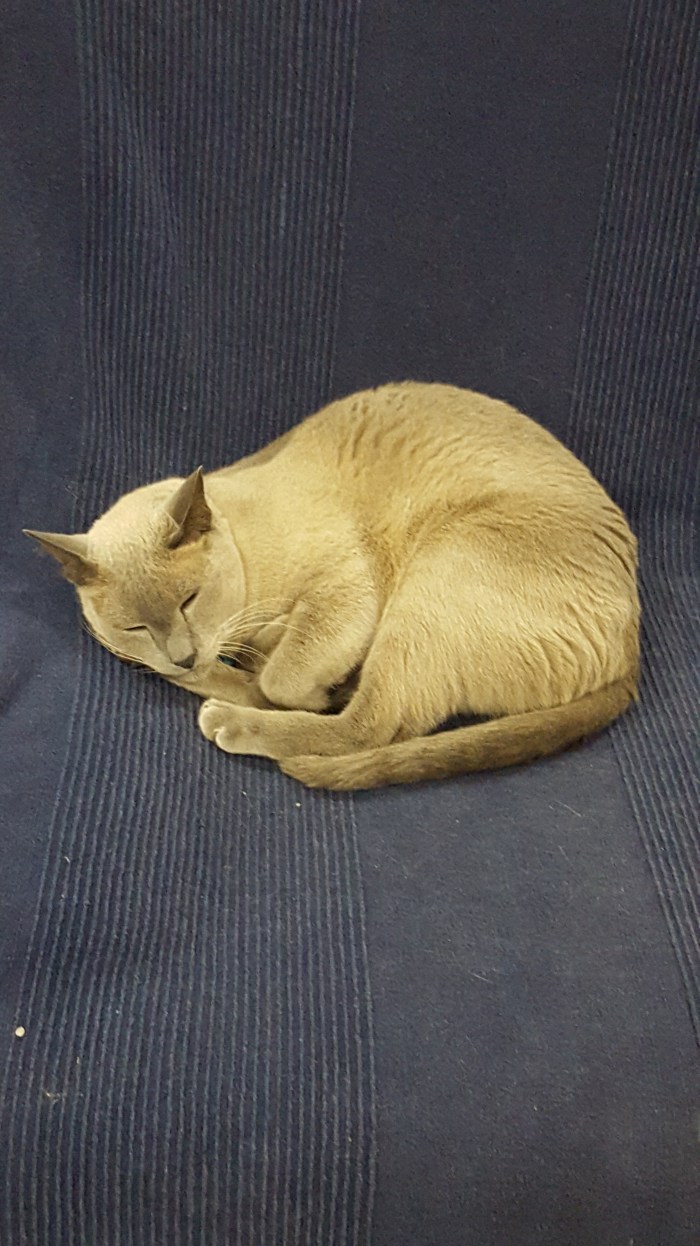
Conversations with my cat – 85

20151219_163915

This is Chester.  We’ve just got the news that our granddaughters’ dog had been taken to the vet.

It’s serious.

But it’s a dog, Chester mutters.  Perhaps I should get sick…

Don’t tell me you’re feeling unloved again.

He sits on my desk, again, giving me the steely-eyed look.

This is about the litter again, isn’t it?

We changed his litter for a cheaper brand.  For some reason, it’s getting more expensive to keep a cat, and the usual brand of litter jumped to nearly double what it was when we first bought it.

He just sticks his nose in the air and refuses to answer.

Well, I’m sorry, but we must economize.

Perhaps then you could use a cheaper brand of toilet paper.

OK, where did that come from?

Four-ply luxury while I get shredded paper.

He jumps off the desk and walks off, but not before saying, this isn’t over.

I can see this is going to be another test of wills.

And who is going to lose!

“Trouble in Store” – Short stories my way: Editing (1)

First drafts are always a little messy.  The words spill out onto the page, and it’s rare that any or all of them are perfect.  Sometimes you get lucky, but most of the time you don’t.

That’s why there’s revision, or by the more dreaded name, editing.

Editing conjures up a lot of different images in my mind, from completely re-writing, to cutting the mss down in size.  Or where you discover the main character’s name has changed from Bill to Fred after a bad night.

Usually, though, as stories progress, they go through a number of rewrites, and sometimes because of what follows.  It depends on how long a period the story is written.  Some of mine take days, others quite a lot longer.

This is the rewrite of the first section of the short story I’m undertaking, adding some new details:


Jack was staring down the barrel of a gun.

He had gone down to the corner shop to get a pack of cigarettes.

He had to hustle because he knew the shopkeeper, Alphonse, liked to close at 11:00 pm sharp.  His momentum propelled him through the door, causing the customer warning bell to ring loudly as the door bashed into it, and before the sound had died away, he knew he was in trouble.

It took a second, perhaps three, to sum up the situation. 

Young girl, about 16 or 17, scared, looking sideways at a man on the ground, then Alphonse, and then Jack.  He recognized the gun, a Luger, German, relic of WW2, perhaps her father’s souvenir, now pointing at him then Alphonse, then back to him.

Jack to another second or two to consider if he could disarm her.  No, the distance was too great.  He put his hands out where she could see them.  No sudden movements, try to remain calm, his heart rate up to the point of cardiac arrest.

Pointing with the gun, she said, “Come in, close the door, and move towards the counter.”

Everything but her hand steady as a rock.  The only telltale sign of stress, the beads of perspiration on her brow.  It was 40 degrees Fahrenheit in the shop.

Jack shivered, and then did as he was told.  She was in the unpredictable category.

“What’s wrong with your friend?”  Jack tried the friendly approach, as he took several slow steps sideways towards the counter.

The shopkeeper, Alphonse, seemed calmer than usual, or the exact opposite spoke instead, “I suspect he’s an addict, looking for a score.  At the end of his tether, my guess, and came to the wrong place.”

Wrong time, wrong place, in more ways than one Jack thought, now realizing he had walked into a very dangerous situation.  She didn’t look like a user.  The boy on the ground, he did, and he looked like he was going through the beginnings of withdrawal.

 “Simmo said you sell shit.  You wanna live, ante up.”  She was glaring at Alphonse. 

The language, Jack thought, was not her own, she had been to a better class of school, a good girl going through a bad boy phase. Caught in a situation she was not equipped to deal with.


© Charles Heath 2016-2020

Writing about writing a book – Day 28

Of course, holiday or not, there’s always something that can go wrong.

Or the fact an enforced holiday can always backfire.

Like now.


I’d almost managed to doze off again when the phone rang.

I jumped to its equally shrill sound cutting through the silence.  It had to be a wrong number because no one at work would call me, and I didn’t have many friends, so I let it ring out.  As far as I could remember, it was only the third time it had rung since I’d moved in, four years ago.

Blissful silence.  I looked at the bedside clock.  7 am.  Who called anyone at that hour?

It rang again.

Ignore it, I thought.  If it was anyone, it would be someone from the office.  I’d told them all not to call me, not unless the building was burning down and they were all trapped in it.

And even then, I’d have to think about it.

Burying my head under the pillow didn’t shut out the insistent ringing, compelling me to answer.  Almost reluctantly I rolled back, pulled the telephone out from under the bed, and lifted the receiver to my ear.

“Bill?”

It was Carl Benton, my immediate superior; an insipid, loathsome, irritating little man, the last person I would want to speak to.  He’d insisted I take this leave, that the office could survive without me, adding in his most condescending manner that I needed the break.

I slammed the receiver down in anger.  It was a forlorn gesture.  Seconds later, it rang again.

“I seem to remember you were the one to tell me to go on holiday, that I needed a holiday.  I’m off the roster.  It can’t be that important.  Call someone else.”  I wasn’t going to give him the opportunity to speak.  Not this morning.  I was not in the mood to listen to that squeaky, falsetto voice of his, one that always turned into a whine when he didn’t get his way.

And hung up again.

Not that it would do any good.  I knew that even if I was in Tibet, he would still call.  Then I realized it was too early for him to be in the office, and if he was, he would have been dragged out of bed and put in a position where if he didn’t produce results, they might realize just how incompetent he was.

At last, my holiday had some meaning and smiled to myself.  I’d make the bastard sweat.

He left it a few minutes before he rang again.  And I let it ring out.  I could see the expression on his face, bewilderment, changing slowly into suffused anger.  How dare I ignore him!

Another five minutes, then the phone began its shrill insistence again.  Before it rang again, I’d moved it from the floor to the bed.  I counted the rings, to ten, and then picked up the receiver.

“Bill?  Don’t hang up.”  Almost pleading.

“Why?  You said I should go, away from work, away from the phones, away to recharge my batteries, I believe you said.”

“That was Friday.  This is Monday. You’re needed.  Richardson has been found shot dead by his desk.  All hell has broken loose!”  Benton rarely used adjectives, so I assumed when he said all hell had broken loose, it meant something had happened he couldn’t fix.  His flowery language and telegram style had momentarily distracted my attention from Richardson’s fate.

Harold Richardson was an accountant, rather stuffy, but good at his job.  I’d spoken to him probably twice in as many years, and he didn’t strike me as the sort who would kill himself.  So why did I think that?  Benton had only said he was shot.

Benton’s voice went up an octave, a sure sign he was going into meltdown.  “It’s a circus down here.  Jennifer is missing, Giles is not in yet, the network is down, and that bunch of nincompoops you call support staff are running around the office like headless chooks.”

It all came out in a nonstop sentence, followed by a gasp for air.  It gave me time to sift the facts.  Jennifer, my sometime assistant, and responsible for data entry and accounts maintenance, was not there, which in itself was unusual, because she kept longer hours than me, Peter Giles, my youthful assistant, just out of university and still being beaten into shape was not in, and that was usual, so it could only mean one thing.

The network was down.


© Charles Heath 2016-2020


In a word: Keep

Yes, this is an easy one.

I want to keep the car.  Especially if it’s a Lamborghini and it didn’t cost $500,000.

This form of the word simply means to hang on to something, or up the proper definition, to have or retain possession of

Paring it with other words is where it gets complicated.

For instance,

Keepings off, make sure that the ball doesn’t get into someone else’s possession.

Keep it to yourself, yes, here’s your chance to become the harbinger of secrets and not tell anyone else.  Not unless a lot of money is involved, or a Lamborghini.

You guessed it, the car is the running joke on this post.

How about, keep a low profile, been there tried that, it’s a lot harder than you think.

What about keeping your cards close to your chest, yes, this had both a literal and figurative meaning which makes it sort of unique.

That might follow the second definition, to continue, or cause to continue a particular state.

Another way of using keep is by delaying or stopping someone from doing something or getting somewhere; ie, I was kept waiting at the doctor’s surgery because he was late.

There are any number of examples of using the word keep in tandem with other words

One that specifically doesn’t relate to all the former examples, is simply the word keep.

What is it?

Usually the strongest part of the castle, and the last to fall in an attack.

At least, that was the theory.

In a word: Anonymous

Which is how I feel sometimes.

It can be a paradox in that an ordinary man may strive to be recognised, that is, to rise above his inherent anonymity simply because he feels he has something more to offer mankind than just making up the numbers.

But sadly, that desire will often be met with staunch resistance, not because there’s an active campaign against him, it’s just the way of the world.

The fact is, most of us will always be anonymous to the rest of the world, but in being so in that respect it’s that anonymity we can live with.  However, it’s far more significant if we become anonymous to those around us.  And, sadly, it can happen.

It’s when we take someone for granted.

At the other end of the scale, there is the celebrity, who has finally found fame, discovers that fame is not all it’s cracked up to be.  You find that meteoric rise from obscurity an adrenaline rush, and you’re no longer anonymous.

But all that changes when you are constantly bailed up in the street by well-meaning but annoying fans when you are being chased by the paparazzi and magazine reporters who thrive not on the fact that you are famous but watching and waiting for you to stumble.

Some often forget that there’s always a camera on them, or there’s a reporter lurking in the shadows, looking for the next scoop, capturing that awkward inexplicable moment when the celebrity is seen with someone who’s not their spouse, or worse, if it could be that, they get drunk and make a fool of themselves.

Do I really want to lose that anonymity that I have?

Not really.  It seems to me like it might be the lesser of two evils.