
AtoZ Challenge – C is for: Can I help you?

C2020

I had once said that Grand Central Station, in New York, was large enough you could get lost in it.  Especially if you were from out of town.

I know, I was from out of town, and though I didn’t quite get lost, back then I had to ask directions to go where I needed to.

It was also an awe-inspiring place, and whenever I had a spare moment, usually at lunchtime, I would go there and just soak in the atmosphere. It was large enough to make a list of places to visit, or find, or get a photograph from some of the more obscure places.

Today, I was just there to work off a temper. Things had gone badly at work, and even though I hadn’t done anything wrong, I still felt bad about it.

I came in the 42nd street entrance and went up to the balcony that overlooked the main concourse. A steady stream of people was coming and going, most purposefully, a few were loitering, and several police officers were attempting to move on a vagrant. It was not the first time.

But one person caught my eye, a young woman who had made a circuit of the hall, looked at nearly every destination board, and appeared to be confused. It was the same as I had felt when I first arrived.

Perhaps I could help.

The problem was, a man approaching a woman from out of left field would have a very creepy vibe to it, so it was probably best left alone.

Another half-hour of watching the world go by, I had finally got past the bad mood and headed back to work. I did a wide sweep of the main concourse, perhaps more for the exercise than anything else, and had reached the clock in the center of the concourse when someone turned suddenly and I crashed into them.

Not badly, like ending up on the floor, but enough for a minor jolt. Of course, it was my fault because I was in another world at that particular moment.

“Oh, I am sorry.” A woman’s voice, very apologetic.

I was momentarily annoyed, then, when I saw who it was, it passed. It was the lost woman I’d seen earlier.

“No. Not your fault, but mine entirely. I have a habit of wandering around with my mind elsewhere.”

Was it fate that we should meet like this?

I noticed she was looking around, much the same as she had before.

“Can I help you?”

“Perhaps you can. There’s supposed to be a bar that dates back to the prohibition era here somewhere. Campbell’s Apartment, or something like that. I was going to ask…”

“Sure. It’s not that hard to find if you know where it is. I’ll take you.”

It made for a good story, especially when I related it to the grandchildren, because the punch line was, “and that’s how I met your grandmother.”
In a word: Order

I gave the order to my assistant to order the supplies we needed in order to maintain stock levels.

Oh, yes, the word order is one of my favourites, because it can confuse the hell out of many people in its simplicity and yet complexity.

I gave the order, it’s what happens in the armed forces, and a lot of other places, but mostly we would associate it with organisations that have hierarchical authority.

The military, for one, cut orders, the means of sending one of its minions to another place, or to do a specific job.

Order supplies, well, just about anyone can order something from somewhere, usually on the internet, and sometimes require or are given an order number so it can be tracked.

In order to maintain, in order to get what I want, in order to get elected, this is just another way of using the word, with the aim of achieving something, though I’m sure there’s probably a better way of expressing these sentiments.

Law and order, well, doesn’t everyone want this, and doesn’t it always turn up in an election campaign, and seems to be the first thing sacrificed after the election.  The thing is, no one can guarantee law and order.

There is the law and there is administering it.  There is no order that comes with it, we just hope that order is maintained, and deplore the situation when it isn’t.

Perhaps in order to maintain law and order, we might need more police.

Then, of course, there is alphabetical order, and numerical order, where things can be designated from A to Z, like this challenge, or from 1 to 10, or more.  We can sort words alphabetically, numbers numerically and data items by keys or an index.

This is naturally called a sort order.

Then there is my car, or bike, or washing machine, or mixmaster.  They are currently in good working order, though that might not last.

And lastly, in deference to all those out there who are thinking of becoming dictators, it’s always possible, one day, there will be a new world order.  They might actually be in their own particular order, whose intellect might be (?) of the highest order.

Surely that is one order too many.

Camp NaNoWriMo – Day 2

The April version of the November write-a-thon is upon us, well, me actually.  I’m not sure hope many others are trying to resurrect an old piece of writing.

The truth is, I’ve been at this story off and on over the past three years, and every time I get a head of steam, something else comes along.

Now I’ve decided to use the April version of NANOWRIMO to get this thing finished, or at least in a first draft state.

The old way I used to write stories was to have a separate file for each chapter, and with some of the books, there are upwards of 100 separate files, and recently I have been combining these into single files.

So much easier to work with, create indexes, and create a synopsis of the story, as well as a character list.

Yes, some of my stories had the main protagonist change name halfway through, and yes, it’s embarrassing.

Today’s word count takes me to the end of Chapter 5 and adds another 4,552 words to the total.

Like falling off a ten-story building, so far, so good.


Camp NaNoWriMo – Day 1

The April version of the November write-a-thon is upon us, well, me actually.  I’m not sure hope many others are trying to resurrect an old piece of writing.

The truth is, I’ve been at this story off and on over the past three years, and every time I get a head of steam, something else comes along.

Well, five other somethings, that is.

Now I’ve decided to use the April version of NANOWRIMO to get this thing finished, or at least in a first draft state.

But, dithering, and doing everything else, I managed to miss day one’s update on the website, which like the early days of last November, the web site had a similar problem/.

So day one has gone into day two and will stay there till the update is available.

Today’s effort is the reading, amending and getting into the gist of the story, processing a total of  3,698 words out of a target I’ve set at 75,000.

As I add the draft chapters to the first draft, the word count will increase.

I’ll try not to miss tomorrow’s update!

In a word: Rabbit

Have you ever heard of someone rabbiting on, you know, endlessly rattling on about nothing?

That’s just one use of the word rabbit.

The most obvious is the animal, a rabbit.  You know, that burrowing, plant-eating, long-eared, short-tailed animal that goes by the name of Bugs Bunny, maybe.

Nearly every child has a stuffed, cuddly one.

Of course, it’s of some significance at the moment because its Easter, and that there are countless chocolate versions of the so-called Easter bunny.

Then there is that 6-foot high invisible rabbit called Harvey, or not necessarily a rabbit, but a pookah.

We use the expression rabbit ears to describe those old interior television antennas.

There’s rabbit stew, rabbit pie, and white rabbit beer.

But my favourite is when the magician pulls the proverbial rabbit out of a hat.  It’s an expression we also use for someone who pulls off an impossible task.

The thing about ‘must read’ lists

And that is, you don’t have to read any of the books on it.

Who really cares if you do or if you don’t?

It’s just a list of books that a particular writer, journalist, or editor puts together simply because they liked them and think you might also.

And sometimes weight of sales numbers will dictate popularity, and therefore some basis to any particular list.

Of course, this doesn’t work if all you read is comics or romance books like Mills and Boon.  Hey, that’s fine.  You’re reading and this is one of the most important aspects of life, to read, and sometimes, to learn.

I know that my life changed dramatically when I read books, lots of different sorts of books.  I’ve never recommended anyone read the dry, dusty tomes about neurosis for psychiatry, or a history of the Roman Empire simply because of it something I was interested in after I saw the film, Ben Hur.

In a similar manner when we go to school, the curriculum sometimes dictates we read certain books, whether this is to give us an understanding of life centuries before, or that there is some deeper, more sinister, meaning to it all, but some of those books I had to read, back then, the meaning was lost on me.

But should I not read them?  I know most of the kids in the class didn’t because they considered reading a waste of time.  There were more important things to do like chase girls and play a sport.  And torment the teachers.  From what I hear, little has changed.

But the point here is, in my case, I’m just giving you the drum on what I read to improve my literary understanding, of life, and of the world, and perhaps in a small way, help with my writing.  After all, writers must read, particularly in their genre so they have some idea of what readers want.

But again that two-word phrase ‘Must read’ is an unfortunate and often misused heading.  We do it all the time.  Ten films you ‘must-see’, ten things you ‘must-have’, ten places you ‘must go’ usually before you die.

It amuses me to see books with a 1000 somethings you must do before you die.  I will no doubt be well and truly dead before I get halfway through even one of those lists, that is, if I actually took any notice of them.

But, what’s more interesting is that I like to see how many I haven’t done, which is probably the reason why we buy the book, usually off the sale table.

Conversations with my cat – 92

20160922_162007

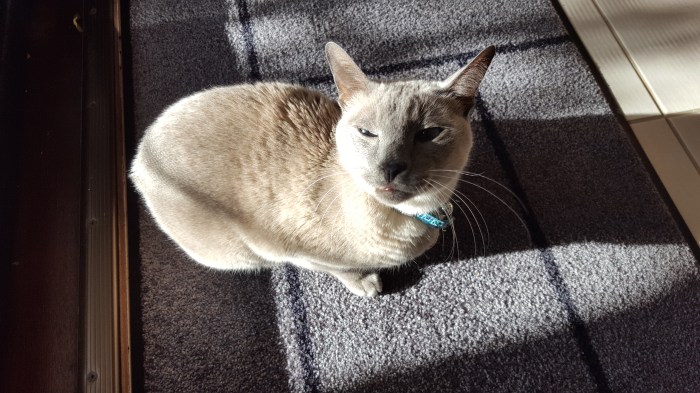
This is Chester.  He’s been missing a lot.

It’s the confined to quarters thing he doesn’t understand.  We had the discussion about the coronavirus, and the need to stay at home and only go out when there is a reason to go out, like to get food.

Which brought up another concern that he didn’t let go of,  that he didn’t think we had enough cat food or cat litter, or treats, though he didn’t define what he meant by treats.

I assumed it was real fish.

I didn’t tell him that it was a treat for us too, the cost of Barramundi and Salmon just a little expensive for pensioners.

Not that he remembered that we have been pensioners since April last year.

I swear that cat is getting more forgetful.  And, yes, that was another heated debate, whether he was getting dementia.

So, now he’s been taking to his hiding places, and keeping away from me, coming out only to get a pat or two from my other half, and give me the daggers look.  And eat, though some nights he turns his nose up at it.

You can tell his displeased because some of it ends up in his water bowl, and then sits by the water bowl and moans and groans till the water’s replaced.

I swear I’m going to go bonkers if we are forced to stay in the same place much longer.

His annual visit to the vet is coming up, and maybe I can get something for his grumpiness.


A to Z Challenge Theme Reveal

1badge

For the A to Z Challenge this year my theme is going to be:

Taking a phrase, and turning it into a mini-story.

The first, as a small hint for the coming days, starting with A is:

A funny thing happened…

in which I have to use the phrase within the story.


Past conversations with my cat – 54

20160903_163858

This is Chester.  Did someone use the word ‘vet’ out loud?

It is odd how some animals can recognise some words and remember what activity is attached to it.

Chester knows the word vet, and his memory attaches a great deal of seemingly horrible experience, not the worst of which is being transported in a pet basket.

Yes, we have just tried carrying him, but there is a sixth sense in every cat that tells them when they’re nearing a vet.  Within 50 metres of the front door, the hair stands up, the cat starts hissing as he would face off against a formidable opponent.

We only carried him once, never again.

But the histrionics start in the house where we have to mound a search party to find hi,  There are innumerable hiding places, and we have to be organised.\

Invariably, each time something like this happens, he finds somewhere new to hide.  We keep forgetting he can use his paws to open sliding doors, and close them again, a talent he had learned.

We’ve also learned to start looking a half-hour earlier than we used to.  The vet is only three minutes away, and we used to leave it to the last minute, but being late for the appointment happens only once.

Vets are worse than doctors when you miss appointments.  PErhaps Chester knows this and tries to use it to his advantage.  It no longer works.

Then, once we find him, the next exercise is to get him into the basket.  I’ve never seen so many tricks on how not to let the humans put him in it.

But, over time, we’ve learned, and sometimes it’s easy, others, I have the scars to prove it.

Then, once we get to the vet, it’ss a completely different cat, not Chester, but some other cat disguised as him.  Chester has never given the vet an ounce of trouble.

Perhaps we should become vets.

Chester is fine, just a little off-colour perhaps from something he ate.  Not all pet food is agreeable, and we’ve been trying to get his to have something different.  I even specially cook fish for him, and maybe that was the problem.

What is off-putting is the ease in which he goes back into the basket for the vet.

But all is well, and he will be glad to get out…

Just one of many reading lists – part 3

**Please don’t assume that you have to, nor would I ever expect you to,  read any or all of these books.  You don’t.**

Everyone, it seems, will publish what they call the top 100 books that you should read. Some are voted on, some belong to the opinion of the editor of the book review section of a newspaper, and, as you know, there are a lot of newspapers, a lot of editors, and a lot of opinions.

I’m not a newspaper, I’m not an editor, but I have a list, based on personal experience, and many, many years of reading.

It’s in no particular order.

41.  The Hound of the Baskervilles by Sir Arthur Conan Doyle, as well as a host of other Sherlock Holmes stories

42.  The Secret Agent by Joseph Conrad, one of Conrad’s later political novels, set in London in 1886 and deals with anarchism and espionage.  In those days spies were called anarchists.

43.  The Ipcress File by Len Deighton, introducing us to Harry Palmer, who was personified by Michael Caine and led to Horse Under Water, and Funeral in Berlin.  More of Len Deighton later on in the list

44.  The Remorseful Day by Colin Dexter introducing the somewhat enigmatic detective, Morse, his first name not revealed for a long time but oddly, Endeavour.  John Thaw brought him to life

45.  Crime and Punishment by Fyodor Dostoevsky, hard to pronounce and even harder to read, but perhaps worth it in the end.  By the time I read this I was wishing for a Russian writer had could use an economy of words

46.  Dr. Zhivago by Boris Pasternak wasn’t it.  A vast and lengthy dissertation on lost love, I felt very sad for Zhivago in the end.  I saw a stage play of the same name, and I’m sorry, but it’s a few hours of my life I will never get back

47.  Casino Royale, the first of the James Bond novels by Ian Fleming.  I have to say these are among my favorite spy books.  I must say I preferred the new James Bond in Casino Royale, though Sean Connery still rules!

48.  The Day of the Jackal by Frederick Forsythe, a fascinating story about an assassin

49.  Anything written by John Le Carre, but in particular, the George Smiley collection.  Finally unmasking his nemesis the Russian spymaster made it all so satisfying.

50.  The Bourne Identity by Robert Ludlam, inspiring a long series by both Ludlam and Eric Lustbader makes entertaining reading, but the first, the man who did not know who or what he really was, was excellent.  Matt Damon didn’t harm his persona either.

51.  Murder Must Advertise by Dorothy Sayers, whose detective is Lord Peter Whimsey, a 1933 mystery novel that’s eighth in the series

52.  Gorky Park by Martin Cruz Smith.  You have to admit that his Russian detective Arkady Renko is up against it when his investigation goes in a direction that uncovers corruption and dishonest in his superiors

53.  The Way of All Flesh by Samuel Butler, a semi-autobiographical novel written between 1987 and 1884, and published in 1903.  The story of the Pontifex family.

54.  Howards End by E. M. Forster, first published in 1910, is an interesting insight into the behavior of the, and between the classes, with the Schlegels acting as the catalyst.

55.  Washington Square by Henry James, originally published as a serial, and covers the conflict between daughter and father.  I must say I prefer The Ambassadors to Washington Square.

56.  Ulysses by James Joyce, a day in the life of an ordinary man, Leopold Bloom, why could it not be the 7th June rather than the 16th, for obvious reasons

57.  The Go-Between by L. P. Hartley is a view of society at the end of the Victorian period through the eyes of a young boy.  I read this while still at school and had no clue why, but later, when I read it again, I understood the meaning

58.  Atonement by Ian McEwan, I saw the film and then read the book.  Never a good idea.  Basically, a young girl makes a bad mistake and tries to atone for it.

59.  Gone With The Wind by Margaret Mitchell, the War and Peace of Americal novels, and as long by comparison.  The only book written by Mitchell, and the second most read book by Americans.  The film was interesting but awfully long.

60.  The English Patient by Michael Ondaatje, with a man with severe burns and the effect he had on three others.  Colin Firth is villain one day and hero the next, this time in the cinematic version, an out and out cad.

More to come…