I fell asleep in front of the computer screen

And when I woke up, I realised that I had just had a very bad dream. Or don’t they call bad dreams nightmares?

Can you diagnose yourself as having depression?

Of course, if you were to tell someone else, in one of this very serious tones, “I think I have depression” they will ask you what you’ve got to be depressed about.

It’s a good question. My first answer would be, “why did the doctor put my on anti depressants?” You know the stuff they give you, some derivative of serapax,

Then, if you tell anyone you’re on that stuff, they turn around and tell you just how bad it is and get off it right now.

That’s all very well, but you tell them you still have depression, and so the argument goes on.

But…

These days, they use low doses of anti depressants to manage pain, and in my case back pain. The first pill they gave me was lyrica, which slowly took my memory away so that I couldn’t remember what anyone had said earlier in the day.

I thought I had early onset Alzheimer’s, or worse, dementia.

So I got off that, got the pain back, and moved to anti depressants. Now I’m seeing things.

That might help with the imagination for writing stories sometimes, but telling people you see the patterns on tiles moving is not a good start to any conversation.

Back to depression, though. It might be caused by being locked down and not being able to go anywhere, but that has never bothered me because I hate going out.

It might be a result of my childhood coming back to haunt me, and, believe me, you would not want the childhood I had, but it’s a maybe. A lot of old people find their past creeping up on them, and what happened 60 years ago seems more relevant than what happened 60 minutes ago.

You might think you’re badly done by, that everyone else is responsible for the mess you made of your life, if it is indeed a mess, but no, that isn’t true. My life is exactly what it’s meant to be, though how I got here remains the biggest of mysteries.

It’s why I’m writing the autobiography of a very ordinary nobody.

OK, that might be a hint, thinking I’m a nobody. After all, when I go out I always feel like I’m invisible.

A friend of mine tells me he always cries when there’s a sad part of a film on, and that’s his determination of depression.

I do too, but I don’t think it’s that.

After all, I did psychology and should understand the nuances of the human psyche, what makes us happy, what makes us sad, what makes us us.

So, rightly or wrongly I’ve stopped taking the anti depressants.

If suddenly my blog suddenly stops, you’ll know I’ve made the wrong decision.

Searching for locations: Oreti Village – No two sunrises are the same – 1

Oreti village, Pukawa Bay, North Island, New Zealand

On the southern tip of Lake Taupo

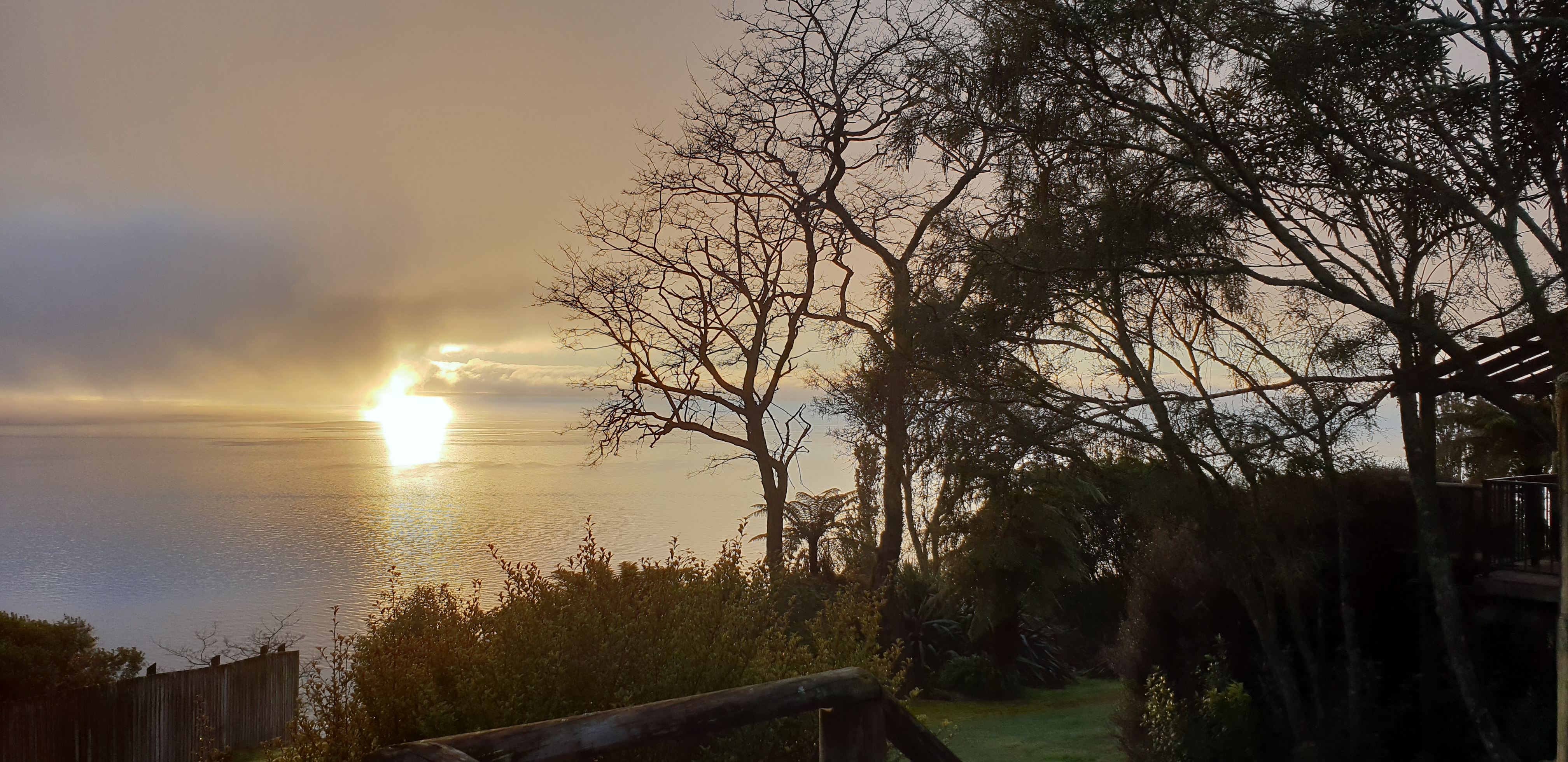
Our first morning there, a Saturday.  Winter.  Cold.  And a beautiful sunrise.

20180812_073230

This was taken from the balcony, overlooking the lake.

The sun is just creeping up over the horizon

20180812_073241

It gradually gets lighter, and then the sun breaks free of the low cloud

It lights up the balcony

20180811_074651

And the trees just beyond, a cascade of colorful ferns.

20180811_074622

It looks like its going to be a fine day, our first for this trip, and we will be heading to the mountains to see snow, for the first time for two of our granddaughters.

Searching for locations: Oreti Village – No two sunrises are the same – 1

Oreti village, Pukawa Bay, North Island, New Zealand

On the southern tip of Lake Taupo

Our first morning there, a Saturday.  Winter.  Cold.  And a beautiful sunrise.

20180812_073230

This was taken from the balcony, overlooking the lake.

The sun is just creeping up over the horizon

20180812_073241

It gradually gets lighter, and then the sun breaks free of the low cloud

It lights up the balcony

20180811_074651

And the trees just beyond, a cascade of colorful ferns.

20180811_074622

It looks like its going to be a fine day, our first for this trip, and we will be heading to the mountains to see snow, for the first time for two of our granddaughters.

Searching for locations: Old Shanghai, China

The old Shanghai refers to a small area of Shanghai that used to be walled in and remained that way until about 1912 when all but a small section of the wall was demolished.  With the advent of the concessions, Old Shanghai became the administrative center until later when it became a shopping complex.

Now it has many restored historical buildings as well as new buildings in a somewhat traditional style that has become one of Shanghai’s main tourist attractions, housing many shops and restaurants.

The “Old Town” is not exclusively old, as you still have a chance to take in the atmosphere if you wander into the quaint side streets.

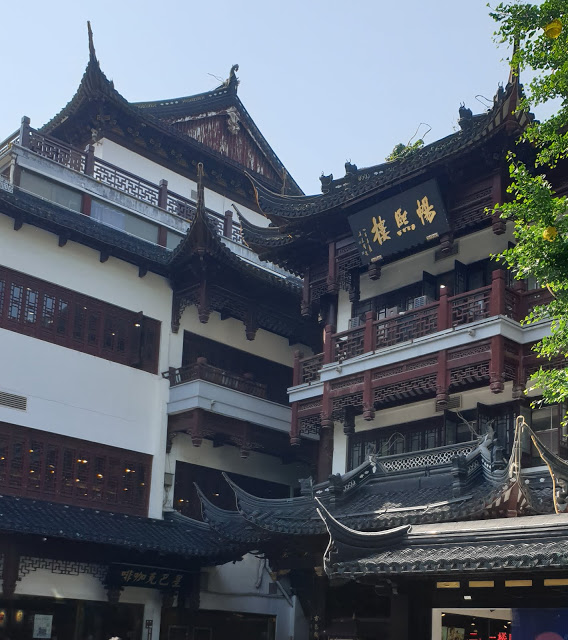
But, on first viewing walking down the street towards the complex, I’m not sure I’d go as far as to say this is in reality old Shanghai, except for what appears to be a true representation of it architecturally. 

The buildings, which are shops and restaurants, are set out symmetrically, with streets, alleyways, and squares which may prove that it was specially built for the tourists, and no mechanized traffic.

Anyway…

The buildings are magnificent, and a photographer’s delight, and you’d finish up having hundreds of photos by the time you leave.  All the buildings are exquisite representations of traditional Chinese architecture. 

As for buying stuff, remember if you’re not Chinese you have the sucker tourist stamp on your forehead, so be prepared to walk away if the vendors will not bargain.  

Nothing here is worth the price tag and in our group discounts like from 130 RMB to 50 RMB and from 1 for 1,200 to 2 for 950 RMB are common.

Here common t-shirts that we can get for 3 dollars back home start at 150 RMB which is roughly 35 dollars.  It’s that kind of market.

We end up is a tea room, on the third floor of the meeting point below, and discover all the tour guides sitting around a table counting money, and I have to say it’s the most $50 notes I’ve ever seen in one place.  
It is, we were told, where they discussed ‘strategy’.

In a word: Course

Yes, of course there’s a golf course.

Firstly, of course, means definitely so, and can be said when a revelation is realised, or sarcastically if the answer is obvious.

Then there’s a course, like a golf course where people chase a small usually white ball, sometimes to be found on a fairway, but more often than not in a bunker, in the water, or in the thicket.

It’s meant to be calming, but I’m betting more than one heart attack has been brought on by a slice, a six shot bunker exit, or any more than three putts on the green.

There’s also mini golf courses, less challenging, sometimes.

That course could also be the part of a creek or a river.

It can be a set of classes that makes up a course, I did a course in English literature

Then, rather topically, over the course of the election there was [you fill in the rest]

Then there’s my favourite, a four course dinner

Or when I’m unwell a course of antibiotics.

And lastly, in a supermarket how often does the trolley in front of you unexpectedly and randomly change course?

This is not to be confused with coarse

Which to be honest can be used sometimes to describe people who swear or are abrupt.  They were coarse people, that is unrefined.  These people often use coarse language and tell course jokes, meaning crude and offensive

It had a coarse texture, ie it was rough not smooth

And then there’s Corse which is not exactly an English word, but can refer to a corpse or dead body.

The bane of our existence: social media

I’m back to writing, sitting at the desk, pad in front of me, pen in hand.

The only thing lacking is an idea.

It’s 9:03 am, too early to start on a six-pack.

I need a distraction.

Blogging, websites, Twitter, and Facebook, all of these social media problems are swirling around in my mind.

The more I read the more it bothers me that if I don’t have the right social media presence if I do not start to build an email list, all of my efforts in writing a book will come to naught.

Then I start trawling the internet for information on marketing and found a plethora of people offering any amount of advice for anything between a ‘small amount’ to a rather large amount that gives comprehensive coverage of most social media platforms for periods of a day, a week or a month.  I don’t have a book so it’s a bit early to be worrying about that.

I move on to the people who offer advice for a cost on how to build a following, how to build a web presence, how to get a thousand Twitter followers, and how to get thousands of email followers before the launch.

The trouble is I’m writing a novel, not a nonfiction book, or have some marvellous 30 page ebook on how to do something, for free just to drive people to my site.

I’m a novelist, not a handyman so those ideas while good are not going to help me.

Yet another problem to wrestle with along with actually creating a product to sell in the first place.

Except I’m supposed to be writing for the love of it without the premeditated idea of writing for gain or getting rich quick.

What am I missing here?

So should l be writing short stories and offering them for free to drive people to my site?  These would have to be genre-specific so it needs time and effort and fit into a convenient size story that will highlight or showcase my talent.

Or should I create a website for the novel and set up pages for the characters and get some interaction going that way?

It will be difficult without giving the whole plot away so if I do it will have to be carefully managed.

I don’t think I will have a good night’s sleep again with all of these social media problems I’m going to have.

Oh well, back to the book.  It’s time to have a nightmare of a different sort!

Searching for locations: Old Shanghai, China

The old Shanghai refers to a small area of Shanghai that used to be walled in and remained that way until about 1912 when all but a small section of the wall was demolished.  With the advent of the concessions, Old Shanghai became the administrative center until later when it became a shopping complex.

Now it has many restored historical buildings as well as new buildings in a somewhat traditional style that has become one of Shanghai’s main tourist attractions, housing many shops and restaurants.

The “Old Town” is not exclusively old, as you still have a chance to take in the atmosphere if you wander into the quaint side streets.

But, on first viewing walking down the street towards the complex, I’m not sure I’d go as far as to say this is in reality old Shanghai, except for what appears to be a true representation of it architecturally. 

The buildings, which are shops and restaurants, are set out symmetrically, with streets, alleyways, and squares which may prove that it was specially built for the tourists, and no mechanized traffic.

Anyway…

The buildings are magnificent, and a photographer’s delight, and you’d finish up having hundreds of photos by the time you leave.  All the buildings are exquisite representations of traditional Chinese architecture. 

As for buying stuff, remember if you’re not Chinese you have the sucker tourist stamp on your forehead, so be prepared to walk away if the vendors will not bargain.  

Nothing here is worth the price tag and in our group discounts like from 130 RMB to 50 RMB and from 1 for 1,200 to 2 for 950 RMB are common.

Here common t-shirts that we can get for 3 dollars back home start at 150 RMB which is roughly 35 dollars.  It’s that kind of market.

We end up is a tea room, on the third floor of the meeting point below, and discover all the tour guides sitting around a table counting money, and I have to say it’s the most $50 notes I’ve ever seen in one place.  
It is, we were told, where they discussed ‘strategy’.

Searching for locations: West Lake, Hangzhou, China

West Lake is a freshwater lake in Hangzhou, China. It is divided into five sections by three causeways. There are numerous temples, pagodas, gardens, and artificial islands within the lake.

Measuring 3.2 kilometers (2 miles) in length, 2.8 kilometers (1.7 miles) in width, and 2.3 meters (7.5 feet) in average depth, the lake spreads itself in an area totaling 6.5 square kilometers (2.5 square miles).

The earliest recorded name for West Lake was the “Wu Forest River”, but over time it changed to two distinct names.  One is “Qiantang Lake”, due to the fact that Hangzhou was called “Qiantang” in ancient times.  The other, “West Lake”, due to the lake being west of the city

It’s about to get busy, with a number of activities planned, and the warmth of the day is starting to make an impact.

The tour starts in the car park about a kilometer away, but the moment we left the car park we were getting a taste of the park walking along a tree-lined avenue.

When we cross the road, once again dicing with death with the silent assassins on motor scooters.

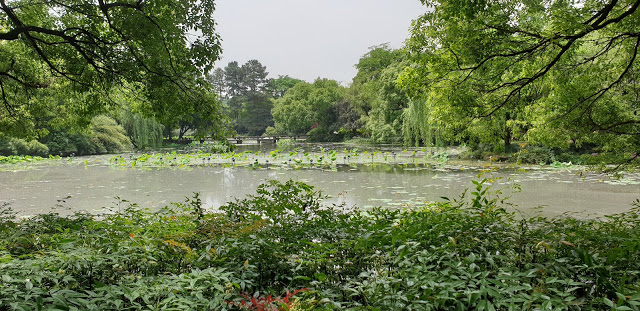
We are in the park proper, and it is magnificent, with flowers, mostly at the start hydrangeas and then any number of other trees and shrubs, some carved into other flower shapes like a lotus.

Then there was the lake and the backdrop of bridges and walkways.

.

And if you can tune out the background white noise the place would be great for serenity and relaxation.

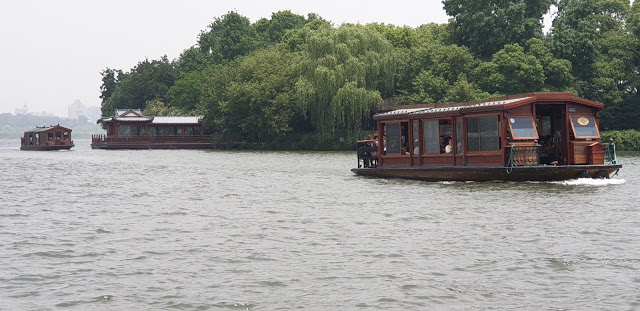
That, in fact, was how the boat ride panned out, about half an hour or more gliding across the lake in an almost silent boat, by an open window, with the air and the majestic scenery.

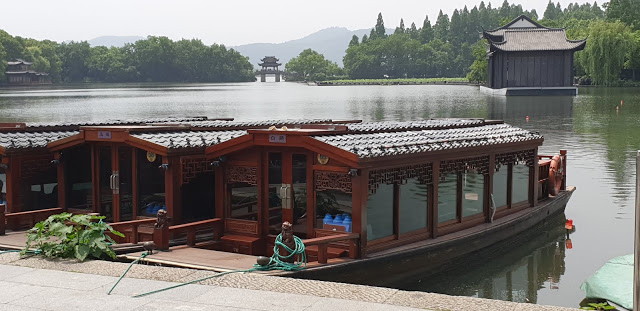
No, not that boat, which would be great to have lunch on while cruising, but the boat below:

Not quite in the same class, but all the same, very easy to tune out and soak it in.

It was peaceful, amazingly quiet, on a summery day

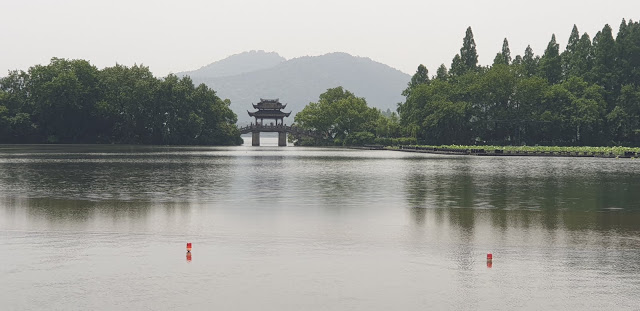
A pagoda in the hazy distance, an island we were about to circumnavigate.

Of all the legends, the most touching one is the love story between Bai Suzhen and Xu Xi’an. Bai Suzhen was a white snake spirit and Xu Xi’an was a mortal man.

They fell in love when they first met on a boat on the West Lake, and got married very soon after.

However, the evil monk Fa Hai attempted to separate the couple by imprisoning Xu Xi’an. Bai Suzhen fought against Fa Hai and tried her best to rescue her husband, but she failed and was imprisoned under the Leifeng Pagoda by the lake.

Years later the couple was rescued by Xiao Qing, the sister of Baisuzhen, and from then on, Bai Suzhen and Xu Xi’an lived together happily.

The retelling of the story varied between tour guides, and on the cruise boat, we had two.  Our guide kept to the legend, the other tour guide had a different ending.

Suffice to say it had relevance to the two pagodas on the far side of the lake.

There was a cafe or restaurant on the island, but that was not our lunch destination.

Nor were the buildings further along from where we disembarked.

All in all the whole cruise took about 45 minutes and was an interesting break from the hectic nature of the tour.

Oh yes, and the boat captain had postcards for sale.  We didn’t buy any.

Lunch

At the disembarkation point there was a mall that sold souvenirs and had a few ‘fast food’ shops, and a KFC, not exactly what we came to China for, but it seemed like the only place in town a food cautious Australian could eat at.

And when tried to get in the door, that’s where at least 3 busloads were, if they were not in the local Starbucks.  Apparently, these were the places of first choice wherever we went.

The chicken supply by the time we got to the head of the line amounted to pieces at 22.5 RMB a piece and nuggets.  Everything else had run out, and for me, there were only 5 pieces left.  Good thing there were chips.

And Starbucks with coffee and cheesecake.

At least the setting for what could have been a picnic lunch was idyllic.

Searching for locations: West Lake, Hangzhou, China

West Lake is a freshwater lake in Hangzhou, China. It is divided into five sections by three causeways. There are numerous temples, pagodas, gardens, and artificial islands within the lake.

Measuring 3.2 kilometers (2 miles) in length, 2.8 kilometers (1.7 miles) in width, and 2.3 meters (7.5 feet) in average depth, the lake spreads itself in an area totaling 6.5 square kilometers (2.5 square miles).

The earliest recorded name for West Lake was the “Wu Forest River”, but over time it changed to two distinct names.  One is “Qiantang Lake”, due to the fact that Hangzhou was called “Qiantang” in ancient times.  The other, “West Lake”, due to the lake being west of the city

It’s about to get busy, with a number of activities planned, and the warmth of the day is starting to make an impact.

The tour starts in the car park about a kilometer away, but the moment we left the car park we were getting a taste of the park walking along a tree-lined avenue.

When we cross the road, once again dicing with death with the silent assassins on motor scooters.

We are in the park proper, and it is magnificent, with flowers, mostly at the start hydrangeas and then any number of other trees and shrubs, some carved into other flower shapes like a lotus.

Then there was the lake and the backdrop of bridges and walkways.

.

And if you can tune out the background white noise the place would be great for serenity and relaxation.

That, in fact, was how the boat ride panned out, about half an hour or more gliding across the lake in an almost silent boat, by an open window, with the air and the majestic scenery.

No, not that boat, which would be great to have lunch on while cruising, but the boat below:

Not quite in the same class, but all the same, very easy to tune out and soak it in.

It was peaceful, amazingly quiet, on a summery day

A pagoda in the hazy distance, an island we were about to circumnavigate.

Of all the legends, the most touching one is the love story between Bai Suzhen and Xu Xi’an. Bai Suzhen was a white snake spirit and Xu Xi’an was a mortal man.

They fell in love when they first met on a boat on the West Lake, and got married very soon after.

However, the evil monk Fa Hai attempted to separate the couple by imprisoning Xu Xi’an. Bai Suzhen fought against Fa Hai and tried her best to rescue her husband, but she failed and was imprisoned under the Leifeng Pagoda by the lake.

Years later the couple was rescued by Xiao Qing, the sister of Baisuzhen, and from then on, Bai Suzhen and Xu Xi’an lived together happily.

The retelling of the story varied between tour guides, and on the cruise boat, we had two.  Our guide kept to the legend, the other tour guide had a different ending.

Suffice to say it had relevance to the two pagodas on the far side of the lake.

There was a cafe or restaurant on the island, but that was not our lunch destination.

Nor were the buildings further along from where we disembarked.

All in all the whole cruise took about 45 minutes and was an interesting break from the hectic nature of the tour.

Oh yes, and the boat captain had postcards for sale.  We didn’t buy any.

Lunch

At the disembarkation point there was a mall that sold souvenirs and had a few ‘fast food’ shops, and a KFC, not exactly what we came to China for, but it seemed like the only place in town a food cautious Australian could eat at.

And when tried to get in the door, that’s where at least 3 busloads were, if they were not in the local Starbucks.  Apparently, these were the places of first choice wherever we went.

The chicken supply by the time we got to the head of the line amounted to pieces at 22.5 RMB a piece and nuggets.  Everything else had run out, and for me, there were only 5 pieces left.  Good thing there were chips.

And Starbucks with coffee and cheesecake.

At least the setting for what could have been a picnic lunch was idyllic.

Searching for locations: The Silk Factory, Suzhou, China

China is renowned for its exquisite silk, so naturally, a visit to the Silk Spinning Factory is part of today’s tour.

After that, we will be heading downtown to an unspecified location where we’re getting a boat ride, walk through a typical Chinese shopping experience, and coffee at a coffee shop that is doubling as the meeting place, after we soak up the local atmosphere.

The problem with that is that if the entire collective trip a deal tourists take this route then the savvy shopkeepers will jack up their prices tenfold because we’re tourists with money.  It’ll be interesting to see how expensive everything is.

So…

Before we reach the silk factory, we are told that Suzhou is the main silk area of China, and we will be visiting a nearly 100 years old, Suzhou No 1 Silk Mill, established in 1926.  Suzhou has a 4,700-year history of making silk products.  It is located at No. 94, Nanmen Road, Suzhou, Jiangsu, China.

Then we arrive at the Silk Factory, another government-owned establishment with a castiron guarantee of quality and satisfaction.

The look and feel of the doona cover certainly backs up that claim

And the colors and variety is amazing (as is the cost of those exquisite sets)

We get to see the silk cocoon stretched beyond imagination, and see how the silk thread is extracted, then off to the showroom for the sales pitch.

It isn’t a hard sell, and the sheets, doonas, pillows, and pillowcases, are reasonably priced, and come with their own suitcase (for free) so you can take them with you, or free shipping, by slow boat, if you prefer not to take the goods with you.

We opt for the second choice, as there’s no room left in our baggage after packing the Chinese Medicine.