In a word: Land


And, yes, the simple description for this word is that area of the earth that isn’t covered by water.

It could also describe that little patch that my house is built on, and is generally covered by the expression, house and land as a package.

After all, a piece of land is not much used to you unless there’s a dwelling on it, or, on rare occasions, under it.  Does that mean then that land in this instance only as what you can see?

OK, now it’s getting confusing.

What if I wanted to live off the land.  A small patch will not do, in this case, is need a large area, perhaps thousands if hectares.

It is said that the Australian aborigines have lived off the land for thousands of years, with a nomadic lifestyle.

No small patch of land for them.

Now, what if I come down out of the sky. Oddly enough this means I have to land, even if I come back to earth over later.  It’s still a landing.

Now it’s getting interesting.

So what if you wanted to refer to where you live?  That would be your homeland or motherland, and it describes a country.

So it’s my patch, my country, any area where there isn’t water.  What about describing a country, say the land of the long white cloud, or the land of the rising sun?

And just to add to the confusion

I can land a fish

Make land, after being all at sea, and,

Best of all, land that much desired job.

Wow.

I’m beginning to think it’s another one of those ‘four-letter words’

Have you ever…

Started to write a post, get so far, and another theme or idea slips in, and demands to be written first?

I’m on this nostalgia kick, simply because when I turned on the TV to catch up with the latest COVID news, it was on a channel that shows old movies.

In case you don’t realize it, I love old movies, not just those from Hollywood, but also from Britain.

What was on?

An American in Paris.

Well, it had to be one of my favorites, even though I’m not a great fan of Gene Kelly, the sheer majesty of the music more than makes up for the story in between.

Could it be said, then, this was from the golden years of Hollywood? Such bright and cheerful movies such as Singing in the Rain, and An American in Paris, perhaps exemplify the Hollywood musical.

Years before, Fred Astaire and Ginger Rogers were the quintessential musical stars, followed by the likes of Judy Garland and Deanna Durbin, and later Bing Crosby and Frank Sinatra. A couple of musicals, in particular, comes to mind, firstly the Wizard of Oz and then High Society.

Moving forward to more modern times, several stand out in the1960s, My Fair Lady and Sound of Music. By this time theatergoers were dining on the superb talents of Rogers and Hammerstein, and Learner and Lowe. Of the former, musicals such as Carousel, South Pacific, and The King and I were on my list of favorites.

Even later still in the 1970s, there is Funny Girl, and Hello Dolly, which has a connection to the past with its director, none other than, yes, Gene Kelly.

But it seems once the 60s had passed the notion of the Hollywood blockbuster musical had gone, and we were left with clip shows like That’s Entertainment, put together while Gene Kelly and Fred Astaire were still alive. WE still had the film versions of the stage plays, but the lustre had, somehow, gone.

Perhaps it will return, who knows, after all, everything old is usually new again, it just takes time to go full circle.

Let’s talk history

What happened yesterday is history, but that’s not necessarily how we view what is history and what isn’t.

Similarly what is and what isn’t history is usually decided on by academics, because history texts that are used in schools are not written by ‘the man in the street’ authors. They’re usually university types who specialise in a particular field, or specialise section of history.

Even then one doubts that what is written is not a consensus of a panel.

So, when we talk about re-writing history, that takes a very brave bunch of people who want to buck the norm.

Our history, that which was taught when I went to school,. about our own country, Australia, started in 1770. Some brave soul tried to say it began earlier than that, before Captain Cook and the British arrived, out up a flag pole, and declared it belonged to Britain, like in 1606 when the Dutch explorer Willem Janszoon landed on the Cape York peninsula, only it wasn’t called that then.

And he might have been as surprised as Captain Cook that there were people here to observe their arrival. Yes, people had been living in this country for tens of thousands of years before the Europeans arrived.

But that was not what we were taught. No, Captain Cook, 1770, the a fleet of ships in 1788, and off we run as a new country, and a dumping ground for Britain’s convicts. Our history starts there, and then meanders through time, dividing the country up into states, having famous explorers like Burke and Wills, and Blaxland, Wentworth, and Lawson, Hume and Hovell.

And we commemorate all these people and those who were in charge over the years, with names of states, cities, rivers, mountains, everything under the sun. You’ve only got to glance at the list of hundreds of these forefathers and explorers to see just how many places in this country were named after them.

No heed was taken of what they may have been called before because no one really understood the languages of the first people who lived here. And they never seem to rate as a matter of study for us children back then.

Now, as people have begun to realise our history goes way, way back, and that there should be a nod to those inhabitants, they are considering re-writing some of our history to incorporate these people. And change the names of places to their original. A famous instance of recent renaming is of Ayers Rock, now called Uluru.

Even then, Australian History didn’t rate very highly, and I have to say, as a child at school 50 odd years ago, I learned more about the British Empire/Commonwealth, and about the English kings and queens, than we did about our own Governor Generals, Prime Ministers and State Premiers.

Could I tell you the name of our first Prime Minister? No. I can say when Australia became Australia, yes. 1901. Can I tell you the first King of England? Yes, William the Conqueror in 1066. There were kings before that but they only ruled of parts of England.

But over the years since I have read the odd book of Australian History but for some reason it never quite seems as colourful or as interesting as that of England or Scotland, or even some of the European countries.

Now, since I’ve been reading about what’s happening in the United States I have begin to take an interest in American history, and it, too, seems to suffer the same problems we have with ours, a bunch of academics decided what it was, and what it would not include, and then there is this thing called the 1619 project.

Wow, that seems to have stirred up a hornet’s nest.

Can’t wait to see what happens next.

What do I do next?

I’m finding it hard to get into the groove.  I suspect I have not been in one lately, but I was writing, and the stories were coming together.

My biggest accomplishments seem to come when I’m writing 50,000 words or more for a NANOWRIMO book.  It’s interesting that it seems to be the only time I can focus my mind on writing.  And as another November is coming up, I’m looking forward to working on the next novel.

I have no idea why on those occasions the creative mind is organised and the ideas and words flowed.  I know it was just supposed to be raw writing, but one one occasion I even had time to rewrite the start.  As we all know, by the time you get to the end, a lot of stuff at the start needs to be fixed, especially in light of plot changes and continuity.

Unless of course you’re a planner, which I’m not.

Now, looking at one of the novels on the screen, I have the job of editing and re-writing, after waiting the requisite few months between finishing the rough draft, and starting on the polishing.

It seems that April is the month to be doing the first editing, but that has passed, and it’s time I looked at the one I wrote last November.  That month came and went, and the file had not been looked at since.

Then there’s the sequel to What Sets Us Apart, called Strangers We’ve Become I’ve finally got to editing several times, and it’s nearly done.

But here’s the thing.

It’s all but done and dusted, and I was doing a final read before handing to the editor for one last check.  That was a mistake.  I seem to be one of those writers that can’t let it go.  I should not have picked it up for a re-read!

I don’t know if anyone else has the same problem, but as soon as I had finished it, I had a feeling (oh no not one of those feelings, I can hear the editor saying) and something was not quite right.  Perhaps I’ll put it back down again, and think some more on it.

Perhaps I should just pour another drink and go back to watching the ice hockey, only I just remember the Maple Leafs crashed out in the first round of the playoffs.

OK, I just had an idea for the third book in the series.

Looking back at the photo archive…

I came across this:

This is like so many roads off in what is known as the Gold Coast hinterland, that tract of land between the ocean and the mountain range that runs along the eastern side of the country, known as the Great Dividing Range.

This is the road that runs behind where friends of ours live, and runs on down into a valley where a river runs, and when the rains come down, floods.

It’s hard to imagine that a few hundred years ago all of this would have been tropical jungle, and intrepid explorers would be making their way north or west, just to see what was there.

I imagine in another 100 years, all of this will be gone, given over to housing, shopping malls, and factories, and anything that resembles country living will have been moved out to far beyond the mountain range and towards the what is called the ‘red’ centre.

Or there is a reckoning with mother nature, and if there is, I know who I’d put my money on.

Past conversations with my cat – 97

20161008_135142

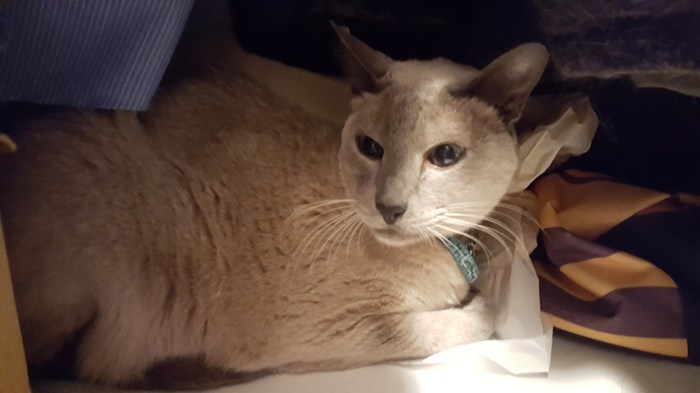
This is Chester

Still hiding away.

Like any wise, old, skeptical cat, he’s not believing the good news.

We do not have a COVID 19 case in our house. Of course, we had to wait an agonizing 24 hours before we got the good news by phone.

It shows that our testing labs are getting through the tests, of which I heard in the news there were about 4,000, with only 10 or so new cases countrywide.

Queensland had none overnight, so if our case had been positive, we would have been in the news for al; the wrong reasons.

So, after broadcasting the news, that is, walking up and down the passage saying it was safe to come out, there’s still no sign of him.

But…

I have a cunning plan.

I bought a can of his absolute favorite food.

Come dinner time I’m putting it out.


Of course, food trumps fear every time.

He walks past me on his way to the tasty treats, the tail movements indicating he is not a happy cat.

The things I have to suffer at the hands of you humans, he mutters.

So, I say casually, we have guests for dinner.

He stops, turns his head in that dismissive manner of his.
What else can you do to me?

COVID 19, Grandchildren, I suppose you’re going to let me outside.

Do you want to go outside?

With COVID 19 lurking on every corner?

It’s under control.

Right. I’ve been watching TV. You do realize there’s good news and fake news, and there’s more of the latter than the former.

So, he’s going with the confuse the poor human with blather.

It’s working. I say, Go back into hiding. I was quite enjoying the silence.

After dinner, he says, ending the conversation with the angry tail swish. Yes, we are not amused.

In a word: Ghost

Have you seen one?  I haven’t.  Yet.

I’ve stayed in a few places where ghosts were purported to be roaming the passages at night, but apparently not the night I was staying.

And that’s something else that I have a problem with, why is it ghosts only come out at night, or is that just the perception I have hot from reading up on the subject.

Maybe my view of ghosts is somewhat stilted, after all, I think my first introduction to ghosts was watching The Centerville Ghost, a movie I saw on t.v. when I was very young.

You have to admit Hollywood’s perception of ghosts is quite interesting.


But…

Do you think they are real?  Do I think they are real?

I think I would have to be presented with some fairly solid evidence they exist, but perhaps not to the point of meeting one.

There are, it seems countless examples of ethereal forces, you know, wind blowing where there’s no wind or draught outside, room temperatures dropping for no apparent reason, knocking, rattling of chains, strange noises like low moaning.


And yet…

There are hotels you can stay in such as the Chelsea Hotel in New York, where it’s possible to run into Sid Vicious.

Sorry, not staying there any time soon.

Then there’s the Hollywood Roosevelt Hotel in Los Angeles where it’s possible to run into Marylin Monroe, who lived in room 229.

That could be an interesting encounter.

Another is the Westin St Francis in San Francisco where the actress Virginia Rappe died while attending a party held in Fatty Arbuckle’s room, Arbuckle’s room, who was later accused of assaulting and murdering her, and whose career tanked after the incident.

Her ghost is seen moving about the hotel tearing her hair out.  It seems all of the spectral activity occurs on the 12th floor.


Good to know if I decide to stay there.  I wonder if they have a 13th floor?

Perhaps in too old to be running the gamut of paranormal experiences, the old heart is not as strong as it used to be.

In a word: Brevity

Now, brevity is something that I have not been able to fully wrap my head around.

The dictionary explains Brevity as

‘concise and exact use of words in writing and speech’

So…

I remember working with a writer a long time ago who explained certain authors styles, and for James A Michener of Hawaii fame, he said Michener wrote sentences instead of words, paragraphs instead of sentences, pages instead of paragraphs and chapters instead of pages.

It was a little harsh considering I’d just read the book and had liked it, despite its length and the time it took.

But some time later I realized he was not criticizing Michener, but trying to tell me, in his, what I came to discover, interesting way, that I should strive to write more compactly.

I then came across a book by Brian Callison which was exactly that, the concise version, a story that fitted into about 200 pages.

That too was a good book and it took me a day to read it, and by his use of that economy of words, it read quickly.

Of course, I have tried over the years to emulate both styles, and to a certain degree, failing, because I think I have created my own style which is somewhere in between.

Still, when editing, it is always in the back of my mind that I should be

Using words instead of sentences

Using sentences instead of paragraphs

Using paragraphs instead of pages, and

Using pages instead of chapters.

The chapters, he said, with an air of amusement, will always take care of themselves.


I’ve been reading a lot

And at times wish I hadn’t.

Having been a journalist in a previous lifetime, and one that always believed that the truth mattered, it didn’t take long to realise that journalists should never let the truth get in the way of a good story.

Newspapers, and all other forms of media, will only write what they believe will sell, or what they think the public wants to read. The truth, sadly, is not the first thing on the readers mind, only that someone is to blame for something they have no control over, and it doesn’t matter who.

And the more outlandish the situation, the more the public will buy into it.

This, I guess, is why we like reading about celebrities and royalty, not for the good they might do, but the fact they stumble and make mistakes, and that somehow makes us feel better about ourselves.

Similarly, if the media can beat up a subject, like the corona-virus, and make it worse that it is, then people will lap up the continuing saga, as it relates to them, and will take one of two stances, that they believe the horror of it, and do as they’re asked, or disbelieve it because nothing can be that bad, and ignore it and the consequences of disobedience. knowing the government will not press too hard against the non compliers simply because of domocracy issues it will stir up.

That is, then the media will get a hold of this angle and push it, and people will start to think disobedience is a good thing not a bad.

So, our problems of trying to get a fair and balanced look at what the coronavirus is all about is nigh on impossible. We are continuously bombarded with both right and wrong information, and the trouble is, both sides are very plausibly supported by facts.

And that’s the next problem we have in reporting. We can get facts to prove anything we want. It;s called the use and abuse of statistics, and was an interest part of the journalism degree I studied for. We were told all about statistics, good and bad, and using them to prove the veracity of our piece.

I remember writing a piece for the tutor extolling the virtues of a particular person who was probably the worst human since Vlad the Impaler, using only the facts that suited my narrative. I also remember the bollocking he gave me for doing so, but had to acknowledge that sometimes that would happen.

Integrity of reporting only went as far as the editor, and if the editor hated something, you had to hate it too. This is infamously covered in various texts where newspaper publishers pick sides, and can influence elections, and governments. It still happens.

So, the bottom line is, when I;m reading an article in the media, I always take it with a grain of salt, and do my own fact checking, remembering, of course, not just to fact check to prove the bias one way of the other, but the get a sense of balance.

We have state elections coming up where I live, but it does not sink to the personal sniping level as it does in the US, we haven’t sunk that low yet, but we haven;t got past the sniping about all the wrongs and failed promises of the govern,ment of the day, or the endless tirade against the opposition and how bad a job they did whenb they were previously in government.

You can see, no one is talking about what they’re going to do for us, no one is telling us what their policies are. It’s simply schoolyard tit for tat garbage speak. What happened to the town hall meeting, a long and winding speech encompassing the policies, what the government plans to do for its people in the next three years, and then genuinely answer questions?

Perhaps we should ban campaigning, and just get each party to write a book about what they intend to do, and keep them away from the papers, the TV, and any other form of media, in other words, don’t let them speak!

And don’t get me started about the drivel they speak in the parliament. Five year olds could do a better job.

OK, rant over.

Well, I just walked aboard my spaceship, and…

For all of those who have seen Star Trek over the years, they will know the command issued to get under way is ‘make it so’.

Right after we have a look ‘on screen’ where we’re headed:

I’m not sure where SP is, so that’s not the destination. On being asked the question by the helmsman (I think they’re the one who steers the ship) where are we going?, I think we’ll just head ‘somewhere out there’, accompanied by a grand gesture that covers the viewer.

Of course, as you can imagine, the helmsman might not have an imagination, so we’re going to have to narrow it down a little:

So, we say we’re off to the moon. In this class of ship, though, that will probably take about an hour, but it does give us time to think further on where we’d like to go.

Then, like all trips into outer space, time seems to fly, and we’re being requested a new destination.

OK, let’s go and check out some of the planets.

Saturn, and try to keep away from the space junk, and then, I think, Pluto, and yes, I hear you, Pluto isn’t a planet.

What’s M75 you ask. I haven’t a clue.