Searching for locations: From Beijing to X’ian by bullet train

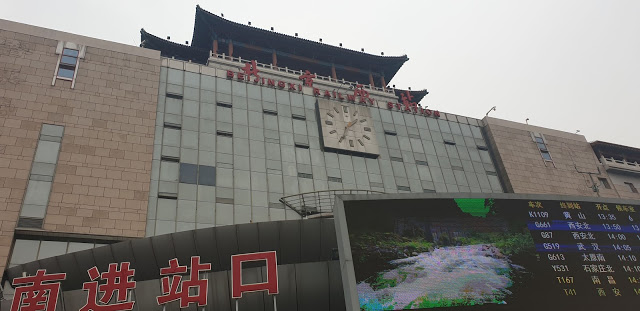
Beijing West train station.

Beijing west railway station is about eight kilometers from the Forbidden City, located at East Lianhuachi Road, Fengtai District.  Most trains traveling between south central, southwest, northwest, and south China are boarded here.

This place is huge and there are so many people here, perhaps the other half of Beijing’s population that wasn’t in the forbidden city.
Getting into the station looked like it was going to be fraught with danger but the tour guide got us into the right queue and then arranged for a separate scanner for the group to help keep us all together
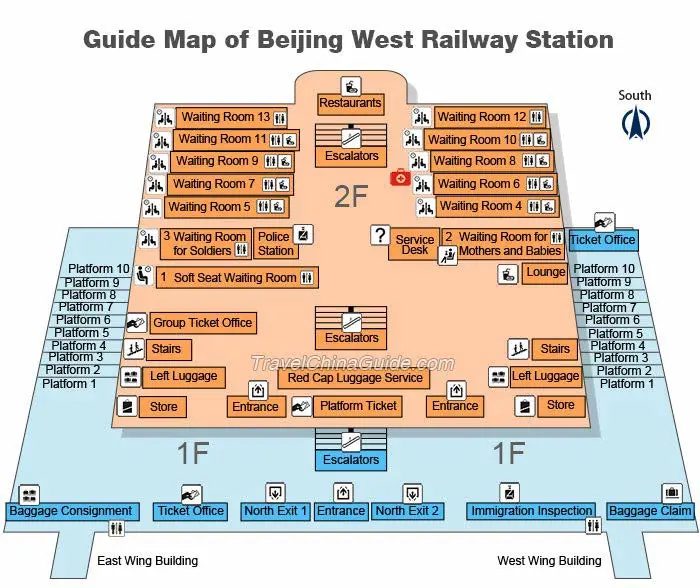
Then we decided to take the VIP service and got to waiting room no 13, the VIP service waiting room which was full to overflowing.  Everyone today was a VIP.  We got the red hat guy to lead us to a special area away from the crowd.

Actually, it was on the other side of the gate, away from the hoards sitting or standing patiently in the waiting room.  It gave us a chance to get something to eat before the long train ride.

The departure is at 4 pm, the train number was G655, and we were told the trains leave on time.  As it is a high-speed train, stops are far and few between, but we’re lucky, this time, in that we don’t have to count stations to know where to get off.

We’re going to the end of the line.

However, it was interesting to note the stops which, in each case, were brief, and you had to be ready to get off in a hurry.

These stops were Shijiazhuang, Zhengzhou East, Luoyang Longmen, Huashan North, and Weinan North.  At night, you could see the lights of these cities from a distance and were like oases in the middle of a desert.  During the day, the most prominent features were high rise apartment blocks and power stations.

A train ride with a difference
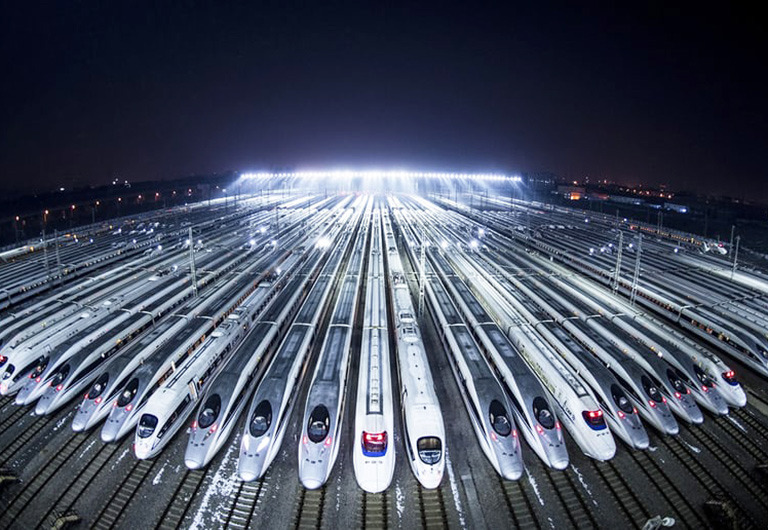
G Trains at Wuhan Railway Station

China’s high-speed trains, also known as bullet or fast trains, can reach a top speed of 350 km/h (217 mph).

Over 2,800 pairs of bullet trains numbered by G, D or C run daily connecting over 550 cities in China and covering 33 of the country’s 34 provinces. Beijing-Shanghai high-speed train link the two megacities 1,318 km (819 mi) away in just 4.5 hours.

By 2019, China keeps the world’s largest high-speed rail (HSR) network with a length totaling over 35,000 km (21,750 mi).

To make the five and a half hours go quicker we keep an eye on the speed which hovers between 290 and 305 kph, and sitting there with our camera waiting for the speed to hit 305 which is a rare occurrence, and then, for 306 and then for 307, which happened when we all took a stroll up to the restaurant car to find there had nothing to eat.

I got a strange flavored drink for 20 yuan.

There was a lady manning a trolley that had some food, and fresh, maybe, fruit on it, and she had a sense of humor if not much English.

We didn’t but anything but the barrel of caramel popcorn looked good.

The good thing was, after hovering around 298, and 299 kph, it finally hit 300.

We get to the end of the line, and there is an announcement in Chinese that we don’t understand and attempts to find out if it is the last station fall on deaf ears, probably more to do with the language barrier than anything else.

Then, suddenly the train conductor, the lady with the red hat, comes and tells us it is, and we have fifteen minutes, so we’re now hurrying to get off.

As the group was are scattered up and down the platform, we all come together and we go down the escalator, and, at the bottom, we see the trip-a-deal flags.

X’ian,and the Xi’an North Railway Station

Xi’an North Railway Station is one of the most important transportation hubs of the Chinese high-speed rail network. It is about 8.7 miles (14 km) from Bell Tower (city center) and is located at the intersection of the Weiyang Road and Wenjing Road in Weiyang District.

This time we have a male guide, Sam, who meets us at the end of the platform after we have disembarked.  We have a few hiccups before we head to the bus.  Some of our travelers are not on his list, but with the other group.  Apparently a trip-a-deal mix-up or miscommunication perhaps.

Then it’s another long walk with bags to the bus.  Good thing its a nicely air-conditioned newish bus, and there’s water, and beer for 10 yuan.  How could you pass up a tsing tao for that price?

Xi’an is a very brightly lit up city at night with wide roads.  It is very welcoming, and a surprise for a city of 10 million out in the middle of China.

As with all hotels, it’s about a 50-minute drive from the railway station and we are all tired by the time we get there.

Tomorrow’s program will be up at 6, on the bus 8.40 and off to the soldiers, 2.00 late lunch, then train station to catch the 4.00 train, that will arrive 2 hours later at the next stop.  A not so late night this time.

The Grand Noble Hotel
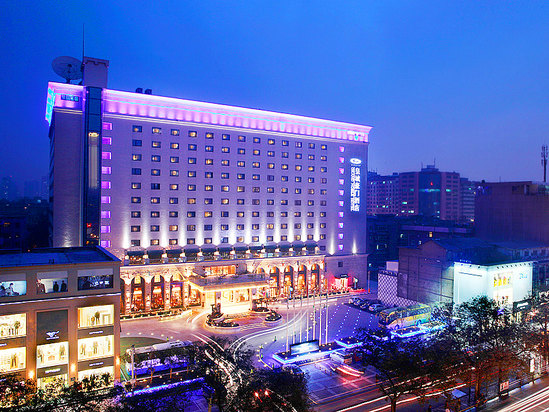
Outdoor scene

Grand Noble Hotel Xi’an is located in the most prosperous business district within the ancient city wall in the center of Xi’an.

The Grand Noble Hotel, like the Friendship Hotel, had a very flash foyer with tons of polished marble.  It sent out warning signals, but when we got to our room, we found it to be absolutely stunning.  More room, a large bathroom, air conditioning the works.

Only one small problem, as in Beijing the lighting is inadequate.  Other than that it’s what I would call a five-star hotel.  This one is definitely better than the Friendship Hotel.

In the center of the city, very close to the bell tower, one of the few ancient buildings left in Xi’an.  It is also in the middle of a larger roundabout and had a guard with a machine gun.

Sadly there was no time for city center sightseeing.
Searching for locations: From Beijing to X’ian by bullet train

Beijing West train station.

Beijing west railway station is about eight kilometers from the Forbidden City, located at East Lianhuachi Road, Fengtai District.  Most trains traveling between south central, southwest, northwest, and south China are boarded here.

This place is huge and there are so many people here, perhaps the other half of Beijing’s population that wasn’t in the forbidden city.

Getting into the station looked like it was going to be fraught with danger but the tour guide got us into the right queue and then arranged for a separate scanner for the group to help keep us all together

Then we decided to take the VIP service and got to waiting room no 13, the VIP service waiting room which was full to overflowing.  Everyone today was a VIP.  We got the red hat guy to lead us to a special area away from the crowd.

Actually, it was on the other side of the gate, away from the hoards sitting or standing patiently in the waiting room.  It gave us a chance to get something to eat before the long train ride.

The departure is at 4 pm, the train number was G655, and we were told the trains leave on time.  As it is a high-speed train, stops are far and few between, but we’re lucky, this time, in that we don’t have to count stations to know where to get off.

We’re going to the end of the line.

However, it was interesting to note the stops which, in each case, were brief, and you had to be ready to get off in a hurry.

These stops were Shijiazhuang, Zhengzhou East, Luoyang Longmen, Huashan North, and Weinan North.  At night, you could see the lights of these cities from a distance and were like oases in the middle of a desert.  During the day, the most prominent features were high rise apartment blocks and power stations.

A train ride with a difference

G Trains at Wuhan Railway Station

China’s high-speed trains, also known as bullet or fast trains, can reach a top speed of 350 km/h (217 mph).

Over 2,800 pairs of bullet trains numbered by G, D or C run daily connecting over 550 cities in China and covering 33 of the country’s 34 provinces. Beijing-Shanghai high-speed train link the two megacities 1,318 km (819 mi) away in just 4.5 hours.

By 2019, China keeps the world’s largest high-speed rail (HSR) network with a length totaling over 35,000 km (21,750 mi).

To make the five and a half hours go quicker we keep an eye on the speed which hovers between 290 and 305 kph, and sitting there with our camera waiting for the speed to hit 305 which is a rare occurrence, and then, for 306 and then for 307, which happened when we all took a stroll up to the restaurant car to find there had nothing to eat.

I got a strange flavored drink for 20 yuan.

There was a lady manning a trolley that had some food, and fresh, maybe, fruit on it, and she had a sense of humor if not much English.

We didn’t but anything but the barrel of caramel popcorn looked good.

The good thing was, after hovering around 298, and 299 kph, it finally hit 300.

We get to the end of the line, and there is an announcement in Chinese that we don’t understand and attempts to find out if it is the last station fall on deaf ears, probably more to do with the language barrier than anything else.

Then, suddenly the train conductor, the lady with the red hat, comes and tells us it is, and we have fifteen minutes, so we’re now hurrying to get off.

As the group was are scattered up and down the platform, we all come together and we go down the escalator, and, at the bottom, we see the trip-a-deal flags.

X’ian,and the Xi’an North Railway Station

Xi’an North Railway Station is one of the most important transportation hubs of the Chinese high-speed rail network. It is about 8.7 miles (14 km) from Bell Tower (city center) and is located at the intersection of the Weiyang Road and Wenjing Road in Weiyang District.

This time we have a male guide, Sam, who meets us at the end of the platform after we have disembarked.  We have a few hiccups before we head to the bus.  Some of our travelers are not on his list, but with the other group.  Apparently a trip-a-deal mix-up or miscommunication perhaps.

Then it’s another long walk with bags to the bus.  Good thing its a nicely air-conditioned newish bus, and there’s water, and beer for 10 yuan.  How could you pass up a tsing tao for that price?

Xi’an is a very brightly lit up city at night with wide roads.  It is very welcoming, and a surprise for a city of 10 million out in the middle of China.

As with all hotels, it’s about a 50-minute drive from the railway station and we are all tired by the time we get there.

Tomorrow’s program will be up at 6, on the bus 8.40 and off to the soldiers, 2.00 late lunch, then train station to catch the 4.00 train, that will arrive 2 hours later at the next stop.  A not so late night this time.

The Grand Noble Hotel

Outdoor scene

Grand Noble Hotel Xi’an is located in the most prosperous business district within the ancient city wall in the center of Xi’an.

The Grand Noble Hotel, like the Friendship Hotel, had a very flash foyer with tons of polished marble.  It sent out warning signals, but when we got to our room, we found it to be absolutely stunning.  More room, a large bathroom, air conditioning the works.

Only one small problem, as in Beijing the lighting is inadequate.  Other than that it’s what I would call a five-star hotel.  This one is definitely better than the Friendship Hotel.

In the center of the city, very close to the bell tower, one of the few ancient buildings left in Xi’an.  It is also in the middle of a larger roundabout and had a guard with a machine gun.

Sadly there was no time for city center sightseeing.
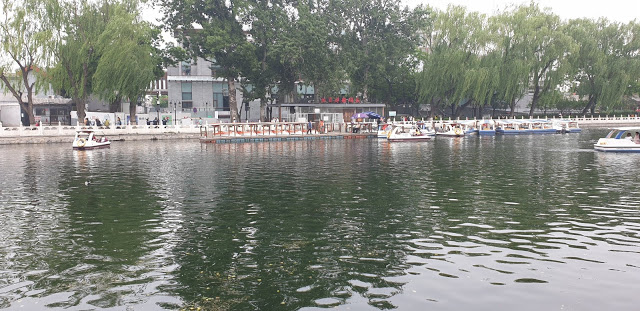
Searching for locations: Hutongs, Beijing, China

What are Hutongs?

In Beijing, Hutongs are formed by lines of traditional courtyard residences, called siheyuan.  Neighbourhoods were formed by joining many hutongs together. These siheyuan are the traditional residences, usually occupied by a single or extended family, signifying wealth, and prosperity. 

Over 500 of these still exist. Many of these hutongs have been demolished, but recently they have become protected places as a means of preserving some Chinese cultural history.  They were first established in the Yuan Dynasty (1279-1368)Many of these Hutongs had their main buildings and gates built facing south, and lanes connecting them to other hutongs also ran north to south.

Many hutongs, some several hundred years old, in the vicinity of the Bell Tower and Drum Tower and Shichahai Lake are preserved and abound with tourists, many of which tour the quarter in pedicabs.

The optional tour also includes a visit to Shichahai, a historic scenic area consisting of three lakes (Qianhai, meaning Front Sea; Houhai, meaning Back Sea and Xihai, meaning West Sea), surrounding places of historic interest and scenic beauty and remnants of old-style local residences, Hutong and Courtyard.  

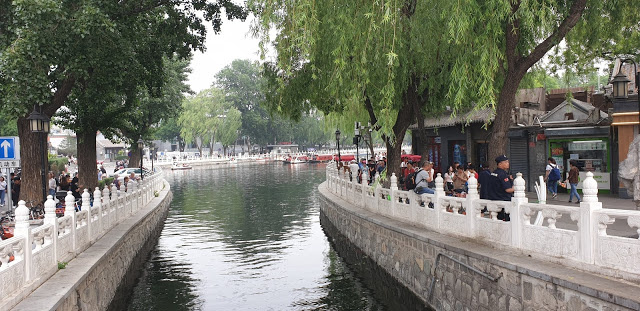
First, we had a short walk through the more modern part of the Hutong area and given some free time for shopping, but we prefer just to meander by the canal.  

There is a lake, and if we had the time, there were boats you could take.

With some time to spare, we take a quick walk down one of the alleyways where on the ground level are small shops, and above, living quarters.

Then we go to the bell and drum towers before walking through some more alleys was to where the rickshaws were waiting.
The Bell tower

And the Drum tower. Both still working today.

The rickshaw ride took us through some more back streets where it was clear renovations were being made so that the area could apply for world heritage listing.  Seeing inside some of the houses shows that they may look dumpy outside but that’s not the case inside.

The rickshaw ride ends outside the house where dinner will be served, and is a not so typical hose but does have all the elements of how the Chinese live, the boy’s room, the girl’s room, the parent’s room, the living area, and the North-south feng shui.

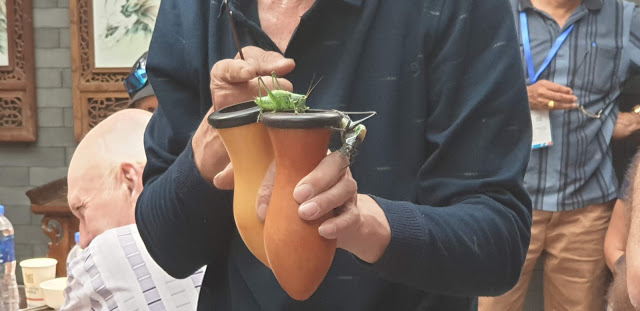
Shortly after we arrive, the cricket man, apparently someone quite famous in Beijing arrives and tells us all about crickets and then grasshoppers, then about cricket racing.  He is animated and clearly enjoys entertaining us westerners.

I’m sorry but the cricket stuff just didn’t interest me.  Or the grasshoppers.

As for dinner, it was finally a treat to eat what the typical Chinese family eats, and everything was delicious, and the endless beer was a nice touch.

And the last surprise, the food was cooked by a man.

Searching for locations: Hutongs, Beijing, China

What are Hutongs?

In Beijing, Hutongs are formed by lines of traditional courtyard residences, called siheyuan.  Neighbourhoods were formed by joining many hutongs together. These siheyuan are the traditional residences, usually occupied by a single or extended family, signifying wealth, and prosperity. 

Over 500 of these still exist. Many of these hutongs have been demolished, but recently they have become protected places as a means of preserving some Chinese cultural history.  They were first established in the Yuan Dynasty (1279-1368)Many of these Hutongs had their main buildings and gates built facing south, and lanes connecting them to other hutongs also ran north to south.

Many hutongs, some several hundred years old, in the vicinity of the Bell Tower and Drum Tower and Shichahai Lake are preserved and abound with tourists, many of which tour the quarter in pedicabs.

The optional tour also includes a visit to Shichahai, a historic scenic area consisting of three lakes (Qianhai, meaning Front Sea; Houhai, meaning Back Sea and Xihai, meaning West Sea), surrounding places of historic interest and scenic beauty and remnants of old-style local residences, Hutong and Courtyard.  

First, we had a short walk through the more modern part of the Hutong area and given some free time for shopping, but we prefer just to meander by the canal.  

There is a lake, and if we had the time, there were boats you could take.

With some time to spare, we take a quick walk down one of the alleyways where on the ground level are small shops, and above, living quarters.

Then we go to the bell and drum towers before walking through some more alleys was to where the rickshaws were waiting.
The Bell tower

And the Drum tower. Both still working today.

The rickshaw ride took us through some more back streets where it was clear renovations were being made so that the area could apply for world heritage listing.  Seeing inside some of the houses shows that they may look dumpy outside but that’s not the case inside.

The rickshaw ride ends outside the house where dinner will be served, and is a not so typical hose but does have all the elements of how the Chinese live, the boy’s room, the girl’s room, the parent’s room, the living area, and the North-south feng shui.

Shortly after we arrive, the cricket man, apparently someone quite famous in Beijing arrives and tells us all about crickets and then grasshoppers, then about cricket racing.  He is animated and clearly enjoys entertaining us westerners.

I’m sorry but the cricket stuff just didn’t interest me.  Or the grasshoppers.

As for dinner, it was finally a treat to eat what the typical Chinese family eats, and everything was delicious, and the endless beer was a nice touch.

And the last surprise, the food was cooked by a man.

Searching for locations: Castello di Monterinaldi, Tuscany, Italy

As part of a day tour by Very Tuscany Tours, we came to this quiet corner of Tuscany to have a look at an Italian winery, especially the Sangiovese grapes, and the Chianti produced here.

And what better way to sample the wine than to have a long leisurely lunch with matched wines.  A very, very long lunch.

But first, a wander through the gardens to hone the appetite:

2013-06-18 11.56.18
2013-06-18 11.56.32
2013-06-18 11.56.51

And a photo I recognize from many taken of the same building:

2013-06-18 11.57.26

Then a tour of the wine cellar:

2013-06-18 11.50.08
2013-06-18 11.52.08

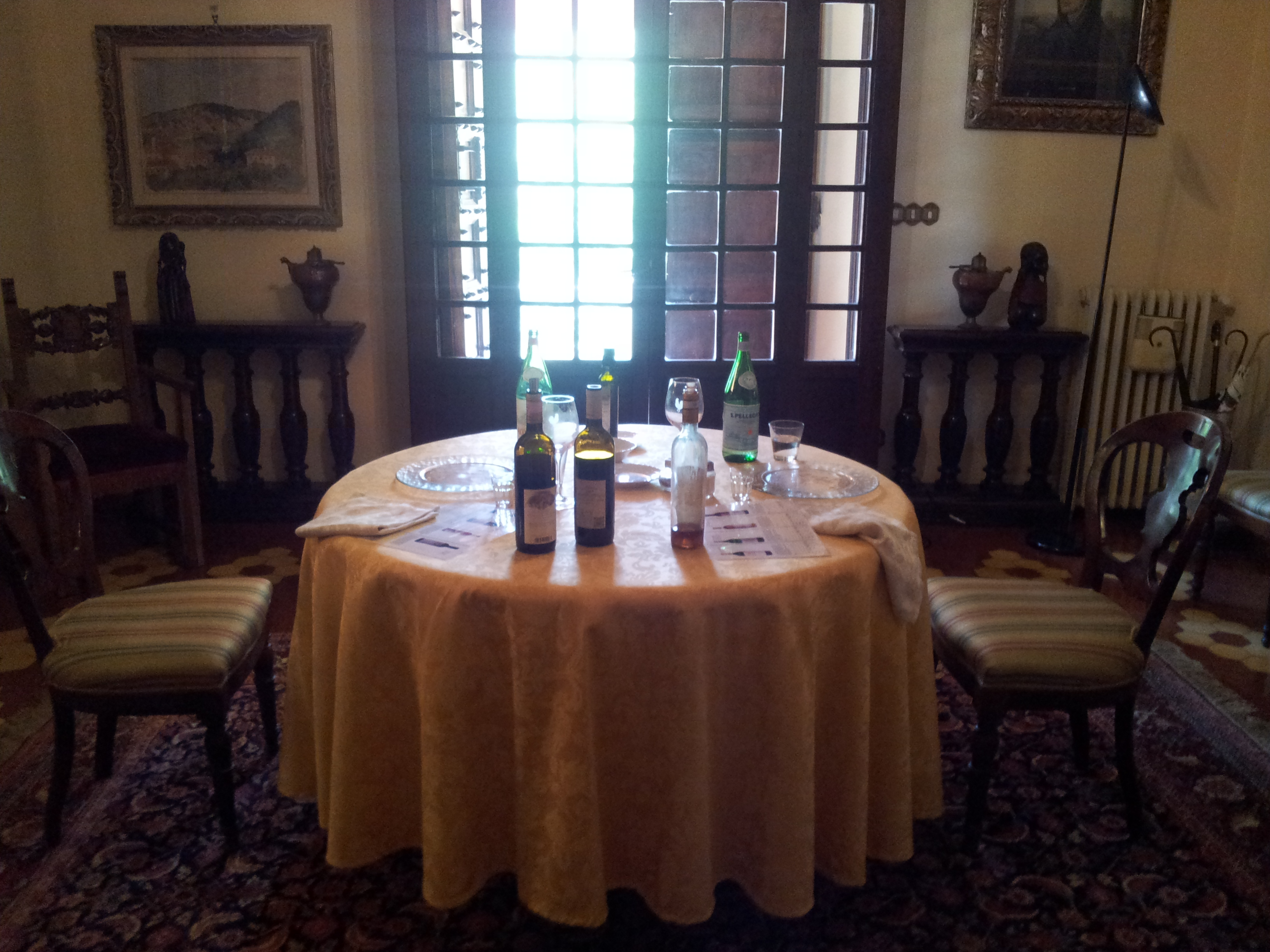
Then on to the most incredible and exquisite lunch and wine we have had.  It was the highlight of our stay in Tuscany.  Of course, we had our own private dining room:

2013-06-18 13.22.40

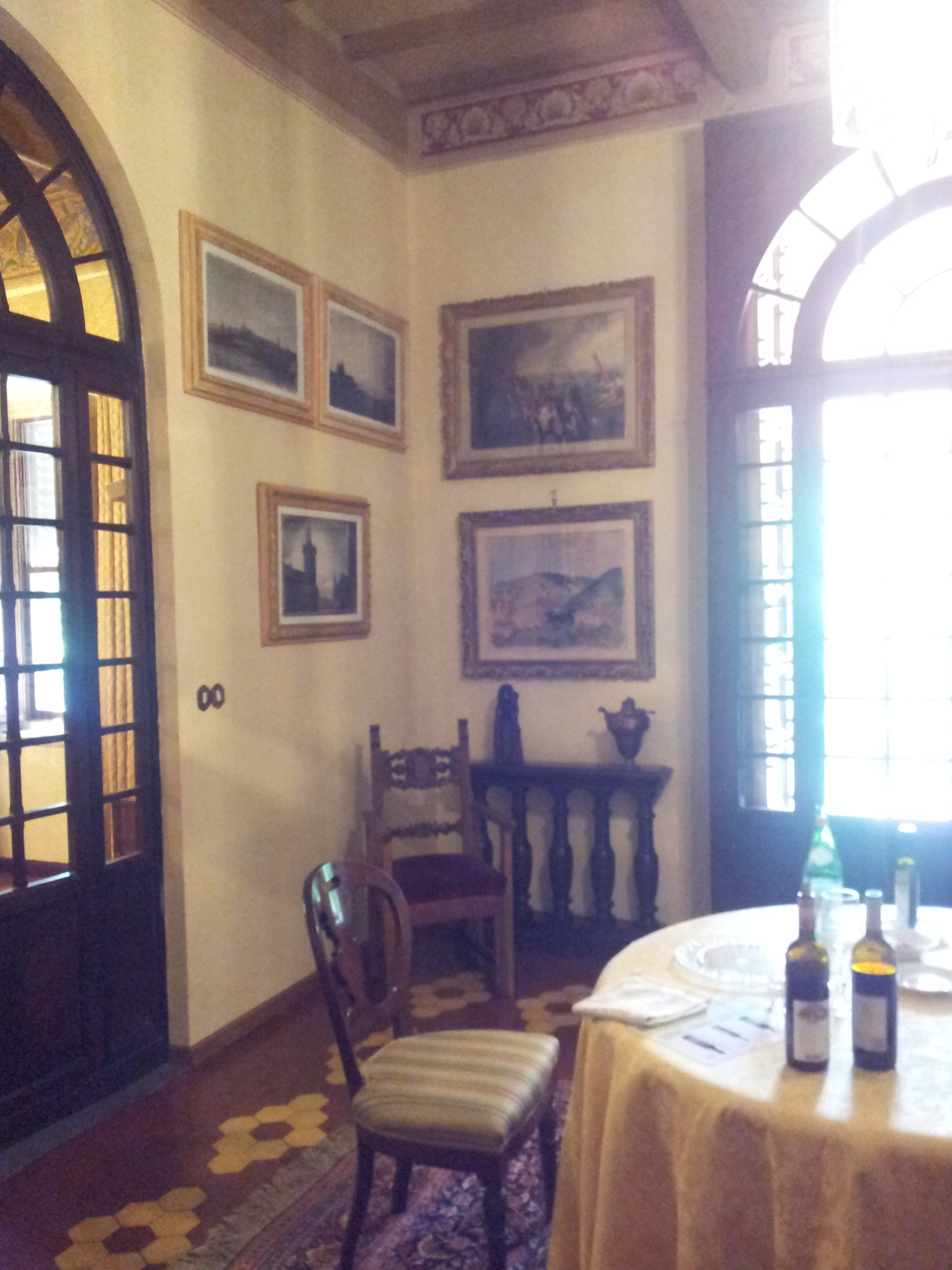
And time to study the paintings and prints on the walls while we finished with coffee and a dessert wine.

2013-06-18 13.23.15

And of course, more wine, just so we could remember the occasion.

Searching for locations: Castello di Monterinaldi, Tuscany, Italy

As part of a day tour by Very Tuscany Tours, we came to this quiet corner of Tuscany to have a look at an Italian winery, especially the Sangiovese grapes, and the Chianti produced here.

And what better way to sample the wine than to have a long leisurely lunch with matched wines.  A very, very long lunch.

But first, a wander through the gardens to hone the appetite:

2013-06-18 11.56.18
2013-06-18 11.56.32
2013-06-18 11.56.51

And a photo I recognize from many taken of the same building:

2013-06-18 11.57.26

Then a tour of the wine cellar:

2013-06-18 11.50.08
2013-06-18 11.52.08

Then on to the most incredible and exquisite lunch and wine we have had.  It was the highlight of our stay in Tuscany.  Of course, we had our own private dining room:

2013-06-18 13.22.40

And time to study the paintings and prints on the walls while we finished with coffee and a dessert wine.

2013-06-18 13.23.15

And of course, more wine, just so we could remember the occasion.

Writing about writing a book – Day 20

It is a day of rest although writers are ready and able to work on any given day at any hour of the day or night when an idea or thought comes to them.

I’m trying not to think, but that’s not working.

I’ve been going over the reasons for writing the first draft of the book 30 odd years ago and it had something to do with the fact I was working with personal computers and local area networking when both were in their infancy, and I wanted to blend this knowledge into a story.

Of course, I’d always wanted to write thrillers, and this presented the opportunity to use computers as a basis for a worldwide conspiracy.  How easy it is these days to do just that, but back in those days, it was a lot of hard work.

I remember sitting in a meeting when the company I was working for at the time had just implemented a network and personal computer to replace the mainframe and dumb terminals, also looking to leverage the new technologies of spreadsheets and word-processing, effectively making accounts staff more productive, and removing typists and moving into the world of centralized word processing.  It was not a new idea with Wangwriter, but using PC’s was.

One of the departmental managers got up to give his take on the new technology, this about six months after implementation, and after a lot of teething troubles caused mainly by people who were vehemently resisting change, and his message was, it should not be called ‘networking’, but ‘not working’, in reference to the number of times the network went down.

But this is a digression.  Computers are only a part of the story.

The story also goes back to a time when there was a clear demarcation between the management levels.  Management offices were oasis’s whereas the staff worked in a stark desert-like environment.  When one came to work for such an organization, it was with the belief that you start at the bottom, and over time, you work your way up the ladder.  There was, very definitely, class distinction, and the various management levels never mixed, at work or socially, except within their own level.

There were Managers, Assistant Managers, and Manager’s Assistants, a typing pool, a secretary, that young, or old, lady who did so many jobs for their boss, that these days it would be considered demeaning.  They were dedicated to their jobs and irreplaceable.  There was no such person as a Personal Assistant.

Nor was such a thing as sexual harassment.  One company I worked in where one of the Assistant Managers was sexually abusing an office girl, her complaints didn’t get a prosecution as it would now, it just had him transferred to another branch.  Reprehensible, yes, and thankfully no longer a problem, except of course, in Fifty Shades of Grey which apparently condones such behavior.

There were department heads, General Managers, and Board Members.  The upper management level and participants were in a world of their own, one few could ever aspire to.  This is the world in which Transworld, my fictitious (but based on a very real) company lives.

I have to work on my company structure to make sure it is right.

Now I have two charts.  A timeline, for both Bill, and the story, and a hierarchy for the office management and staff.

This is beginning to be more complicated than I thought.


© Charles Heath 2016-2020

Writing about writing a book – Day 9

Blogging, Social  Media, and other stuff.


Aren’t there more important things to do like writing?

I think reading the 101 things to do to establish your author brand is finally getting to me.  I leave this to read the last thing before I go to bed and it’s beginning to give me nightmares.

So, for starters, I’ve created a twitter page but I’m not sure what to do with it.  Yet.

Then I created a Facebook page but there is one for authors and I think l have created the wrong one.  It’s very confusing.

And reading 10 things an author shouldn’t do, one of them was not to use Facebook.  Who to believe?

Now I’m lingering at WordPress after googling writer blogs and got a choice of so many, some free, others quite expensive, and I’m not sure what half the stuff is they’re offering.

There’s also Site blog, and there’s collaborative blogging.  Perhaps it’s time to get back to the easy stuff like plotting and writing my book!

That might have been easy if a little voice in my head wasn’t screaming ‘you need a website’.

Once again I’m googling my fingers to the bone trying to decide if I want a free one or pay.  At least if I pay there might not be ghastly ads for porn sites.  That’s one criticism I read that can be a problem.

I decided to pay a nominal amount but now I strike a new problem, I need to get a domain name such as ‘authorname.com’.

I put in my name and it is taken already so in order not to pay the person who snapped it up in the hope of making a million dollars, or perhaps because he has the same name as me and thought of it first, I have to accept one of the variations.

It then gives me the opportunity to buy right now that particular name because it is free, and I found myself working with a hyphen.  It could be worse, I suppose.

It also offers a few extra web domains with different endings such as .com,.info, etc.

What the hell it’s only a few extra dollars and I’ll worry about what to do with them in two years’ time except for the .com which I’ll use now.

The website started and a month paid for, got a .com to link it to, and now all I have to do something with it.  No, I’m not a web designer even after I picked a template that looked author like.

It can wait.

Social media investigated but looks like its going to suck up a lot of my time.

Better get back to the book and write my page, or 1000 words, or 2000 words for the day.


I look over at the rubbish bin and it is overflowing.  It looks like a scene out of a bad movie, where the writer pretends he’s a pro basketball player who can’t shoot.

It’s just not flowing.  I’m beginning to hate Bill as a name.  Perhaps I’ll change it to Tarquin.  No, that’s not quite a name that suits the character.  It leads to a mental debate about what is an appropriate name for a character and sends me off into Google land again to see what various names mean.

The name is Bill until I find something better.

I guess that leads to some introspection on how I see, or what I want, the character to be.  So far he’s been married, and divorced, not been much of a husband to his wife, or children, maybe because of what happened to him when he was in the army, something he knows about in a peripheral sense but is about to learn a whole lot more.

Being shot, ending up in a hospital, sparks a memory, in a dream, brought on by a particular type of painkiller, and he is about to remember who and what he was, stuff that he has previously not realized, or knew about.  Those last traumatic events in the war zone caused his memory to be wiped.

It’s not the sort of memories certain people want to be brought into the open.

OK, finally something to work with.

I need to work on the dream or nightmare sequence.

Pen in hand, I start writing…


© Charles Heath 2018-2020

Writing about writing a book – Day 8

I am painfully reminded that I need to have Social Media presence.

Marilyn told me that if I was on ‘Facebook’ I would have been able to follow her ‘adventures’.  If I was on Twitter I could acquire reading followers, and Instagram, to share photos of book covers and my travels.

I drag out the dusty laptop computer, the one that had an email account that goes back to the early days of the internet, and used a VT52 mainframe interface, or at least that was what I think it was called, and fire it up.  The operating system is out of date, error messages on top of error messages.  Thankfully the desktop works, but it too, is out of date, running Windows 97.

Even my mobile phone is more powerful and sophisticated than both my boat anchors.

Time to get into the ‘real’ world!

My writing is now on hold.  Shopping for a new computer, and updating operating system software, is a priority.


I am pleasantly surprised at just how inexpensive reasonable good laptop computers cost.  I looked at tablets from Apple, Samsung, and the Surface.  All very nice, but a computer, as big and cumbersome as it is, is still the cheapest option.

My afternoon is taken up with installing windows 10, setting up a Gmail email account, investigating, and signing up for Twitter, Instagram, and Facebook.  I also take out a cheap subscription to Microsoft Office.  I need Word for manuscripts, and Excel to budget, Powerpoint to dazzle.

I take to reading the information about ‘creating an author presence on the internet’ and see that perhaps I need to have a ‘blog’, whatever that is, and a website.

There’s free and there’s not so free.

Damn.  A day wasted in computer and social media land.  They even had something called the ‘cloud’.  I think I have been out of the computer world too long, having transferred into middle management just as the next phase of the computer technology started making an impact.

Tomorrow I tackle blogging.


I can’t sleep, not without writing something for the day.  My thoughts have been swirling around Bill and Jennifer, and it’s time to bring them together, and by, guess what, a calamity!


I start scribbling:


Hospitals were places I rarely visited.  Like others who shared my fear, it would take a rather compelling reason to get me there.  On this occasion, it had been a compelling reason.  If I hadn’t got to the hospital when I did, I would now be dead.

When I woke, it was to disorientation and confusion.  I didn’t remember much of anything that had happened after having lunch with Jennifer, and running into Aitchison.

When I finally came from the depths of unconsciousness and returned to whatever version of reality that was running at the time, I found myself in a position where any movement, including breathing, was painful.

It was dark, the shapes were blurry, and some moved.  As objects slowly came into focus, activity increased, and more people arrived.  My major concern at that time was the sensation of immobility, and of how difficult it was to breathe, or, more to the point, how painful.  Muffled voices spoke in a strange language.  After a short time, consciousness slipped away, as, mercifully, did the pain.

It was another week, though it seemed like a month before I realized where I was.  It had taken a while, but it was definitely a hospital.  One of the shadowy figures also became recognizable.

Jennifer.

She, too, had a number of bandages, and the black and blue look of a person who’d just survived a hit and run.

Then I remembered.

Aitchison.

Outside the restaurant.

When my eyes finally came into focus I looked at her and saw her smile.  Another realization, though it became clearer sometime later, was that my hand was in hers, and as she squeezed it gently, I felt it give me strength.

“Welcome back.”  She was quite close, close enough for her perfume to overpower the clinical disinfectant.

“Where did I go?”  My voice was barely above a whisper, my throat dry.

“We’re not sure.  You died once.  Now you only have eight lives left.”

It was odd that I’d heard it before, somewhere in the distant past, so I believed I had fewer lives to spare.  I looked at her.  “Aitchison?”

“He didn’t make it.”

“You?”

“I got caught in the crossfire.  So did you.  The police said Aitchison was the target.  We were in the wrong place at the wrong time.”

I’d heard that before, too.  I think that was Richardson’s problem, and he’d suffered the same fate, but his end result was terminal.

The conversation had exhausted me, and the pain returned.  It was still difficult to breathe, and I dared not look where most of the tubes were going.  Tears ran down my cheeks as the pain became unbearable.  I heard her call a nurse, and not long after the pain receded.  So did my consciousness.


Enough, it’s time for sleep.


© Charles Heath 2016-2020

Searching for locations: Oreti Village – No two sunrises are the same – 1

Oreti village, Pukawa Bay, North Island, New Zealand

On the southern tip of Lake Taupo

Our first morning there, a Saturday.  Winter.  Cold.  And a beautiful sunrise.

20180812_073230

This was taken from the balcony, overlooking the lake.

The sun is just creeping up over the horizon

20180812_073241

It gradually gets lighter, and then the sun breaks free of the low cloud

It lights up the balcony

20180811_074651

And the trees just beyond, a cascade of colorful ferns.

20180811_074622

It looks like its going to be a fine day, our first for this trip, and we will be heading to the mountains to see snow, for the first time for two of our granddaughters.