In a word: Pause

Yes, when you are going at it like a bat out of hell, it might be an idea to take a pause and regroup.

That being a pause as an interruption to an activity.

In music, it’s a mark over a note.

Perhaps it’s a good idea to pause recording a TV show while the ads are on.  Networks don’t like it, but it makes the show make more sense without the distractions of advertisements, sometimes quite inane, or annoying.

What I just said, might give pause to my opposite number in this debate.

Have you been in a conversation, someone says something quite odd, and there’s a pregnant pause?

How did the word pregnant get into the conversation?  That, of course, usually means something significant will follow, but rarely does.  But it can also be a conversation killer where no one says anything.

Is that a wide eye in awe moment?  You did WHAT?

Then there is the word pours, sounds the same but is completely different.

In this case, the man pours water from the bucket on the plants.

Or my brother pours cold water on my plans.  Not literally, but figuratively, making me think twice about whether it would work or not.  Usually not.

Or a confession pours out of a man with a guilty conscience.  AKA sings like a bird.  Don’t you just love these quaint expressions?  It reminded me of a gangster film back in Humphrey Bogart’s day.

It never rains but it pours?  Another expression, when everything goes wrong.  A bit like home renovations really.

Really, it means to flow quickly and in large quantities, ie. rain pours down.

And if that isn’t bad enough, what about paws?

Sounds the same again, but, yes it’s what an animal has as feet, especially cats, dogs, and bears.

One use of it, out of context, of course, is ‘get your paws off me!’

And one rabbit paw might be good luck, but having two rabbit pows, I might win the lottery.

If only….


It’s raining, it’s pouring…

Yes, and with the residual summer heat, it’s almost unbearable. I guess it might have something to do with climate change.

But, assumptions aside, I guess that’s about all we can expect from being nearly at the end of summer.

Outside, its been overcast most of the day, but I have to go out so I’m sure we’re going to get rain.

It’s been threatening for the last few days, and the meterology department, who rarely get the weather right, have been telling us there’s big storm movements coming our way.

The other night we got a hint of it with a few short sharp heavy falls, but then nothing.

So, half past two in the afternoon and I’m off on the grand child pickup run, one from the school up the road, and one from the railway stations some distance away.

Sitting in the car, I’m watching the dark clouds gather, whilst in the other direction the sky is blue. A rather fascinating contrast. Then, suddenly, as it hit 3 pm, time to collect the child, you guessed it, it began to rain.

Not five minutes before, not=r five minutes after, but just as I stopped at the slot for her to get in.

One wet child in the back.

We then head for the railway station, about three km away, and half way there, stuck in a traffic jam, the rain stops. I get a call from the child on the train, just to make sure I have remembered to pick her up.

The clouds are black and low, but there’s no rain.

Instead we have a lightning display, and sit in the car counting the seconds after the bright lightning strike. Younger grand daughter is trying to be brave, but the cracking thunder scares the both of us.

The train is arriving, and, you guessed it, the rain suddenly becomes torrential, and poor elder grand daughter gets drenched in the short distances from the train to the car.

A few minutes later it stops.

Weather is unpredictable, and sometimes a complete pain. At least I didn’t have to get out of the car, but the damp children, that will live on for a day or so as all wet material does, and for some reason seems to be worse in cars.

Let’s see if the weather can be kinder to us tomorrow.

Oh, and something else, we need the rain, specially for my garden. Water is very expensive these days, where once it was not.

Searching for locations: The Pagoda Forest, near Zhengzhou City, Henan Province, China

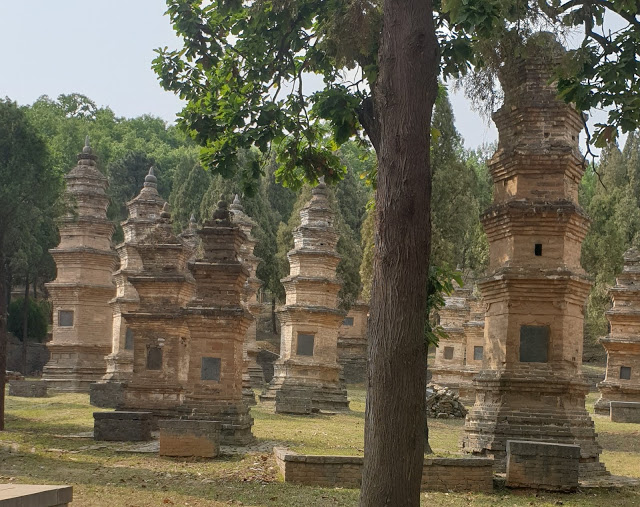
The pagoda forest

After another exhausting walk, by now the heat was beginning to take its toll on everyone, we arrived at the pagoda forest.

A little history first:

The pagoda forest is located west of the Shaolin Temple and the foot of a hill.  As the largest pagoda forest in China, it covers approximately 20,000 square meters and has about 230 pagodas build from the Tang Dynasty (618-907) to the Qing Dynasty (1644-1911).

Each pagoda is the tomb of an eminent monk from the Shaolin Temple.  Graceful and exquisite, they belong to different eras and constructed in different styles.  The first pagoda was thought to be built in 791.

It is now a world heritage site.

No, it’s not a forest with trees it’s a collection of over 200 pagodas, each a tribute to a head monk at the temple and it goes back a long time.  The tribute can have one, three, five, or a maximum of seven layers.  The ashes of the individual are buried under the base of the pagoda.

The size, height, and story of the pagoda indicate its accomplishments, prestige, merits, and virtues. Each pagoda was carved with the exact date of construction and brief inscriptions and has its own style with various shapes such as a polygonal, cylindrical, vase, conical and monolithic.

This is one of the more recently constructed pagodas

There are pagodas for eminent foreign monks also in the forest.

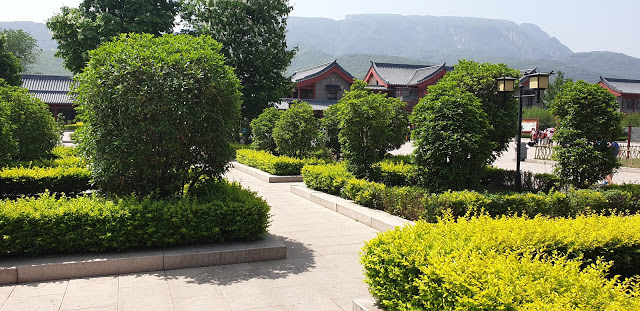
From there we get a ride back on the back of a large electric wagon

to the front entrance courtyard where drinks and ice creams can be bought, and a visit to the all-important happy place.

Then it’s back to the hotel.

What do I do next?

I’m finding it hard to get into the groove.  I suspect I have not been in one lately, but I was writing, and the stories were coming together.

My biggest accomplishments seem to come when I’m writing 50,000 words or more for a NANOWRIMO book.  It’s interesting that it seems to be the only time I can focus my mind on writing.  Last November though, is the first that I didn’t finish it, even though I;d got about 65,000 words done.

I have no idea why on those occasions the creative mind is organised and the ideas and words flowed.  I know it was just supposed to be raw writing, but one one occasion I even had time to rewrite the start.  As we all know, by the time you get to the end, a lot of stuff at the start needs to be fixed, especially in light of plot changes and continuity.

Unless of course you’re a planner, which I’m not.

Now, looking at one of the novels on the screen, I have the job of editing and re-writing, after waiting the requisite few months between finishing the rough draft, and starting on the polishing.

It seems that April is the month to be doing the first editing, and I may be still on track for that to happen as I’ve continued writing past November, through January, and now have written nearly 140,000 words.  It was not supposed to be this long, but it is the story writing itself.  There’s only a few chapters to go, so it’s looking good to finish this month and give it a rest before April.

In the meantime, and slipping further and further on the schedule is the sequel to What Sets Us Apart, called Strangers We’ve Become, I’ve finally got to editing several times, and it’s nearly done.

But here’s the thing.

It’s all but done and dusted, and I was doing a final read before handing to the editor for one last check.  That was a mistake.  I seem to be one of those writers that can’t let it go.  I should not have picked it up for a re-read!

I don’t know if anyone else has the same problem, but as soon as I had finished it, I had a feeling (oh no not one of those feelings, I can hear the editor saying) and something was not quite right.  Perhaps I’ll put it back down again, and think some more on it.

Perhaps I should just pour another drink and go back to watching the ice hockey, because the Maple Leafs are doing well at the moment.

OK, I just had an idea for the third book in the series.

Searching for locations: Hutongs, Beijing, China

What are Hutongs?

In Beijing Hutongs are formed by lines of traditional courtyard residences, called siheyuan.  Neighborhoods were formed by joining many hutongs together. These siheyuan are the traditional residences, usually occupied by a single or extended family, signifying wealth, and prosperity. 

Over 500 of these still exist.Many of these hutongs have been demolished, but recently they have become protected places as a means of preserving some Chinese cultural history.  They were first established in the Yuan Dynasty (1279-1368)Many of these Hutongs had their main buildings and gates built facing south, and lanes connecting them to other hutongs also ran north to south.

Many hutongs, some several hundred years old, in the vicinity of the Bell Tower and Drum Tower and Shichahai Lake are preserved and abound with tourists, many of which tour the quarter in pedicabs.

The optional tour also includes a visit to Shichahai, a historic scenic area consisting of three lakes (Qianhai, meaning Front Sea; Houhai, meaning Back Sea and Xihai, meaning West Sea), surrounding places of historic interest and scenic beauty and remnants of old-style local residences, Hutong and Courtyard.  

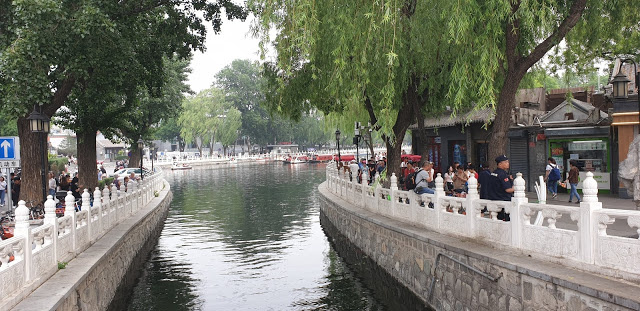
First, we had a short walk through the more modern part of the Hutong area and given some free time for shopping, but we prefer just to meander by the canal.  

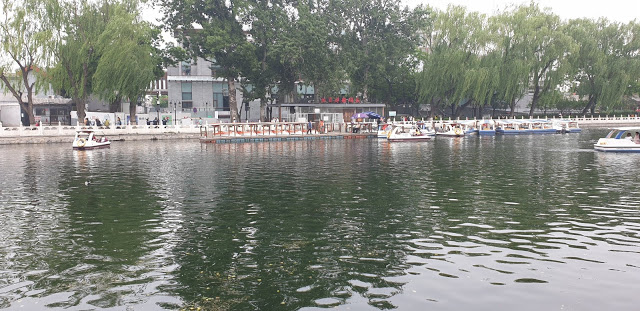
There is a lake, and if we had the time, there were boats you could take.

With some time to spare, we take a quick walk down one of the alleyways where on the ground level are small shops, and above, living quarters.

Then we go to the bell and drum towers before walking through some more alleys was to where the rickshaws were waiting.
The Bell tower

And the Drum tower. Both still working today.

The rickshaw ride took us through some more back streets where it was clear renovations were being made so that the area could apply for world heritage listing.  Seeing inside some of the houses shows that they may look dumpy outside but that’s not the case inside.

The rickshaw ride ends outside the house where dinner will be served, and is a not so typical hose but does have all the elements of how the Chinese live, the boy’s room, the girl’s room, the parent’s room, the living area, and the North-south feng shui.

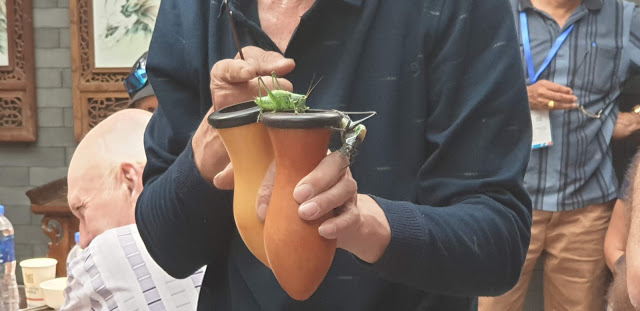
Shortly after we arrive, the cricket man, apparently someone quite famous in Beijing arrives and tells us all about crickets and then grasshoppers, then about cricket racing.  He is animated and clearly enjoys entertaining us westerners.

I’m sorry but the cricket stuff just didn’t interest me.  Or the grasshoppers.

As for dinner, it was finally a treat to eat what the typical Chinese family eats, and everything was delicious, and the endless beer was a nice touch.

And the last surprise, the food was cooked by a man.

Leaving a legacy…

I’ve been reading a few blog posts off and on today, and one that caught my eye was about leaving a legacy.

This I presumed to be ‘something to be remembered by’.

I have always suspected that when I pass on, the memory will not linger very long, except when someone, in the years ahead, pulls out a an old photo, and says, “Who’s this old man?”

I’m sure the answer would hover somewhere between “You don’t really want to know,” to “He’s the eccentric side of the family.”

The thing is, I’ve discovered that children in this family seem to have an insatiable appetite for discovering information about their forebears. It also seems to be that the school they go to makes a big deal about the children learning genealogy, and get an assignment either in year 5 or year 6 where they have to trace their forebears back as far as they can.

I have to say I’ve always been curious, but never really did anything about it, except go back a few generations, i.e. those people we could remember, and, yes, we had eccentric aunts and uncles, grandmothers, and grandfathers.

But my older brother, he got the bug, and went into genealogy in a big way, got himself a university degree, and then takes a trip or two overseas every year delving into the murky past of the Heaths and the Auhls.

The Heaths apparently came from Dorset in England, and the Auhls, somewhere in Germany. He told me, but I’ve forgotten, but I do have a file somewhere that tells me.

And being in Australia, it’s like gold if you have a forebear who was a convict, but unfortunately we didn’t, though I recently learned one of our forebears who came out to Tasmania, was a pseudo Luddite (he was arraigned as guilty by association, but he was no Luddite) in the 1860’s.

But finding a legacy somewhere amongst all those relatives is no mean feat, because it seems none of us were famous, and I haven’t broken the mold, or at least not yet. I might still get to be a (famous?) writer or blogger.

So I am sitting here wondering what the real definition of legacy is, if it can’t apply to wealth or fame. Could it be the next generation of Heaths, the grandchildren? Could one call them a legacy? We will no doubt eventually leave them behind to continue, and maybe one of them will be famous.

The youngest has a desire to be an artist, and she is quite good at drawing, The middle granddaughter wants to be a scientist, and is doing well at school. Of course, there are the middle years, where boys are not yet a distraction, so who knows what the future will bring. As for the eldest, being 16 going on 17 is just too hard.

How could you possibly know at 16 or 17 what it is you want to be? When I was that age I had a choice of being academic, ie maths and science, or hand’s on, a carpenter, sheet metal worker or mechanic.

I did work as a builder for a while, but moved to night switchboard operator/postman, shipping clerk, services manager, and then computer programmer, which none of my learning while at school had any bearing on, except perhaps for maths.

So I’m guessing my legacy was my children, and their legacy is their children, and so on.

As for fame, I don’t think it’s all it’s cracked up to be.

Searching for locations: Queenstown Gardens, New Zealand

Queenstown Gardens are not far from the center of Queenstown.  They are just down the hill from where we usually stay at Queenstown Mews.

More often than not we approach the Gardens from the lakeside during our morning walk from the apartment to the coffee shop.  You can walk alongside the lake, or walk through the Gardens, which, whether in summer or winter, is a very picturesque walk.

There’s a bowling club, and I’m afraid I will never be that sort of person to take it up (not enough patience) and an Ice Arena, where, in winter I have heard players practicing ice hockey.

I’m sure, at times, ice skating can also be done.

There is a stone bridge to walk across, and in Autumn/Winter the trees can add a splash of color.

There is a large water feature with fountain, and plenty of seating around the edge of the lake, to sit and absorb the tranquility, or to have a picnic.

There are ducks in the pond

and out of the pond

and plenty of grassed areas with flower beds which are more colorful in summer.  I have also seen the lawns covered in snow, and the fir trees that line the lake side of the gardens hang heavy with icicles.

NaNoWriMo – Day 30 + 16

I’ve managed to get some writing time for this story, mainly to keep continuity as it’s quite often lost when stretching it over a long period of time.

One of the parts I’ve been working on lately had been difficult to write, to say the least, and there have been about seven attempts to get it right.

Nothing is ever as simple as it seems.

I’ve been reading up on the way stories told over time change. I think these types of stories are called Chinese Whispers. That got me to thinking about the whole legend itself, and the fact that it would be different in each of the kingdoms in the realm, simply because each would cast their own hero.

And since it was a story that was rarely committed to paper, the oral retelling would always have the tellers stamp upon it. If it were me reciting the story, the saviour would be a boy. Since the story was mostly related to children by their mothers, the saviour was, and always be a girl.

This morning when mulling over some completely different problems, the end, a different one to that I was contemplating, came into my head, and, in fitting with the nature of how the legend was passed on, it will be completely unexpected.

Also, for the ending, there will be an epic face off, one that has be brewing for hundreds of years.

For the word counters, another 4,200 words this session, for a total of 137,621.

My disdain for some reporters, and reporting these days

It is sometimes quite trashy and that’s saying something!

Having been a journalist in a previous lifetime, and one that always believed that the truth mattered, it didn’t take long to realise that journalists should never let the truth get in the way of a good story.

Newspapers, and all other forms of media, will only write what they believe will sell, or what they think the public wants to read. The truth, sadly, is not the first thing on the readers mind, only that someone is to blame for something they have no control over, and it doesn’t matter who.

And the more outlandish the situation, the more the public will buy into it.

This, I guess, is why we like reading about celebrities and royalty, not for the good they might do, but the fact they stumble and make mistakes, and that somehow makes us feel better about ourselves.

Similarly, if the media can beat up a subject, like the corona-virus, and make it worse that it is, then people will lap up the continuing saga, as it relates to them, and will take one of two stances, that they believe the horror of it, and do as they’re asked, or disbelieve it because nothing can be that bad, and ignore it and the consequences of disobedience. knowing the government will not press too hard against the non compliers simply because of domocracy issues it will stir up.

That is, then the media will get a hold of this angle and push it, and people will start to think disobedience is a good thing not a bad.

So, our problems of trying to get a fair and balanced look at what the coronavirus is all about is nigh on impossible. We are continuously bombarded with both right and wrong information, and the trouble is, both sides are very plausibly supported by facts.

And that’s the next problem we have in reporting. We can get facts to prove anything we want. It;s called the use and abuse of statistics, and was an interest part of the journalism degree I studied for. We were told all about statistics, good and bad, and using them to prove the veracity of our piece.

I remember writing a piece for the tutor extolling the virtues of a particular person who was probably the worst human since Vlad the Impaler, using only the facts that suited my narrative. I also remember the bollocking he gave me for doing so, but had to acknowledge that sometimes that would happen.

Integrity of reporting only went as far as the editor, and if the editor hated something, you had to hate it too. This is infamously covered in various texts where newspaper publishers pick sides, and can influence elections, and governments. It still happens.

So, the bottom line is, when I;m reading an article in the media, I always take it with a grain of salt, and do my own fact checking, remembering, of course, not just to fact check to prove the bias one way of the other, but the get a sense of balance.

We have state elections coming up where I live, but it does not sink to the personal sniping level as it does in the US, we haven’t sunk that low yet, but we haven;t got past the sniping about all the wrongs and failed promises of the govern,ment of the day, or the endless tirade against the opposition and how bad a job they did whenb they were previously in government.

You can see, no one is talking about what they’re going to do for us, no one is telling us what their policies are. It’s simply schoolyard tit for tat garbage speak. What happened to the town hall meeting, a long and winding speech encompassing the policies, what the government plans to do for its people in the next three years, and then genuinely answer questions?

Perhaps we should ban campaigning, and just get each party to write a book about what they intend to do, and keep them away from the papers, the TV, and any other form of media, in other words, don’t let them speak!

And don’t get me started about the drivel they speak in the parliament. Five year olds could do a better job.

OK, rant over.

In a word: While

How long is a piece of string?

Yes, that’s the meaning of the word while.

Simply because I want you to wait here while I go down the shops.

How long will that be?

I don’t know.  A while.  Anything from half an hour to a lifetime.

Then there’s another way of using the word:  While I do this can you do that.

This is more definite but still ambiguous.  How long will that be?

As long as it takes.  Anything from half an hour to a lifetime.

it is by definition, a period of time.

Then it gets more ambiguous, in that the arrangements say in place while he is alive.

Being a murder mystery writer and reader, it becomes a sufficient reason to kill a wealthy relative to get their inheritance.  But, if murder is not in mind, then it can be anything from a half-hour to a lifetime!

Less of an enigma is this use of the word:  I’m going the while away the time playing computer games.

At least you know how long that’s going to be, i.e. till you get bored.

This is not to be confused with the word wile, which means to use a cunning or devious means to get someone to do your bidding.

We’ve all heard of feminine wiles.  Granddaughters are experts in using them, I can personally attest to that.

There are other meanings but these are no longer used in modern English.