Whilst I found this tree house to be interesting, it seems to be far from practical because there was little to keep the wind and rain out, though I suppose, in the book, that might not be such a problem.
Be that as it may, and if it was relatively waterproof, then the furnishings would probably survive, and one had to also assume that much of the furnishings, such as the writing desk below, would have washed up as debris from the shipwreck.
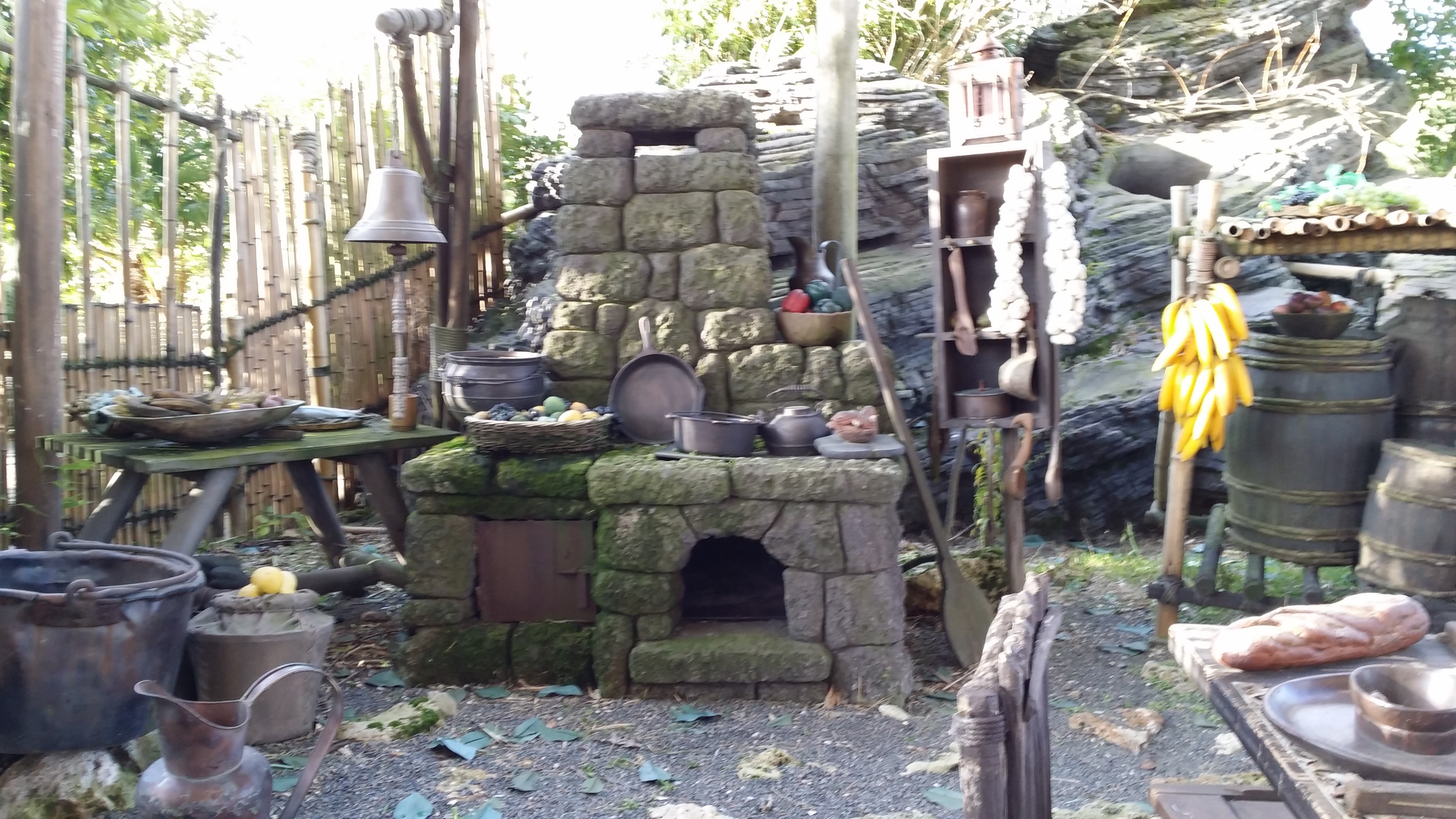
The stove and oven would have to be built by hand, and it is ‘remarkable’ such well-fitting stones were available. It doesn’t look like it’s been used for a while judging by the amount of gree on it. Perhaps it is not in a waterproof area.
The dining table and the shelf in the background have that rough-hewn look about them
A bit of man-made equipment here for drawing water from the stream
And though not made in the era of electricity, there is an opportunity to use the water wheel to do more than it appears to be doing
And tucked away in a corner the all-important study where one can read, or play a little music on the organ. One could say, for the period, one had all the comforts of home.
We have been to Paris a number of times over the years.
The last time we visited Paris we brought the two eldest grandchildren. We took the Eurostar train from St Pancras station direct to Disneyland, then took the free bus from the station to the hotel. The train station was directly outside Disneyland.
We stayed at the Dream Castle Hotel, rather than Disneyland itself as it was a cheaper option and we had a family room that was quite large and breakfast was included every morning. Then it was a matter of getting the free bus to Disneyland.
We spent three days, time which seem to pass far too quickly, and we didn’t get to see everything. They did, however, find the time to buy two princess dresses, and then spent the rest of the time playing dress-ups whenever they could.
In Paris, we stayed at the Crown Plaza at Republique Square.
We took the children to the Eiffel Tower where the fries, and the carousel at the bottom of the tower, seemed to be more memorable than the tower itself. The day we visited, the third level was closed. The day was cold and windy so that probably accounted for the less than memorable visit. To give you some idea of conditions, it was the shortest queue to get in I’ve ever seen.
We traveled on the Metro where it was pointed out to me that the trains actually ran on rubber tires, something I had not noticed before. It was a first for both children to travel on a double-decker train.
The same day, we went to the Louvre.
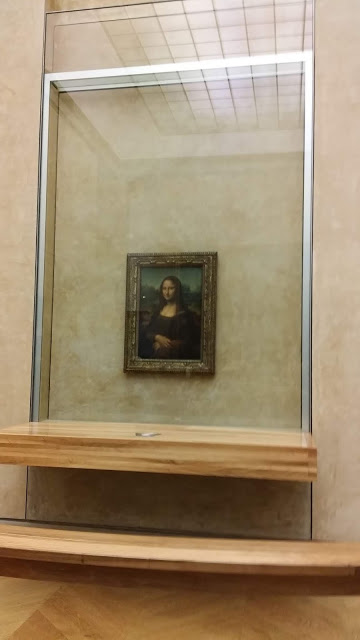
Here, it was cold, wet and windy while we waited, Once inside we took the girls to the Mona Lisa, and after a walk up and down a considerable numkber of stairs, one said, “and we walked all this way to see this small painting”.
It quickly became obvious their idea of paintings were the much larger ones hanging in other galleries.
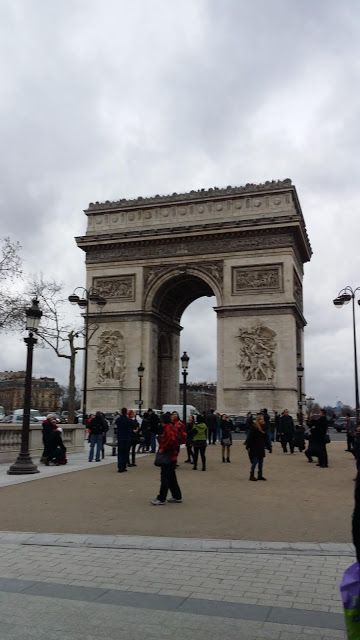
We also took them to the Arc de Triomphe.
We passed, and for some reason had to go into, the Disney shop, which I’m still wondering why after spending a small fortune at Disneyland itself.
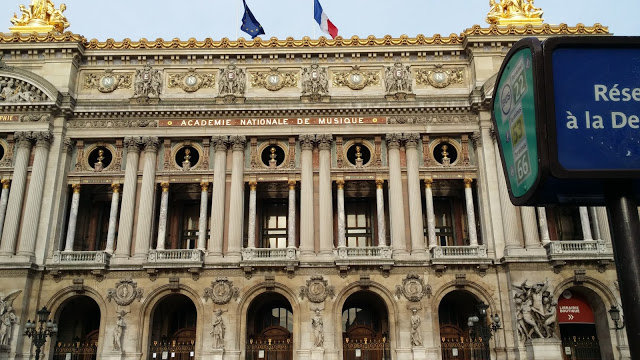
Next on the tour list was the Opera House.
where one of the children thought she saw the ghost and refused to travel in one of the elevators. At least it was quite amazing inside with the marble, staircases, and paintings on the roof.
Sadly, I don’t think they were all that interested in architecture, but at the Opera House, they did actually get to see some ballet stars from the Russian Bolshoi ballet company practicing. As we were leaving the next day we could not go and see a performance.
Last but not least was Notre Dame with its gargoyles and imp[osing architecture.
All in all, traveling with children and experiencing Paris through their eyes made it a more memorable experience.
The first we visited Paris was at the end of a whirlwind bus tour, seven countries in seven days or something like that. It was a relief to get to Paris and stay two nights if only to catch our breath.
I remember three events from that tour, the visit to the Eiffel Tower, the tour of the night lights, not that we were able to take much in from the inside of the bus, and the farewell dinner in one of the tour guides specially selected restaurants. The food and atmosphere were incredible. It was also notable for introducing us to a crepe restaurant in Montmartre, another of the tour guide’s favorite places.
On that trip to Paris, we also spent an afternoon exploring the Palace of Versailles.
The next time we visited Paris we flew in from London. OK, it was a short flight, but it took all day. From the hotel to the airport, the wait at the airport, departure, flying through time zones, arrival at Charles De Gaulle airport, now there’s an experience, and waiting for a transfer that never arrived, but that’s another story.
I can’t remember where we stayed the first time, it was somewhere out in the suburbs, but the second time we stayed at the Hilton near both the Eiffel Tower and the Australian Embassy, notable only because the concierge was dating an Australian girl working in the Embassy. That was our ticket for special treatment, which at times you need to get around in Paris.
It was the year before 2000 and the Eiffel Tower was covered in lights, and every hour or so it looked like a bubbling bottle of champagne. It was the first time we went to Level 3 of the Tower, and it was well worth it. The previous tour only included Level 2. This time we were acquainted with the fries available on the second level, and down below under the tower.
This time we acquainted ourselves with the Metro, the underground railway system, to navigate our way around to the various tourist spots, such as Notre Dame de Paris, The Louvre, Sacre-Coeur Basilica, and Les Invalides, and, of course, the trip to the crepe restaurant.
We also went to the Louvre for the express purpose of seeing the Mona Lisa, and I came away slightly disappointed. I had thought it to be a much larger painting. We then went to see the statue of Venus de Milo and spent some time trying to get a photo of it without stray visitors walking in front of us. Aside from that, we spent the rest of the day looking at the vast number of paintings, and Egyptian artifacts in the Museum.
We also visited the Opera House which was architecturally magnificent.
The third time we visited Paris we took our daughter, who was on her first international holiday. This time we stayed in a quaint Parisian hotel called Hotel Claude Bernard Saint Germain, (43 Rue Des Ecoles, Paris, 75005, France), recommended to us by a relation who’d stayed there the year before. It was small, and the elevator could only fit two people or one person and a suitcase. Our rooms were on the 4th floor, so climbing the stairs with luggage was out of the question.
It included breakfast and wifi, and it was quite reasonable for the four days we stayed there.
It was close to everything you could want, down the hill to the railway station, and a square where on some days there was a market, and for those days when we were hungry after a day’s exploring, a baguette shop where rolls and salad were very inexpensive and very delicious.
To our daughter we appeared to be experienced travelers, going on the Metro, visiting the Louvre, going, yes once again, to the crepe restaurant and the Basilica at Montmartre, Notre Dame, and this time by boat to the Eiffel Tower. We were going to do a boat rode on the Seine the last time but ran out of time.
We have some magnificent photos of the Tower from the boat.
Lunch on one of the days was at a restaurant not far from the Arc de Triomphe, where our daughter had a bucket of mussels. I was not as daring and had a hamburger and fries. Then we went to the center of the Arch and watched the traffic.
Our first time in Paris the bus driver got into the roundabout just to show us the dangers of driving in an unpredictable situation where drivers seem to take huge risks to get out at their exit. Needless to say, we survived that experience, though we did make a number of circuits.
We have been to Paris a number of times over the years.
The last time we visited Paris we brought the two eldest grandchildren. We took the Eurostar train from St Pancras station direct to Disneyland, then took the free bus from the station to the hotel. The train station was directly outside Disneyland.
We stayed at the Dream Castle Hotel, rather than Disneyland itself as it was a cheaper option and we had a family room that was quite large and breakfast was included every morning. Then it was a matter of getting the free bus to Disneyland.
We spent three days, time which seem to pass far too quickly, and we didn’t get to see everything. They did, however, find the time to buy two princess dresses, and then spent the rest of the time playing dress-ups whenever they could.
In Paris, we stayed at the Crown Plaza at Republique Square.
We took the children to the Eiffel Tower where the fries, and the carousel at the bottom of the tower, seemed to be more memorable than the tower itself. The day we visited, the third level was closed. The day was cold and windy so that probably accounted for the less than memorable visit. To give you some idea of conditions, it was the shortest queue to get in I’ve ever seen.
We traveled on the Metro where it was pointed out to me that the trains actually ran on rubber tires, something I had not noticed before. It was a first for both children to travel on a double-decker train.
The same day, we went to the Louvre.
Here, it was cold, wet and windy while we waited, Once inside we took the girls to the Mona Lisa, and after a walk up and down a considerable numkber of stairs, one said, “and we walked all this way to see this small painting”.
It quickly became obvious their idea of paintings were the much larger ones hanging in other galleries.
We also took them to the Arc de Triomphe.
We passed, and for some reason had to go into, the Disney shop, which I’m still wondering why after spending a small fortune at Disneyland itself.
Next on the tour list was the Opera House.
where one of the children thought she saw the ghost and refused to travel in one of the elevators. At least it was quite amazing inside with the marble, staircases, and paintings on the roof.
Sadly, I don’t think they were all that interested in architecture, but at the Opera House, they did actually get to see some ballet stars from the Russian Bolshoi ballet company practicing. As we were leaving the next day we could not go and see a performance.
Last but not least was Notre Dame with its gargoyles and imp[osing architecture.
All in all, traveling with children and experiencing Paris through their eyes made it a more memorable experience.
The first we visited Paris was at the end of a whirlwind bus tour, seven countries in seven days or something like that. It was a relief to get to Paris and stay two nights if only to catch our breath.
I remember three events from that tour, the visit to the Eiffel Tower, the tour of the night lights, not that we were able to take much in from the inside of the bus, and the farewell dinner in one of the tour guides specially selected restaurants. The food and atmosphere were incredible. It was also notable for introducing us to a crepe restaurant in Montmartre, another of the tour guide’s favorite places.
On that trip to Paris, we also spent an afternoon exploring the Palace of Versailles.
The next time we visited Paris we flew in from London. OK, it was a short flight, but it took all day. From the hotel to the airport, the wait at the airport, departure, flying through time zones, arrival at Charles De Gaulle airport, now there’s an experience, and waiting for a transfer that never arrived, but that’s another story.
I can’t remember where we stayed the first time, it was somewhere out in the suburbs, but the second time we stayed at the Hilton near both the Eiffel Tower and the Australian Embassy, notable only because the concierge was dating an Australian girl working in the Embassy. That was our ticket for special treatment, which at times you need to get around in Paris.
It was the year before 2000 and the Eiffel Tower was covered in lights, and every hour or so it looked like a bubbling bottle of champagne. It was the first time we went to Level 3 of the Tower, and it was well worth it. The previous tour only included Level 2. This time we were acquainted with the fries available on the second level, and down below under the tower.
This time we acquainted ourselves with the Metro, the underground railway system, to navigate our way around to the various tourist spots, such as Notre Dame de Paris, The Louvre, Sacre-Coeur Basilica, and Les Invalides, and, of course, the trip to the crepe restaurant.
We also went to the Louvre for the express purpose of seeing the Mona Lisa, and I came away slightly disappointed. I had thought it to be a much larger painting. We then went to see the statue of Venus de Milo and spent some time trying to get a photo of it without stray visitors walking in front of us. Aside from that, we spent the rest of the day looking at the vast number of paintings, and Egyptian artifacts in the Museum.
We also visited the Opera House which was architecturally magnificent.
The third time we visited Paris we took our daughter, who was on her first international holiday. This time we stayed in a quaint Parisian hotel called Hotel Claude Bernard Saint Germain, (43 Rue Des Ecoles, Paris, 75005, France), recommended to us by a relation who’d stayed there the year before. It was small, and the elevator could only fit two people or one person and a suitcase. Our rooms were on the 4th floor, so climbing the stairs with luggage was out of the question.
It included breakfast and wifi, and it was quite reasonable for the four days we stayed there.
It was close to everything you could want, down the hill to the railway station, and a square where on some days there was a market, and for those days when we were hungry after a day’s exploring, a baguette shop where rolls and salad were very inexpensive and very delicious.
To our daughter we appeared to be experienced travelers, going on the Metro, visiting the Louvre, going, yes once again, to the crepe restaurant and the Basilica at Montmartre, Notre Dame, and this time by boat to the Eiffel Tower. We were going to do a boat rode on the Seine the last time but ran out of time.
We have some magnificent photos of the Tower from the boat.
Lunch on one of the days was at a restaurant not far from the Arc de Triomphe, where our daughter had a bucket of mussels. I was not as daring and had a hamburger and fries. Then we went to the center of the Arch and watched the traffic.
Our first time in Paris the bus driver got into the roundabout just to show us the dangers of driving in an unpredictable situation where drivers seem to take huge risks to get out at their exit. Needless to say, we survived that experience, though we did make a number of circuits.
We as authors always like to see two little words in every review, page turner.
Alas, sometimes they’re not, but usually this applied to non fiction simple because they’re reference books. Then another two words apply: boat anchor.
The good stuff is usually over the page.
Page in this instance refers to a leaf in a book, which generally has many pages.
Then the is a page boy, not what you’d find lurking around these days but were more common in days past, but refers to a boy in training to become a knight, or an errand boy for a nobleman.
These days a page boy opens doors and runs messages in a hotel.
Another variation is being paged over the P.A. system, always a major cause of embarrassment because you and everyone else thinks your in trouble.
Of course, before there were mobile phones, there were pagers, and sometimes in the deathly silence of the classroom, it went off. Definitely not advisable to have one on you if you are trying to sneak up on someone. Same goes for the modern equivalent, the mobile phone.
For the person who uses a word processor, you are familiar with pages, and having the software generate page numbers, of course, not for the title page, and a different numbering for other pages like an index, before the story starts.
Complicated? Sometimes.
And many years ago a boss of mine often used to say I needed to turn over a new page, and it did make much sense to me. That might have been because I was young and stupid. But, later on I realised what he was really saying was that I needed to turn over a new leaf.
Kind of strange, but then a lot saying are.
And did I?
Eventually.
And just to end on a high note, Paige is also the name of a girl, I think, and one I’ve decided to use in a story.
Is this what is known as getting down to the pointy end? I’m in the home stretch, and what makes it more of an event is that I now have a clear idea of the front cover.
This was made possible when I was sent some photographs of my eldest granddaughter in her formal dress. Here we call that event to mark the end of secondary school a formal. Elsewhere I have heard it is called a prom.
It makes a perfect illustration of Princess Marigold, although rather than transcribe the photo, I have converted into a sketch drawing which is remarkably accurate. She was not quite sure if she wanted to have her likeness splashed across the cover in full colour. However, I have to come up with the rest of the cover design, hopefully with a representation of a castle in the sky, or something similar.
As for the story, a new character found its way into the pages of the story, one I hadn’t envisaged in the beginning, but had made herself a necessity in the final battle between good and evil.
As for the title, it had been set in stone for as long as I’ve been writing it, but now, as the curtain is coming down, the story is ending in a way I hadn’t considered, and it is almost as if the characters have taken over and writing their own ending.
I can feel another brainstorming session coming on.
For the word counters, another 4,404 words this session, for a total of 149,773.
It’s hard to believe that both the 17 year old and the 14 year old have just both got jobs and started on their path of working for the next 50 to 60 years.
They seem quite amused at the thought, and not without reason, and are not really considering the idea. Not yet, anyway.
The novelty is still quite new, and it has a sense of excitement, but this will no doubt wear off in the coming months. After all, as new workers, they only have to do between 3 and 5 hour shifts.
I guess the fact they have decided to work at such a young age reminded me of my experience, way back when I was 15.
Unhlike them, who will be afforded to opportunity to remain in school to the end, Year 12, and possibly the chance to go to University, in my case we did not have the money to continue education beyond Year 10, and there was no question of ever going to University. Only the rich could afford that, and we were anything but rich.
Instead, I guess hating school helped facilitate my departure, and the notion that I would have to pay my own way, forced me into working.
Of course, it helped living in a small country town, and my father having a job that brought him in contact with everyone who was an anyone, and thus got offers to work in whatever profession I chose.
I ended up in the Post Office, what I considered as the easiest of jobs, originally employed as a telegram delivery boy, and mail collector from the post boxes scatted about the town. As you can imagine, there were not many telegrams to deliver, so other duties included sorting mail, and then mail delivery. Yes I because a postman!
Then, after a few months, I became the night switchboard operator, and with a host of other operators, had some of the most interesting and varied conversations imaginable.
It was a bit of a wrench when we finally moved from the country town back to the city.
When we did, my father bought a small business, and for a year of so, I became a shop assistant.
That lasted for a year or two, until I was 17. Realising that a lack of education was going to make it difficult to ever get a good paying job, I took the opportunity to go back to night school while I had the chance, and it necessitated finding another job to help pay for it.
That was packing books for a wholesale bookseller, part of a small team hidden away in the basement of a very old building. It might not be the best paying job, or the best working conditions, but I suspect it was the universe telling me something.
That job, and being surrounded by books started me off on a journey of reading, and eventually writing.
Ever heard of a dual carriageway, it’s a fancy name for a road that has at least two lanes each way.
Even more strange might be the expression, dual personalities. No, we’re not talking about a person who has schizophrenia , but someone who is a Gemini, and might be happy one minute and suddenly horrible the next.
I’m a Gemini and have first hand experience.
I learned to drive in a car with dual controls, and it was sometimes disconcerting to find the car stopping, and you were not doing it.
Dual controls also exist in airplanes, which I have to say is a good thing, especially if either of the pilots have a heart attack.
Some people have a dual nationality. I would have liked to be British as well as Australian, but it’s no longer possible, and like most countries you have to pick one and pledge your allegiance to it.
Or is that duel?
Let’s gets some swords and have a duel. I know who would win, and it would not be me.
OK, let’s switch to pistols and 20 paces, and alas, I don’t think I’d win that one either.
Duels are this actions people have with deadly weapons usually over a matter of honour. I’m not sure why those duels are at dawn when most people are still asleep, including the duellers.
I wonder if this duel thing had something to do with throwing down the gauntlet. It’s an interesting subject and one I’ll look into later.
I write about spies, washed out, worn out, or thrown out.
It’s always in the back of my mind, sometimes fuelled by a piece in the paper that has a sense of conspiracy about it, and from there, an idea starts turning into words that need to find their way to paper.
Then, if that’s the extent of the first draft, sometimes it goes into the ‘I will come back to this later’ folder and, sometimes, it’s gone and forgotten.
Until I wake up suddenly in the middle of the night, an old story with a new idea fills my head, and I have to get it down.
Then, it will bother me over the next few days, until I give it the attention it’s calling out for. This will often lead to more writing, but planning leading to a synopsis.
The first sentence of a novel is always the hardest. Like I guess many others, I sit and ponder what I’m going to write, whether it will be relevant, whether it will pull the reader into my world, and cause them to read on.
And that’s the objective, to capture the reader’s imagination and want to see what’s going to happen next.
The problem is, we have to set the scene.
Or do we?
Do we need to cover the who, what, where, and when criteria in that first sentence? Can we just start with the edge of the seat suspense, like,
The first bullet hit the concrete wall about six inches above my head with a resounding thwack that scared the living daylights out of me. The second, sent on its way within a fraction of a second of the first found its mark, the edge of my shoulder, slicing through the material, and creasing skin and flesh. There was blood and then panic.
Milliseconds later my brain registered the near-miss and sent the instruction: get down you idiot.
I hit the ground just as another bullet slammed into the concrete where my head had just been.
It can use some more work, less commas, perhaps shorter, sharper sentences to convey the urgency and danger.
Perhaps we could paint a picture of the main character.
He tentatively has the name of Jackson Galworthy. He has always aspired to be a ‘secret agent’ or ‘spy’ and but through luck more than anything else, he was given his opportunity. The problem is he failed his first test and failure means washing out of the program.
What had ‘they’ said? When the shit hits the fan, you need to be calm, cool, and collected. He’d been anything but.
Maybe we’ll flesh the character out as we go along.
OK, I just had another thought for an opening,
Light snow was still falling, past the stage where each flake dissolved as it hit the ground, and now starting to gather in white patches.
It was cold, very cold, and even with the three layers I still shivered.
What surprised me was the silence, but, of course, it was a graveyard beside an ancient church, and everyone who had attended the funeral service had left.
It was a short service for the few that came, and a shorter burial. No one seemed keen to hang around, not with the evening darkness and the snow setting in.
I stood, not far from the filled grave looking at it, but not looking at it. Was I expecting it’s occupant to rise again? Was I expecting forgiveness? I certainly didn’t deserve it.
The truth is, I was responsible for this person’s death, making a mistake a more seasoned professional might not, and the reason why I was shown the door. I had been given very simple instructions; protect this man at all costs.
It was going to be a simple extraction, go in, get the target, and get out before anyone noticed.
A pity then I was the only one who got that memo.
It’s a start, but with the TV going on in the background, Chester complaining about something, and the weeds in the yard are getting higher, there’s too much else going to consider this even a start.
I’ve managed to get some writing time for this story, mainly to keep continuity as it’s quite often lost when stretching it over a long period of time.
For a long time I always knew how the story would end, it was probably one of the few that I’ve written that had an ending in mind. Now, that’s all up in the air.
What had brought on the change of heart? It might be one of the hazards of being a pantser, which when I took to the notion I would finish it come this NaNoWriMo, and when I didn’t, realised something was fundamentally wrong.
Not with the story, but just how it would end, which for Marigold, will always be the same, but for the realm. The thing is, the deeper you dig into a story, the more people who are affected, and the different points of view, and variations on the story from kingdom to kingdom, the more the resolution is affected.
What’s good for one might not be the same for another, and once there are new variables, new people, now wishes are taken into account, the more impossible the job is. And especially for a young princess who just came of age, and had no experience of a world beyond her own orbit.
In a way it reflects the world on my eldest granddaughter, for whom it was written, and her life has changed as much momentously as had Marigold’s. Different people, different ages, different times, that transition from wide eyed child to difficult teenager wasn’t as hard as I remembered it, but then things were different when I was young.
And perhaps more telling, not a princess either.
For the word counters, another 4,258 words this session, for a total of 144,369.
I have often wondered just how much or how little of the author’s personality and experiences end up in a fictional character.
Have they climbed mountains,
Have they escaped from what is almost the inescapable,
Have they been shot, tortured, or worse,
Have they been dumped, or divorced,
Have they travelled to dangerous places, or got locked up in a foreign jail?
We research, read, and I guess experience some or all of the above on the way to getting the book written, but it’s perhaps an interesting fundamental question.
Who am I today? Or, more to the point, who do I want to be today?
Or it can be a question, out of left field, in an interview; “Who are you?”
My initial reaction was to say, “I’m a writer.” But that wasn’t the answer the interviewer is looking for.
Perhaps if she had asked, “Who are you when you’re writing your latest story?” it would make more sense.
Am I myself today?
Am I some fictional character an amalgam of a lot of other people?
Have I got someone definite in mind when I start writing the story?
The short answer might be, “I usually want to be someone other than what I am now. It’s fiction. I can be anyone or anything I want, provided, of course, I know the limitations of the character.”
“So,” she says, “what if you want to be a fireman?”
“I don’t want to be a fireman.”
“But if the story goes in the direction where you need a fireman…”
“What is this thing you have with firemen?” I’m shaking my head. How did we get off track?
“Just saying.”
“Then I’d have to research the role, but I’m not considering adding a fireman anytime soon.”
She sighs. “Your loss.”
Moving on.
And there is that other very interesting question; “Who would you like to be if you could be someone else?”
A writer in that period between the wars, perhaps like an F Scott Fitzgerald or Ernest Hemingway, in Paris, or if it is a fictional character, Jay Gatsby.
He’s just the sort of person who is an enigma wrapped up in a mystery.