What do you call time away from what you usually do?

And, do you truly ever have any time ‘off’?

Of course, in our minds, this time off has any one of a large number of different descriptions, like Annual Leave, Vacation, Holiday, Leave.

We want to believe this is a time when we can rest and relax.

Can we do this at home?

No.

Can we do this when we are away?

Maybe.

It depends on where ‘away’ is.

A holiday shack, or cabin?  Chances are it is deep in the woods, or on the shore of a lake, or river, or beside the sea somewhere in another state, or just far enough away that home is no longer home.

Except, you have all the comforts of home?  Then it really isn’t a holiday as such, just a decamping to another location.

So, do we go for the ‘real’ holiday, out of the country and far away, far enough away that we might not be reminded of our usual life?

Maybe that will do the trick.

If we don’t deliberately take our cell phones, just in case the boss calls, or there is a problem.  And that’s the point, some of us cannot find a cutoff point.

Those long days at the office, the decisions, the deadlines, the endless pressure of having to achieve the impossible are supposed to all melt away when you walk out the door.

Does it?  Can it?  Will it?

Let’s just say you have made the effort, you’ve switched off, and that pesky phone.

As anyone will tell  you, it’s often wise to travel the next day if at all possible, because you need some time to decompress before tackling what sometimes can be an arduous getting to the final destination, especially if it is at a peak holiday period, or on planes where anything and everything can go wrong very quickly.

Been there done that.

But, this time, we traveled the next day, nothing went wrong, and all is fine.

Except …

As a writer and having spent the last few months finishing off my last novel, I was looking forward to some downtime.  The editor has the final draft, and I’m happy.

Then, as it always does, the best-laid plans of mice and men …

It all comes unstuck.

Inspiration often comes out of left field; something happens, a piece in a newspaper, an item on TV, or just lying down staring at the ceiling, when ‘bang’  it hits you.

The start of a story, a theme that you can run with.

Damn.

I’ve been away for four days now and written seven chapters and the words will not stop.

If only …

Hey, what a great title for the story…

Sorry, got to get back to work!

My disdain for some reporters, and reporting these days

It is sometimes quite trashy and that’s saying something!

Having been a journalist in a previous lifetime, and one that always believed that the truth mattered, it didn’t take long to realize that journalists should never let the truth get in the way of a good story.

Newspapers, and all other forms of media, will only write what they believe will sell, or what they think the public wants to read. The truth, sadly, is not the first thing on the reader’s mind, only that someone is to blame for something they have no control over, and it doesn’t matter who.

And the more outlandish the situation, the more the public will buy into it.

This, I guess, is why we like reading about celebrities and royalty, not for the good they might do, but the fact they stumble and make mistakes, and that somehow makes us feel better about ourselves.

Similarly, if the media can beat up a subject, like the corona-virus, and make it worse than it is, then people will lap up the continuing saga, as it relates to them, and will take one of two stances, that they believe the horror of it, and do as they’re asked, or disbelieve it because nothing can be that bad, and ignore it and the consequences of disobedience. knowing the government will not press too hard against the non-compliers simply because of democracy issues it will stir up.

That is, then the media will get a hold of this angle and push it, and people will start to think disobedience is a good thing, not a bad one.

So, our problems of trying to get a fair and balanced look at what the coronavirus is all about is nigh on impossible. We are continuously bombarded with both right and wrong information, and the trouble is, both sides are very plausibly supported by facts.

And that’s the next problem we have in reporting. We can get facts to prove anything we want. It’s called the use and abuse of statistics and was an interesting part of the journalism degree I studied for. We were told all about statistics, good and bad, and using them to prove the veracity of our piece.

I remember writing a piece for the tutor extolling the virtues of a particular person who was probably the worst human since Vlad the Impaler, using only the facts that suited my narrative. I also remember the bollocking he gave me for doing so but had to acknowledge that sometimes that would happen.

The integrity of reporting only went as far as the editor, and if the editor hated something, you had to hate it too. This is infamously covered in various texts where newspaper publishers pick sides and can influence elections, and governments. It still happens.

So, the bottom line is, when I’m reading an article in the media, I always take it with a grain of salt, and do my own fact-checking, remembering, of course, not just to fact check to prove the bias one way of the other, but then get a sense of balance.

We have state elections coming up where I live, but it does not sink to the personal sniping level as it does in the US, we haven’t sunk that low yet, but we haven’t got past the sniping about all the wrongs and failed promises of the government of the day, or the endless tirade against the opposition and how bad a job they did when they were previously in government.

You can see, no one is talking about what they’re going to do for us, no one is telling us what their policies are. It’s simply schoolyard tit for tat garbage speak. What happened to the town hall meeting, a long and winding speech encompassing the policies, what the government plans to do for its people in the next three years, and then genuinely answering questions?

Perhaps we should ban campaigning, and just get each party to write a book about what they intend to do, and keep them away from the papers, the TV, and any other form of media, in other words, don’t let them speak!

And don’t get me started about the drivel they speak in the parliament. Five-year-olds could do a better job.

OK, rant over.

My disdain for some reporters, and reporting these days

It is sometimes quite trashy and that’s saying something!

Having been a journalist in a previous lifetime, and one that always believed that the truth mattered, it didn’t take long to realize that journalists should never let the truth get in the way of a good story.

Newspapers, and all other forms of media, will only write what they believe will sell, or what they think the public wants to read. The truth, sadly, is not the first thing on the reader’s mind, only that someone is to blame for something they have no control over, and it doesn’t matter who.

And the more outlandish the situation, the more the public will buy into it.

This, I guess, is why we like reading about celebrities and royalty, not for the good they might do, but the fact they stumble and make mistakes, and that somehow makes us feel better about ourselves.

Similarly, if the media can beat up a subject, like the corona-virus, and make it worse than it is, then people will lap up the continuing saga, as it relates to them, and will take one of two stances, that they believe the horror of it, and do as they’re asked, or disbelieve it because nothing can be that bad, and ignore it and the consequences of disobedience. knowing the government will not press too hard against the non-compliers simply because of democracy issues it will stir up.

That is, then the media will get a hold of this angle and push it, and people will start to think disobedience is a good thing, not a bad one.

So, our problems of trying to get a fair and balanced look at what the coronavirus is all about is nigh on impossible. We are continuously bombarded with both right and wrong information, and the trouble is, both sides are very plausibly supported by facts.

And that’s the next problem we have in reporting. We can get facts to prove anything we want. It’s called the use and abuse of statistics and was an interesting part of the journalism degree I studied for. We were told all about statistics, good and bad, and using them to prove the veracity of our piece.

I remember writing a piece for the tutor extolling the virtues of a particular person who was probably the worst human since Vlad the Impaler, using only the facts that suited my narrative. I also remember the bollocking he gave me for doing so but had to acknowledge that sometimes that would happen.

The integrity of reporting only went as far as the editor, and if the editor hated something, you had to hate it too. This is infamously covered in various texts where newspaper publishers pick sides and can influence elections, and governments. It still happens.

So, the bottom line is, when I’m reading an article in the media, I always take it with a grain of salt, and do my own fact-checking, remembering, of course, not just to fact check to prove the bias one way of the other, but then get a sense of balance.

We have state elections coming up where I live, but it does not sink to the personal sniping level as it does in the US, we haven’t sunk that low yet, but we haven’t got past the sniping about all the wrongs and failed promises of the government of the day, or the endless tirade against the opposition and how bad a job they did when they were previously in government.

You can see, no one is talking about what they’re going to do for us, no one is telling us what their policies are. It’s simply schoolyard tit for tat garbage speak. What happened to the town hall meeting, a long and winding speech encompassing the policies, what the government plans to do for its people in the next three years, and then genuinely answering questions?

Perhaps we should ban campaigning, and just get each party to write a book about what they intend to do, and keep them away from the papers, the TV, and any other form of media, in other words, don’t let them speak!

And don’t get me started about the drivel they speak in the parliament. Five-year-olds could do a better job.

OK, rant over.

The unthinkable has happened…

I’m lying awake in the dark, my mind is racing with endless thoughts centred on a world wide disaster. There are things happening that could lead to what could only be described as a catastrophic event that leads to a dystopian world, one no one thought could possible happen.

Of course, it hasn’t happened, but could it…

Here’s how my mind is connecting the dots.

There are two superpowers, both nuclear equipped, and both antagonistic towards each other. Tensions have been rising, but not only with one country, but a number of countries.

In the other, an election comes and goes, there’s no decisive result, and it leads to skirmishes that eventually break out into the second civil war. No heed is paid to the virus that had been killing indiscriminately before, and seemingly had disappeared.

A fearsome world is watching what will happen as millions are being killed.

The adversarial country deems, when the civil war is at it’s zenith to attack an uncoordinated and vulnerable country, thinking no one would have their finger on the button. Nuclear weapons are launched on either side, other countries join in, and that plunges the world into a nightmare no one could have predicted.

It takes three months for the dust to settle, and to realise that more than three billion people have died from the nuclear fallout, and whole countries are now just infertile and dangerous wastelands.

And then the virus comes back, because there are no medical facilities, no fresh or running water, and no food. No electricity, no oil, no petrol, no vehicles, or transport of any kind.

In one decisive and utterly stupid move, everyone is back in the stone age, or worse.

Every day is a battle to survive, to keep away from the virus infected people, find food, find or build shelter, and above all, find water. All of which are not contaminated.

The land in one country that was more or less suffered two destroyed cities and caused millions of deaths, looks from a certain perspective, as though nothing has happened. There are tracts of land that are still fertile, near water, but have been taken over by the few who thought to have weapons and the forethought to create fiefdoms.

People can go there, but they are subjugated into what could be called slavery, and sacrifice everything, including their freedom, as the price to live. It’s inevitable that some will rule and others will follow, much like feudal England in the early years.

The people thought that their rights and freedom had been trampled on before the great conflagration, but now, they realise that was nothing compared to the new normal. Executions, heinous punishment for simple crimes, starvation and dehydration. The dreaded socialism that was earlier feared has come home to roost.

It’s not the first story of it’s type, it follows a fairly standard formula that I’ve read in a few books, each using a different premise for the reason, and taking a more reasonable line in the aftermath where people help each other rather than the few subjugating the masses.

To be honest, I don’t think there would be much kindness and co-operation in a world like that, simply because we’ve gone too far down the road being greedy and searching for power, particularly over others.

The meek will certainly not inherit the earth.

Of course, there’s always an exception to very rule, and this is the protagonist for this story.

Feel free to adapt it any way you like.

And let’s hope it doesn’t happen in reality.

The unthinkable has happened…

I’m lying awake in the dark, my mind is racing with endless thoughts centred on a world wide disaster. There are things happening that could lead to what could only be described as a catastrophic event that leads to a dystopian world, one no one thought could possible happen.

Of course, it hasn’t happened, but could it…

Here’s how my mind is connecting the dots.

There are two superpowers, both nuclear equipped, and both antagonistic towards each other. Tensions have been rising, but not only with one country, but a number of countries.

In the other, an election comes and goes, there’s no decisive result, and it leads to skirmishes that eventually break out into the second civil war. No heed is paid to the virus that had been killing indiscriminately before, and seemingly had disappeared.

A fearsome world is watching what will happen as millions are being killed.

The adversarial country deems, when the civil war is at it’s zenith to attack an uncoordinated and vulnerable country, thinking no one would have their finger on the button. Nuclear weapons are launched on either side, other countries join in, and that plunges the world into a nightmare no one could have predicted.

It takes three months for the dust to settle, and to realise that more than three billion people have died from the nuclear fallout, and whole countries are now just infertile and dangerous wastelands.

And then the virus comes back, because there are no medical facilities, no fresh or running water, and no food. No electricity, no oil, no petrol, no vehicles, or transport of any kind.

In one decisive and utterly stupid move, everyone is back in the stone age, or worse.

Every day is a battle to survive, to keep away from the virus infected people, find food, find or build shelter, and above all, find water. All of which are not contaminated.

The land in one country that was more or less suffered two destroyed cities and caused millions of deaths, looks from a certain perspective, as though nothing has happened. There are tracts of land that are still fertile, near water, but have been taken over by the few who thought to have weapons and the forethought to create fiefdoms.

People can go there, but they are subjugated into what could be called slavery, and sacrifice everything, including their freedom, as the price to live. It’s inevitable that some will rule and others will follow, much like feudal England in the early years.

The people thought that their rights and freedom had been trampled on before the great conflagration, but now, they realise that was nothing compared to the new normal. Executions, heinous punishment for simple crimes, starvation and dehydration. The dreaded socialism that was earlier feared has come home to roost.

It’s not the first story of it’s type, it follows a fairly standard formula that I’ve read in a few books, each using a different premise for the reason, and taking a more reasonable line in the aftermath where people help each other rather than the few subjugating the masses.

To be honest, I don’t think there would be much kindness and co-operation in a world like that, simply because we’ve gone too far down the road being greedy and searching for power, particularly over others.

The meek will certainly not inherit the earth.

Of course, there’s always an exception to very rule, and this is the protagonist for this story.

Feel free to adapt it any way you like.

And let’s hope it doesn’t happen in reality.

Books, books, and more books

If there is one thing I cannot resist is walking into a book store wherever it might be.

It usually elicits a groan from everyone I’m with because for them, watching grass grow is a more fascinating exercise.

But…

The best bookshops are the pop-up ones that appear in various shopping centres where there are empty spaces, and these have a wide variety of books for just $7 each.

And there are lots of bargains…

As you can see, I have been on a few bargain hunts lately and like any writer’s room, tucked away with the boxes of drinks, gardening equipment and everything else that just doesn’t fit in the house, are the piles of books awaiting being put into the shelves

As you can see, the shelves are almost full so it’s going to be an uphill battle to find spaces for them.

By the way, there are eight such book cases on the surrounding walls, as well as a new one, recently discarded from the lounge room, to house the reference books

Along with a few stuffed bears.

The job of putting books on shelves falls to the grandchildren, whom I am trying to convince that when they get older, they should too embrace the idea of having a reading room, which my writing room will also be when I eventually get to throw out the accumulation of years of discarded homewares.

Perhaps one day next year…

Books, books, and more books

If there is one thing I cannot resist is walking into a book store wherever it might be.

It usually elicits a groan from everyone I’m with because for them, watching grass grow is a more fascinating exercise.

But…

The best bookshops are the pop-up ones that appear in various shopping centres where there are empty spaces, and these have a wide variety of books for just $7 each.

And there are lots of bargains…

As you can see, I have been on a few bargain hunts lately and like any writer’s room, tucked away with the boxes of drinks, gardening equipment and everything else that just doesn’t fit in the house, are the piles of books awaiting being put into the shelves

As you can see, the shelves are almost full so it’s going to be an uphill battle to find spaces for them.

By the way, there are eight such book cases on the surrounding walls, as well as a new one, recently discarded from the lounge room, to house the reference books

Along with a few stuffed bears.

The job of putting books on shelves falls to the grandchildren, whom I am trying to convince that when they get older, they should too embrace the idea of having a reading room, which my writing room will also be when I eventually get to throw out the accumulation of years of discarded homewares.

Perhaps one day next year…

Books, books, and more books

If there is one thing I cannot resist is walking into a book store wherever it might be.

It usually elicits a groan from everyone I’m with because for them, watching grass grow is a more fascinating exercise.

But…

The best bookshops are the pop-up ones that appear in various shopping centres where there are empty spaces, and these have a wide variety of books for just $7 each.

And there are lots of bargains…

As you can see, I have been on a few bargain hunts lately and like any writer’s room, tucked away with the boxes of drinks, gardening equipment and everything else that just doesn’t fit in the house, are the piles of books awaiting being put into the shelves

As you can see, the shelves are almost full so it’s going to be an uphill battle to find spaces for them.

By the way, there are eight such book cases on the surrounding walls, as well as a new one, recently discarded from the lounge room, to house the reference books

Along with a few stuffed bears.

The job of putting books on shelves falls to the grandchildren, whom I am trying to convince that when they get older, they should too embrace the idea of having a reading room, which my writing room will also be when I eventually get to throw out the accumulation of years of discarded homewares.

Perhaps one day next year…

A photograph from the inspirational file – 9

I remeber once being told that if you shoot for the moon, you’ll land in the clouds, if you shoot for the tree tops, you’ll finish up back where you started from.

It was a silly analogy, but I always remembered it when I looked up at the sky and saw clouds.

That was back in those hazy carefree days just after you were finished with school and you had your whole life in front of you. Your parents were there as the safety net, and were still proud of your scholastic achievements, and were not in too much of a hurry to hustle you out of the house.

But what happened when there’s a recession that came upon everyone without any warning.

Stocks plummeted, people lost their life’s savings, those with mortgages and loans suddenly finding that along with unemployment came no income, no ability to pay the bills, and therefore lost everything.

Although I never said it, I was thinking what good was an education when the whole world had gone to hell in a handbasket.

Two things I remember from back then, which in the context of disaster, wasn’t all that long ago. Firstly, my father making us children go camping from before we could walk, and with it, to survive with nothing but the clothes on our backs, and our wits.

It had happened to him, as a member of am expedition in Africa in his younger days, thinking that he might become the next great explorer, or archeologist, and finishing up getting lost, even though he asserted the other members had deliberately left him behind.

And secondly, that it was essential that we forge working relationships with any and all those who were like minded, such as those who wanted to be saved, not those who expected everyone else to so the work. It was obvious he had met a lot of those type of people too.

It served us well.

When nations began turning on each other, when essential resources like electricity and fuel stopped being distributed and rationed, when food suddenly became scarce, that’s when the real trouble started. My father said, at the outset, what would happen, and was glad our mother was not there to see it.

Then, when neighbours attacked neighbours once food became scarce, it was time to leave. The pity of it was, he died defending us, even after offering up some of the food we had stored away, but that had not appeased a hungry or angry mob.

His last words, “Go to where we said we would go, and remember everything I’ve taught you” were etched in my brain, and my brother and I did as he asked.

But, even knowing where we had to go, and how to get there, a plan of action made many years before, and trialled in recent years with success, nothing in the past could have prepared us for the journey.

It was, literally, time to shoot for the moon.

© Charles Heath 2021

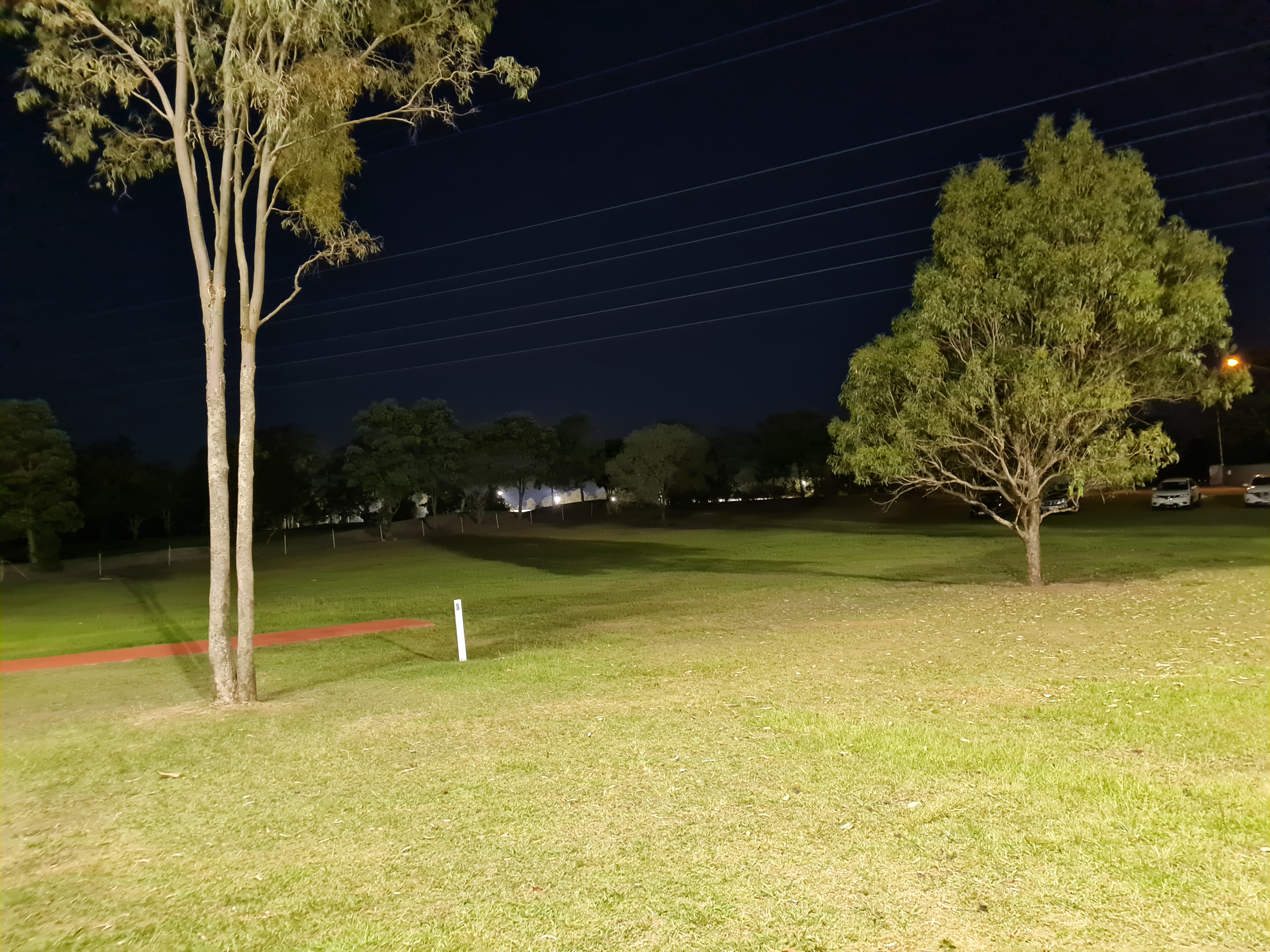
A photograph from the inspiration file – 8

A picture can paint a thousand words, or more, or less, but…

The interesting thing about a place in the dark, in the distance, and behind a chain wire fence usually means something. Especially when there are mysterious lights involved.

We were at a night sports event, watching over a thousand screaming and yelling kids from five to eighteen pretending to compete in a variety of athletic events.

I was there to nominally to support my granddaughter in her endeavours, but right at that moment, on the far side of the track, what I was really there to see was what was behind the wire fence

“Are you watching, Poppy?”

Well, at that moment I wasn’t, but I did turn just in time to see her clear a meter high high jump and execute an elegent backflip, a result no doubt of the ballet training she had since the age of four. Seven years later those lessons had transformed into a high jumper with a great future.

Except, she couldn’t really care less. It was more about the parents and athletic organisers expectations, than hers. I was there, she told me in a secretive tone, to tell everyone to back off.

if you think spying was a dangerous occupation, then let me tell you trying to navigate a safe path between child and parents, and then the rest of the word, forget it.

So, with my trusty phone camera, slightly modified, I was pretending to take pictures of surrounding trees in the high density lighting for the athletics oval, whilst zooming in on the real target.

And, about to take the money shot, I could feel a tugging on the side of my jacket.

I looked down to see the petulant face of a child not happy.

“You said you were coming to see me perform.”

I had. I looked over at the woman the boss had assigned as my ‘date’, Nancy, and whom I’d introduced as a long time friend who deigned to suffer my invitation so she could meet the girl I was always talking about.

“Yes, Poppy,” she said with an evil undertone. “You said you wanted to see her high jumps. You’d better get over there, while I take some pictures of the trees for you.”

“Why do you want pictures of dumb old trees?” That was a question I would have asked myself, and I didn’t quite have an answer for it.

Nancy did. “Because he’s odd like that. It’s one of the quirks I like about him.” She took the camera out of my hand and shooed us off.

And, heading back to the high jump, she asked, “What’s a quirk?”

“Just ask your father later. He knows all about quirks.”

© Charles Heath 2021