A photograph from the inspirational bin – 6

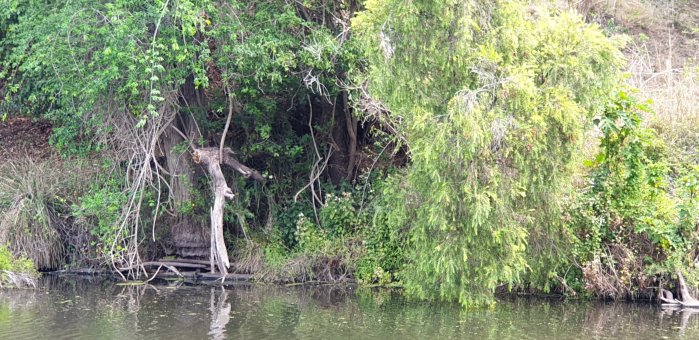
For those who are wondering what this is a photograph of, it is a tree bordered stream that runs along a long valley that runs from outside Canungra, in Queensland, to the Lamington National Park.

It’s near a place we like to stay for a few days when we want to get away from everything, and I mean everything. There is no television, and cell phone reception is awful if not non existent.

So, you can see the benefits.

Sitting at the table on the veranda overlooking the fields, and this stream, you have time to just think, or not, about what it might have been like before the settlers came.

What is was like when the explorers we seeking new places to live, and they chanced upon this valley. It it was me back then, I would have followed the stream.

But, as for a story…

I have read a great many stories for the explorers of this country, and the hazardous nature of their treks.

What seemed to be the most common theme was crossing from south to north, that is from Melbourne to the Northern most tip of Queensland, or from Adelaide to the Northern Territory. In both cases they would have to traverse a very dry, very hot outback where the sight of a stream, or river, like above, would have been very welcome.

For some, it became an impossible quest, and stuck in the desert, they eventually perished. That in itself, the trials and tribulations of an early explorer would make a great story.

Australia is a very fertile country around the coastal regions, but one you start venturing inland, it is dry, dusty and almost uninhabitable. Unless there’s water from rivers, streams, or underground, or mining settlements, there is very little else to see.

The exceptions to this are Uluru and Kakadu National Park, in the Northern Territory, Shark Bay and The Pinnacles in Western Australia, MacKenzie Falls in Victoria, The Simpson Desert, the Boodjamulla (Lawn Hill) National Park, and the Carnarvon Gorge in Queensland, to name a few.

One day I might get to see them.

The cinema of my dreams – I never wanted to go to Africa – Episode 15

Our hero knows he’s in serious trouble.

The problem is, there are familiar faces and a question of who is a friend and who is foe made all the more difficult because of the enemy, if it was the enemy, simply because it didn’t look or sound or act like the enemy.

But, it seems our hero has ‘escaped’ and had found his way back home.

Except not quite how he expected it would be.


Rest was impossible while so many thoughts about my recent experiences were swirling around in the back of my head.  Now, when thinking it through, it made sense that they make sure I was found alive, but in very bad shape.

Two reasons, one, to remind me that they could do whatever they liked to me, and the second, to appease Breeman, who, no doubt realizing a helicopter was missing, would send out search teams, a no-fly zone or not.

But it was a calculated risk assuming I would not tell Breeman, or someone else, about what had happened to me, whether they believed it or not.

That led to the next thought, why was I still alive.  It would be just as easy to kill me and be discovered after dying from injuries received in the crash.  Supposition, they still needed me, or, and this was a hail Mary at best, they needed access to the base, and Breeman.

Did that mean either of the two men I’d seen at the other camp would suddenly turn up?  My money was on Colonel Bamfield.  He was my first Commanding Officer, he had a keen interest in me from the get-go, and he was the one who facilitated my transfer to my current base before I knew he was working for ‘other interests’. 

I still didn’t want to think it was the enemy.

Another question popped into my head, what was his, or their, interest in Breeman because the line of questioning centered on her.

My best guess was that it was no accident I was on that helicopter, that she had directed the pilot to make a flyover, and wasn’t expected that we would be shot down and that she had assumed there would be no repercussions on either myself or the pilot.

It was also clear that if she had to explain how I came to be where they found me, and the fact no one had launched a similar attack of the rescue team, that what happened was simply a breach of orders, and a court-martial offense.

It would solve Bamfield and his new friend’s problem.  Whatever the outcome of the court-martial she would be sent home, relieved of her command.

It seemed the military, as always, had a mind of its own, and not always have the best interests of its personnel at heart.

I’d soon find out.


© Charles Heath 2019


Writing about writing a book – Day 15

Our main character Bill probably needs to give an account of the situation he found himself in.  I have, for a while, considered that he is just another soldier who found himself in the wrong place at the wrong time, but now, I want to add a dimension.

He finishes up where he is, in the end, because he chose to be there, and it was something of a rocky ride to get there.

That I’m still planning in my head.

In the meantime, this is the initial piece I wrote for his situation description:

I used to joke about telling people my middle name was ‘danger’.  It seemed I was not the only one, and for a time, worked with a group of soldiers and ex-soldiers in a capacity similar to that of being a mercenary.

Each one of us had a specialty.  Mine was being the sniper.  Johnny had knife skills and not the sort that was used in a kitchen.  Freddie, explosives, Bill, well, you just left Bill alone because he had a grudge against the world and everyone in it.

The Colonel used to say we were all handpicked, but that wasn’t necessarily the case.  I knew for a fact some of the team came straight out of the stockade before their time was up.

Because some of us were expendable.

The thing was; none of us cared.  For those who were ‘rescued’, it was better out in the jungle, dodging bullets, than being inside, your fate left in the hands of the Gods. 

I knew how it was.  I’d been there once or twice myself.

This morning had started the same as many others.  Rise and shine, a breakfast of sorts, into the chopper, and after an hour or so, dropping into a grassy patch, with nothing but jungle in every direction.  Our mission was to find and liberate a number of our people who had gone missing, read captured, on the border between Cambodia and Vietnam.  It was a familiar country because I had, over the last year or so, gone hunting missing POW’s in the area.  Old prisons had been converted into drug laboratories, and we’d broken up a few of those too.

The noise of the chopper put paid to any sort of stealthy approach and, by the time it dropped us off, if there was anyone nearby, our advantage, if we ever had one, was gone.  The trouble was, to cover the same distance by foot would take a week, and, by the time we arrived, if we arrived, more than half the team would be dead.  We may have been good, but we were not that good.  It was not our home turf.

It was hot, sticky, and nothing like home.  There wasn’t a day that passed when I thought to myself it was getting harder and harder to remember when I wasn’t constantly hot and sweaty, nor as frightened.  It happened that way, towards the end of a tour.

Once on the ground, every man was on full alert.  We changed the lead and tail end constantly, to make sure we didn’t lose anyone.  And it was hard going, the constant heat, sweat, punctuated with slight relief when it rained.

Then as quickly as it came, it went, leaving you wet then sticky.

And if that wasn’t enough to contend with, there was the enemy.   You couldn’t see them, nor hear them yet you had the feeling he was watching you the whole time, and it made your skin crawl.

Sometimes the enemy attacked when we had to camp, invisibly swooping, shooting from the trees, and firing a mortar or two, then disappearing back into the luminous greenery without a trace.  These were the remnants of the Viet Cong, Cambodian armed forces, disaffected Laotians, or the Chinese, or so we believed, but they were well-trained mercenaries and just the sort of people the drug cartels would use.

And surviving the operation, any operation, was like playing Russian roulette.  Was it your turn this time, or someone else’s?  You could be walking along, straining your eyes and ears, and next minute, find the man who was covering your back, dead.  Booby traps were silent and swift.  Landmines are loud and very messy.  Both hangovers from the war, and never cleaned up.  People you’d meet, you never knew whose side they were on, so it was best to avoid all contact.

© Charles Heath 2015-2021

Memories of the conversations with my cat – 84

As some may be aware, but many not, Chester, my faithful writing assistant, mice catcher, and general pain in the neck, passed away some months ago.

Recently I was running a series based on his adventures, under the title of Past Conversations with my cat.

For those who have not had the chance to read about all of his exploits I will run the series again from Episode 1

These are the memories of our time together…


cat-1

This is Chester.  He is looking out the door at the rain.

After a long spell of heat and humidity that was practically unbearable, we now have rain and cold.

I’m standing at the back door watching the near torrential downpour, and both of us are watching the river of water flowing from the back yard down the side of the house.

Chester looks at me.  Is that the look that’s asking me to let him outside.,

I’m toying with the idea.

He turns his head and looks up at me.  Is that an imploring look to stay in or go out.

The hell with it, I open the door.  If he wants to go out in the rain, that’s his business.

He stands up and turns his head to look at me.

OK, I get it.  When you know I can’t go out, you let me out.  That’s just not right.

What’s stopping you?

You know exactly what the problem is.  Water.  You know I hate water.

That’s every other cat.  A while back you convinced you were not like the other cats.  Fearless, you said, able to take on any challenge.

Open door, it’s an invitation to paradise.

He takes two tentative steps towards freedom.  The rain comes down harder as if someone up there is playing a mean joke on him.

Another step, just about through the door.

The wind blows and we both catch a spray of water.

He jumps and scuttles back inside so fast, and I’m left alone at the door.  I close it again.

We will be discussing invincibility sometime soon, I yell out.  But, he’s gone.

I shrug and go back inside.  I will savor this victory for the next few minutes.

Or for along as he’ll let me.

“Sunday in New York”, a romantic adventure that’s not a walk in the park!

“Sunday in New York” is ultimately a story about trust, and what happens when a marriage is stretched to its limits.

When Harry Steele attends a lunch with his manager, Barclay, to discuss a promotion that any junior executive would accept in a heartbeat, it is the fact his wife, Alison, who previously professed her reservations about Barclay, also agreed to attend, that casts a small element of doubt in his mind.

From that moment, his life, in the company, in deciding what to do, his marriage, his very life, spirals out of control.

There is no one big factor that can prove Harry’s worst fears, that his marriage is over, just a number of small, interconnecting events, when piled on top of each other, points to a cataclysmic end to everything he had believed in.

Trust is lost firstly in his best friend and mentor, Andy, who only hints of impending disaster, Sasha, a woman whom he saved, and who appears to have motives of her own, and then in his wife, Alison, as he discovered piece by piece damning evidence she is about to leave him for another man.

Can we trust what we see with our eyes or trust what we hear?

Haven’t we all jumped to conclusions at least once in our lives?

Can Alison, a woman whose self-belief and confidence is about to be put to the ultimate test, find a way of proving their relationship is as strong as it has ever been?

As they say in the classics, read on!

Purchase:

http://tinyurl.com/Amazon-SundayInNewYork

Books, books, and more books

If there is one thing I cannot resist is walking into a book store wherever it might be.

It usually elicits a groan from everyone I’m with because for them, watching grass grow is a more fascinating exercise.

But…

The best bookshops are the pop-up ones that appear in various shopping centres where there are empty spaces, and these have a wide variety of books for just $7 each.

And there are lots of bargains…

As you can see, I have been on a few bargain hunts lately and like any writer’s room, tucked away with the boxes of drinks, gardening equipment and everything else that just doesn’t fit in the house, are the piles of books awaiting being put into the shelves

As you can see, the shelves are almost full so it’s going to be an uphill battle to find spaces for them.

By the way, there are eight such book cases on the surrounding walls, as well as a new one, recently discarded from the lounge room, to house the reference books

Along with a few stuffed bears.

The job of putting books on shelves falls to the grandchildren, whom I am trying to convince that when they get older, they should too embrace the idea of having a reading room, which my writing room will also be when I eventually get to throw out the accumulation of years of discarded homewares.

Perhaps one day next year…

An excerpt from “What Sets Us Apart”, a mystery with a twist

See excerpt from the story below, just a taste of what’s in store…

http://amzn.to/2Eryfth

whatsetscover

McCallister was old school, a man who would most likely fit in perfectly campaigning on the battlefields of Europe during the Second World War. He’d been like a fish out of water in the army, post-Falklands, and while he retired a hero, he still felt he’d more to give.

He’d applied and was accepted as head of a SWAT team, and, watching him now as he and his men disembarked from the truck in almost military precision, a look passed between Annette, the police liaison officer, and I that said she’d seen it all before. I know I had.

There was a one in four chance his team would be selected for this operation, and she had been hoping it would be one of the other three. While waiting for them to arrive she filled me in on the various teams. His was the least co-operative, and the more likely to make ad-hoc decisions rather than adhere to the plan, or any orders that may come from the officer in charge.

This, she said quite bluntly, was going to end badly.

I still had no idea why Prendergast instructed me to attend the scene of what looked to be a normal domestic operation, but as the nominated expert in the field in these types of situations, it was fairly clear he wasn’t taking any chances. It was always a matter of opinion between us, and generally I lost.

In this case, it was an anonymous report identifying what the authorities believed were explosives in one of the dockside sheds where explosives were not supposed to be.

The only reason why the report was given any credence was the man, while not identifying himself by name, said he’d been an explosive expert once and recognized the boxes. That could mean anything, but the Chief Constable was a cautious man.

With his men settled and preparing their weapons, McCallister came over to the command post, not much more than the SUV my liaison and I arrived in, with weapons, bulletproof vests, and rolls of tape to cordon off the area afterward. We both had coffee, steaming in the cold early morning air. Dawn was slowly approaching and although rain had been forecast it had yet to arrive.

A man by the name of Benson was in charge. He too had groaned when he saw McCallister.

“A fine morning for it.” McCallister was the only enthusiastic one here.

He didn’t say what ‘it’ was, but I thought it might eventually be mayhem.

“Let’s hope the rain stays away. It’s going to be difficult enough without it,” Benson said, rubbing his hands together. We had been waiting for the SWAT team to arrive, and another team to take up their position under the wharf, and who was in the final stages of securing their position.

While we were waiting we drew up the plan. I’d go in first to check on what we were dealing with, and what type of explosives. The SWAT team, in the meantime, were to ensure all the exits to the shed were covered. When I gave the signal, they were to enter and secure the building. We were not expecting anyone inside or out, and no movement had been detected in the last hour since our arrival and deployment.

“What’s the current situation?”

“I’ve got eyes on the building, and a team coming in from the waterside, underneath. Its slow progress, but they’re nearly there. Once they’re in place, we’re sending McKenzie in.”

He looked in my direction.

“With due respect sir, shouldn’t it be one of us?” McCallister glared at me with the contempt that only a decorated military officer could.

“No. I have orders from above, much higher than I care to argue with, so, McCallister, no gung-ho heroics for the moment. Just be ready to move on my command, and make sure you have three teams at the exit points, ready to secure the building.”

McCallister opened his mouth, no doubt to question those orders, but instead closed it again. “Yes sir,” he muttered and turned away heading back to his men.

“You’re not going to have much time before he storms the battlements,” Benson quietly said to me, a hint of exasperation in his tone. “I’m dreading the paperwork.”

It was exactly what my liaison officer said when she saw McCallister arriving.

The water team sent their ‘in position’ signal, and we were ready to go.

In the hour or so we’d been on site nothing had stirred, no arrivals, no departures, and no sign anyone was inside, but that didn’t mean we were alone. Nor did it mean I was going to walk in and see immediately what was going on. If it was a cache of explosives then it was possible the building was booby-trapped in any number of ways, there could be sentries or guards, and they had eyes on us, or it might be a false alarm.

I was hoping for the latter.

I put on the bulletproof vest, thinking it was a poor substitute for full battle armor against an exploding bomb, but we were still treating this as a ‘suspected’ case. I noticed my liaison officer was pulling on her bulletproof vest too.

“You don’t have to go. This is my party, not yours,” I said.

“The Chief Constable told me to stick to you like glue, sir.”

I looked at Benson. “Talk some sense into her please, this is not a kindergarten outing.”

He shrugged. Seeing McCallister had taken all the fight out of him. “Orders are orders. If that’s what the Chief Constable requested …”

Madness. I glared at her, and she gave me a wan smile. “Stay behind me then, and don’t do anything stupid.”

“Believe me, I won’t be.” She pulled out and checked her weapon, chambering the first round. It made a reassuring sound.

Suited up, weapons readied, a last sip of the coffee in a stomach that was already churning from nerves and tension, I looked at the target, one hundred yards distant and thought it was going to be the longest hundred yards I’d ever traversed. At least for this week.

A swirling mist rolled in and caused a slight change in plans.

Because the front of the buildings was constantly illuminated by large overhead arc lamps, my intention had been to approach the building from the rear where there was less light and more cover. Despite the lack of movement, if there were explosives in that building, there’d be ‘enemy’ surveillance somewhere, and, after making that assumption, I believed it was going to be easier and less noticeable to use the darkness as a cover.

It was a result of the consultation, and studying the plans of the warehouse, plans that showed three entrances, the main front hangar type doors, a side entrance for truck entry and exit and a small door in the rear, at the end of an internal passage leading to several offices. I also assumed it was the exit used when smokers needed a break. Our entry would be by the rear door or failing that, the side entrance where a door was built into the larger sliding doors. In both cases, the locks would not present a problem.

The change in the weather made the approach shorter, and given the density of the mist now turning into a fog, we were able to approach by the front, hugging the walls, and moving quickly while there was cover. I could feel the dampness of the mist and shivered more than once.

It was nerves more than the cold.

I could also feel rather than see the presence of Annette behind me, and once felt her breath on my neck when we stopped for a quick reconnaissance.

It was the same for McCallister’s men. I could feel them following us, quickly and quietly, and expected, if I turned around, to see him breathing down my neck too.

It added to the tension.

My plan was still to enter by the back door.

We slipped up the alley between the two sheds to the rear corner and stopped. I heard a noise coming from the rear of the building, and the light tap on the shoulder told me Annette had heard it too. I put my hand up to signal her to wait, and as a swirl of mist rolled in, I slipped around the corner heading towards where I’d last seen the glow of a cigarette.

The mist cleared, and we saw each other at the same time. He was a bearded man in battle fatigues, not the average dockside security guard.

He was quick, but my slight element of surprise was his undoing, and he was down and unconscious in less than a few seconds with barely a sound beyond the body hitting the ground. Zip ties secured his hands and legs, and tape his mouth. Annette joined me a minute after securing him.

A glance at the body then me, “I can see why they, whoever they are, sent you.”

She’d asked who I worked for, and I didn’t answer. It was best she didn’t know.

“Stay behind me,” I said, more urgency in my tone. If there was one, there’d be another.

Luck was with us so far. A man outside smoking meant no booby traps on the back door, and quite possibly there’d be none inside. But it indicated there were more men inside, and if so, it appeared they were very well trained. If that were the case, they would be formidable opponents.

The fear factor increased exponentially.

I slowly opened the door and looked in. A pale light shone from within the warehouse itself, one that was not bright enough to be detected from outside. None of the offices had lights on, so it was possible they were vacant. I realized then they had blacked out the windows. Why hadn’t someone checked this?

Once inside, the door closed behind us, progress was slow and careful. She remained directly behind me, gun ready to shoot anything that moved. I had a momentary thought for McCallister and his men, securing the perimeter.

At the end of the corridor, the extent of the warehouse stretched before us. The pale lighting made it seem like a vast empty cavern, except for a long trestle table along one side, and, behind it, stacks of wooden crates, some opened. It looked like a production line.

To get to the table from where we were was a ten-yard walk in the open. There was no cover. If we stuck to the walls, there was equally no cover and a longer walk.

We needed a distraction.

As if on cue, the two main entrances disintegrated into flying shrapnel accompanied by a deafening explosion that momentarily disoriented both Annette and I. Through the smoke and dust kicked up I saw three men appear from behind the wooden crates, each with what looked like machine guns, spraying bullets in the direction of the incoming SWAT members.

They never had a chance, cut down before they made ten steps into the building.

By the time I’d recovered, my head heavy, eyes watering and ears still ringing, I took several steps towards them, managing to take down two of the gunmen but not the third.

I heard a voice, Annette’s I think, yell out, “Oh, God, he’s got a trigger,” just before another explosion, though all I remember in that split second was a bright flash, the intense heat, something very heavy smashing into my chest knocking the wind out of me, and then the sensation of flying, just before I hit the wall.

I spent four weeks in an induced coma, three months being stitched back together and another six learning to do all those basic actions everyone took for granted. It was twelve months almost to the day when I was released from the hospital, physically, except for a few alterations required after being hit by shrapnel, looking the same as I always had.

But mentally? The document I’d signed on release said it all, ‘not fit for active duty; discharged’.

It was in the name of David Cheney. For all intents and purposes, Alistair McKenzie was killed in that warehouse, and for the first time ever, an agent left the Department, the first to retire alive.

I was not sure I liked the idea of making history.


© Charles Heath 2016-2020

A photograph from the inspirational bin – 5

I found this:

The innocuous explanation for this photo is that I took it at my grand daughter’s little athletics competition, now most sensibly being held on Friday evenings.

For those who don’t know how the weather can be in Brisbane, Queensland, it is generally hot, particularly from November when temperatures are between 35 and 40 degrees centigrade.

But not only is it hot but humidity, the real problem, is around 100 percent.

So at the moment we have reasonably cool evenings, ideal conditions for the young athletes.

But, where a photo could be innocuous there can a more interesting, if not sinister description.

Lurking in the back of my mind, and perhaps a lot of others, that there might be an unidentified flying object somewhere in the sky.

Of course, there might not be any, but it doesn’t mean that we stop looking, or assume, sometimes that a moving light in the sky isn’t a UFO.

And its been said that humans are quite arrogant in thinking that we are the only people in the universe.

Personally, I don’t think we are, and I keep an eye on the sky every time I’m out at night, perhaps the most likely time we might see one.

The only issue I might have is that if I am that lucky to see one, or that it lands nearby, what I would do when confronted by an alien.

And, yes, there’s definitely a story in that.

Writing about writing a book – Day 14 Continues

Whilst Davenport’s backstory is now coming together, I’m back with the main character, and working on a bit of his backstory too, mainly what he is about to remember of his past, locked away for many years, most likely caused by the trauma he suffered at the hands of the enemy, though the definition of ‘enemy’ here will have a number of different meanings.

These first dreams are disjointed but point to one certainty, Bill was, for a time, a prisoner, whether it was as a prisoner of war, or something else, he is yet to discover.

Another certainty he will learn in time is that he holds a secret, a secret several people would like to find out about, and who will go to extreme lengths to get it from him.

This memory fragment confirms he was a prisoner, despite the assurances to the contrary:


I woke suddenly, tense, eyes open, and alert.  I could feel the fear coursing through my veins, every nerve end tingling.

I had only one thought in mind.

Escape.

Now.

Before it started again.

I moved my hand and found it strapped down as was my other hand and my legs.  I was barely able to move.

A sudden jolt of pain went through me, starting at my shoulder where the knife had been dug in and twisted, the memory of which was very clear in my mind.  It increased as I struggled against the restraints, the fear of it happening again stirring me to try harder.

I’d been here before and the result was bad.

Very bad.

I struggled harder.

I looked around and saw no one or anything else.  The room seemed different from the one I last remembered, more closed in, claustrophobic.  The light came on, bright neon lights, blinding me.  The flash I got before I closed my eyes, it was a hospital room.  I was captive, and it was after the torture session, where the doctors put me back together just enough to last the next session.

Torture, recovery, torture, recovery, over and over, night, day, light, dark, warm, cold.  I had no idea where I was, what day, week, month, or year it was, when I’d last eaten, or eaten at all.

And I didn’t know why.

Why they didn’t kill me and get it over with.  I didn’t know anything.

The door opened and I opened my eyes, now a little more adjusted to the bright light.  He came over and looked down at me.

Chinese.

The enemy.

One of the insidious men keeping me alive.

I kept my eyes on him as he looked at the folder beside the bed, and checked my vital signs.

“How are we this morning?”

English, with only a trace of a Chinese accent.  They all spoke nearly perfect English, confusing me, making me think I was safe.  That I would talk to them.  Confide in them.

I didn’t feel safe and I had nothing to say.

“You had a very bad night.”

Tell me something I didn’t know.  I struggled against the restraints.

“They’re for your own protection.  You tried to get out of bed and reopened your wound.  I’m sorry, but we have had to restrain you.”

“Let me go,” I hissed, “or kill me.”

“I assure you no one wants to kill you.”

I didn’t believe him.  He was trying to trick me.  Trying to allay my fears.  I knew all of their tricks now.

I had to escape.  I had to get away or die trying.  I could not take another session.  Not in that dark, dank, evil room.

I tried harder to escape, felt the restraining hands of his friends, holding me down as he administered another injection, silence, and darkness closing in once again.


Still not sure where this is going, but it’s defining the past of our main character, and will become a lot clearer as the story progresses.

I am intending for these dreams, if extracted and put in order, will be the basis of the missing past the main character has not been able to remember, and given how horrific some of them are, it’s no surprise they’ve been buried very deep in his subconscious.


© Charles Heath 2015-2020

Memories of the conversations with my cat – 83

As some may be aware, but many not, Chester, my faithful writing assistant, mice catcher, and general pain in the neck, passed away some months ago.

Recently I was running a series based on his adventures, under the title of Past Conversations with my cat.

For those who have not had the chance to read about all of his exploits I will run the series again from Episode 1

These are the memories of our time together…

20161008_135142

This is Chester.  He has reminded me that it’s Groundhog Day.

So I had to ask, where on earth did you get that from?

Everybody knows it’s Groundhog Day.  He sits there with this knowing look in his face, and it dawns on me, he’s been looking up stuff on the computer again.

I am going to have to remember to turn it off.

In Canada and America maybe, but we don’t have it here because we don’t have the cold and snow like they do.

We have cold because you light the fire.  I’m sure there’s been snow.

Now I know he’s finally losing it.

It’s 35 degrees Celcius outside, and even when it is cold it’s still 16 degrees Celcius, not Fahrenheit.

Look, get with the program here.  We need something to celebrate.

Why?  And a second later realizing I should not ask.

It’s been a bit dull, no mice, no treats, all bad news on the internet.  Oh and by the way, since cats only get cat flu, you want to be careful not to get that new coronavirus going around.

I shake my head.

Now I’m definitely turning off the computer at night.

Cat flu indeed!