It’s what I’d always expected of my teachers, having to stand up the front of the classroom and look like they were in control.
These days, not so much, but back in my day, teachers, and particularly the men, were to be feared, and stern expressions were the features of an effective teacher.
So, in this context, it means a hardness or severity of manner.
Whilst in a sense that was frightening to us kids, another form of the word also can be used to express a forbidding or gloomy appearance.
Grandfathers also have that stern look, but it’s more forbidding, more authoritarian, more severe, more austere, well, you get the picture. A six-year-old would be trembling in his or her boots.
There again, in facing up to either possibility above, you could stand firm with a stern resolve not to buckle under the pressure.
Of course, not a good idea if you’re facing a tank (with a stern-looking tank master)
Then…
If you’re standing at the end of the boat, not the front, but the rear, you would be standing at the stern of the boat, or ship.
Oddly, when issuing instructions to go in reverse, not something you would say if you were on the bridge, you would instead say, or possibly yell, full speed astern, because you’re about to hit an iceberg.
Or some idiot in a jet ski who likes to think he or she can beat the bullet (or 65,000 tonnes of a ship that has very little mobility).
Yes, I’m drawing a blank, which means I have no idea
It seems that I do this a lot these days, perhaps one of the perils of being a writer
But…
Using blank in a story doesn’t necessarily convey the antagonist is clueless, more likely he or she just used one in a gun, put there by a person who didn’t want to get shot.
No, still drawing a blank on this one.
A blank space means there’s nothing in it, and you see a lot of these in crosswords and sudoku, even when the user has been toiling for hours
I’m thinking anyone who met me might misinterpret my blank expression, well, it’s not too expressive in the first place
Perhaps before the coin becomes a coin; it is a piece of blank metal to begin with. How good would it be to get a one-sided coin, that’d be worth a lot?
And the very worst description of blank; having a blank piece of paper in front of you, and you really are drawing a blank!
You take the gondola up to the Skyline and get some of the most amazing views.
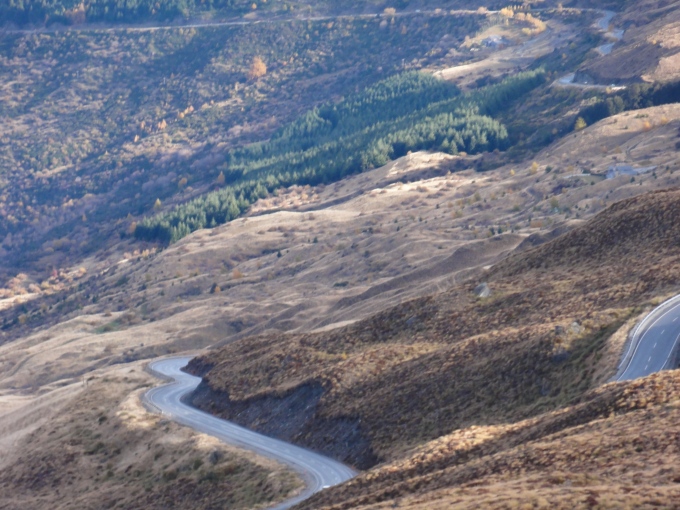
Below is a photo of The Remarkables, one of several ski resorts near Queenstown.
You can see the winding road going up the mountainside. We have made this trip several times and it is particularly frightening in winter when chains are required.
In the other direction, heading towards Kingston, the views of the mountains and the lake are equally as magnificent.
Or manage to capture a photo of the Earnslaw making its way across the lake towards Walter Peak Farm. It seems almost like a miniature toy.
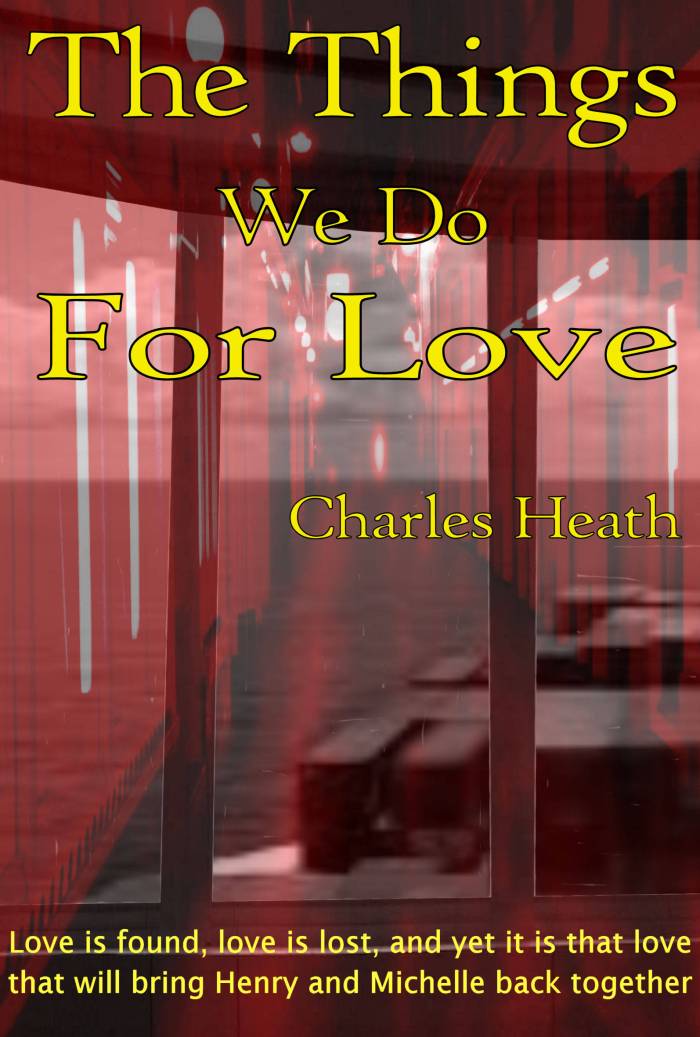
In the distance he could hear the dinner bell ringing and roused himself. Feeling the dampness of the pillow, and fearing the ravages of pent up emotion, he considered not going down but thought it best not to upset Mrs. Mac, especially after he said he would be dining.
In the event, he wished he had reneged, especially when he discovered he was not the only guest staying at the hotel.
Whilst he’d been reminiscing, another guest, a young lady, had arrived. He’d heard her and Mrs. Mac coming up the stairs, and then shown to a room on the same floor, perhaps at the other end of the passage.
Henry caught his first glimpse of her when she appeared at the door to the dining room, waiting for Mrs. Mac to show her to a table.
She was about mid-twenties, slim, long brown hair, and the grace and elegance of a woman associated with countless fashion magazines. She was, he thought, stunningly beautiful with not a hair out of place, and make-up flawlessly applied. Her clothes were black, simple, elegant, and expensive, the sort an heiress or wife of a millionaire might condescend to wear to a lesser occasion than dinner.
Then there was her expression; cold, forbidding, almost frightening in its intensity. And her eyes, piercingly blue and yet laced with pain. Dracula’s daughter was his immediate description of her.
All in all, he considered, the only thing they had in common was, like him, she seemed totally out of place.
Mrs. Mac came out of the kitchen, wiping her hands on her apron. She was, she informed him earlier, chef, waitress, hotelier, barmaid, and cleaner all rolled into one. Coming up to the new arrival she said, “Ah, Miss Andrews, I’m glad you decided to have dinner. Would you like to sit with Mr. Henshaw, or would you like to have a table of your own?”
Henry could feel her icy stare as she sized up his appeal as a dining companion, making the hair on the back on his neck stand up. He purposely didn’t look back. In his estimation, his appeal rating was minus six. Out of a thousand!
“If Mr. Henshaw doesn’t mind….” She looked at him, leaving the query in mid-air.
He didn’t mind and said so. Perhaps he’d underestimated his rating.
“Good.” Mrs. Mac promptly ushered her over. Henry stood, made sure she was seated properly and sat.
“Thank you. You are most kind.” The way she said it suggested snobbish overtones.
“I try to be when I can.” It was supposed to nullify her sarcastic tone but made him sound a little silly, and when she gave him another of her icy glares, he regretted it.
Mrs. Mac quickly intervened, asking, “Would you care for the soup?”
They did, and, after writing the order on her pad, she gave them each a look, imperceptibly shook her head, and returned to the kitchen.
Before Michelle spoke to him again, she had another quick look at him, trying to fathom who and what he might be. There was something about him.
His eyes, they mirrored the same sadness she felt, and, yes, there was something else, that it looked like he had been crying? There was a tinge of redness.
Perhaps, she thought, he was here for the same reason she was.
No. That wasn’t possible.
Then she said, without thinking, “Do you have any particular reason for coming here?” Seconds later she realized she’s spoken it out loud, had hadn’t meant to actually ask, it just came out.
It took him by surprise, obviously not the first question he was expecting her to ask of him.
“No, other than it is as far from civilization, and home, as I could get.”
At least we agree on that, she thought.
It was obvious he was running away from something as well.
Given the isolation of the village and lack of geographic hospitality, it was, from her point of view, ideal. All she had to do was avoid him, and that wouldn’t be difficult.
After getting through this evening first.
“Yes,” she agreed. “It is that.”
A few seconds passed, and she thought she could feel his eyes on her and wasn’t going to look up.
Until he asked, “What’s your reason?”
Slight abrupt in manner, perhaps as a result of her question, and the manner in which she asked it.
She looked up. “Rest. And have some time to myself.”
She hoped he would notice the emphasis she had placed on the word ‘herself’ and take due note. No doubt, she thought, she had completely different ideas of what constituted a holiday than he, not that she had actually said she was here for a holiday.
Mrs. Mac arrived at a fortuitous moment to save them from further conversation.
Over the entree, she wondered if she had made a mistake coming to the hotel. Of course, there had been no possible way she could know than anyone else might have booked the same hotel, but realized it was foolish to think she might end up in it by herself.
Was that what she was expecting?
Not a mistake then, but an unfortunate set of circumstances, which could be overcome by being sensible.
Yet, there he was, and it made her curious, not that he was a man, by himself, in the middle of nowhere, hiding like she was, but for very different reasons.
On discreet observance whilst they ate, she gained the impression his air of light-heartedness was forced and he had no sense of humor.
This feeling was engendered by his looks, unruly dark hair, and permanent frown. And then there was his abysmal taste in clothes on a tall, lanky frame. They were quality but totally unsuited to the wearer.
Rebellion was written all over him.
The only other thought crossing her mind, and rather incongruously, was he could do with a decent feed. In that respect, she knew now from the mountain of food in front of her, he had come to the right place.
“Mr. Henshaw?”
He looked up. “Henshaw is too formal. Henry sounds much better,” he said, with a slight hint of gruffness.
“Then my name is Michelle.”
Mrs. Mac came in to take their order for the only main course, gather up the entree dishes, then return to the kitchen.
“Staying long?” she asked.
“About three weeks. Yourself?”
“About the same.”
The conversation dried up.
Neither looked at the other, rather at the walls, out the window, towards the kitchen, anywhere. It was, she thought, almost unbearably awkward.
Mrs. Mac returned with a large tray with dishes on it, setting it down on the table next to theirs.
“Not as good as the usual cook,” she said, serving up the dinner expertly, “but it comes a good second, even if I do say so myself. Care for some wine?”
Henry looked at Michelle. “What do you think?”
“I’m used to my dining companions making the decision.”
You would, he thought. He couldn’t help but notice the cutting edge of her tone. Then, to Mrs. Mac, he named a particular White Burgundy he liked and she bustled off.
“I hope you like it,” he said, acknowledging her previous comment with a smile that had nothing to do with humor.
“Yes, so do I.”
Both made a start on the main course, a concoction of chicken and vegetables that were delicious, Henry thought, when compared to the bland food he received at home and sometimes aboard my ship.
It was five minutes before Mrs. Mac returned with the bottle and two glasses. After opening it and pouring the drinks, she left them alone again.
Henry resumed the conversation. “How did you arrive? I came by train.”
“By car.”
“Did you drive yourself?”
And he thought, a few seconds later, that was a silly question, otherwise she would not be alone, and certainly not sitting at this table. With him.
“After a fashion.”
He could see that she was formulating a retort in her mind, then changed it, instead, smiling for the first time, and it served to lighten the atmosphere.
And in doing so, it showed him she had another more pleasant side despite the fact she was trying not to look happy.
“My father reckons I’m just another of ‘those’ women drivers,” she added.
“Whatever for?”
“The first and only time he came with me I had an accident. I ran up the back of another car. Of course, it didn’t matter to him the other driver was driving like a startled rabbit.”
“It doesn’t help,” he agreed.
“Do you drive?”
“Mostly people up the wall.” His attempt at humor failed. “Actually,” he added quickly, “I’ve got a very old Morris that manages to get me where I’m going.”
The apple pie and cream for dessert came and went and the rapport between them improved as the wine disappeared and the coffee came. Both had found, after getting to know each other better, their first impressions were not necessarily correct.
“Enjoy the food?” Mrs. Mac asked, suddenly reappearing.
“Beautifully cooked and delicious to eat,” Michelle said, and Henry endorsed her remarks.
“Ah, it does my heart good to hear such genuine compliments,” she said, smiling. She collected the last of the dishes and disappeared yet again.
“What do you do for a living,” Michelle asked in an off-hand manner.
He had a feeling she was not particularly interested and it was just making conversation.
“I’m a purser.”
“A what?”
“A purser. I work on a ship doing the paperwork, that sort of thing.”
“I see.”
“And you?”
“I was a model.”
“Was?”
“Until I had an accident, a rather bad one.”
“Oh, I’m sorry.”
So that explained the odd feeling he had about her.
As the evening had worn on, he began to think there might be something wrong, seriously wrong with her because she didn’t look too well. Even the carefully applied makeup, from close up, didn’t hide the very pale, and tired look, or the sunken, dark ringed eyes.
“I try not to think about it, but it doesn’t necessarily work. I’ve come here for peace and quiet, away from doctors and parents.”
“Then you will not have to worry about me annoying you. I’m one of those fall-asleep-reading-a-book types.”
Perhaps it would be like ships passing in the night and then smiled to himself about the analogy.
Dinner now over, they separated.
Henry went back to the lounge to read a few pages of his book before going to bed, and Michelle went up to her room to retire for the night.
But try as he might, he was unable to read, his mind dwelling on the unusual, yet the compellingly mysterious person he would be sharing the hotel with.
Overlaying that original blurred image of her standing in the doorway was another of her haunting expressions that had, he finally conceded, taken his breath away, and a look that had sent more than one tingle down his spine.
She may not have thought much of him, but she had certainly made an impression on him.
50 photographs, 50 stories, of which there is one of the 50 below.
They all start with –
A picture paints … well, as many words as you like. For instance:
And the story:
It was once said that a desperate man has everything to lose.
The man I was chasing was desperate, but I, on the other hand, was more desperate to catch him.
He’d left a trail of dead people from one end of the island to the other.
The team had put in a lot of effort to locate him, and now his capture was imminent. We were following the car he was in, from a discrete distance, and, at the appropriate time, we would catch up, pull him over, and make the arrest.
There was nowhere for him to go.
The road led to a dead-end, and the only way off the mountain was back down the road were now on. Which was why I was somewhat surprised when we discovered where he was.
Where was he going?
“Damn,” I heard Alan mutter. He was driving, being careful not to get too close, but not far enough away to lose sight of him.
“What?”
“I think he’s made us.”
“How?”
“Dumb bad luck, I’m guessing. Or he expected we’d follow him up the mountain. He’s just sped up.”
“How far away?”
“A half-mile. We should see him higher up when we turn the next corner.”
It took an eternity to get there, and when we did, Alan was right, only he was further on than we thought.”
“Step on it. Let’s catch him up before he gets to the top.”
Easy to say, not so easy to do. The road was treacherous, and in places just gravel, and there were no guard rails to stop a three thousand footfall down the mountainside.
Good thing then I had the foresight to have three agents on the hill for just such a scenario.
Ten minutes later, we were in sight of the car, still moving quickly, but we were going slightly faster. We’d catch up just short of the summit car park.
Or so we thought.
Coming quickly around another corner we almost slammed into the car we’d been chasing.
“What the hell…” Aland muttered.
I was out of the car, and over to see if he was in it, but I knew that it was only a slender possibility. The car was empty, and no indication where he went.
Certainly not up the road. It was relatively straightforward for the next mile, at which we would have reached the summit. Up the mountainside from here, or down.
I looked up. Nothing.
Alan yelled out, “He’s not going down, not that I can see, but if he did, there’s hardly a foothold and that’s a long fall.”
Then where did he go?
Then a man looking very much like our quarry came out from behind a rock embedded just a short distance up the hill.
“Sorry,” he said quite calmly. “Had to go if you know what I mean.”
I’d lost him.
It was as simple as that.
I had been led a merry chase up the hill, and all the time he was getting away in a different direction.
I’d fallen for the oldest trick in the book, letting my desperation blind me to the disguise that anyone else would see through in an instant.
It was a lonely sight, looking down that road, knowing that I had to go all that way down again, only this time, without having to throw caution to the wind.
Sometimes they’re your fault, sometimes they’re not.
The accident I was in was not. Late at night driving home from work, a car came speeding out of a side street and T-boned my car.
It could have been worse, though the person who said it had a quite different definition of the word worse than I did.
To start with, I lost three months of my life in a coma, and even when I surfaced, it took another month to realize what had happened. Then came two months of working out my recovery plan.
If that wasn’t trial enough, what someone else might describe as the ‘last straw that broke the camel’s back’, my wife of 22 years decided to send me a text that morning, what was six months in hospital, to the day.
“I’m sorry, Joe, but enough is enough. I cannot visit you anymore, and for the sake of both our sanity, I think it’s time to draw a line in the sand. I know what happened isn’t your fault but given the prognosis, I don’t think I can cope with the situation. I need time to think about what will happen next and to do so, I’ll be going home to spend some time with family. Once again, I’m so sorry not to be doing this in person. I’ll let you know what I decide in due course. In the meantime, you have my best wishes for your recovery.”
In other words, goodbye. Her family lived in England, about 12,000 miles away in another hemisphere, and the likelihood of her returning was remote. We had meant to visit them, and had, in fact, booked the tickets shortly before the accident. I guess she couldn’t wait any longer.
My usual nurse came in for the first visit on this shift. She had become the familiar face on my journey, the one who made it worth waking up every morning.
“You look a little down in the dumps this morning. What’s up?”
She knew it couldn’t be for medical reasons because the doctor just yesterday had remarked how remarkable my recovery had been in the last week or so. Even I had been surprised given all the previous negative reports.
“Ever broken up by text?”
“What do you mean?”
“Frances has decided she no longer wants to be involved. I can’t say I blame her, she has put her whole life on hold because of this.”
“That’s surprising. She’s never shown any disappointment.”
“Six months have been a long time for everyone. We were supposed to be going home so she could see her family. Maybe that’s what it’s all about.”
I gave her the phone and she read the message.
Then she handed it back. “That’s goodbye, Tom. I’m sorry. And no, I’ve never had a breakup by text, but I guess there could always be a first time.”
She spent the next ten minutes going through the morning ritual, then said, “I’ve heard there’s a new doctor coming to visit you. Whatever has happened in the last few days had tongues wagging, and you might just become the next modern miracle. Fame and fortune await.”
“Just being able to walk again will be miracle enough.”
That had been the worst of it. The prognosis that it was likely I’d never be able to walk again, or work, and the changes to our lives that would cause. I knew Frances was bitterly disappointed that she might become the spouse who had to spend the rest of her life looking after, and though she had said it didn’t matter, that she would be there for me, deep down I knew a commitment like that took more internal fortitude than she had.
She ran her own business, managed three children into adulthood, and had a life other than what we had together. When I was fit and able, and nothing got in the way, it had worked. Stopping everything to cater to my problems had severely curtailed her life. Something had to give, and it had.
But, as I said, I didn’t blame her. She had tried, putting in a brave face day after day but once the daily visits slipped to every other day, to once a week, I knew then the ship was heading towards the rocks.
This morning it foundered.
I pondered the situation for an hour before I sent a reply. “I believe you have made the right decision. It’s time to call it and going home and take some time to consider what to do next is right. In normal circumstances, we would not be considering any of this, but these are not normal circumstances. But, just in case you are worried about the effect of all of this on me, don’t. I will get over it, whatever the result is, and what you need to do first and foremost is to concentrate on what is best for you. If that means drawing a line on this relationship, so be it. All I want for you is for you to be happy, and clearly, having to contend with this, and everything else on your plate, is not helping. I am glad we had what time we had together and will cherish the memories forever, and I will always love you, no matter what you decide.”
It was heart-felt, and I meant it. But life was not going to be the same without her.
…
I’d dozed off after sending the message, and only woke again when my usual doctor came into the room on his morning rounds, the usual entourage of doctors and interns in tow. I’d been a great case for sparking endless debate on the best route for my recovery among those fresh out of medical school. Some ideas were radical, others pie in the sky, but one that seemed implausible had got a hearing, and then the go-ahead, mainly because there was little else that apparently could be done.
That doctor, and now another I hadn’t seen before was standing in the front row, rather than at the back.
The doctor in charge went through the basics of the case, as he did every day, mainly because the entourage changed daily. Then, he deferred to the radical doctor as I decided to call her.
She went through the details of a discovery she had made, and the recommendation she’d made as a possible road to recovery, one which involved several radical operations which had been undertaken by the elderly man standing beside her. When I first met him, I thought he was an escaped patient from the psychiatric ward, not the pre-eminent back surgeon reputed to be the miracle worker himself.
It seemed, based on the latest x-rays that a miracle had occurred, but whether it was or not would be known for another week. Then, if all went well, I would be able to get out of bed, and, at the very least, be able to stand on my own. In the meantime, I had endless sessions of physio in the lead-up to the big event. Six months in bed had taken its toll on everything, and the week’s work was going to correct some of that.
It meant there was hope, and despite what I said and thought, hope was what I needed.
There had been ups and downs before this, fuelled by a morning when I woke up and found I could wriggle my toes. It was after the second operation, and I thought, given the amount of pain killers, it had been my imagination.
When I mentioned it, there was some initial excitement, and, yes, it was true, I wasn’t going out of my mind, it was real. The downside was, I couldn’t move anything else, and other than an encouraging sign, as the days passed, and nothing more happened, the faces got longer.
Then, the physiotherapist moved in, and started working on the areas that should be coming back to life. I felt little, maybe the pain killers again, until the next, and perhaps the last operation. I managed to lift my left leg a fraction of an inch.
But we’d been here before, and I wasn’t going to hold my breath.
…
Annabel, the daughter that lived on the other side of the country, finally arrived to visit me. I had thought, not being so far away she might have come earlier, but a few phone calls had sorted out her absence. Firstly, there was no much use visiting a coma patient, second, she was in a delicate stage of her professional career and a break might be the end of it, and thirdly, she accepted that I didn’t want to see her until I was much better.
She was not very happy about it, but it was a costly venture for her, in terms of time, being away from a young family, and just getting there.
Now, the time had come. She had a conference to attend, and I was happy to play second fiddle.
After the hugs and a few tears, she settled in the uncomfortable bedside chair.
“You don’t look very different than the last time I saw you,” she said.
“Hospitals have perfected the art of hiding the worst of it, but it’s true. The swelling had receded, the physios have revived the muscles, and I have a little movement again.”
“The injuries are not permanent?”
“Oh, they’re permanent, but not as bad as first thought.”
“Pity my mother isn’t here.”
“She was, day after day, through the darkest period. I wouldn’t wish that on anyone. But your mother is an independent woman, and she has always been free to do what she wants, and I would not have had it any other way.”
“But deserting you in the middle of all this…”
“It’s been very debilitating on her. I can understand her reasons, and so should you. She will still be your mother no matter what happens to us.”
There had been a number of phone calls, from each of the children, decrying her actions after she had sent a text message to each of them telling them what she was doing. She had not told them she was leaving, in so many word, but leaving the door ajar, perhaps to allay their fears she was deserting them too. Annabel had been furious. The other two, not so much.
“And this latest development?”
I had also told her about the miracle worker, and the possibilities, without trying to get hopes up.
“On a scale of one to ten, it’s a three. We’ve been here before, so I’m going to save the excitement for when it happens, if it happens.”
“And if it doesn’t?”
It was a question I’d asked myself a number of times, one that I didn’t want an answer to. Hope was staving it off, each day a new day of discovery, and a day closer to the idea I might walk again. I had to believe it would happen, if not the next day, the next week, month, year, that it would eventually happen.
For now, all I had to do was stand on my own two feet.
It was ironic, in a way, that simple statement. ‘Stand on your own two feet’. Right then, it seemed so near, and yet, at the same time, so far away.
I didn’t answer that question, but did what I usually did with visitors, run a distraction and talk about everything else. This visit was no exception. I had a lot of catching up to do.
It’s odd how some call the day of momentous events D-Day because to me nothing would be more momentous than the invasion of France during the second world war.
Others were not quite of the same opinion. It was going to be a momentous day.
It started the same as any other.
The morning routine when the duty nurse came to do the checks. Then the physio, now a permanent fixture mid-morning, just after the tea lady arrived. Deliberate, I thought, to deprive me of my tea break, and some unbelievably delicious coconut cookies.
Then the routine changed, and the escort arrived to take me down to the room where the physio had set up an obstacle course. It looked like one, and I’d told him so when I first saw it, and he had said by the time he was finished with me, I’d be able to go from start to finish without breaking a sweat.
In my mind perhaps, but not with this broken body. I didn’t say that because I was meant to be positive.
An entourage arrived for the main event. I would have been happier to fail in front of the doctor, the miracle worker, and the physio, but it seemed everyone wanted a front row seat. If it worked, the physio confided in me, there was fame and fortune being mentioned in Lancet, what was a prestigious medical journal.
Expectations were running high.
The physio had gone through the program at least a hundred times, and the previous day we had got to the point where I was sitting on the side of the bed. We’d tried this ordinary manoeuvre several times, previously without success under my own steam but this morning, for some reason it was different.
I was able to sit up, and then, with a struggle move my legs part of the way, and with a little help for the rest.
What was encouraging, was being able to swing my legs a short distance. IT was those simple things that everyone could do without thinking, that had seemed impossible not a month before, that got people excited. I didn’t know how I felt other than I missed those simple things.
Then the moment had arrived. Hushed silence.
There was a structure in place. All I had to do was pulled myself across, at the same time sliding off the bed and into a standing position. There was a safety harness attached so that if my grip slipped it would prevent me from falling.
It was probably not the time to tell them the pain in my lower back was getting worse.
So, like I’d been instructed, and going one step further than the day before, I reached out, grabbed the bars and pulled myself up and over, at the same time, sliding off the side of the bed. I could feel the tug of the safety harness which told me I had left the safety of the bed, and was in mid motion.
I could feel my legs straightening, and then very softly landing on the floor, the safety harness letting my body drop down slowly.
The pain increased exponentially as the weight came down onto my legs, but my body had stopped moving. I could not feel the tightness of the harness, but a rather odd sensation in my legs.
All that time I had been concentrating so hard that I had heard nothing, not even the encouraging words from the physio.
Until I realised, from the noise around me, that it had worked. I was standing on my own two feet, albeit a little shakily.
And I heard the physio say, in his inimitable way, “Today you just landed on the moon. Tomorrow, it’s going to be one small step for mankind. Well done.”
John Pennington’s life is in the doldrums. Looking for new opportunities, prevaricating about getting married, the only joy on the horizon was an upcoming visit to his grandmother in Sorrento, Italy.
Suddenly he is left at the check-in counter with a message on his phone telling him the marriage is off, and the relationship is over.
If only he hadn’t promised a friend he would do a favor for him in Rome.
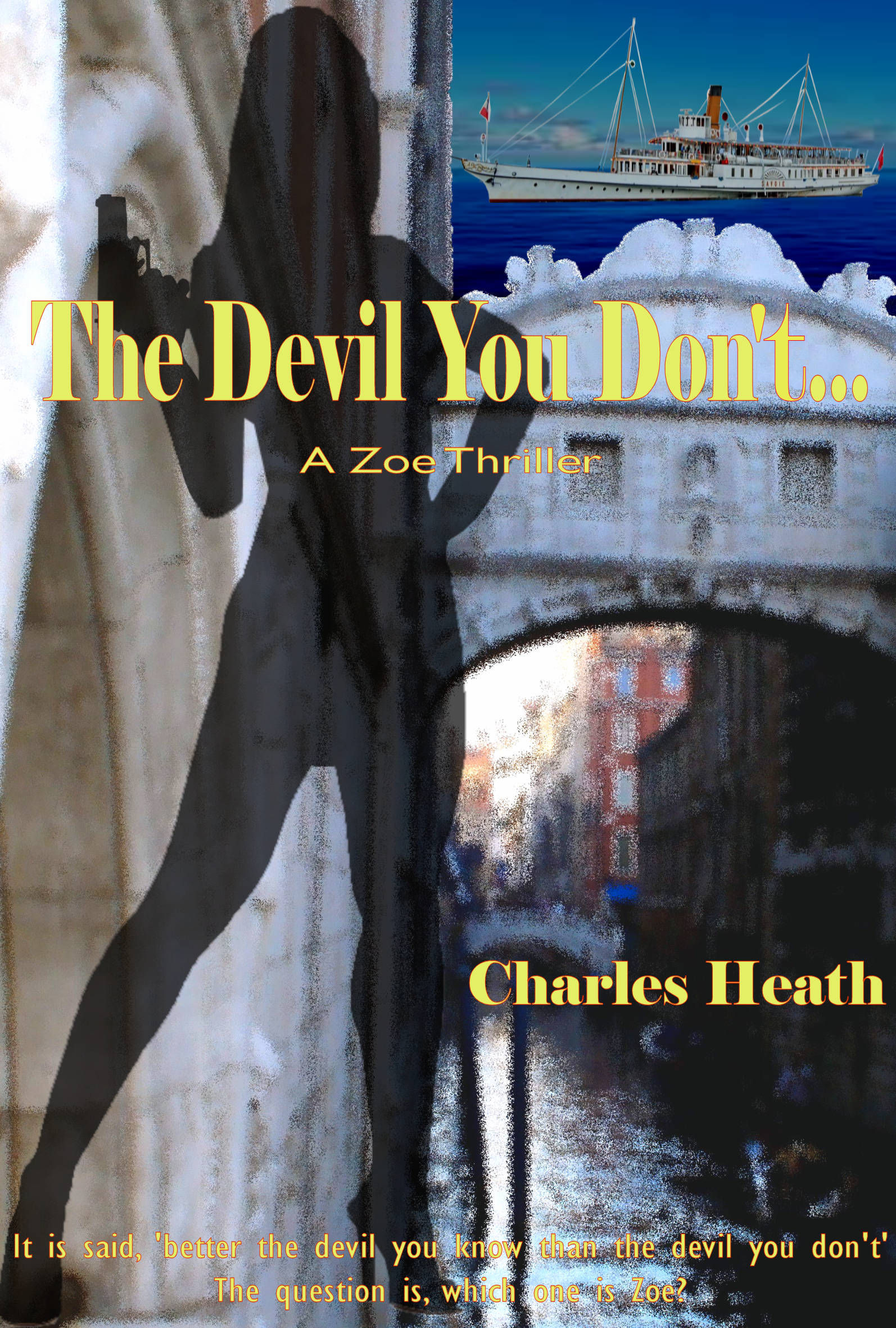
At the first stop, Geneva, he has a chance encounter with Zoe, an intriguing woman who captures his imagination from the moment she boards the Savoire, and his life ventures into uncharted territory in more ways than one.
That ‘favor’ for his friend suddenly becomes a life-changing event, and when Zoe, the woman who he knows is too good to be true, reappears, danger and death follow.
Shot at, lied to, seduced, and drawn into a world where nothing is what it seems, John is dragged into an adrenaline-charged undertaking, where he may have been wiser to stay with the ‘devil you know’ rather than opt for the ‘devil you don’t’.
The story proceeds. That underlying suspicion of Maryanne’s motives rears it’s head again, but for different reasons.
Of course, Jack, the main character has a name, if not a little trite but it suits him, has always been suspicious because he’s not the type to be approached by beautiful women, and yet, so far has managed to allay those fears but being the perfect companion.
But, what’s a self confessed gate crasher got up her sleeve.
Out of the hospital and on their road trip, they’re heading for an island and a hotel that overlooks the Mediterranean, what might be synonymous with the perfect location for romance.
But all of that is shattered when he sees her with another man, at the rear of the ferry, and the animation in her manner tells him the man is not just someone who ran into her.
Jack knows who it is, and what he does, so that makes the meeting even more mysterious.
And perhaps dangerous.
Yes, we are exploring the theme of ‘everyone has secrets’.
Today’s effort amounts to 2,444 words, for a total, so far, of 20,594.
“Sunday in New York” is ultimately a story about trust, and what happens when a marriage is stretched to its limits.
When Harry Steele attends a lunch with his manager, Barclay, to discuss a promotion that any junior executive would accept in a heartbeat, it is the fact his wife, Alison, who previously professed her reservations about Barclay, also agreed to attend, that casts a small element of doubt in his mind.
From that moment, his life, in the company, in deciding what to do, his marriage, his very life, spirals out of control.
There is no one big factor that can prove Harry’s worst fears, that his marriage is over, just a number of small, interconnecting events, when piled on top of each other, points to a cataclysmic end to everything he had believed in.
Trust is lost firstly in his best friend and mentor, Andy, who only hints of impending disaster, Sasha, a woman whom he saved, and who appears to have motives of her own, and then in his wife, Alison, as he discovered piece by piece damning evidence she is about to leave him for another man.
Can we trust what we see with our eyes or trust what we hear?
Haven’t we all jumped to conclusions at least once in our lives?
Can Alison, a woman whose self-belief and confidence is about to be put to the ultimate test, find a way of proving their relationship is as strong as it has ever been?
Yes, I’m drawing a blank, which means I have no idea
It seems that I do this a lot these days, perhaps one of the perils of being a writer
But…
Using blank in a story doesn’t necessarily convey the antagonist is clueless, more likely he or she just used one in a gun, put there by a person who didn’t want to get shot.
No, still drawing a blank on this one.
A blank space means there’s nothing in it, and you see a lot of these in crosswords and sudoku, even when the user has been toiling for hours
I’m thinking anyone who met me might misinterpret my blank expression, well, it’s not too expressive in the first place
Perhaps before the coin becomes a coin; it is a piece of blank metal to begin with. How good would it be to get a one-sided coin, that’d be worth a lot?
And the very worst description of blank; having a blank piece of paper in front of you, and you really are drawing a blank!