A photograph from the inspirational bin – 8

A picture can paint a thousand words, or more, or less, but…

…

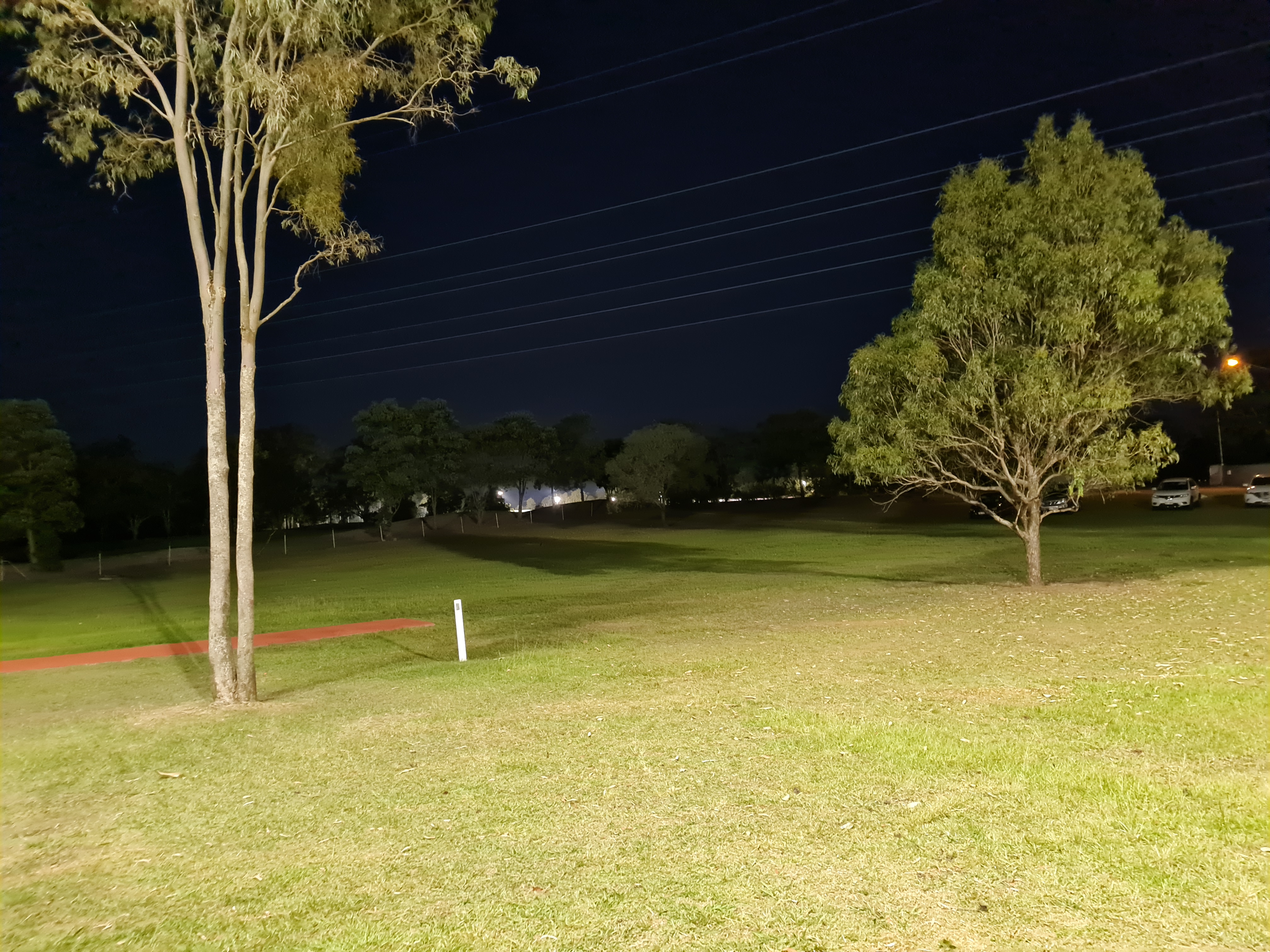
The interesting thing about a place in the dark, in the distance, and behind a chain wire fence usually means something. Especially when there are mysterious lights involved.

We were at a night sports event, watching over a thousand screaming and yelling kids from five to eighteen pretending to compete in a variety of athletic events.

I was there to nominally to support my granddaughter in her endeavours, but right at that moment, on the far side of the track, what I was really there to see was what was behind the wire fence

“Are you watching, Poppy?”

Well, at that moment I wasn’t, but I did turn just in time to see her clear a meter high high jump and execute an elegent backflip, a result no doubt of the ballet training she had since the age of four. Seven years later those lessons had transformed into a high jumper with a great future.

Except, she couldn’t really care less. It was more about the parents and athletic organisers expectations, than hers. I was there, she told me in a secretive tone, to tell everyone to back off.

if you think spying was a dangerous occupation, then let me tell you trying to navigate a safe path between child and parents, and then the rest of the word, forget it.

So, with my trusty phone camera, slightly modified, I was pretending to take pictures of surrounding trees in the high density lighting for the athletics oval, whilst zooming in on the real target.

And, about to take the money shot, I could feel a tugging on the side of my jacket.

I looked down to see the petulant face of a child not happy.

“You said you were coming to see me perform.”

I had. I looked over at the woman the boss had assigned as my ‘date’, Nancy, and whom I’d introduced as a long time friend who deigned to suffer my invitation so she could meet the girl I was always talking about.

“Yes, Poppy,” she said with an evil undertone. “You said you wanted to see her high jumps. You’d better get over there, while I take some pictures of the trees for you.”

“Why do you want pictures of dumb old trees?” That was a question I would have asked myself, and I didn’t quite have an answer for it.

Nancy did. “Because he’s odd like that. It’s one of the quirks I like about him.” She took the camera out of my hand and shooed us off.

And, heading back to the high jump, she asked, “What’s a quirk?”

“Just ask your father later. He knows all about quirks.”

…

© Charles Heath 2021

The cinema of my dreams – I never wanted to go to Africa – Episode 19

Our hero knows he’s in serious trouble.

The problem is, there are familiar faces and a question of who is a friend and who is foe made all the more difficult because of the enemy, if it was the enemy, simply because it didn’t look or sound or act like the enemy.

Now, it appears, his problems stem from another operation he participated in.

…

It didn’t take much effort to come to the only viable explanation of why a buried operation had been brought back to life.

Colonel Bamfield.

And it didn’t take much more effort to realise that operation had been one of his, not that any of us knew that at the time, but for whatever reason, it had gone badly and now he was looking for answers.

Answers to what though?

It was a simple extraction; two operatives had their cover blown and were in hiding.  A seven-man team in two choppers, get in, collect them, and get out.  Seven men were overkill, but they were important operatives with vital intelligence.

I was a last minute addition to the team, replacing one of the sergeants who had been injured in an accident.  It was a tight-knit team and I was not made to feel welcome.  It was the usual fate of outsiders and it didn’t bother me.

It was their leader that did.  Lieutenant Treen.  But that came later, all it was, at first, was a sense of unease with his informal manner of command, and somewhat edgy disposition.

When I landed at the airfield, I was met by the other Sergeant, Mason, and taken to the briefing, which had been delayed until my arrival.  Treen was there, pacing up and down like a caged tiger.  It was apparent there were still some details still being worked on.  Being so close to wheels up, I was not surprised at the tension among the group.

A Captain, a man named Worsefell, conducted the briefing, and it was patchy.  Not the worst I’d been to, but it appeared the situation on the ground had changed considerably in the last 12 hours, necessitating a change in plans.

 The operative had managed to get cover in an old abandoned building.  That was fine until a group of enemy soldiers arrived and set up camp in the field not 100 yards from their position.  Now, it was not possible to leave without being seen, day or night.

We now had to either distract or remove the enemy soldiers, an enemy we had no numbers or how heavily armed they were because our source on the ground had gone quiet.  To me, it was possible the source had been captured, and if that was the case, it was also possible the enemy knew we were coming.  But according to the Captain, this particular source had gone quiet before, in similar circumstances, so my suggestion was ignored.

Instead, the consensus was to go in and make an assessment on the ground.  It meant we had to land further away, and have a long journey by foot with all the problems that might involve, and then return.  That was the plan.  The Captain had left it in Treen’s hands.

And Treen was not one to back away from a fight, not even when it was clear to everyone in that room, with or without the necessary intelligence, that the odds were stacked against success.

I looked at Lallo who was waiting for an answer.  “I guess the brass didn’t know what to do with me, sir.”

My use of the word sir was noted.

“Be that as it may, I have a few questions about that operation.”

“I’m afraid it’s classified, and I’m under oath not to speak about it.”

Lallo took out a piece of folded paper from the inside pocket of his uniform jacket unfolded it and passed it to me.

From the very General who had ordered my silence.

…

© Charles Heath 2019-2022

Writing about writing a book – Day 19

I’m still working on the sequence of flashbacks for the story, filling out the back story to how Bill became associated with a man called Colonel Davenport.

It is important to remember that while Davenport may have begun with good intentions, it was not difficult to go slowly mad given the conditions.  This character, Davenport, runs a multitude of operations within the war zone, turning a huge profit and setting up a business for when the war ended.

Bill meets his Davenport’s cronies and then the man himself.  Life is not what it seems, and working for him is not a guarantee of safety, so Bill not only has to watch out for the enemy but also those with whom he also works.


Part 3 – In the Service of Davenport

Davenport and punishment

Busted mission, the first threat to Davenport

Manilow’s death – and how he got there

More on Manilow, the night before his death

Taken to rendezvous with Davenport’s boss

Identify Davenport by ‘sniveling morons’

Sniper – killing Ellen’s father – set up

Sniper – Killing Ellen’s father, execution

Planes and death


Bill gets to meet an interesting cast of characters, not the least of which is Davenport’s right-hand men, and a very unlucky lad who was supposed to see through his tour in the command station far from the war zone, and who is connected to a person close to him.

He was also unwittingly involved in a murder, one set up by Davenport, and one designed to keep his silence.


Part 4 – The Lead up to Capture, and in a POW camp

The object that Davenport is seeking

After R & R revoked, retrieved by Davenport for the last mission

Capture by Cho’s forces, delivered by Davenport’s men

In the POW Camp, and the arrival of Cho

Day of Rescue from Cho

Ellen and Jacobson after rescue in the hospital


Bill’s safety may have been assured had he simply toed the line, but, while on a secret mission with Davenport’s men, he sees an opportunity to take some evidence of Davenport’s activities, as an act of self-preservation.

Of course, he doesn’t reckon with the ruthlessness of Davenport and ends up in a camp where Bill is handed over to the chief interrogator, a friend of Davenport’s.  There is no doubt what Cho’s mission is.

But, like all seemingly simple plans, it doesn’t go the way Davenport wants, Bill does not talk, and is eventually rescued.


Part 5 – Post Rescue and Transworld

Employment at Transworld, then first interrogation via Collins

In hospital immediately after being shot

Davenport in my hospital room, post being shot

Recognize Jorgenson


Davenport discovers Bill was rescued, and that is has lost his memory of all the time in his service, so just in case Bill does, one day, remember, he will be there to get the answers, and the missing information.

It is almost a story within a story, and maybe one day will be published as such.

At least now I have some idea of how to work the much larger story into the flashbacks, as a prelude to what happens to Bill once he realizes who is behind everything that is happening at Transworld.


© Charles Heath 2015-2020

“The Price of Fame”, A Short Story

I looked at the invitation, a feeling of dread coming over me.  It was not entirely unexpected but like a great many things that had suddenly come into my life, it caused equal measures of fear and excitement.

The gold edging and the perfect script displaying my name in the exact centre of the envelope made it almost unique.  Very few people ever received such an invitation.

I held it in my hand for a longer than necessary, then put it down on the desk carefully, as if it would explode if I dropped it.

My first instinct, driven by fear, was not to accept.

But, fear or not, there was no question of me not attending.  Circumstances had painted me into a corner; I’d agreed to go a long time ago when I thought there was no chance it would come to pass.

Way back then, I had been compared to the aspiring painter in an attic having to die before I made any sort of impression.  In those days people thought it amusing.  I thought it was amusing.  Kirsty, in particular, had thought it was as impossible as I had.

Now it was not amusing.  Not even remotely.

My life was once quiet, peaceful, sedate, even boring.  That didn’t mean I lacked imagination, it was just not out on display for everyone to see.  Inspired by reading endless books, I had the capacity to transport myself into another world, divorced from reality, where my boring existence became whatever I wanted it to be.

It was also instrumental in bringing Kirsty into my life.  In reality, I thought she’d never take a second look at me, let alone a first.  So I pretended to be someone else.  Original, witty, charming, underneath more scared than I’d ever known.

And yet she knew, she’d always known and didn’t care.

As we spent more time together, she discovered I liked to write, not finish anything, just start, write a hundred pages, then lose interest.  Like everything I did.  Start, and never finish.

Why not?  It would never be published.  It would never succeed.

So she bribed me.  If I didn’t finish my first book and send it away, I couldn’t marry her.  It didn’t matter if it was rejected, all I had to do was finish a book, and send it.

The thought of marrying her had not entered my mind, because I hadn’t thought she would.  Incentive enough, I picked out one of the unfinished manuscripts and humoured her.  She read bits of it, not saying a word.  Sometimes she’d put a note or two on the manuscript, her equivalent to sweet nothings, and with it I gained inner confidence in my own ability, not only to write but in many other aspects of my life.

When it was finished, it was Kirsty who sent it off.  She read it, packaged it, addressed it, and sent it before I had a chance to change her mind.  Once gone, I heaved a huge sigh of relief.  It was done. That was, as far as I was concerned, the end of it.

It was not possible that one letter could change a person’s life so dramatically.  I came home to the all-knowing smile, and mischievous whimsicality that had always suggested trouble.

Trouble indeed!

My book was accepted.  With a cheque called an advance.  For more money than I knew what to do with.

This was followed not long after by publication.  And a dramatic change to my life, one I didn’t want.  To become a public person, to face an enormous number of people, people I didn’t know.

I went back to being scared.

Kirsty smiled at me and told me how wonderful I looked in my monkey suit.  Why couldn’t I go in jeans and a dress shirt?  All the best actors in Hollywood did it.

“This is not Hollywood.  You’re not an actor.”  It was a simple, practical, answer.

The hell I wasn’t.  I could act sick, dying, fake a heart attack, anything.  “What am I going to say?”

“You could talk about books.”  Quiet, efficient, oozing the confidence I didn’t feel.

She didn’t fuss.  She took it in her stride.  She dressed in her usual simple elegance, in a manner that made me love to be seen with her.  I couldn’t tie my tie, so she did it for me.  She straightened my jacket because I couldn’t do that either.  Nerves.  Can’t live with them, can’t live without them.  Or was that a reference to wives, or mistresses, or something else?

The palms of my hands were sweating.  Meatball hands, I thought, the sort of palms that betrayed the pretenders.  Me, I was the pretender.  My neck felt too large for the shirt.  Beads of sweat formed on my brow.  Where was a sponge when you needed one?

“I can’t do this.”

“You can.”

We hadn’t even left the hotel yet.

“How long before the execution.”

She looked at me with her whimsical smile.  “Long enough for me to give you a hard time.”

I lost count of the number of times I had to go to the bathroom, for one thing, or another.  Nerves I said.  Perhaps a dozen Valium or something similar.  Did I have any?  Had she hidden them?  Why did she keep smiling?

In the car, I looked at my watch at least a dozen times.  I couldn’t breathe.  It was too hot, too cold.  She held my hand, and it served best to stop the trembling that had set in.  Why did I agree to this?  Why?

We were greeted by the Events Manager, who was polite and genuinely interested.  He took us inside where he introduced the interviewer, another woman who oozed confidence and charm, who went over the format and generally tried to set me at ease.

I didn’t let Kirsty’s hand go.  Not yet.  She was my lifeline, the umbilical cord.  When it was severed, I knew I was going to die.

Bathroom?  Where was the bathroom?  Hell, five minutes to go, and I felt like passing out.  No, Kirsty couldn’t come in.  Comb my hair.  Straighten my tie, no it was straight.  Maybe I could hide in here?  I looked around.  No, maybe not.

Time.

The cue man was standing beside me, hand gently on my back.  He knew the score.  He knew I would turn and run the first chance I got.  Kirsty was on the other side, smiling.  Did she know too?

Then the announcement, my cue to walk on.

The gentle shove, the bright lights, the deafening applause, the seemingly endless walk to the chair, dear God, would I make it without tripping over?

How many times had I made this trip?  I stood, facing the audience, waved, then sat.  It was the fifteenth.  You’d think I’d learned by now.

There was nothing to it.

© Charles Heath 2016-2022
Memories of the conversations with my cat – 88

As some may be aware, but many not, Chester, my faithful writing assistant, mice catcher, and general pain in the neck, passed away some months ago.

Recently I was running a series based on his adventures, under the title of Past Conversations with my cat.

For those who have not had the chance to read about all of his exploits I will run the series again from Episode 1

These are the memories of our time together…

20160909_062838-2

This is Chester.  He had reminded me that it is Dr. Seuss’s birthday

Or perhaps that of the Cat in the Hat.

Chester told me once he auditioned for the role of Cat in the Hat, but he couldn’t get the hat to sit right.

A stitch-up, really, he added.  There was this fat cat, and he told everyone the role was his.

Period.

So, I had to ask, did he get the role?

No.  You’ve seen the Cat in the Hat, haven’t you?  Nothing like him.

So, other than trying to intimidate the competition, what was so scary about him?

Oh, I wasn’t scared or anything like that.  I just didn’t want to make a scene in front of the ladies.

I take a minute, trying to equate the cat in front of me, and that of the Cat in the Hat.

No resemblance at all.

And as for the scaredy-cat part, I decide not to remind him of his all-conquering fear of the grandchildren.

I’ll just wait until the next time they visit…

In less than two hours.

A photograph from the inspirational bin – 9

…

I remeber once being told that if you shoot for the moon, you’ll land in the clouds, if you shoot for the tree tops, you’ll finish up back where you started from.

It was a silly analogy, but I always remembered it when I looked up at the sky and saw clouds.

That was back in those hazy carefree days just after you were finished with school and you had your whole life in front of you. Your parents were there as the safety net, and were still proud of your scholastic achievements, and were not in too much of a hurry to hustle you out of the house.

But what happened when there’s a recession that came upon everyone without any warning.

Stocks plummeted, people lost their life’s savings, those with mortgages and loans suddenly finding that along with unemployment came no income, no ability to pay the bills, and therefore lost everything.

Although I never said it, I was thinking what good was an education when the whole world had gone to hell in a handbasket.

Two things I remember from back then, which in the context of disaster, wasn’t all that long ago. Firstly, my father making us children go camping from before we could walk, and with it, to survive with nothing but the clothes on our backs, and our wits.

It had happened to him, as a member of am expedition in Africa in his younger days, thinking that he might become the next great explorer, or archeologist, and finishing up getting lost, even though he asserted the other members had deliberately left him behind.

And secondly, that it was essential that we forge working relationships with any and all those who were like minded, such as those who wanted to be saved, not those who expected everyone else to so the work. It was obvious he had met a lot of those type of people too.

It served us well.

When nations began turning on each other, when essential resources like electricity and fuel stopped being distributed and rationed, when food suddenly became scarce, that’s when the real trouble started. My father said, at the outset, what would happen, and was glad our mother was not there to see it.

Then, when neighbours attacked neighbours once food became scarce, it was time to leave. The pity of it was, he died defending us, even after offering up some of the food we had stored away, but that had not appeased a hungry or angry mob.

His last words, “Go to where we said we would go, and remember everything I’ve taught you” were etched in my brain, and my brother and I did as he asked.

But, even knowing where we had to go, and how to get there, a plan of action made many years before, and trialled in recent years with success, nothing in the past could have prepared us for the journey.

It was, literally, time to shoot for the moon.

—

© Charles Heath 2021

In a word: Story

All of us writers know what this is, the sort of combination of words that all come together as a story.  A tale about anything whether it is true or just plain fiction.

A story can be long, or it can be short.  It could be a magazine or newspaper article, it could be what a child tells his or her mother or father when they get into trouble.

Come to think of it, I think that’s where I got an interest in writing stories because as a child I was always in trouble.

Of course, if you are telling certain types of stories,, then it’s bound to be a lie.  And made even worse if it is gossip!

That story might even be my interpretation of events, and as it happens, it’s possible no two stories are the same, especially if I and others had witnessed the same event.

This is not to be confused with the other version, storey, which is a single level in a building, one that might have thirty or more stories.

And, just to add to the confusion, living in Brisbane in Australia we have the Storey Bridge.

Wishful thinking will not get us there any faster!

My phone, being smart and all, has been creating a notification that tells me I have some memories stored on it for this day a year ago, or two years, or many years.

The pictures it is showing are of our trip to China a few years ago.

Not much chance of going back, and, back then, neither of us could imagine that everything that has happened in the last two years could happen.

But, it did.

And one of the effects of those events is no more overseas travel whilst COVIS is still alive and kicking.

No travel of any sort can be contrmplated at the moment with the Omicron variant is running almost rampant.  We can’t even fly to another state because such close proximity to someone with it, fully vaccinated or not, would be dangerous for my state of health which is compromised.

Travel, of course, is the main escape, where we can get away from our daily lives, and go somewhere quite different from where we live and experience a different world.  The people, the food, the sights.

What is probably more significant is that we might not be able to go away again, now it’s been assumed there is no cure for the virus, just the varying degrees of seriousness.  I for one, would not want to risk catching it in another country, simply because of the medical expenses, and the chances are that travel insurance will not cover me for the Coronavirus because of my compromised immune system.  We all know insurance companies love to find loopholes to not pay.

And no cover means no travel, even if you are able to.

So, it means that any travel we will be doing, when we can, will be in our own country when it is safe to do so.  So too for New Zealand, and we may be able to travel there.

One day.

Until then, my smartphone is going to keep sending me gentle reminders of what it was like in another lifetime.

A photograph from the inspirational bin – 7

There is always something strange about certain photographs that is not evident when you take them.

For instance, the photograph above.

While this might look like some vegetation by the side of a river or stream, its that are of blackness behind what looks like steps up from the water level that adds a level of intrigue or mystery.

For instance:

…

We had spent two weeks slowly going upriver looking for a needle in a haystack. It was an apt description, because there had been quite a large number of likely spots, all of which after investigation, came to nothing.

I mean, the description Professor Bates had given is was as hazy as day is long in these parts.

His recollection: that it was what looked like a cave behind lush undergrowth, with steps fashioned out of stone.

It was all the more confuse. Because when we found him, he was drifting on a rough hewn and constructed raft, half dead from dehydration. We were told he’d been on the raft for nearly a week.

That meant the cave could be anywhere between where we found him at the 10 mile mark, and 200 miles further on based on river flow.

We were currently at the 150 mile mark and the river was losing depth and width, and soon there would not be enough water to continue in the boat.

It was dusk and too dark to continue. We’d been enthusiastic those first days, continuing on in the dark, on shifts, using the arc lamps.

Then after a week, having lights on made us target practise, and after sever brushes with death, and the loss of all the bulbs being shot out, we got the message.

There was the odd marauder during the day, but we had the width of the river for safety.  Now that had gone too, and we had lookouts posted, but seeing into the dense jungle was difficult.

But we got through another night with no activity, and come morning, what looked like the entrance to a cave was not fifteen feet from us.

All we had to was row over and check.

…

© Charles Heath 2020-2021

In a word: Park

We mostly understand that a park is an area set aside for recreation, and can have trees, flowers, a lake, and vast lawns.  These parks are also sometimes called ‘gardens’.

A great example of a park is Central Park in New York.

Nearly every city has a park or some sort, some have more than one.

But the word park has a number of other uses.  For instance,

You can park a car, or bike, or yourself; in other words, it’s a place where you stop for a while.  For cars, it is a carpark.

You could say ‘it’s just a walk in the park’, which means that the job is going to be easy.  I never understood that analogy because quite a lot of parks have walks that are difficult, and not so much ‘a walk in the park’.

It is also used to describe a place where animals are kept, other than calling it a zoo, it can go by the name of a wildlife park.  Zoos though are more for cities.  Wildlife parks can be quite huge and many are found in Africa.

A park can also be used to describe a sporting arena or field.

You can park a bag in a locker.

You can park an idea in the back of your mind and come back to it later, or if you are like me, it disappears into the ether.

It can be an area of land around a manor house, but there are very few of those left now.  The most notable of these are in England, and were designed by a man called Capability Brown.