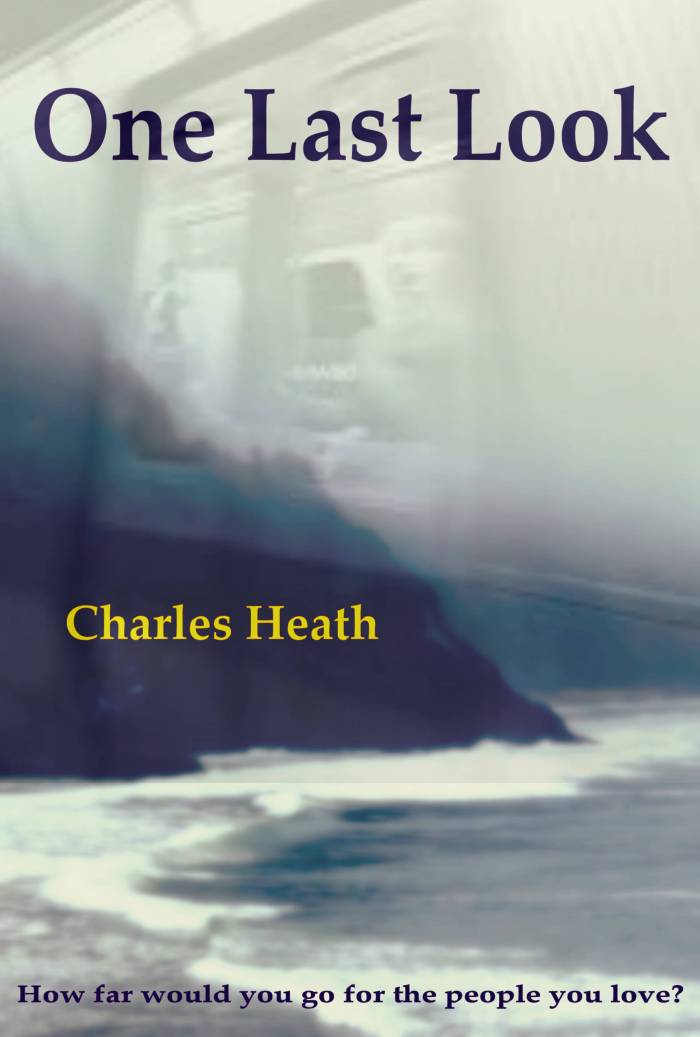
“One Last Look”, a thriller

A single event can have enormous consequences.

A single event driven by fate, after Ben told his wife Charlotte he would be late home one night, he left early, and by chance discovers his wife having dinner in their favorite restaurant with another man.

A single event where it could be said Ben was in the wrong place at the wrong time.

Who was this man?  Why was she having dinner with him?

A simple truth to explain the single event was all Ben required.  Instead, Charlotte told him a lie.

A single event that forces Ben to question everything he thought he knew about his wife, and the people who are around her.

After a near death experience and forced retirement into a world he is unfamiliar with, Ben finds himself once again drawn back into that life of lies, violence, and intrigue.

From London to a small village in Tuscany, little by little Ben discovers who the woman he married is, and the real reason why fate had brought them together.

http://amzn.to/2CqUBcz

onelastlookcoverfinal2

What would you ask a writer?

I’ve been sitting at this desk staring at the screen thinking of what to write that might interest other people.

Seems I’m not very good at it.

So I moved seats, and sit opposite the writer’s chair, taking a good long hard look at the person, the so-called writer, and conjuring up in my mind, if I was someone I’d just dragged in off the street, what would I ask?

That thought hadn’t occurred to me before, except at some time or other I might have to give an interview.

And as for being ‘dragged off the street’, most of us walk down the street trying to avoid everyone else and anything bad that might happen.

But I’m here now, so for a free cup of tea and a Doubletree cookie, I consider myself available to play the part.

Question 1:  Why on earth would you want to write when there are a billion other books out there?  Seems a complete waste of time to me.

[Answer] Good point, most days when I get out of bed or rather stare at the ceiling from under the covers, I wonder why I bother to get up.

OK, that’s the borderline manic depressive speaking, and most likely suffering from a hangover, trying to get those last 1,000 words for the day done.

Question 2: You write when you’re drunk?  That must make a lot of sense, not!

This person has found me out in two questions.

[Answer] No, a little Scotch helps to oil the wheels in the mind.

Question 3:  What do you do for inspiration?

[Answer] Thinking up new and novel ways of killing off people, I often drag people in off the street to ask me questions about myself, then kill them.  You know, it’s the old story, if I tell you I’ll have to kill you?  No, sorry, didn’t mean that.  I haven’t a mean bone in my body.  Inspiration you say?

I look around.

So does the inquisitor.  There is seven floor to ceiling bookcases full of my favorite authors, about 2,000 or so books, aside from the reference library that is mostly in e-book format which runs to about 10,000.

Question 4:  You read all of these?

[Picks up a copy of ‘Kill Me If You Can’ by James Patterson]  This one.

I nod yes.  I have read most of them.  I tell him writers must read.  Someone told me that a long time ago.  Not only thrillers and crime, but the classics.  I found War and Peace heavy going, but not so much as Madame Bovary, or Vanity Fair.

You can ask one more question.

Question 5:  Can I borrow this book [James Patterson]

As always the answer is yes.  I encourage people to read.  It doesn’t have to be my work.  It would be nice but I’m realistic enough to know there are a billion other books out there I have to compete with.

Thank God that’s over!


Distractions, distractions…

A writer’s life is a constant battle, keeping the flashing cursor busy, making sure blank pages are filled with words, not doodles, and keeping the ideas coming at a steady rate.

Just like driving down the freeway at a steady rate?

The first is not as easy as the second, and even the second can be a bit of a trial when there are other cars around, or you don’t have cruise control.

Perhaps it’s time for a cruise control for writers.

Or not.

As you can see, I’m easily distracted from what I should be doing.

Writing.


A few weeks ago I was sitting in front of the computer screen, the ever pervasive cursor flashing on a blank piece of digitized paper, and that was as far as I got.

No, the house wasn’t burning down, there was no major catastrophe lurking, nor was a family member or friend in dire need of my help.

I just didn’t know what to write.  The idea factory had closed its doors.

It was not necessarily a problem.

I have been writing, but not in the normal sense.  I have SomNote on my phone and my tablet, and when I’m waiting, usually for doctors or in Government offices, I write.

A bit of this, a bit of that, but usually the YA novel I’m writing for, and not necessarily about, my 13-year-old grand-daughter.

I find SomNote excellent for just putting words down, emailing it my myself and rehashing it later.  It has basically been used to write the first 37 chapters of the novel.

But as for other writing?

‘Strangers We’ve Become’, the follow up to ‘What Sets Us Apart’ has taken a different direction.  As this is the next book to be published, I should be working on it, but instead, some of it is still swirling around in my head.

The other day I went back to have a look at it.  Except for one chapter, possibly two, it’s done and so much better than the original.  Never let anyone tell you there’s not something else to be done after 10 edits and endless re-writes.

‘The Things We Do For Love’, a little story I wrote many years ago, was resurrected almost intact and is also almost ready for publication.  It will be categorized as Romantic Suspense, along with ‘Sunday In New York’.

My serial, the cases of Harry Walthenson, private investigator, has taken a back burner for a while, as I try to get a handle on where it is going.  It is a story now that is so very different than when I originally started it.  I suppose that’s indicative of a serial.


After that, Zoe, who first features in ‘The Devil You Don’t’, will be back.  After the trials and tribulations in her first adventure, she finds the past she tried to leave behind has come back to bite her.

The second adventure is called ‘First Dig Two Graves’, because it is about revenge and whether or not it’s best served cold.  And as for whether or not John’s romantic aspirations are fulfilled, you’ll just have to wait a little longer.

That’s my life at the moment, how is yours?

What’s that coming out of left field?

Why is it ideas come at the least expected and most inconvenient time?

I thought I’d trained my thoughts to assemble when I was having a shower.  It seems that has not worked so well, and now the telephone rings instead.

Don’t you hate that?

I wasn’t considering a new idea for yet another book; I have so many on the go already.  But, the sad truth is, you have no control over it.

When I sit down, listening to Ravel, or some other classical music, I close my eyes and drift along to the music, waiting for the imagination to kick in.

Can’t force it, can you?

But, five minutes to three, after a frantic call announcing yet another storm in a teacup, I’m racing out the door, setting the alarm, locking the door, and …

… bing …

The idea is there, out of left field, in front of me.


Here’s the pitch:

Detroit, ghost town, a nightwatchman, formerly a high flyer on Wall Street, is doing the rounds.

Yep, different location, same story as a dozen others, you say.

Pitch on:

With him, his work partner, from Mexico, a woman with a checkered past, maybe an illegal, maybe not, but who would work for the kind of pay they got if there was not something they were either running or hiding from?

A man and a woman thrown together by fate.  Seriously?

Pitch on:

They’re guarding a large factory, looking exactly the same as it had the day the doors closed, only there are no people, no work, and no likelihood of it reopening.

It’s night.  It’s dark.  Only the security lighting casts a dim glow over everything, casting shadows.  The walls and roof creaks as the building moves, as all do in a wind.

From here it could go anywhere, ghosts, murder, mayhem, or …

Pitch on:

Every night is the same, go to point B, the extent of the guard’s run, and no further.  Punch a card to say you’ve done the check, then back to the office.

That’s it.

As for the rest of the factory, don’t worry.  They were told that beyond point B was taken care of by another team.  It was a large factory, and neither had questioned their orders.  A job was a job in a city where jobs were at a premium.

Six months, from the office to point B and back.

Of course, the story has to suddenly come alive, like when you’re sitting alone in a dark room watching a horror moving, and the music hypes the fear factor to 1000% and you nearly jump out of your skin.

Not so easy to do in writing, but we try.

Pitch on:

Six months and one day later, it was time to find out what was beyond point B.

What they found was to change the fabric and course of their lives.


Reads like blurb inside the cover of a bestseller, doesn’t it?

All it will take is somewhere between 50,000 and 100,000 words, and the time to write them.

Scouring the newspapers, still looking for inspiration, maybe

I’ve been thinking…

… and that could be a good thing or a bad thing.

An idea had popped into my head, fired up from seeing the news on television.  I don’t normally look at the news if I can help it because usually its all bad, deaths, fires, drugs, and worst of all, politics.

This item was the equivalent of a two paragraph ‘mention’ buried on page six of the newspaper.

It was the umpteenth variation of a common story, wife having an affair, wife murdered, and, after seeing so many American and English cop shows, assumed the husband would be the number one suspect, no children involved mercifully, but there was something else going on, something I thought I could read between the lines.

No names were mentioned.

I’m not sure why it captured my imagination, but it did, and it swirled around in my head for about a week.

Then, out came a pad and pen and I started to write.

I put myself in the place of the husband and tried to imagine what it was like.

It is a work in progress.

A week or so later, another small paragraph appeared on page five, getting closer to the front page.

No names still because I assume the relative had not been tracked down.

But this alluded to something else as being the cause, and it was the manner of the death that warranted further investigation.

My imagination went into overdrive.

Rest assured I’ll be scouring the papers for the next ‘clue’.


At times I have this small problem, who the hell am I?

I have often wondered just how much or how little of the author’s personality and experiences end up in a fictional character.

Do they climb mountains, escape from what is almost the inescapable, been shot, tortured, get dumped, get divorced, .become world travelers, or get locked up in a foreign jail.

We research, read, and I guess experience some or all of the above on the way to getting the book written, but it’s perhaps an interesting fundamental question.

Who am I today?

Or it can be a question, out of right field, in an interview; “Who are you?”

My initial reaction was to say, “I’m a writer.”  But that wasn’t the answer the interviewer is looking for.

Perhaps if she had asked, “Who are you when you are writing your stories?” it would make more sense.

Am I myself?

Am I some fictional character made up of a lot of other people?

Have I got someone definite in mind when I start writing the story?

The short answer might be, “I usually want to be someone other than what I am now.  It’s fiction.  I can be anyone or anything I want, provided, of course, I know the limitations of the character.”

“So,” she says, “what if you want to be a fireman?”

“I don’t want to be a fireman.”

“But if the story goes in the direction where you need a fireman…”

“What is this thing you have with firemen?”  I’m shaking my head.  How did we get off track?

“Just saying.”

“Then I’d have to research the role, but I’m not considering adding a fireman anytime soon.”

She sighs.  “Your loss.”

Moving on.

And there is that other very interesting question; “Who would you like to be if you could be someone else?”

A writer in that period between the wars, perhaps like an F Scott Fitzgerald or Ernest Hemingway, in Paris, or if it is a fictional character, Jay Gatsby.

He’s just the sort of person who is an enigma wrapped up in a mystery.

Thoughts while staring into space, figuratively!

I can see how it is that a writer’s life can be a lonely one.  That’s why, I guess, so many writers have an animal as a pet, someone to talk to, or just feel as though you are not alone in this quest.

I’m often sitting in front of the computer screen, or in a large lounge chair with my trusty tablet computer, writing the words, or staring into space!

Sometimes the words don’t make any sense, sometimes the thoughts leading to those words don’t make any sense.

Sometimes the most sensible person in the room is the cat.

I’m sure his thoughts are not vague or scrambled, or wrestling with the ploys of several stories on the go, getting locations right, getting characters to think and do their thing with a fair degree of continuity.

The cat’s world is one of which chair to lie on, where is that elusive mouse be it real or otherwise, and is this fool going to feed me, and please, please, don’t let it be the lasagna.  I am not that cat!

Unlike other professions, there is no 9 to 5, no overtime, no point where you can switch off and move into leisure time.  Not while you are writing that next masterpiece.  It’s a steady sometimes frustrating slog where you can’t just walk away, have a great time, and come back and pick up where you left off.

Stories have to be written from beginning to end, not a bit here and a bit there.

It’s a bit like running a marathon.  You are in a zone, the first few miles are the hardest, the middle is just getting the rhythm and breathing under control, and then you hope you get to the end because it can seem that you’ve been going forever and the end is never in sight.

But, when you reach the end, oh, isn’t the feeling one of pure joy and relief.

And, yes, perhaps you’ve just created another masterpiece!

Writing and re-writing, or so the story goes

The process of writing is rewriting editing and more rewriting.

Some time ago l wrote some words.  I didn’t like them.  But it had laid the groundwork for a second draft.

Here it is:


Growing up I did not believe l had one of those lovable faces.

My brother, known in school as the best looking boy of his graduating class, said it was a face only a mother could love.

He was mean.

Simone, a girl who was a friend, not a girlfriend, said my face had character.

She was charming and polite.

Looking now, in the mirror, l decided I’d aged gracefully.

I could truthfully say my brother had not, but that was as far as the comparison went.

My overachieving brother was the epitome of success in business, a veritable god zillionaire.  Everything he touched turned to gold.

My ultra successful sister, Penelope, had married into the right family perhaps by chance, but she was also a very learned scholar whose life was divided between her chair at the university and her social life with the rich and famous.

Then there was me.

I gave up on my chance at university because l was not the scholarly sort and didn’t last long.  Sadly l was the first of my family to be sent down from Oxford.

Instead, l took on a series of professions such as seasonal laborer, farm hand, factory worker, and lastly, night watchman.  At least now I had a uniform and looked like I’d made something of myself.

It would not be enough for my parents who every year didn’t say it out loud but the disappointment was always there in their expressions.

My brother in his usual blunt manner said l was a loser and would never change.

My sister was not quite so blunt.  She simply said it was disappointing so much potential was going to waste.  I only asked her once what she meant and lost me after the first four syllable word.

Finally, I’d taken their comments to heart and decided l would not be going home to the family Christmas holiday reunion.

I told my boss l was available to work the night shift over the holidays, the shift no one else wanted.

It was he said a time for reflection.  He hated his family as much as I did so we would be able to lament our bad luck through the long cold hours from dusk till dawn.

It was 3 a.m. and it was like standing on the exact epicenter of the North Pole.  I’d just stepped from the warehouse into the car park.

The car was covered in snow.  The weather was clear now, but more snow was coming.

It was going to be a white Christmas, all I needed.  I hoped I remembered to put the antifreeze in my radiator this time.

As I approached my car, the light went on in an SUV parked next to my car.  The door opened and what looked to be a woman was climbing down from the driver’s seat.

She closed the door and leaned against the side of the car.  “Graham?”

It was a voice I was familiar with, though I hadn’t heard it for a long time, my ultra successful sister, Penelope.  From what I could see, she didn’t look too well.

“What do you want?”

“Help.”

My help, I was the last person to help her or anyone for that matter.  But curiosity got the better of me.  “Why?”

“Because my husband is trying to kill me.”

The instant the last word left her lips I saw her jerk back into the car, and then start sliding down to the ground.  There was no mistaking the red streak following her as she fell.

She’d been shot from what appeared to be a sniper rifle, which meant …


It still needs work but I’ve got the gist of where I want to go.

The idea is not to make a character so loathsome no one would want to read about him.

This will evolve and you can if you like to come along for the ride!


© Charles Heath 2016-2018
Driving in suburbia

It was one of those beautiful Autumn mornings, blue sky with a smattering of clouds but a sunny day all the same.  It’s Sunday so there is not as much traffic on the road.

Anyone with any sense would be going to their favorite coffee place and settling down to your choice of coffee and perhaps a toaster or muffin to accompany the conversation.

This is what’s happening at the cafe we go for coffee.  9:00 in the morning it is packed.  But great coffee is hard to find, and this is apparently great coffee.

It’s that in-between time before it gets windy, cold and wet, with the sort of chill you can feel in your bones, rather it’s the time when you have a barbeque in the mid-afternoon and get home before the cold sets in, or take the kids to the park for some healthy exercise.

Today I have to take a drive from one side of suburbia to the other, taking a network of main roads with rather anonymous names such as North and South

We travel through the older suburbs, those with a collection of red or white bricks and timber dating back to the fifties and sixties.  They are not, for the most part, in a good state of repair, and rather than looking ramshackle, it’s more like they are slowly decaying.

Fences are rotting or falling over, extensions like they have been glued on rather than added by an architect, and paint either fading or missing.  For the most part, people are struggling to keep up with the cost of living, and too busy to worry about maintenance.

Some have been bulldozed and replaced, blocks are cleared awaiting new development, others are being renovated.  Any way you look at them they are still worth a great deal of money being relatively close to the city.  Nut it’s a double-edged sword, worth a lot, but costing more to keep.

It’s a location we could never afford.  Because we were not affluent we were pushed out to the less expensive outer suburbs.  This was of course 50 years ago, and now those outer suburbs are now the new inner suburbs and people are buying up to 50 km further out in the new estates.  When I was young these suburbs were farms and open land.

It also surprises me that people would want to live on the main road because with traffic as it is heading into the city, it would be difficult to leave or return by car.  At least for these people, public transport is better than in the outer suburbs.

Because it’s Sunday my trip takes a lot less time, except for those unpredictable traffic lights, some of which I missed and took a while to cycle through the other traffic before it was our time to move.  It’s the only disappointment of the modern era, the fact roads were never made to handle the traffic, and the fact they now have to bulldoze homes to make way for roads.

Pity they didn’t lay down the foundations of a proper transport system, much like they have in major European cities.