Conversations with my cat – 35

20160922_162010_001

Chester and the great escape.

It’s like watching that movie, you know the one, with Steve McQueen and the motorcycle?

I accidentally didn’t close the back screen door properly and Chester, a cat with many talents, managed to prise the door open wide enough for him to squeeze through.

And, then there’s that momentary elation of having escaped.

Out into the wide open space, where the air is fresher, the sky is blue, the sun is warmer.

And he is no longer restricted.

But…

Why is he standing just three feet away from the door, on the concrete path?  Has he seen a creature he can chase, or worse, torment?  Is he savouring that first few moments of freedom, and soaking up the sun’s warm rays on his back?

Or is he waiting to see if I’ll follow, and try to either catch him or bring him back?

He turns, and looks at me, as if to say, well, what are you going to do?

There’s a certain sense of smugness in that look.

I shrug.  “Just remember there’s no one out there who will wait on you hand and foot like we do.”

I’m sure that was not what he was expecting.

I open the door wider, and add, “Make up your mind now, because once the door closes, that’s it.  You’re out.”

He turned to look back at the great outdoors.  I can see the wheels turning.  A life of luxury or a life on the run?

I almost caught his tail in the door as it closed.  Who said cats weren’t smart?

Waiting, perhaps, for the robots to come to life – maybe?

It seems that we spend nearly as much time waiting as some of us do sleeping.  In fact, I’ve been known to be sleeping while waiting.

What is it in this era of mechanization and computerization that we still have to wait.  Is it the human element that is still holding us back?

But, hang on, isn’t it the human element that creates the mechanization and computerization?  Perhaps we are building in redundancy so that we are not replaced by the very things we are creating to make our lives easier?

We don’t have robots who can perform the same tasks as a GP doctor because we still need the human factor, and since one size does not fit all, no consultation can ever be fit into a specific time frame so there will always be waiting especially as the day wears on.

We cannot completely automate phone call answering except for the part where you are put in a queue and told your call is important and then you sit there listening to some awful music, seemingly forgotten

There will always be hundreds of calls in a queue for the most important services. or when you need an answer in a hurry, because only a few people are available to answer the phone.  Robots will not be able to answer calls either, because once again, only a real person can respond to the randomness of callers questions.

Artificial intelligence only works in science fiction.

Then there is the time we spend waiting at traffic lights, and then, even when the lights are with us, in traffic jams.  We are still stumped by trying to find an all-conquering answer to moving masses of people, either by the roads or by public transport.

The latter is all too frequently suffering delays and congestion due to the number of services needed and decaying networks and infrastructure, all of which is only going to get worse, with, of course, longer delays and more waiting.

Maybe the answer is to work from home but sadly the internet, that so-called answer to all our off-site networking, is not going to cope, and in fact, in this country, our latest update is a retrograde step on speed and availability, ie more waiting and less work.

Waiting, it seems, we are stuck with it whether we like it or not.  Good thing then our lives are longer.  But, if we delve into the mystery of longer lives now against what they were back when there was less waiting, maybe we still have the same amount of life, and the fact we’re living longer is negated by all the waiting.

I’m sure we didn’t have to wait very long for anything a hundred years ago.

Just saying.

In a word: Tap

There is nothing worse than, when lying in bed unable to get to sleep, you hear every noise in the house and out, but none worse than a dripping tap.

Its often not because someone forgot to turn the tap off, but a washer is on its last legs.

There are taps for the fallen brave, but aside from the fact that is the name of a piece of music, I think it’s also the title of a film.  But taps itself is a bugle call at dusk, and also played at military funerals.

Then there’s that income stream that you can tap into, other than your next door neighbours power supply.

But what would be far more interesting than to tap into a phone line and listen in?  Despite the fact that eavesdroppers never hear anything good about themselves, you could learn something you didn’t want to know.

Then we can go back to the 1930s and a series of films that starred one of my favourite actors Fred Astaire, who was, of course, a tap dancer, along with Ginger Rogers.

In fact, my middle granddaughter is quite a good tap dancer.

And, lastly, was that a tap on the door, or a tap in the window?

What happens after the action-packed start – Part 18

Our hero knows he’s in serious trouble.

The problem is, there are familiar faces and a question of who is a friend and who is foe made all the more difficult because of the enemy, if it was the enemy, simply because it didn’t look or sound or act like the enemy.

Now, it appears, his problems stem from another operation he participated in.


The debriefing team were not quite what I expected, a man and a woman, one a Major, the other a Lieutenant, and it was apparent they had just met before coming into the room.

He was Major Lallo, Army intelligence, and the woman, Lieutenant Jill Monroe, a familiar name as I’m sure I’d heard it before.

Lallo was not a fighting soldier, he was a paperwork man.  I suspect he was more at home with an order book, and filing communications though that didn’t explain the rank, which he would have to have front line experience to attain.

Monroe looked to me to be the sort of woman soldier that had to prove she was better than any man and had the muscular form to go with it.  Not the sort of a woman to get into a fight over or against.

She stood at the end of the bed, and I suspect by her posture that she was there to make sure I didn’t run, which, by the way, was physically impossible.

Lallo sat in the chair beside the bed, tried to make himself comfortable.  He was going to ask the questions.  He had a small notebook he took out of his pocket with a list of questions.  The small pencil that slotted into the binding was there to write down the answers if any.  I was not sure I was up to answer any questions.

Settled, he started with, “You don’t have to answer, but I suggest you do.  I think by now you are starting to realise that, no matter how strong you think you might be, you’re not.  If you decided to be unforthcoming, then you can be assured that we will be interrogating you with a lot more, shall we say, enthusiasm than in the past.”

By the way he said it, I got the impression he would be the one.  His tone had changed suddenly, to a man who enjoyed others discomfort, and he was looking forward to breaking me if it came to that.

“And if I don’t have the answers to your questions, or should I say, not the answers you are expecting, what then?”

“One step at a time.  We’ll start with the easy questions first.”

I’m not quite sure what he classified as easy.  I didn’t think there were any.

“How long have you been at this base?”

Maybe I was wrong.  “Two months, three days.”

“How did your transfer to this specific base come about?”

“I don’t know.  I was at a training base in Ohio one day, then being presented with orders to get the next transport out the next.”

“Did you, or someone else you know, request your transfer to a new base?”

I didn’t think that was possible.  Someone of my rank went where they were told to go.

“No.  I’m a Sergeant, not a General.”

But was it possible Colonel Bamfield arranged for me to be transferred.  Given the fact he was here, now, it was not beyond the realms of possibility.  But if so, why?

“What was your function at your last base?”

What had this to do with my current situation or anything else for that matter?

“Instructor.”

“In what?”

“Infiltration, covert operations.”

“And I’m assuming then you been involved in these, shall we say, covert operations?”

No use denying it.  It was obvious he had seen my file, which all of a sudden had some very disturbing possibilities.  Just how much information though.

“Yes, but they’re classified and I can’t tell you anything and that.”

“Normally that would be the case, but…”  He left the sentence hanging there for a few seconds before adding, “There was a problem with your last operation, the reason, it appears, you were transferred to the training base in Ohio.  Is that correct?”

A mission that I had been told never to mention, speak of to anyone, no matter how high their rank in the military or government, or even think about again.

A mission I was told had been buried so deep it would never see the light of day.

Until now.


© Charles Heath 2019

In a word: Brevity

Now, brevity is something that I have not been able to fully wrap my head around.

The dictionary explains Brevity as

‘concise and exact use of words in writing and speech’

So…

I remember working with a writer a long time ago who explained certain authors styles, and for James A Michener of Hawaii fame, he said Michener wrote sentences instead of words, paragraphs instead of sentences, pages instead of paragraphs and chapters instead of pages.

It was a little harsh considering I’d just read the book and had liked it, despite its length and the time it took.

But some time later I realized he was not criticizing Michener, but trying to tell me, in his, what I came to discover, interesting way, that I should strive to write more compactly.

I then came across a book by Brian Callison which was exactly that, the concise version, a story that fitted into about 200 pages.

That too was a good book and it took me a day to read it, and by his use of that economy of words, it read quickly.

Of course, I have tried over the years to emulate both styles, and to a certain degree, failing, because I think I have created my own style which is somewhere in between.

Still, when editing, it is always in the back of my mind that I should be

Using words instead of sentences

Using sentences instead of paragraphs

Using paragraphs instead of pages, and

Using pages instead of chapters.

The chapters, he said, with an air of amusement, will always take care of themselves.


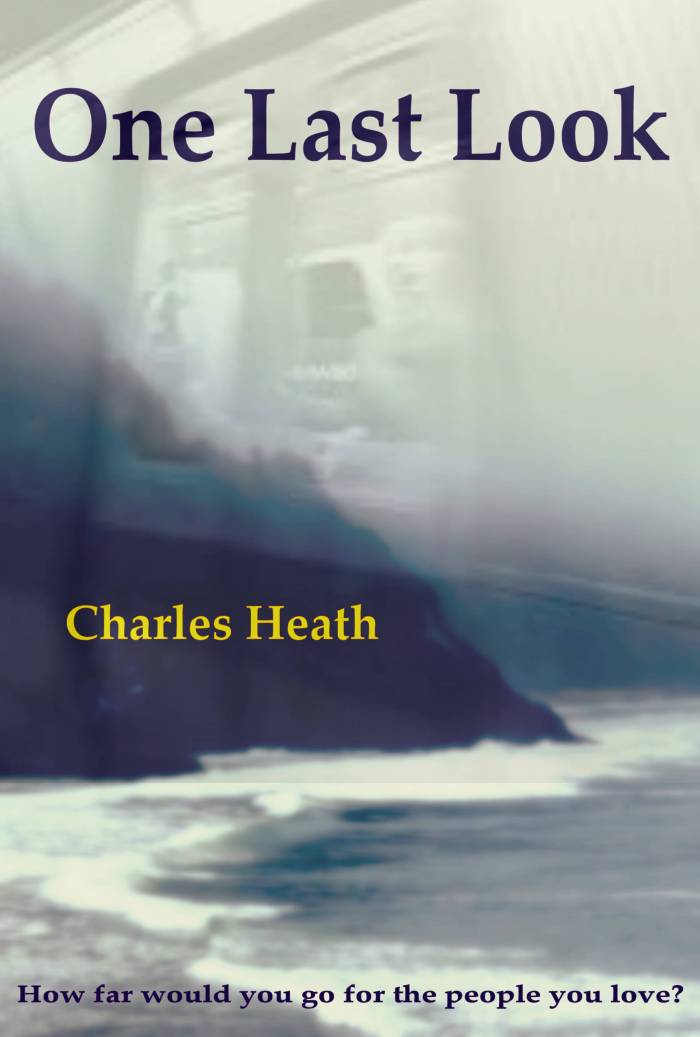
“One Last Look”, nothing is what it seems

A single event can have enormous consequences.

A single event driven by fate, after Ben told his wife Charlotte he would be late home one night, he left early, and by chance discovers his wife having dinner in their favorite restaurant with another man.

A single event where it could be said Ben was in the wrong place at the wrong time.

Who was this man?  Why was she having dinner with him?

A simple truth to explain the single event was all Ben required.  Instead, Charlotte told him a lie.

A single event that forces Ben to question everything he thought he knew about his wife, and the people who are around her.

After a near death experience and forced retirement into a world he is unfamiliar with, Ben finds himself once again drawn back into that life of lies, violence, and intrigue.

From London to a small village in Tuscany, little by little Ben discovers who the woman he married is, and the real reason why fate had brought them together.

http://amzn.to/2CqUBcz

onelastlookcoverfinal2

In a word: Leg

Aside from the fact it is one of those necessary items to walk with, and the fact we can have two or four for most humans and animals, there are a few other uses for the word ‘leg’.

Like…

‘You haven’t got a leg to stand on’, doesn’t necessarily mean you have no legs, but that you are in a precarious position.

“the table had ornate legs’, yes, even non-living objects can have legs, like tables and chairs.

“It was the fifth leg of the race’, meaning it can be a stage of a race.

“He was legless’, meaning that he was too drunk to stand up.  Some might think being legless is a badge of honour, but I suspect those people have been drinking a long time and the alcohol has destroyed most of their brain cells.

“leg it!’, meaning get the hell out of here before you’re caught.

Then, finally, ‘he’s on his last legs’, meaning that he’s exhausted, or about to die.

I’m sure there’s more but that’ll do for now.

I have to use my legs to get some exercise, of which the first leg is to the tripod to check if its legs are stable, and the second leg is to come back to the table and replace one of the legs which is broken.  Then I’ll leg it to the pub where hopefully I won’t become legless.

Hmm…

In a word: Good

There is a TV show on at the moment called ‘The Good Place’.

It’s really the bad place which makes you wonder if there really is a ‘good place’.

This started me thinking.

How many people do you know, when you ask them how they are, they say ‘good’?

Can we see behind the facade that is their expression and see how they really feel?

Quite often, not.  It is sometimes amazing just how good people are at hiding their true feelings.

And, thinking about that, how many of us reveal our true feelings?

It seems to me there is an acceptable level of understanding that we take people at their word and move on from there.

How many times when we suspect there is something wrong, we tend to overlook it in what is regarded as respect for that person?

What if something awful happened?

What if we could have prevented it?

What if we could have tried to gently probe deeper?

The problem is we seem to be too polite and there is nothing wrong with that.

But maybe, just maybe, the next time …

It’s just a thought.


Was it just another surveillance job – Episode 2 – Revised

Back to the explosion at what was first thought to be at a takeaway.  Certainly, it had been levelled, but so had several other building in the near vicinity, but we haven’t got to that part yet.

The boredom of the flight is still giving me an opportunity to explore the opening sequence a little further, where we left our man on the scene under tight police guard.


In five minutes, perhaps less, the whole scene had turned into countless vehicles with red and blue flashing lights, screams from the victims, and yelling from the rescuers.

I was still under police guard, but coming from the other side of the scene, a rather battered and bleeding street policeman came running towards us, stopping short of the man standing back, the one I assumed was in charge.

“Tell me you’ve got them,” he gasped, then looking from the man in charge to me then back again, looking very concerned.

“We have.” He looked very calm and pleased with himself.

“What?  Him?” He nodded in my direction. “He was blown up in the blast and from what I saw was chasing the real culprits, two men covered in dust, one of whom was carrying a large duffel bag.”

“This guy was caught running from the scene.”

I decided to add my bit to the discussion.  “Your car drove straight past them.  I can’t see how you missed them.”

He was starting to look worried.  “We were given your exact description from an anonymous tip.”

The battered policeman bent over and the collapsed to the ground.  Two of my captors went towards him, but he motioned them away.  “Of course you did, by the two men escaping.  Get after them, before it’s too late.  And free this guy.  He’s got nothing to do with the blast.”

After removing the cuffs they jumped back in their car and headed back in the direction they came.  Too late now, the two men would be long gone.

I went over to the policeman on the ground just as another ambulance pulled up and as the paramedics got out, I motioned to them to come and attend him.

“What happened,” I asked him

“A bank robbery, the clowns used far too much explosive and almost brought the building down on them.  Not so lucky for the neighbours.”

He was looking around, then stopped, looking at the place where I’d just been held down. I followed his gaze and then saw what he saw.  The cuffs were still on the ground where the man who removed them had obviously dropped them.

His expression changed, and for a moment I thought he was going to explode.

“What’s wrong.”  Obviously, something was but I couldn’t see it.

“The cuffs.  We haven’t used those for years now.  They weren’t real police.”

My mind clicked into gear at the same time as he uttered the words.

They were there to help the others escape whilst holding us both up with a phony arrest.  I wonder what they would do if they hadn’t been sent after their fellow robbers.

The battered policeman just sighed and lay down on the pavement and let the paramedics work on him.

Only then did we notice he had a piece of an iron bar sticking out of his side.

Then, of course, people just\  don’t happen to be in the wrong place at the wrong time.

Or do they?


© Charles Heath 2019

In a word: Happy

“I’m happy to be being here.”

Yes, I actually heard that answer given in a television interview, and thought, at the time, it was a quaint expression.

But in reality, this was a person for whom English was a second language, and that was, quite literally, their translation from their language to English.

Suffice to say, that person was not happy when lost the event she was participating in.

But that particular memory was triggered by another event.

Someone asked me how happy I was.

Happy is another of those words like good, thrown around like a rag doll, used without consequence, or regard for its true meaning.

“After everything that’s happened, you should be the happiest man alive!”

I’m happy.

I should be, to them.

A real friend might also say, “Are you sure, you don’t look happy.”

I hesitate but say, “Sure.  I woke up with a headache,” or some other lame reason.

But, in reality, I’m not ‘happy’.  Convention says that we should be happy if everything is going well.  In my case, it is, to a certain extent, but it is what’s happening within that’s the problem.  We say it because people expect it.

I find there is no use complaining because no one will listen, and definitely, no one likes serial complainers.

True.

But somewhere in all those complaints will be the truth, the one item that is bugging us.

It is a case of whether we are prepared to listen.  Really listen.

And not necessarily take people at their word.