Two novels are on special for $0.99 for the next two weeks.
They are
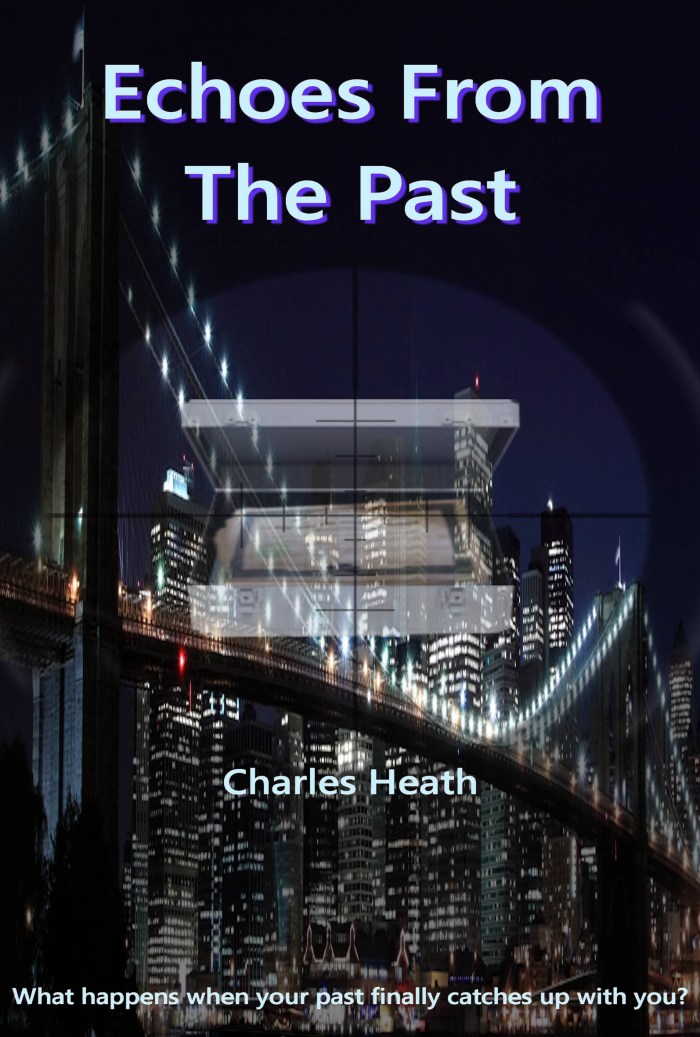

for “Echoes from the Past” go to https://amzn.to/2CYKxu4
for “The Devil You Don’t” go to https://amzn.to/2Xyh1ow
Two novels are on special for $0.99 for the next two weeks.
They are
for “Echoes from the Past” go to https://amzn.to/2CYKxu4
for “The Devil You Don’t” go to https://amzn.to/2Xyh1ow
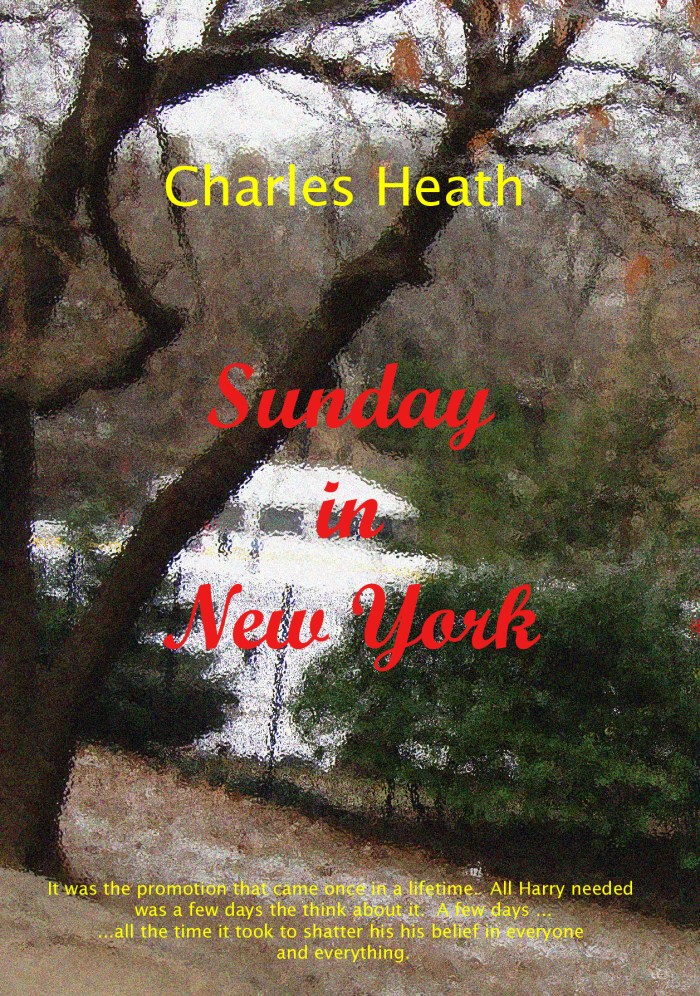
“Sunday in New York” is ultimately a story about trust, and what happens when a marriage is stretched to its limits.
When Harry Steele attends a lunch with his manager, Barclay, to discuss a promotion that any junior executive would accept in a heartbeat, it is the fact his wife, Alison, who previously professed her reservations about Barclay, also agreed to attend, that casts a small element of doubt in his mind.
From that moment, his life, in the company, in deciding what to do, his marriage, his very life, spirals out of control.
There is no one big factor that can prove Harry’s worst fears, that his marriage is over, just a number of small, interconnecting events, when piled on top of each other, points to a cataclysmic end to everything he had believed in.
Trust is lost firstly in his best friend and mentor, Andy, who only hints of impending disaster, Sasha, a woman whom he saved, and who appears to have motives of her own, and then in his wife, Alison, as he discovered piece by piece damning evidence she is about to leave him for another man.
Can we trust what we see with our eyes or trust what we hear?
Haven’t we all jumped to conclusions at least once in our lives?
Can Alison, a woman whose self-belief and confidence is about to be put to the ultimate test, find a way of proving their relationship is as strong as it has ever been?
As they say in the classics, read on!
Purchase:
http://tinyurl.com/Amazon-SundayInNewYork
This is an easy one.
It’s a part of a book or film which covers a single event, and predominantly with a set group of characters.
It could also mean it might relate to a particular genre that you like, as in,
I’m part of the jazz scene or the symphonic scene, though I think it had a more sinister context back in the late 60s early 70s.
A scene could also be a landscape (especially in art)
Then, of course, the last thing you want is a child to make a scene in front of others, in a display of temper, or bad manners
This is not to be confused with seen, as in, you should be seen and not heard, an oft used expression by a parent.
You could be seen, especially in places where you were not meant to be, or, conversely, make sure you are seen by the ‘right’ people in the ‘right’ places
Have you seen my dictionary, it’s quite large and heavy
I have seen his bad qualities
I have seen better days, though at the moment I can’t remember when
I have seen them all, sometimes seemingly impossible, but it is generated by exasperation, and generally more like I’ve seen everything now!
I’m back to writing, sitting at the desk, pad in front of me, pen in hand.
The only thing lacking, an idea
It’s 9:03 am, too early to start on a six-pack.
I need to try and concentrate on the job at hand, but it isn’t working.
Blogging, websites, Twitter and Facebook, all of these social media problems are swirling around in my mind.
The more I read the more it bothers me that if I don’t have the right social media presence if I do not start to build an email list, all of my efforts in writing a book will come to naught. And especially so, if I don’t hire a professional to do my cover. Another problem to add to the ever-growing list.
Then I start trawling the internet for information on marketing and found a plethora of people offering any amount of advice for anything between a ‘small amount’ to a rather large amount that gives comprehensive coverage of most social media platforms for periods of a day, a week or a month. I don’t have a book so it’s a bit early to be worrying about that.
I move onto the people who offer advice for a cost on how to build a following, how to build a web presence, how to get a thousand Twitter followers, how to get thousands of email followers before the launch.
The trouble is I’m writing a novel, not a nonfiction book, or have some marvelous 30-page ebook on how to do something, for free just to drive people to my site. I’m a novelist, not a handyman so those ideas while good is not going to help me. And there are enough people out there telling the rest of us how to be a writer, how to be a marketer and then some. The problem is, most of them are one long advertisement, offering the ‘real’ answers’ for money.
I’m not sure how many people have my email address, but I’m getting over a hundred emails a day, all asking me to buy some sort of guaranteed service.
Yet another problem to wrestle with along with actually creating a product to sell in the first place.
Except I’m supposed to be writing for the love of it without the premeditated idea of writing for gain or getting rich quick.
What am I missing here?
So should l be writing short stories and offering them for free to drive people to my site? These would have to be genre-specific so it needs time and effort and fit into a convenient size story that will highlight or showcase my talent.
Or should I create a website for the novel and set up pages for the characters and get some interaction going that way? It will be difficult without giving the whole plot away so if I do it will have to be carefully managed. And, in doing so, it will be taking me away from what I’m supposed to be doing, writing.
Of course, I could get someone else to set all this up for me, but I haven’t got fifty dollars, let along the $5,000 they are asking. Yes, I can create a free site, yes, I can find a cheaper option if I looked hard enough, but, again, it takes me away from my primary objective.
I don’t think I will have a good night’s sleep again with all of these social media problems I’m going to have.
Oh well, back to the book. It’s time to have a nightmare of a different sort!
When I opened my eyes I was in a room, not immediately recognizable, because it looked like my room, in my parent’s house where I grew up, when I was a young boy.
The curtains fluttered on the other side of the room, around the edges a muted light that could have been the moon or street lighting.
It was warm, the breeze pushing pas the curtain material and washing over me in gentle waves. I was hot and could feel the sweat on my brow.
It reminded me of the long summer days, the warmth stretching into the night, and the cool breezes that made the endless heat bearable, where the only covering you needed was a sheet, and then sometimes not.
There was movement, also, on the other side of the room, a figure curled up in a chair, the form of which was framed as a silhouette against the indistinct light, now a little brighter. My eyes were rapidly adjusting, and shapes were becoming clearer.
I turned my head slightly and saw a door with a window in it, slightly ajar. My bedroom door had never had a window,
I tried to speak but couldn’t, my throat dry, and made swallowing difficult. It felt like something was stuck in my throat.
I tried to think, but it made my head hurt, and, then, a thousand images flashed before my eyes, or what seemed like a thousand, of a time I’d never known about.
Not until now.
Of a past that I’d known was lurking somewhere in my mind. Of a missing period of my life that had been, up till now, locked away, and beyond my grasp.
And for a good reason.
It was awful.
No. It was horrendous.
No. It was worse than that. Words could not describe the images, the feelings, the despair, the hopelessness.
And then I screamed. Bound, in pain, feeling a charge of electric current run through me, trying to beg them to stop, only to find my mouth stuffed with a filthy, horrible tasting rag, making me gag.
Then it stopped, and I slumped back, easing the muscles that had tensed in pain, opening my eyes to see a man, Chinese, holding a knife over me, saying, “You will tell me what I want to know” over and over, then slowly pushing the knife near my shoulder, the pain unbearable as I screamed and begged for him to stop.
And as suddenly it started, it stopped.
It had to be a dream. It had to be.
Then nothing.
I’m not sure about the knife wound, what impact or damage it may have or cause so some investigation is needed.
And that’s not where it ends. More of the nightmare tomorrow!
© Charles Heath 2018
Our hero knows he’s in serious trouble.
The problem is, there are familiar faces and a question of who is a friend and who is foe made all the more difficult because of the enemy, if it was the enemy, simply because it didn’t look or sound or act like the enemy.
Now, it appears, his problems stem from another operation he participated in, and because of it, he has now been roped into what might be called a suicide mission.
Onboard the plane shortly after it took off, I watched Monroe go to each of the team and give them a folder with their role, and, no doubt, instructions on what they had to do, and to handle the equipment they were assigned. The list I’d seen required a sound technician, a grip, a cameraman, his assistant, the director, the producer, which I took to be Monroe, and a few other production assistants.
None looked happy, and probably already knew what the cover story would be. I didn’t see or hear any objections, each just took their folder and started on their homework.
She didn’t spend much time with Jacobi, just enough to tell him he was going to be the guide. It was a role he was most suited to, and that of local liaison. At least it would explain why he was with us.
After that, she came to see me.
“Was it your idea or Lallo’s?” I asked.
“Lallo’s. I’m as surprised as you, but you have to admit it’s a great cover story.”
“For a group who wouldn’t know one end of the camera from the other.”
“Plenty of time to learn. You don’t have to worry. All you have to do is be perennially bad-tempered and yell a lot. I’m sure you can do that without having me tell you how to.”
“No. probably not. Bamfield said it all the equipment worked.”
“When we take the C4, detonators, grenades, and a few other assorted armaments out it will.”
“You know where the other stuff is,” I said, hoping she understood that it was the diamonds I was talking about.
“Somewhere in one of the boxes. It was best not to tell anyone, so if anything happens, we can’t give it away. We can worry about that once we get past the border. I suggest you get your head down. At least one of us has to be sharp at the other end when we land.”
With that, she went back to her corner, ran her eye over the team now deep in their studies, then looked like she was going to get some sleep.
After a few hours, the enthusiasm to learn had died down, and each of the team members made themselves comfortable. There would be more time to study on the other side of the fuel stop. Everyone on board got what sleep they could, not that it was the best of places in the cargo hold of a C-130. One destination we were all familiar with was that of Djibouti when we would set down to refuel at the airbase there.
It was a half-hour stop, and, as Monroe advised, we didn’t leave the plane. It was best no one knew we were aboard or what we were doing, a feat I thought quite remarkable because if it was my airbase, I’d want to know.
But, as airbases went, it was the same as the rest.
Back in the air, we were heading for Uganda. It was another 6 or 7 hours, so it was a good time to get some more rest before we landed. I had no idea when the next time would be that there would be time for some shuteye.
I’d been keeping an eye on Monroe. She appeared to be the liaison for everything, and had accompanied the pilot to the base tower, most likely to file the flight plan, one of several I imagine, and to report back to Bamfield. It explained why the pilot returned without her, and she didn’t get back until 15 minutes before we were due to leave.
Should I be worried? There wasn’t much point.
After an hour, I went up the back of the plane and sat next to Jacobi. He had been ostracised by the rest of the team; an order given by Monroe for them to leave him alone. He’d been escorted onto the plane by two burly military policemen, and his bag of equipment given to Monroe for safekeeping, so we were sure from the time he left the cell at the black site to getting on the plane he had communicated with anyone.
Even so, I was sure he had been in similar situations before, and he was still alive to tell about it. If he had a plan, whatever that plan was, we would soon find out.
In the meantime, I thought he might have an interesting story to tell, and I had a few hours to kill.
He sullenly watched me come down the fuselage, and then sit next to him, loosely putting what passed as a seat belt on just in case we hit an air pocket. The flight was not as smooth as it might be on a commercial airliner and was certainly a lot noisier.
“Have you spoken to the right people yet?” I almost had to yell in his ear.
Lallo had said he was going to get Jacobi to call his friendly General in the Congo army to smooth the way, and it would be interesting to know under what circumstances Jacobi had explained our arrival at his border. And another to tell the kidnappers we were on our way. Monroe said he had made several supervised phone calls, but not exactly who to.
We had to pray that the General would be among those to also help us locate the targets and, once the exchange was made, assist us in our departure, for a small sum to compensate them for the inconvenience.
He knew why I’d come to see him. “The captors know we are coming, and hopefully before the time limit has passed. They will kill them this time if we don’t get there in time.”
“I’m sure they’d like us to think that, but you know as well as I do they need the ransom for their ongoing operations. Let’s hope it doesn’t come down to plan f which is where they kill us, the hostages, and just take the ransom. Either way, I hate to be the one who is only going to make things worse, but I don’t get to decide what’s right or wrong.”
“It’s how it works out there. Everyone is available for a price. If it wasn’t this lot, it’d be another or another.”
“Or the military, maybe, looking to cash in because the state doesn’t pay them enough. That’s why we’re putting you at the head of the procession. If we’re ambushed, you’ll be the first to go.”
“I admire your lack of faith in me.”
“You haven’t done anything to inspire faith, Jacobi. But so long as you keep your word, and do everything right, I won’t have to shoot you.”
There was no horrified look. He knew the score of being in the ‘Mr. In-Between’ business. He would no doubt get a share of the diamonds for brokering the deal, on top of whatever Lallo offered him, and a cut of the General and his men’s fees for guaranteeing our safety. I guess his business also had its hazards, wasn’t for the faint-hearted, and for those working all sides of the fence, a particularly exciting time.
Generals, soldiers, kidnappers, rebels, practically every man and his dog had an itchy trigger finger.
“It’s not me you have to worry about.”
“How so?”
“I didn’t betray them the last time, and that person was never identified.”
A good point. “Then let’s hope no one else knows we’re coming, or what we’re bringing as ransom.”
He looked at me, a look that told me I thought he might just make a play for the diamonds himself and forget about the targets. It was a very tempting ransom.
“You know how it is. Spies are everywhere.”
“Just make sure you’re not one of them.”
I think I said it with just enough sincerity that he believed me.
“It’s not worth my while, I assure you. Once you’re involved in a double-cross, you cease to be of worth to anyone. I will not be the source of your problems if there are any.”
For a man who’d already been caught out in a raft of lies, there was nothing he could say that would make me trust him. He was going to require an escort once we landed.
I had two perfect candidates for the job. Williamson and Shurl. From what I had observed on the ground before we boarded the plane, and in the plane, they stuck together. I got the impression they knew each other.
After I left Jacobi, I told them what I wanted them to do.
It was the day for sullen responses. They didn’t want to be babysitters. Tough.
Next, I went and visited Mobley, sitting closer to the front of the plane, by himself. Monroe had sat with him for an hour or so before we reached Djibouti, and it had raised a small flag.
I staggered towards him, the pilots deciding to take the rough path through the sky, and almost fell into the seat next to him.
He didn’t look at me the whole time, even when I’d sat down. Was he pretending to ignore me, or had he decided he was above taking my orders?
“I’ve got a few hours to waste so if you think I’m going away forget it,” I said, loud enough to get his attention.
A slight flutter of an eyelid. Not asleep.
“Monroe tells me you’re in charge of this motley crew,” he said, still not looking at me.
“Not because I want to be. I’m not sure what your reason is to be here, and, frankly, I don’t care, but I really don’t want to be here. I wasn’t given a choice. I’m guessing you did from what I’ve been told. We don’t have time to debate the issue. What I want you to do is when we arrive at the base, is hang back, come up with whatever excuse will fly, and give us several hours head start. You’ll be with one of Chiswick’s men. What’s important is to check no one follows us.”
“You think someone might?” A look of almost interest.
“I’m sure of it. There’s no way we will get to the base in Uganda, no matter how far from civilization it is, and not be noticed, or worse, that someone already knows we’re coming.”
“What’s the ultimate rendezvous?”
“Over the border in the Congo.” I passed him a hand-drawn map of the area, from the landing strip to the GPS co-ordinates of the exchange point in the Congo, but not the track that we would be taking, some of which I hoped might be by the river. I think Monroe had given him as much detail of the job as she could, as she probably had all of them.
“Monroe in the loop?”
“She will be by the time we land.”
“Good.”
Eyes closed again; the conversation was over.
Time to have a talk to Monroe.
“Got some good news,” she said when I sat next to her.
“We’re turning around and going home?”
“Where is home?”
It was an interesting question. I’d been bounced around so many airbases, I don’t think I’d had a permanent fixed address from the day I signed up. Was it where I used to live? No point going back, everyone I’d known back then had either moved on or died. Technically I was now an orphan, and unlike others, I had no family of my own to go home to.
“No idea anymore, I’m afraid. So, what’s this good news.”
“We have an exit strategy. Bamfield told me to tell you everything is in place. All we have to do is liberate a plane and we’re on our way home. It’s the reason why Davies is on the mission, Bamfield says she can fly anything.”
“I’ve never heard of a plane called ‘anything’.”
“You know what I mean.”
“Any other details?”
“We’ll know exactly what the score is when we get there. That’s all I know at the moment.”
“There’s more?”
“Hopefully through the pilot’s last contact with Bamfield. Otherwise, it’s going to be just another boring day at the office.”
© Charles Heath 2019
John Pennington’s life is in the doldrums. Looking for new opportunities, prevaricating about getting married, the only joy on the horizon was an upcoming visit to his grandmother in Sorrento, Italy.
Suddenly he is left at the check-in counter with a message on his phone telling him the marriage is off, and the relationship is over.
If only he hadn’t promised a friend he would do a favour for him in Rome.
At the first stop, Geneva, he has a chance encounter with Zoe, an intriguing woman who captures his imagination from the moment she boards the Savoire, and his life ventures into uncharted territory in more ways than one.
That ‘favour’ for his friend suddenly becomes a life-changing event, and when Zoe, the woman who he knows is too good to be true, reappears, danger and death follows.
Shot at, lied to, seduced, and drawn into a world where nothing is what it seems, John is dragged into an adrenaline-charged undertaking, where he may have been wiser to stay with the ‘devil you know’ rather than opt for the ‘devil you don’t’.

This is Chester. Somehow he has worked out it’s Christmas.
He comes down to the office and discovers I’m not there. I can hear him wandering around until suddenly I realise there is a presence in the kitchen doorway.
Chester, a mischievous look on his face, sitting and waiting.
Waiting for what? I stupidly ask why, and almost instantly regret it because I know what’s coming.
You’ve blocked off the path to my basket, again. Why have you got a tree growing in the house?
You know why.
You mean to say it’s Christmas again. I thought we got that over with years ago.
No, it happens every year.
So, what’s in the pretty coloured paper boxes?
Presents.
Oh, is there one for me?
Several actually. Everyone decided to get you something this year. Especially since you decided to let the grandchildren pat you.
I see him visibly shudder.
Once doesn’t mean forever.
You want those presents?
He wanders off towards the tree, and I can see he’s working out if he can climb it. He had tried before with another tree, and I will not detail the mess that turned out to be.
I come out of the kitchen, and see him sitting a few feet away.
Chester, I say sternly, there will be no climbing the tree, am I understood.
He turns his head. OK. No climbing the tree. He heads off towards the new location for his basket.
Next morning, questions need to be asked. Decorative balls on the ground, and tinsels bits in his bed.
Good thing then he’s missing. I’ll be just another problem to deal with Christmas morning.
There’s nothing like ‘hitting the wall’. It’s a rather quaint expression used when you have used up all your energy and there’s nothing left. A lot of sportspeople are very familiar with this expression.
But it doesn’t have anything to do with hitting a real wall, you know the sort, made out of plaster, or bricks, or timber. Some people hit the wall in this case too, and soon find out what it’s like to have a broken hand.
There’s wall street, you know the one, it has a bull in it, and it’s in New York, down that end of the city where the Twin Towers used to be. It’s rumoured lots of ‘jiggery-pokery’ goes on there.
Try stonewalling, you know, give answers to questions that don’t answer the questions, or find something else to do and put off being questioned. I’m not sure, however, that’s how Stonewall Jackson got his name.
We can climb the walls, metaphorically speaking, but it is something we don’t actually do when we’re bored.
And, I’m sure everyone has heard of the Great Wall of China. Even those who travel in space have seen it, from a long, long way away. I’ve tried walking along it, and up it, yes, parts of it go up the sides of mountains, and it’s challenging. Maybe you should try it sometime.
Perhaps a few others, just to finish with, like
I got hit by a wall of water – yep, watch out for them tidal waves
There’s a wall between us, nope, not gonna talk to you
His stomach wall is failing, which means he’s in very bad shape, and
He couldn’t get through the wall of players, oh, well, maybe we’ll win the FA cup final next year!
Is love the metaphorical equivalent to ‘walking the plank’; a dive into uncharted waters?
For Henry the only romance he was interested in was a life at sea, and when away from it, he strived to find sanctuary from his family and perhaps life itself. It takes him to a small village by the sea, s place he never expected to find another just like him, Michelle, whom he soon discovers is as mysterious as she is beautiful.
Henry had long since given up the notion of finding romance, and Michelle couldn’t get involved for reasons she could never explain, but in the end both acknowledge that something happened the moment they first met.
Plans were made, plans were revised, and hopes were shattered.
A chance encounter causes Michelle’s past to catch up with her, and whatever hope she had of having a normal life with Henry, or anyone else, is gone. To keep him alive she has to destroy her blossoming relationship, an act that breaks her heart and shatters his.
But can love conquer all?
It takes a few words of encouragement from an unlikely source to send Henry and his friend Radly on an odyssey into the darkest corners of the red light district in a race against time to find and rescue the woman he finally realizes is the love of his life.
The cover, at the moment, looks like this:

From the days of wandering the remote country towns of New South Wales in Australia.
The man who had said that we would never make the distance was right.
It had been my idea to go ‘troppo’, forsake everything, hop on a motorbike and go around Australia. I was, at that stage fed up with everything and, catching Harry in one of his low spots, he decided there and then he would join me.
For the first few days, we believed we were stark staring mad and talked about calling it quits, but perseverance made all the difference. After two months we were glad we had the resolve to keep going, and in that time we had managed to see more of the Australian countryside than we’d seen all our lives.
That was until this particular morning when we arrived in Berrigum, what could have been called a one-horse town. It consisted of one hotel, one general store (that sold everything from toothpicks to petrol) and an agricultural machinery depot. It also had a station and some wheat silos, and this appeared to be the only reason for a town in this particular spot in the middle of nowhere.
And it was the railway station that interested Harry, who was, by this time, getting a little homesick and fed up with his motorbike.
After coughing and spluttering for the last week it had finally died, and the five-mile walk to Berrigum had not helped either his temper, or his disposition, and had only served to firm his resolve to return home.
It was hot but not unbearably so, unlike a hot summer’s day in the city, and even worse still in public transport. For miles around as we tramped those five miles all we could see was acres and acres of wheat, but no sign of life. It was the same when we reached the town. It appeared all the people were either hiding or had left. Harry suspected the latter given the state of the road, and the buildings, more or less the epitome of a ghost town.
Standing at the end of what could have been called the main street with only our own dust for company, one look took in the whole town. In a car, one wouldn’t have given it a second look, if one had time to give it a first. I didn’t remember seeing neither any speed restriction signs nor signpost advertising a town ahead.
And since no amount of argument could sway him from his resolve, the first objective was to get a train timetable, if such a thing existed, and make arrangements for Harry’s return.
The station was as deserted as the town itself, and a quick glance in the stationmaster’s office showed no sign of life.
Leaving the bikes on the platform outside the office, we headed for the hotel for both a drink and make enquiries about rail services. Being a hot day and the morning’s tramp somewhat hot and dusty, we were looking forward to a cold glass (or two) of beer.
The hotel looked as though it was a hundred years old though there was no doubting a few relentless summers would reduce it to the same state. It was as bad inside as out, though the temperature was several degrees lower, and we could sit down in what appeared to be the main bar. We were the only occupants and still to find any sign of life. Overhead, two fans were struggling to move the hot air around.
More than once Harry reckoned it was a ghost town and I was beginning to believe him when, after five minutes, no one arrived.
After ten, we stood, ready to leave, only to stop halfway out of our chairs when a voice behind us said, “Surely you’re not going back out there without refreshment?”
“I was beginning to think the town was deserted,” I said.
“It is during the day, but when the sun goes down…”
I didn’t ask. We followed him to the bar where he had stationed himself behind the counter. “The name is Jack.” He stretched out his hand towards us. “We don’t bother with last names here.”
“Bill,” I said, shaking it, and nodding to Harry, “Harry.”
Harry nodded and shook his hand too.
“The first one’s on the house.” He poured three glasses and put ours in front of us. “Cheers.”
In all cases, it went down without touching the sides (as they say) and he poured a second, at the same time asking, “What brings you to our little corner of the earth?”
“Just passing through,” I said, “Or at least for me.”
“And you?” Jack looked at Harry.
“I can’t hack the pace. I can truthfully say I have thoroughly enjoyed the trip so far, except for a few mishaps, but for me, it’s time to get back to the big smoke. My ‘do your own thing’ has run out of momentum. Do you know if there is a train that goes anywhere important?”
The publican looked at him almost pityingly. “Important, eh?” He rubbed his chin feigning thought. “You make it sound like you are in purgatory.”
“Aren’t we?”
I suppose one could hardly blame Harry for his attitude. After all, at the beginning, he had numerous accidents, caught a virus that stayed with him (and a couple of torrential downpours had done little to help it), and now his motorbike had finally died. No wonder his humour was at an all-time low.
For a moment I thought the publican was going to tell Harry what he thought of him, but then he smiled and the tension passed. “Perhaps to a city fellow like you it might be,” he said. “The mail train which has a passenger carriage comes through once a week, and, my good man, you’re in luck. Today’s the day.”
“Good. How do I get a ticket?”
“You’d have to see the Station Master.”
“And where might he be at the moment? We were at the station a while back and there was no sign of life.”
“Nor will there be until the train comes. Meanwhile, there’s time enough for lunch. I’m sure you will stay?” He looked questioningly at us.
I looked at Harry, who nodded.
“Why not.”
Over lunch, we talked.
I remember not so long ago when I had to attend a large number of lunches where the talk was of business, or, if anything, mostly about subjects that I had no interest in. It was always some posh restaurant, time seemed important, the atmosphere never really relaxed, and to get into a relaxed state it took a large amount of alcohol to deaden the despair and distaste of that one had to fete in order to secure their business.
How different it was here.
We talked about the country, and, after seeing as much of it, and worked on it as we had to fund our odyssey, we could talk about it authoritatively. And, most of all, it was interesting.
The atmosphere too was entirely different than it had been in the city. Out here the people were always friendly, people always willing to stop and talk, particularly farmers; share a drink or some food.
There was none of this carefree purposefulness in the city, and more than once I’d thought of the fact one could travel in the same train with the same people for year after year and still not know any of them. It was the same at work. Even after five years I still hadn’t known three-quarters of the office staff, and most of them probably didn’t want to know me. Harry was virtually the only real friend I’d had at work.
But here, in ‘the middle of nowhere’ as Harry had called it, I felt as though I’d known the publican all of my life instead of the few short hours.
Some hours later and after much argument, where Jack and I tried to talk Harry into staying (Jack said he knew someone who could fix anything including Harry’s bike), Harry remained unconvinced and resolute. Jack, to round off the occasion (we were the first real guests from outside he had had in a week) provided another on-the-house ale and then saw us to the station. “After all”, he had said, “I’ve nothing else to do at the moment.”
By that time the station was showing a little more life than it had before. A station assistant, moving several parcels with a hand trolley, slowly ambled towards the end of the platform.
And whether it could be called a platform was a debatable point. It was a gravel and grass affair that looked more like part of cutting through a hill than a station.
At the station, Jack portentously announced he was also the stationmaster and would be only too happy to take care of Harry’s requirements. It would be, he added, “the first passenger ticket sold for several months.” Certainly, the ticket he handed Harry bore witness to that. It had yellowed with age.
One would have thought with the imminent arrival of the train there would be more people, but no. The only event had been the station assistant’s stroll to the end of the platform and back. Now both he and Jack had disappeared into the office and we were left alone on the platform. Very little in the whole town stirred, nor had it the whole time we’d been there.
“Well,” I said to break the silence. “I’m sorry to see you going through with it. I thought I might have been able to talk you out of it…” I shrugged, leaving the sentence unfinished.
“I’m sorry to be going too, but a body can take only so much bad luck, and God knows that’s all I’ve had.”
“Yes.” I couldn’t think of much else to say. “But it’s been good to have your company these last few months.”
“And you. When do you think you’ll get back?”
“When I get sick of it I suppose.”
“Look us up then when you get back.”
“I will.”
Thankfully the appearance of the train in the distance broke off the conversation. I had begun to think of what it was going to be like out on the road with no one to talk to but myself. The thought was a little depressing and I tried not to let it show.
We said little else until the train pulled in, three flat cars, seven enclosed wagons, a passenger carriage and the guard’s van. The train stopped with only part of the passenger carriage and the guard’s van at the station.
The guard took aboard the parcels the station assistant had left for him earlier, and then put those that were for Berrigum on the trolley.
I shook Harry’s hand and said I’d see him around. Then he, the motorbike, and the guard were aboard and the train was off, disappearing slowly into the afternoon haze.
The station assistant then repeated his amble to the end of the platform to collect the hand trolley.
“Staying or moving on.” Jack had come up behind me and gave me a bit of a start.
“Staying I guess, until tomorrow or maybe later.”
“I had heard one of the farm hands is leaving tomorrow heading back to Sydney. There could be a vacancy.”
“Sounds like a plan,” I said.
“I could put in a word for you.”
“Thanks.”
Jack just grinned and we headed for the hotel.
© Charles Heath 2016-2019

