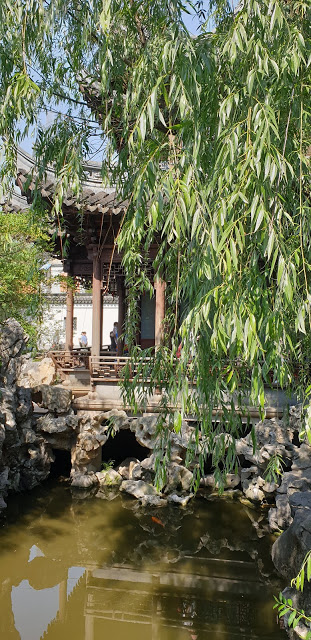
The Yu Gardens (or Yuyuan Gardens) are located at No. 137, Anren Street, Huangpu District, very close to the Old City God Temple, in the northeast of the Old City of Shanghai at Huangpu.
Yu Garden was first built in 1559 during the Ming Dynasty by Pan Yunduan and finished approximately 1577, created specifically as a private garden of the Pan family for Pan Yunduan’s parents to enjoy in their old age.
Yu Garden occupies an area of 5 acres, and is divided into six general areas:
-Sansui Hall which includes the Grand Rockery was originally used to entertain guests,
-Wanhua Chamber is a delicate building surrounded by derious cloisters,
-Dianchun Hall, built in 1820, includes Treasury Hall and the Hall of Harmony,
-Huijing Hall which includes Jade Water Corridor.
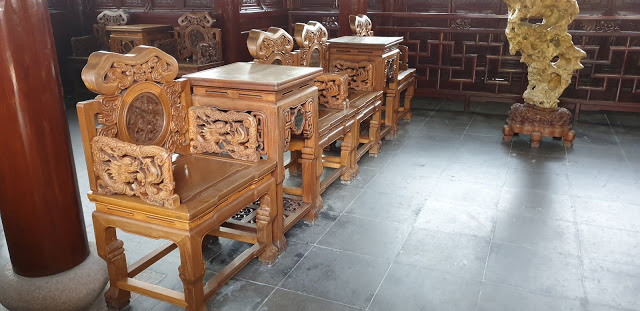
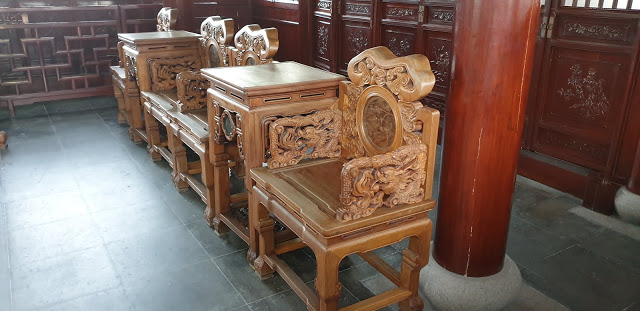
-Yuhua Hall which is furnished with rosewood pieces from the Ming Dynasty, and,
-The Inner Garden with rockeries, ponds, pavilions, and towers; first laid out in 1709. As the quietest part of Yu Gardens, it includes the Hall of Serenity and the Acting and Singing Stage.
The Mid-Lake Pavilion Teahouse, within the gardens, is the oldest teahouse in Shanghai.
A centerpiece of the gardens is the Exquisite Jade Rock, a 5-ton boulder that was originally meant for the Huizong Emperor (Northern Song Dynasty from 1100-1126 AD) but was salvaged from the Huangpu River after the boat carrying it had sunk.
These gardens house a lot of buildings that seemed to be a perfect blend of the old and the new, and if it was up to me, I’d keep the old. Both the building and the gardens they are set in are like an oasis in the middle of an industrial complex, and perhaps impractical for the number of people living in Shanghai.
All of the ponds had a lot of fish in them
It was a pleasant afternoon, for both a stroll through the gardens
In and out of the rockery on narrow pathways
And to look inside the buildings that were sparsely furnished
There was even an area set aside for entertainment.
50 photographs, 50 stories, of which there is one of the 50 below.
They all start with –
A picture paints … well, as many words as you like. For instance:
And, the story:
Have you ever watched your hopes and dreams simply just fly away?
Everything I thought I wanted and needed had just left in an aeroplane, and although I said I was not going to, i came to the airport to see the plane leave. Not the person on it, that would have been far too difficult and emotional, but perhaps it was symbolic, the end of one life and the start of another.
But no matter what I thought or felt, we had both come to the right decision. She needed the opportunity to spread her wings. It was probably not the best idea for her to apply for the job without telling me, but I understood her reasons.
She was in a rut. Though her job was a very good one, it was not as demanding as she had expected, particularly after the last promotion, but with it came resentment from others on her level, that she, the youngest of the group would get the position.
It was something that had been weighing down of her for the last three months, and if noticed it, the late nights, the moodiness, sometimes a flash of temper. I knew she had one, no one could have such red hair and not, but she had always kept it in check.
And, then there was us, together, and after seven years, it felt like we were going nowhere. Perhaps that was down to my lack of ambition, and though she never said it, lack of sophistication. It hadn’t been an issue, well, not until her last promotion, and the fact she had to entertain more, and frankly I felt like an embarrassment to her.
So, there it was, three days ago, the beginning of the weekend, and we had planned to go away for a few days and take stock. We both acknowledged we needed to talk, but it never seemed the right time.
It was then she said she had quit her job and found a new one. Starting the following Monday.
Ok, that took me by surprise, not so much that it something I sort of guessed might happen, but that she would just blurt it out.
I think that right then, at that moment, I could feel her frustration with everything around her.
What surprised her was my reaction. None.
I simply asked where who, and when.
A world-class newspaper, in New York, and she had to be there in a week.
A week.
It was all the time I had left with her.
I remember I just shrugged and asked if the planned weekend away was off.
She stood on the other side of the kitchen counter, hands around a cup of coffee she had just poured, and that one thing I remembered was the lone tear that ran down her cheek.
Is that all you want to know?
I did, yes, but we had lost that intimacy we used to have when she would have told me what was happening, and we would have brainstormed solutions. I might be a cabinet maker but I still had a brain, was what I overheard her tell a friend once.
There’s not much to ask, I said. You’ve been desperately unhappy and haven’t been able to hide it all that well, you have been under a lot of pressure trying to deal with a group of troglodytes, and you’ve been leaning on Bentley’s shoulder instead of mine, and I get it, he’s got more experience in that place, and the politics that go with it, and is still an ally.
Her immediate superior and instrumental in her getting the position, but unlike some men in his position he had not taken advantage of a situation like some men would. And even if she had made a move, which I doubted, that was not the sort of woman she was, he would have politely declined.
One of the very few happily married men in that organisation, so I heard.
So, she said, you’re not just a pretty face.
Par for the course for a cabinet maker whose university degree is in psychology. It doesn’t take rocket science to see what was happening to you. I just didn’t think it was my place to jump in unless you asked me, and when you didn’t, well, that told me everything I needed to know.
Yes, our relationship had a use by date, and it was in the next few days.
I was thinking, she said, that you might come with me, you can make cabinets anywhere.
I could, but I think the real problem wasn’t just the job. It was everything around her and going with her, that would just be a constant reminder of what had been holding her back. I didn’t want that for her and said so.
Then the only question left was, what do we do now?
Go shopping for suitcases. Bags to pack, and places to go.
Getting on the roller coaster is easy. On the beginning, it’s a slow easy ride, followed by the slow climb to the top. It’s much like some relationships, they start out easy, they require a little work to get to the next level, follows by the adrenaline rush when it all comes together.
What most people forget is that what comes down must go back up, and life is pretty much a roller coaster with highs and lows.
Our roller coaster had just come or of the final turn and we were braking so that it stops at the station.
There was no question of going with her to New York. Yes, I promised I’d come over and visit her, but that was a promise with crossed fingers behind my back. After a few months in t the new job the last thing shed want was a reminder of what she left behind. New friends new life.
We packed her bags, three out everything she didn’t want, a free trips to the op shop with stiff she knew others would like to have, and basically, by the time she was ready to go, there was nothing left of her in the apartment, or anywhere.
Her friends would be seeing her off at the airport, and that’s when I told her I was not coming, that moment the taxi arrived to take her away forever. I remember standing there, watching the taxi go. It was going to be, and was, as hard as it was to watch the plane leave.
So, there I was, finally staring at the blank sky, around me a dozen other plane spotters, a rather motley crew of plane enthusiasts.
Already that morning there’s been 6 different types of plane depart, and I could hear another winding up its engines for take-off.
People coming, people going.
Maybe I would go to New York in a couple of months, not to see her, but just see what the attraction was. Or maybe I would drop in, just to see how she was.
As one of my friends told me when I gave him the news, the future is never written in stone, and it’s about time you broadened your horizons.
Well, that’s his, and this is mine. Possession is 9 points of the law, or so they say.
What’s mine is mine and what’s his is mine. Sound like a divorce settlement? Sure is!
There are often a lot of arguments over the possession of goods, and who they belong to. Perhaps it’s best to own nothing, then no one can take it from you.
Sound like a lawyer contesting his own divorce? Probably.
But that’s not the only mine. Take for instance a land mine or a sea mine.
Devilish things to walk on, or brush up against. It spawned a new type of ship, a minesweeper, and I’ve read a few books about the exploits of those aboard, and how close they come to death when a ship hits one.
And land mines, the damage they can cause.
Then, of course, you can go underground, way underground, into a mine.
Gold in South Africa, coal in Wales, tin in Sumatra, copper in New Guinea.
And it doesn’t have to be underground. You can have an open cut mine, which accounts for a lot of coal mines in Australia.
Oddly, you can mine data, the sort that’s stored in databases on computers. I’ve done a bit of that in a former life.
You can mine talent,
Or you can mine bitcoin, but that’s a whole different ballgame, and everyone seems to be in on some sort of scam when it comes to bitcoin. It seems to me the only way you would make money out of bitcoin was to buy units the very first day it was released.
It’s not, and never will be, something I’ll dabble in.
This case has everything, red herrings, jealous brothers, femme fatales, and at the heart of it all, greed.
See below for an excerpt from the book…
Coming soon!
An excerpt from the book:
When Harry took the time to consider his position, a rather uncomfortable position at that, he concluded that he was somehow involved in another case that meant very little to him.
Not that it wasn’t important in some way he was yet to determine, it was just that his curiosity had got the better of him, and it had led to this: sitting in a chair, securely bound, waiting for someone one of his captors had called Doug.
It was not the name that worried him so much, it was the evil laugh that had come after the name was spoken.
Doug what? Doug the ‘destroyer’, Doug the ‘dangerous’, Doug the ‘deadly’; there was any number of sinister connotations, and perhaps that was the point of the laugh, to make it more frightening than it was.
But there was no doubt about one thing in his mind right then: he’d made a mistake. A very big. and costly, mistake. Just how big the cost, no doubt he would soon find out.
His mother, and his grandmother, the wisest person he had ever known, had once told him never to eavesdrop.
At the time he couldn’t help himself and instead of minding his own business, listening to a one-sided conversation which ended with a time and a place. The very nature of the person receiving the call was, at the very least, sinister, and, because of the cryptic conversation, there appeared to be, or at least to Harry, criminal activity involved.
For several days he had wrestled with the thought of whether he should go. Stay on the fringe, keep out of sight, observe and report to the police if it was a crime. Instead, he had willingly gone down the rabbit hole.
Now, sitting in an uncomfortable chair, several heat lamps hanging over his head, he was perspiring, and if perspiration could be used as a measure of fear, then Harry’s fear was at the highest level.
Another runnel of sweat rolled into his left eye, and, having his hands tied, literally, it made it impossible to clear it. The burning sensation momentarily took his mind off his predicament. He cursed and then shook his head trying to prevent a re-occurrence. It was to no avail.
Let the stinging sensation be a reminder of what was right and what was wrong.
It was obvious that it was the right place and the right time, but in considering his current perilous situation, it definitely was the wrong place to be, at the worst possible time.
It was meant to be his escape, an escape from the generations of lawyers, what were to Harry, dry, dusty men who had been in business since George Washington said to the first Walthenson to step foot on American soil, ‘Why don’t you become a lawyer?” when asked what he could do for the great man.
Or so it was handed down as lore, though Harry didn’t think Washington meant it literally, the Walthenson’s, then as now, were not shy of taking advice.
Except, of course, when it came to Harry.
He was, Harry’s father was prone to saying, the exception to every rule. Harry guessed his father was referring to the fact his son wanted to be a Private Detective rather than a dry, dusty lawyer. Just the clothes were enough to turn Harry off the profession.
So, with a little of the money Harry inherited from one of his aunts, he leased an office in Gramercy Park and had it renovated to look like the Sam Spade detective agency, you know the one, Spade and Archer, and The Maltese Falcon.
There’s a movie and a book by Dashiell Hammett if you’re interested.
So, there it was, painted on the opaque glass inset of the front door, ‘Harold Walthenson, Private Detective’.
There was enough money to hire an assistant, and it took a week before the right person came along, or, more to the point, didn’t just see his business plan as something sinister. Ellen, a tall cool woman in a long black dress, or so the words of a song in his head told him, fitted in perfectly.
She’d seen the movie, but she said with a grin, Harry was no Humphrey Bogart.
Of course not, he said, he didn’t smoke.
Three months on the job, and it had been a few calls, no ‘real’ cases, nothing but missing animals, and other miscellaneous items. What he really wanted was a missing person. Or perhaps a beguiling, sophisticated woman who was as deadly as she was charming, looking for an errant husband, perhaps one that she had already ‘dispatched’.
Or for a tall, dark and handsome foreigner who spoke in riddles and in heavily accented English, a spy, or perhaps an assassin, in town to take out the mayor. The man was such an imbecile Harry had considered doing it himself.
Now, in a back room of a disused warehouse, that wishful thinking might be just about to come to a very abrupt end, with none of the romanticized trappings of the business befalling him. No beguiling women, no sinister criminals, no stupid policemen.
Just a nasty little man whose only concern was how quickly or how slowly Harry’s end was going to be.
**Please don’t assume that you have to, nor would I ever expect you to, read any or all of these books. You don’t.**
Everyone, it seems, will publish what they call the top 100 books that you should read. Some are voted on, some belong to the opinion of the editor of the book review section of a newspaper, and, as you know, there are a lot of newspapers, a lot of editors, and a lot of opinions.
I’m not a newspaper, I’m not an editor, but I have a list, based on personal experience, and many, many years of reading.
It’s in no particular order.
41. The Hound of the Baskervilles by Sir Arthur Conan Doyle, as well as a host of other Sherlock Holmes stories
42. The Secret Agent by Joseph Conrad, one of Conrad’s later political novels, set in London in 1886 and deals with anarchism and espionage. In those days spies were called anarchists.
43. The Ipcress File by Len Deighton, introducing us to Harry Palmer, who was personified by Michael Caine and led to Horse Under Water, and Funeral in Berlin. More of Len Deighton later on in the list
44. The Remorseful Day by Colin Dexter introducing the somewhat enigmatic detective, Morse, his first name not revealed for a long time but oddly, Endeavour. John Thaw brought him to life
45. Crime and Punishment by Fyodor Dostoevsky, hard to pronounce and even harder to read, but perhaps worth it in the end. By the time I read this I was wishing for a Russian writer had could use an economy of words
46. Dr. Zhivago by Boris Pasternak wasn’t it. A vast and lengthy dissertation on lost love, I felt very sad for Zhivago in the end. I saw a stage play of the same name, and I’m sorry, but it’s a few hours of my life I will never get back
47. Casino Royale, the first of the James Bond novels by Ian Fleming. I have to say these are among my favorite spy books. I must say I preferred the new James Bond in Casino Royale, though Sean Connery still rules!
48. The Day of the Jackal by Frederick Forsythe, a fascinating story about an assassin
49. Anything written by John Le Carre, but in particular, the George Smiley collection. Finally unmasking his nemesis the Russian spymaster made it all so satisfying.
50. The Bourne Identity by Robert Ludlam, inspiring a long series by both Ludlam and Eric Lustbader makes entertaining reading, but the first, the man who did not know who or what he really was, was excellent. Matt Damon didn’t harm his persona either.
51. Murder Must Advertise by Dorothy Sayers, whose detective is Lord Peter Whimsey, a 1933 mystery novel that’s eighth in the series
52. Gorky Park by Martin Cruz Smith. You have to admit that his Russian detective Arkady Renko is up against it when his investigation goes in a direction that uncovers corruption and dishonest in his superiors
53. The Way of All Flesh by Samuel Butler, a semi-autobiographical novel written between 1987 and 1884, and published in 1903. The story of the Pontifex family.
54. Howards End by E. M. Forster, first published in 1910, is an interesting insight into the behavior of the, and between the classes, with the Schlegels acting as the catalyst.
55. Washington Square by Henry James, originally published as a serial, and covers the conflict between daughter and father. I must say I prefer The Ambassadors to Washington Square.
56. Ulysses by James Joyce, a day in the life of an ordinary man, Leopold Bloom, why could it not be the 7th June rather than the 16th, for obvious reasons
57. The Go-Between by L. P. Hartley is a view of society at the end of the Victorian period through the eyes of a young boy. I read this while still at school and had no clue why, but later, when I read it again, I understood the meaning
58. Atonement by Ian McEwan, I saw the film and then read the book. Never a good idea. Basically, a young girl makes a bad mistake and tries to atone for it.
59. Gone With The Wind by Margaret Mitchell, the War and Peace of Americal novels, and as long by comparison. The only book written by Mitchell, and the second most read book by Americans. The film was interesting but awfully long.
60. The English Patient by Michael Ondaatje, with a man with severe burns and the effect he had on three others. Colin Firth is villain one day and hero the next, this time in the cinematic version, an out and out cad.
It could have been anywhere in the world, she thought, but it wasn’t. It was in a city where if anything were to go wrong…
She sighed and came away from the window and looked around the room. It was quite large and expensively furnished. It was one of several she had been visiting in the last three months.
Quite elegant too, as the hotel had its origins dating back to before the revolution in 1917. At least, currently, there would not be a team of KGB agents somewhere in the basement monitoring everything that happened in the room.
There was no such thing as the KGB anymore, though there was an FSB, but such organisations were of no interest to her.
She was here to meet with Vladimir.
She smiled to herself when she thought of him, such an interesting man whose command of English was as good as her command of Russian, though she had not told him of that ability.
All her knew of her was that she was American, worked in the Embassy as a clerk, nothing important, who life both at work and at home was boring. Not that she had blurted that out the first tie she met, or even the second.
That first time, at a function in the Embassy, was a chance meeting, a catching of his eye as he looked around the room, looking, as he had told her later, for someone who might not be as boring as the function itself.
It was a celebration, honouring one of the Embassy officials on his service in Moscow, and the fact he was returning home after 10 years. She had been there one, and still hadn’t met all the staff.
They had talked, Vladimir knew a great deal about England, having been stationed there for a year or two, and had politely asked questions about where she lived, her family, and of course what her role was, all questions she fended off with an air of disinterested interest.
It fascinated him, as she knew it would, a sort of mental sparring as one would do with swords, if this was a fencing match.
They had said they might or might not meet again when the party was over, but she suspected there would be another opportunity. She knew the signs of a man who was interested in her, and Vladimir was interested.
The second time came in the form of an invitation to an art gallery, and a viewing of the works of a prominent Russian artist, an invitation she politely declined. After all, invitations issued to Embassy staff held all sorts of connotations, or so she was told by the Security officer when she told him.
Then, it went quiet for a month. There was a party at the American embassy and along with several other staff members, she was invited. She had not expected to meet Vladimir, but it was a pleasant surprise when she saw him, on the other side of the room, talking to several military men.
A pleasant afternoon ensued.
And it was no surprise that they kept running into each other at the various events on the diplomatic schedule.
By the fifth meeting, they were like old friends. She had broached the subject of being involved in a plutonic relationship with him with the head of security at the embassy. Normally for a member of her rank it would not be allowed, but in this instance it was.
She did not work in any sensitive areas, and, as the security officer had said, she might just happen upon something that might be useful. In that regard, she was to keep her eyes and ears open, and file a report each time she met him.
After that discussion she got the impression her superiors considered Vladimir more than just a casual visitor on the diplomatic circuit. She also formed the impression the he might consider her an ‘asset’, a word that had been used at the meeting with security and the ambassador.
It was where the word ‘spy’ popped into her head and sent a tingle down her spine. She was not a spy, but the thought of it, well, it would be fascinating to see what happened.
A Russian friend. That’s what she would call him.
And over time, that relationship blossomed, until, after a visit to the ballet, late and snowing, he invited her to his apartment not far from the ballet venue. It was like treading on thin ice, but after champagne and an introduction to caviar, she felt like a giddy schoolgirl.
Even so, she had made him promise that he remain on his best behaviour. It could have been very easy to fall under the spell of a perfect evening, but he promised, showed her to a separate bedroom, and after a brief kiss, their first, she did not see him until the next morning.
So, it began.
It was an interesting report she filed after that encounter, one where she had expected to be reprimanded.
She wasn’t.
It wasn’t until six weeks had passed when he asked her if she would like to take a trip to the country. It would involve staying in a hotel, that they would have separate rooms. When she reported the invitation, no objection was raised, only a caution; keep her wits about her.
Perhaps, she had thought, they were looking forward to a more extensive report. After all, her reports on the places, and the people, and the conversations she overheard, were no doubt entertaining reading for some.
But this visit was where the nature of the relationship changed, and it was one that she did not immediately report. She had realised at some point before the weekend away, that she had feelings for him, and it was not that he was pushing her in that direction or manipulating her in any way.
It was just one of those moments where, after a grand dinner, a lot of champagne, and delightful company, things happen. Standing at the door to her room, a lingering kiss, not intentional on her part, and it just happened.
And for not one moment did she believe she had been compromised, but for some reason she had not reported that subtle change in the relationship to the powers that be, and so far, no one had any inkling.
She took off her coat and placed it carefully of the back of one of the ornate chairs in the room. She stopped for a moment to look at a framed photograph on the wall, one representing Red Square.
Then, after a minute or two, she went to the mini bar and took out the bottle of champagne that had been left there for them, a treat arranged by Vladimir for each encounter.
There were two champagne flutes set aside on the bar, next to a bowl of fruit. She picked up the apple and thought how Eve must have felt in the garden of Eden, and the temptation.
Later perhaps, after…
She smiled at the thought and put the apple back.
A glance at her watch told her it was time for his arrival. It was if anything, the one trait she didn’t like, and that was his punctuality. A glance at the clock on the room wall was a minute slow.
The doorbell to the room rang, right on the appointed time.
She put the bottle down and walked over to the door.
**Please don’t assume that you have to, nor would I ever expect you to, read any or all of these books. You don’t.**
Everyone, it seems, will publish what they call the top 100 books that you should read. Some are voted on, some belong to the opinion of the editor of the book review section of a newspaper, and, as you know, there are a lot of newspapers, a lot of editors, and a lot of opinions.
I’m not a newspaper, I’m not an editor, but I have a list, based on personal experience, and many, many years of reading.
It’s in no particular order.
21. Passage of Arms by Eric Ambler, I have to say I have read most of his novels and they are very good
22. Jane Eyre by Charlotte Bronte, a very powerful story of a courageous, independent woman
23. The Riddle of the Sands by Erskine Childers, a 1903 secret service story, and a good example of an early espionage novel
24. The Father Brown stories by G. K. Chesterton, which features a Roman Catholic priest who is also an amateur detective
25. The Grantchester Mysteries by James Runcie, similar to the above, but featuring an Anglican vicar Sidney Chambers and set in the 1950s. Recently brought to life on television.
26. The High Commissioner by Jon Cleary, an Australian author, this novel introduces Sargeant Scobie Malone, in the first of many adventures
27. A Tale of Two Cities by Charles Dickens, the first Dickens book I read, possibly because it was one of the shortest, and paved the way to read all of his books. Who could forget Madame Defarge
28. Brideshead Revisited by Evelyn Waugh, another of those delightful but depressing stories of the 20s through to the 40s, perhaps for some, the golden age. What could be said, in the end, about the Flytes?
29. The Godfather by Mario Puzo, is the story of the Corleone mafia family, and for me, the most interesting part was that of the horse’s head, and of course, the death and mayhem
30. The Shipping News by Annie Prouix, a Pulitzer Prize winner, and a story about a man, Quoyle, who against all odds puts his life slowly back together
31. Detection Unlimited by Georgette Heyer, noted mostly for her Regency romances, she also wrote a series of detective novels. This was her last detective novel published in 1953
32. Poldark by Winston Graham, a series of stories about the Poldarks and Cornwall, and his arch-nemesis, George Warleggan
33. Our Man in Havana by Graham Greene, one of many very interesting novels, this the first I read, followed by the Quiet American and Travels With My Aunt. Seeing movies of some didn’t enhance the reading experience.
34. The Mayor Of Casterbridge by Thomas Hardy, another of his interesting but sometimes hard to read novels of rural England. This led to Jude the Obscure and others in the ‘series’. It all started with Tess of the D’Urbervilles.
35. A Farewell to Arms by Ernest Hemingway, set during the Italian campaign of World War 1. He also wrote The Old Man of the Sea
36. Lucky Jim by Kingsley Amis, I don’t think he was all that lucky
37. Whiskey Galore by Compton MacKenzie, the story of the ‘rescue’ of several hundred cases of whiskey and the locals’ efforts to hide it. Also famous for writing Monarch of the Glen, later a television series
38. The Expedition of Humphry Clinker by Tobias Smollett, a collection of satirical observations of English life in the 1700s in spa towns and seaside resorts
39. Barchester Towers by Anthony Trollope, part of the series known as The Chronicles of Barsetshire and features the unpopular Bishop Proudie and Mrs. Proudie
40. The Mysterious Affair at Styles by Agatha Christie, Christie’s first book published in 1920, and introduced Poirot, Arthur Hastings, and Inspector Japp. Who knew so many books would follow
The novel ‘Echoes from the past’ started out as a short story I wrote about 30 years ago, titled ‘The birthday’.
My idea was to take a normal person out of their comfort zone and led on a short but very frightening journey to a place where a surprise birthday party had been arranged.
Thus the very large man with a scar and a red tie was created.
So was the friend with the limousine who worked as a pilot.
So were the two women, Wendy and Angelina, who were Flight Attendants that the pilot friend asked to join the conspiracy.
I was going to rework the short story, then about ten pages long, into something a little more.
And like all re-writes, especially those I have anything to do with, it turned into a novel.
There was motivation. I had told some colleagues at the place where I worked at the time that I liked writing, and they wanted a sample. I was going to give them the re-worked short story. Instead, I gave them ‘Echoes from the past’
Originally it was not set anywhere in particular.
But when considering a location, I had, at the time, recently been to New York in December, and visited Brooklyn and Queens, as well as a lot of New York itself. We were there for New Years, and it was an experience I’ll never forget.
One evening we were out late, and finished up in Brooklyn Heights, near the waterfront, and there was rain and snow, it was cold and wet, and there were apartment buildings shimmering in the street light, and I thought, this is the place where my main character will live.
It had a very spooky atmosphere, the sort where ghosts would not be unexpected. I felt more than one shiver go up and down my spine in the few minutes I was there.
I had taken notes, as I always do, of everywhere we went so I had a ready supply of locations I could use, changing the names in some cases.
Fifth Avenue near the Rockefeller center is amazing at first light, and late at night with the Seasonal decorations and lights.
The original main character was a shy and man of few friends, hence not expecting the surprise party. I enhanced that shyness into purposely lonely because of an issue from his past that leaves him always looking over his shoulder and ready to move on at the slightest hint of trouble. No friends, no relationships, just a very low profile.
Then I thought, what if he breaks the cardinal rule, and begins a relationship?
But it is also as much an exploration of a damaged soul, as it is the search for a normal life, without having any idea what normal was, and how the understanding of one person can sometimes make all the difference in what we may think or feel.
**Please don’t assume that you have to, nor would I ever expect you to, read any or all of these books. You don’t.**
Everyone, it seems, will publish what they call the top 100 books that you should read. Some are voted on, some belong to the opinion of the editor of the book review section of a newspaper, and, as you know, there are a lot of newspapers, a lot of editors, and a lot of opinions.
I’m not a newspaper, I’m not an editor, but I have a list, based on personal experience, and many, many years of reading.
It’s in no particular order.
The Life and Opinions of Tristram Shandy, Gentleman by Laurence Sterne. Don’t ask me why but I found this an interesting slice of life in England in the 1700s
Vanity Fair by William Thackeray. I met a direct descendant of him in England on a research visit which fuelled an interest in the book. Another large tome recently brought to life by the mini-series on television.
The Moonstone by Wilkie Collins. Arguably the first detective novel, it was fuel for the imagination of any budding detective novel author. He also wrote The Woman in White.
Middlemarch by George Eliot, a remarkable novel, and famous for the fact it was written by a woman who thought it was best to use a male name in order to get recognition.
Any of the Sherlock Holmes stories by Arthur Conan Doyle
New Grub Street by George Gissing, very, very gritty
The Thirty-Nine Steps by John Buchan, another of those incredibly well-written spy stories
A Passage to India by E.M. Forster, a novel that brings up the subject of the British Empire
The Great Gatsby by F. Scott Fitgerald, a story from the jazz age and the mysterious Jay Gatsby whom no one could figure out
The Maltese Falcon by Dashiell Hammett, one of the few books that opened up the world of the Private Detective, and fostered a brilliant movie with Humprey Bogart as Sam Spade.
The Big Sleep by Raymond Chandler, the author who introduced us to Philip Marlowe, with two definitive characterizations by Humprey Bogart and Robert Mitchum
The Grapes of Wrath by John Steinbeck, the classic about a family in the Great Depression, and my first introduction to Henry Fonda in the movie version of the book
To Kill a Mockingbird by Harper Lee. I had to read this when I was at school and probably a time when I didn’t understand it’s importance. Seeing the film with Gregory Peck much later helped.
Catch 22 by Joseph Heller. A friend recommended this and after I read it, I wondered what the hell it was about. Only now do I understand it’s anti-war undertones
Far from the Madding Crowd by Thomas Hardy was the novel that introduced me to Hardy
Rural Rides by William Cobbett is a slice of life in the southern English countryside in the 1800s
Pride and Prejudice by Jane Austen, the first book of hers I read and found it fascinating. Of course, when Mr. Darcy was brought to life in the television series, it found a whole new generation of readers
Great Expectations by Charles Dickens, the remarkable story of Pip, Miss Havisham, and the mysterious benefactor
Fahrenheit 451 by Ray Bradbury, apparently the temperature that paper burns, but this is more about Guy Montag and the saving of books rather than burning them
Madame Bovary by Gustave Flaubert, probably the most depressing novel I’ve ever read, about a woman married to a mediocre doctor and seeks to escape to a fantasy world that leads to disappointment and devastating consequences
Is love the metaphorical equivalent to ‘walking the plank’; a dive into uncharted waters?
For Henry the only romance he was interested in was a life at sea, and when away from it, he strived to find sanctuary from his family and perhaps life itself. It takes him to a small village by the sea, s place he never expected to find another just like him, Michelle, whom he soon discovers is as mysterious as she is beautiful.
Henry had long since given up the notion of finding romance, and Michelle couldn’t get involved for reasons she could never explain, but in the end both acknowledge that something happened the moment they first met.
Plans were made, plans were revised, and hopes were shattered.
A chance encounter causes Michelle’s past to catch up with her, and whatever hope she had of having a normal life with Henry, or anyone else, is gone. To keep him alive she has to destroy her blossoming relationship, an act that breaks her heart and shatters his.
But can love conquer all?
It takes a few words of encouragement from an unlikely source to send Henry and his friend Radly on an odyssey into the darkest corners of the red light district in a race against time to find and rescue the woman he finally realizes is the love of his life.