Writing a book in 365 days – 175

Day 175

Writing Exercise

Don’t ask me how I got in the middle of the family version or World War 3, but I just happened to call in at the family home on my way home to the residence I’d always wanted after finally moving out of the home.

Enough parental hints had been dropped that it was time to leave the ‘nest, and I agreed.

My older brother had moved out a long time ago and went overseas. I never understood why, and he never explained. He just didn’t come back, and oddly enough no one talked about it.

My younger sister was still at home, and she had hinted there was going to be some news if I decided to come to dinner, and since she was cooking, I agreed. She was a professional chef, and her cooking was not to be missed when on offer.

But…

When I let myself in and announced I’d arrived, there was … silence.

Very unusual, because the house was always a cacophony of noise for one reason or another. At the very least, Susannah and my mother would be exchanging ideas in what my father often called a robust discussion.

Then my mother came out of the dining room at the sound of my arrival, much like a spectre out of the darkness.

“You go talk to Sue. She’s under a great deal of strain and not thinking clearly.”

This meant if I interpreted the tone, my mother had tried to tell her, rather than suggest, what to do, and Sue didn’t take orders very well. She never had, and her last three years at high school had been fraught. Things had settled down after she left for college and cooking school, but it all started up again when she returned home.

Mother had a death wish, father said. He understood that Sussanah needed to find her own path, but Mother had always expected her to follow in her footsteps. She had started the family restaurant but was now getting on, as she called it, and wanted Sue to take over.

Sue said she would if she could modernise the menu. That was the proverbial red rag to the bull.

I went out to the kitchen, but it was empty, so that meant she would be upstairs in her room. I slowly climbed the stairs, thinking back on the last time I had been in the house, about a month before. Sue had just returned from a culinary tour of the south of France and was full of enthusiasm and new recipes.

I’d picked her up from the airport, and we had a discussion, whether mother would ever change her mind, or bring the restaurant into the modern era. I was sure then as I was now, the only way anything would change was if she were to retire or die. Neither option was a possibility.

The door was closed, a bad sign. Mother-daughter arguments had been the mainstay of my youth. She was too much like her mother. My brother and I just kept out of her way.

I knocked, then said, “It’s me.”

“What do you want?” It was not the most welcoming of tones.

“You did ask me to come around, with the offer of fine dining. And a revelation. I guess there’s not going to be a revelation.”

The door opened, and once again I noticed that the sister I once knew had gone, replaced by the new and more mature version of what had always been a brilliant chef. But it was the youthfulness, charm, and playful manner that made it hard to believe just how good she was.

She stood to one side and let me pass. It was probably the third time ever that I had been let into the inner sanctum. It was where she and Matilda, the girl I had always hoped to marry one day, plotted to make my life miserable.

She went back to the unmade, messy bed, and sat cross-legged in the middle, next to several stuffed animals. “How is Matty?”

Oh, by the way, I did marry her, despite the prank my sister pulled that almost made me miss the wedding.

“Wishing she didn’t have to work in New York, but it won’t be for much longer.”

“She told me.”

To further her career and make an impact back home, she had to dazzle the media moguls. That done, the prestigious award for her news coverage, which was recently presented, was enough to impress the local media people, and they finally offered her a job.

“And you? Mother says you are under a great deal of stress.”

“Who wouldn’t with her looking over your shoulder, micro-managing. I was cooking dinner until she decided I needed a hand. When is she ever going to realise I am not her clone or her lackey, that she is only partially responsible for the chef I am today?”

“Funny how she never says that about me.”

“You’re a short-order cook at the local diner. That is not fine dining, that is feeding slop to the pigs at the trough.” She said it with the exact tones and emphasis my mother did when she decried the fact I was wasting my talent in such a den of iniquity.

The truth was I had no talent. Just the ability to make slop look more appealing to the customers, at least better than what Harvey, the previous short-order chef, did. “That’s not what you said about my baseball legend hamburgers.”

She smiled. “OK. You have a knack for presenting edible food, which is a first for the diner. They’re lucky to have you. It’s better than being a busboy in our mother’s place.”

She was right. I did that every summer from the time I could wash dishes. Just because we were family didn’t mean we got privileges.

“True.” I sat down on the chair beside the makeup desk and saw, in the corner, a pile of clothes tossed in a suitcase, the one she had come home with. Hadn’t finished unpacking or getting ready to leave?

“So, silly question, but I’m guessing dinner is off?”

“Yes. She’s annoyed with me for the last time.”

“Meaning?”

“I got an offer to help update the dessert menu for a restaurant chain in LA. One of the instructors at cooking school heard there was an opening, and he always liked my desserts. I’m going to take it while my mother tries to decide what she wants to do.”

“You’re going to do a Jeremy?” My older brother, who’d stormed out after another ‘robust’ discussion with the matriarch.

“I’ve tried talking, olive branches, and common sense. She hasn’t any. That place is going downhill, and she can’t see it and can’t be told. Even father has given up. I know you’ve tried, but she is what she is.”

“When are you going?”

“I was just waiting to see you, ask you to take me to the airport. I’ll stay the night at the hotel and leave tomorrow.”

“You can stay with me, and I’ll take you.”

“Don’t you do the breakfast shift at the diner?”

“Fred can fill in. Pancakes, beans and eggs. Anyone can do that.”

She shrugged. “OK. Down in ten.”

By the time I got to the bottom of the stairs, I still didn’t have a clue how I was going to break the news. The one person who didn’t deserve this was my father, but he always knew life was going to be difficult. He’d accepted that years ago, and just got on with his own life.

Sometimes it seemed to me they were not even connected. I’d always got the impression he knew Jeremy was going to leave, and I also knew, quite by accident, that he frequently visited him in his new home. Being in sales for a company that dealt with a lot of overseas customers, he was able to travel without letting on.

I’d suspected getting me out of the house was so he could move forward with retirement plans, but that dream had been parked.

I went into the lounge room, or what was their TV room, where the TV was on CNN.

“Did you talk some sense into her?” Mother seemed agitated.

“No. But sadly, I have to agree with her. You should consider semi-retirement, and let her run the restaurant. She would be like a breath of fresh air.”

If I’d thought first, I might not have said it. It got the expected reaction.

“While there is still breath in me…”

“Yes, that’s all well and good, mother, but it’s going to be very painful when there are no customers. You know and I know what was great thirty years ago, is not any more, and you can’t deny business has dropped nearly fifty per cent. If you persist down this path, the doors will close in less than six months. You have to move with the times or close the doors. It’s that simple. Three other restaurants, like yours, have closed in the last four months.”

She glared at me. She knew as well as I did what was happening around her. Closing her eyes and hoping it would go away was never going to happen.

“This is coming from a cook at best at the local slophouse.”

“Call the diner whatever you like, mother, but it is always full. People want simple and affordable food. Families can’t afford the cost of dining out fancy any more. The diner isn’t fancy, but it’s homely, they can sit together in a booth, and it’s where their friends go.”

“So, I should turn my place into a slophouse?”

Sue had come down the stairs and left her case at the door.

“Maybe you should, if you want to still have a place.”

“You’ve been cooking for a week, what would you know about anything?”

“Only what you taught me, and if you’re denigrating your own talented mother, then I think it’s time you took a good, long, hard look at yourself. Let’s go, David. I don’t know who this woman is, but it’s not my mother.”

Then she turned and walked out. This was exactly how it ended with Jeremy. I shrugged. There was not going to be any resolution this night.

Mother looked at me, and I thought, perhaps for the first time, she realised what was happening.

“Where’s she going?”

“Away. She’s going to work in LA. At least others think she is a talented and innovative chef. By the time you realise that, it will be too late. Good night.”

I followed Susannah to where she was waiting for me at the front door. She took a long, last look around. “Pity,” she muttered.

I opened the door, and she went through, heading towards my car, parking in the street.

She didn’t look back.

©  Charles Heath 2025

Writing a book in 365 days – 174

Day 174

Emotional Responses

Have you found yourself writing a passage where you have either burst out laughing or shed a tear?

Sometimes, when we are writing certain emotional scenes, that depth of feeling required might actually be a response to something that may have happened to you.

I never thought I could write comedy, because I didn’t believe I had that sort of humour in me. And yet, not so long ago, I was writing a scene where the lines were not meant to be comedic, but just the way the words were going on paper caused me to smile. It was actually something that made me want to write more, if possible, to feed off that first line.

It didn’t quite come as I expected, but over a few days working and reworking, the whole scene came off better than I’d expected, and I was hoping the reader got it.

The same goes for more serious stuff, and I did eventually lean on some of my own feelings on the subject.

But when I was writing it, it was sad, yes, but it didn’t evoke an emotional response.

When I came back to it a few days later, for some odd reason, it did. I actually found tears in my eyes, and I realised that it did hark back to an event where, at the time, it hadn’t affected me, but with more of the story, it did.

Now, writing about my family history and finding out a lot of things I didn’t know about my parents and grandparents, those emotions sometimes run so high, it’s not possible to write. I wonder, when someone finally gets around to reading it, they might have the same feelings.

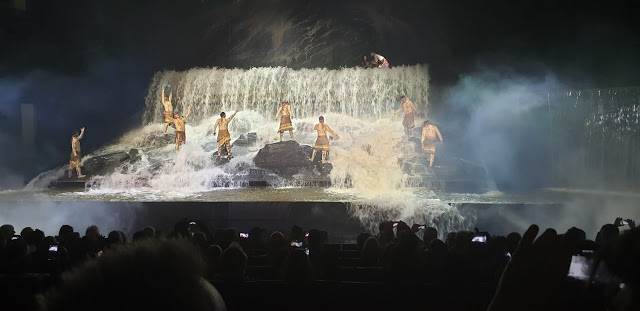
Searching for locations: The Golden Mask Dynasty Show, Beijing, China

The Golden Mask Dynasty Show was located at the OCT Theatre in Beijing’s Happy Valley. 

The theatre was quite full and the seats we had were directly behind the VIP area; as our guide told us, we had the best seats in the house. 

The play has 20 different dance scenes that depict war, royal banquets, and romance.  There are eight chapters and over 200 actors, and throughout the performance we were entertained by dancers, acrobats, costumes, lighting, and acoustics.

The story:

It is of romantic legend and historical memories, the Golden Mask Queen leads her army in defeating the invading Blue Mask King’s army, and afterwards the lands return to a leisurely pastoral life until the Queen forges a ‘mysterious tree’.  When the tree has grown, the Queen has a grand celebration, and releases the captured Blue soldiers, much to the admiration of the Blue Mask King.
This is followed by monstrous floods, and to save her people, and on the advice from the ‘mysterious tree’, the Queen sacrifices herself to save her people.  The Queen then turns into a golden sunbird flying in the sky blessing the people and that of the dynasty.

Billed as the best live show in China, described as a large scale dramatic musical, “The Golden Mask Dynasty” it lived up to its reputation and was thoroughly enjoyed by all.

It was not just singing dancing and acrobatics, it had a story and it was told so that language and cultural issues aside, it worked.  There was a narration of the story running beside the stage, but it was hard to divide attention between what was happening, and what was being related.

Then came the peacock dance, with live peacocks

And this was followed by a waterfall, well, I don’t think anyone in that audience could believe what they were seeing.

I know I was both astonished and in awe of the performance.

What a way to finish off our first day in Beijing.

Oh, sorry, that high was dented slightly when we had to go back to our room.

Searching for locations: The Jade Factory, Beijing, China

The first stop is at a Jade Museum to learn the history of jade. In Chinese, jade is pronounced as “Yu” and it has a history in China of at least four thousand years.  On the way there, we are given a story about one of the guide’s relatives who had a jade bracelet, and how it has saved her from countless catastrophes.It is, quite literally ‘the’ good luck charm.  Chinese gamblers are known to have small pieces of jade in their hands when visiting the casinos, for good luck.  I’m not sure anything could provide a gambler with any sort of luck given how the odds are always slanted towards the house.

At any rate, this is neither the time of the place to debunk a ‘well-known fact’.

 On arrival, our guide hands us over to a local guide, a real staff member, and she begins with a discussion on jade while we watch a single worker working on an intricate piece, what looks to be a globe within a globe, sorry, there are two workers, and the second is working on a dragon.

At the end of the passage that passes by the workers, and before you enter the main showroom, you are dazzled by the ship and is nothing short of magnificent.

Then it’s into a small room just off the main showroom where we are taken through the colors, and the carving process in the various stages, without really being told how the magic happens.

Then it’s out into the main showroom where the sales are made, and before dispersing to look at the jade collection, she briefly tells us how to tell real and fake jade, and she does the usual trick of getting one of the tour group to model a piece.

Looks good, let’s move on.  To bigger and better examples.

What interested me, other than the small zodiac signs and other smallish pieces on the ‘promotion’ table, was the jade bangle our tour guide told us about on the bus.  If anyone needs one, it is my other half, with all the medical issues and her sometimes clumsiness, two particular maladies this object is supposed to prevent.
Jade to the Chinese is Diamonds to westerners, and the jade bangle is often handed down to the females of the family from generation to generation, often as an engagement present, to be worn on the left hand, the one closest to the heart.

There are literally thousands of them, but, they have to be specially fitted to your wrist because if it’s too large, you might lose it if it slips off and I didn’t think it could be too small.  
Nor is it cheap, and needing a larger size, it is reasonably expensive.  But it is jadeite, the more expensive of the types of jade, and it can only appreciate in value, not that we are interested in the monetary value, it’s more the good luck aspect.

We could use some of that.

But, just to touch on something that can be the bugbear of traveling overseas, is the subject of happy houses, a better name for toilets, and has become a recurrent theme on this tour.  It’s better than blurting out the word toilet and it seems there can be some not so happy houses given that the toilets in China are usually squat rather than sit, even for women.
And apparently, everyone has an unhappy house story, particularly the women, and generally in having to squat over a pit.  Why is this a discussion point, it seems the jade factory had what we have come to call happy, happy houses which have more proper toilets, and a stop here before going on the great wall was recommended, as the ‘happy house’ at the wall is deemed to be not such a happy house.

Not even this dragon was within my price range.  Thank heaven they had smaller more affordable models.  The object of having a dragon, large or small, is that it should be placed inside the main door to the house so that money can come in.

It also seems that stuffing the dragon’s mouth with money is also good luck.  We passed on doing that.

After spending a small fortune, there was a bonus, free Chinese tea.  Apparently, we will be coming back, after the Great Wall visit, to have lunch upstairs.


Writing a book in 365 days – 174

Day 174

Emotional Responses

Have you found yourself writing a passage where you have either burst out laughing or shed a tear?

Sometimes, when we are writing certain emotional scenes, that depth of feeling required might actually be a response to something that may have happened to you.

I never thought I could write comedy, because I didn’t believe I had that sort of humour in me. And yet, not so long ago, I was writing a scene where the lines were not meant to be comedic, but just the way the words were going on paper caused me to smile. It was actually something that made me want to write more, if possible, to feed off that first line.

It didn’t quite come as I expected, but over a few days working and reworking, the whole scene came off better than I’d expected, and I was hoping the reader got it.

The same goes for more serious stuff, and I did eventually lean on some of my own feelings on the subject.

But when I was writing it, it was sad, yes, but it didn’t evoke an emotional response.

When I came back to it a few days later, for some odd reason, it did. I actually found tears in my eyes, and I realised that it did hark back to an event where, at the time, it hadn’t affected me, but with more of the story, it did.

Now, writing about my family history and finding out a lot of things I didn’t know about my parents and grandparents, those emotions sometimes run so high, it’s not possible to write. I wonder, when someone finally gets around to reading it, they might have the same feelings.

First Dig Two Graves

A sequel to “The Devil You Don’t”

Revenge is a dish best served cold – or preferably so when everything goes right

Of course, it rarely does, as Alistair, Zoe’s handler, discovers to his peril. Enter a wildcard, John, and whatever Alistair’s plan for dealing with Zoe was dies with him.

It leaves Zoe in completely unfamiliar territory.

John’s idyllic romance with a woman who is utterly out of his comfort zone is on borrowed time. She is still trying to reconcile her ambivalence, after being so indifferent for so long.

They agree to take a break, during which she disappears. John, thinking she has left without saying goodbye, refuses to accept the inevitable, calls on an old friend for help in finding her.

After the mayhem and being briefly reunited, she recognises an inevitable truth: there is a price to pay for taking out Alistair; she must leave and find them first, and he would be wise to keep a low profile.

But keeping a low profile just isn’t possible, and enlisting another friend, a private detective and his sister, a deft computer hacker, they track her to the border between Austria and Hungary.

What John doesn’t realise is that another enemy is tracking him to find her too. It could have been a grand tour of Europe. Instead, it becomes a race against time before enemies old and new converge for what will be an inevitable showdown.

Writing a book in 365 days – 172/173

Days 172 and 173

Writing exercise – Something they thought they had known all their lives turns out to be false.

Someone once told me that weddings and funerals brought out the worst in people.  Even those you thought were family.

Of course, it was not so much the fact that people could be very nasty, they could and with very little provocation, but there was always a catalyst, and it had nothing to do with human nature.

It had everything to do with money.

I knew this because I had spent the last 30 years of my life with my older brothers and, like the last sibling in the family spoiled and treated more favourably than those who came before, but not in a bad way.

After all, we were family.

Our mother and father treated us all with the same disdain the moment we were all old enough to fend for ourselves.  They had the means and wherewithal to give us an easy life, but they instead chose to cut us off the dat we turned 21 and made it a rule we had to fend for ourselves

For David, the eldest, now 45, and William, his twin brother, for Wendy, second eldest, 43, George, third eldest, 41 and Petulia, my youngest sister, 39 and then me, the surprise, Andrew, who just turned 30.

The others went to very expensive schools and had the benefit of the old school tie, some of which they often bemoaned, having spent time at boarding school.

The girls did the same, and then were finished off in Switzerland, the sort of girls who should have married Dukes or sons of Dukes and be living in castles.  They certainly had the expenses, the expensive tastes, and the posh voices to go with it.

Just not the Dukes.

And my brothers, they had all perfected the art of starting, but never finishing, a project and had to be saved, if only to save the family name.

My father didn’t like failure.  I took that to heart and used my polytechnic education and turned it into a gold mine, one I simply avoided telling the others about because I knew this day would come.

The day the cash cow stopped handing out cash.

The day our parents died in a plane crash, in a plane my father was piloting until he had a heart attack and lost control of it, and from which plane my mother had called me to ask me what she could do.

I didn’t get to tell her it was too late.

Three days after the funeral, one that made page two in the national dailies for a reason I won’t go into, that would take a book, we assembled in the morning room of Ballyshore Manor, the family seat.

It was the reading of the will.  It was exactly the same for Mother as it was for Father.

Expectations were high.  My siblings were not the sort of people who understood economics or the vagaries of accounting. 

They had no idea how much it cost to run a household, maintain servants or a hundred-acre estate, or the value of family heirlooms and history.

They had all met, without me, to discuss what it was worth and how they would divvy up the proceeds.  I deduced this when they all arrived at the Manor, and under the guise of reacquainting themselves with their home, each had a section, a clipboard with lots of blank paper and started writing down everything that was for sale.

They thought their surreptitious activities were undetectable.  They forgot about the servants who noted everything they did, and those activities were in Davidson’s report to me.

Davidson was the Butler, the head of the household, along with Joanne, in charge of everything else, and if she was to be believed, everything Davidson was responsible for.

They and the other servants had their future to worry about.  But what they did was no surprise.  They showed no remorse or feelings at the funeral, other than a few crocodile tears.

They filed in one by one, each giving the other a sly look, like they had a shared secret, one that had been kept from me.

Mr Wilkinson of Wilkinson, Wilkinson, Wilkinson, and Wilks, the elder and my father’s best friend from school days, was the solicitor who would be reading the will.

I had asked him if he knew what was in it, and he said no.  Father had made a late change, and Wilkinson, the younger, had attended to the details, then sealed it.

Father had wanted it that way.

And he had said just before the twins arrived, he was looking forward to the roller coaster ride.

With everyone in attendance, I chose a seat in the third row, and the reading began.

“Firstly, I would like to thank you all for coming.  Your father specifically asked that I should do the reading from this room rather than in Chambers.

“It is a pleasure to finally get back here and I know that both your parents wanted to keep the Manor in the family, but, as you can imagine,” he held up the sealed envelope with the new will in it, “I’m guessing it will depend on what’s in here.”

He then made a great show of opening the envelope and showing it the Wilkinson the younger to verify it was the last will and testament.

I could see the reflection of the five other siblings in the floor-to-ceiling doors that, in summer, opened out on the patio, but closed for winter, salivating at the riches they were about to get their hands on.

I tried hard to hide my disappointment.

He read the legal stuff before getting to the meat of the matter.

“Your mother and I were proud as punch when our twins, David and William, were born, and there have been ongoing discussions, sometimes heated, over who was first.  It can now be settled.  David was first, therefore the eldest, and all things considered, the heir apparent.

“In name only, though.  Whether first or sixth, it had no bearing on how the inheritances are allocated.”

A momentary pause while David’s supercilious and smug look turned to a rather pug-ugly expression.

“The idea was that each of you should get one-sixth of the inheritance.  Then Dorothy,” that was Mother’s name, “said we should take into account the benefits we paid out each time each of you stumbled, because quite frankly she was annoyed that after being given the best education and the best start in life all of you managed to fail, not once, but in one case six times.  And all during those failures, not once did you think to exercise economy and stop living high on the hog.”

Wilkinson stopped and looked at each one of them.

When he got to David, David said, ” You can skip the pathetic attempt to tell us we were not as good as them.  It was their fault anyway.  They knew baling us out.  They should have been tougher.”

It probably was their fault, but like all proud parents, they had hoped sooner or later one or all of them might change.

That was never going to happen.

“Well, perhaps belatedly they might be.  Let us continue.”  He shuffled through three sheets, a long dissertation no doubt of their shortcomings, and then at the next took up the reading.

“So, in light of all yor failures, the final sums to be deducted in round numbers, from your inheritances will be, David, twenty three million pounds, William, twenty eight million pounds, Wendy, twelve million pounds, George, twenty two million pounds, Joanne, one million pounds, and Andrew, zero pounds.”

“How does he get no deduction?”  William demanded.

“He had a successful company and contributed about a hundred million pounds to the estate.”

“What?  How?”  David swivelled on his chair to glare at me.

“Father never lent me anything.  I told him I had an idea, and he said to run with it.  When the estate was having financial problems, I contributed some working capital.”

“Which in turn means that your parents have to return those funds as per the terms of the loan agreement between your parents and Andrews company, Lightseek Investments.”

“Wouldn’t that be up to the heirs of the estate?”

“It could be argued that it is possible.  But it would have to be deducted from the proceeds of the sale if such a sale were contemplated by the heirs.”

“Then I guess it’s time to find out who the heirs are, not that we don’t already know.”

I was guessing he had the estate valued, and if he was smarter than I thought he was, he would have asked around whether any of the neighbours and one in particular, were interested.  My own enquiries valued the estate as a going concern, at about three hundred and twenty-five million pounds.

“Right.  There’s just a little more preamble.  After thirty years of disappointing results, I asked a private investigator to look into each of my children and their heritage.  The thing is, my brother’s children are all successful businesspeople and success was written into our DNA.  Samples were taken from each of my brothers’ children and mine and compared.

“Here’s the surprise.  The only child in the room, who is my son, is Andrew.  The rest of you are not.  Apparently, Dorothy had a long-standing affair with another man, and each of you is his progeny, not mine.  Therefore, as far as I’m concerned, none of you is entitled to inherit anything from the estate, except Andrew.  You may be entitled to inherit something from your mother and the man who is your legitimate father.  If you can find him.  Therefore, the whole of my estate and everything else that I possessed are left to my son, Andrew.”

David leapt out of his chair, and his usual high-pitched bluster, yelled, ” This is rubbish.  He can’t do this.  We are his children irrespective of who our real or imaginary father is or was.  We will fight this and win.”

“That might be so, but there’s just one more problem.  You can sue for possession of the Manor, the estate and everything else, but currently it is under an order where, unless the debts of the estate are not paid within one month of the date of your parents’ death, the property will be siexed by the financiers given the debt.”

“That can’t be much,”

“Thirty-six million pounds, after the loan to Andrew’s company, is repaid.  The finance company will have a fire sale, and you will all inherit debt, which none of you can pay.”

“Andrew will pay it,” Joanna said, as a favour to his siblings.  After all, it sounds like he’s made of money, plenty to go around.”

I smiled.  She was sweetly naive but of the same stock as her older brothers and sister.

“No.  You wasted every opportunity afforded you, and I’m not going to perpetuate fathers’ generosity.  You leave her with debts to pay or nothing.  Your high life is over.

“This can’t be happening,” Wendy muttered.  “How can Mother have done this to us?”

I stood and looked at Wilkinson, the elder.  “When does all of this need to be settled?”

“The weeks.  I’ve scheduled a meeting with the creditors.”

“Good.  I’ll see you again in several days.  Tell the staff they have nothing to worry about.  I’ll be staying here for six months of the year.”

“What about us?” George said. 

“You are not family, and have no right to live here or to expect anything.  I suggest you find your real father and sponge off him.  Or, worst possible scenario, get a job.  I’m sure my employment people will find you something.  Wilkinson has the cards if you want one.”

“Did you know?” Wendy asked.

“No.  He never said a word to me or anyone.  He did tell me how proud he was of you lot when he didn’t know you were not his, and had always hoped success would happen.  But maybe he did have an idea because now I remember our last conversation before he died.  He rather cryptically said that he hoped one day that you would overcome the genes you inherited.  I didn’t have much of it at the time.

“You can’t just leave us here with nothing.”

“No.  I guess not.  Tell you what.  You prove to Wilkinson here that you have a job and are earning an income for three months, and I’ll have him issue you with a check for half a million pounds.  And if you can keep that job, a half million each year thereafter.  Take it or leave it.”

They took it.

But what happened on the road to achieving success was another story. 

©  Charles Heath  2025

Searching for locations: The Jade Factory, Beijing, China

The first stop is at a Jade Museum to learn the history of jade. In Chinese, jade is pronounced as “Yu” and it has a history in China of at least four thousand years.  On the way there, we are given a story about one of the guide’s relatives who had a jade bracelet, and how it has saved her from countless catastrophes.It is, quite literally ‘the’ good luck charm.  Chinese gamblers are known to have small pieces of jade in their hands when visiting the casinos, for good luck.  I’m not sure anything could provide a gambler with any sort of luck given how the odds are always slanted towards the house.

At any rate, this is neither the time of the place to debunk a ‘well-known fact’.

 On arrival, our guide hands us over to a local guide, a real staff member, and she begins with a discussion on jade while we watch a single worker working on an intricate piece, what looks to be a globe within a globe, sorry, there are two workers, and the second is working on a dragon.

At the end of the passage that passes by the workers, and before you enter the main showroom, you are dazzled by the ship and is nothing short of magnificent.

Then it’s into a small room just off the main showroom where we are taken through the colors, and the carving process in the various stages, without really being told how the magic happens.

Then it’s out into the main showroom where the sales are made, and before dispersing to look at the jade collection, she briefly tells us how to tell real and fake jade, and she does the usual trick of getting one of the tour group to model a piece.

Looks good, let’s move on.  To bigger and better examples.

What interested me, other than the small zodiac signs and other smallish pieces on the ‘promotion’ table, was the jade bangle our tour guide told us about on the bus.  If anyone needs one, it is my other half, with all the medical issues and her sometimes clumsiness, two particular maladies this object is supposed to prevent.
Jade to the Chinese is Diamonds to westerners, and the jade bangle is often handed down to the females of the family from generation to generation, often as an engagement present, to be worn on the left hand, the one closest to the heart.

There are literally thousands of them, but, they have to be specially fitted to your wrist because if it’s too large, you might lose it if it slips off and I didn’t think it could be too small.  
Nor is it cheap, and needing a larger size, it is reasonably expensive.  But it is jadeite, the more expensive of the types of jade, and it can only appreciate in value, not that we are interested in the monetary value, it’s more the good luck aspect.

We could use some of that.

But, just to touch on something that can be the bugbear of traveling overseas, is the subject of happy houses, a better name for toilets, and has become a recurrent theme on this tour.  It’s better than blurting out the word toilet and it seems there can be some not so happy houses given that the toilets in China are usually squat rather than sit, even for women.
And apparently, everyone has an unhappy house story, particularly the women, and generally in having to squat over a pit.  Why is this a discussion point, it seems the jade factory had what we have come to call happy, happy houses which have more proper toilets, and a stop here before going on the great wall was recommended, as the ‘happy house’ at the wall is deemed to be not such a happy house.

Not even this dragon was within my price range.  Thank heaven they had smaller more affordable models.  The object of having a dragon, large or small, is that it should be placed inside the main door to the house so that money can come in.

It also seems that stuffing the dragon’s mouth with money is also good luck.  We passed on doing that.

After spending a small fortune, there was a bonus, free Chinese tea.  Apparently, we will be coming back, after the Great Wall visit, to have lunch upstairs.


Another excerpt from ‘Betrayal’; a work in progress

My next destination in the quest was the hotel we believed Anne Merriweather had stayed at.

I was, in a sense, flying blind because we had no concrete evidence she had been there, and the message she had left behind didn’t quite name the hotel or where Vladimir was going to take her.

Mindful of the fact that someone might have been following me, I checked to see if the person I’d assumed had followed me to Elizabeth’s apartment was still in place, but I couldn’t see him. Next, I made a mental note of seven different candidates and committed them to memory.

Then I set off to the hotel, hailing a taxi. There was the possibility the cab driver was one of them, but perhaps I was slightly more paranoid than I should be. I’d been watching the queue, and there were two others before me.

The journey took about an hour, during which time I kept an eye out the back to see if anyone had been following us. If anyone was, I couldn’t see them.

I had the cab drop me off a block from the hotel and then spent the next hour doing a complete circuit of the block the hotel was on, checking the front and rear entrances, the cameras in place, and the siting of the driveway into the underground carpark. There was a camera over the entrance, and one we hadn’t checked for footage. I sent a text message to Fritz to look into it.

The hotel lobby was large and busy, which was exactly what you’d want if you wanted to come and go without standing out. It would be different later at night, but I could see her arriving about mid-afternoon, and anonymous among the type of clientele the hotel attracted.

I spent an hour sitting in various positions in the lobby simply observing. I had already ascertained where the elevator lobby for the rooms was, and the elevator down to the car park. Fortunately, it was not ‘guarded’ but there was a steady stream of concierge staff coming and going to the lower levels, and, just from time to time, guests.

Then, when there was a commotion at the front door, what seemed to be a collision of guests and free-wheeling bags, I saw one of the seven potential taggers sitting by the front door. Waiting for me to leave? Or were they wondering why I was spending so much time there?

Taking advantage of that confusion, I picked my moment to head for the elevators that went down to the car park, pressed the down button, and waited.

The was no car on the ground level, so I had to wait, watching, like several others, the guests untangling themselves at the entrance, and an eye on my potential surveillance, still absorbed in the confusion.

The doors to the left car opened, and a concierge stepped out, gave me a quick look, then headed back to his desk. I stepped into the car, pressed the first level down, the level I expected cars to arrive on, and waited what seemed like a long time for the doors to close.

As they did, I was expecting to see a hand poke through the gap, a latecomer. Nothing happened, and I put it down to a television moment.

There were three basement levels, and for a moment, I let my imagination run wild and considered the possibility that there were more levels. Of course, there was no indication on the control panel that there were any other floors, and I’d yet to see anything like it in reality.

With a shake of my head to return to reality, the car arrived, the doors opened, and I stepped out.

A car pulled up, and the driver stepped out, went around to the rear of his car, and pulled out a case. I half expected him to throw me the keys, but the instant glance he gave me told him was not the concierge, and instead brushed past me like I wasn’t there.

He bashed the up button several times impatiently and cursed when the doors didn’t open immediately. Not a happy man.

Another car drove past on its way down to a lower level.

I looked up and saw the CCTV camera, pointing towards the entrance, visible in the distance. A gate that lifted up was just about back in position and then made a clunk when it finally closed. The footage from the camera would not prove much, even if it had been working, because it didn’t cover the life lobby, only in the direction of the car entrance.

The doors to the other elevator car opened, and a man in a suit stepped out.

“Can I help you, sir? You seem lost.”

Security, or something else. “It seems that way. I went to the elevator lobby, got in, and it went down rather than up. I must have been in the wrong place.”

“Lost it is, then, sir.” I could hear the contempt for Americans in his tone. “If you will accompany me, please.”

He put out a hand ready to guide me back into the elevator. I was only too happy to oblige him. There had been a sign near the button panel that said the basement levels were only to be accessed by the guests.

Once inside, he turned a key and pressed the lobby button. The doors closed, and we went up. He stood, facing the door, not speaking. A few seconds later, he was ushering me out to the lobby.

“Now, sir, if you are a guest…”

“Actually, I’m looking for one. She called me and said she would be staying in this hotel and to come down and visit her. I was trying to get to the sixth floor.”

“Good. Let’s go over the the desk and see what we can do for you.”

I followed him over to the reception desk, where he signalled one of the clerks, a young woman who looked and acted very efficiently, and told her of my request, but then remained to oversee the proceeding.

“Name of guest, sir?”

“Merriweather, Anne. I’m her brother, Alexander.” I reached into my coat pocket and pulled out my passport to prove that I was who I said I was. She glanced cursorily at it.

She typed the name into the computer, and then we waited a few seconds while it considered what to output. Then, she said, “That lady is not in the hotel, sir.”

Time to put on my best-confused look. “But she said she would be staying here for the week. I made a special trip to come here to see her.”

Another puzzled look from the clerk, then, “When did she call you?”

An interesting question to ask, and it set off a warning bell in my head. I couldn’t say today, it would have to be the day she was supposedly taken.

“Last Saturday, about four in the afternoon.”

Another look at the screen, then, “It appears she checked out Sunday morning. I’m afraid you have made a trip in vain.”

Indeed, I had. “Was she staying with anyone?”

I just managed to see the warning pass from the suited man to the clerk. I thought he had shown an interest when I mentioned the name, and now I had confirmation. He knew something about her disappearance. The trouble was, he wasn’t going to volunteer any information because he was more than just hotel security.

“No.”

“Odd,” I muttered. “I thought she told me she was staying with a man named Vladimir something or other. I’m not too good at pronouncing those Russian names. Are you sure?”

She didn’t look back at the screen. “Yes.”

“OK, now one thing I do know about staying in hotels is that you are required to ask guests with foreign passports their next destination, just in case they need to be found. Did she say where she was going next?” It was a long shot, but I thought I’d ask.

“Moscow. As I understand it, she lives in Moscow. That was the only address she gave us.”

I smiled. “Thank you. I know where that is. I probably should have gone there first.”

She didn’t answer; she didn’t have to, her expression did that perfectly.

The suited man spoke again, looking at the clerk. “Thank you.” He swivelled back to me. “I’m sorry we can’t help you.”

“No. You have more than you can know.”

“What was your name again, sir, just in case you still cannot find her?”

“Alexander Merriweather. Her brother. And if she is still missing, I will be posting a very large reward. At the moment, you can best contact me via the American Embassy.”

Money is always a great motivator, and that thoughtful expression on his face suggested he gave a moment’s thought to it.

I left him with that offer and left. If anything, the people who were holding her would know she had a brother, that her brother was looking for her, and equally that brother had money.

© Charles Heath – 2018-2025

Writing a book in 365 days – 172/173

Days 172 and 173

Writing exercise – Something they thought they had known all their lives turns out to be false.

Someone once told me that weddings and funerals brought out the worst in people.  Even those you thought were family.

Of course, it was not so much the fact that people could be very nasty, they could and with very little provocation, but there was always a catalyst, and it had nothing to do with human nature.

It had everything to do with money.

I knew this because I had spent the last 30 years of my life with my older brothers and, like the last sibling in the family spoiled and treated more favourably than those who came before, but not in a bad way.

After all, we were family.

Our mother and father treated us all with the same disdain the moment we were all old enough to fend for ourselves.  They had the means and wherewithal to give us an easy life, but they instead chose to cut us off the dat we turned 21 and made it a rule we had to fend for ourselves

For David, the eldest, now 45, and William, his twin brother, for Wendy, second eldest, 43, George, third eldest, 41 and Petulia, my youngest sister, 39 and then me, the surprise, Andrew, who just turned 30.

The others went to very expensive schools and had the benefit of the old school tie, some of which they often bemoaned, having spent time at boarding school.

The girls did the same, and then were finished off in Switzerland, the sort of girls who should have married Dukes or sons of Dukes and be living in castles.  They certainly had the expenses, the expensive tastes, and the posh voices to go with it.

Just not the Dukes.

And my brothers, they had all perfected the art of starting, but never finishing, a project and had to be saved, if only to save the family name.

My father didn’t like failure.  I took that to heart and used my polytechnic education and turned it into a gold mine, one I simply avoided telling the others about because I knew this day would come.

The day the cash cow stopped handing out cash.

The day our parents died in a plane crash, in a plane my father was piloting until he had a heart attack and lost control of it, and from which plane my mother had called me to ask me what she could do.

I didn’t get to tell her it was too late.

Three days after the funeral, one that made page two in the national dailies for a reason I won’t go into, that would take a book, we assembled in the morning room of Ballyshore Manor, the family seat.

It was the reading of the will.  It was exactly the same for Mother as it was for Father.

Expectations were high.  My siblings were not the sort of people who understood economics or the vagaries of accounting. 

They had no idea how much it cost to run a household, maintain servants or a hundred-acre estate, or the value of family heirlooms and history.

They had all met, without me, to discuss what it was worth and how they would divvy up the proceeds.  I deduced this when they all arrived at the Manor, and under the guise of reacquainting themselves with their home, each had a section, a clipboard with lots of blank paper and started writing down everything that was for sale.

They thought their surreptitious activities were undetectable.  They forgot about the servants who noted everything they did, and those activities were in Davidson’s report to me.

Davidson was the Butler, the head of the household, along with Joanne, in charge of everything else, and if she was to be believed, everything Davidson was responsible for.

They and the other servants had their future to worry about.  But what they did was no surprise.  They showed no remorse or feelings at the funeral, other than a few crocodile tears.

They filed in one by one, each giving the other a sly look, like they had a shared secret, one that had been kept from me.

Mr Wilkinson of Wilkinson, Wilkinson, Wilkinson, and Wilks, the elder and my father’s best friend from school days, was the solicitor who would be reading the will.

I had asked him if he knew what was in it, and he said no.  Father had made a late change, and Wilkinson, the younger, had attended to the details, then sealed it.

Father had wanted it that way.

And he had said just before the twins arrived, he was looking forward to the roller coaster ride.

With everyone in attendance, I chose a seat in the third row, and the reading began.

“Firstly, I would like to thank you all for coming.  Your father specifically asked that I should do the reading from this room rather than in Chambers.

“It is a pleasure to finally get back here and I know that both your parents wanted to keep the Manor in the family, but, as you can imagine,” he held up the sealed envelope with the new will in it, “I’m guessing it will depend on what’s in here.”

He then made a great show of opening the envelope and showing it the Wilkinson the younger to verify it was the last will and testament.

I could see the reflection of the five other siblings in the floor-to-ceiling doors that, in summer, opened out on the patio, but closed for winter, salivating at the riches they were about to get their hands on.

I tried hard to hide my disappointment.

He read the legal stuff before getting to the meat of the matter.

“Your mother and I were proud as punch when our twins, David and William, were born, and there have been ongoing discussions, sometimes heated, over who was first.  It can now be settled.  David was first, therefore the eldest, and all things considered, the heir apparent.

“In name only, though.  Whether first or sixth, it had no bearing on how the inheritances are allocated.”

A momentary pause while David’s supercilious and smug look turned to a rather pug-ugly expression.

“The idea was that each of you should get one-sixth of the inheritance.  Then Dorothy,” that was Mother’s name, “said we should take into account the benefits we paid out each time each of you stumbled, because quite frankly she was annoyed that after being given the best education and the best start in life all of you managed to fail, not once, but in one case six times.  And all during those failures, not once did you think to exercise economy and stop living high on the hog.”

Wilkinson stopped and looked at each one of them.

When he got to David, David said, ” You can skip the pathetic attempt to tell us we were not as good as them.  It was their fault anyway.  They knew baling us out.  They should have been tougher.”

It probably was their fault, but like all proud parents, they had hoped sooner or later one or all of them might change.

That was never going to happen.

“Well, perhaps belatedly they might be.  Let us continue.”  He shuffled through three sheets, a long dissertation no doubt of their shortcomings, and then at the next took up the reading.

“So, in light of all yor failures, the final sums to be deducted in round numbers, from your inheritances will be, David, twenty three million pounds, William, twenty eight million pounds, Wendy, twelve million pounds, George, twenty two million pounds, Joanne, one million pounds, and Andrew, zero pounds.”

“How does he get no deduction?”  William demanded.

“He had a successful company and contributed about a hundred million pounds to the estate.”

“What?  How?”  David swivelled on his chair to glare at me.

“Father never lent me anything.  I told him I had an idea, and he said to run with it.  When the estate was having financial problems, I contributed some working capital.”

“Which in turn means that your parents have to return those funds as per the terms of the loan agreement between your parents and Andrews company, Lightseek Investments.”

“Wouldn’t that be up to the heirs of the estate?”

“It could be argued that it is possible.  But it would have to be deducted from the proceeds of the sale if such a sale were contemplated by the heirs.”

“Then I guess it’s time to find out who the heirs are, not that we don’t already know.”

I was guessing he had the estate valued, and if he was smarter than I thought he was, he would have asked around whether any of the neighbours and one in particular, were interested.  My own enquiries valued the estate as a going concern, at about three hundred and twenty-five million pounds.

“Right.  There’s just a little more preamble.  After thirty years of disappointing results, I asked a private investigator to look into each of my children and their heritage.  The thing is, my brother’s children are all successful businesspeople and success was written into our DNA.  Samples were taken from each of my brothers’ children and mine and compared.

“Here’s the surprise.  The only child in the room, who is my son, is Andrew.  The rest of you are not.  Apparently, Dorothy had a long-standing affair with another man, and each of you is his progeny, not mine.  Therefore, as far as I’m concerned, none of you is entitled to inherit anything from the estate, except Andrew.  You may be entitled to inherit something from your mother and the man who is your legitimate father.  If you can find him.  Therefore, the whole of my estate and everything else that I possessed are left to my son, Andrew.”

David leapt out of his chair, and his usual high-pitched bluster, yelled, ” This is rubbish.  He can’t do this.  We are his children irrespective of who our real or imaginary father is or was.  We will fight this and win.”

“That might be so, but there’s just one more problem.  You can sue for possession of the Manor, the estate and everything else, but currently it is under an order where, unless the debts of the estate are not paid within one month of the date of your parents’ death, the property will be siexed by the financiers given the debt.”

“That can’t be much,”

“Thirty-six million pounds, after the loan to Andrew’s company, is repaid.  The finance company will have a fire sale, and you will all inherit debt, which none of you can pay.”

“Andrew will pay it,” Joanna said, as a favour to his siblings.  After all, it sounds like he’s made of money, plenty to go around.”

I smiled.  She was sweetly naive but of the same stock as her older brothers and sister.

“No.  You wasted every opportunity afforded you, and I’m not going to perpetuate fathers’ generosity.  You leave her with debts to pay or nothing.  Your high life is over.

“This can’t be happening,” Wendy muttered.  “How can Mother have done this to us?”

I stood and looked at Wilkinson, the elder.  “When does all of this need to be settled?”

“The weeks.  I’ve scheduled a meeting with the creditors.”

“Good.  I’ll see you again in several days.  Tell the staff they have nothing to worry about.  I’ll be staying here for six months of the year.”

“What about us?” George said. 

“You are not family, and have no right to live here or to expect anything.  I suggest you find your real father and sponge off him.  Or, worst possible scenario, get a job.  I’m sure my employment people will find you something.  Wilkinson has the cards if you want one.”

“Did you know?” Wendy asked.

“No.  He never said a word to me or anyone.  He did tell me how proud he was of you lot when he didn’t know you were not his, and had always hoped success would happen.  But maybe he did have an idea because now I remember our last conversation before he died.  He rather cryptically said that he hoped one day that you would overcome the genes you inherited.  I didn’t have much of it at the time.

“You can’t just leave us here with nothing.”

“No.  I guess not.  Tell you what.  You prove to Wilkinson here that you have a job and are earning an income for three months, and I’ll have him issue you with a check for half a million pounds.  And if you can keep that job, a half million each year thereafter.  Take it or leave it.”

They took it.

But what happened on the road to achieving success was another story. 

©  Charles Heath  2025