Never let it be said that I would try to have four commas in a sentence. Not that I would deliberately expect to see how it would sound.
After all, the comma is the point where the reader takes a breath. One official definition of the comma is to separate clauses or lists of three or more items.
Someone might want to tell the people who create grammar checkers that, because sometimes their suggested edits are a little perplexing.
Of course, the humble comma is also very useful for making the author’s meaning clearer to the reader, who, it seems, is always trying to misinterpret what he or she is trying to say.
Sadly, just about everything I write can be misinterpreted, especially by those strange grammar checkers. You see, the programmers who are behind such beasts injected their own interpretation, so no matter what you want to say, they change it into something incomprehensible.
Unless, of course, you take charge and override the changes or simply ignore the suggestions. The problem is, it won’t let it go, underscoring or highlighting what it thinks is wrong and takes you back, like an errant child, expecting you to conform.
Even selecting ignore only lets you think you have won!
But all the same, there are eight rules for using commas, and it doesn’t hurt to at least read what they are so you can make up your own mind.
The next battle, and believe me, I have drawn the line on the battlefield, a line these mechanical behemoths simply roll right over.
I know what words I was to use. It doesn’t or shouldn’t after what I use because those ate my words. The checker can not possibly know what I want to convey.
And yet there it is, saying that I have no idea what I’m talking about.
OK. I get it. We don’t want to have too much flowery language. But just what is flowery language? Acting dumb, I’d say I don’t use flowers to describe stuff.
Then, there’s a lavender aroma, a rose coloured cheek, as yellow as a daffodil.
Who doesn’t know of a yellow daffodil, a red rose, though these days there are red, yellow, white, and pink roses.
Oops, I just used more than four commas in a sentence.
But there is a good argument for using words that most people would recognise because the last thing you need is reader frustration. But, again, you still have to take into consideration the narrator or the character and their characteristics.
Lastly, who hasn’t used an afterthought or an explanation in the middle of a sentence just to make sure the reader knows what is going on
I mean, we shouldn’t have to; it should be readily apparent if we had spelled out beforehand, but that little reminder is so that the reader isn’t left scratching their head, which can sometimes happen.
It’s not ideal, but sometimes necessary.
I use it myself, which, of course, isn’t a validation of its use. It’s just the way I write.
It is just another thing on that ever-growing list of pointers that we accumulated as we advance further into the writing mire.
Never let it be said that I would try to have four commas in a sentence. Not that I would deliberately expect to see how it would sound.
After all, the comma is the point where the reader takes a breath. One official definition of the comma is to separate clauses or lists of three or more items.
Someone might want to tell the people who create grammar checkers that, because sometimes their suggested edits are a little perplexing.
Of course, the humble comma is also very useful for making the author’s meaning clearer to the reader, who, it seems, is always trying to misinterpret what he or she is trying to say.
Sadly, just about everything I write can be misinterpreted, especially by those strange grammar checkers. You see, the programmers who are behind such beasts injected their own interpretation, so no matter what you want to say, they change it into something incomprehensible.
Unless, of course, you take charge and override the changes or simply ignore the suggestions. The problem is, it won’t let it go, underscoring or highlighting what it thinks is wrong and takes you back, like an errant child, expecting you to conform.
Even selecting ignore only lets you think you have won!
But all the same, there are eight rules for using commas, and it doesn’t hurt to at least read what they are so you can make up your own mind.
The next battle, and believe me, I have drawn the line on the battlefield, a line these mechanical behemoths simply roll right over.
I know what words I was to use. It doesn’t or shouldn’t after what I use because those ate my words. The checker can not possibly know what I want to convey.
And yet there it is, saying that I have no idea what I’m talking about.
OK. I get it. We don’t want to have too much flowery language. But just what is flowery language? Acting dumb, I’d say I don’t use flowers to describe stuff.
Then, there’s a lavender aroma, a rose coloured cheek, as yellow as a daffodil.
Who doesn’t know of a yellow daffodil, a red rose, though these days there are red, yellow, white, and pink roses.
Oops, I just used more than four commas in a sentence.
But there is a good argument for using words that most people would recognise because the last thing you need is reader frustration. But, again, you still have to take into consideration the narrator or the character and their characteristics.
Lastly, who hasn’t used an afterthought or an explanation in the middle of a sentence just to make sure the reader knows what is going on
I mean, we shouldn’t have to; it should be readily apparent if we had spelled out beforehand, but that little reminder is so that the reader isn’t left scratching their head, which can sometimes happen.
It’s not ideal, but sometimes necessary.
I use it myself, which, of course, isn’t a validation of its use. It’s just the way I write.
It is just another thing on that ever-growing list of pointers that we accumulated as we advance further into the writing mire.
This story has been ongoing since I was seventeen, and just to let you know, I’m 71 this year.
Yes, it’s taken a long time to get it done.
Why, you might ask.
Well, I never gave it much interest because I started writing it after a small incident when I was 17, and working as a book packer for a book distributor in Melbourne
At the end of my first year, at Christmas, the employer had a Christmas party, and that year, it was at a venue in St Kilda.
I wasn’t going to go because at that age, I was an ordinary boy who was very introverted and basically scared of his own shadow and terrified by girls.
Back then, I would cross the street to avoid them
Also, other members of the staff in the shipping department were rough and ready types who were not backwards in telling me what happened, and being naive, perhaps they knew I’d be either shocked or intrigued.
I was both adamant I wasn’t coming and then got roped in on a dare.
Damn!
So, back then, in the early 70s, people looked the other way when it came to drinking, and of course, Dutch courage always takes away the concerns, especially when normally you wouldn’t do half the stuff you wouldn’t in a million years
I made it to the end, not as drunk and stupid as I thought I might be, and St Kilda being a salacious place if you knew where to look, my new friends decided to give me a surprise.
It didn’t take long to realise these men were ‘men about town’ as they kept saying, and we went on an odyssey. Yes, those backstreet brothels where one could, I was told, have anything they could imagine.
Let me tell you, large quantities of alcohol and imagination were a very bad mix.
So, the odyssey in ‘The things we do’ was based on that, and then the encounter with Diana. Well, let’s just say I learned a great deal about girls that night.
Firstly, not all girls are nasty and spiteful, which seemed to be the case whenever I met one. There was a way to approach, greet, talk to, and behave.
It was also true that I could have had anything I wanted, but I decided what was in my imagination could stay there. She was amused that all I wanted was to talk, but it was my money, and I could spend it how I liked.
And like any 17-year-old naive fool, I fell in love with her and had all these foolish notions. Months later, I went back, but she had moved on, to where no one was saying or knew.
Needless to say, I was heartbroken and had to get over that first loss, which, like any 17-year-old, was like the end of the world.
But it was the best hour I’d ever spent in my life and would remain so until I met the woman I have been married to for the last 48 years.
As Henry, he was in part based on a rebel, the son of rich parents who despised them and their wealth, and he used to regale anyone who would listen about how they had messed up his life
If only I’d come from such a background!
And yes, I was only a run away from climbing up the stairs to get on board a ship, acting as a purser.
I worked for a shipping company and they gave their junior staff members an opportunity to spend a year at sea working as a purser on a cargo ship that sailed between Melbourne, Sydney and Hobart in Australia.
One of the other junior staff members’ turn came, and I would visit him on board when he would tell me stories about life on board, the officers, the crew, and other events. These stories, which sounded incredible to someone so impressionable, were a delight to hear.
Alas, by that time, I had tired of office work and moved on to be a tradesman at the place where my father worked.
It proved to be the right move, as that is where I met my wife. Diana had been right; love would find me when I least expected it.
It was the small town that we had visited once, some years ago, that had enticed me back.
Those had been happier times, times when the stench of money hadn’t overtaken sensibility, and who we really were.
Not that I had changed all that much, except for the Upper West Side apartment, and a posh car to go with it, but what had disappointed me was the change in Liz, the woman I thought once was the love of my life.
Without the trappings of wealth, she was the kindest, most thoughtful, and generous person I knew, but that changed when I became the recipient of an inheritance that beggared belief. We both made a promise from the outset that it would not change us, but unfortunately, it did.
And that was probably the main reason I was standing outside an old fixer-upper house on several acres overlooking the ocean.
I’d asked Liz to come, but she was having a weekend away in Las Vegas with her new friends, or as one of the ladies rather salaciously said, ‘what happens in Vegas stays in Vegas’ kind of weekend.
Charmaine had told me about the house, one that she had admired for a long time, but didn’t have the means to buy it.
Charmaine was a painter, a rather good one, and both Liz and I had met her on a weekend away upstate, and I’d bought one of her landscapes to hang in our new apartment. Liz hated it, but I think that had more to do with the painter than the painting, and that was because Charmaine had flirted with me, and that, I had observed over time, was how she was with everyone.
She called it her sales technique. After all, it had worked on me.
I listened to the auctioneer go through the rules of the auction and then move on to a physical description of the property. I’d attended several viewings and gained an idea of what was needed if I were to buy it. It had good foundations and had only suffered from a lack of TLC. It was how the auctioneer summed it up.
When he called for the first bid, I felt a hand slip into mine, and a glance sideways showed it to be Charmaine. I had asked her along for support, but she had something else to do; it appeared now that she hadn’t.
“So,” she whispered next to my ear, “you were serious about this place?”
I had been dithering, not being able to make up my mind, but Liz, in the end, made the decision for me. I’d overheard a snippet of conversation with one of her new friends, and to be honest, I’d been surprised.
“Perhaps it was time to find a hideaway.”
“Things that bad?”
I shrugged. “Maybe I’m writing too much into it. At any rate, I needed an excuse to get out of town, and being here was as good as any.”
The first bid came in at 450,000. I knew the reserve was about 700,000, and I was prepared for 850,000. I was hoping to spend less than that, as the renovations would be another 250,000.
“We could go and have a picnic. It’ll certainly cost less than buying this place.”
“I’m here now.”
Holding hands was just one of Charmaine’s ‘things’, and I had never written anything into what might have been called a relationship of sorts. We were not lovers, and the conversation had never been steered in that direction, but I did find myself gravitating towards her when Liz was off doing her thing with her friends. To be honest, I simply liked the idea of a picnic and watching Charmaine paint her landscapes.
I raised the bid to 500,000. Another from the previous bidder, 550,000. Another at 600,000. It seems there were three bidders for the property. The other sixteen people attending were observers, undoubtedly locals interested in how this would help their property value.
I went 625,000 when the auctioneer changed the increment after a lack of bidding. It was countered, and the next bid was 650,000. Another at 657,500, and then the first bidder went to 700,000, the reserve.
“You do realise the other bidders are friends of the owner and are there to push the price up?” Charmaine whispered in my ear.
I’d heard of it happening, but I’d not suspected it until she mentioned it.
“Going once, going twice at 700,000.” The auctioneer looked at me. “I’ll accept 10,000 increments.”
I nodded. 710,000. It quickly moved to 800,000, after I bid 790,000.
The auctioneer looked at me expectantly. “810,000, sir?”
That was more than I wanted to spend, though an elbow in the ribs was the clincher, and when I declined, there was an air of disappointment.
“Going once, going twice, all done at 800,000?” A look around the crowd confirmed we were all done, and the gavel came down.
“Looks like we’re going on a picnic,” she said. “I’d expect a call in an hour or so.”
Two things happened that weekend, both of which surprised me. The first, Charmaine was right, I did get a call, and finished up with a hideaway in the country, overlooking the ocean. The second, Liz didn’t come back from Las Vegas. She had apparently found someone new, someone more exciting, or so she said.
I was disappointed but not overly concerned. She had changed, and I had not, and if the truth be told, we were drifting apart. We parted amicably, sold the apartment, and moved on in different directions.
I had a new residence and renovations to take my mind off the break-up, and when I told Charmaine, she said she thought we were not a perfect match, in her opinion. And in light of my new status, I could now ask her to come and stay in the spare bedroom, a lot better, I said, than the one-person tent she had been using, an offer she readily accepted.
Until, a year later, it became something more than that.
In keeping with the new travel plan, we are picking places in Australia, where we can exchange our timeshare week.
Some people consider timeshares as a waste of time and money, and the process of getting one is very painful, which it can be.
Certainly, in some of the places we have gone, they tried hard to sell you another which can be a downside to staying, but the fact we get to stay in a three-bedroom fully kitted apartment of bungalow for $200 for the week far outweighs the small inconveniences.
Previously, we stayed at Coffs Harbour, but this time, we decided to stay at Port Macquarie.
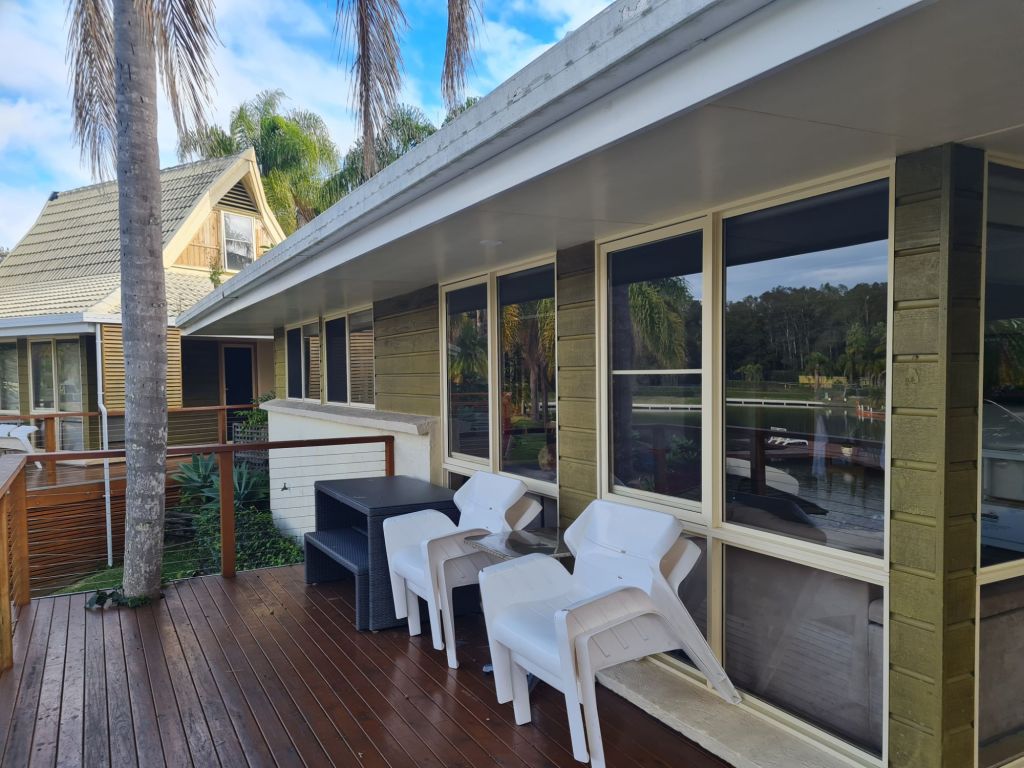
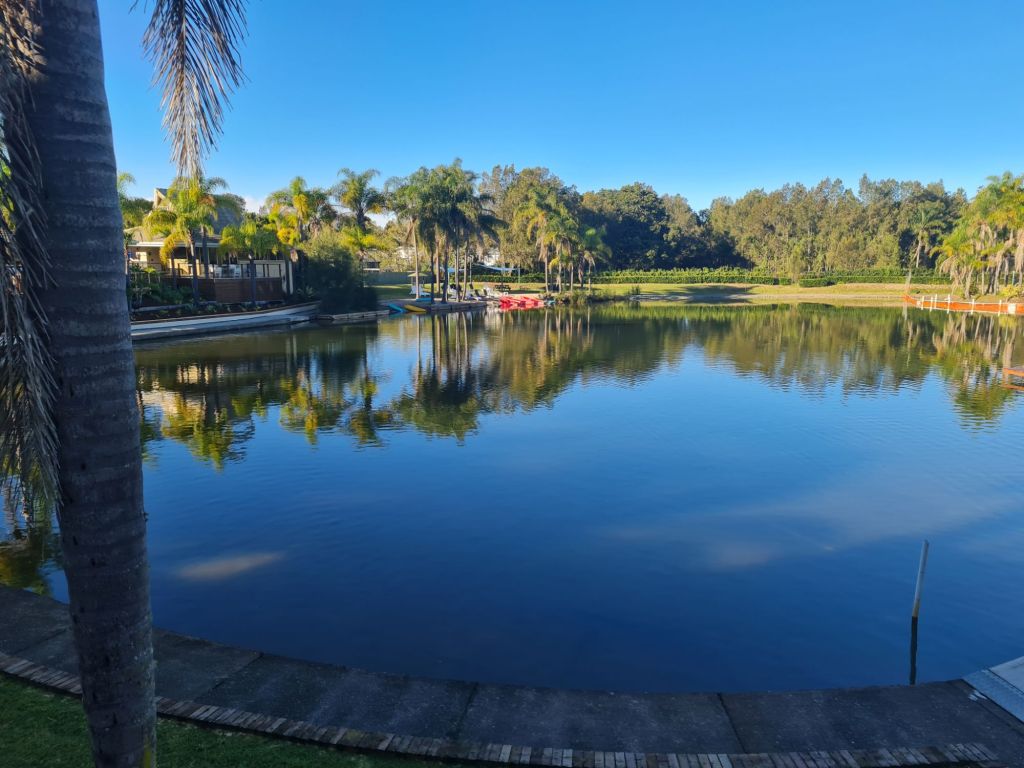
Our bungalow, as they are called, is on the edge of the lagoon, which has an island and has been stocked with fish, though I doubt we would be allowed to go fishing in it.
For the more adventurous, there are canoes. I think I would prefer the BBQ, and watch the planes taking off and landing at the airport just on the other side of the tree line on the other side of the lagoon.
At least they are only smaller planes like the De Havilland Dash 8.
And, knowing the airport was only minutes away, we dropped in for a quick photo op and got the following
It was the small town that we had visited once, some years ago, that had enticed me back.
Those had been happier times, times when the stench of money hadn’t overtaken sensibility, and who we really were.
Not that I had changed all that much, except for the Upper West Side apartment, and a posh car to go with it, but what had disappointed me was the change in Liz, the woman I thought once was the love of my life.
Without the trappings of wealth, she was the kindest, most thoughtful, and generous person I knew, but that changed when I became the recipient of an inheritance that beggared belief. We both made a promise from the outset that it would not change us, but unfortunately, it did.
And that was probably the main reason I was standing outside an old fixer-upper house on several acres overlooking the ocean.
I’d asked Liz to come, but she was having a weekend away in Las Vegas with her new friends, or as one of the ladies rather salaciously said, ‘what happens in Vegas stays in Vegas’ kind of weekend.
Charmaine had told me about the house, one that she had admired for a long time, but didn’t have the means to buy it.
Charmaine was a painter, a rather good one, and both Liz and I had met her on a weekend away upstate, and I’d bought one of her landscapes to hang in our new apartment. Liz hated it, but I think that had more to do with the painter than the painting, and that was because Charmaine had flirted with me, and that, I had observed over time, was how she was with everyone.
She called it her sales technique. After all, it had worked on me.
I listened to the auctioneer go through the rules of the auction and then move on to a physical description of the property. I’d attended several viewings and gained an idea of what was needed if I were to buy it. It had good foundations and had only suffered from a lack of TLC. It was how the auctioneer summed it up.
When he called for the first bid, I felt a hand slip into mine, and a glance sideways showed it to be Charmaine. I had asked her along for support, but she had something else to do; it appeared now that she hadn’t.
“So,” she whispered next to my ear, “you were serious about this place?”
I had been dithering, not being able to make up my mind, but Liz, in the end, made the decision for me. I’d overheard a snippet of conversation with one of her new friends, and to be honest, I’d been surprised.
“Perhaps it was time to find a hideaway.”
“Things that bad?”
I shrugged. “Maybe I’m writing too much into it. At any rate, I needed an excuse to get out of town, and being here was as good as any.”
The first bid came in at 450,000. I knew the reserve was about 700,000, and I was prepared for 850,000. I was hoping to spend less than that, as the renovations would be another 250,000.
“We could go and have a picnic. It’ll certainly cost less than buying this place.”
“I’m here now.”
Holding hands was just one of Charmaine’s ‘things’, and I had never written anything into what might have been called a relationship of sorts. We were not lovers, and the conversation had never been steered in that direction, but I did find myself gravitating towards her when Liz was off doing her thing with her friends. To be honest, I simply liked the idea of a picnic and watching Charmaine paint her landscapes.
I raised the bid to 500,000. Another from the previous bidder, 550,000. Another at 600,000. It seems there were three bidders for the property. The other sixteen people attending were observers, undoubtedly locals interested in how this would help their property value.
I went 625,000 when the auctioneer changed the increment after a lack of bidding. It was countered, and the next bid was 650,000. Another at 657,500, and then the first bidder went to 700,000, the reserve.
“You do realise the other bidders are friends of the owner and are there to push the price up?” Charmaine whispered in my ear.
I’d heard of it happening, but I’d not suspected it until she mentioned it.
“Going once, going twice at 700,000.” The auctioneer looked at me. “I’ll accept 10,000 increments.”
I nodded. 710,000. It quickly moved to 800,000, after I bid 790,000.
The auctioneer looked at me expectantly. “810,000, sir?”
That was more than I wanted to spend, though an elbow in the ribs was the clincher, and when I declined, there was an air of disappointment.
“Going once, going twice, all done at 800,000?” A look around the crowd confirmed we were all done, and the gavel came down.
“Looks like we’re going on a picnic,” she said. “I’d expect a call in an hour or so.”
Two things happened that weekend, both of which surprised me. The first, Charmaine was right, I did get a call, and finished up with a hideaway in the country, overlooking the ocean. The second, Liz didn’t come back from Las Vegas. She had apparently found someone new, someone more exciting, or so she said.
I was disappointed but not overly concerned. She had changed, and I had not, and if the truth be told, we were drifting apart. We parted amicably, sold the apartment, and moved on in different directions.
I had a new residence and renovations to take my mind off the break-up, and when I told Charmaine, she said she thought we were not a perfect match, in her opinion. And in light of my new status, I could now ask her to come and stay in the spare bedroom, a lot better, I said, than the one-person tent she had been using, an offer she readily accepted.
Until, a year later, it became something more than that.
Latanzio had given up the notion he was going to go free and escape with Angelina. Amy had made it very clear that her father, Benito, wanted him dead, and because he had nowhere to go, least of all with Angelina, and even less likely with Gabrielle, it might force him into a corner, or unlikely as it appeared, he might make a mistake.
He hadn’t denied the fact he’d tried to kill me or seem concerned that Amy had referred to me as a very dangerous character. Latanzio didn’t get where he was in the crime business by being scared. He was going to be all bluster, until he worked out what was really going on, and then he would become dangerous.
But, when given a choice between the two women in his life, the fact he chose Gabrielle over Angelina said a lot. She had been circumspect from the beginning when Amy took her into ‘protective custody’. She was smarter than Angelina, she had to be, given what Angelina’s father would do to her if he found out.
It was time for him to be taken to Gabrielle and explain what was happening. Amy had implied, in her discussion with Gabrielle, that his facilitated escape and subsequent survival was not assured, hinting that her employers were not happy with him over his most recent mistake in killing a witness.
I was back in front of the monitors, this time to see Fabio with Gabrielle. Amy had joined me in the control room and sat in the chair next to me.
“Ready to see some sparks fly,” she asked.
“How so?”
“We sat her down and laid the whole scenario out on the table, Fabio’s marriage, his role in the death of a rival, the planned attack on you, and the fact your people are actively seeking vengeance, and that we can’t hold you for longer than 24 hours before we have to hand him over, a time that expires in about an hour. She also knows, in no uncertain terms, that Benito wants him dead, and that most likely will include her.”
“So not to put any pressure on him, then?”
“His options are extremely limited, and he knows it. He can go to jail or Benito will get him. He can go on the run, but Angelina won’t go with him. If truth be told, she’ll probably kill him before he gets out of here. And as for what he’s going to do about Gabrielle, that we’re about to find out.”
We watched him be escorted down the narrow passage. A door at the end of the passage opened, and he was thrust in. On a second monitor, in the room, we saw him stagger in and the door closed behind him.
Gabrielle was not pleased to see him, but, unlike Angelina, she was a little more reserved in her responses, thinking, or knowing, they were at the very least wired for sound.
It seemed to me he was more in tune with Gabrielle than with Angelina. Perhaps Gabrielle came without baggage.
Gabrielle was the first to speak. “That bitch in charge doesn’t like you, but then neither does your wife’s father. Not a man to be crossed, Fabio, and yet you were dumb enough to do so.”
“She means nothing to me. The old man always treated me like I was dirt.”
“And this man you killed?”
“I didn’t kill anyone.”
She frowned at him. “You don’t lie to me, remember. I know you have for some time now, but this thing, I need to know. You kill him or not?”
I looked sideways at Amy. “You ask her to ask him?”
“I did, but she told me in no uncertain terms what to do with myself. But it seems it sowed some doubt, she’s curious herself now.”
Fabio sat down on the side of the bed and looked over at the boy lying facing the wall on a camp stretcher. He’d looked when Fabio entered the room, but then went back to his book.
Fabio shrugged. “It was an accident. The fool drew a gun on me and in the wrestle, it went off and he died. I swear that wasn’t my intention to kill him, just make him see sense.”
There could be a shred of truth in that statement, if they had wrestled for the gun, but they didn’t. One of Fabio’s goons had disarmed him, then when he stepped away, Fabio shot him. The goon had been horrified. It was not what was expected of him.
She shook her head. “That better be the truth of it, Fabio, or I’ll kill you myself. What was the deal with the witness?”
“It has to be a fabrication, a ruse to try and convict me, but there was no witness. I asked the boys to find this character to have a talk, but they discovered he was being held in a secret location, one they could find out about. Now there’s suddenly all this nonsense they’re using as an excuse to hunt me down.”
“But you wanted to find him. Why? For him to tell the police your version of the truth?”
He was like a man bailing out a sinking ship, and not making any progress as it sank lower and lower in the water. Gabrielle was the alligator in the water, circling, waiting.
“It doesn’t matter now.”
“Actually, it does. I’m told he survived, and he’s now looking for you. And that means if he’s coming after you, and I’m with you, he’s also coming after me and my son. So, here’s the deal. You want to leave here with me, you need to square away the witness, sort out the bitch from hell, and get Benito’s contract off your head. Think you can do that?”
Tall order, with odds ranging from impossible all the way up to needing a miracle.
“Perhaps we should just take him to Benito’s house and drop him off,” Amy said.
Her attitude towards Fabio had changed from the moment Fabio had sent in a hit team. Once she might have seen matters from a goodness and light perspective, but now, I don’t think Fabio was her list of best friends. Not after trying to kill us, and succeeding with other members of her team.
“Or give me five minutes in a locked room with him. I’m sure I could drum some sense into him,” I said.
She looked sideways at me, then shook her head. “That’s not how we do things.”
I shrugged. “It could be. You’ve broken more rules and laws today that you’ve probably done in a lifetime. What were you expecting to get out of this?”
I waved my hand at the screens. What she was doing, it didn’t really make much sense. Fabio wasn’t going to confess, and with Benito on his case, all he could do was run. Or try to make peace with him, and give up the mistress.
On the other side, there was another door, but before we went through it, I was ‘decontaminated,’ which meant being sprayed with a gas of some sort. It didn’t have a bad smell.
Then another invisible door, or archway, opened, and beyond, it was a large open space with blue skies, trees, flowers, what was once parkland, because we had something similar in what was called a ‘public space’, but on a smaller scale. Life, such as before me, was still not possible on the outside, but it was improving.
Or so we were told.
It was a world within a world. It was warm, there were creatures, and people tended it.
“It’s a pity we have to die before we get to see what we once had,” I said. She had slowed down to match my movement.
She was what we called a power walker.
“There is much to explore over the coming week.”
It was large and a long walk. There was a lake, and there were small row boats. The only rowing I’d done was in a gym. Perhaps I’d get a chance to go on a boat.
We walked for half an hour. We reached a row of bungalows built along the water’s edge. At the third bungalow, she said, “This will be your residence for the next week.”
She led the way. As we approached the door, it opened. She went in, and I followed. It was far better than anything I’d lived in my whole life, the sort of place we speculated management lived in.
“You have everything you need for the next week.”
“Am I free to explore that world outside my door?”
“With me, yes. I will be staying here with you.”
Interesting. “And interaction with any others who are staying here.”
“Of course. This is not a prison. But as I said, I will be with you.”
It was beginning to feel like it was a prison.
She sat down at the table. “Please join me, and we’ll go over the rules.”
Was I disappointed? No. I could think of worse ways to live the last week of my life. It was just so unexpected that places like this existed, and my last week would be an endless reminder of what I had, in more ways than one.
About ten minutes into what seemed to be a well-rehearsed speech, I made a discovery. Well, it was not so much a discovery as it was confirmation of a theory I once had.
About a year before, I was given a case that involved a missing woman who had not turned up for work that morning. Normally, people had to be missing several days before we investigated, but I got the impression she was important.
And a surprise because crimes involving people were far and few between, and anyone committing crimes that killed or seriously injured others and was found guilty was summarily terminated.
In a small community, it was an effective deterrent.
And being such an important case, I was surprised my superior dropped the file on my desk with the warning, discretion was paramount, that I was to report results to him directly and only him, and if anyone came to me for information, I was to direct them to him.
It was an odd case, one where I should have got a similar story from everyone, especially in her block where she lived, but no two stories were the same. Similar, perhaps, but always a key detail amiss.
Only one of the thirty-odd people I spoke to had a completely different story. He had been missing the week she arrived, and when he came back, he discovered her living next door.
And when he tried to talk to her, she simply ignored him. Another strange thing was that she had a visitor who turned up late at night, and they would leave together, return in the early hours, and the visitor left before anyone else in the block woke.
And then, that very morning, neither returned.
When I asked why he didn’t report the events, he, like many others, said they didn’t want to get involved. I knew he knew more than he was telling me, but I also recognised fear.
I took my findings to my superior, and he told me it was imperative that I find her as soon as possible. He didn’t say why.
But I knew what it was he wasn’t saying.
A lot of my job involved discretion; one of only a few who were privy to information that was restricted. Yes, we had security levels, and due to seniority and my ability to keep secrets, I’d advanced to the highest level.
It was a privilege and also a curse.
It was where I discovered the people above my pay grade had a different life and privileges, which most people, if they knew, would be surprised. It was, someone once said, a case of don’t do as I do, do as I say.
Very apt.
It led me to the conclusion that she was having an illicit relationship with a man she worked with. I could go to her workplace to ask embarrassing questions, but instead visited the more exclusive hotels where illicit relationships played out.
There were seven I knew about, one near the block where she lived. I went there first, and when I told them who I was and what I was doing there, I was taken to the manager’s office, and then to a room where, very carefully laid out, the body of the missing woman.
They had known someone would come for her, and that it was better they did not report it via the usual means.
There were no visible signs of violence, so no harm had been inflicted on her. I asked who had booked the room and received a blank stare. No names were ever used, and there was no CCTV footage.
In certain circumstances, of which this was one. It told me that management was, or could be, involved.
I dismissed the manager and made a cursory inspection of the room and the body. Fully dressed, she looked as though she were asleep. It was not my job to determine the cause of death, but the skin under my fingers when determining if there was a pulse was odd.
She was perfect in every way, not exactly the norm.
Examination completed, I reported back and was told to leave, my job done. As I went through the foyer, I could see that someone had spoken to the manager; he looked a deathly shade of white.
I remained at a cafe not far from the hotel to see what happened next, and within ten minutes, two black cars and a van arrived, men in black uniforms from the cars, and men in white suits from the van.
Ten more minutes, and they were gone. I didn’t see the body being removed.
Nothing more was said, but seeing Miranda in front of me, now, she had all the same characteristics.
In keeping with the new travel plan, we are picking places in Australia, where we can exchange our timeshare week.
Some people consider timeshares as a waste of time and money, and the process of getting one is very painful, which it can be.
Certainly, in some of the places we have gone, they tried hard to sell you another which can be a downside to staying, but the fact we get to stay in a three-bedroom fully kitted apartment of bungalow for $200 for the week far outweighs the small inconveniences.
Previously, we stayed at Coffs Harbour, but this time, we decided to stay at Port Macquarie.
Our bungalow, as they are called, is on the edge of the lagoon, which has an island and has been stocked with fish, though I doubt we would be allowed to go fishing in it.
For the more adventurous, there are canoes. I think I would prefer the BBQ, and watch the planes taking off and landing at the airport just on the other side of the tree line on the other side of the lagoon.
At least they are only smaller planes like the De Havilland Dash 8.
And, knowing the airport was only minutes away, we dropped in for a quick photo op and got the following
It was the first time in almost a week that I made the short walk to the cafe alone. It was early, and the chill of the morning was still in the air. In summer, it was the best time of the day. When Susan came with me, it was usually much later, when the day was much warmer and less tolerable.
On the morning of the third day of her visit, Susan said she was missing the hustle and bustle of London, and by the end of the fourth she said, in not so many words, she was over being away from ‘civilisation’. This was a side of her I had not seen before, and it surprised me.
She hadn’t complained, but it was making her irritable. The Susan that morning was vastly different to the Susan on the first day. So much, I thought, for her wanting to ‘reconnect’, the word she had used as the reason for coming to Greve unannounced.
It was also the first morning I had time to reflect on her visit and what my feelings were towards her. It was the reason I’d come to Greve: to soak up the peace and quiet and think about what I was going to do with the rest of my life.
I sat in my usual corner. Maria, one of two waitresses, came out, stopped, and there was no mistaking the relief in her manner. There was an air of tension between Susan and Maria I didn’t understand, and it seemed to emanate from Susan rather than the other way around. I could understand her attitude if it was towards Alisha, but not Maria. All she did was serve coffee and cake.
When Maria recovered from the momentary surprise, she said, smiling, “You are by yourself?” She gave a quick glance in the direction of my villa, just to be sure.
“I am this morning. I’m afraid the heat, for one who is not used to it, can be quite debilitating. I’m also afraid it has had a bad effect on her manners, for which I apologise. I cannot explain why she has been so rude to you.”
“You do not have to apologise for her, David, but it is of no consequence to me. I have had a lot worse. I think she is simply jealous.”
It had crossed my mind, but there was no reason for her to be. “Why?”
“She is a woman, I am a woman, she thinks because you and I are friends, there is something between us.”
It made sense, even if it was not true. “Perhaps if I explained…”
Maria shook her head. “If there is a hole in the boat, you should not keep bailing but try to plug the hole. My grandfather had many expressions, David. If I may give you one piece of advice, as much as it is none of my business, you need to make your feelings known, and if they are not as they once were, and I think they are not, you need to tell her. Before she goes home.”
Interesting advice. Not only a purveyor of excellent coffee, but Maria was also a psychiatrist who had astutely worked out my dilemma. What was that expression, ‘not just a pretty face’?
“Is she leaving soon?” I asked, thinking Maria knew more about Susan’s movements than I did.
“You would disappoint me if you had not suspected as much. Susan was having coffee and talking to someone in her office on a cell phone. It was an intense conversation. I should not eavesdrop, but she said being here was like being stuck in hell. It is a pity she does not share your love for our little piece of paradise, is it not?”
“It is indeed. And you’re right. She said she didn’t have a phone, but I know she has one. She just doesn’t value the idea of getting away from the office. Perhaps her role doesn’t afford her that luxury.”
And perhaps Alisha was right about Maria, that I should be more careful. She had liked Maria the moment she saw her. We had sat at this very table, the first day I arrived. I would have travelled alone, but Prendergast, my old boss, liked to know where ex-employees of the Department were, and what they were doing.
She sighed. “I am glad I am just a waitress. Your usual coffee and cake?”
“Yes, please.”
Several months had passed since we had rescued Susan from her despotic father; she had recovered faster than we had thought, and settled into her role as the new Lady Featherington, though she preferred not to use that title, but go by the name of Lady Susan Cheney.
I didn’t get to be a Lord, or have any title, not that I was expecting one. What I had expected was that Susan, once she found her footing as head of what seemed to be a commercial empire, would not have time for details like husbands, particularly when our agreement made before the wedding gave either of us the right to end it.
There was a moment when I visited her recovering in the hospital, where I was going to give her the out, but I didn’t, and she had not invoked it. We were still married, just not living together.
This visit was one where she wanted to ‘reconnect’ as she called it, and invite me to come home with her. She saw no reason why we could not resume our relationship, conveniently forgetting she indirectly had me arrested for her murder, charges both her mother and Lucy vigorously pursued, and had the clone not returned to save me, I might still be in jail.
It was not something I would forgive or forget any time soon.
There were other reasons why I was reluctant to stay with her, like forgetting small details, an irregularity in her character I found odd. She looked the same, she sounded the same, she basically acted the same, but my mind was telling me something was not right. It was not the Susan I first met, even allowing for the ordeal she had been subjected to.
But, despite those misgivings, there was no question in my mind that I still loved her, and her clandestine arrival had brought back all those feelings. But as the days passed, I began to get the impression my feelings were one-sided and she was just going through the motions.
Which brought me to the last argument, earlier, where I said if I went with her, it would be business meetings, social obligations, and quite simply her ‘celebrity’ status that would keep us apart. I reminded her that I had said from the outset I didn’t like the idea of being in the spotlight, and when I reiterated it, she simply brushed it off as just part of the job, adding rather strangely that I always looked good in a suit. The flippancy of that comment was the last straw, and I left before I said something I would regret.
I knew I was not a priority. Maybe somewhere inside me, I had wanted to be a priority, and I was disappointed when I was not.
And finally, there was Alisha. Susan, at the height of the argument, had intimated she believed I had an affair with her, but that elephant was always in the room whenever Alisha was around. It was no surprise when I learned Susan had asked Prendergast to reassign her to other duties.
At least I knew what my feelings for Alisha were, and there were times when I had to remember she was persona non grata. Perhaps that was why Susan had her banished, but, again, a small detail; jealousy was not one of Susan’s traits when I first knew her.
Perhaps it was time to set Susan free.
When I swung around to look in the direction of the lane where my villa was, I saw Susan. She was formally dressed, not in her ‘tourist’ clothes, which she had bought from one of the local clothing stores. We had fun that day, shopping for clothes, a chore I’d always hated. It had been followed by a leisurely lunch, lots of wine and soul searching.
It was the reason why I sat in this corner; old habits die hard. I could see trouble coming from all directions, not that Susan was trouble or at least I hoped not, but it allowed me the time to watch her walking towards the cafe in what appeared to be short, angry steps; perhaps the culmination of the heat wave and our last argument.
She glared at me as she sat, dropping her bag beside her on the ground, where I could see the cell phone sitting on top. She followed my glance down, and then she looked unrepentant back at me.
Maria came back at the exact moment she was going to speak. I noticed Maria hesitate for a second when she saw Susan, then put her smile in place to deliver my coffee.
Neither spoke nor looked at each other. I said, “Susan will have what I’m having, thanks.”
Maria nodded and left.
“Now,” I said, leaning back in my seat, “I’m sure there’s a perfectly good explanation as to why you didn’t tell me about the phone, but that first time you disappeared, I’d guessed you needed to keep in touch with your business interests. I thought it somewhat unwisethat you should come out when the board of one of your companies was trying to remove you, because of what was it, an unexplained absence? All you had to do was tell me there were problems and you needed to remain at home to resolve them.”
My comment elicited a sideways look, with a touch of surprise.
“It was unfortunate timing on their behalf, and I didn’t want you to think everything else was more important than us. There were issues before I came, and I thought the people at home would be able to manage without me for at least a week, but I was wrong.”
“Why come at all. A phone call would have sufficed.”
“I had to see you, talk to you. At least we have had a chance to do that. I’m sorry about yesterday. I once told you I would not become my mother, but I’m afraid I sounded just like her. I misjudged just how much this role would affect me, and truly, I’m sorry.”
An apology was the last thing I expected.
“You have a lot of work to do catching up after being away, and of course, in replacing your mother and gaining the requisite respect as the new Lady Featherington. I think it would be for the best if I were not another distraction. We have plenty of time to reacquaint ourselves when you get past all these teething issues.”
“You’re not coming with me?” She sounded disappointed.
“I think it would be for the best if I didn’t.”
“Why?”
“It should come as no surprise to you that I’ve been keeping an eye on your progress. You are so much better doing your job without me. I told your mother once that when the time came I would not like the responsibilities of being your husband. Now that I have seen what it could possibly entail, I like it even less. You might also want to reconsider our arrangement, after all, we only had a marriage of convenience, and now that those obligations have been fulfilled, we both have the option of terminating it. I won’t make things difficult for you if that’s what you want.”
It was yet another anomaly, I thought; she should look distressed, and I would raise the matter of that arrangement. Perhaps she had forgotten the finer points. I, on the other hand, had always known we would not last forever. The perplexed expression, to me, was a sign she might have forgotten.
Then, her expression changed. “Is that what you want?”
“I wasn’t madly in love with you when we made that arrangement, so it was easy to agree to your terms, but inexplicably, since then, my feelings for you changed, and I would be sad if we parted ways. But the truth is, I can’t see how this is going to work.”
“In saying that, do you think I don’t care for you?”
That was exactly what I was thinking, but I wasn’t going to voice that opinion out loud. “You spent a lot of time finding new ways to make my life miserable, Susan. You and that wretched friend of yours, Lucy. While your attitude improved after we were married, that was because you were going to use me when you went to see your father, and then almost let me go to prison for your murder.”
“I had nothing to do with that, other than to leave, and I didn’t agree with Lucy that you should be made responsible for my disappearance. I cannot be held responsible for the actions of my mother. She hated you; Lucy didn’t understand you, and Millie told me I was stupid for not loving you in return, and she was right. Why do you think I gave you such a hard time? You made it impossible not to fall in love with you, and it nearly changed my mind about everything I’d been planning so meticulously. But perhaps there was a more subliminal reason why I did because after I left, I wanted to believe, if anything went wrong, you would come and find me.”
“How could you possibly know that I’d even consider doing something like that, given what you knew about me?”
“Prendergast made a passing comment when my mother asked him about you; he told us you were very good at finding people and even better at fixing problems.”
“And yet here we are, one argument away from ending it.”
I could see Maria hovering, waiting for the right moment to deliver her coffee, then go back and find Gianna, the café owner, instead. Gianna was more abrupt and, for that reason, was rarely seen serving the customers. Today, she was particularly cantankerous, banging the cake dish on the table and frowning at Susan before returning to her kitchen. Gianna didn’t like Susan either.
Behind me, I heard a car stop, and when she looked up, I knew it was for her. She had arrived with nothing, and she was leaving with nothing.
She stood. “Last chance.”
“Forever?”
She hesitated and then shook away the look of annoyance on her face. “Of course not. I wanted you to come back with me so we could continue working on our relationship. I agree there are problems, but it’s nothing we can’t resolve if we try.”
I had been trying. “It’s too soon for both of us, Susan. I need to be able to trust you, and given the circumstances, and all that water under the bridge, I’m not sure if I can yet.”
She frowned at me. “As you wish.” She took an envelope out of her bag and put it on the table. “When you are ready, it’s an open ticket home. Please make it sooner rather than later. Despite what you think of me, I have missed you, and I have no intention of ending it between us.”
That said, she glared at me for a minute, shook her head, then walked to the car. I watched her get in and the car drive slowly away.






 Thrills, Spills, and just a dash of Romance