This book has also been written for some time, like The Document, and the manuscript was also sitting in a box with half a dozen others gathering dust and not quite as complete, so this month it is going to get the makeover, a first draft for the editor.
And so it begins…
…
It’s the end of the first week
Is it plain sailing? No.
We’ve circled back to Chapter 9 and it is problematical. I read it, and I don’t like it.
So, I went to one of my beta readers, gave her a copy, and asked for an opinion. I knew that fishing with crocodiles was going to be more fun, but I couldn’t afford to go to Florida.
Two days later I got a three-page critique.
She could have sugar-coated it. You know, yes it suits the flow but there are a few tweaks required, not the last paragraph in capitals saying, IT NEEDS REWRITING.
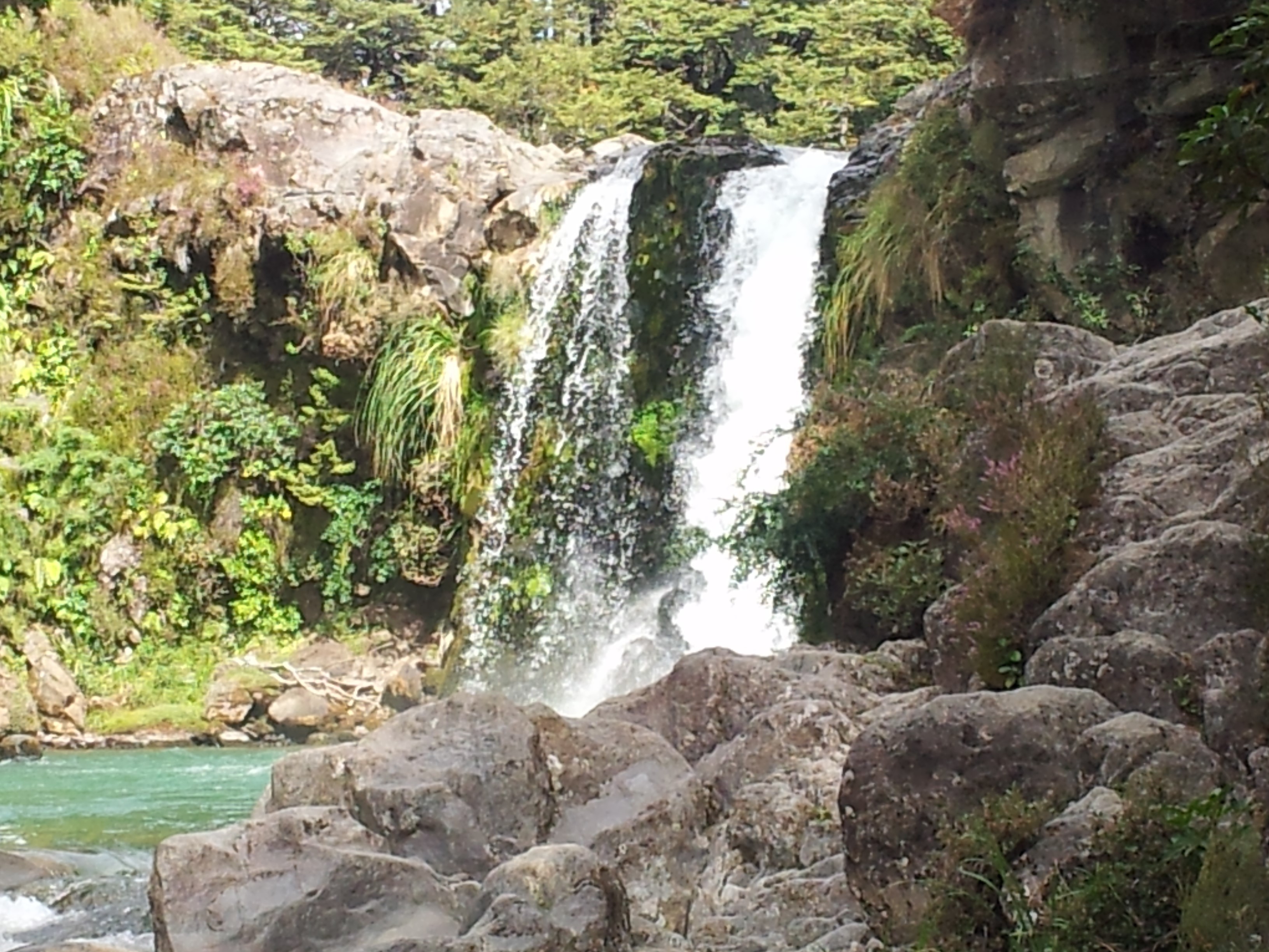
Tawhai Falls is a 13-meter high waterfall located in Tongariro National Park.
It is located about 4 km from the Tongariro National Park Visitor Centre, on State Highway 48.
An easy walk takes just 10-15 minutes to reach the waterfall’s lookout.
The top of the falls. There was not much water coming down the river to feed the falls when we were there in May
Tawhai Falls is also the filming location of Gollum’s pool where Faramir and his archers are watching Gollum fish.
It’s a rocky walk once you are down at ground level, and it may be not possible to walk along the side of the stream if the falls have more water coming down the river from the mountain.
I’m sure a lot of people have considered the prospect of whale watching. I’m not sure how the subject came up on one of our visits to New Zealand, but I suspect it was one of those tourist activity leaflets you find in the foyer of motels, hotels, and guesthouses.
Needless to say, it was only a short detour to go to Kaikoura and check out the prospect.
Yes, the ocean at the time seemed manageable. My wife has a bad time with sea sickness, but she was prepared to make the trip, after some necessary preparations. Seasickness tablets and special bands to wear on her wrist were recommended and used.
The boat was large and had two decks, and mostly enclosed. There were a lot of people on board, and we sat inside for the beginning of the voyage. The sea wasn’t rough, but there was about a meter and a half swell, easily managed by the boat while it was moving.
It took about a half hour or so to reach the spot where the boat stopped and a member of the crew used a listening device to see if there were any whales.
That led to the first wave of sickness.
We stopped for about ten minutes, and the boat moved up and down on the waves. It was enough to start the queasy stomachs of a number of passengers. Myself, it was a matter of going out on deck and taking in the sea air. Fortunately, I don’t get seasick.
Another longish journey to the next prospective site settled a number of the queasy stomachs, but when we stopped again, the swell had increased, along with the boat’s motion. Seasick bags were made available for the few that had succumbed.
By the time we reached the site where there was a whale, over half the passengers had been sick, and I was hoping they had enough seasick bags, and then enough bin space for them.
The whale, of course, put on a show for us, and those that could went out on deck to get their photos.
By the end of the voyage, nearly everyone on board was sick, and I was helping to hand out seasick bags.
Despite the anti sickness preparations, my wife had also succumbed. When we returned and she was asked if the device had worked, she said no.
But perhaps it had because within half an hour we were at a cafe eating lunch, fish and chips of course.
This activity has been crossed off the bucket list, and there’s no more whale watching in our traveling future. Nor, it seems, will we be going of ocean liners.
Perhaps a cruise down the Rhine might be on the cards. I don’t think that river, wide as it is in places, will ever have any sort of swell.
This book has also been written for some time, like The Document, and the manuscript was also sitting in a box with half a dozen others gathering dust and not quite as complete, so this month it is going to get the makeover, a first draft for the editor.
And so it begins…
…
It’s the end of the first week
Is it plain sailing? No.
We’ve circled back to Chapter 9 and it is problematical. I read it, and I don’t like it.
So, I went to one of my beta readers, gave her a copy, and asked for an opinion. I knew that fishing with crocodiles was going to be more fun, but I couldn’t afford to go to Florida.
Two days later I got a three-page critique.
She could have sugar-coated it. You know, yes it suits the flow but there are a few tweaks required, not the last paragraph in capitals saying, IT NEEDS REWRITING.
This book has also been written for some time, like The Document, and the manuscript was also sitting in a box with half a dozen others gathering dust and not quite as complete, so this month it is going to get the makeover, a first draft for the editor.
And so it begins…
…
At last, the story is coming together.
…
The first seven chapters, with the necessary revisions and additions to provide stepping stones for later events, have been amended.
The next chapter has been slightly revised.
Chapter 9 is still under construction and can be written later. The information on the characters in this chapter will be drawn upon for later events, and it doesn’t have to happen straight away.
Chapter 10 is now done and has tied up several loose ends.
I have now been able to sit down and do the forward plan for at least three more chapters, and I know what will happen next.
Stay tuned, anything can happen between now and the next report!
I’m sure a lot of people have considered the prospect of whale watching. I’m not sure how the subject came up on one of our visits to New Zealand, but I suspect it was one of those tourist activity leaflets you find in the foyer of motels, hotels, and guesthouses.
Needless to say, it was only a short detour to go to Kaikoura and check out the prospect.
Yes, the ocean at the time seemed manageable. My wife has a bad time with sea sickness, but she was prepared to make the trip, after some necessary preparations. Seasickness tablets and special bands to wear on her wrist were recommended and used.
The boat was large and had two decks, and mostly enclosed. There were a lot of people on board, and we sat inside for the beginning of the voyage. The sea wasn’t rough, but there was about a meter and a half swell, easily managed by the boat while it was moving.
It took about a half hour or so to reach the spot where the boat stopped and a member of the crew used a listening device to see if there were any whales.
That led to the first wave of sickness.
We stopped for about ten minutes, and the boat moved up and down on the waves. It was enough to start the queasy stomachs of a number of passengers. Myself, it was a matter of going out on deck and taking in the sea air. Fortunately, I don’t get seasick.
Another longish journey to the next prospective site settled a number of the queasy stomachs, but when we stopped again, the swell had increased, along with the boat’s motion. Seasick bags were made available for the few that had succumbed.
By the time we reached the site where there was a whale, over half the passengers had been sick, and I was hoping they had enough seasick bags, and then enough bin space for them.
The whale, of course, put on a show for us, and those that could went out on deck to get their photos.
By the end of the voyage, nearly everyone on board was sick, and I was helping to hand out seasick bags.
Despite the anti sickness preparations, my wife had also succumbed. When we returned and she was asked if the device had worked, she said no.
But perhaps it had because within half an hour we were at a cafe eating lunch, fish and chips of course.
This activity has been crossed off the bucket list, and there’s no more whale watching in our traveling future. Nor, it seems, will we be going of ocean liners.
Perhaps a cruise down the Rhine might be on the cards. I don’t think that river, wide as it is in places, will ever have any sort of swell.
A relatively unassuming lane leads to what could be described as a grand hotel, called Waitomo Caves Hotel.
The original hotel was built in 1908, and it was later extended in 1928. Part of it is ‘Victorian’, based on an eastern Europe mountain chalet, and part of it is ‘Art Deco’, the concrete wing, and a feature, if it could be called that, is none of the four corners are the same.
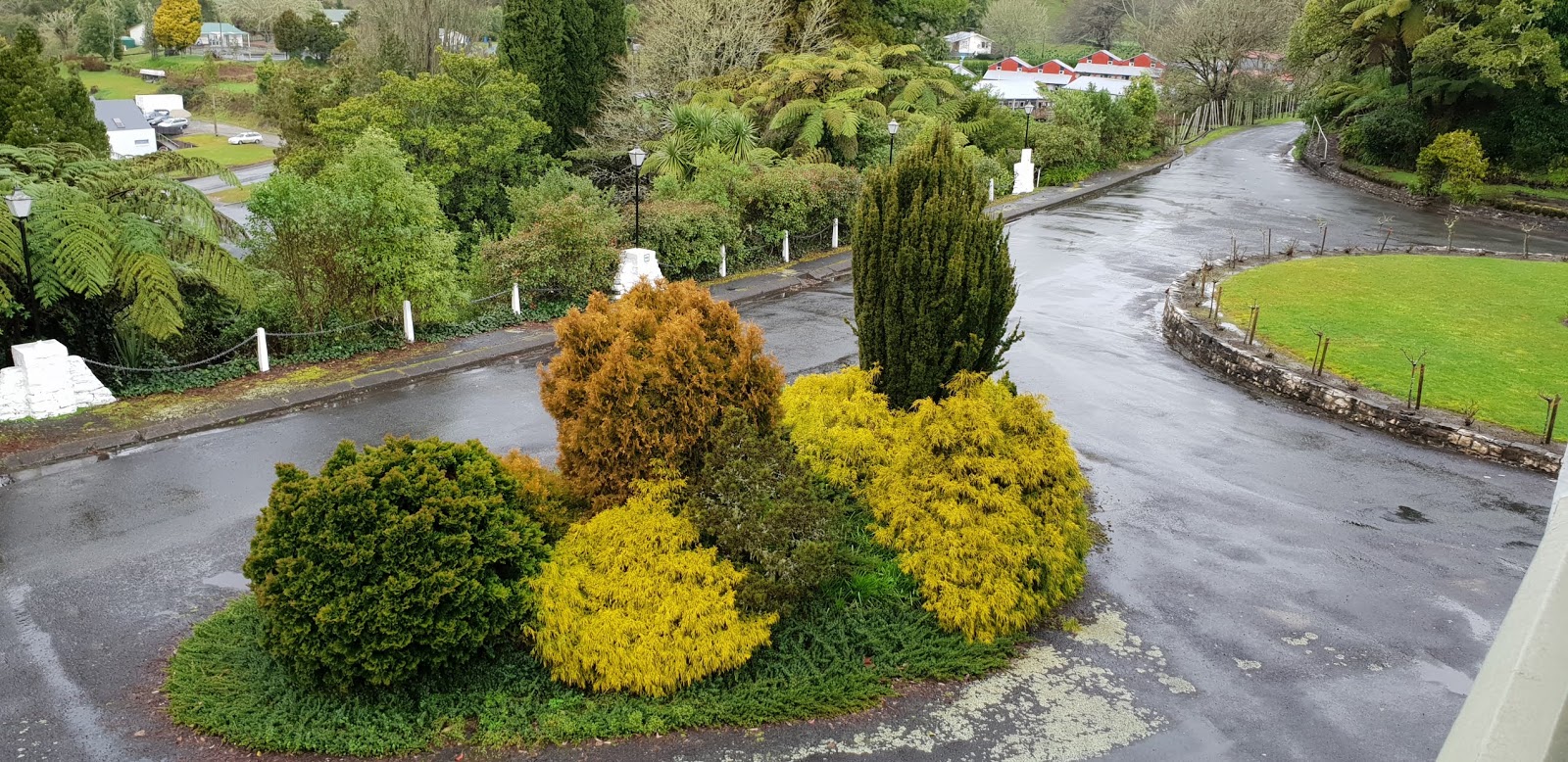
Views from the balcony show part of the surrounding gardens
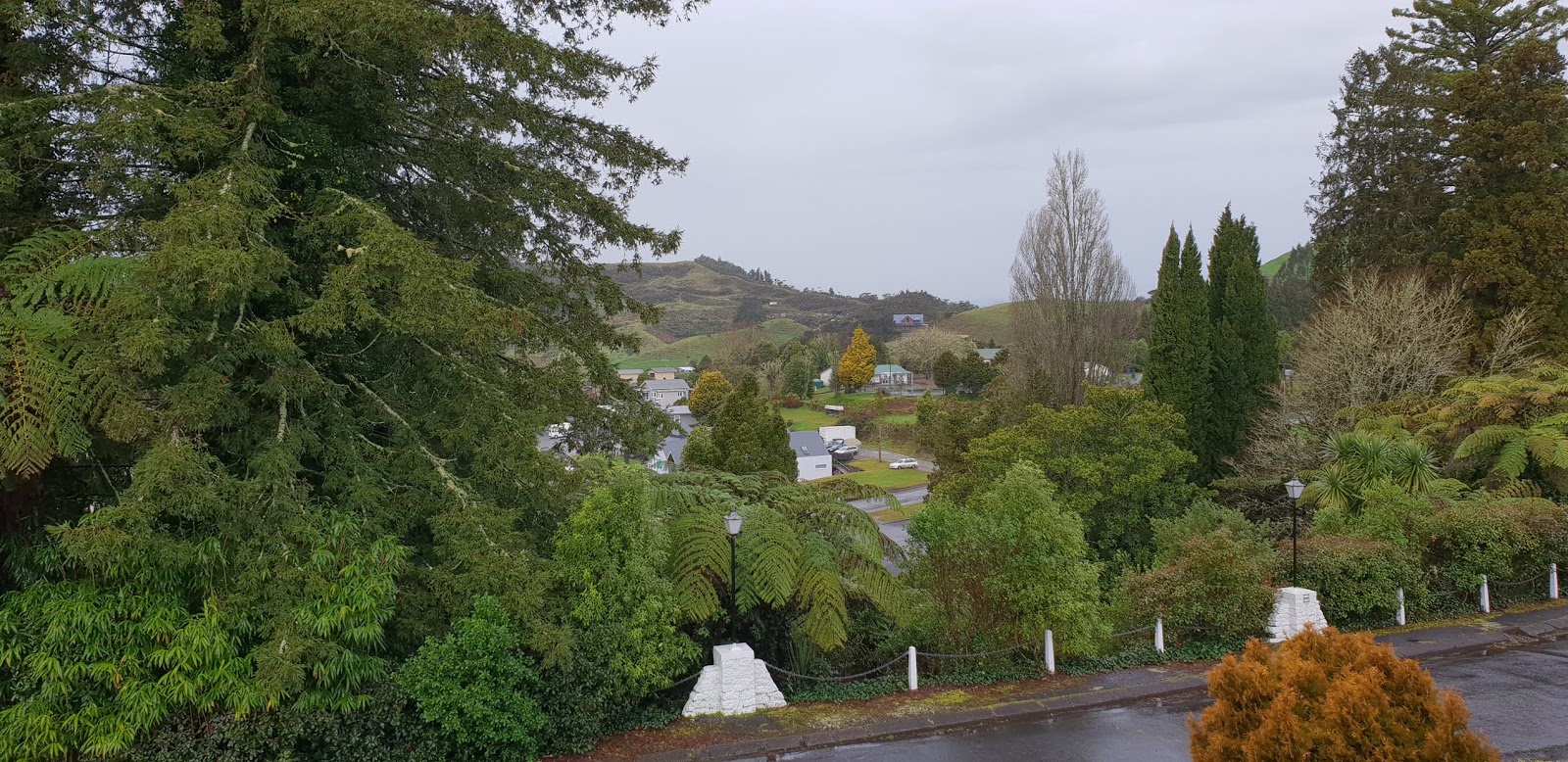
and the town of Waitomo in the distance.
In gloomy weather, it does look rather spooky, and I suspect there may be a ghost or two lurking somewhere in the buildings.
But…
This a a very interesting, and the words of one of my younger grand daughters, a very creepy place. It would make an excellent base for paranormal activity, and there could very well be ghosts walking the corridors of this hotel.
It has the long darkish passageways that lead in all directions and to almost hidden rooms, a creepy nighttime aspect, and the creaky woodwork.
I know when we were exploring, it was easy to lose your bearings, if not get lost, trying to find certain places, and once found, hard to find your way back.
All in all, it was one of the best stays in a very old place going through the throes of modernisation.
And looking at it from the outside at night, I’ll leave you with that thought…
This book has also been written for some time, like The Document, and the manuscript was also sitting in a box with half a dozen others gathering dust and not quite as complete, so this month it is going to get the makeover, a first draft for the editor.
And so it begins…
…
At last, the story is coming together.
…
The first seven chapters, with the necessary revisions and additions to provide stepping stones for later events, have been amended.
The next chapter has been slightly revised.
Chapter 9 is still under construction and can be written later. The information on the characters in this chapter will be drawn upon for later events, and it doesn’t have to happen straight away.
Chapter 10 is now done and has tied up several loose ends.
I have now been able to sit down and do the forward plan for at least three more chapters, and I know what will happen next.
Stay tuned, anything can happen between now and the next report!
This book has also been written for some time, like The Document, and the manuscript was also sitting in a box with half a dozen others gathering dust and not quite as complete, so this month it is going to get the makeover, a first draft for the editor.
And so it begins…
…
So you think everything is running smoothly.
…
Think again!
So, here’s the thing …
I changed the start. It was bothering me. Bothering me so much I couldn’t sleep.
Parts of the first chapters were alluding to events that didn’t seem to add up, so I wrote the whole piece so I could draw upon it later on.
Yes, I like the idea of full-on action to start, bullets flying, people dying, and heart-racing tension. I call it the ‘James Bond’ start, like what happens at the start of a James Bond film.
And, yes, you guessed it, I now have to make changes down the line in the first four chapters, now delaying the completion of chapter five for day six.
A relatively unassuming lane leads to what could be described as a grand hotel, called Waitomo Caves Hotel.
The original hotel was built in 1908, and it was later extended in 1928. Part of it is ‘Victorian’, based on an eastern Europe mountain chalet, and part of it is ‘Art Deco’, the concrete wing, and a feature, if it could be called that, is none of the four corners are the same.
Views from the balcony show part of the surrounding gardens
and the town of Waitomo in the distance.
In gloomy weather, it does look rather spooky, and I suspect there may be a ghost or two lurking somewhere in the buildings.
But…
This a a very interesting, and the words of one of my younger grand daughters, a very creepy place. It would make an excellent base for paranormal activity, and there could very well be ghosts walking the corridors of this hotel.
It has the long darkish passageways that lead in all directions and to almost hidden rooms, a creepy nighttime aspect, and the creaky woodwork.
I know when we were exploring, it was easy to lose your bearings, if not get lost, trying to find certain places, and once found, hard to find your way back.
All in all, it was one of the best stays in a very old place going through the throes of modernisation.
And looking at it from the outside at night, I’ll leave you with that thought…





 Thrills, Spills, and just a dash of Romance