This book has been written for some time and the manuscript was sitting in a box with half a dozen others gathering dust and not quite as complete, so this month it is going to get the makeover, a first draft for the editor.
And so it begins…
…
Coping without technology
…
There are no more surprises at least for today.
We have no internet, the power company came along and removed an old pole and that was the end of it.
It’s amazing what you can’t do when there’s no internet and then all the things you said you would do one day if only you had the time.
This morning’s word count accumulates quickly without the distractions so I had the afternoon to finally clean up my workspace.
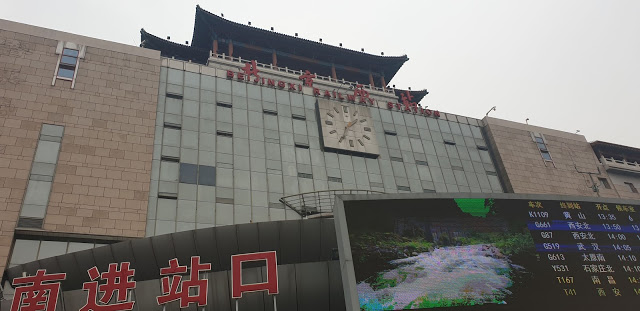
Beijing west railway station is about eight kilometers from the Forbidden City, located at East Lianhuachi Road, Fengtai District. Most trains traveling between south central, southwest, northwest, and south China are boarded here.
This place is huge and there are so many people here, perhaps the other half of Beijing’s population that wasn’t in the forbidden city.
Getting into the station looked like it was going to be fraught with danger but the tour guide got us into the right queue and then arranged for a separate scanner for the group to help keep us all together
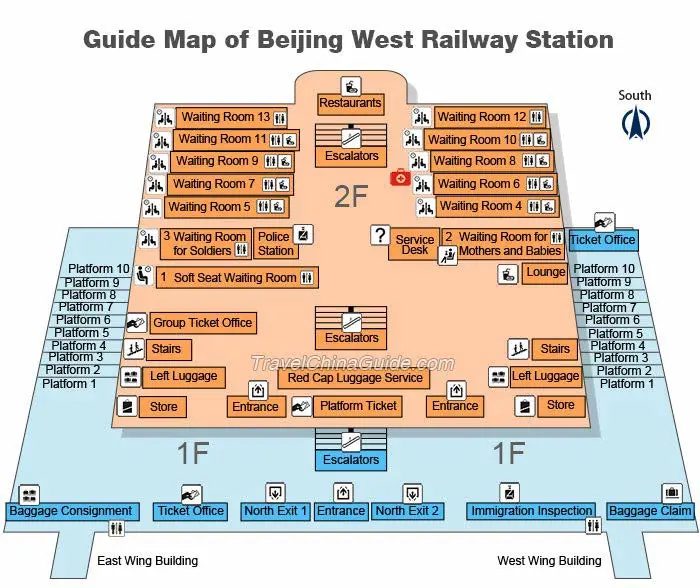
Then we decided to take the VIP service and got to waiting room no 13, the VIP service waiting room which was full to overflowing. Everyone today was a VIP. We got the red hat guy to lead us to a special area away from the crowd.
Actually, it was on the other side of the gate, away from the hoards sitting or standing patiently in the waiting room. It gave us a chance to get something to eat before the long train ride.
The departure is at 4 pm, the train number was G655, and we were told the trains leave on time. As it is a high-speed train, stops are far and few between, but we’re lucky, this time, in that we don’t have to count stations to know where to get off.
We’re going to the end of the line.
However, it was interesting to note the stops which, in each case, were brief, and you had to be ready to get off in a hurry.
These stops were Shijiazhuang, Zhengzhou East, Luoyang Longmen, Huashan North, and Weinan North. At night, you could see the lights of these cities from a distance and were like oases in the middle of a desert. During the day, the most prominent features were high rise apartment blocks and power stations.
A train ride with a difference
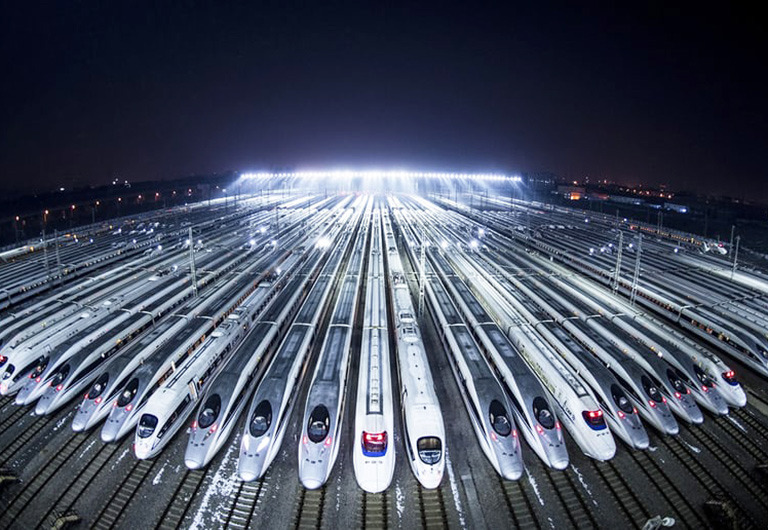
China’s high-speed trains, also known as bullet or fast trains, can reach a top speed of 350 km/h (217 mph).
Over 2,800 pairs of bullet trains numbered by G, D or C run daily connecting over 550 cities in China and covering 33 of the country’s 34 provinces. Beijing-Shanghai high-speed train link the two megacities 1,318 km (819 mi) away in just 4.5 hours.
By 2019, China keeps the world’s largest high-speed rail (HSR) network with a length totaling over 35,000 km (21,750 mi).
To make the five and a half hours go quicker we keep an eye on the speed which hovers between 290 and 305 kph, and sitting there with our camera waiting for the speed to hit 305 which is a rare occurrence, and then, for 306 and then for 307, which happened when we all took a stroll up to the restaurant car to find there had nothing to eat.
I got a strange flavored drink for 20 yuan.
There was a lady manning a trolley that had some food, and fresh, maybe, fruit on it, and she had a sense of humor if not much English.
We didn’t but anything but the barrel of caramel popcorn looked good.
The good thing was, after hovering around 298, and 299 kph, it finally hit 300.
We get to the end of the line, and there is an announcement in Chinese that we don’t understand and attempts to find out if it is the last station fall on deaf ears, probably more to do with the language barrier than anything else.
Then, suddenly the train conductor, the lady with the red hat, comes and tells us it is, and we have fifteen minutes, so we’re now hurrying to get off.
As the group was are scattered up and down the platform, we all come together and we go down the escalator, and, at the bottom, we see the trip-a-deal flags.
X’ian,and the Xi’an North Railway Station
Xi’an North Railway Station is one of the most important transportation hubs of the Chinese high-speed rail network. It is about 8.7 miles (14 km) from Bell Tower (city center) and is located at the intersection of the Weiyang Road and Wenjing Road in Weiyang District.
This time we have a male guide, Sam, who meets us at the end of the platform after we have disembarked. We have a few hiccups before we head to the bus. Some of our travelers are not on his list, but with the other group. Apparently a trip-a-deal mix-up or miscommunication perhaps.
Then it’s another long walk with bags to the bus. Good thing its a nicely air-conditioned newish bus, and there’s water, and beer for 10 yuan. How could you pass up a tsing tao for that price?
Xi’an is a very brightly lit up city at night with wide roads. It is very welcoming, and a surprise for a city of 10 million out in the middle of China.
As with all hotels, it’s about a 50-minute drive from the railway station and we are all tired by the time we get there.
Tomorrow’s program will be up at 6, on the bus 8.40 and off to the soldiers, 2.00 late lunch, then train station to catch the 4.00 train, that will arrive 2 hours later at the next stop. A not so late night this time.
The Grand Noble Hotel
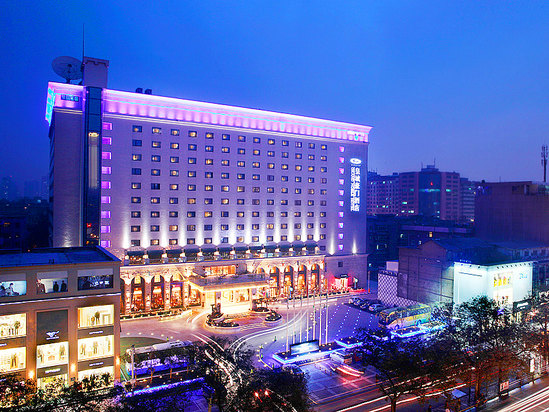
Grand Noble Hotel Xi’an is located in the most prosperous business district within the ancient city wall in the center of Xi’an.
The Grand Noble Hotel, like the Friendship Hotel, had a very flash foyer with tons of polished marble. It sent out warning signals, but when we got to our room, we found it to be absolutely stunning. More room, a large bathroom, air conditioning the works.
Only one small problem, as in Beijing the lighting is inadequate. Other than that it’s what I would call a five-star hotel. This one is definitely better than the Friendship Hotel.
In the center of the city, very close to the bell tower, one of the few ancient buildings left in Xi’an. It is also in the middle of a larger roundabout and had a guard with a machine gun.
Sadly there was no time for city center sightseeing.
This book has been written for some time and the manuscript was sitting in a box with half a dozen others gathering dust and not quite as complete, so this month it is going to get the makeover, a first draft for the editor.
And so it begins…
…
A twist I didn’t see coming
…
Yes.
I had worked out who the murderer was going to be.
Don’t you just hate it when the story unfolds in a different manner? The current person tapped for the murder is looking very guilty, except for one piece of evidence that was not taken into account.
I can’t say what it is.
And I can’t tell you who the likely suspect is, because now I’m not quite sure myself. I feel this is like a true-life murder crime. plodding through the leads and clues one at a time.
Once again I’m still writing a story even in the first edit that unfolds for me just as it would for the reader.
This book has been written for some time and the manuscript was sitting in a box with half a dozen others gathering dust and not quite as complete, so this month it is going to get the makeover, a first draft for the editor.
And so it begins…
…
A twist I didn’t see coming
…
Yes.
I had worked out who the murderer was going to be.
Don’t you just hate it when the story unfolds in a different manner? The current person tapped for the murder is looking very guilty, except for one piece of evidence that was not taken into account.
I can’t say what it is.
And I can’t tell you who the likely suspect is, because now I’m not quite sure myself. I feel this is like a true-life murder crime. plodding through the leads and clues one at a time.
Once again I’m still writing a story even in the first edit that unfolds for me just as it would for the reader.
Beijing west railway station is about eight kilometers from the Forbidden City, located at East Lianhuachi Road, Fengtai District. Most trains traveling between south central, southwest, northwest, and south China are boarded here.
This place is huge and there are so many people here, perhaps the other half of Beijing’s population that wasn’t in the forbidden city.
Getting into the station looked like it was going to be fraught with danger but the tour guide got us into the right queue and then arranged for a separate scanner for the group to help keep us all together
Then we decided to take the VIP service and got to waiting room no 13, the VIP service waiting room which was full to overflowing. Everyone today was a VIP. We got the red hat guy to lead us to a special area away from the crowd.
Actually, it was on the other side of the gate, away from the hoards sitting or standing patiently in the waiting room. It gave us a chance to get something to eat before the long train ride.
The departure is at 4 pm, the train number was G655, and we were told the trains leave on time. As it is a high-speed train, stops are far and few between, but we’re lucky, this time, in that we don’t have to count stations to know where to get off.
We’re going to the end of the line.
However, it was interesting to note the stops which, in each case, were brief, and you had to be ready to get off in a hurry.
These stops were Shijiazhuang, Zhengzhou East, Luoyang Longmen, Huashan North, and Weinan North. At night, you could see the lights of these cities from a distance and were like oases in the middle of a desert. During the day, the most prominent features were high rise apartment blocks and power stations.
A train ride with a difference
China’s high-speed trains, also known as bullet or fast trains, can reach a top speed of 350 km/h (217 mph).
Over 2,800 pairs of bullet trains numbered by G, D or C run daily connecting over 550 cities in China and covering 33 of the country’s 34 provinces. Beijing-Shanghai high-speed train link the two megacities 1,318 km (819 mi) away in just 4.5 hours.
By 2019, China keeps the world’s largest high-speed rail (HSR) network with a length totaling over 35,000 km (21,750 mi).
To make the five and a half hours go quicker we keep an eye on the speed which hovers between 290 and 305 kph, and sitting there with our camera waiting for the speed to hit 305 which is a rare occurrence, and then, for 306 and then for 307, which happened when we all took a stroll up to the restaurant car to find there had nothing to eat.
I got a strange flavored drink for 20 yuan.
There was a lady manning a trolley that had some food, and fresh, maybe, fruit on it, and she had a sense of humor if not much English.
We didn’t but anything but the barrel of caramel popcorn looked good.
The good thing was, after hovering around 298, and 299 kph, it finally hit 300.
We get to the end of the line, and there is an announcement in Chinese that we don’t understand and attempts to find out if it is the last station fall on deaf ears, probably more to do with the language barrier than anything else.
Then, suddenly the train conductor, the lady with the red hat, comes and tells us it is, and we have fifteen minutes, so we’re now hurrying to get off.
As the group was are scattered up and down the platform, we all come together and we go down the escalator, and, at the bottom, we see the trip-a-deal flags.
X’ian,and the Xi’an North Railway Station
Xi’an North Railway Station is one of the most important transportation hubs of the Chinese high-speed rail network. It is about 8.7 miles (14 km) from Bell Tower (city center) and is located at the intersection of the Weiyang Road and Wenjing Road in Weiyang District.
This time we have a male guide, Sam, who meets us at the end of the platform after we have disembarked. We have a few hiccups before we head to the bus. Some of our travelers are not on his list, but with the other group. Apparently a trip-a-deal mix-up or miscommunication perhaps.
Then it’s another long walk with bags to the bus. Good thing its a nicely air-conditioned newish bus, and there’s water, and beer for 10 yuan. How could you pass up a tsing tao for that price?
Xi’an is a very brightly lit up city at night with wide roads. It is very welcoming, and a surprise for a city of 10 million out in the middle of China.
As with all hotels, it’s about a 50-minute drive from the railway station and we are all tired by the time we get there.
Tomorrow’s program will be up at 6, on the bus 8.40 and off to the soldiers, 2.00 late lunch, then train station to catch the 4.00 train, that will arrive 2 hours later at the next stop. A not so late night this time.
The Grand Noble Hotel
Grand Noble Hotel Xi’an is located in the most prosperous business district within the ancient city wall in the center of Xi’an.
The Grand Noble Hotel, like the Friendship Hotel, had a very flash foyer with tons of polished marble. It sent out warning signals, but when we got to our room, we found it to be absolutely stunning. More room, a large bathroom, air conditioning the works.
Only one small problem, as in Beijing the lighting is inadequate. Other than that it’s what I would call a five-star hotel. This one is definitely better than the Friendship Hotel.
In the center of the city, very close to the bell tower, one of the few ancient buildings left in Xi’an. It is also in the middle of a larger roundabout and had a guard with a machine gun.
Sadly there was no time for city center sightseeing.
In Beijing, Hutongs are formed by lines of traditional courtyard residences, called siheyuan. Neighbourhoods were formed by joining many hutongs together. These siheyuan are the traditional residences, usually occupied by a single or extended family, signifying wealth, and prosperity.
Over 500 of these still exist. Many of these hutongs have been demolished, but recently they have become protected places as a means of preserving some Chinese cultural history. They were first established in the Yuan Dynasty (1279-1368)Many of these Hutongs had their main buildings and gates built facing south, and lanes connecting them to other hutongs also ran north to south.
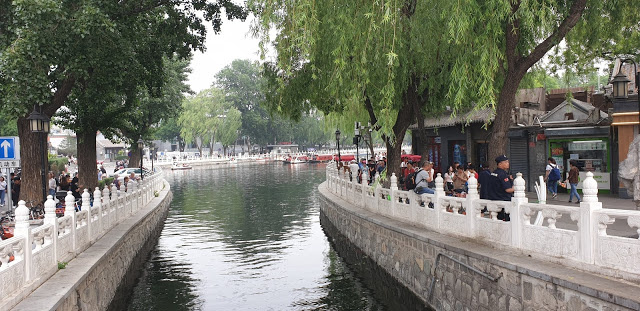
Many hutongs, some several hundred years old, in the vicinity of the Bell Tower and Drum Tower and Shichahai Lake are preserved and abound with tourists, many of which tour the quarter in pedicabs.
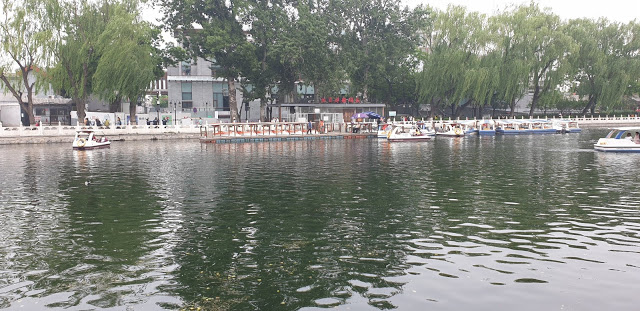
The optional tour also includes a visit to Shichahai, a historic scenic area consisting of three lakes (Qianhai, meaning Front Sea; Houhai, meaning Back Sea and Xihai, meaning West Sea), surrounding places of historic interest and scenic beauty and remnants of old-style local residences, Hutong and Courtyard.
First, we had a short walk through the more modern part of the Hutong area and given some free time for shopping, but we prefer just to meander by the canal.
There is a lake, and if we had the time, there were boats you could take.
With some time to spare, we take a quick walk down one of the alleyways where on the ground level are small shops, and above, living quarters.
Then we go to the bell and drum towers before walking through some more alleys was to where the rickshaws were waiting. The Bell tower
And the Drum tower. Both still working today.
The rickshaw ride took us through some more back streets where it was clear renovations were being made so that the area could apply for world heritage listing. Seeing inside some of the houses shows that they may look dumpy outside but that’s not the case inside.
The rickshaw ride ends outside the house where dinner will be served, and is a not so typical hose but does have all the elements of how the Chinese live, the boy’s room, the girl’s room, the parent’s room, the living area, and the North-south feng shui.
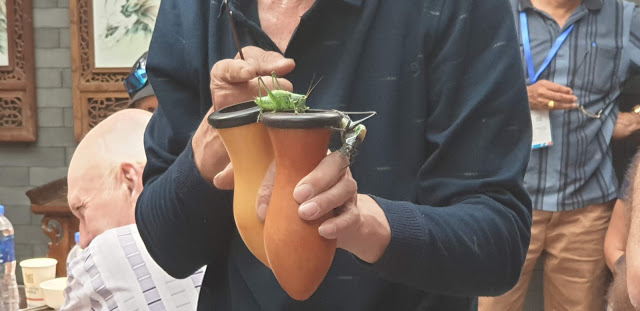
Shortly after we arrive, the cricket man, apparently someone quite famous in Beijing arrives and tells us all about crickets and then grasshoppers, then about cricket racing. He is animated and clearly enjoys entertaining us westerners.
I’m sorry but the cricket stuff just didn’t interest me. Or the grasshoppers.
As for dinner, it was finally a treat to eat what the typical Chinese family eats, and everything was delicious, and the endless beer was a nice touch.
And the last surprise, the food was cooked by a man.
This book has been written for some time and the manuscript was sitting in a box with half a dozen others gathering dust and not quite as complete, so this month it is going to get the makeover, a first draft for the editor.
And so it begins…
…
Half way there
…
Yes, 15 days down and 15 days to go.
At this point my hand is starting to cramp from the toils of writing, yes, I’m one of those writers who often puts words to paper longhand.
Two weeks is a long time, but I think this sort of exercise is what’s needed if you want to write a novel every year, though this one is going to come out with more than 50,000 words.
I think there are about three more chapters to go to end part two, then I can get onto the big finale in part three.
It has turned out to be a bigger project than I originally thought, and I didn’t think I could stretch it to 50,000 words. Now, I’m hoping to keep it to about 60,000.
Still, no need to get ahead of myself. Murphy’s law may yet rear its ugly head.
This book has been written for some time and the manuscript was sitting in a box with half a dozen others gathering dust and not quite as complete, so this month it is going to get the makeover, a first draft for the editor.
And so it begins…
…
Half way there
…
Yes, 15 days down and 15 days to go.
At this point my hand is starting to cramp from the toils of writing, yes, I’m one of those writers who often puts words to paper longhand.
Two weeks is a long time, but I think this sort of exercise is what’s needed if you want to write a novel every year, though this one is going to come out with more than 50,000 words.
I think there are about three more chapters to go to end part two, then I can get onto the big finale in part three.
It has turned out to be a bigger project than I originally thought, and I didn’t think I could stretch it to 50,000 words. Now, I’m hoping to keep it to about 60,000.
Still, no need to get ahead of myself. Murphy’s law may yet rear its ugly head.
In Beijing, Hutongs are formed by lines of traditional courtyard residences, called siheyuan. Neighbourhoods were formed by joining many hutongs together. These siheyuan are the traditional residences, usually occupied by a single or extended family, signifying wealth, and prosperity.
Over 500 of these still exist. Many of these hutongs have been demolished, but recently they have become protected places as a means of preserving some Chinese cultural history. They were first established in the Yuan Dynasty (1279-1368)Many of these Hutongs had their main buildings and gates built facing south, and lanes connecting them to other hutongs also ran north to south.
Many hutongs, some several hundred years old, in the vicinity of the Bell Tower and Drum Tower and Shichahai Lake are preserved and abound with tourists, many of which tour the quarter in pedicabs.
The optional tour also includes a visit to Shichahai, a historic scenic area consisting of three lakes (Qianhai, meaning Front Sea; Houhai, meaning Back Sea and Xihai, meaning West Sea), surrounding places of historic interest and scenic beauty and remnants of old-style local residences, Hutong and Courtyard.
First, we had a short walk through the more modern part of the Hutong area and given some free time for shopping, but we prefer just to meander by the canal.
There is a lake, and if we had the time, there were boats you could take.
With some time to spare, we take a quick walk down one of the alleyways where on the ground level are small shops, and above, living quarters.
Then we go to the bell and drum towers before walking through some more alleys was to where the rickshaws were waiting. The Bell tower
And the Drum tower. Both still working today.
The rickshaw ride took us through some more back streets where it was clear renovations were being made so that the area could apply for world heritage listing. Seeing inside some of the houses shows that they may look dumpy outside but that’s not the case inside.
The rickshaw ride ends outside the house where dinner will be served, and is a not so typical hose but does have all the elements of how the Chinese live, the boy’s room, the girl’s room, the parent’s room, the living area, and the North-south feng shui.
Shortly after we arrive, the cricket man, apparently someone quite famous in Beijing arrives and tells us all about crickets and then grasshoppers, then about cricket racing. He is animated and clearly enjoys entertaining us westerners.
I’m sorry but the cricket stuff just didn’t interest me. Or the grasshoppers.
As for dinner, it was finally a treat to eat what the typical Chinese family eats, and everything was delicious, and the endless beer was a nice touch.
And the last surprise, the food was cooked by a man.
This book has been written for some time and the manuscript was sitting in a box with half a dozen others gathering dust and not quite as complete, so this month it is going to get the makeover, a first draft for the editor.
And so it begins…
…
I’m ahead of target so time for more serious revision
…
Whenever I’m writing, especially when I’m working on a plan, things never quite go the way I’d originally envisaged.
You get so far, and an idea pops into your head, and then, thinking it will work well, often it requires a little extra in previously written work.
Of course, when also writing under a time constraint, that’s not always possible, so your desk, computer keyboard or monitor becomes a repository for endless yellow Post-it notes reminding you of the plot holes to be fixed.
I have time, and today I will be fixing them.
I also suspect this might make my word count for the project exceed the required 50,000.



 Thrills, Spills, and just a dash of Romance