Searching for locations: Auckland, New Zealand – Another city that has a tower

Nearly every city has a high building, a tower, or a large Ferris wheel.

London had the London eye
Paris has the Eiffel tower
The Galata in Istanbul
The CN Tower in Toronto
The towers of San Gimignano
Pisa has a leaning tower

We’ve managed to see all of the above bar the Galata in Istanbul.  One day we might get there.

But, on this side of the world, there are two, the Sydney Tower, and the Sky Tower in Auckland, which we just visited recently.

20140522_153338

It’s not a tall tower, but it definitely gives great vies of Auckland, particularly to the north

20140522_150952

The mountain in the background at the top of the photo is of a volcano on Rangitoto Island.  When we were visiting, there were reports that it might become active again.

20140522_151039

To give a height perspective, it didn’t seem all that far down to the apartment building and gardens nearby.

An excerpt from “The Things We Do For Love”

In the distance he could hear the dinner bell ringing and roused himself.  Feeling the dampness of the pillow, and fearing the ravages of pent up emotion, he considered not going down but thought it best not to upset Mrs. Mac, especially after he said he would be dining.

In the event, he wished he had reneged, especially when he discovered he was not the only guest staying at the hotel.

Whilst he’d been reminiscing, another guest, a young lady, had arrived.  He’d heard her and Mrs. Mac coming up the stairs, and then shown to a room on the same floor, perhaps at the other end of the passage.

Henry caught his first glimpse of her when she appeared at the door to the dining room, waiting for Mrs. Mac to show her to a table.

She was about mid-twenties, slim, long brown hair, and the grace and elegance of a woman associated with countless fashion magazines.  She was, he thought, stunningly beautiful with not a hair out of place, and make-up flawlessly applied.  Her clothes were black, simple, elegant, and expensive, the sort an heiress or wife of a millionaire might condescend to wear to a lesser occasion than dinner.

Then there was her expression; cold, forbidding, almost frightening in its intensity.  And her eyes, piercingly blue and yet laced with pain.  Dracula’s daughter was his immediate description of her.

All in all, he considered, the only thing they had in common was, like him, she seemed totally out of place.

Mrs. Mac came out of the kitchen, wiping her hands on her apron.  She was, she informed him earlier, chef, waitress, hotelier, barmaid, and cleaner all rolled into one.  Coming up to the new arrival she said, “Ah, Miss Andrews, I’m glad you decided to have dinner.  Would you like to sit with Mr. Henshaw, or would you like to have a table of your own?”

Henry could feel her icy stare as she sized up his appeal as a dining companion, making the hair on the back on his neck stand up.  He purposely didn’t look back.  In his estimation, his appeal rating was minus six.  Out of a thousand!

“If Mr. Henshaw doesn’t mind….”  She looked at him, leaving the query in mid-air.

He didn’t mind and said so.  Perhaps he’d underestimated his rating.

“Good.”  Mrs. Mac promptly ushered her over.  Henry stood, made sure she was seated properly and sat.

“Thank you.  You are most kind.”  The way she said it suggested snobbish overtones.

“I try to be when I can.”  It was supposed to nullify her sarcastic tone but made him sound a little silly, and when she gave him another of her icy glares, he regretted it.

Mrs. Mac quickly intervened, asking, “Would you care for the soup?”

They did, and, after writing the order on her pad, she gave them each a look, imperceptibly shook her head, and returned to the kitchen.

Before Michelle spoke to him again, she had another quick look at him, trying to fathom who and what he might be.  There was something about him.

His eyes, they mirrored the same sadness she felt, and, yes, there was something else, that it looked like he had been crying?  There was a tinge of redness.

Perhaps, she thought, he was here for the same reason she was.

No.  That wasn’t possible.

Then she said, without thinking, “Do you have any particular reason for coming here?”  Seconds later she realized she’s spoken it out loud, had hadn’t meant to actually ask, it just came out.

It took him by surprise, obviously not the first question he was expecting her to ask of him.

“No, other than it is as far from civilization, and home, as I could get.”

At least we agree on that, she thought.

It was obvious he was running away from something as well.

Given the isolation of the village and lack of geographic hospitality, it was, from her point of view, ideal.  All she had to do was avoid him, and that wouldn’t be difficult.

After getting through this evening first.

“Yes,” she agreed.  “It is that.”

A few seconds passed, and she thought she could feel his eyes on her and wasn’t going to look up.

Until he asked, “What’s your reason?”

Slight abrupt in manner, perhaps as a result of her question, and the manner in which she asked it.

She looked up.  “Rest.  And have some time to myself.”

She hoped he would notice the emphasis she had placed on the word ‘herself’ and take due note.  No doubt, she thought,  she had completely different ideas of what constituted a holiday than he, not that she had actually said she was here for a holiday.

Mrs. Mac arrived at a fortuitous moment to save them from further conversation.


Over the entree, she wondered if she had made a mistake coming to the hotel.  Of course, there had been no possible way she could know than anyone else might have booked the same hotel, but realized it was foolish to think she might end up in it by herself.

Was that what she was expecting?

Not a mistake then, but an unfortunate set of circumstances, which could be overcome by being sensible.

Yet, there he was, and it made her curious, not that he was a man, by himself, in the middle of nowhere, hiding like she was, but for very different reasons.

On discreet observance whilst they ate, she gained the impression his air of light-heartedness was forced and he had no sense of humor.

This feeling was engendered by his looks, unruly dark hair, and permanent frown.  And then there was his abysmal taste in clothes on a tall, lanky frame.  They were quality but totally unsuited to the wearer.

Rebellion was written all over him.

The only other thought crossing her mind, and rather incongruously, was he could do with a decent feed.  In that respect, she knew now from the mountain of food in front of her, he had come to the right place.

“Mr. Henshaw?”

He looked up.  “Henshaw is too formal.  Henry sounds much better,” he said, with a slight hint of gruffness.

“Then my name is Michelle.”

Mrs. Mac came in to take their order for the only main course, gather up the entree dishes, then return to the kitchen.

“Staying long?” she asked.

“About three weeks.  Yourself?”

“About the same.”

The conversation dried up.

Neither looked at the other, rather at the walls, out the window, towards the kitchen, anywhere.  It was, she thought, almost unbearably awkward.


Mrs. Mac returned with a large tray with dishes on it, setting it down on the table next to theirs.

“Not as good as the usual cook,” she said, serving up the dinner expertly, “but it comes a good second, even if I do say so myself.  Care for some wine?”

Henry looked at Michelle.  “What do you think?”

“I’m used to my dining companions making the decision.”

You would, he thought.  He couldn’t help but notice the cutting edge of her tone.  Then, to Mrs. Mac, he named a particular White Burgundy he liked and she bustled off.

“I hope you like it,” he said, acknowledging her previous comment with a smile that had nothing to do with humor.

“Yes, so do I.”

Both made a start on the main course, a concoction of chicken and vegetables that were delicious, Henry thought, when compared to the bland food he received at home and sometimes aboard my ship.

It was five minutes before Mrs. Mac returned with the bottle and two glasses.  After opening it and pouring the drinks, she left them alone again.

Henry resumed the conversation.  “How did you arrive?  I came by train.”

“By car.”

“Did you drive yourself?”

And he thought, a few seconds later, that was a silly question, otherwise she would not be alone, and certainly not sitting at this table. With him.

“After a fashion.”

He could see that she was formulating a retort in her mind, then changed it, instead, smiling for the first time, and it served to lighten the atmosphere.

And in doing so, it showed him she had another more pleasant side despite the fact she was trying not to look happy.

“My father reckons I’m just another of ‘those’ women drivers,” she added.

“Whatever for?”

“The first and only time he came with me I had an accident.  I ran up the back of another car.  Of course, it didn’t matter to him the other driver was driving like a startled rabbit.”

“It doesn’t help,” he agreed.

“Do you drive?”

“Mostly people up the wall.”  His attempt at humor failed.  “Actually,” he added quickly, “I’ve got a very old Morris that manages to get me where I’m going.”

The apple pie and cream for dessert came and went and the rapport between them improved as the wine disappeared and the coffee came.  Both had found, after getting to know each other better, their first impressions were not necessarily correct.

“Enjoy the food?” Mrs. Mac asked, suddenly reappearing.

“Beautifully cooked and delicious to eat,” Michelle said, and Henry endorsed her remarks.

“Ah, it does my heart good to hear such genuine compliments,” she said, smiling.  She collected the last of the dishes and disappeared yet again.

“What do you do for a living,” Michelle asked in an off-hand manner.

He had a feeling she was not particularly interested and it was just making conversation.

“I’m a purser.”

“A what?”

“A purser.  I work on a ship doing the paperwork, that sort of thing.”

“I see.”

“And you?”

“I was a model.”

“Was?”

“Until I had an accident, a rather bad one.”

“Oh, I’m sorry.”

So that explained the odd feeling he had about her.

As the evening had worn on, he began to think there might be something wrong, seriously wrong with her because she didn’t look too well.  Even the carefully applied makeup, from close up, didn’t hide the very pale, and tired look, or the sunken, dark ringed eyes.

“I try not to think about it, but it doesn’t necessarily work.  I’ve come here for peace and quiet, away from doctors and parents.”

“Then you will not have to worry about me annoying you.  I’m one of those fall-asleep-reading-a-book types.”

Perhaps it would be like ships passing in the night and then smiled to himself about the analogy.

Dinner now over, they separated.

Henry went back to the lounge to read a few pages of his book before going to bed, and Michelle went up to her room to retire for the night.

But try as he might, he was unable to read, his mind dwelling on the unusual, yet the compellingly mysterious person he would be sharing the hotel with.

Overlaying that original blurred image of her standing in the doorway was another of her haunting expressions that had, he finally conceded, taken his breath away, and a look that had sent more than one tingle down his spine.

She may not have thought much of him, but she had certainly made an impression on him.


© Charles Heath 2015-2020

lovecoverfinal1

The fourth attempt, let’s look at the main character

So there’s words on paper, and three times I’ve tried to fix it, or, perhaps just make it sound better, because reading it in my head, there’s too little background, and too many questions.

The flow of the story isn’t working for me, so I guess it’s time to sit down and work out what it is I’m trying to say.

The notion that our main character, Graham, is a loser seems to shine through, and that’s not what I’m trying to portray him as.  No, far from it, it’s been a lifetime of bad choices that have put him where he is, and he knows it.

So, in part, this is about owning your mistakes, and it’s my job to make him come across as a hero in waiting.  There’s good in him, perhaps too much, but there is also that attitude that led to all those bad choices, the one that can get him into trouble, and a sort of intransience inherited from his father, that has more or less got him ostracised from the family. 

I want this character to be a chop off the old block, both of whom are the type not to back down, not to say sorry, and, to quote a rather apt allegory, would cut their nose off to spite their face.

Graham’s intransience led to his refusal to follow his father into business, refusal to go to University despite having the necessary qualifications, and just to round out the defiance, his choice of women whom he knew would meet with family disapproval.

And these factors, over a period of time, saw him bounce from a low paying job to jobs with no prospects, and a string of failed relationships, until this moment in time, where he was basically on his own, working the graveyard shift as a security guard.  The sort of job where qualifications weren’t looked for and workmates looked like and probably were ex-cons.

There are a few more details like the older brother, Jackson, politician and schemer, the same as his father before him (the seat was passed down through the family), like the younger sister who is a highly successful surgeon, married into immense wealth.  His brother had been less successful in the marital stakes but what he lacked in a wife was more than made up with a string of highly eligible and beautiful women.

And, no, he doesn’t resent the fact they’re rich, or that his parents were, too, just that they treated him with contempt.

It was almost five years since the last time he had seen any of them, that last time he attended the family Christmas in Martha’s Vineyard, the ‘Stockdale Residence’ an ostentatious sprawling fifty room mansion that, in a drunken rage, he’s tried to burn down.

Once again, he had not received an invitation to the next, due in a few days, and it was not entirely unexpected.

Graham has his faults, but that even, five years ago, had pulled him off the road to self-destruction, helped along by a year stint in jail where he learned a great many lessons about life itself, and survival.

The four years since?

A lot of regret, and a lot of repentance.  Life after jail was a lot worse than life trying to defy the family and the system.  There were two roads he could have gone down, and thankfully for him, it was not the wrong one.

So, he’s back on the path, a whole lot wiser, a whole lot tougher.

That might not have been exactly what I was thinking for him over the first three attempts.  I don’t think any character really begins to shine until halfway through, as you find him meeting various challenges in ways even you, as the writer, find quite unexpected.

Is that the end result of being a pantser over being a planner?

I don’t think, even as a planner, you can create a character that’s not going to change, or ever surprise you, as the story evolves.

And somehow I don’t think I’m about to change from one to the other.

Well, not completely.

But there’s more, and no, it’s not steak knives!

© Charles Heath 2020

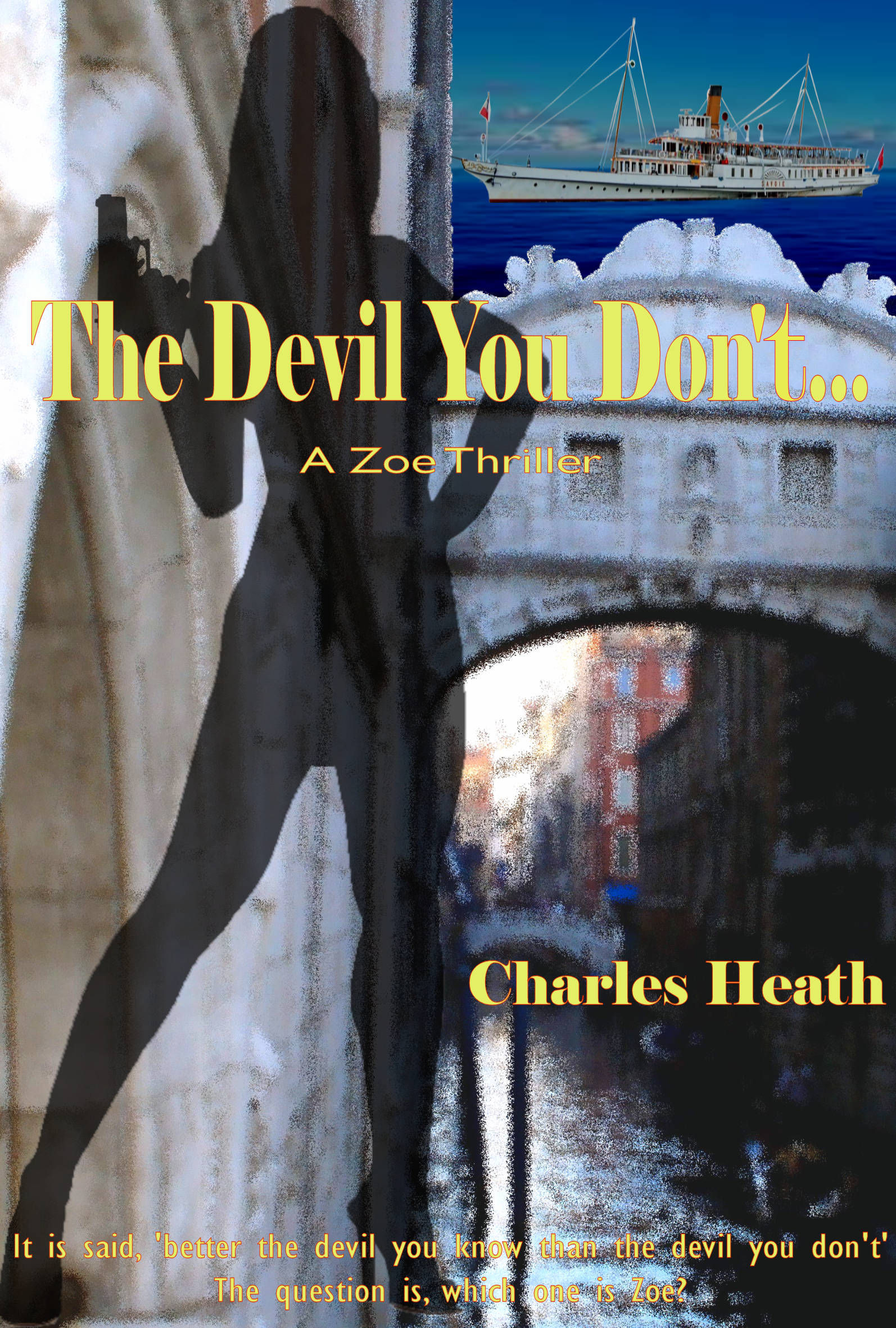
“The Devil You Don’t”, be careful what you wish for

Now only $0.99 at https://amzn.to/2Xyh1ow

John Pennington’s life is in the doldrums. Looking for new opportunities, prevaricating about getting married, the only joy on the horizon was an upcoming visit to his grandmother in Sorrento, Italy.

Suddenly he is left at the check-in counter with a message on his phone telling him the marriage is off, and the relationship is over.

If only he hadn’t promised a friend he would do a favor for him in Rome.

At the first stop, Geneva, he has a chance encounter with Zoe, an intriguing woman who captures his imagination from the moment she boards the Savoire, and his life ventures into uncharted territory in more ways than one.

That ‘favor’ for his friend suddenly becomes a life-changing event, and when Zoe, the woman who he knows is too good to be true, reappears, danger and death follow.

Shot at, lied to, seduced, and drawn into a world where nothing is what it seems, John is dragged into an adrenaline-charged undertaking, where he may have been wiser to stay with the ‘devil you know’ rather than opt for the ‘devil you don’t’.

newdevilcvr6

The fourth attempt, let’s look at the location

Equally important is the location.  Dark and brooding characters need dark and brooding locations.  It’s undeniable that there’s evil everywhere, we just have to look for it.

Of course, that’s not what I do, but …

I have been in a few tight corners, with some possibly dark and brooding characters where my heart rate has increased exponentially, and was saved by quick thinking, and a desire not to hang around and see what happens (for the purposes of a writable experience – no,, I’m not that stupid).

As the story stands, we move form a small staff room, or rest room, and then we move out to the car park of … what?  It’s not exactly clear where it is, only that Graham is leaving work to go home.

Whether it’s clear or not, Graham is a security guard, part of a team that work on an industrial estate where there’s a number of factories and office blocks. 

Some of those buildings are empty, for a variety of reasons, so a back story for this might be created so that I can convey a clearer picture of not only the bricks and mortar, but what it’s like there.

Ergo the first descriptive line, steeping outside into the epicentre of the south pole.  There is snow everywhere, which meant it was falling while he was inside at work, but now, the moment he leaves, it’s stopped.  Cold, then, and clear.

So it begins…

Now, as a secondary theme, it might not be obvious the owners are lax in the hiring of security staff to watch over their assets, staff that are relatively dubious in character, which might, in turn, mean that the notion of using cut-price security might mean something else is going on.

Are the empty factories empty?  Or have they been repurposed, and the guards are not sure what their guarding?  Do they want to know?  A job is a job, and in this situation, either from a hint from the employer, or the words of an old hand, and it doesn’t pay to poke a nose in where it’s not wanted.

So, as you can see, when starting the story I didn’t give proper thought to the background story, the fact that I could weave another or several storylines intertwined with what will be the master plotline.

What is the master plotline?

I have an idea or two, but let’s not get to ahead of ourselves.

Let’s stitch together a scenario or two for the back story and see where it takes us.  Remember that this was more or less part of the storyline originally in my mind but may not have been articulated in what I wrote at the time.

Basically, then, we’re dealing with a large industrial site on the outskirts of a city in decline.  Everyone can relate to the problematic times we’re in now, but this was written at the height of the last global financial meltdown about fifteen year ago, which caused a deep recession.

Within that framework a lot of businesses and people went to the wall.  Graham, and others, lost a decent paying job, as well as his house, having finally got on the property ladder, only to find he couldn’t pay for it.

At the time he was not alone in that respect.  And lenders were not immune either, so there’s the possibility of one or two industrial park owners not exactly being legit in some of their business dealings, not after taking heavy hits financially.

In that scenario, there’s always the possibility of insurance fraud as a means of cutting losses, hence the need for security that might be asked to look the other way.

Another possibility could be that empty buildings and enterprising men, or women, fit the category of ‘the devil finds work for idle hands’. 

Or someone who recognises an opportunity to make some money.  That particular scenario opens the door to a plethora of ideas.

© Charles Heath 2020

“Sunday in New York”, it’s a bumpy road to love

“Sunday in New York” is ultimately a story about trust, and what happens when a marriage is stretched to its limits.

When Harry Steele attends a lunch with his manager, Barclay, to discuss a promotion that any junior executive would accept in a heartbeat, it is the fact his wife, Alison, who previously professed her reservations about Barclay, also agreed to attend, that casts a small element of doubt in his mind.

From that moment, his life, in the company, in deciding what to do, his marriage, his very life, spirals out of control.

There is no one big factor that can prove Harry’s worst fears, that his marriage is over, just a number of small, interconnecting events, when piled on top of each other, points to a cataclysmic end to everything he had believed in.

Trust is lost firstly in his best friend and mentor, Andy, who only hints of impending disaster, Sasha, a woman whom he saved, and who appears to have motives of her own, and then in his wife, Alison, as he discovered piece by piece damning evidence she is about to leave him for another man.

Can we trust what we see with our eyes or trust what we hear?

Haven’t we all jumped to conclusions at least once in our lives?

Can Alison, a woman whose self-belief and confidence is about to be put to the ultimate test, find a way of proving their relationship is as strong as it has ever been?

As they say in the classics, read on!

Purchase:

http://tinyurl.com/Amazon-SundayInNewYork

In a word: Happy

“I’m happy to be being here.”

Yes, I actually heard that answer given in a television interview, and thought, at the time, it was a quaint expression.

But in reality, this was a person for whom English was a second language, and that was, quite literally, their translation from their language to English.

Suffice to say, that person was not happy when lost the event she was participating in.

But that particular memory was triggered by another event.

Someone asked me how happy I was.

Happy is another of those words like good, thrown around like a rag doll, used without consequence, or regard for its true meaning.

“After everything that’s happened, you should be the happiest man alive!”

I’m happy.

I should be, to them.

A real friend might also say, “Are you sure, you don’t look happy.”

I hesitate but say, “Sure.  I woke up with a headache,” or some other lame reason.

But, in reality, I’m not ‘happy’.  Convention says that we should be happy if everything is going well.  In my case, it is, to a certain extent, but it is what’s happening within that’s the problem.  We say it because people expect it.

I find there is no use complaining because no one will listen, and definitely, no one likes serial complainers.

True.

But somewhere in all those complaints will be the truth, the one item that is bugging us.

It is a case of whether we are prepared to listen.  Really listen.

And not necessarily take people at their word.


In a word: Blue

Of course we all know this word is a colour, or color depending on where you live.

You know, blue sky, deep blue sea, blonde hair blue eyes.  Very descriptive.

But it can also mean you are down in the dumps, a rather strange, for some, expression that means you are sad or unhappy.

For others to have a blue means to have a fight with someone

And oddly, and I know this from first hand experience, that a red haired person will be called bluey, or less pleasing either carrot top or blood nut.  I used to ignore those people who used those expressions, except for my father in law.

You can do something until you are blue in the face, which means do it without result until exhaustion, another way of saying your wasting your time.

And if something comes out of the blue, it usually means its entirely unexpected.  For me, that’s always a bill I wasn’t expecting, for someone else an inheritance.

And in some parts of the world, blue is used as a synonym for conservative political party, for insistence, the Liberal party in Australia, and the Democrats in the United States

Blue should not be confused with the word blew, which is the past tense of blow, which is wind causing an air current, or blowing air through pursed lips.

That doesn’t mean that if something blew up it was just a giant air mass exploding because it can’t.  If a bomb blew up it means it detonated.

And if that sounds complicated:

What if something blew my mind?  Does that mean my head exploded?  No, it just means its incomprehensible, whether good or bad.

Or

What if I blew a fortune on a three legged horse?  We all throw good money after bad, but you can easily lose a fortune, or blew it.

Its the same thing with opportunities, for instance, he had a chance and he blew it.  Yes, obviously something better came along, not, or he just ignored a sterling opportunity.

The first case of PI Walthenson – “A Case of Working With the Jones Brothers”

This case has everything, red herrings, jealous brothers, femme fatales, and at the heart of it all, greed.

See below for an excerpt from the book…

Coming soon!

PIWalthJones1

An excerpt from the book:

When Harry took the time to consider his position, a rather uncomfortable position at that, he concluded that he was somehow involved in another case that meant very little to him.

Not that it wasn’t important in some way he was yet to determine, it was just that his curiosity had got the better of him, and it had led to this: sitting in a chair, securely bound, waiting for someone one of his captors had called Doug.

It was not the name that worried him so much, it was the evil laugh that had come after the name was spoken.

Doug what? Doug the ‘destroyer’, Doug the ‘dangerous’, Doug the ‘deadly’; there was any number of sinister connotations, and perhaps that was the point of the laugh, to make it more frightening than it was.

But there was no doubt about one thing in his mind right then: he’d made a mistake. A very big. and costly, mistake. Just how big the cost, no doubt he would soon find out.

His mother, and his grandmother, the wisest person he had ever known, had once told him never to eavesdrop.

At the time he couldn’t help himself and instead of minding his own business, listening to a one-sided conversation which ended with a time and a place. The very nature of the person receiving the call was, at the very least, sinister, and, because of the cryptic conversation, there appeared to be, or at least to Harry, criminal activity involved.

For several days he had wrestled with the thought of whether he should go. Stay on the fringe, keep out of sight, observe and report to the police if it was a crime. Instead, he had willingly gone down the rabbit hole.

Now, sitting in an uncomfortable chair, several heat lamps hanging over his head, he was perspiring, and if perspiration could be used as a measure of fear, then Harry’s fear was at the highest level.

Another runnel of sweat rolled into his left eye, and, having his hands tied, literally, it made it impossible to clear it. The burning sensation momentarily took his mind off his predicament. He cursed and then shook his head trying to prevent a re-occurrence. It was to no avail.

Let the stinging sensation be a reminder of what was right and what was wrong.

It was obvious that it was the right place and the right time, but in considering his current perilous situation, it definitely was the wrong place to be, at the worst possible time.

It was meant to be his escape, an escape from the generations of lawyers, what were to Harry, dry, dusty men who had been in business since George Washington said to the first Walthenson to step foot on American soil, ‘Why don’t you become a lawyer?” when asked what he could do for the great man.

Or so it was handed down as lore, though Harry didn’t think Washington meant it literally, the Walthenson’s, then as now, were not shy of taking advice.

Except, of course, when it came to Harry.

He was, Harry’s father was prone to saying, the exception to every rule. Harry guessed his father was referring to the fact his son wanted to be a Private Detective rather than a dry, dusty lawyer. Just the clothes were enough to turn Harry off the profession.

So, with a little of the money Harry inherited from one of his aunts, he leased an office in Gramercy Park and had it renovated to look like the Sam Spade detective agency, you know the one, Spade and Archer, and The Maltese Falcon.

There’s a movie and a book by Dashiell Hammett if you’re interested.

So, there it was, painted on the opaque glass inset of the front door, ‘Harold Walthenson, Private Detective’.

There was enough money to hire an assistant, and it took a week before the right person came along, or, more to the point, didn’t just see his business plan as something sinister. Ellen, a tall cool woman in a long black dress, or so the words of a song in his head told him, fitted in perfectly.

She’d seen the movie, but she said with a grin, Harry was no Humphrey Bogart.

Of course not, he said, he didn’t smoke.

Three months on the job, and it had been a few calls, no ‘real’ cases, nothing but missing animals, and other miscellaneous items. What he really wanted was a missing person. Or perhaps a beguiling, sophisticated woman who was as deadly as she was charming, looking for an errant husband, perhaps one that she had already ‘dispatched’.

Or for a tall, dark and handsome foreigner who spoke in riddles and in heavily accented English, a spy, or perhaps an assassin, in town to take out the mayor. The man was such an imbecile Harry had considered doing it himself.

Now, in a back room of a disused warehouse, that wishful thinking might be just about to come to a very abrupt end, with none of the romanticized trappings of the business befalling him. No beguiling women, no sinister criminals, no stupid policemen.

Just a nasty little man whose only concern was how quickly or how slowly Harry’s end was going to be.

© Charles Heath 2019

Searching for locations: Kaikoura, New Zealand, and, of course, the whales

I’m sure a lot of people have considered the prospect of whale watching.  I’m not sure how the subject came up on one of our visits to New Zealand, but I suspect it was one one of those tourist activity leaflets you find in the foyer of motels, hotels, and guesthouses.

Needless to say, it was only a short detour to go to Kaikoura and check out the prospect.

Yes, the ocean at the time seemed manageable.  My wife has a bad time with sea sickness, but she was prepared to make the trip, after some necessary preparations.  Seasickness tablets and special bands to wear on her wrist were recommended and used.

The boat was large and had two decks, and mostly enclosed.  There were a lot of people on board, and we sat inside for the beginning of the voyage.  The sea wasn’t rough, but there was about a meter and a half swell, easily managed by the boat while it was moving.

It took about a half hour or so to reach the spot where the boat stopped and a member of the crew used a listening device to see if there were any whales.

That led to the first wave of sickness.

We stopped for about ten minutes, and the boat moved up and down on the waves.  It was enough to start the queasy stomachs of a number of passengers.  Myself, it was a matter of going out on deck and taking in the sea air.  Fortunately, I don’t get seasick.

Another longish journey to the next prospective site settled a number of the queasy stomachs, but when we stopped again, the swell had increased, along with the boat’s motion.  Seasick bags were made available for the few that had succumbed.

By the time we reached the site where there was a whale, over half the passengers had been sick, and I was hoping they had enough seasick bags, and then enough bin space for them.

The whale, of course, put on a show for us, and those that could went out on deck to get their photos.

DSCN1026.JPG
DSCN1028.JPG
DSCN1029.JPG

By the end of the voyage, nearly everyone on board was sick, and I was helping to hand out seasick bags.

Despite the anti sickness preparations, my wife had also succumbed.  When we returned and she was asked if the device had worked, she said no.

But perhaps it had because within half an hour we were at a cafe eating lunch, fish and chips of course.

This activity has been crossed off the bucket list, and there’s no more whale watching in our traveling future.  Nor, it seems, will we be going of ocean liners.

Perhaps a cruise down the Rhine might be on the cards.  I don’t think that river, wide as it is in places, will ever have any sort of swell.