Some call time off from work whether it is for a day, a few days, and couple of weeks, or maybe longer, a holiday.
Or leave, leave of absence, annual leave, or long service leave.
Others may call it vacation.
It depends on what part of the world you live in.
But the end result is the same, you do not go to work, so you stay home and do all those things that have mounted up, you drive up, and for some reason it is always up, to the cabin, for a little hunting shooting a fishing, or you get on a planr or a ship and try to get as far away from home and work as possible.
That’s called going overseas. It seems if there is an ocean between w there you go and where you live, no one will be able to disturb you.
Sorry, I bet you didn’t leave that mobile phone or iPad home did you?
But, of course there are a few other obscure references to the word holiday.
For instance,
It can be a day set aside to commemorate an event or a person, a day when you are not expected to work, e.g. Memorial Day, Christmas Day, Good Friday. In Britain they used to be called Bank Holidays.
It can be a specified period that you may be excused from completing a task, or doing something such as getting a one year tax exemption, which maifh also be called a one year tax holiday.
Yes, now that is an obscure reference, particularly when no tax department would ever grant anyone an exemption of any sort.
I’m back home and this story has been sitting on a back burner for a few months, waiting for some more to be written.
The trouble is, there are also other stories to write, and I’m not very good at prioritizing.
But, here we are, a few minutes opened up and it didn’t take long to get back into the groove.
Chasing leads, maybe
…
I had a change of mind before I went on an odyssey to Peaslake. I needed help, and I was going to try and convince Jennifer to help me. If she had been injured, that might be more difficult.
I caught a train and a bus to Putney and then walked the remaining fifty yards to her front door. It was a flat over the top of a shop, and, when I read the name of the shop, I thought I knew why she was there. The shop, and quite likely the building belonged to her family, not that it was her surname, but I could be hopeful.
I went up the side stairs and reached the landing. There were two doors, one with 1A on it, and one with 1B on it. Hers was 1A.
I knocked on the door.
A minute later nothing had happened.
I knocked again, this time a little harder.
There was no answer, again, but there was a movement in the flat next door, then the door opened and a scruffy young man, perhaps a university student put his head out.
“She’s not here.”
“Not here, and in no longer living here, or not here as in she is out somewhere and will be back.”
He looked at me blankly, like I’d spoken too fast, or used too many words for him to understand. Possibly he’d just woken up.
He shook his head. “Just out probably getting coffee or something. The shops on the other side of the road, three or four doors up. Can’t miss it, it smells like coffee.”
He gave me a look up and down, gauging whether or not I could be of interest to her, then went back inside his room and closed the door.
It might be a lie, but I was going to take him at his word.
I went back down the stairs and out onto the sidewalk and looked up and down both sides of the street. There was a café, on the other side, not far away.
I waited for a break in the traffic, then crossed the road.
She was inside, reading a paper, oblivious to those around her, and, in particular, those coming from outside. She should be casually keeping an eye out for trouble.
I managed to get inside and take the seat next to her before she raised her head to see who it was.
No surprise.
“You,” she said. “You made it out alive too?”
“You should be more careful.”
“I was told I was no longer employed, that the people who hired me were ex-agents with some sort of agenda.”
I glanced at the open page of the newspaper. The jobs vacant page.
“Then it might come as a bit of a surprise to realize you’re still on their books, just assigned to a different department. Same as me.”
“They told me I was redundant.”
“Who told you?”
“A woman. Monica Sherive she said her name was.”
“I spoke to her earlier this morning. I didn’t ask, but I will the next time I’m in the office. What do you remember about the assignment?”
“We were supposed to maintain surveillance on a man, no name, just a photograph. I heard you had him in sight and was about to pass him off to Adam. I didn’t hear Adam acknowledge. I heard an explosion and all hell broke loose. No point carrying on, so I left.”
And that was what saved her life. Incorrect procedure. Unless she reported in.
“Did you report to the overseer.”
“Over the radio. He told me to go. What happened to Adam and Jack?”
“Dead. Murdered by the target, I think. The target’s dead too. A chap by the name of O’Connell, though the more I find out about him, the more interesting it gets.”
I could see the cogs ticking over behind her eyes as she put one and one together. “So…”
“You should be dead too. What saved your life was just up and leaving.”
“How did you escape?”
“I didn’t. I found the target again after the explosion and followed him to an alley. When I got there he told me I was making a mistake, and then he was shot. Severin and Maury turned up, and that was it.”
“Did they kill him?”
“No. It was a sniper, and I’m still wondering why I didn’t get shot too.”
“The woman told me Severin and Maury didn’t work for the organization. How could that be? They seemed real to me. I think whatever they and we were doing became a mess that needed to be cleaned up by getting rid of everyone associated with it. I liked that job. Now I have to go back to a daily drudge job.”
“Don’t think so. Like I said, I saw your name listed as active in the same department as me, the head of which is a guy called Nobbin. I’ve met him, I’m supposed to be investigating O’Connell, who, by the way, was one of his people, who had allegedly some documents on him when he died. You feel like helping out?”
“I would, but are you sure I’m supposed to be working for these people, God, I don’t know who they are or what I was doing anymore.”
“We can go to the office and ask questions. Get this Monica and get her to tell you. But in the meantime, I had a job I need to do, and it would be better with two. Can you help?”
“If you come with me to the office?”
“Sure.”
She folded the paper and slid off the seat. “Then, let’s go.”
I have decided to write about the process for me to write a book, working on the book at the same time. The character writing the book is fictional and bears no relation to me, well, mostly not.
You will join me on the rollercoaster.
It will be appearing a bit at a time over the coming months, with the first instalment below.
Day One
I woke to a day where the sun was shining through the crack in the curtains. It was not so much the brightness, but the fact it was moving, the gentle breeze moving the curtains and creating a strobing effect.
It was the first day of the rest of my life.
I was about to start the next Pulitzer Prize for literature. Or something like that.
For so many years now my life had been weighed down by the monotony of a job I hated, a life that was going nowhere, and the pursuit of that no existent fortune that I believed was the answer to all my problems.
Those prayers to the great God Money were never heeded.
So, contrary to the well-meaning advice everyone gave me, I ignored them all, sold off the albatross around my neck, a house with a gigantic mortgage attached, and moved into a small but comfortable garret in a picturesque part of town.
It was called a ‘renovators’ delight. What did it matter the wallpaper was peeling the paint fading and the carpet had seen better days.
It was mine.
Whether or not in the coming days, weeks, or months, I was a ‘renovator’ would be interesting.
My wife, Anne, had often said I wouldn’t know which end of the hammer to use.
Oh, and did I tell you, I moved on from her, or probably it was the other way around. I’d let her down one too many times, she said, and found someone else more ‘reliable’.
Good for her, my brother had always said she deserved someone better, and it surprised me the marriage lasted as long as it did. I still loved her, I always would.
I sprung out of bed and opened the curtains. Spread out in front of me was a blue sky, bright sunshine casting its glow over the park and gardens opposite.
On my darkest days, I used to sit on a bench and watch the ducks swimming in the pond. I wanted a carefree life like they had, and that was my dream.
Now I was living the dream.
Or would be till the money ran out.
I had enough for a year.
The second bedroom was the writing room. The walls were lined with shelves, books by my favourite authors, books on writing, all dog-eared and well-read.
The typewriter was sitting on the desk waiting for the first words to be written.
I had a computer, but I was not going to use it for the second draft.
I had a supply of writing pads. Like the great authors, I was going to write the first draft by hand, revise, and then type it.
I was going to be old school.
I sat down, picked up a pen, and scratched my head.
I began writing, ‘It was a dark and stormy night’.
In 1974 a 26-year-old farmer, Yang Jide, was drilling a well and found fragments of the terracotta soldiers and bronze weapons.
What was discovered later was one of the biggest attended burial pits of China’s first feudal Emperor, Qin Shi Huang. In the following years remains had been found in 3 pits, yielding at least 8,000 soldiers and horses, and over 100 chariots. The soldiers were infantry, cavalry, and others.
Emperor Qin was born in 259 BC and died in 210 BC. He began building a mausoleum for himself at the foot of Mount Li when he was 13. Construction took 38 years, from 247 BC to 208 BC. It was divided into 3 stages and involved 720,000 conscripts.
The pits of pottery figures are 1.5 km east of Emperor Qin’s mausoleum. Pit 1 has about 6,000 terracotta armored warriors and horses and 40 wooden chariots. Pit 2 is estimated to have over 900 terracotta warriors and 350 terracotta horses with about 90 wooden chariots. Pit 3 had so far yielded only 66 pottery figures and one chariot drawn by four horses.
Official records say it was discovered later that it was likely Xiang Yu, a rebel, intentionally damaged the Mausoleum and the soldiers in the pits, by setting fire to the wooden roof rafters, and these fell on and broke the warriors into pieces.
However, we were told that after the terracotta warriors were completed, the Emperor ordered the builders to be killed so that they would not tell anyone about the warriors, and then of those that remained alive deliberately smashed all of the artifacts.
The thing is, all of the terracotta figures that have been found are in pieces, and they need computers to piece them back together again.
The visit: The first impression is the size of the car park and the number of buses parked in the lot, and a hell of a lot more outside up the road an off on side streets. Obviously, it costs money to park in the parking lot.
The other first impressions; the numbers waiting to get in were not as many as yesterday outside the forbidden city, in fact, a lot less.
Be warned there’s a long walk from the entrance gate where your bags are scanned and a body scan as well, before admittance. This walk is through a landscaped area which it is expect might sometime in the future reveal more soldiers, or other artifacts.
At the end of the walk that takes about ten minutes, you can get a one-way ride to the second checkpoint, but we opted not to as no one else in our group did.
That walk is the warm-up exercise to an organized viewing of the exhibits after going through a second ticket checkpoint. On the other side, we had to hand our tickets back to the tour guide which was disappointing not to end up with a memento of actually having been there.
So, on the other side in the courtyard, the guide told us the most important parts of the exhibition, that we should spend most of the time looking at pit 1, and then spent a little time in 2 which is only there in the first stages of excavation. Then move onto the museum if only to see the replica chariots.
We do.
The chariots were small but interesting
The horses were better and intricately detailed
These are soldiers, perhaps complete examples of those types found in the end pit.
This is one of the archers. You can tell by the way he wears his hair.
Pit 2
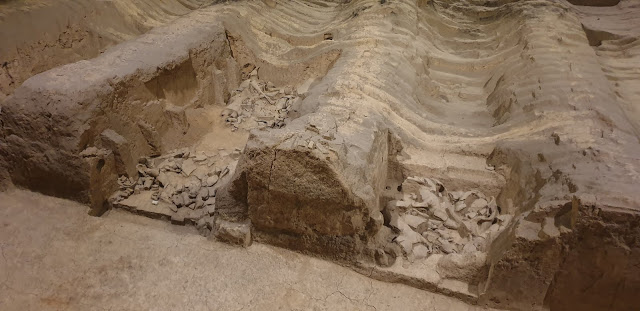
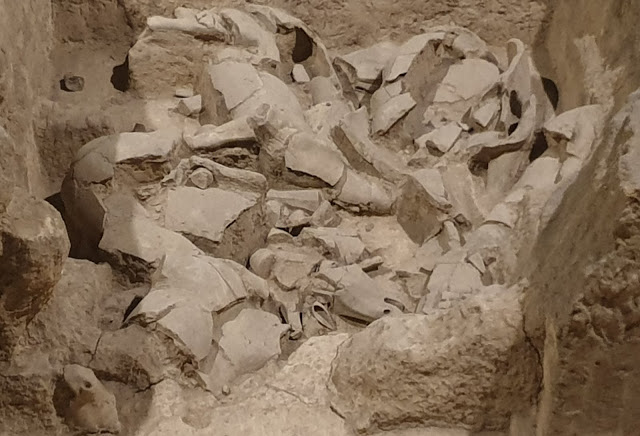
The excavation of this pit has only just begun, so it is possible to see where they have carefully removed the top cover, and you can see the broken parts of the warriors lying in a heap.
Some parts of the warriors are more discernible closer up
These parts are carefully extracted and taken to the ‘hospital’ where they are digitised and the computer will match each part with the warrior it belongs to.
Pit 1
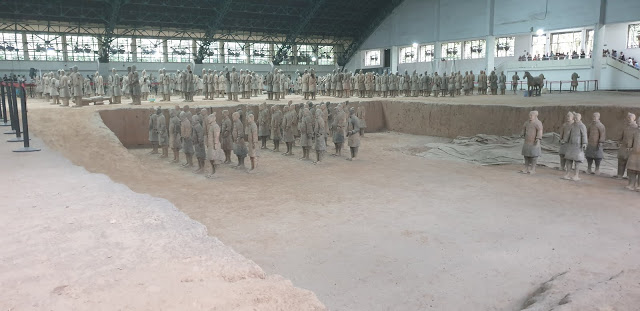
This has quite a number of standing soldiers that have been glued back together, but not necessarily complete and I notice a number if the statues were incomplete. And if they cannot find the missing pieces, then they are not added to or filled in.
The scale of the pit is enormous, and they have hardly scratched the surface in the restoration process.
What is there is a number of horses as well.
That’s at the front of the pit, a long line of statues, and what is clear is the location of the well where the first fragments were found by a farmer.
There are about eight lines of soldiers, and some lining the sides.
Midway down there is a large area currently under excavation
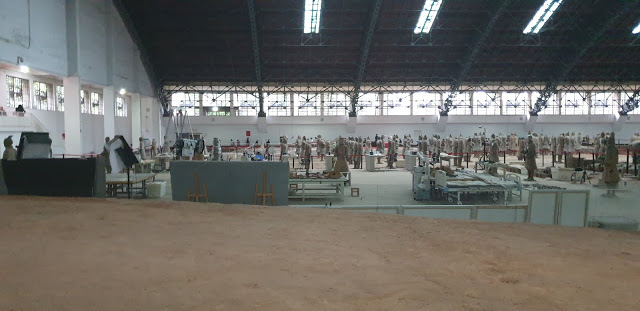
At the back is the hospital where the soldiers are reassembled. There’s nearly a hundred in the various stages of rebuilding. These days the soldiers are rebuilt using computer imaging.
The hospital area is where they are put back together
And these are some of the statues in various stages of reconstruction
Another two views of the size and scale of the reconstruction project
The coffee shop is also a sales centre, but there are too many people waiting for coffee and too few places to sit down.
I’m back home and this story has been sitting on a back burner for a few months, waiting for some more to be written.
The trouble is, there are also other stories to write, and I’m not very good at prioritizing.
But, here we are, a few minutes opened up and it didn’t take long to get back into the groove.
Chasing leads, maybe
I’m glad she didn’t ask me about Nobbin, or the fact a woman by the name of Josephine was working for him. That went ditto for Severin, and Jan, who was working for him.
It was a tangled web. Now, apparently, I was working for her.
I had another idea, and went back to the computer room to do another search, this time for the names of those who had been on my training course, and who was also assigned to the surveillance job.
I checked the name Jack Temple, and his file was marked closed, with a stark, red, deceased across the first page.
I checked the name Adam Alwin, and it was the same, deceased.
I checked the name Jennifer Underwood, and it had the label inactive, on medical leave. She had been injured and was recovering. There was no reference to her being in a hospital, or a recovery facility so I presumed she was at home.
It was another address to remember, this time what I assumed was a flat in Putney. It was not something she had mentioned in all the time we have been together. She had spoken of a house in Scotland.
But, then, who really told the truth when we were trained and continually told to lie about everything. In the end I don’t think we quite knew who we were. I knew her as Jennifer, but I doubted that was her real name.
Maybe I’d find out when I went to see her. I needed help and from someone I could trust. It was logical to select her. We had, for at least six months, relying on each other to get through.
I cam out into the daylight and it hurt my eyes. The artificial light, not that it was very bright, had queered my sight briefly. No good, because for a minute at least I was vulnerable to an attack.
Good thing it didn’t happen.
But something else did. A car pulled up on the side of the road, one I instantly recognised as the same Nobbin had used when he collected Josephine.
He wound down the rear kerbside window and said, “Sam. Just the man I want to see. Get in.”
I saw him slide over. I opened the door, got in, and the driver drove off.
He seemed pleased with himself.
“How is the hunt?”
“How do you think it’s going?”
He looked quizzically at me. “Why would I ask if I knew the answer?”
“I think you do. I was at O’Connell’s flat when one of your assistants was there. She discovered the same as I did, nothing.”
“What assistant?” He tried to sound surprised.
“We’re not going to be very good friends if you are going to lie to me. She called herself Josephine. I wouldn’t be much of an agent if I didn’t have a few tricks up my sleeve. And, lets be clear about one thing, if nothing else, you want to play games, fine. So will I.”
“What did Monica want?”
“What everyone wants. There appear to be secret documents on the loose. Everyone thinks they’re on a USB, and that O’Connell has hidden them somewhere. They’re not in his flat, and the cat wasn’t talking.”
“Just remember that O’Connell was working for me, and he was getting the documents for me.”
“So you know what these documents are about?”
“No. He didn’t tell me because he didn’t look at them. He couldn’t. They’re encrypted, and he doesn’t have the code.”
Which wouldn’t do much good for me if I tried to see what the fuss was about. Perhaps the best idea would be to destroy the USB so no one had these documents, given the trouble they’d caused so far.
“Anyone check O’Connell’s body properly for the USB? He may have had it hidden in his clothing somewhere.” I knew I didn’t have sufficient time to thoroughly check myself.
“No one knows where the body is.”
“I saw the cleaners arrive to process the scene.”
“Well, if they did, the job never reached the books. According to the cleaners, no one was dispatched to take care of anything at the location.”
Which meant Severin had the body, had checked as I would if I had the time, and it was not on him. Otherwise, he would not have paid me a visit. It was back to Peaslake then, the next step in the investigation.
“Recovery of these documents is time-sensitive Sam. You need to double your effort.”
“A lack of clues is not helping. Nor is everyone working on their own agenda.”
“Then don’t lose focus.”
I saw him motion to the driver to pull over and let me out.
I waved as the car pulled back out into the traffic.
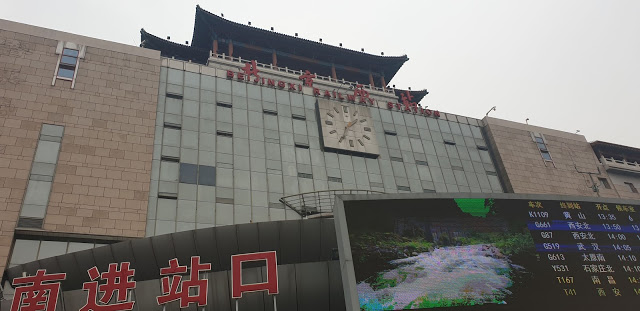
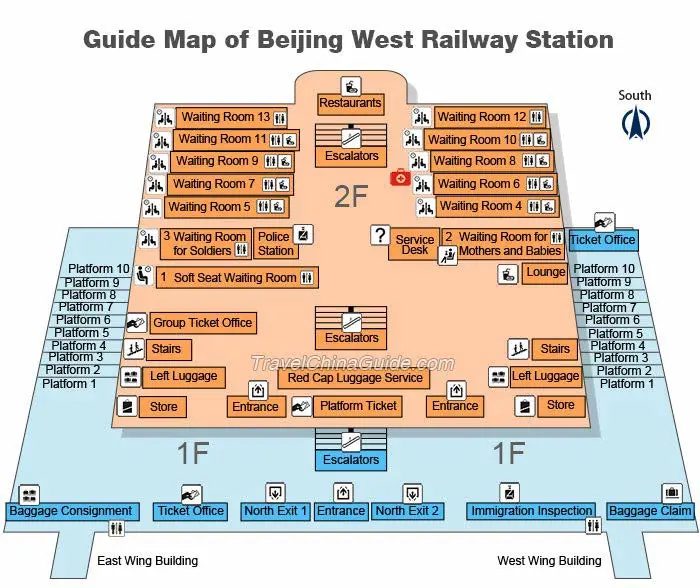
Beijing west railway station is about eight kilometers from the Forbidden City, located at East Lianhuachi Road, Fengtai District. Most trains traveling between south central, southwest, northwest, and south China are boarded here.
This place is huge and there are so many people here, perhaps the other half of Beijing’s population that wasn’t in the forbidden city.
Getting into the station looked like it was going to be fraught with danger but the tour guide got us into the right queue and then arranged for a separate scanner for the group to help keep us all together
Then we decided to take the VIP service and got to waiting room no 13, the VIP service waiting room which was full to overflowing. Everyone today was a VIP. We got the red hat guy to lead us to a special area away from the crowd.
Actually, it was on the other side of the gate, away from the hoards sitting or standing patiently in the waiting room. It gave us a chance to get something to eat before the long train ride.
The departure is at 4 pm, the train number was G655, and we were told the trains leave on time. As it is a high-speed train, stops are far and few between, but we’re lucky, this time, in that we don’t have to count stations to know where to get off.
We’re going to the end of the line.
However, it was interesting to note the stops which, in each case, were brief, and you had to be ready to get off in a hurry.
These stops were Shijiazhuang, Zhengzhou East, Luoyang Longmen, Huashan North, and Weinan North. At night, you could see the lights of these cities from a distance and were like oases in the middle of a desert. During the day, the most prominent features were high rise apartment blocks and power stations.
A train ride with a difference
China’s high-speed trains, also known as bullet or fast trains, can reach a top speed of 350 km/h (217 mph).
Over 2,800 pairs of bullet trains numbered by G, D or C run daily connecting over 550 cities in China and covering 33 of the country’s 34 provinces. Beijing-Shanghai high-speed train link the two megacities 1,318 km (819 mi) away in just 4.5 hours.
By 2019, China keeps the world’s largest high-speed rail (HSR) network with a length totaling over 35,000 km (21,750 mi).
To make the five and a half hours go quicker we keep an eye on the speed which hovers between 290 and 305 kph, and sitting there with our camera waiting for the speed to hit 305 which is a rare occurrence, and then, for 306 and then for 307, which happened when we all took a stroll up to the restaurant car to find there had nothing to eat.
I got a strange flavored drink for 20 yuan.
There was a lady manning a trolley that had some food, and fresh, maybe, fruit on it, and she had a sense of humor if not much English.
We didn’t but anything but the barrel of caramel popcorn looked good.
The good thing was, after hovering around 298, and 299 kph, it finally hit 300.
We get to the end of the line, and there is an announcement in Chinese that we don’t understand and attempts to find out if it is the last station fall on deaf ears, probably more to do with the language barrier than anything else.
Then, suddenly the train conductor, the lady with the red hat, comes and tells us it is, and we have fifteen minutes, so we’re now hurrying to get off.
As the group was are scattered up and down the platform, we all come together and we go down the escalator, and, at the bottom, we see the trip-a-deal flags.
X’ian,and the Xi’an North Railway Station
Xi’an North Railway Station is one of the most important transportation hubs of the Chinese high-speed rail network. It is about 8.7 miles (14 km) from Bell Tower (city center) and is located at the intersection of the Weiyang Road and Wenjing Road in Weiyang District.
This time we have a male guide, Sam, who meets us at the end of the platform after we have disembarked. We have a few hiccups before we head to the bus. Some of our travelers are not on his list, but with the other group. Apparently a trip-a-deal mix-up or miscommunication perhaps.
Then it’s another long walk with bags to the bus. Good thing its a nicely air-conditioned newish bus, and there’s water, and beer for 10 yuan. How could you pass up a tsing tao for that price?
Xi’an is a very brightly lit up city at night with wide roads. It is very welcoming, and a surprise for a city of 10 million out in the middle of China.
As with all hotels, it’s about a 50-minute drive from the railway station and we are all tired by the time we get there.
Tomorrow’s program will be up at 6, on the bus 8.40 and off to the soldiers, 2.00 late lunch, then train station to catch the 4.00 train, that will arrive 2 hours later at the next stop. A not so late night this time.
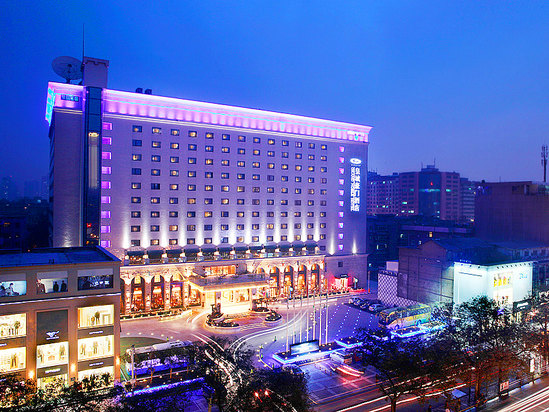
The Grand Noble Hotel
Grand Noble Hotel Xi’an is located in the most prosperous business district within the ancient city wall in the center of Xi’an.
The Grand Noble Hotel, like the Friendship Hotel, had a very flash foyer with tons of polished marble. It sent out warning signals, but when we got to our room, we found it to be absolutely stunning. More room, a large bathroom, air conditioning the works.
Only one small problem, as in Beijing the lighting is inadequate. Other than that it’s what I would call a five-star hotel. This one is definitely better than the Friendship Hotel.
In the center of the city, very close to the bell tower, one of the few ancient buildings left in Xi’an. It is also in the middle of a larger roundabout and had a guard with a machine gun.
Sadly there was no time for city center sightseeing.
We might have to use some might to beat the mite. Confused?
Might is force, so expending might is much the same as what Thor does with his hammer.
We might expend some force, we this might is a maybe. You’re never quite sure when someone uses the word might, whether or not they will actually do it.
I might do a lot of things, but somehow I never seem to get around to actually doing them,
Of and just for the record, it’s the past tense of the word may. You know, you may do something, or you might not.
You might also use the word might when being polite, which seems to be a rarity these days because everyone is terse, tense, and it a hurry.
So might I go to the movie will aways get a resounding no if it means you get home late at night. And you’re only 10 years old.
I might be interested, but I don’t think so. Let me think about it. Which also means no.
Of course, if you’re slack in doing homework, you might want to try a little harder next time.
What might have been if only you tried harder?
Then there’s that little pest called a mite, though it goes by a lot of other names, one of which is everywhere, a termite.
Or a dust mite.
It also could be used slangily for a child in distress, that is, look at that poor little mite, he looks so tired.
Or another word for slightly, for example, the girl seemed a mite embarrassed.
I’m back home and this story has been sitting on a back burner for a few months, waiting for some more to be written.
The trouble is, there are also other stories to write, and I’m not very good at prioritizing.
But, here we are, a few minutes opened up and it didn’t take long to get back into the groove.
Chasing leads, maybe
She gave me a minute to think about the situation, and then said what I was thinking, “So he could be anywhere?”
“He was dead. I felt for a pulse. There wasn’t one.”
I could interpret that expression on her face, ‘you’re not a doctor’.
She turned another page, read a few lines, then made a note at the bottom.
It read, if my deciphering was up to scratch, ‘doesn’t know if subject dead or not’.
She looked up again. “It appears these documents are out there,” she waved her hand in the air, “somewhere. Fortunately, they have not turned up, not has someone tried to sell them back or to the newspapers, so we’re lucky. So far. That isn’t going to last for much longer. Every extra day out there is another chance for the government to be embarrassed.”
“You know what the contents are?”
“Don’t be silly. That’s above my pay grade, and besides, you and I are better off not knowing. So, what you need to do is find O’Connell and/or find the documents on this USB drive.”
She slid a card across the table. It had a name and a telephone number. Monica Sherive. A mobile number, a burner no doubt that couldn’t be traced back to her.
“You find either, you tell me first.”
“Nobbin?”
“Second, and when I tell you.”
“So you don’t trust him either?”
“At the moment, for both you and I have to be careful who we trust.”
I added her to the list of people I couldn’t trust, not that she had told me I could trust her. Yet.
“And if I get contacted by Severin again?”
“Have you?”
I had thought about not telling her about that brief meeting where he told me about the USB drive, but it couldn’t do any harm. At least she hadn’t asked me if I knew about the USB, which was something, I suppose.
“Yes. Once. Told me to keep my head down. And asked me if O’Connell had time to talk to me. It was the same answer I gave him back in the alley. No. I’d just managed to corner him when he was shot.”
“By Severin, or this other fellow,” she shuffled back several pages, then said, “Maury?”
“No. That was what was odd about it. The shot came from somewhere else. A sniper I would have thought.”
And, my brain suddenly moving into overdrive, piecing together what might be a coincidence, but in our business, they were rarely coincidences. A sniper shot him., say Nobbin or one of his people, he looks dead, waits for a call to the cleaners, intercepts it, and collects the so-called dead O’Connell. It was a good conspiracy theory.
And as far-fetched as one.
Severin had to have the body somewhere, trying to figure out how to bring O’Connell back to life so he could torture the USB location out of him.
Hell, that was as twisted as the conspiracy theory.
Time to change the subject. “Do you have any idea who Severin and Maury are?”
She went to the back of the file and pulled out some photographs, mug shots perhaps of staff members. She put five faces in front of me and asked me if the two were there.
They were. The first, with the name of David Westcott, and the fourth with the name of Bernie Salvin.
“Who are they?”
“They used to work in the training department for ten or so years ago. Westcott was also a handler for several years. They both requested a transfer to operations, and we give a mission. Six agents were assigned, and all six were killed, an investigation after the fact found that their identities had been leaked to the enemy before they reached the target.”
“They gave them up?”
“Nobody knows for sure. There were others in that group, but in the end, the department retired them all. All their years in training served them well. We found the place where you were trained.”
Another photograph of the main building. I nodded.
“It was an old training facility closed down five years ago. It was just sitting there waiting for an enterprising crew. It won’t happen again. Needless to say, we haven’t been able to find either of them, only the people they employed, who believed it was in good faith. A mess in other words. Now, go. Find me answers.”
I’m back home and this story has been sitting on a back burner for a few months, waiting for some more to be written.
The trouble is, there are also other stories to write, and I’m not very good at prioritizing.
But, here we are, a few minutes opened up and it didn’t take long to get back into the groove.
Chasing leads, maybe
…
She had brought a file. It looked the same as the last one she brought with her, the one with my name on it.
This time it was thicker.
Intelligence gathering at its finest. There’d be stuff in there that even I didn’t know about me.
She didn’t open it, just looked at me.
“What have you been doing?”
“Working?”
“For whom?”
“Nobbin, of course. I am now assigned to his section. Did you do that?”
“He did. He tells me you’re working on the O’Connell investigation.”
“Is that what it’s called. He never told me that. And I had to find out where I’d been assigned by logging onto a computer. An email or a letter would have made my life a little easier.”
“You’re just lucky you’re still working here. Now, tell me more about this Severin character.”
“I told you everything I knew the last time you spoke to me. Apparently, you seemed to know who it was. Perhaps you might tell me, too.”
“It’s…”
“And,” I interrupted, “don’t tell me it’s above my pay grade. I was potentially working for traitors and could have finished up in jail for treason.”
“You might still get there.”
Then why hadn’t she had me arrested and thrown in a dungeon the last time we met? There was an easy answer to that question. She needed me out in the field. Nobbin needed me in the field. They presumably needed me to remain available to Severin for whatever reason.
“What do you want?”
She opened the file, turned a few pages, and stopped at a yellow sheet of paper. I wasn’t able to read it upside down, but it had very small spidery writing on it.
Then she looked at me again.
“Some secret documents appear to have gone missing. We believe that is to say Director Dobbin thinks these may have been on a USB drive that was in the possession of O’Connell at the time of his death. You were there at the time of his death. You can see where this is going…”
No matter which answers I gave it was the wrong one, which led to do not pass go and do not collect two hundred dollars, or pounds as the case may be.
“I haven’t got it, and he didn’t tell me where it was, and I saw him die.”
“If you say so.” She went back to the file and turned some more pagers.
“What do you mean?”
She looked up. “So far, there’s no body been recovered, or any evidence there was a shooting where you said it was.”
“Are you trying to tell me he’s alive, because if you are, then I must be a very poor judge of people who have no pulse. He was not about to get up and walk away.”
“Did you see the body removed?”
Now there’s an interesting point. I had done as I was told and left when told to. I assumed Severin would sort the problem out, in fact, hadn’t he called in the cleaners? I saw a white van.
Actually, when I thought about it, I had no idea what happened after I left. And, now that I remember, I didn’t see anyone get out of the white van.
In Beijing Hutongs are formed by lines of traditional courtyard residences, called siheyuan. Neighborhoods were formed by joining many hutongs together. These siheyuan are the traditional residences, usually occupied by a single or extended family, signifying wealth, and prosperity.
Over 500 of these still exist.Many of these hutongs have been demolished, but recently they have become protected places as a means of preserving some Chinese cultural history. They were first established in the Yuan Dynasty (1279-1368)Many of these Hutongs had their main buildings and gates built facing south, and lanes connecting them to other hutongs also ran north to south.
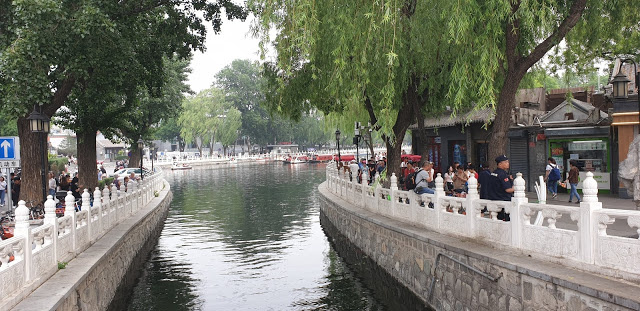
Many hutongs, some several hundred years old, in the vicinity of the Bell Tower and Drum Tower and Shichahai Lake are preserved and abound with tourists, many of which tour the quarter in pedicabs.
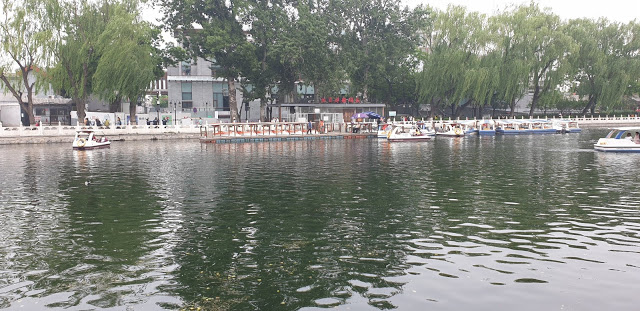
The optional tour also includes a visit to Shichahai, a historic scenic area consisting of three lakes (Qianhai, meaning Front Sea; Houhai, meaning Back Sea and Xihai, meaning West Sea), surrounding places of historic interest and scenic beauty and remnants of old-style local residences, Hutong and Courtyard.
First, we had a short walk through the more modern part of the Hutong area and given some free time for shopping, but we prefer just to meander by the canal.
There is a lake, and if we had the time, there were boats you could take.
With some time to spare, we take a quick walk down one of the alleyways where on the ground level are small shops, and above, living quarters.
Then we go to the bell and drum towers before walking through some more alleys was to where the rickshaws were waiting. The Bell tower
And the Drum tower. Both still working today.
The rickshaw ride took us through some more back streets where it was clear renovations were being made so that the area could apply for world heritage listing. Seeing inside some of the houses shows that they may look dumpy outside but that’s not the case inside.
The rickshaw ride ends outside the house where dinner will be served, and is a not so typical hose but does have all the elements of how the Chinese live, the boy’s room, the girl’s room, the parent’s room, the living area, and the North-south feng shui.
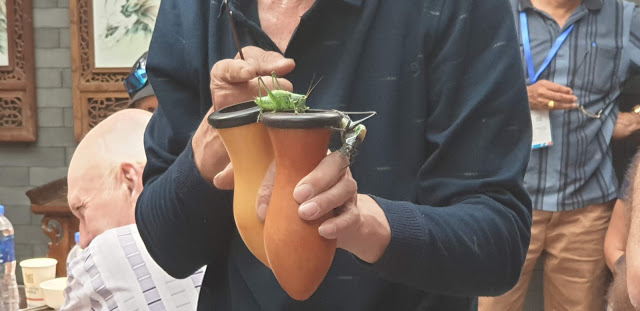
Shortly after we arrive, the cricket man, apparently someone quite famous in Beijing arrives and tells us all about crickets and then grasshoppers, then about cricket racing. He is animated and clearly enjoys entertaining us westerners.
I’m sorry but the cricket stuff just didn’t interest me. Or the grasshoppers.
As for dinner, it was finally a treat to eat what the typical Chinese family eats, and everything was delicious, and the endless beer was a nice touch.
And the last surprise, the food was cooked by a man.