The cinema of my dreams – Was it just another surveillance job – Episode 52

This story is now on the list to be finished so over the new few weeks, expect a new episode every few days.

The reason why new episodes have been sporadic, there are also other stories to write, and I’m not very good at prioritizing.

But, here we are, a few minutes opened up and it didn’t take long to get back into the groove.

Things are about to get complicated…


We took the elevator down to one of the basement levels, and then along a long poorly lit passageway which in my estimation had taken us to another building.

It would not have surprised me if it had been part of a large underground complex used in the second world war, safe from the overhead bombing raids.  Certainly, a lot of the fittings and paintwork looked very, very old, and I could imagine armed soldiers stationed along the length of the corridor each in his own little cutaway.

At the end, the building was a lot more modern and bright.

There was a large open space, and we headed towards one of the corners where the walls had wallpaper scenic views that if you didn’t know it was a photograph, it could almost be mistaken for a view overlooking the Thames.

It made that corner space more liveable.

There were two desks, more computers, and another girl who appeared like she had been waiting for us.

“I was told you wanted to view CCTV for the day of the recent street bombing.”

If the girl knew what I was looking for, then Monica would already have seen it and most likely had it analyzed by a team of experts.  If it wasn’t for the fact I wanted to see it myself, I might have just gone to her for the official report.

“Yes.”

I sat down beside her, and Joanne remained standing, behind us.

“OK.  There are seven cameras in that location, five of which were working at the time.  There is one across the road from the café, and it provided a good view of the actual explosion.”

She brought it up on the screen and ran it from shortly before O’Connell passed the front.  Then he came into view, walking as though he was purposefully going from one place to the next, almost stopping to look sideways into the café.  A prolonged moment looking through the window told me he had seen the reporter.

We could not see the reporter from our viewpoint.

But it was clear that O’Connell had seen something else because his pace quickened.

Then the explosion happened, and he was caught up in the aftermath, as was I as I had just entered the frame, following diligently.  My effort to look nonchalant, and not following O’Connell was not very good.  If this was a training tape on what not to do, that was me.

Watching it was horrifying, watching myself being blown a short distance across the pavement, followed by rubble.  Watching a dozen other people suffering far worse injuries were far worse.

I saw myself getting gingerly up off the ground, then seeing two men running past in the opposite direction, one of whom was McConnell.  I hadn’t realized at the time it was him.  Then we disappeared out of frame.

“Is there a camera farther along?”

She checked the list, picked a site, and brought up the feed for that timeframe, and just in from on the left-hand side was me, pinned to the ground by two men, and a street policeman, covered in dust walking up to us.

A discussion ensued, then the two men got in the car and drove off.

McConnell then suddenly reappeared from the right-hand side of the frame, walking past me and the policeman now on the ground.

Where had he come from?  How did he manage to get back to the bomb site, if that was where he had gone?

“Can we go back to the bomb site from where we left off before?”

A few seconds before the footage recommenced.

A minute, perhaps a little longer passed as those who had survived were trying to get up, McConnell reappeared from an alley two shops along from café, almost untouched by the blast, and crossed the road.

A few seconds later another person came out of the alley and followed him.

“Can you focus on that person who came out of the alley?”

She stopped the feed, zoomed in, and then cleaned up the blurry image until it showed a woman’s face.

“Who is she?”

She brought up the comments that went with the footage.  It had been already reviewed previously, as part of the investigation into the bombing. 

“They couldn’t formally identify her.”

“Anyone hazard a guess?”

“No.  She’s still a person of interest though.”

I gave the girl a piece of paper with a list of seven of the scientists from the laboratory.  “See if you can find wives of the male scientists.”

Joanne had been intrigued the whole time we had watched the event unfolding.

“That was you caught up in the explosion, wasn’t it?”

The pictures had been grainy and indistinct, so all I looked like was an anonymous blob.  Monica had obviously not told her of my involvement.

“Yes.  And McConnell.  I suspect McConnell did get the hand-off, but not from the journalist.  The journalist was in the café with the wife of the scientist who stole the information, though it would only be speculation to assume they were together, or whether she was there to sell the information, and give it to McConnell.”

“Anna Jacovich, wife of Erich Jacovich.  Microbiologist,” the girl said.

McConnell had lied.

© Charles Heath 2020-2022

Searching for locations: Eating In, Peninsula Hotel, Hong Kong

Hotel dining can be a very expensive experience, but if you are there as one of those bucket list fulfillments like we were, then it’s not unusual to go the whole nine yards.

Since the stay coincided with my birthday, the first day was set aside to have dinner at the Chinese restaurant upstairs and was one of those sublime experiences.  Of course, it had to be Peking Duck, expensive champagne, and several cocktails.

Oddly enough, breakfast wasn’t included in the room rate, but that seems to be normal for a lot of hotels.  It can be if you want to pay upfront, but we don’t always have breakfast, particularly if we have dinner the night before.

Or can be bothered getting out of bed the next morning because quite often the breakfast hours do go with staying in bed.

During this stay, we decided to have breakfast one morning, cereal, bacon and eggs, coffee, toast, you know, the usual stuff.

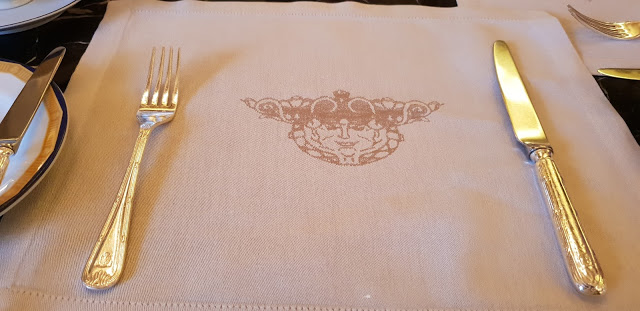
No paper placemats here and the silverware was just that, silverware.  This was going to be full on old world charm.

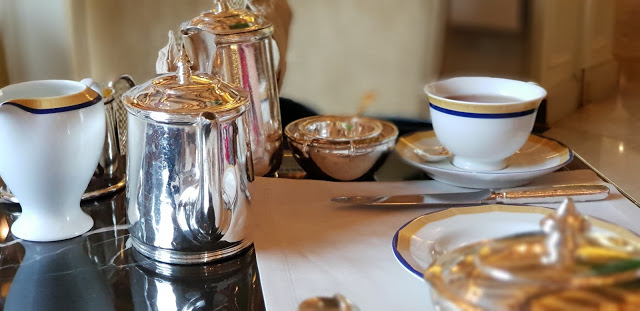
Coffee served from a silver coffee pot, fine bone china from Staffordshire, not Thailand, tea service for milk and sugar, condiments all in a row.
The only disappointment, I don’t think the eggs were free-range.

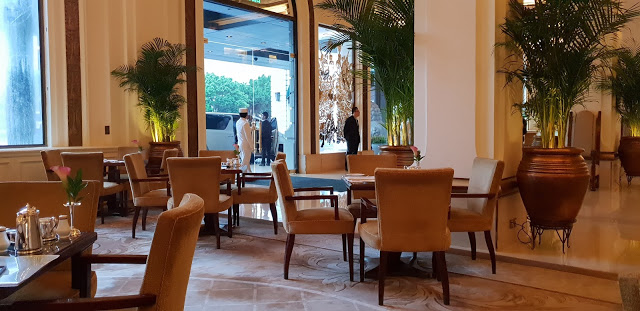
And, when the conversation dries up, there’s always a steady stream of people coming and going through the front door, and the doorman is always at the ready to open the door.

WE went once for lunch, and yes, we had to go to the famous Afternoon Tea, for which you had to book or stand in a very long line.  We booked and discovered preference was given to those who were staying at the hotel.

Out came the silver tea service, and one could imagine that this was the same as what it had been a hundred years ago.  I had tea, after all, it was afternoon tea!

The cakes were interesting, there were quarter sandwiches rather than finger sandwiches, and though I’m not a fan of fruit scones, I’m always up for something different.
After it, it’s probably not a good idea to go out for dinner too.

Overall, the experience was worth it.

NaNoWriMo – April 2022 – Day 17

First Dig Two Graves, the second Zoe thriller.

Yesterday there was a moment where I went back over the plot, and whilst that exercise was a success in a way, it also got me thinking, and like always, I couldn’t sleep, thinking about how the timeline was working, but the narrative wasn’t.

Yes, I made the fatal mistake of considering editing in the middle of a writing marathon.

What brought this self-destructive mood on? A movie. No relevance at all to my story, but it was a study in interactions between disparate people, which is what I have going on between John and Zoe.

It works in the first story because they are thrown together and everything is new and crazy.

In the second, the premise is that the novelty of the thing they had is wearing off.

Zoe needs to keep occupied and doing something other than all she’s ever known is not exactly on her to-do list.

Of course, that’s all put on hold because she is now a target because of the death of Alistair, and it’s a problem she has to take care of. Alone.

I realize now there needs to be some discussion around this, and the way the story starts does not set the scene.

Similarly, there should be more definition of the relationship as it stands, or not as the case may be, and reasons why John decides to go after her, if only to get the truth because he believes she is using the people seeking revenge as an excuse to keep him at arm’s length.

And, from her perspective, it’s not so much she doesn’t want to be with him, it’s because she doesn’t want him ending up dead, given the sort of people she was up against. Not being able to articulate her feelings, as it’s not something she really knew how to, there’s bound to be some confusion.

Inevitably he is going to find her, and when they d, the reasons why they are together are clear, but there’s still many reasons why he shouldn’t be there. Her life is not the sort of life he would want, by choice, and it’s not going to improve, so where is this thing going to take them?

I haven’t thought it though, so I’m going to take some time out to sort it out. I’m 47,000 odd words into the narrative, so I have a day, two at the most to review, and perhaps rewrite to get the missing perspective I’m looking for

Today’s writing, a part of the assessment of their relationship underway, 560 words, for a total of 47,626.

A photograph from the Inspirational bin – 28

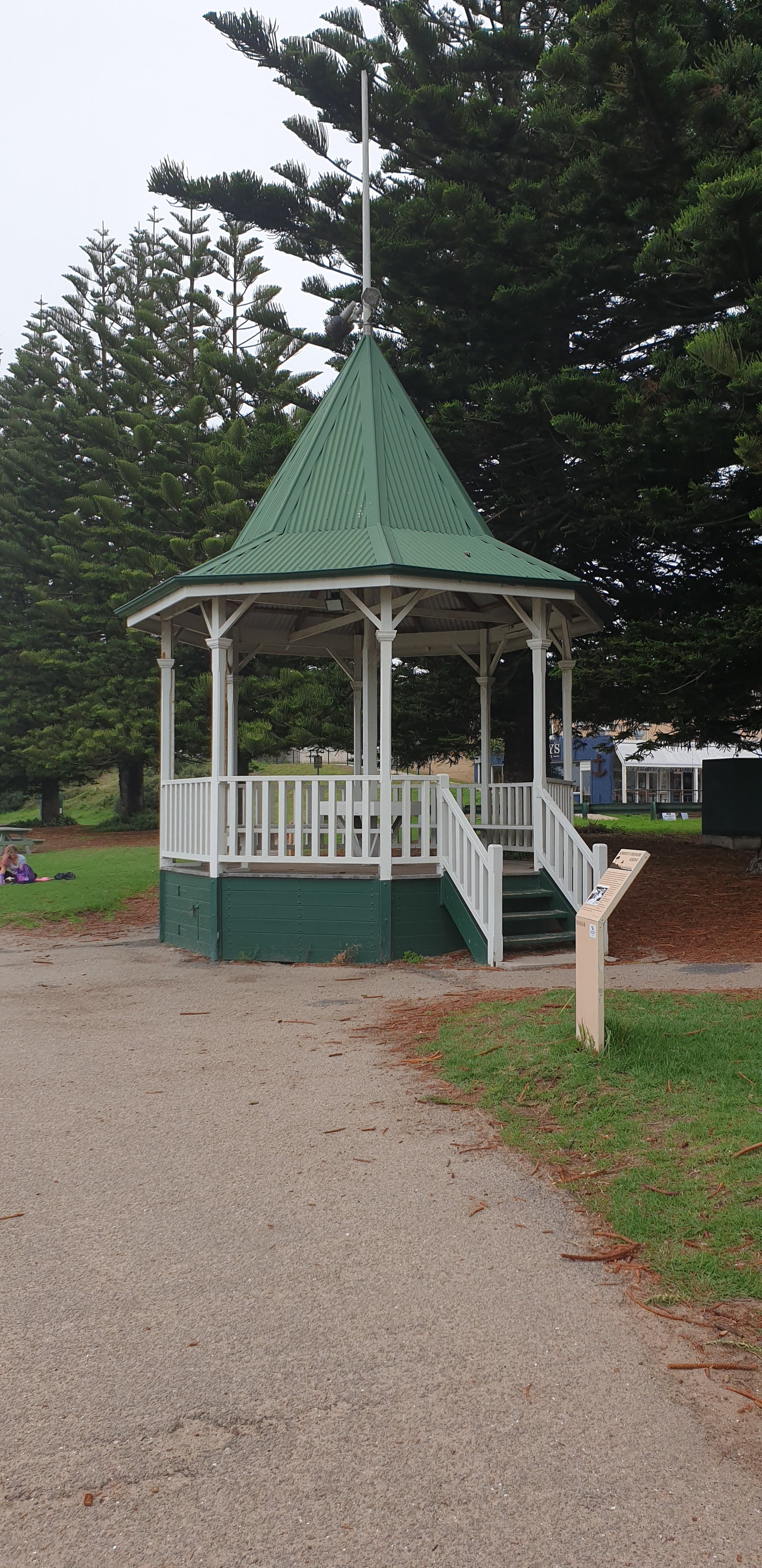
Just what everyone needs in their backyard:  A Gazebo, or a small bandstand!

20200215_142419

Often when we go to different places, it gives us ideas, sometimes ideas beyond what is possible.

I have always wanted a gazebo, perhaps not on the same grand scale as the one above, but one where we can put a BBQ and a few seats, and relax on a sunny afternoon.

Shade, a cool breeze, a cold glass of wine or beer, and the aroma of meat cooking on an open flame.

But…

Reality sets in.  The backyard isn’t big enough, so my dream will stay just that.

But as an idea for a story, I suspect this might be the place where you first met the love of your life in circumstances that become the stuff of legends.

It can definitely be a meeting place, whether to carry on illegal activities, whether it’s after sneaking away to be with someone whom others will not approve, or whether it is many, many years later to reminisce, or to reconnect.

As usual, the possibilities are endless.

The cinema of my dreams – I never wanted to go to Africa – Episode 39

Our hero knows he’s in serious trouble.

The problem is, there are familiar faces and a question of who is a friend and who is foe made all the more difficult because of the enemy, if it was the enemy, simply because it didn’t look or sound or act like the enemy.

Now, it appears, his problems stem from another operation he participated in, and because of it, he has now been roped into what might be called a suicide mission.


“Are there?  How many should I have?”

The only way he could know there was not a full complement as if he had been told by someone how many people were in our group from the outset.  I looked at Jacobi, and he shrugged.

“This is not a good time to be playing games, Sergeant James.”

The guards gripped their weapons a little tighter and looked ready to use them.

“The only one playing games here would be you.  It would be irrelevant if I had more or I had fewer people here because you have more than enough to cover us, and then some.  But you would agree it would be imprudent for me to put all my eggs in one basket as it were, and yes, there are several others, but they are waiting for me to call them, further down the track.  Not to put too fine a point on it, distrust works both ways.  We don’t come back, I can assure you, your losses will be bigger than ours.  Oh, and a word of advice, don’t go looking for them, not unless you want good men to die needlessly.”

Tough talk, and could get us killed, but I was hoping that until he had the diamonds in his hands, he would humor me.  A minute or so passed where I assumed he was making a calculation on what the odds were, then he shrugged.  There was merit in what I’d told him.  Monroe and Shurl had plenty of ammunition and would have a foxhole that wouldn’t be over-run or penetrated.

“I think you might be right, so let’s not get bogged down in an argument that’s going nowhere.  We have what you want, and you have what we want.  Let’s go inside and talk.”

Was that a sigh of relief moment?  Perhaps.  But it was clear he needed us out of the way before his men could search the cars.  I was happy to let him think he had the upper hand.

“Lead the way.”

We all filed into the building and sat down around a large table.  There were bottles of water out, and we might have drunk from them but I could see the seal had been broken on min so it looked like we would be going thirsty.

The commander drank from his, no doubt as a gesture that the water was safe.  None of my people were buying it.

“I’ll kick it off,” I said.  “Are our people in good health?”

“Of course.  Healthy enough to walk out of here of their own accord.  Did you bring the compensation with you?”

“I did.”

“Can I see it?”

“Can I see our people.”

Friendly, and time-consuming double talk.  I could see he was waiting impatiently.  “All in good time.  “Did you have any trouble getting here?” he asked casually.  “I heard there were some local militias on the road collecting road taxes earlier today.”

“If there was, we didn’t see any.  Smooth run, except for the state of the roads.  I hope the road taxes those people are collecting are to fix the roads.”

He smiled.  “It is what it is.  This is the Democratic Republic of the Congo, not the United States of America.  Things are done differently here.  We put the people first, and the roads second.”

There was a discreet knock on the door, followed by a cowering man coming into the room and walking up behind the commander.  He took a few seconds to whisper into his ear, during which the commander’s expression turned very dark.

I had to assume that they had found all the weapons we had left for them to find, and not done a very close inspection to find those we did not want them to find.  It was a bold assumption and could make a difference once we left, and if we were attacked.  I was sure that was part of the message the man had relayed to his commander.

The man almost ran out of the building, slamming the door behind him.

The commander looked at me.  “Where are the diamonds?”

That was as direct as he could get.

“At this point, that’s for me to know until I’m assured you intend to honor your part of the agreement.  Searching our cars for the diamonds tells me you are not a man to be trusted, and, you should have realized in making that discovery, you’re not dealing with fools.”

The dark expression eased, and he tried to look like the man who held all the cards.  He probably did, but it would be interesting to see to what extent he would press his advantage.  We had nothing to lose, though it didn’t send a very good message to the team that I was willing to sacrifice them.  This was after all supposed to be a suicide mission.

“What’s to stop me from just shooting your people one by one until you tell me.”

“The same reason I told you at the gate.  You will lose a lot more than I will.  Something you might not be aware of is that the people who sent me have control over satellites.  You might not be familiar with satellite technology, but be assured that we are being observed, and have been on this little odyssey.  It also means that they, sitting in a bunker somewhere in the world, also have access to nasty drones, you know, the sort that leaves craters where villages and settlements once were.  This place would not withstand a direct hit, and there would be no one left alive after it.  Killing any or all of us will incur wrath you really don’t want to deal with.  Put simply, if I don’t drive out of here with my people within half an hour this whole area will become an uninhabitable crater.”

Bamfield had said as one option, not that he could order such a strike, was to threaten them with a drone strike.  I hadn’t done that in as many words, but the commander looked as though he got the inference.

“You could do that anyway.”

“I could, but that’s not the way I work.  For some odd reason. The people I work for seem to think you might be useful to them in the future, and Jacobi here will be happy to stay and talk about it.  Now, the clock is ticking.”

He took a moment, then stood.  “Let’s go meet your people then.”


Ⓒ Charles Heath  2020

“Because it’s not me” – a short story

If the was one fault I had, it was prevarication.

For a long time, I had always been afraid of making a mistake, after I had done exactly that.  They said our mistakes didn’t define us, but that one had.  I had lost the trust of everyone, from my parents to friends.

It was only a small lie, or so I told myself, but it had far-reaching ramifications, and almost cost someone their life.  But whilst I believed it was not all that bad, and the police had agreed that anyone who had been put in the same position would have done the same, there were those who didn’t agree.

It was a moment in time I often relived in my mind, over and over, and eventually led to several outcomes.

The first, I left home, the town where up till then I’d lived all of my life, walking away from family and those who used to be friends, knowing that what they said and what they felt were two entirely different things.  For all concerned, it was better that I left, cutting all ties, and make a fresh start, away from those whom I knew would never forget, even though they forgave me.

The second, and most dire, I changed my name, and my history, even how I looked.  Today, I was a very different person to that of thirty years ago.

The third, I moved to another country and vowed never to return, always looking constantly over my shoulder, expecting someone from the past to find me.  I instinctively knew that I would never escape, that one day a stark reminder would come back and destroy everything.

I picked the one occupation that would keep me both occupied and invisible.

Journalist.

I had started at the bottom, literally writing death notices, and worked my way up to what is ubiquitously known as ‘foreign correspondent’, going to places where no one else would go, those hotbeds of unrest, and war zones, reporting from both sides.

Perhaps it could say I had a death wish, a statement my editor had once said when he came to see me in hospital back in London after I’d been caught up in a rocket attack and repatriated.  He had come to offer me a job back home, to tell me my tour was over.

I declined the opportunity, and he left, shaking his head.

But that was not the only visitor that came to the hospital that day.  The other visitor was an elderly man, immaculately dressed in a pinstripe suit and bowler hat.  It screamed public servant, and the moment I saw him wandering up the passage, a chill ran down my spine.

Although he looked like he was looking for someone else, I knew he would eventually finish up in my doorway.

Five minutes after I first saw him.

When he appeared at the door, I thought about ignoring him, but realized that wasn’t going to change anything.  Besides that, I guess I wanted to know why he would want to see me.

“James Wilson?”

“Would it make any difference if I said no?”  Well, it didn’t mean I couldn’t spar with him, just a little.  “Who are you.”

“Do you mind if I come in?”

I got the impression he would do it anyway, irrespective of what I said.  I said no, and as I suspected he came in anyway, closing the door behind him, then took a minute or two to make himself comfortable in the visitor’s chair, which was an impossible task.

Then, settled, he said, “I understand you have just been repatriated from Syria.”

“I was in the wrong place at the wrong time.”

It wasn’t common knowledge where I’d come from, so this person knew something about me, which was immediate cause for concern.

“The bane of a reporter trying to cover a dangerous situation,” he said, with just the right amount of levity in his tone.  “I get it, by the way.  I once had that devil may care attitude you need to get the story.  I was chasing a Pulitzer, believe it or not, and used a few of those nine lives in the process.  Which one are you up to?”

I was going to say that awards didn’t matter but among those who made up the press pack in those God-forsaken places, there was an unwritten desire to be rewarded other than by pay.  For me, though, it was not a defining factor.

“Lost count.  But why would that interest you, or whoever it is you represent?  By the way, just who do you represent?”

Second attempt at finding out who this man was.  If he was dodging and weaving, it would suggest a clandestine organization.

“People who would like to use your unique talent in getting into trouble spots around the world.  We’re not asking you to come work for us exclusively, rather piggyback on the job that you already do so well.”

An unnamed man from an unnamed organization.  What he was offering wasn’t unheard of, and I had been warned, more than once, that jobs, like he was suggesting, were more often than not offered to people like me.  With that came one line of advice, turn around and run like hell.

But, with nothing to amuse me in hospital, I was curious.  “Doing what exactly?”

The fact his expression changed indicated my response had taken him by surprise.  Perhaps he was used to being told where to go.  Not yet.  I had this fanciful notion in the back of my mind that what he might offer might get me closer to the story.

“Keeping your eyes and ears open.  We’ll tell you what to look for, all you’ll be doing is looking for evidence.  There will be no need to go looking for trouble, if there’s evidence we ask you to report it, if not, no harm done.”

Not so hard.  If that was all it was.  The trouble was, if something sounds simple, which that did, but inevitably, it was going to be anything but.  I’d heard stories and the consequences.

“You’re presuming that my editor will send me back.  He just offered me a job at home.”

“I think both of us know you’re not interested in domesticity.  If he isn’t willing to adhere to your wishes, I’m sure we could find someone else who would be willing to take you on.  You have had several offers recently, have you not?”

So, without a doubt, he knew a lot about me, especially if he asked around.  I had had several offers, but I was happy where I was.  I liked the no questions about your past that my current employer had promised.

Yes, looking at the determination on this man’s face, I had no doubt they or he could do what he said.  No one comes to a meeting like this without holding all the cards.  Also, not that I wanted it to be so, It told me that my agreement was not necessarily going to be optional.

But I was happy to dither and find out.  “Since I’m not sure when the hospital is going to discharge me, and the fact I’m not exactly very mobile at the moment, can I consider the proposal.  Right now, as you can imagine, getting back to work is not exactly a priority.”

“Of course.”  He took a card out of his coat pocket and put it on the bedside table.  “By all means.  Call me on that number when you’ve decided.”

He stood.  “It will be a great opportunity.  Thank you for your time.”

Of course, the two impressions I was left with were, one, he had me mixed up with someone else, and two, that I would never see him again.

It was an impossible task, for me at least, because I did not have a poker face, and could barely carry a lie.  I would be the last person they’d want for the job.

And thinking that, I rolled over, put it out of my mind, and went back to sleep.


© Charles Heath 2021

Trying to get off, or is that on, the merry-go-round

Self-published authors are fully aware that perhaps the easiest part of the writing journey is the actual writing.  Well, compared to the marketing aspect I believe it is.

I have read a lot of articles, suggestions and tips and tricks to market the book to the reading public.  It is, to say the least, a lot harder to market eBooks than perhaps their hard or paper-covered relatives.

This is despite the millions of eReaders out there.

Then there is that other fickle part of the publishing cycle, the need for reviews.

Proper reviews of course.

As we are learning, reviews can be bought, and in more ways than one.  What happened to finding writers of the same genre and offering to buy one copy and write a review in return for a buy one copy and write a review.

I’ve noticed that all the current best selling novelists do the same for their fellow novelists though I guess when you get to be a best-seller, you might not have to buy a copy, so I can only dream of attaining such lofty heights in the publishing world.

But until I reach such rarefied air, I guess I have to figure out how to appeal to my fellow writers, and, of course, hope that my work is good enough.

It might be a start in getting through that difficult cycle, more reviews means more sales, etc.  And getting those first sales and reviews  …

Therein lies the conundrum.  It is a question of paying for advertising or working it out for ourselves.  I guess if I were to get more sales, I could afford the advertising … yes, back on the merry-go-round!

And yet, the harder the road, the more I enjoy what I do.  It is exhilarating while writing, it is a joy to finish the first draft, it is an accomplishment when it is published, but when you sell that first book, well, there is no other feeling like it.

I am inspired.

Now as for that advertisement and where to post it…

The cinema of my dreams – Was it just another surveillance job – Episode 52

This story is now on the list to be finished so over the new few weeks, expect a new episode every few days.

The reason why new episodes have been sporadic, there are also other stories to write, and I’m not very good at prioritizing.

But, here we are, a few minutes opened up and it didn’t take long to get back into the groove.

Things are about to get complicated…


We took the elevator down to one of the basement levels, and then along a long poorly lit passageway which in my estimation had taken us to another building.

It would not have surprised me if it had been part of a large underground complex used in the second world war, safe from the overhead bombing raids.  Certainly, a lot of the fittings and paintwork looked very, very old, and I could imagine armed soldiers stationed along the length of the corridor each in his own little cutaway.

At the end, the building was a lot more modern and bright.

There was a large open space, and we headed towards one of the corners where the walls had wallpaper scenic views that if you didn’t know it was a photograph, it could almost be mistaken for a view overlooking the Thames.

It made that corner space more liveable.

There were two desks, more computers, and another girl who appeared like she had been waiting for us.

“I was told you wanted to view CCTV for the day of the recent street bombing.”

If the girl knew what I was looking for, then Monica would already have seen it and most likely had it analyzed by a team of experts.  If it wasn’t for the fact I wanted to see it myself, I might have just gone to her for the official report.

“Yes.”

I sat down beside her, and Joanne remained standing, behind us.

“OK.  There are seven cameras in that location, five of which were working at the time.  There is one across the road from the café, and it provided a good view of the actual explosion.”

She brought it up on the screen and ran it from shortly before O’Connell passed the front.  Then he came into view, walking as though he was purposefully going from one place to the next, almost stopping to look sideways into the café.  A prolonged moment looking through the window told me he had seen the reporter.

We could not see the reporter from our viewpoint.

But it was clear that O’Connell had seen something else because his pace quickened.

Then the explosion happened, and he was caught up in the aftermath, as was I as I had just entered the frame, following diligently.  My effort to look nonchalant, and not following O’Connell was not very good.  If this was a training tape on what not to do, that was me.

Watching it was horrifying, watching myself being blown a short distance across the pavement, followed by rubble.  Watching a dozen other people suffering far worse injuries were far worse.

I saw myself getting gingerly up off the ground, then seeing two men running past in the opposite direction, one of whom was McConnell.  I hadn’t realized at the time it was him.  Then we disappeared out of frame.

“Is there a camera farther along?”

She checked the list, picked a site, and brought up the feed for that timeframe, and just in from on the left-hand side was me, pinned to the ground by two men, and a street policeman, covered in dust walking up to us.

A discussion ensued, then the two men got in the car and drove off.

McConnell then suddenly reappeared from the right-hand side of the frame, walking past me and the policeman now on the ground.

Where had he come from?  How did he manage to get back to the bomb site, if that was where he had gone?

“Can we go back to the bomb site from where we left off before?”

A few seconds before the footage recommenced.

A minute, perhaps a little longer passed as those who had survived were trying to get up, McConnell reappeared from an alley two shops along from café, almost untouched by the blast, and crossed the road.

A few seconds later another person came out of the alley and followed him.

“Can you focus on that person who came out of the alley?”

She stopped the feed, zoomed in, and then cleaned up the blurry image until it showed a woman’s face.

“Who is she?”

She brought up the comments that went with the footage.  It had been already reviewed previously, as part of the investigation into the bombing. 

“They couldn’t formally identify her.”

“Anyone hazard a guess?”

“No.  She’s still a person of interest though.”

I gave the girl a piece of paper with a list of seven of the scientists from the laboratory.  “See if you can find wives of the male scientists.”

Joanne had been intrigued the whole time we had watched the event unfolding.

“That was you caught up in the explosion, wasn’t it?”

The pictures had been grainy and indistinct, so all I looked like was an anonymous blob.  Monica had obviously not told her of my involvement.

“Yes.  And McConnell.  I suspect McConnell did get the hand-off, but not from the journalist.  The journalist was in the café with the wife of the scientist who stole the information, though it would only be speculation to assume they were together, or whether she was there to sell the information, and give it to McConnell.”

“Anna Jacovich, wife of Erich Jacovich.  Microbiologist,” the girl said.

McConnell had lied.

© Charles Heath 2020-2022

NaNoWriMo – April 2022 – Day 18

First Dig Two Graves, the second Zoe thriller.

It’s time to delve into the past that Zoe tries so hard not to remember because the memories are painful.

It was a time before she became the emotionless killer she was now, and the people who had turned her into one.

Friends, lovers, teachers, mentors, but, in the end, all people who wanted her for one thing or another because they were selfish.

Alistair’s mother, Olga, was one, the woman who first had the job of training her, the first to recognize while gifted, she would be trouble.

She had been recommended to her by a man called Yuri, the first of many to take advantage of an innocent girl who didn’t know any better.

Once trained, she was placed with Alistair, and he too, wanted her for himself, until he found her replacement, a man who wrongly thought she was so emotionless she would be happy to share him with others.

It was a mistake he wouldn’t be making again.

It was Yuri she discovered who had been in contact with the kidnappers in Marsailles, and perhaps inadvertently inserting himself into her quest for those seeking to kill her. He would know who it was seeking her, and who the name Romanov referred to.

After ensuring John was safe, she contacted him.

There’s a conversation, and he agrees to meet her, reluctantly, as being seen with a fugitive might harm his reputation.

It’s going to be an interesting conversation and reunion.

Today’s writing, with Zoe traveling from Budapest to Zurich, 2,285 words, for a total of 49,911.

The cinema of my dreams – I never wanted to go to Africa – Episode 38

Our hero knows he’s in serious trouble.

The problem is, there are familiar faces and a question of who is a friend and who is foe made all the more difficult because of the enemy, if it was the enemy, simply because it didn’t look or sound or act like the enemy.

Now, it appears, his problems stem from another operation he participated in, and because of it, he has now been roped into what might be called a suicide mission.


“So, Jacobi, tell me what I don’t know.”

I was taking the track slowly and keeping within a short distance of the cars behind me.  The road was little more than a dirt track, and in places, there were almost un-navigable ruts.  We would not have got a truck down this road.

He looked sideways at me.  “You know as much as I do.”

“That’s not possible.  I know nothing.  You set this up.  Tell me about the leader of this group.  Is he the heard of his own militia group?”

“An area commander of a larger group spread out across the top of the Republic, bordering onto Sudan.  They get their guns and other military hardware across that border.  Where we’re going, it’s their main camp in this location.”

“How many men will be here?”

“Twenty, thirty.  Sometimes they train new recruits.”

“Those militia back there, were they his people?”

“I don’t know.”

“I think you do, Jacobi.  And I think if you want to come out of this alive, you might consider giving me all the facts.  If they were his men, there could be ramifications if they don’t report back, especially if he was expecting to add to his payday.”

“Even if they were, there’s no communication lines out here.  They would have to report back to the camp first.  And then there’s the possibility with all the money they were supposed to collect, there might be a detour.  It’s why I think they asked for 10,000 rather than the 5,000.  The commander was going to take a cut.  Loyalty only goes so far in these places.”

“No likely surprises?”

“None that I’m aware of.  You killed them all anyway.  Dead men do not get up, walk back to come and inform.”

No, they didn’t.


A mile to go I saw the rear car stop for a few seconds and Monroe and Stark get out and disappear into the bush.  The chances were they could walk through the bush faster than we could drive on the track, and beat us there.

And, then, the checkpoint was in sight, a pair of empty petrol drums with a piece of wood across the road, each end resting on a drum.  Behind the barrier were three men, one I presumed to be the commander, the other two, guns at the ready, his guard.  Behind them was a clearing with several buildings and to one side several huts that might belong to some villagers.  There were a truck and two Toyota tray utilities parked to one side.

All in all, I could see about ten men.

When I reached the barrier, I stopped but left the engine running.  Just before we arrived, I gave the order to hide the hand weapons.  It was risky going in unarmed, but the chances were they’d take the guns if we were wearing them.  This way, if we needed them, there was a slight chance we might be able to retrieve them.

Both Jacobi and I got out.  I left my door open.  Jacobi closed his.

“Sergeant James, I presume.”  Good English, beaming smile, friendly manner.

“I think I know how Dr. Livingston felt.  I am he.”

A puzzled look for a moment, then the resumption of good nature.  He didn’t understand the nuances of British history in Africa.

There was no handshake, none was expected.  Jacobi stepped forward.  “I assume the packages are here, and in good condition.”

“Of course.  I assume that you have brought the exchange material.”

“We have.  Now, if we can just park these cars, we can get on with the exchange.”

“In a hurry, Jacobi?  Somewhere else to be?”

“Yes, as it happens.  I’m a busy man, as you are aware.”

Politeness disappeared from his face as quickly as the sun sometimes went behind a cloud.

The commander looked over towards a hut just back from the road, one I hadn’t seen from the car because it was hidden by a grove of bushes.  Two men came out.

“Move the barrier.”

As they did, he said to me, “Tell your men to get out of the vehicles and come slowly up the track.  My men will bring the vehicles into the camp.  Tell them also not to make any sudden or suspicious moves, or there will be trouble.”

A glance back showed another four of his men, also armed, appearing out of the bush towards the driver’s side of the cars.

I’d brought the radio and gave them the instructions the commander had given me.

Five minutes later we were standing outside one of the huts, the cars were parked neatly in a row, and each of us had been frisked as I thought we would.  The four who acted as drivers were now our guards, not with weapons trained on us, but they could be very quickly.

The commander waited until the guards at the checkpoint had replaced the barrier, then came striding towards us.  I could see he was counting heads and seemed perplexed by the time he reached us.

“There are men missing.  Where are they?”
© Charles Heath 2019-2020