The cinema of my dreams – I always wanted to write a war story – Episode 17

For a story that was conceived during those long boring hours flying in a steel cocoon, striving to keep away the thoughts that the plane and everyone in it could just simply disappear as planes have in the past, it has come a long way.

Whilst I have always had a fascination in what happened during the second world war, not the battles or fighting, but in the more obscure events that took place, I decided to pen my own little sidebar to what was a long and bitter war.

And, so, it continues…


Jack was the first to realise that Marina was coming back, hearing her outside long before I did.  He stood up and looked in the direction of where he expected to see her.

A minute later she appeared, looking and sounding out of breath, as if she had been in a hurry? 

Chased, or had some urgent news?

“Is everything OK?” I asked, waiting till she came in and shut the door behind her.

The building we were in used to be a factory or a repair shop.  The strange smell I’d picked up a few hours ago was that of machine oil.

“We need to have a chat with the two who picked you up.”

“Where are they now?”

“I’ve organised to meet them at another facility we have.  Not everyone comes here.  It’s why we are still here.  Francesco nor any of the resistance he took with him were aware of this location.

I considered myself lucky to be among the few.

“Is there a reason why I need to be there?”

“Yes.  But it’ll wait until we get there.  Let’s go.”

She had barely got in the door, nor caught her breath.  It was just enough time to collect a spare clip of ammunition for a gun she had on her, but I couldn’t see.

I followed her out into the darkness, not realising it was night, for the first time since I’d arrived, and once outside, realised that it was an underground bunker rather than a building on an allotment, so it couldn’t be easily seen from any direction.  It was surrounded by trees and bushes, looking as though they had not been tended properly for some time.

It was as much as I could see, close by because it was a moonless night.

We went up some stairs and came out in a clump of bushes, and walked several yards where there was a disguised walkway zig-zagging through the bushes.  It, too, would be hard to see from a distance.  When we came out the other side, I could just barely see a car parked under a tree, looking rather worse for wear, and I thought it had been abandoned there. 

When Marina told me to get in, I realised it was, like everything else, well disguised.

The surrounding area was that of forest and farms.  It was hard to imagine that this part of the world was in the grip of a world war, and not too far away, there was the castle, and further north, the Germans and what was left of the Italian military forces dug in for a last-ditch effort.  The tide was turning, but ever so slowly.

It was hard to imagine just how dangerous it was for those defectors to try and get through without being shot.

And, just for good measure, Marina said, there were quite a few soldiers, disguised as ordinary workers who had infiltrated the villages, and surrounding farms, and reporting back what they saw and heard.

We were, in going about in the vehicle, attracting unwanted attention, but it was why we were doing this at night, she said, perhaps gleaning from my expression the fact I was worried about getting caught.

“The people at the castle tend not to go out at night for fear of being picked off.  I’m surprised you didn’t learn this when you were there.”

“I suspect the suspended any activities from the moment I arrived.  One of the prisoners told me that all movements of people had stopped, and they were waiting to be shipped out.  Obviously, they thought I might discover what was going on.  They definitely stopped me from going below the main floor.”

“I was told you have some knowledge of the castle layout?”

“Some.  We have old plans back in London, but I suspect those would be out of date now and since the German occupation.  The only time I got to look downstairs was when I tried to escape and found an old below ground exit, then when they locked me in a cell, and then when I was set free.  It matched much of what I remember seeing on the plans.  But, I suspect there’s more because I didn’t get to see the holding cells with the other prisoners.”

“Perhaps Carlo can help you with that.”

“We spoke about it.  I think he’s going to pay them a visit and exact revenge.”

“I told him we have to wait for some reinforcements.”

“No word from London?”

“Not yet.”

We stopped and parked the car between a church and what was left of what might have been a rectory, set aside from some other buildings that looked like part of a village.  It was not that dark that I couldn’t see that several of the buildings had been bombed, minus roofs, and one had the front section reduced to rubble.  No attempt had been made to clean it up.

“German tanks,” Marina said.  “An early landing party of your army parachuted in about a kilometre behind the church.  The local commander mobilised his forces and chased them into those buildings, which, at the time, housed four families.  They were given the option to surrender.  They didn’t, so the commander gave the order to raze the buildings to the ground, with them in there.  Along with the four innocent families.  No one survived.”

“The church?”

“The commander thought it would be bad luck to destroy the house of God.  The soldiers should have hidden in there.  They shot the priest anyway.”

It seemed odd to me that any sort of group would parachute into this part of Italy for any reason, castle withstanding.  There was, as far as I knew, nothing of interest or importance here.  Perhaps I’d ask when I made it back to London.  If I made it back.

I followed her through the rubble and in through a side entrance to the church.  Inside it was dark, and Marina was using her torchlight sparingly in case someone was watching.  From what I could see, the inside of the church was untouched, but everything was covered in dust from disuse.

“No one thought to send another priest?” I asked.

“No.  When they heard what happened to the last one, they decided to wait until the war was over.  Besides, with everything that’s happened, the people around here believe God has abandoned them.”

Perhaps he had.  I know that I wasn’t all that religious to begin with, but a lot of people I knew had lost their faith in a God that allowed such tragedies to happen.

We passed through a door at the back of the church, behind the nave, and into what looked like the vestment room.  To one side was another door, and then steps down.  The church had a cellar.

At the bottom of the stairs, there was a large storage area lit by a portable lantern.

Carlo was standing to one side, his weapon ready to use.

Opposite him were a man and a woman, the woman I’d seen before, she was the one who shot me with the tranquilizer.  The man, I’d not seen him before.


© Charles Heath 2019

The A to Z Challenge – L is for “Last boat to nowhere”

I had, literally, just witnessed the end of the world on the large screen TV.

Live and on CNN.

There had been skirmishes, Russia looking to take back its satellite countries and restore the USSR, and NATO posturing when the leaders of the countries asked for help and received none.  Everyone knew what would happen if they did.  War.

But, the playing field changed when Russia set it sights on Poland.

Rollback 83 years, the last time a country rolled into Poland.  What happened?  War.

This time, threats, empty it seemed for a month, and then, yes, we were plunged back into War.

This time, however, everything was different.  Yes, wars were once predominantly waged with men and machines.  That type of warfare changed when Germany introduced the VI Rocket bombs, a means of remotely bombing selective targets.  Hit and miss maybe, but it worked.  Last time we had an atomic bomb, or two as it happened.

This time, we had guided missiles, with nuclear warheads, not a hundred, but thousands, deployed all around the world, aimed at selected targets, not necessarily military targets, but civilians.

There were some who thought they could negotiate a peace settlement.

And, in the middle of that, someone pressed the button.  You know that infamous button that sends a nuclear weapon on its way.

We all saw it launch, live.

We all saw it land, dodging every defence system in its path, with devastating effect, as the camera melted, and everything just went black.  Not one, but all over the world.

It was estimated that the whole world lost a third of its population in four hours, vaporised by missile strikes, and another third would be dead within a month from proximity radiation.  The remaining third, when the dust settled, and those who were not in the direct line of fire, well, the weather would soon decimate them.

Us.

We all thought nuclear weapons were just a deterrent.

Now, well, it was too late to think about anything.  We were, as I just heard on the TV, all going to die from the fallout.  It was only a matter of time before it reached us.  Then, according to the expert, we would all end up with radiation poisoning and die.

I was fortunate enough to live on one of the most southern parts of Australia, a small town by the name of Cockle Creek, Tasmania.  Even though I had never heard of it until overwhelmed by the loss of my wife, I wanted to hide from the world, and Cockle Creek was just the place.

Now, for a while, it was going to be a haven.

Before the storm clouds arrived.

I switched off the TV, and most likely wouldn’t be turning it back on.  There wasn’t going to be any good news, and I really didn’t want to know how long we had left.  I put several bottles of red wine, some cheese, bread, and meat into a bag, and headed down to the beach.

It was part of a secluded part of the shore that backed onto a half dozen houses, and on rare occasions, the neighbours appeared, spoke briefly and went about their business.  People in my street were at best recluses, at worst hermits, all of us running away from something.

It wasn’t long before Angie appeared, at the end of her evening run.  I’d met her several times, and knew a little of her history, once married to a cheating bastard, once had a good job but because of him had to leave, now no longer interested in anything.

I understood her.

She stopped.  I expected a wave as she passed by.

“Max.”

“Angie.  How are you?”

“Usual.  See the news?”

“Hard to miss it.”

“Not a lot to look forward to?”

“I came here to spend my last days in peace, there’s just fewer of them, I guess.”

“Pragmatic.”

“Realistic.

She came over and sat beside me.  For some odd reason, I’d packed two glasses.  Had I a premonition she would drop by?

“Red?”

“Why not?”

We sat there and drank wine, first from one bottle, then starting on the next.  We didn’t say anything, there wasn’t anything to say.

“Would you believe me if I said I was once a scientist?  There’s a more specific name, but the scientist will do?”

“Why wouldn’t I?”

“My dad refused to believe a woman could be that smart.  My husband was a bit like that, never liked the idea that I might be smarter than him.”

“Some men feel threatened.”

“Would you?”

“My wife was far smarter than I was, but I loved her because she was her, not the smart part.  That was just a small part of who she was.  And she didn’t care if I was a dustman.”

“Were you?”

“No.  I owned a bookshop, served coffee, and talked to strange people all day.”

“Lots of dusty books then?”

I had no idea if she was joking or just commenting, but it didn’t matter.  It was amusing to think of it like that.

“Lots.  So, what branch of science was it?”

“Snow science.”

OK, so my poker face wasn’t quite working, and it wasn’t hard to guess what I was thinking.

“Look it up, it’s real.”

“No internet anymore.  Kind of got nuked along with a lot of other stuff.  But, despite the scepticism I suspect there is such a thing, and, if I remember right, is that something to do with the study of snow and ice movement, possible for the prediction of similar events?”

“It had a lot to do with predicting storms, and how snow affected water supplies.  There’s a whole lot more, but it’s rather irrelevant now.  Like me.”

“Like all of us, I think, though if you’re feeling irrelevant, come and see me and I’ll try to think of a way to change that.”

“Could you?”

“Probably not.  But I know how you feel.  That’s why I’m here.”

Another few glasses of wine, enough time to consider what she said, and how to make sense of it, before she said, “My last job was for an eccentric billionaire.  I never told anyone because it was the craziest two years of my life.”

“Why bring it up?”

“It doesn’t matter anymore.  Turns out he wasn’t batshit crazy after all.

”OK, I’ll bite.  Why was he crazy?”

“Because he built a huge city like complex under the ice in Antarctica.  He said that man would destroy the earth sooner rather than later, and he wasn’t going to hang around and watch them do it.  Space travel was too difficult, so he did the next best thing.  A haven for 5,000 specially selected people.  I was his snow and ice expert.”

“It’s all melting.”

“Deep in the ice.  There are a few thousand years before it all dissipates, and even then, it’s below ground.  We anticipated every scenario.”

“Bet you didn’t think of aliens with excavators.”

“Now you’re mocking me.”

I shook my head.  “No.  Ivan Rostov, an oligarch.  Strange man, stranger idea, bet rich enough not to care what the world thought of him.  You knew Ivan?”

“Slept with him once.  Bit of a disappointment.”

“Sorry to hear that.  Before or after your husband strayed.”

“After.  I have principles.”

“You should be there, with him.”

“Wasn’t open for business.  When I left, just before I came here, it was in the last stages of being shut up until when it would be needed.  I guess that’s about now.  But I don’t work for him, and he doesn’t need me, and I don’t think I could stay there anyway.  How long do you think people would have to stay there?”

“From what I’ve been reading, between 5,000 and 25,000 years, but that’s very extreme and assumes plutonium has been used.  A substantial amount of the northern hemisphere has been rendered radioactive, and if Chernobyl is anything to go by, a long time.  People wouldn’t see daylight in this lifetime.”

“Sounds like fun then.  You up for a home-cooked meal.  Long time since I’ve entertained, seems like there might not be many more opportunities.”

“Why not?”

Sitting opposite a woman who I had probably seen a dozen times in a year, and spoke to here, albeit briefly, on three of those occasions, I felt remarkably at ease in her company.

Perhaps it was the fact we were all living on borrowed time, perhaps in those circumstances, we had let a lot of our guard down.  Whatever it was, sitting there, enjoying the moment, I felt as though I’d known her all my life.

An odd ringing sound broke the silence that had settled on us.

She got up.  “Excuse me for a moment.”

She went into another room, the ringing stopped and I could hear her muffled voice.  A minute later she returned with a device that looked like a satellite phone in her hand.

She put it on the table and sat down.  “You’re on speakerphone.  Now, tell me what you just said again.”

A male voice, relatively old if I was to guess, and authoritative.

“We are just packing, and tomorrow we will be going to nowhere.  I’m sorry I haven’t been as communicative in recent times, so much to do, so little time, but, as you are aware, the world has finally gone to hell in a handbasket, and we’re getting everything ready.  I’d like you to come.  After all, it’s as much your pet as it was mine.”

“Tempting offer, but I don’t think we’ll ever see daylight again.”

“That maybe so, or maybe not.  We have no idea how mother nature is going to handle this swipe, but that’s in the future.  Staying outside is simply a death sentence, and you’re too good for that.”

I looked at her, the look conveying the unspoken quester, ‘Is that your former boss?”

She nodded, a sign to me at least, that she could read minds.  Perhaps then not a good thing.

“I have a friend here, if he wanted to, could I bring him as my plus one?”

“Certainly.”

“I need time to think about it.  Can I call you back?”

“Any time.  As I say we leave tomorrow and will be there in a week.  I’ll be dropping in anyway, whatever you decide.”

“Ok.  Thanks.”

She disconnected the call.

“Nowhere?”

We gave New Eden and name that people would never quite understand.  We used to say, we’re going nowhere, when we were going to the building site.  It was how we kept it secret.”

”You should go.  Life is precious and you should hang on to it for as long as possible.”

“What about you?”

“I’m sure there are other more important people you could take.”

“There are none that I care about.  Not anymore.  Why do you think I’m here, alone, and never leave?”

I shrugged.

“You don’t know me.”

“I know enough.  There’s no obligation on your part to be anything but a friend.  If I go, I need to have at least one person there I know.”

“Won’t all the people who built it be there?”

“I never got to know any of them.  Didn’t want to.  But with you, after one afternoon, I feel as though I want, I need to know more about you.  You are perhaps what some would call a kindred spirit.  I know it doesn’t make any sense, but these are strange times, are they not?”

I smiled.  They were.  And oddly enough, I felt the same about her.

“Perhaps if we both take the week to think about it?”

She nodded.  “Dinner at yours tomorrow?”

“Afternoon wine, same time, same place?”

A nod and a nod.

I saw the superyacht arrive and drop anchor about a mile offshore, and then, after a half-hour of activity on the rear deck, the launching of a tender, which then headed slowly towards our section of the beach.

It was a no brainer, in the end, we got along so well, why would I want it to end?  So we had to live in a bunker for 50,000 years.  It would be with her, and that’s all I cared about.

She took my hand in hers.  “So, are you ready to catch the last boat to nowhere?”


© Charles Heath 2022

The A to Z Challenge – C is for “Call me!”

You know what it’s like on Monday morning, especially if it’s very cold and the double glazing is failing miserably to keep the cold out.

It was warm under three blankets thick sheets and a doona, and I didn’t want to get up.

It doesn’t help if in the last few months, the dream job you once had had turned into a drudge, and there was any number of reasons to stay home rather than go into the office. Once, that was trying to find an excuse to stay home because you’d rather go to work.

That was a long time ago or felt like it.

My cell phone vibrated, an incoming message, or more likely a reminder. I reached out into the icy wasteland that was the distance from under the covers to my phone on the bedside table. It was very cold out there, and for a moment I regretted that impulse to check.

It was a reminder; I had a meeting at HR with the manager. I had thought I might be eligible for redundancy since the company was in the throes of a cost cutting exercise. Once I might have been apprehensive, but now, given my recent change in department and responsibility, I was kind of hoping now that it was.

I felt a hand on my shoulder. “Time to get up sleepy head. You have a meeting to go to, not one to be late.”

It felt strange to wake up with someone else in the bed. My luck in that department hadn’t been all that hood lately, but something changed, and at the usual Friday night after work drinks at the pub I ran into one of the PA’s I’d seen around, one who was curious to meet me as much as I was to meet her.

One thing had led to another and when I asked her if she wanted to drop in on the way home, she did.

“I’d prefer not to. I can think of better things to do.”

“So, could I but that’s not the point. Five more minutes, then I’m pushing you out.”

She snuggled into my back, and I could feel the warmth of her body, and having the exact opposite effect than she intended. But she was right. It was important, and I had to go. But, in the meantime it was four more minutes and counting.

When you get a call from the head of HR it usually means one of two things, a promotion, or those two dreaded words, ‘you’re fired’, though not usually said with the same dramatic effect.

This year had already been calamitous enough getting sidelined from Mergers and Acquisitions because I’d been usurped. That was the word I was going with, but it was to a certain extent, my fault. I took my eye off the ball, and allowed someone else to make their case.

Of course, it helped that the person was connected to all the right people in the company, and, with the change in Chairman, it was also a matter of removing some of the people who were appointed by the previous incumbent.

I and four of my equivalent managers had been usurped and moved to places where they would have less impact. I had finished up in sales and marketing, and to be quite honest, it was such a step down, I had already decided to leave when the opportunity presented itself.

My assistant manager, who had already put in his resignation, was working out his final two weeks. I told him to take leave until the contract expired, but he was more dedicated than that. He had got in before me and was sitting at his desk a cup of coffee in his hand and another on the desk.

“How many days?”

“Six and counting. What about you? You should be out canvassing. There’s at least three other places I know would be waiting to hear from you.”

“It’s still in the consideration phase.”

“You’re likely to get the chop anyway, with this thing you have with Sharky.”

Sharkey was the HR manager.

You know something I don’t?” I picked up the coffee, removed the lid and took in the aroma.
“They’re downsizing. Broadham had decided to go on a cost cutting exercise, and instead of the suggested efficiencies we put up last year, they’re going with people. I don’t think he quite gets it.”

“You mean my replacement doesn’t know anything about efficiency. He makes a good yes man though, telling Broadham exactly what he wants to hear.”

Broadham, the new Chairman, never did understand that people appointed to important positions needed to have the relevant qualifications and experience. My replacement had neither. That was when the employees loyal to the previous Chairman had started leaving.

We had called it death, whilst Broadham had called it natural attrition. He didn’t quite understand that so far, over 300 years of experience had left, and as much again was in the process of leaving.

“Are you going to tell Sharky you’re leaving?”

“I’ll wait and see what he has to say. I think he knows the ship is sinking.”

There wasn’t much I didn’t know about the current state of the company, and with the departures, I knew it was only a matter of time. Sharky was a good man, but he couldn’t stem the tide.

He also knew the vagaries of profits and share prices, and we had been watching the share price, and the market itself. It was teetering, and in the last few months, parcels of shares were being unloaded, not a lot at one time, but a steady trickle.

That told me that Broadham and his cronies were cashing in while the going was good, and quite possibly were about to steer the ship onto the rocks. The question was who was buying, and that, after some hard research I found to be certain board members. Why, I suspected, was to increase their holdings and leverage, but I don’t think they quite realised that there would be nothing left but worthless stock certificates.

It was evidence, when I finally left, that I would pass on to the relevant authorities.

In the meantime, I had a meeting to go to.

“Best of luck,” my assistant muttered as I passed his desk.

“If I don’t return, I’ll will have been escorted from the building. If that happens, Call me.”

It had happened before. When people were sacked, they were escorted to their office, allowed to pack their belongings, and were then escorted to the front door. It would be an ignominious end to an illustrious career, or so I’d been told by the girl who was no doubt still asleep in my bed.

She had heard the whispers.

The walk to the lift, the traversing of the four floors to the executive level, and then to the outer office where Sharky’s PA sat took all of three minutes. I had hoped it would be longer.

“He’s waiting for you,” she said, “go on in.”

I knocked on the door, then went in, closing it behind me. “Now, sir, what on earth could you want to see me about?


© Charles Heath 2021

A story inspired by Castello di Briolio – Episode 45

For a story that was conceived during those long boring hours flying in a steel cocoon, striving to keep away the thoughts that the plane and everyone in it could just simply disappear as planes have in the past, it has come a long way.

Whilst I have always had a fascination with what happened during the second world war, not the battles or fighting, but in the more obscure events that took place, I decided to pen my own little sidebar to what was a long and bitter war.

And, so, it continues…

——

A second report from Blinky’s surveillance of the castle had Leonardo on the move, and a second shadowy person following them.

It had to be Jackerby, Atherton thought.  Jackerby would be the only one who didn’t trust anyone, or, perhaps, he had more murderous intentions.  Maybe he had worked out that Leonardo was rapidly becoming a liability.

Or he had some other agenda.

“How many of resistance are waiting at the barn?” Atherton asked the soldier.

“Four.  The fifth went to find them.”

“OK.  Carlo, take some of the soldiers and stop them.”

He grinned.  At last.

“I’ll deal with the other man.” I whistled and Jack came over.  “We have a job to do, Jack.”  He had no idea what I was saying, but his enthusiasm was obvious.

“Taking any prisoners,” Blinky asked.

“If the situation warrants it, but if the fire on us, we fire back.”

“And, once that’s done?”

“We retake the castle.”

“Sounds a bit like a story out of a Boys Own annual.”

“It does.  It’ll certainly make a good story to tell your grandchildren one day.”

“If we make it back.”

“We will.  If we’re careful and don’t take unnecessary risks.  I won’t be bringing a prisoner back.  If it’s Jackerby, I have a score to settle with him.”

“Don’t let revenge cloud your judgment.”

“I won’t.  See you soon.”

When we reached the woods, on the opposite side of the castle, I planned to come at Jackaby from an angle he would not be expecting anyone.

From the moment we entered the woods, Jack went into what I would call stealth mode as if he was hunting.  In a sense he was, and perhaps he knew instinctively what we were looking for.

It took about a half-hour of carefully moving through the woods to get to a point where I could just see Jackerby, sitting beside a tree, watching the barn.  I moved a little closer, and the change of angle brought Leonardo and two other men of the resistance, sitting behind the barn, and one of sentry duty, waiting for the fifth to return.

I turned back to see where Jack was, but he had gone off.  A rabbit perhaps, or something else.

I moved closer; Jackerby’s attention was fully on the resistance members, so he would not hear me coming.

What was he doing?  He was taking an enormous risk coming out of the castle alone or did he think that if I was clever enough to have the castle under surveillance, he could assume I might be stupid enough to follow him.

It was an interesting thought, broken by the sudden rustling through the undergrowth, and then a yelp, as Jack launched himself at Jackerby, taking him completely by surprise, then, when Jackeby tried to get a gun in hand, Jack attacked that hand.

Long enough for me to get there, gun in hand.  “Stop resisting, or I’m sure Jack will do some serious damage to that hand.”

It looked serious enough to me.

“So, this is where you’re hiding?”

“Enough, Jack.”

Curiously, the dog stopped, but remained menacingly close, growling.

“I should have shot that dog when I had the chance.”

Jack moved forward and growled in his face, baring his teeth, and Jackerby shrank back.

“Don’t upset him.  He obviously doesn’t like you.”

Our attention was interrupted by gunfire, and a glance over to the barn saw two men with their hands up against the wall, and the two on the ground, including Leonardo.   Carlo was in the process of ‘interrogating’ the other two.

“Carlo is not a happy man, Jackerby.  And I promised him five minutes alone with you.”

Another glance over at the barn, Carlo was kicking one of the men who had fallen on the ground, with enthusiasm.  I didn’t rate the man’s chances of surviving.  “You really shouldn’t have let Leonardo mistreat Chiara or Martina, wherever you’ve got her.”

“She is still alive.  We can do a deal here, Atherton.”

“The trouble I have with anything you say is that I can’t believe you.  I’m sure you’d say or do anything to stay alive and renege the moment you got back to the castle.”

“I give you my word as an officer.  We are, like you, men of honor.”

I shook my head.  “You’re Gestapo, or worse, Jackerby.  And they, as far as I’m concerned, are the lowest of the low, little more than murderous thugs.  No.”

I aimed the gun and pulled the trigger.

The only way Jackerby was leaving the woods was as dead weight.

——-

© Charles Heath 2020-2022

The cinema of my dreams – I always wanted to write a war story – Episode 16

For a story that was conceived during those long boring hours flying in a steel cocoon, striving to keep away the thoughts that the plane and everyone in it could just simply disappear as planes have in the past, it has come a long way.

Whilst I have always had a fascination in what happened during the second world war, not the battles or fighting, but in the more obscure events that took place, I decided to pen my own little sidebar to what was a long and bitter war.

And, so, it continues…


The message I sent to Forster, in London, was short and to the point,

‘Castle in hands of Germans led by Thompson, others, and a further 12 soldiers parachuted in.  Defectors, our original soldiers? and villagers held captive in dungeons.  Resistance limited to five plus self.  Available resources cannot retake castle and will have difficulty in intercepting incoming package.  Suggestions?’

Marina read it and added her name before it was sent.  Now, all we could do was wait for a reply, though I was not sure what Forster would make of my request for suggestions.  I was supposed to make decisions in the field, but that was when we had a full complement of resistance fighters.  What I’d discovered was the worst-case scenario, and everyone in London was hoping that would not be the case.

I wondered what happened to the two men who had been following me, hoping I would lead them to what were now the remaining resistance members.

“Did you see the two men from the castle that had been following me?  I told the two who had captured me, a man and a woman, though the man emphatically denied he worked for the resistance, about them before the woman shot me with a tranquilizer gun.”

Martina looked puzzled.  It was obvious the two hadn’t mentioned anything about my situation to her.

“That did not come up in the debriefing.  The man is, in fact, a farmer, Leonardo, who doesn’t advertise his involvement, and only works with us if we need him.  Chiara tends to shoot first and ask questions later.  You were lucky her gun wasn’t loaded with bullets.  What is this story of yours, then?”

“One of the guards released me from my cell, and then set me free with the intention of following, not too close, to see if I led them to you.  I was hiding from them when they passed by, shortly before you people turned up.  They would have had to see them if they came from the village.”

The implications of what I just said only dawned on me after I said it.

“That might mean…” I said.

She put her hand up, not wanting me to continue.

“It doesn’t necessarily mean anything, but I will have to talk to them.  If anything, they would have avoided them or ignored them.  We don’t use that track from the village to the castle for the simple reason we might run into any of them.  Whether they were originally our allies, or not, we never trusted them.”

“Did they bring me here?”

“No.  We have a separate meeting point for intercepts like yourself and the defectors.  Then, if we think it’s safe to do so, we bring them here.  Only three of us know about this place, and two of us are here now.”

“The third?”

“You’ll meet him later when he brings some food and wine.  His name is Carlo.  He used to be a gardener at the castle, and his mother was the cook.  The Germans killed her the first time they were here, and now he hates Germans.”

Good for us, very bad for anyone at the castle, particularly if they are German.

“Pity we didn’t know about that earlier so we could organise a trap for them  We could do with two fewer adversaries, and quite possibly we might get some information out of them.  They might be still in the village.”

She stood, and put on her coat, and put a gun in the coat pocket where she could easily reach it.  “I’m going to have a word with Chiara, and warn Carlo that you’re here.  He’s a little trigger happy too.  Nothing much is going to happen until we hear back from the Colonel.  I suggest you get some rest, we have a few long days ahead.”

Carlo was a surprise.  Six foot ten, over 250 pounds, and carrying a sten gun over his shoulder, not a man to become an enemy of.  He came into the room without warning, and it was clear he was expecting to see me, and equally that I might be the enemy.

It was clear that he knew how to use the weapon, and had it ready in case he had to use it.

“You this Anderson character?”

He was more English than Italian, but could certainly pass for an Italian.

“I am.”

“From up yon castle?”

“Escaped?”

“How?”

“The lower level, where there are a few storerooms turned into cells.  The passage ran alongside the outer wall to a room that had a door to the outside.  Not one you’d easily pick.”

“Neat the communications room?”

“Probably above there.”

“You know the castle?”

“A little.  I used to be an archaeologist before this war came along, and had been to the castle before the war.  I’m familiar with the above-ground parts, but not so much below.  You were, I was told, a gardener?”

“Once.”

“Then you’d know your way around?”

“Possibly.  Why?”

“Because at some point we’re going to have to retake the place, and it would be good to have someone who knows their way around.  At least, better than I do.”

“Taking prisoners?”

“No.    We will be assuming anyone there whose not a prisoner is hostile.”

“Good.  Count me in.”

He dropped a basket he’d brought with him on the table in the corner.  “Dinner.”  Marina will be back shortly.

“You’re not staying?”

“Guard duty.  So you can eat in peace.”

With that, he was gone.  A large man, but a very quiet one.  I didn’t hear him arrive, and it was very nearly the same when he left.  A useful man in a fight indeed.


© Charles Heath 2019

Searching for locations: We’ve just arrived in Beijing International Airport, China

Instead of making a grand entrance, arriving in style and being greeted by important dignitaries, we are slinking in via an airplane, late at night. It’s hardly the entrance I’d envisaged. At 9:56 the plane touches down on the runway.  Outside the plane, it is dark and gloomy and from what I could see, it had been raining.  That could, of course, simply be condensation.

Once on the ground, everyone was frantically gathering together everything from seat pockets and sending pillows and blankets to the floor.  A few were turning their mobile phones back on, and checking for a signal, and, perhaps, looking for messages sent to them during the last 12 hours. Or perhaps they were just suffering from mobile phone deprivation.

It took 10 minutes for the plane to arrive at the gate. That’s when everyone moves into overdrive, unbuckling belts, some before the seatbelt sign goes off, and are first out of their seats and into the overhead lockers.  Most are not taking care that their luggage may have moved, but fortunately, no bags fall out onto someone’s head. The flight had been relatively turbulent free.

When as many people and bags have squeezed into that impossibly small aisle space, we wait for the door to open, and then the privileged few business and first-class passengers to depart before we can begin to leave. As we are somewhere near the middle of the plane, our wait will not be as long as it usually is.  This time we avoided being at the back of the plane.  Perhaps that privilege awaits us on the return trip.

Once off the plane, it is a matter of following the signs, some of which are not as clear as they could be.  It’s why it took another 30 odd minutes to get through immigration, but that was not necessarily without a few hiccups along the way. We got sidetracked at the fingerprint machines, which seemed to have a problem if your fingers were not straight, not in the center of the glass, and then if it was generally cranky, which ours were, continue to tell you to try again, and again, and again, and again…That took 10 to 15 minutes before we joined an incredibly long queue of other arrivals,

A glance at the time, and suddenly it’s nearly an hour from the moment we left the plane.

And…

That’s when we got to the immigration officer, and it became apparent we were going to have to do the fingerprints yet again.  Fortunately this time, it didn’t take as long.  Once that done, we collected our bags, cleared customs by putting our bags through a huge x-ray machine, and it was off to find our tour guide.


We found several tour guides with their trip-a-deal flags waiting for us to come out of the arrivals hall.  It wasn’t a difficult process in the end.  We were in the blue group.  Other people we had met on the plane were in the red group or the yellow group.  The tour guide found, or as it turned out she found us, it was simply a matter of waiting for the rest of the group, of which there were eventually 28.Gathered together we were told we would be taking the bags to one place and then ourselves to the bus in another.  A glance in the direction of the bus park, there were a lot of busses.

Here’s a thought, imagine being told your bus is the white one with blue writing on the side.

Yes, yours is, and 25 others because all of the tourist coaches are the same.  An early reminder, so that you do not get lost, or, God forbid, get on the wrong bus, for the three days in Beijing, is to get the last five numbers of the bus registration plate and commit them to memory.  It’s important.  Failing that, the guide’s name is in the front passenger window.

Also, don’t be alarmed if your baggage goes in one direction, and you go in another. In a rather peculiar set up the bags are taken to the hotel by what the guide called the baggage porter.  It is an opportunity to see how baggage handlers treat your luggage; much better than the airlines it appears.


That said, if you’re staying at the Beijing Friendship Hotel, be prepared for a long drive from the airport.  It took us nearly an hour, and bear in mind that it was very late on a Sunday night.

Climbing out of the bus after what seemed a convoluted drive through a park with buildings, we arrive at the building that will be our hotel for the next three days.  From the outside, it looks quite good, and once inside the foyer, that first impression is good.  Lots of space, marble, and glass.  If you are not already exhausted by the time you arrive, the next task is to get your room key, find your bags, get to your room, and try to get to be ready the next morning at a reasonable hour.

Sorry, that boat has sailed.

We were lucky, we were told, that our plane arrived on time, and we still arrived at the hotel at 12:52.  Imagine if the incoming plane is late.

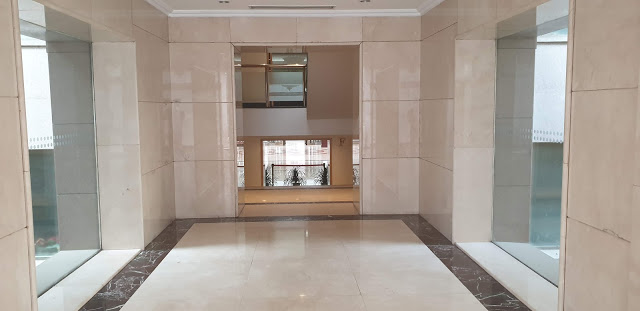
This was taken the following morning.  It didn’t look half as bland late at night.

This is the back entrance to Building No 4 but is quite representative of the whole foyer, made completely of marble and glass.  It all looked very impressive under the artificial lights, but not so much in the cold hard light of early morning.

This the foyer of the floor our room was on.  Marble with interesting carpet designs.  Those first impressions of it being a plush hotel were slowly dissipating as we got nearer and nearer to the room.  From the elevator, it was a long, long walk.

So…Did I tell you about the bathroom in our room?

The shower and the toilet both share the same space with no divide and the shower curtain doesn’t reach to the floor.  Water pressure is phenomenal.  Having a shower floods the whole shower plus toilet area so when you go to the toilet you’re basically underwater.

Don’t leave your book or magazine on the floor or it will end up a watery mess.

And the water pressure is so hard that it could cut you in half.  Only a small turn of the tap is required to get that tingling sensation going.

It’s after 1:30 before we finally get to sleep.

As for the bed, well, that’s a whole other story.

The A to Z Challenge – B is for “Because it’s not me”

If the was one fault I had, it was prevarication.

For a long time, I had always been afraid of making a mistake, after I had done exactly that.  They said our mistakes didn’t define us, but that one had.  I had lost the trust of everyone, from my parents to friends.

It was only a small lie, or so I told myself, but it had far reaching ramifications, and almost cost someone their life.  But whilst I believed it was not all that bad, and the police had agreed that anyone who had been put in the same position would have done the same, there were those who didn’t agree.

It was a moment in time I often relived in my mind, over and over, and eventually led to several outcomes.

The first, I left home, the town where up till then I’d lived all of my life, walking away from family and those who used to be friends, knowing that what they said and what they felt were two entirely different things.  For all concerned, it was better that I left, cutting all ties, and make a fresh start, away from those whom I knew would never forget, even though they forgave me.

The second, and most dire, I changed my name, and my history, even how I looked.  Today, I was a very different person to that of thirty years ago.

The third, I moved to another country, and vowed never to return, always looking constantly over my shoulder, expecting someone from the past to find me.  I instinctively knew that I would never escape, that one day a stark reminder would come back and destroy everything.

I picked the one occupation that would keep me both occupied and invisible.

Journalist.

I had started at the bottom, literally writing death notices, and worked my way up to what is ubiquitously known as ‘foreign correspondent’, going to places where no one else would go, those hotbeds of unrest, and war zones, reporting from both sides.

Perhaps it could say I had a death wish, a statement my editor had once said when he came to see me in hospital back in London after I’d been caught up in a rocket attack and repatriated.  He had come to offer me a job back home, to tell me my tour was over.

I declined the opportunity, and he left, shaking his head.

But that was not the only visitor that came to the hospital that day.  The other visitor was an elderly man, immaculately dressed in a pin stripe suit and bowler hat.  It screamed public servant, and the moment I saw him wandering up the passage, a chill ran down my spine.

Although he looked like he was looking for someone else, I knew he would eventually finish up in my doorway.

Five minutes after I first saw him.

When he appeared at the door, I thought about ignoring him, but realised that wasn’t going to change anything.  Besides that, I guess I wanted to know why he would want to see me.

“James Wilson?”

“Would it make any difference if I said no?”  Well, it didn’t mean I couldn’t spar with him, just a little.  “Who are you.”

“Do you mind if I come in?”

I got the impression he would do it anyway, irrespective of what I said.  I said no, and as I suspected he came in anyway, closing the door behind him, then took a minute or two to make himself comfortable in the visitor’s chair, what was an impossible task.

Then, settled, he said, “I understand you have just been repatriated from Syria.”

“I was in the wrong place at the wrong time.”

It wasn’t common knowledge where I’d come from, so this person knew something about me, which was immediate cause for concern.

“The bane of a reporter trying to cover a dangerous situation,” he said, with just the right amount of levity in his tone.  “I get it, by the way.  I once had that devil may care attitude you need to get the story.  I was chasing a Pulitzer, believe it or not, and used a few of those nine lives in the process.  Which one are you up to?”

I was going to say that awards didn’t matter but among those whom made up the press pack in those God forsaken places, there was an unwritten desire to be rewarded other than by pay.  For me, though, it was not a defining factor.

“Lost count.  But why would that interest you, or whoever it is you represent?  By the way, just who do you represent?”

Second attempt at finding out who this man was.  If he was dodging and weaving, it would suggest a clandestine organisation.

“People who would like to use your unique talent in getting into trouble spots around the world.  We’re not asking you to come work for us exclusively, rather piggyback on the job that you already do so well.”

An unnamed man from an unnamed organisation.  What he was offering wasn’t unheard of, and I had been warned, more than once, that jobs like he was suggesting were more often than not offered to people like me.  With that came one line of advice, turn around and run like hell.

But, with nothing to amuse me in hospital, I was curious.  “Doing what exactly?”

The fact his expression changed indicated my response had taken him by surprise.  Perhaps he was used to being told where to go.  Not yet.  I had this fanciful notion in the back of my mind that what he might offer might get me closer to the story.

“Keeping your eyes and ears open.  We’ll tell you what to look for, all you’ll be doing is looking for evidence.  There will be no need to go looking for trouble, if there’s evidence we ask you to report it, if not, no harm done.”

Not so hard.  If that was all it was.  The trouble was, if something sounds simple, which that did, but inevitably, it was going to be anything but.  I’d heard stories, and the consequences.

“You’re presuming that my editor will send me back.  He just offered me a job at home.”

“I think both of us know you’re not interested in domesticity.  If he isn’t willing to adhere to your wishes, I’m sure we could find someone else who would be willing to take you on.  You have had several offers recently, have you not?”

So, without a doubt, he knew a lot about me, especially if he asked around.  I had had several offers, but I was happy where I was.  I liked the no questions about your past that my current employer had promised.

Yes, looking at the determination on this man’s face, I had no doubt they or he could do what he said.  No one comes to a meeting like this without holding all the cards.  Also, not that I wanted it to be so, It told me that my agreement was not necessarily going to be optional.

But I was happy to dither and find out.  “Since I’m not sure when the hospital is going to discharge me, and the fact I’m not exactly very mobile at the moment, can I consider the proposal.  Right now, as you can imagine, getting back to work is not exactly a priority.”

“Of course.”  He took a card out of his coat pocket and put it on the bedside table.  “By all means.  Call me on that number when you’ve decided.”

He stood.  “It will be a great opportunity.  Thank you for your time.”

Of course, the two impressions I was left with were, one, he had me mixed up with someone else, and two, that I would never see him again.

It was an impossible task, for me at least, because I did not have a poker face, and could rarely carry a lie.  I would be the last person they’d want for the job.

And thinking that, I rolled over, put it out of my mind, and went back to sleep.


© Charles Heath 2021

A story inspired by Castello di Briolio – Episode 44

For a story that was conceived during those long boring hours flying in a steel cocoon, striving to keep away the thoughts that the plane and everyone in it could just simply disappear as planes have in the past, it has come a long way.

Whilst I have always had a fascination with what happened during the second world war, not the battles or fighting, but in the more obscure events that took place, I decided to pen my own little sidebar to what was a long and bitter war.

And, so, it continues…

——

Mayer was woken by the abrupt jolting of the guard van, and for a few moments was disorientated.  It was no longer dark, and the light was coming in through the cracks of the windows, and he could see now the van was quite old and battered.

And that odd smell was the residue of many fires in the potbelly stove, that presumably kept the guard warm in winter.  There were a few scattered coals on the floor.

Then he remembered he was in the van and it felt like it was being connected to a shunting loco.

That, and the sound of voices outside the van.

“How long has this lot been sitting here?”

“Three weeks, the shunting crew seem to have just forgotten about these wagons.  They were supposed to be sent back south months ago.”

Suddenly there was the sound of footsteps on the stones outside.

Mayer slipped down off the bunk, taking the blanket with him, and looked for somewhere to hide.  There was a door in the panel under the bed; he opened it and saw an empty space.

It was not very big, and in places, daylight could be seen through cracks in the outside wall.  It was smelly but manageable, and he wriggled into the space and jammed the door closed so if they tried to open it, it would not, and they would assume it had not been used in a long time.  Or he was hoping that’s what they’d think.

Just in time, steps on the ladder, and the door bang open.

“Ghastly, it’s ready for the scrap heap.”

“It’s for the war effort, even scrap is good.  You staying?”

“Until they hook it up, but outside.  This place feels like someone died in it.”

Mayer squirmed until he was in a more comfortable position, thankful that the space was large enough to stretch out, though cold.

He could see through the cracks, back up the track where another train was waiting.

His watch said it was near seven in the morning, and that mean he had slept for about four hours.  He had intended to get off before anyone would notice, but it was too late for that now.

At least he would be going in the right direction, it was just a matter of where the wagons would end up.  Maybe he would get lucky, and that would be Florence.

But, the chances were he would be discovered before then because if the man who had boarded before was going to stay with the train, the chances were he’d come back to the van, it would very likely he’d explore out of sheer boredom, and that would include that space behind the door.

For now, though, the two men were still outside beside the van, waiting for the signal to get aboard.

Another hour passed before there was more clanking and jolting as another engine connected to the wagons.  It was only a matter of time before the men came back.

A minute passed, two, five, ten, then the shrill sound of the whistle of a steam engine, followed by the stretching of wagon joiners and the slow movement forward.  The men had not returned, but, Mayer knew, they were aboard the train somewhere.

For the moment, it didn’t matter.  With each passing minute, he was closer to his objective, Florence.

It was slow progress, with a stop nearly once an hour, shunted aside while a more important train raced by.  People going about their business as if there was no war.  Mayer had time to lament his foolishness of being swept up in the fervor of restoring the Reich to its rightful place in the world.

It had also sounded legitimate, but, as it wore on, the news that they were winning the war and it would all be over soon, turned to disenchantment.  They could not have so many victories and not have won already.

Several of his friends had private said they believed the war was going badly, hence the pressure on his group to create better weapons so they could turn the tide.  Of course, no one would openly say things were going bad, that would invite the Gestapo on your doorstep, but people were beginning to suspect.

Mayer was not the first to consider turning himself over to the other side before it was too late.

The sporadic stop-start motion of the train went on all day, and into the night, after passing through several large rail yards, and cities.  He couldn’t be sure, but he believed they had passed through Verona, and then hours later, Bologna.

At Bologna, the stay was protracted, and once again the men came to the wagon, and this time, as he feared, they had a look around, rattled the door that he had barricaded, and at least they didn’t stay, one of them saying it had probably rusted with age.

Still, he didn’t breathe again until they left.

Nighttime, and very cold, he tried to get comfortable, and finally fell into a fitful sleep.

——-

© Charles Heath 2020-2022

The cinema of my dreams – I always wanted to write a war story – Episode 15

For a story that was conceived during those long boring hours flying in a steel cocoon, striving to keep away the thoughts that the plane and everyone in it could just simply disappear as planes have in the past, it has come a long way.

Whilst I have always had a fascination in what happened during the second world war, not the battles or fighting, but in the more obscure events that took place, I decided to pen my own little sidebar to what was a long and bitter war.

And, so, it continues…


The new leader of the resistance was the woman, Martina, best if I didn’t know her last name.  Fair enough.  There had been a necessary restructure after the infiltration, and untimely deaths of over half their number.

When I asked what happened to the former leader, I learned that he, and all but five other members were captured and taken to the castle.  They were now, for all intents and purposes, double agents, working for the Thompson at the castle.

The remaining five, of which Giuseppe and Martina belonged, had been forced to hide, dodging the men sent from the castle to hunt them down and kill them.

It was both the lack of reporting from the castle, followed by a message received regarding a possible traitor inside the resistance we had received in London, that set everything in motion, including my arrival to ascertain what was happening within the resistance group, and also at the castle.  Until that information reached us, there had been no reason to suspect that anything was wrong, and that the plans set in place to facilitate the defection of useful German scientists and, in some cases, high ranking officers, or that it had been infiltrated and to put it bluntly, original members had been killed and replaced.

I hadn’t realised who was in charge until the paratroopers had arrived and I’d become a prisoner.  Part of my brief had also been to verify the layout of the castle in accordance with old plans we had found using my archaeology background as a front, and Id managed to explore certain areas before Thompson had become suspicious and basically stopped me.  I’d searched part of the lower levels of the castle, but hadn’t got as far as the dungeons, where I eventually discovered becoming one myself, they were keeping many more prisoners.

I hadn’t long enough in the dungeons to discover whether any of the prisoners were part of the original team sent, whether there were any defectors being still held there, except for two that I’d seen, and definitely one I talked to, but there had to be more.

And, now that I’d found the remaining members of the resistance, it was my intention to return to rescue then, and retake the castle.  What was going to make it difficult, if not impossible, was the fact there were only five, and they were all busy trying not to get caught.  Still, I had to try, and I asked Martina if it was possible to get everyone together for a meeting.

Martina just laughed.  Whether it was my request or my plan to retake the castle was the cause of her mirth.

“With what?”  she said incredulously, “there are only five of us left, and we spend most of our time keeping one step ahead of the turncoats.”

“How many of them are there?”

“Too many, led by that bastard Francesco.  He didn’t like taking orders from a woman, thought we’d picked the wrong side, especially when the Germans killed about fifty of the villagers when we refused to give ourselves up.  They killed his wife and mother  after he refused to send them away.”

That didn’t seem right to me, to align yourself with that sort of enemy, not after what they had done.  Except there was no telling what anyone might do in the face of such an adversary, or circumstances.  But I had to ask, “Why would they?”

“They’ve got hostages from the village up there, in the dungeons.  That’s how they turned them.”

Damn.  I was not going to be able to turn them back, not when the lives of their friends, even family, was being threatened.

“Is that the case for those who didn’t surrender?”

“No.  Our relatives left when we could see what was going to happen.”

“So, the problem we have is, freeing the hostages, freeing the soldiers if there are any of the original group, retake the castle, and get the pipeline working again.”  And, I thought to myself, pull off seven miracles in fifteen minutes.

I was putting forward what was for all intents and purposes impossible.

“There’s more,” she said.  “There is a high-value scientist coming, last advice was that he was in transit from Germany to here.  We know, and they know, courtesy of Francesco.  They want him captured; we want him safely delivered to the submarine waiting to take him to England.  He’s due in three days, and he doesn’t know the castle’s allegiances have changed.”

“Then we’ll have to intercept him.”

“Yes, but we don’t know what he looks like, but we do have a code name.  Francesco and the castle don’t have that, only his real name.”

A name I saw on a highly confidential document on Forster’s desk the day he briefed me on my current mission.  Blackfoot.  I thought it was an operation.  I think that was the code name for the defector.

“Blackfoot?”

“How did you know?”

“A lucky guess.” 

The question I had was, why didn’t he tell me about it?  Did he think I was going to get captured and tortured?

“Well, you’re right.  But it means Francesco and his men are going to be looking extra hard for us, because without that codename, as soon as they fail to confirm their identity to him, he will kill himself rather than go back, which I’m guessing will be their least preferred option.  And to make matters worse, London’s orders are quite specific, this man must be delivered alive.  He has critical information they need, and which will hasten the end of the war”

“Then I think we should tell London the nature of our situation and see what they come up with.”


© Charles Heath 2019

Searching for locations: Sydney to Beijing, China – Every flight is different

Sydney to Beijing – Qantas A330-200
Boarding 11:45, everyone on board by 12:02, for a 12:10 departure. Pushing back 12:12 Take off 12:27

Lunch
Airline food is getting better but the fact they serve it up to you in a metal tray with a thick aluminum lid does nothing for the quality of the food inside.  I get what the chef is trying to do but often there is too little of one thing and too much of another and what you finish up with is slop in a tray.  Sometimes it’s edible sometimes it’s not.  Sometimes the meat is tender and other times it’s like boot leather.  As it is today. I think it’s pork, I should have had the chicken.  Or perhaps it was chicken.  I hate it when you can’t tell what it is that you’re eating. But, the drinks were good.

Rest or Sleep, maybe
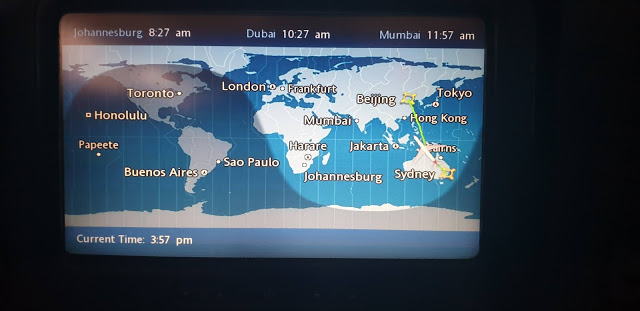
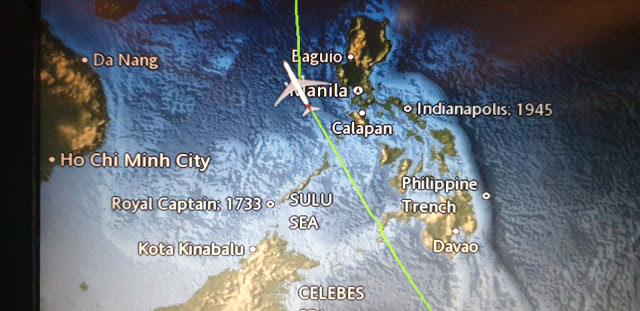
It’s going to take 11 hours and 20 minutes from Sydney to Beijing, a long time to sit in a plane with nothing much to do other than crosswords, read a book or newspaper or magazine, listen to music on your own device, or the in-flight entertainment, watch a movie again by the in-flight entertainment – if it works – or try to get some sleep. I started with the crosswords but got bored quickly. I fiddled with the in-flight entertainment, looked at the movies and tv shows but none really interested me, not then at least, so I set it to the flight path. Not exactly stellar entertainment, but it’s always interesting to know where the plane is. Or is it? If we crash, what good would it do me to know it’s somewhere over the ocean, not far from Manila, or somewhere else.  It’s not as if I could phone someone up, on the way down, to let them know where we are. But, just after dinner, we still haven’t left Australia

However, by the time I’ve finished fiddling with and dismissing all of the entertainment alternatives, it’s back to the flight path and now we are…

Somewhere approaching the Sulu Sea, which I’ve never heard of before, so it looks like I’ll have to study up on my geography when I get home.

OK, Manila looks like somewhere I’ve heard of, so we have to be flying over the Philippines.  Not far left of that is Vietnam.  Neither of those places is on my travel bucket list, so I’ll just look from up here and be satisfied with that.

Working, or not
Chronic boredom is setting in by the time we are just past halfway to our destination. We are over 6 hours into the flight and there no possible way I’m going to get any sleep. I brought my Galaxy Tab loaded with a few of my novel outlines, and planning for missing chapters, thinking I might get a little thinking time in.  Plane rides, I find, are excellent for getting an opportunity to write virtually unhindered by outside interruptions, if, of course, you discount the number of times people brush past, knocking your seat, the person in front lowering the seat into your face, or people around you continually asking you to turn off your light because they’re trying to sleep. Sorry, I say, but you can suffer my pain with me.  It’s one of the joys of flying with over two hundred others in a claustrophobic environment.  Besides, aren’t the lights supposed to be slanted so only I get the rays of light?  Except, I guess when the fixed light doesn’t line up with where the airline has fixed the seat (usually so they can squash more people in).So, sorry, not sorry, take it up with the airline.

Back to work, and I put in some quality time on a part of the story that had been eluding me for a while.  I knew what I wanted to write, but not how I was going to approach it, so that blissfully quiet and intense time worked in my favor, something that would not have happened back hope. I won’t bore you with the synopsis, just suffice to say it’s finally down on paper, digitally that is, and it’s a huge step forward towards finishing it. There is, of course, the end play, the reading of the will but not before there’s a few thrusts and parry’s by some of the players, but all in all the objective was to showcase a group of people with their strengths and weaknesses pushing their characters in various directions, some at odds with what is expected of them. But enough of that.   A quick check of our position shows we’re still over water but closer to our destination, so much so, we might start the pre-landing rituals, starting with food.

Dinner
7:00 – Dinner is served, well, the lights go on and a lot of tired people try to shake the sleep, and sleeplessness, out of their systems. Then flight attendants that are far too cheerful, and must have beamed in from somewhere else, serve another interesting concoction that says what’s in it but you can’t really be sure of the ingredients.  It comes and it goes.

9:10 – We begin our descent into Beijing, you know, that moment when the engines almost stop and there’s a sickening lurch and the plane heads downward. 9:56 – We touch down on the runway, in the dark and apparently it has been raining though from inside the plane you’d never know. 10:10 – the plane arrives at the gate,  the usual few minutes to open the door, and, being closer to the front of the plane this time, it doesn’t take that long before the queue is moving.

Early or late, it doesn’t matter.  After clearing customs and immigration, we have to go in search of our tour guide, waiting for us somewhere outside the arrivals terminal.