For instance, I’ve heard someone mutter, “the devil you say…”
Or another, who was telling his friend, who, at the time was in a spot of bother, ‘You’re between the devil and the deep blue sea.”
Wrong. We all know the sea is green, not blue.
But whatever the circumstances, the devil seems to pop up a lot.
For instance,
Better the devil you know than the devil you don’t.
It seems I’ve heard that somewhere before, or at least a part of it. Hmmm.
Maybe you’ve “gone to the devil”. Can that be paired with “going downhill at a rapid rate of knots”?
OK, it’s impossible to go downhill using the speed measure of knots, that only applies to boats, so who came up with that saying, a landlubber sailor?
Hang on, isn’t there a team called the New Jersey Devils? Funny, I didn’t see if the players had horns or not, and they were using hockey sticks not tridents.
Maybe I misheard.
Neutral men are the devil’s allies, therefore there must be a lot of devils in Switzerland
The devil finds work for idle hands, oh yes, my grandmother used this often on me whenever she caught me doing nothing, or digging around in her magazine room … which was a lot
But my favorite,
When in hell, only the devil can show you the way out.
For a story that was conceived during those long boring hours flying in a steel cocoon, striving to keep away the thoughts that the plane and everyone in it could just simply disappear as planes have in the past, it has come a long way.
Whilst I have always had a fascination with what happened during the second world war, not the battles or fighting, but in the more obscure events that took place, I decided to pen my own little sidebar to what was a long and bitter war.
And, so, it continues…
By the time they reached the outskirts of Munich, what the Standartenfuhrer considered their biggest hurdle, it was quite dark and almost impossible to see where they were going.
The whole city seemed to have disappeared so effectively was the blackout.
But there was one benefit, there was little or no traffic on the roads, which lessened the chance of running into another car or truck.
And it was time to refill the tank with two more petrol cans, leaving two remaining. Filling up now, the Standartenfuhrer said, would get them to Innsbruck.
He sounded confident, but Mayer got the distinct impression it was mostly that he was putting on a brave face. There had been one instance, the checkpoint before Munich where he nearly lost his nerve. For the first time, there had been SS guards at the checkpoint, and which had been entirely unexpected.
An SS officer of the same rank had been summoned and he had requested their written orders. They had paperwork, but Mayer wasn’t sure if it related to their current situation, further confirming his belief this had been a very carefully planned operation to get him out of Germany, and that there was a more pressing reason why. It definitely had something to do with the V2’s, but had their intelligence services found out about something else, something he didn’t know about?
Given the level of risk to the two men with him, and that at every turn there was a possibility of capture or death, given the level of planning and the run so far, one he would have never thought of trying on his own, he didn’t have a very high level of confidence that they would get away with it.
Those in the SS were not fools, trusted no one, believed nothing they were told, and disregarded anything written on paper. Check, double-check, then check again. Take nothing as read. The document he’d been given on what made a first-class SS officer in the eyes of the Reich, was fundamentally not him, nor most of the German population.
The officer at this checkpoint reminded him of the one who had shot the shooting in the hotel, and for at least ten tense minutes, during which time the other two had conferred quietly in English, one suggestion they cut and run.
That would have invited a hail of machine-gun fire that none of them would survive.
Both looked visibly relieved when he returned, having obviously called the name of the officer who had signed the order. The only explanation he had for this was that the level of discontent among officers Military of SS must be greater than he thought.
They managed to cross over into Austria without any problems, the route they had taken, a series of back roads and tracks which had been given to them. Once again, Mayer was surprised that so many people could be working against their own country, but, of what he’d seen, conditions were harsh no matter which part of Germany they were in.
The war was not going the way the German people were being told, and it was hard to see any resolution of the conflict any time soon.
Perhaps everyone in the high command was hoping the new V2 rockets were going to change the country’s fortunes in the war. If they were, they were going to be bitterly disappointed. What they needed was the jet-propelled fighters and bombers, something that remarkably had not been implemented years earlier, and would have given them air superiority.
He’d worked on those early jet engines and they were remarkable, and faster than anything the British or the Americans had. It was hard to comprehend why high command had not pushed forward the new jet-propelled planes that Belin had finally decided to implement.
And just when the trio had agreed that everything would work out about 100 kilometers from Innsbruck, on the road to the Italian border crossing, they took the wrong route. It was a mistake brought on by tiredness, and a momentary lapse in concentration.
Every time I close my eyes, I see something different.
I’d like to think the cinema of my dreams is playing a double feature but it’s a bit like a comedy cartoon night on Fox.
But these dreams are nothing to laugh about.
Once again there’s a new installment of an old feature, and we’re back on the treasure hunt.
“How long have you been working on this?”
“A week. Lying in bed is boring, so I decided to look at everything I’ve got again, and then again. There were some old maps of the coastline stored with the treasure maps, so I think my father was trying to find the actual location his treasure maps were based on and came up against the same problem. Physical landmarks on the treasure maps are no longer there, and if you didn’t know any better, I would think you were looking in the wrong place.”
“So, in actual fact, what you’re saying now is that your father had no idea where the treasure was buried, that he was just producing maps for the Cossatino’s’ to sell.”
That, of course, could be looked at from a different angle, one that I wasn’t going to suggest right then because Boggs was not ready to hear it. I think the real maps Boggs had found with eh treasure maps were the basis for the treasure maps, that is, his father had to give them real-life elements to keep the punters interested.
“No, not necessarily. I think he knew it was somewhere along this coastline give or take a hundred miles, because of its proximity to the Spanish Maine, but essentially you’re right. He probably had no idea.”
So, he hadn’t come to the same conclusion I had. Yet.
And if I could come to that conclusion, surely Cossatino also would, after all, he was the one who got Boggs senior to make the maps. Why all of a sudden did he think that there was a real treasure map. It couldn’t be simply because Boggs had said there was one. He’d have to know that anything Boggs junior found was an invention commissioned by him,
Or hadn’t Vince told his father what he was doing? Surely the father would have told the son about the treasure map scam.
As for Benderby, senior could base his assumption of the fact that he’d found some old coins off the coast nearby that could be part of the trove. Alex then may have decided to usurp his father’s search with one of his own, conveniently forgetting the treasure maps were an invention of the Cossatino’s. IT was a tangled web of lies deceit and one-upmanship, one that was going to leave a trail of human wreckage in its wake.
Boggs and I were two of the first three. We had lived to tell about it, Frobisher was the first casualty.
But what I suppose was more despairing was how taken Boggs was with the notion that the treasure was real, hidden out there somewhere, and that his father had ‘the’ map. I was loath to label him delusional, but his pathological desire to prove his father’s so-called legacy was going to not end well, especially when we found nothing.
And, yet, I had to admire the lengths he had gone to, to prove his case. Even now, looking at the overlaid maps, there was no guarantee we’d find anything, but at first look, the evidence was compelling.
Except I had a feeling Boggs had something up his sleeve. I had to ask the question. “Where did you get the idea of matching the treasure map to the real map?”
“My father’s journal. It was tossed in the bottom of a box of his other stuff. There are about ten boxes stacked in the shed, stuff my mother just couldn’t be bothered sorting through after he disappeared. Again, boredom pushed me into going through everything over and over just in case I missed something.”
He reached in under the mattress of his bed and pulled out an old leather-bound notebook. It had a strap that bound it together, and by the look of it had extra papers inserted or glued to pages, as well as papers at the start and back of the volume, making it look about twice the original size.
He handed it to me. The leather was old, cracked, and had that distinctive aroma of the hide. I loosened the strap and the top cover opened. The first page was a newspaper cutting, a small piece about some old coins being found about a hundred yards offshore by some surfers. Were these the same coins that Benderby had claimed were part to the trove?
“Benderby was getting that antiquarian that was murdered to identify some coins,” I said after a quick glance through the article.
“I spoke to one of the surfers the other day,” Boggs said. “He told me he came off his board on a big wave and as he was going down saw something glinting on the seabed. He managed to pull up three coins. There were more but he had to come up for air. When he went down again, he realized he’d been dragged away by the current.”
Tides and currents along this part of the coast were particularly bad, and the undertow, at times could get surfers and swimmers alike into a lot of trouble. I’d been caught out once in a dinghy myself, finishing up ten miles further down the coast that I expected to be.
“Then, I take it he can’t remember the exact spot so he could go back.”
“He tried, but alas no. Said he sold the coins to old man Benderby for a hundred apiece and told him approximately where he thought the others were, but nothing’s been found since.”
Not that Benderby would tell anyone if he did. But it explained where the coins came from that he gave to Frobisher.
“Except we can assume that it’s off our coastline somewhere, right?”
“Five miles of coastline to be precise. He and his mate always had a few reefers before they went out, made the ride more interesting he said. He could have been off the coast of Peru for all he knew.”
Surfers, drugs and a colorful story.
“It explains why Benderby and a team of divers have been out in his new boat,” Boggs added, “probably trying to either find the location or line up landmarks on his map from the seaward side at the same time. But he doesn’t know what we know.”
What did we know? I leafed through a few more pages of the diary, but the scrawled notes were almost illegible. I picked up various words, like a marina, underground river, dry lakebed, but none of it made any sense.
“Which map did we give to Alex?”
Boggs went over to a drawer in the wardrobe and leafed through the papers in it and pulled out one and gave it to me. Like the rest it showed the shore, the hills, the lake, and two what looked to be rivers flowing into the sea. Each of the maps had those same features but in different places.
I didn’t want to say it, but it seemed to me we were playing a very dangerous game. The maps might look different in some respects, but the chances were, if Alex was smart enough to hire an expert, that we might run across him out there, and, to be honest, he would be the last person I’d want to see.
“You do realize our paths are going to cross at some point.”
“Maybe, maybe not.”
A shiver went down my spine, an omen I thought. Boggs has something up his sleeve, and I really didn’t want to know.
Probably the sagest piece of advice I had ever been given, just before I headed out onto that highway called the rest of your life, was from an aunt who died not long after she delivered it. She was old and cranky, which I thought had been because my mother was such a pain in the neck to her, but it was more because she was simply old and tired.
Always look to the intentions of people who ask you to do things for them. People can be lying, cheating, deceitful creatures who dress up their motives in sugar-coating, so you don’t realize what their true motives are.
It hadn’t happened to me yet, and yes, we had been taught to take people at face value, but I suspect she had seen a bit more of life from all angles than both my parents. But at the time, when she delivered it, along with a lot more advice on what I should do with my life, I didn’t take much notice.
What grandchild did?
…
We are taught to take people at face value, that we should respect them until they prove otherwise. It worked most of the time because we all have that sixth sense that tells us if something is too good to be true, it generally is.
It can equally apply to goods as it does to people, though with people there are some who know how to confuse even the most trusting of souls. They just take a little longer before they reveal themselves.
Me, I had a few bad experiences that led to a degree of cynicism. Relationships that had failed, and jobs that didn’t end up quite as described. That’s why when I found my current role, and the fact I’d been asked for personally, made it all that more satisfying.
Of course, there was an element of flattery involved, but after so much disappointment, maybe I lowered the blinkers just slightly. But all things withstanding, it had turned out to be rewarding as well.
A few awards, some paid vacation days for meeting milestones, I thought I was going well.
Then, as the latest reward I’d been sent do a conference on the other side of the country, the equivalent to and all expenses paid junket, the sort only senior management went on.
It was an eye-opening experience, with team building exercises that supposedly only senior management went on. There were people from all over the country, from a variety of companies.
On the first day we were put into teams of four, two women and two men. The idea was that we were all equally responsible for each other, removing the gender stereotyping.
For me, it was what I understood out company was undertaking. For the other male member, he was not so gender neutral, though he spoke the words, his actions were quite different away from the women. It was wrong, but I ignored it because it was only for a few days.
On day two, at the end of the day’s exercises, I ran into him at the bar downstairs. He was more sociable than I, and was the sort who was the life of the party, only u think others had realised his shortcomings, possibly from the night before, and was nursing a drink at the bar on his own.
I was going to go somewhere else, but he saw me before I could escape, so I crossed the room and sat on the next bar stool. There was a familiar scent in the air, and it might have belonged to one of the two women. He had said earlier that he fancied the blonde, and it was clear what his motives were.
It was probably why he was alone.
“What have you got on for tonight?”
I’d barely got on the seat and caught my breath. A replacement drink arrived in front of him, a large cocktail that looked lethal.
I asked the bar tender for a club side with lots of ice.
“You’re not going to have much fun with that,” he said after the bar tender left.
“Not much of a drinker, I’m afraid.”
“Bit hard to let your hair down then?”
Like all drunks, he believed a good time could not be had unless soaked in alcohol. I’d had arguments with friends no more on exactly that subject.
“Perhaps not, but that’s not why I’m here.”
“Didn’t your boss tell you it was just a junket. There’s no working just playing. Do the stuff they throw at you for a few hours so you can get the attendance certificate that no one fails, then move on.
And I thought I was cynical.
“Where did you say you worked again?”
I told him.
“Do you know a chap called Jerry Blowfell?”
“My boss as it happens.”
“Is it now? I used to work for him at a different place, on the east coast.”
“What was he like then?’
“A mongrel. Used everyone to raise his profile in the company, taking promotions that others should have got by stealing the credit for their work.”
“Doesn’t sound like the same man.”
Short chap, likes turtleneck sweaters, black hair with a white streak.”
That was Blowfell. But it didn’t sound like him.
“He does have a white streak.”
“Got it when he was struck by lightning, or so he said. It was really caused by using the wrong sort of hair shampoo.”
It was clear from his manner that he didn’t like him.
“Tell you what, call him back at the office, mention my name and see what result you get.”
It sounded like it might be like a red rag to a bull situation. I said I’d think about it, had another drink, then left.
…
His words had made an impression. I had thought at first there was no way he was right, that it was just the words of a spiteful drunk.
Then I stewed over it for no real reason because there was no suggestion of impropriety.
But I would call him and see what he had to say about Jerry. It was going to no doubt confirm Jerry’s sour grapes after being fired, because very few people left of their own accord in the current economic climate.
So, when the time differences allowed, I called the office and asked to be put through. It ended with an unfamiliar girl’s voice.
“Do you know where he is,” I asked, after she told me he was not in the office.”
“Paris taking a well-deserved reward for his hard work on the Johnson contract. The board were delighted with the result.”
“Oh,” I muttered, then hung up.
He had done nothing towards the Johnson contract, other than to hand the file to me. Our last conversation, the day before I left for this conference was to confirm the details of the settlement.
And yet he was the one in Paris. My first thought, that should be me.
My second thought, Jerry was right.
But the question was, how did he manage it?
It wasn’t hard to work out. Taking people with low expectations, he had dazzled me with this conference, firstly to get me out of the office, then secondly to go away, perhaps over the exact same period, and in normal circumstances I might never discover what happened.
Such was his skill at compartmentalising, none of us in his tear ever knew what the others were doing spread out as we were around the country. The fact was, I only discovered what had happened from someone outside the country.
I took breakfast on my room, livid. But as angry as I might be, I didn’t want Jerry to know he was right.
Instead, I came up with endless scenarios of tackling him about it, but knew, if he’d been doing for this long, he would have the bases covered, and my complaints would fall on deaf ears.
If he was going to get caught out, I would have to come up with an elaborate scheme to trap him.
…
Fast forward three months
I got over my anger, went back to work, and pretended like nothing had happened. My boss had got back from Paris the day before I returned from the conference and was there to greet me when I returned.
It was a strange feeling to cast eyes upon someone in such a different light. I figured that if I tried to find out what else he had perpetrated on the back of other team members, he’d find out, and asking anyone who could tell me, could be potential conspirators. Doing what did did could not be done on his own, so there had to be others.
But, one by one, when the opportunity arose from a work perspective, I spoke to each of the other people in the team, and all had been sent to the same conference I had. Only one voiced an opinion, one I had not asked for, and that was to say they thought they’d seen him at the conference but must have been mistaken.
But it got me thinking, and I looked up the venue and the online presence of the program. It was well received and awarded by chambers of commerce and industry associations alike.
There was a history of how it came into being, theme changes that had been made in response to changing times and new industry regulations, and a profile of the man who brought it into being.
My boss’s brother. There was a picture of him, and there was no mistaking the family likeness. It wasn’t a stretch to believe that my boss may have leaned on his brother to grant places on his courses, paid for the company. It wasn’t wrong, but if he could steal credit where it wasn’t due, maybe he arranged kickbacks for places.
It was all that I could assumed because there was no proof of his deeds anywhere and that might have been part of a non-disclosure agreement made with anyone who discovered his secret.
It was nothing I could take to the board. I would have to find another way. That presented itself some weeks after I returned when he dropped a new file on my desk.
Our specially was to analyse companies or organisations that were teetering on the edge of disaster and set them up in such a way that larger companies could step in and take them over for a mutually beneficial deal.
The last, what we call settlements, was that which my boss had taken the credit for, involved a sole trader who had a great product but hadn’t been able to manage the financial aspects of the business, and with the downturn, which caused him to close the doors.
This case was something similar in that the owner had taken his idea and made it into a successful business, then tried to turn it into a franchise. The only problem was, with a pandemic induced downturn that heavily relied on people presenting themselves, the sudden loss of those people threw everything into disarray.
He needed a buyer, someone with a lot of financial backing to tide the business over until the market returned to normal.
When I did my investigation, I discovered that one of the casualties of the imminent collapse was none other than the boss’s brother, and the man who ran the conference I had recently gone to. He was one of about a dozen around the country who were, through no fault of their own, in trouble.
It was most likely a call from him that resulted in the file that I now had sitting in front of me.
It led to the creation of two solutions, one of which I would give the boss and he would run with as his own, and the other I would keep in the filing cabinet to pull out and save the day. It would no doubt cause considerable consternation for his brother for a short period, but it was going to solve the problem we analysts had.
And something else that I hadn’t realised was the MSN who was in charge of us was not sufficient versed in the processes that drove our solutions, just very savvy in his ability to pick people who were. It meant that he would not be able told discern the solution provided would not necessarily solve the problem with the best outcome. Only those who vetted it before it was implemented would.
And once I’d completed the two analyses, I set the plan in motion.
It was two weeks before a person I’d never seen before, but whose name was familiar gave me a call.
He introduced himself as one of those who acted on the information we supplied, to whom the boss would have sent the file I had supplied him.
“So, here’s the problem. After we looked at the file he supplied, it showed some critical errors, which is a first for his work, and when we asked him to explain how he’d reached his conclusions, he said some of it was obtained externally, and when pressed gave us your name and number. What can you tell me?”
I was not sure what I was expecting as an outcome to my subterfuge but perhaps this was the only chance I was going to get to plead my case.
“That none of it was his work, and that he has been taking the credit when it was not due.”
Then I explained what I’d done, and then emailed the correct version of the file, and after he had read the relevant sections I ended with the damming phrase, “if he had the necessary experience and accounting knowledge, he would have seen though it fairly quickly like you had.”
When he had he would look into the allegations I’d presented, I suddenly though I may have overstated my case, particularly when I didn’t hear anything back. The only saving grace was that I hadn’t been fired which if he had a strategy in place in case someone like me tried to burn him would have happened reasonably quickly.
Then one morning I got a phone call from one of the other analysts.
“Have you ready your email this morning?”
I hadn’t. Not feeling well, I hadn’t gone into the office and decided I would work from home if anything came up. We had recently been set up to work remotely because of the pandemic and subsequent shutdowns.
I went online and opened the mailbox. At the top of the inbox was an email advising that the company had accepted the resignation of our former boss who had cited personal reasons for leaving.
In other words, he had jumped before he had been pushed.
Below it was another email from HE advising they were recruiting his replacement from within and were looking for applications.
And there was one more, almost hidden by the white noise of spam, one that specifically thanked me for my contribution to the recent file, with an invitation to meet the people who implement our plans.
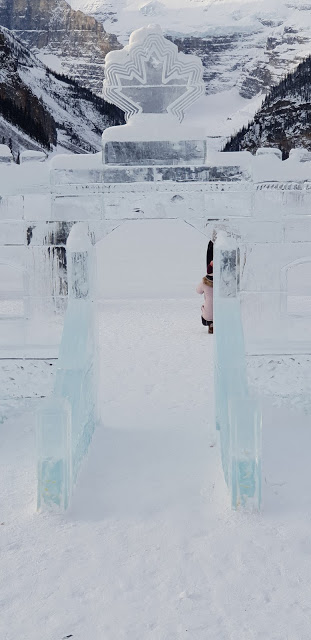
The Fairmont at Lake Louise, in Canada, is noted for its ice castle in winter. This has been created by the ice sculptor, Lee Ross since 2007, using about 150 blocks of ice, each weighing roughly 300 pounds.
When I first saw it, from a distance, looked like it was made out of plastic It’s not. Venturing out into the very, very cold, a close inspection showed it was made of ice.
And, it’s not likely to melt in a hurry given the temperature when I went down to look at it was hovering around minus 10 degrees Fahrenheit.
You can pick your friends but you can’t pick your relatives.
So sayeth my sister, who for years refused to acknowledge I was her brother.
The point is, as I was trying to tell Nancy, the woman who had agreed to marry me, “my family has long been ashamed of me because I refused to become a doctor.”
“That’s no excuse, I’m fact that’s the most ridiculous thing I’ve ever heard.”
To most people, it would. I agreed with her. But then, her family had not had a forebear who stood shoulder to shoulder with George Washington at the Siege of Yorktown.
It was a statement my mother had often pulled out of nowhere at dinner parties, and sometimes in general conversation, just to impress. I thought of trotting out as another example of ridiculous statements, but though better of it.
It was a situation I had not bargained for, and probably why it took so long to find someone to share the rest of my life with.
Perhaps I hadn’t quite thought through what would happen once I asked the question, and it was a yes.
It was not as if Nancy and I hadn’t taken the long road with our relationship. She had been burned a few times, and I always had my family in the back of my mind as the biggest obstacle.
In fact, I always had considered it insurmountable, and because of that, rarely made a commitment. But Nancy was different. She was very forgiving and had the sort of temperament saints were blessed with.
Her family sounded like very reasonable people who lived up state out of Yonkers on a farm she simply said had been in the family forever.
She didn’t have big city aspirations, was not impressed by wealth, travel, large houses, or a resume a mile long with achievements. It was everything I didn’t have and didn’t want, and my job as storeman and fork life driver was one where I could go to work and leave it there.
Nancy on the other hand, was a checkout clerk at a large supermarket, with no aspirations to be a boss or run the place. She had a run in with a tractor early on in life and could manage a lot of the farming basics.
Her parents sent her to the big city to learn a different trade, but she just wasn’t interested. She was a country girl and would never change.
We met when she was attending the same pre wedding party that I was, both with different partners at the time, and both of whom were more party animals that we were.
A week later we ran into each other in the same bar, and it grew from there, and after a rather interesting six months or so, we had ended up making the ultimate commitment.
…
“I guess, now, we have to tell our parents,” she said, stating what was to her, the obvious.
Such a simple statement with so many connotations. I had deliberately steered the conversation away from all of them, and so, at this point in time, she knew I had parents, grandparents, and three other siblings. And that they lived on the other side of the country.
Asked why I had moved so far away, I told her that I’d failed to meet their expectations and preferred to be as far away as possible. My brothers more than made up for my failings, so it was not necessary I stay there.
It was only recently I’d told her those expectations were of me following the family tradition into medicine. It was when I told her my father was a pre-eminent thoracic heart surgeon, my brothers top of whatever field they’d chosen and my sister, a well-regarded general practitioner.
When she asked in what way I’d failed, I said it was not in the education because like all Foresdale’s, we were always top of the class, and as much as I tried to fail, the teachers knew better.
I just refused to go to University. Instead, I tried to disappear, but my father had the best private detective at his disposal. It took a very long, loud, screaming match to sever that tie, get disinherited, and leave to make my own way in the world.
Perhaps, I said, it would be best to just say I was an orphan.
That, of course, to Nancy, was not an option. She came from practical people who always found a solution to any problem, and they had had a few really difficult ones over the years.
But, for the first time, there was an look of perplexing on her face. Maybe she was thinking that she should have asked more probing questions about my family before agreeing to be my wife.
“I think I can safely say that your parents will be more approachable than mine. Those expectations on me will also fall on you.”
And having said it aloud, it sounded so much more like a threat. The problem was, I knew what there were like, living in that rarefied air where the upper classes lived.
I might be a forklift driving storeman, but I was still a Foresdale, and my match had to be commensurate to the family values.
“Then we’re just going to have to go visit them and lower those expectations. I’m not afraid of them.”
No, I expect she was not. I’d seen her deal with all types of miscreants at the checkout counter, rich and poor alike. She had the sort of gumption I always had wanted but was too much of a coward to confront the problem.
Perhaps now, it would be the perfect opportunity.
“We should go next week. I’ve got some vacation days owing, and I’m sure the boss will let you go if you tell him the reason.”
Practical as ever. Confront the beast and get it over with.
“Sure. I’ll talk to the boss, arrange the tickers, and let someone know we’re coming. But I will not be staying at the house. That way if it gets too intense, we can leave.”
I saw her shrug. I’m not sure she agreed that was a good idea, but I didn’t want to see them corner they way they had a habit of when any of us children brought anyone home. I did once, and never again.
“It will be fine.”
Famous last words.
…
I had the phone number of my sister Eric’s, stored on my phone, not that I’d ever intended to call her. It was there because she had called me, I had made the mistake of giving it to her when I left, because she asked me for it.
I hadn’t spoken to her since I left home all those years ago, nearly ten by my reckoning, and perhaps it was a testament to my father that not one of them had called, or even reached out.
Being cut off literally meant that. But it was not something that irked me. I was glad not to see them. I could easily keep up with them in the newspapers and magazines, such was their visibility.
I was surprised Nancy hadn’t made the association.
I don’t know how long it was that I stared at that number, finger hovering over the green button. My first concern was whether I’d remain civil, or how long it would take before I disconnected the call.
Then, courage summoned, I pressed the button.
An anticlimax might occur is there was no answer, or the number had been disconnected, but such was not the case. It rang.
Almost for the full number of rings before a familiar voice answered. “Good morning, this is Erica speaking.”
If only I’d learned to answer a phone properly like that.
“It’s Perry.” Damn, I hated that name, and once I left home, I adopted my middle name, James.
“Now that’s a blast from the past. Never expected to hear from you again.”
“Believe me, if I had my way, you wouldn’t, but there’s a person who insists she meets the family. I tried to talk her out of it, but she’s a force to be reckoned with.”
“Good for her. I always knew you’d meet a sensible girl who wouldn’t put up with your nonsense. I’m assuming you asked her to marry you?”
“I’m beginning to wonder if I should have just outright lied and said I was an orphan.”
“Yes, and how would that have worked when we finally ran you to ground. Besides, your father has known where you’ve been hiding all along. You are still a Foresdale, and that will never change.”
“Even when I’ve been ex-communicated from the family.”
“That’s only your assumption. Everyone here might have expected you to change your minds somewhat earlier, but we never doubted you would return. Now, just who is this Nancy, and who does she belong to?”
I had gone over a number of different ways I could run into Juliet, but most seemed staged, and I got the impression from her most recent conversation with Larry, that she was not silly.
In fact, in my mind, a second meeting, coincidental or not, would send up a red flag. This was where spycraft bordered on Hollywood, we needed to set the stage, and for that, we needed extras.
And that meant a phone call to Alfie. I told him what I needed, and he asked for 24 hours to set it up, and true to his word, I was in the arrival hall of Venice Airport, waiting for the newest member of the team.
Cecilia Walker was an aspiring actress, an ideal cover for her so-called part-time profession as an agent at large. We all had cover stories, with both personal and legitimate reasons for being in places that we’d not normally be expected to be. And in her case, she was never the same person twice, quite literally the master of disguise.
For Cecilia, there was a film festival in Venice she would be attending. Timing in this case was everything.
As for me, I had a background in archaeology and journalism and was actually employed to write articles for a number of publications, a job I kept up after I left the service, along with the idea of writing a book, which became the object of a long-standing joke between Violetta and I.
One day I would finish it
But ironically, Cecilia had the perfect cover, being able to slip into any role without having to work too hard on the finer details.
Alfie had sent a photo of her, and even though I did spend a few moments wondering if I might recognize her from some part she may have played, it didn’t stir up any recollection. Of course, there was always a vast difference between studio poses and real life, and the woman that came out of the gate was quite different from the one I was expecting.
Although the few paparazzi that were loitering in the terminal just in case a celebrity did suddenly arrive, didn’t recognize her, that might be due to the fact she was dressed casually and had changed both hairstyle and color, and, as I had learned from the woman I’d spent a lot of time with, nuances in make-up could make all the difference.
But there was one photographer that was interested, perhaps he had seen her before, and I waited until she had spoken to him before wandering over. She had scanned the gate area, both to familiarise herself with the layout and people there, as well as locate me, all without looking like she was doing anything other than immediately disembarking the plane.
It showed experience, and preparedness, not her first, as they say, rodeo.
She had been tracking me the whole time, so once I was in her direct line of sight, anyone observing us would assume we were old friends.
There was a hug before words were spoken, the sort that made me realize what I had been missing for some time, warm personal contact.
“You haven’t aged a bit,” she said, a smile lingering.
“It’s the wine, excellent preservative. You, on the other hand, have grown up.”
The script called for old friends who hadn’t seen each other for a year or so.
She performed a pirouette and then burst into giggles. “Sorry, it’s just when I did that for one of my grandmothers, she said I was acting like a tart.”
“Grandmothers can be like that,” I said, remembering Violetta used to use the same word for her sister’s grandchildren.
“My house is a renovator’s disaster at the moment, so we’re staying in a quaint hotel on the edge of the main Canal, and some interesting restaurants.”
Alfie had booked us adjoining rooms on the same floor as Juliet, which, when she learned I would be staying there too, would give me the surprise element I was looking for.
“I am so looking forward to this week. If we get the time, you’ll have to show me everything.”
In that short distance from the airport terminal to the water taxi berths, there was time enough to discover what had exactly been missing in my life since Violetta had died.
Yes, there was a period of mourning, a period where there had been no point in getting out of bed, a period where I felt completely lost without the one person who made my life make sense.
But in those few short minutes, there it was again, and with it the belief that perhaps there was someone else out there who could fill that gap, but never replace her because there would never be anyone else like her. Cecilia was not the one, but she was part of the process.
I had to remember, also, she was a consummate actress, that she was playing a role, and it was totally believable.
Once we were on the water taxi and away from prying eyes and ears, I had to ask, “how did you end up on Rodby’s roster, especially in light of how good an actor you are?”
“You think so, why thank you. But the duality, accidentally. I got caught in the crossfire, and thinking at the time, someone had changed the script and forgot to tell me, sort of kicked some ass. Delusions of becoming a female version of Liam Neeson. Instead, I was offered a recurring female James Bond, in real life.”
Good to know I could depend on her in a scrap.
“This might not come to that, in fact, it might be quite boring.”
She smiled. “A free trip to Venice, a film festival pass to everything, working with a legend, what’s not to like?”
What had Alfie told her? Legend I was not, perhaps slightly more successful than the average agent, but I was just doing my job until I didn’t want to do it anymore. How many of us could say we preferred to sacrifice everything for the love of the one?
“I assume you are up to speed with what’s required of you in the first instance?”
“A role is a role, Evan, and I love a good role. This woman you’re supposed to be cozying up to, and the guy using her, it’s almost like a plotline in a B grade movie.”
I hadn’t thought of it like that, but now that she mentioned it, it felt a bit like exactly that.
“Should I make her jealous?”
“It’s not like that, or at least that’s the impression I got when I ran into her. Depends on what Larry’s intentions are. Chances are when we get to the hotel we might see her again, and you might get an idea. I’m not the best person reading women’s minds.”
“No man ever is. We have to have that element of surprise to keep you interested, but if I was in her position, and I saw you with a woman like me, and I was supposed to get close to you for whatever reason, I might be forced into making a move I didn’t want to. The fact she’s here with you in her sights generally means one thing.”
The question was, how desperate would she be? That would depend on the motivation, or what leverage he had. Pushing the envelope might, as Cecilia said force her hand.
So much for a softly, softly approach.
And it might force Larry’s hand as well
“So, is it your first time in Venice?”
“No, I used to come here when younger with my mother who was I guess a Venetian. After she died, not so much.”
“No other baggage?” It had surprised me she had only one carrying bag.
It was always excess baggage when traveling anywhere with my ex.
“Only emotional. I was told to pack light, anything I needed you’d get for me.”
The accompanying wicked smile was enough. I’d have to make sure the expense account was big enough.
After a pleasant forty-five-minute grand tour of the canals going the long way to the berths not far from St Mark’s Square, we jumped off as soon as the taxi came alongside.
The hotel wasn’t far from the bronze equestrian monument to Victor Emmanuel IIstatue, which she took a moment to look at, almost causing several strollers to walk into her.
That element of careless tourist didn’t make her stand-up as much as if she had purposefully walked from the berth to the hotel, a small detail in a studied persona, the role of an extra perhaps in a film.
It was the part of the day, for late summer that I liked the best, and in a week or so, the weather would slowly get colder until Christmas, and winter, was upon us.
Then, she did the complete 360-degree turn just taking it all in. “Some things never change, I remember all of this.”
Perhaps living off and on for so long here had made me a little immune to the charm of the place, but it was hard not to get caught up in the moment.
“Your hotel awaits.”
For a few seconds the reality of the situation faded into the background, and I could push all the nastiness of Larry and his machinations aside, but then the reality came back, I remembered who I was and what I’d been, and how important it was not to lose sight of the objective.
It had not been easy while Violetta was still alive, nor was hiding the real truth of my past from her. Yes, I had told her a version of my precious life, and the possible dangers it could present, which was why she suggested we live in a number of different places, never the same in a single location, but with Venice, it had been different. It had a profound effect on her, and it was where she chose to spend her last days.
It had not held the same effect on me. Not since she passed, and I had been looking to leave, find somewhere new, and different to stay, more so since I learned of Larry’s plans.
Now it just made me angry.
“I’m sorry,” she said, suddenly next to me, “do we need to be someplace?”
“What, no, sorry.”
“You looked annoyed, I hope not with me.”
“No, never. Just thinking about Larry. And Juliet, I guess I’m lamenting the nuisance the pair of them are in intruding on my solitude. Something to note, you don’t ever get the luxury of retirement in this business, except in death.”
Aside from the fact it is one of those necessary items to walk with, and the fact we can have two or four for most humans and animals, there are a few other uses for the word ‘leg’.
Like…
‘You haven’t got a leg to stand on’, doesn’t necessarily mean you have no legs, but that you are in a precarious position.
“the table had ornate legs’, yes, even non-living objects can have legs, like tables and chairs.
“It was the fifth leg of the race’, meaning it can be a stage of a race.
“He was legless’, meaning that he was too drunk to stand up. Some might think being legless is a badge of honour, but I suspect those people have been drinking a long time and the alcohol has destroyed most of their brain cells.
“leg it!’, meaning get the hell out of here before you’re caught.
Then, finally, ‘he’s on his last legs’, meaning that he’s exhausted, or about to die.
I’m sure there’s more but that’ll do for now.
I have to use my legs to get some exercise, of which the first leg is to the tripod to check if its legs are stable, and the second leg is to come back to the table and replace one of the legs which is broken. Then I’ll leg it to the pub where hopefully I won’t become legless.
For a story that was conceived during those long boring hours flying in a steel cocoon, striving to keep away the thoughts that the plane and everyone in it could just simply disappear as planes have in the past, it has come a long way.
Whilst I have always had a fascination with what happened during the second world war, not the battles or fighting, but in the more obscure events that took place, I decided to pen my own little sidebar to what was a long and bitter war.
And, so, it continues…
Rolf Mayer had only ever wanted to design and build rockets for exploration of space.
Somewhere between the germination of that desire, and where he was right now, in the back of a black Mercedes SS staff car heading south towards Nuremberg something had gone horribly wrong.
Back at Nordhausen, he may have been terrified most of the time from the demands of the Reich, and the horrors of how the Reich was achieving its goals, he was, at least, safe.
Now he was a traitor, with stolen plans, with two Britisher spies, heading for Italy and from there to, well it hadn’t quite been specified where he might end up, but he assumed it would be England.
As yet they had not asked him whether he had the answer to stop this new weapon, and, if he really thought about it, there wasn’t an answer. Perhaps, with a sense of irony, he could say that in kidnapping him, they might not fix the gyro guidance system which caused a lot of the rockets to go off course and miss their intended targets, but still, a large number would still reach their destination with devasting effect.
As for stopping it, he doubted it could be done. They were fired from mobile positions, there were no static launching sites so the enemy couldn’t bomb those sites, not could they stop the production of them because it was underground. A lot of lessons had been learned since Pennemunde.
And that brought another thought to mind. Who was the enemy now, if he was willing to go with these spies? He was German, and he loved his country, but seeing what he had seen, it was hard to balance that patriotism with the means to achieve their goals. Perhaps the blame lay with the Fuhrer, but no one ever spoke of what they really thought, only of their undying allegiance to the mother country and its heroic leader.
No doubt, when he reached his final destination he was going to hear a lot of things that may or may not be true about Reich and its leadership.
Mayer noticed the Standartenfuhrer had a map and at various times they would stop the car and consult the map, an older touring map that predated the war.
Listening to their conversations he had learned that the car had a 50-liter tank that was full at the start of their journey. From Nordhausen to Weimar had been 120 kilometers and had used about 18 liters of petrol. From that, he deduced that the car would go about 300 kilometers per tankful. This means they would need more petrol before they reached Nurnberg.
It was one thing to say they were going to take care of the details but getting one of the most heavily rationed commodities in Germany, or anywhere within the sphere of the Reich was nigh on impossible. He knew this simply because his superiors at the Nordhausen site couldn’t get any petrol for their vehicles.
At this stage of the war, a war they were continually told they were winning, there seemed precious little of anything still available or not rationed, especially food. Because they were SS they fared reasonably well, but the others not so much, making him feel guilty that he was not going hungry like everyone else.
In fact, he was feeling hungry now, and he didn’t remember seeing any food in the car.
Some distances from Bayreuth, after passing through another checkpoint, they stopped a further 10 kilometers up the rood, in a layby that sheltered them from any other traffic, not that there had been anything other than army convoys. Several ties there had been airplanes overhead, either coming or going in small groups, perhaps training runs, so perhaps there was a Luftwaffe station nearby
Outside there was another consultation of the map and then the driver headed towards the rear of the car and opened the trunk. The Standartenfuhrer opened the door. “You can get out and stretch your legs.”
Mayer climbed out and found just how stiff and sore he was, and it hadn’t been a very long drive, but the roads were not as good as they once were, before the war.
Then he noticed the driver lugging a large can to the petrol cap, opened it, put a funnel in and with some assistance, started refilling the tank. When he walked towards the rear of the car he saw six such cans in the trunk. They had come prepared, and given the nature of how they had collected him, he realized that he had been targeted, which meant someone inside the Nordhausen complex was an agent working for British Intelligence.
They emptied two of the tanks into the car, replaced the cans back in the trunk.
The Standartenfuhrer called him over to show him the map.
It had a line roughly drawn from Nordhausen down to Florence, and notes on the side in red, the most pertinent being the distance by road, if they could take the direct route, which now he knew the circumstances, they could not, was about 1,150 kilometers.
Even in the best of circumstances that would take about three days, maybe more. And there was certainly not enough fuel in the rear truck to go the whole distance.
The Standartenfuhrer ran his finger down the line, “This is the intended route we decided on, though not exactly sticking to the main roads. WE do not anticipate problems in Germany, but once we cross into Austria and onto Innsbruck there might be a few problems. We’re not quite sure what to expect at the border.”
“There is no border, not as far as the Reich and the Fuehrer is concerned.”
“Let’s hope you’re right. But I think it’s about time we had a talk about what happened if anything happens to the two of us. We’re not planning to get captured, or killed if it’s possible but there’s a lot of risks involved in an operation like this.”
“You expect me to go on alone?”
“Yes. With the plans and drawings. You have to get to a town called Gaiole in Chianti which is about 70 kilometers south of Florence. There you will need to find a man named Luigi Fosini, who will take care of the rest of your journey. There is a code you will need to give him, but we’ll talk about that later. All you need, for now, is the destination.”
Discussion over, the got back in the car and continued on their way.
Then he realized he’d forgotten to ask about food, but judging by the dark expressions they wore, he decided to wait a little longer.
Zoe is now painfully reminded why she did not get involved with other people, why it was better to be responsible only for herself. It was easy perhaps to blame John for making his own problems by not heeding her advice, but, just the same, she felt a small shred of responsibility for his current situation.
After learning that John has been kidnapped by Olga, Zoe first goes to see an old colleague, and Yuri’s friend, Dominica to interrogate her, then meets up with Yuri, and it does not end well for one of them. After telling her he’s the elusive Romanov, Yuri informs her of the fact Olga has taken John, and that Worthington is about to use John’s mother as leverage against her.
Not knowing immediately where Olga is, but believing she will not kill him because Zoe will come to her, she detours to take care of Worthington, having finally realized why he was searching for her. In another of her many disguises, room service visits his room, and Worthington gets more than dinner served up to him.
Of course, Yuri lies. He is not Romanov, and Romanov is not trying to kill her, but find her.
Who is her, well, you’ll have to read the book to find out.
And, as for Olga, well, hell hath no fury than a woman avenging a woman avenging her son!
…
Today’s writing, with Zoe languishing in a dungeon waiting for a white knight, 1,923 words, for a total of 59,911.




 Thrills, Spills, and just a dash of Romance