Sayings: Before you can say Jack Robinson

Once upon a time, you could have told me Jack Robinson was a jack in the box, the name meant nothing to me.

Not until Phryne Fisher came along, a rather brilliant 1920s private detective series set in the back streets of Melbourne, as well as more salubrious houses of the rich and famous.
In this series, there is a policeman, a foil for her detective moments, and a love interest that is always just beyond her grasp, a man by the name of Inspector Jack Robinson.

How coincidental.

But…

As for the saying, before you can say Jack Robinson…

It has nothing to do with Phryne Fishers Inspector.

Instead,

There is one story of a politician, Jack Robinson, in the late eighteenth century who was accused of bribery on the floor of the house of commons in England. His accuser was another MP who was asked to name the culprit, and thereby coined the term, ‘I could name him as soon as I could say Jack Robinson’.

The second was a Jack Robinson, the hero of a story written in the nineteenth century who came home to find his intended wife married to another, and to assuage the pain of it was back to the sea, ‘afore you could say Jack Robinson’.

I’m sure there’s a ton of other saying that could be attached to the name, but these seem to be the accepted reason for the term ‘before you can say Jack Robinson’.

The cinema of my dreams – I always wanted to write a war story – Episode 29

For a story that was conceived during those long boring hours flying in a steel cocoon, striving to keep away the thoughts that the plane and everyone in it could just simply disappear as planes have in the past, it has come a long way.

Whilst I have always had a fascination with what happened during the second world war, not the battles or fighting, but in the more obscure events that took place, I decided to pen my own little sidebar to what was a long and bitter war.

And, so, it continues…


They reached a point a few kilometers from what was known as Brenner Pass at four in the morning, having navigated their way through patchy snow, icy roads, and bitter cold.

Progress at times was slow and the roads were difficult, the driver, at times, nearly losing control of the car.

The checkpoint appeared almost when they were on top of it, one that hadn’t been marked on the map, so they had not been prepared for it. Too late to turn back, they had to stop.

Once again the soldier that came out of the hut beside the boom was an army Unteroffizier who was more concerned about the cold than those in the car.

The Standartenfuhrer once again explained the nature of their business, and again the sentry went back to his hut and made a call.

While he was there the driver was checking the number of other soldiers were in attendance and had pulled his weapon out from under the seat and had it ready to use.

The Standartenfuhrer had done the same, also having checked the extent of the staffing of the post.

Then the driver said, “This looks like one of several. I think we may have walked into a hornet’s nest. The Brenner Pass is very important to the Germans for supplies from Germany to its soldiers in Italy.”

“You think our luck has finally run out?”

They had both seen the guard change expression, from the languid guard worrying more about the cold than a lone car at night, to a soldier who looked like he was about to attend a Nazi rally.

“I think they’ve finally discovered that our friend Mayer is missing.”

“Which means we’re about to get a small platoon of soldiers down on us. OK. You keep them off as long as you can so Mayer and I can get into the woods.”

The Standartenfuhrer turned to Mayer. “This is it, then end of the line for driving. We’re about to get a lot of unwanted visitors.”

He thrust the folder of plans into Mayer’s hands along with a coat.

“Let’s go.”

“Where?” Mayer was almost panic-stricken. The situation was deteriorating with each passing second. He, like the others, could see six men jogging towards them.

Their only advantage was the lack of illumination.

The driver said, “See you on the other side.”

The Standartenfuhrer leaned over, opened the door, and said, forcefully, “Get out, now.”

Mayer tumbled out almost slipping on the icy surface, and the sudden cold hitting him hard.

The Standartenfuher was right behind him, closing the door, and then literally dragging him off the side of the road and towards the tree line about 50 meters away, just barely visible again the dark sky. Thankfully there was no moon peeking through the clouds.
But light snow just began to fall, and it would hide them behind an artificial white wall.

They made it to the edge of the forest just as the soldiers reached the car.

Mayer turned to look and could see the sentry now with a torch, probably checking the car which was now barely visible to them. He had seen three people before, now there was only one.

No time to see the inevitable, the Standartenfuhrer dragged him away with, “We have to go before they bring out the dogs.”

Further into the trees, and moving as quickly as they could through the trees and undergrowth, and at times slipping and sliding on both snow and ice, it was five minutes before they heard six shots in rapid succession, followed by the sound of a machine gun.

“Let’s hope he killed at least six of them before he died.”

The problem was, Mayer thought, there was probably another hundred others waiting to take their place.


Mayer had come totally unprepared for the snow, and the cold. At least he had a coat.

Another problem was that he was hungry and that only added to his discomfort. And now they had no means of transport, it was going to take a lot longer to get to Florence, or anywhere for that matter.

An hour passed as they worked their way steadily through the trees, and cover. The dreaded dogs had not been unleashed on them, but they had to assume that someone at the border checkpoint would raise the alarm that there were fugitives in the area, and probably wait until morning before looking for them,

They could calculate how far they had walked and sent in search teams from there.

Or not.

Four hours after they’d left the car, they stumbled upon a cabin. It was not much, having been abandoned quite some time ago and left for the forest to reclaim, but it was shelter and a place to rest. It was not long before first light, and then they could assess their situation.

It was also time for the Standartenfuhrer to give Mayer all the information he needed once he got to Gaiole because at some point they were going to have to split up and Mayer would have to go alone.

Just when he thought it couldn’t get any worse.


© Charles Heath 2020

The cinema of my dreams – I always wanted to go on a treasure hunt – Episode 37

Here’s the thing…

Every time I close my eyes, I see something different.

I’d like to think the cinema of my dreams is playing a double feature but it’s a bit like a comedy cartoon night on Fox.

But these dreams are nothing to laugh about.

Once again there’s a new installment of an old feature, and we’re back on the treasure hunt.


I took a moment longer to study the differences in the maps, trying to see what our edge was.

“So, according to this map, Alex would be looking for a stretch of shore with two rivers going inland, which you say are no longer there.”

“I do because they’re not.  Well, they’re not visible these days from the seaward side, and not really visible from shore either because I think one of the two might have started where the mini marina is.”

The mini marina wasn’t as marina as such, rather an area of seawater surrounded by a promenade with a bridge over the entrance from the ocean, and a lot of expensive Italian tiles.  It was part of the redevelopment of the old marina when the shopping mall had been built.

“Wasn’t that the old marina, which was part of the old navy yard for PT boats?”

Everyone knew the potted history of the town and the navy yard that put it briefly on the map.  There had been an inlet where a marina was built in the early days.  Then with war looming, the navy was looking for a place to build PT boats, carry out repairs to medium-sized warships, and train PT crews.

“One and the same.  There’s very little in the archives about what happened back then, but I did manage to find a document, mentioned in my father’s notebook, about the navy set up a base.  Attached to it was a geological report that stated two facts, the first, they would be building over a watercourse which at the time was believed to be underground, and secondly, deep foundations would be required.  In the event all of it was ignored, they built the port and it was operational up until the end of the war.”

After which as everyone knew they shut the facility down, put up fences and signs with the words hazardous and dangerous, and trespassers would be shot, and it sat there like a festering eyesore until a plan was mooted to turn the site into a mall.

It was a favorite place for us children to go and play, having the fearless mentality that every child was born with.  Yes, there were hazards on the grounds, in for form of rusting metal and hundreds of barrels holding what must have been hazardous material, but best of all, there were two nearly intact boats moored there, and I remembered being captain at least once on a vessel that had taken on everything the enemy had.

“And then they built a mall.”

He nodded.  “My father always said that it was doomed to failure. There’s a section in his notebook about an earlier plan to rebuild the marina with facilities to repair those new larger ocean-going yachts that proliferate in Bermuda and places like that, only he couldn’t find anyone to back the project.  The Benderby’s at the time didn’t like the idea, and since they basically owned the town nothing was going to happen without their approval.”

The mall, however, was something the Benderby’s could get their hooks into, in the building of it, then a slice of every business that moved in.  It would also be good for employment, and people employed mean customers for their other criminal activities.  Deals were made with the Cossatino’s and everyone was happy.  For a few years anyway.

That’s when a newspaper expose on the mall was published.

Exposes were never plucked out of thin air and presented, there had to be a catalyst.  There had been allegations of corruption regarding all aspects of the mall, from planning through the opening day, and especially in the building.  Allegations of payoffs to get approvals, substandard materials used, and the worst allegation, that the builder had not properly cleaned up the site before building commenced.

All of this came to a head when, not long after the tenth anniversary of opening, large cracks started to appear in the floors and walls, so bad that nearly half the mall, that part that had been built over the old navy base, had to be closed, and now was in danger of collapse.

The mini marina, the focal point for the mall, had also been closed because the pool had become polluted from the old navy base waste that had been improperly disposed of in the foundations rather than being properly removed and stored in a special dump.  But there had also been other problems like excess water continuously flooding the lower level carparks, and flowing into the sea pool making it unusable, and at times, very smelly.

Boggs’s father had discovered at the same time as his research for the treasure maps, that the water came from the underground river that had been mentioned in the geological report made before the naval base had been built.  Just because it hadn’t been there at the time, didn’t mean it wasn’t there at all.  It just depended on rainfall back up in the hills, and the year the problems started for the mall coincided with the wettest period for the area in more than 50 years.

His father’s notebook was a goldmine of information, Boggs said.

“It appears there was a lake right where the map says it was, about a hundred years ago.  Since then an earthquake caused a fault line that drained the lake and makes a river instead.  That river ran from the hills to the sea.  Until someone decided to build on the old lake, raised the level and piped the river underground, and drawing from it for the towns and sounding areas water supply.  That in effect reduced the water flow from the lake to the sea to a trickle, or rather a stream.

“But every now and then when it rains heavily and for a long period, the stream becomes a river, and it backs up until with nowhere else to go, it floods the mall carparks.  The lowest level carpark is actually the lowest depth of the river, and it comes out at the sea where the pool now is.  Unfortunately, with the old naval waste rotting in those old rusting barrels, it collects that waste and not only stinks up the mall but also the pool area which is why it’s now closed.

“And the bad news is, it can’t be fixed.  But that’s got nothing to do with our quest.  It’s just an aside to our quest, proving that three of the landmarks on the treasure map actually existed once, and in some form still do.  The thing is, neither the Benderby’s or the Cossatino’s will realize that which means we have a clear run at getting past the first hurdle and with any luck we will be able to identify the river from the hills which is the starting point.”

A simple job, no doubt in Boggs’s mind.  He never had any trouble coming up with hair-brained schemes, only the logistics to carry them out.  This one required proper transport because there was no way we’re going to be able to cycle there and back in a morning, the only time I had free for exploring.

“How do you propose we do this?”

“Rico’s car.  It’s sitting in the marina carpark.  The keys for it are on his boat.”

“Do you know how to drive?”

“I’ve had a few lessons.  How hard could it be?”

Ⓒ Charles Heath 2020

The A to Z Challenge – O is for “Oh my God!”


I was one of six people who answered a house-sitting ad.  What stood out was the money, as was intended.

When I arrived at the interview, held in an accountant’s office downtown, there was no suggestion that it was a trick, or there were ulterior motives.

Just $5,000 for a week’s work.  Move in, act like a security guard and check all entrances and exits, and all rooms that had windows to the outside every four or so hours, particularly at night.

The reason?

The owner had to maintain residence in the house for the week, as he was going away, under a clause in the sale contract.  The reason for hiring civilians, that it was too expensive to get live in people from a security company.

The owner freely admitted he was a cheapskate.

But fir someone like me, the $5,000 was a lot of money and would help pay beck everyone I owed money to.

I earnestly pleaded my case, submitted myself to a background check and then waited to hear back.

When I didn’t hear anything by the due date I figured some other lucky person had pleaded a better case, then, exactly a week later I got the call.

The next day a courier delivered the keys to the house, and the address.  My week started at exactly 9am the next morning.

The cab dropped Mr off at the front gate of the house, only it wasn’t a house so much as a mansion, and one that had seen better days.

It was at the end of the street, behind two large gates, and a high brick fence.  I could see the driveway on the other side, and just make out the house behind the unkempt shrubbery.

I had a bunch of keys, and it took a few attempts to find the one that fitted the lock and chain preventing the gates from opening.

I just unlocked it when another car pulled up in the same place my can had, and a young woman got out.  She rescued her sports bag from the trunk and paid the cabbie.

“Who are you,” she said.

“The caretaker for the next week.  I might ask the same question.”

“The ex-wife with nowhere to go.”

No one mentioned an ex-wife that was part of the deal.

“I wasn’t told anyone else would be here, so it would be best you left.”

I slipped the lock back in place and stood my ground.  She could be anyone.

She pulled out her phone and rang a number.

A heard the voice on the other end say hello.

“You can tell you dead head caretaker that I’m staying for a few days.”

Then I watched her expression turn very dark, and then the words, “I have nowhere else to go, and it will only be a few days.”  Then silence and an accompanying ground, ending with, “You don’t want me to come after you because you know how that will end”.

She listened, then handed the phone to me.

“Hello.”

“I’m the owner requesting the service.  You are not responsible for her, but if she becomes a problem, lock her in the basement.”

Then he hung up. It was not the best of answers to the problem.

“Are you going to open the gate?”

I shook my head and then pretended to fumble through the keys looking for the eight one.  “You know this place,” I asked without turning around.

“No.  The bastard didn’t tell me about a lot of the stuff he owns.”  Her tone bristled with resentment.

I ‘found’ the key and opened the lock and started pulling the chain through the fence.  I could feel her eyes burning into my back.

When I swung open the gate, she barged past, and kept walking.  I stepped though, and immediately felt the change in the temperature.  It was cold, even though the sun was out and I could feel an un-natural chill go through me.

By the time I closed and relocked the gate she had gone as far as, and round a slight bend in the driveway.  I thought about hurrying to catch up, but I didn’t think it mattered, she didn’t have a key.  Or perhaps I hoped she didn’t have one.

I headed towards the house at a leisurely pace.  I didn’t have to be there in the next instant, and I wanted to do a little survey of the grounds.  If I was checking windows, then I needed to know what the access might be like through any of them.

As I got closer to the house, the overgrowth was worse, but that might have been because no one could see it from the roadside, or through the iron gate.

Accessibility via the gardens would-be problematic for anyone who attempted it because there was no easy access.  It was one less immediate problem to deal with.

The driveway widened out into a large gravel covered square outside the front of the house.  It had an archway under which cars could stop and let out passengers under cover, ideal for ball goers, which meant the house had been build somewhere during the last century.

There were aspects that would warrant me taking a look on the internet about its history.

She was waiting outside the door, showing some exertion, and the mad dash had been for nothing.

“I take it you have a key?”

I decided to ignore that.  I hoped she would disappear to another part of the house and leave me alone.  I had too much to do without having to worry about where she was, or what she was doing.  It seemed, base on the short time I spoke to him, that the owner had a mistake marrying her, if they were in fact married.  Ex could mean almost anything these days.

Again, I made a show of trying to find the right key, though in the end it was hit and miss, and it took the fourth of fifth attempt to find it.

The door was solid oak, but it swung open easily and silently.  I had expected it to make a squeaking sound, one associated with rusty hinges.  This time she was a little more circumspect when she passed by me.  I followed and closed and locked the door behind me.

Inside was nothing like I expected.  Whilst the outside looked like the building hadn’t been tended to for years, inside had been recently renovated, and had that new house smell of new carpets and painted walls.

There was a high vaulted roof, and a mezzanine that was accessed by a beautifully restored wooden staircase and ran around the whole upper floor so that anyone could stand anywhere n ear the balustrading and look down into the living space, and, towards the back, the kitchen and entertaining area.

The walls had strategically place paintings, real paintings, that looked old, but I doubted were originals, because if they were similar to those I’d seen in a lot of English country estates they would be priceless, but not left in an empty building.

I had also kept her in the corner of my eye, watching her look around almost in awe.

“What do you think these paintings are worth?”

Was she going to suddenly take an inventory?

“Not a lot.  You don’t leave masterpieces in an abandoned house.  I suspect nothing in here would be worth much, and really only for decorative purposes so the owner can have a better chance of selling the place.  Empty cavernous buildings do not sell well.”

“What are you again?”

“No one of any particular note.  I’ve been asked to look after the place for the next week until it is handed over to the new owners.  Aside from that I know nothing about the place, nor do I want to.  According to the note I got with the key, there are bedrooms off that mezzanine you can see up there.”  I pointed to the balustrading.  The kitchen has food, enough for the few days I’ll be here, but I’m sure there’s enough to share.”

“Good.  You won’t see me again if I can help it.”

I watched her walk to the staircase and go upstairs.  The mud map told me there were bedrooms up of the mezzanine, and also across from this area.  There was another large room adjacent to this, a games area or room big enough to hold a ball, a part of the original house, and which led out onto the side lawns.  I’d check later to see what the access was like, because eI suspected there would be a few doors that led out from the hall to the garden.

When she disappeared along the upstairs passageway, I headed towards the next room.  IT was large, larger than that next door, and had another grand staircase leasing down to the dance floor.  I guess the people used to stay in rooms upstairs, get dressed, then make a grand entrance down those stairs.

I hadn’t expected this house to be anything like the old country estates, and it was a little like icing of the cake.  I would have to explore, and transport myself back to the old days, and imagine what it was like.

She was true to her word, and I didn’t see her the next morning.  I was staying a world away from her.  I was in the refurbished old section and she was staying in the newly renovated and modernised part of the house.

I did discover, on the first day of getting my bearings and checking all of the entrances and windows ready for my rounds, that above the bedrooms on the second floor of the old section, there was a third floor with a number of smaller rooms which I assumed were where the servants lived.

I stayed in one of those rooms.  The other main bedrooms, with ornate fireplaces and large shuttered windows smelled a little too musty for me, and I wasn’t about to present someone with an open window.  The views form the balconies was remarkable too or would have been in the garden had been kept in its original state.

In the distance I could see what might have once been a summerhouse and promised myself a look at it later.  A long day had come to a tiring end, and I was only destined for a few hours sleep before embarking on my first midnight run.   I was going to do one at eight, after eating, another at midnight, and another at six in the morning.  I’d make adjustments to the schedule after running the first full night’s program.

I brought my special alarm with me, the one that didn’t make a sound but was very effective in waking me.  It was fortuitous, because I had not been expected someone else to come along for the ride, and didn’t want them to know where and when I would be doing the rounds.

It had taken longer than I expected to get to sleep, the sounds of the house keeping me awake.  Usually a sound sleeper, perhaps it was the first night in different, and unusual surroundings.

I shuddered as I got out of bed, a cold air surrounding me, a feeling like that when I walked through the gate.  I had the sensation that someone was in the room with me, but in the harsh light after putting the bedside light on, it was clearly my imagination playing tricks.

I dressed quickly, and headed out.

The inside of the house was very dark, and the light from my torch stabbed a beam of light through what might have been an inky void.  The circle of light on the walls was never still, and I realised that my hand had acquired a touch of the shakes.

Creaking sounds as I walked across the flooring had not been discernible the previous night, and it was odd they only happened at night.  A thought that the house may be haunted when through my mind, but I didn’t believe in ghosts, or anything like that.

The creaking sounds followed me as I started my inspection.  I headed downstairs, and once I reached the back end of what I was going to call the ball room.  Before I went to bed the previous evening, I drew up a rough map of the places I would be going, ticking them off as I went.

The first inspection was of the doors that led out onto the lawns.  The floor to ceiling windows were not curtained, and outside the undergrowth was partially illuminated by moonlight.  The day had been warm, that period in autumn leading into winter where the days were clear but getting colder.  Outside I could see a clear starry night.

Then, out of the corner of my eye I thought I saw the flash of a torch light in the gardens.  I stopped, and looked more carefully, but there was nothing.  I waited for about ten minutes, but there was still no movement.

I was going to have to park my imagination before starting rounds or I’d never get the job done.

I went out of the room and into the living area.  There seemed to be lights all arounds me, those small pilot lights that told you appliances were on standby.

I was heading towards the stairs when suddenly there was a blood curdling scream, followed by what sounded like a gun shot, a sharp loud bang that, on top of the scream, made me jump.

The woman.

I raced as fast as I could up the stairs.  The sounds had come from there, but when I reached the top of the stairs, I realised I had no idea in which direction it came from.  Pointing the torch in both directions, there was nothing to see.

I could see a passage which might lead to the bedrooms on this level, and headed towards it, moving slowly, keeping as quiet as I could, listening form anything, or if someone else was lurking.

I heard a door slam, the echo coming down the passage.  I flashed the light up the passage, but it didn’t seem to penetrate the darkness.  I moved quickly towards the end, half expecting to see someone.

Then I tripped over, and as I tried to get to my feet, realised it was a body.  I flashed the torch on it, and it was the woman.

Dead, a gunshot wound in the chest, and blood everywhere.

I scrambled to my feet, and ran towards the end of the passage, and stopped at what appeared to be a dead end.  With nowhere to go, I turned.

I wasn’t alone, just hearing before seeing the presence of another person, but it was too late to react.  I felt an object hitting me on the back of the head, and after that, nothing.

I could feel a hand shaking me, and a voice coming out of the fog.  I opened my eyes, and found myself in completely different surroundings.

A large ornate bedroom, and a four-poster bed, like I had been transported back to another age.  Then I remembered I had been in a large house that had been renovated, and this was probably one of the other bedrooms on the floor where the woman had been staying.

Then I remembered the body, being hit, and sat up.

A voice beside me was saying, “You’re having that nightmare again, aren’t you?”

It was a familiar voice.

I turned to see the woman who I had just moments before had seen dead, the body on the floor of the passage.

“You’re dead,” I said, in a strangely detached tone.

“I know.  I’m supposed to be.  You helped me set it up so I could escape that lunatic ex-husband of mine.”

I must have looked puzzled.

“Don’t worry.  The doctor says your memory will return, one day.  But, for now, all you need to do is rest.  All you need to know is that we’re safe, thanks to you.”

© Charles Heath 2021

Sayings: Flogging a dead horse

This wouldn’t be so apt if it didn’t bring back a raft of bad memories, those days I used to go to the races, and back all of the wrong horses.

I had a knack, you see, of picking horses that fell over, or came dead last.

Perhaps that’s another of those sayings, dead last, with a very obvious meaning.  Dead!  Last!

But…

In the modern vernacular, flogging a dead horse is like spending further time on something in which the outcome is already classed as a complete waste of time.

However…

Back in the old days, the dead horse referred to the first month’s wages when working aboard a ship, usually paid for before you stepped on board the ship.  At the end of the first month, the theoretical dead horse was tossed overboard symbolically, and thereafter you were paid.

It still didn’t make sense to me that someone would tell me I was flogging a dead horse, until I realized, one day, the lesson to be learned was never to get paid in advance.


The cinema of my dreams – I always wanted to write a war story – Episode 28

For a story that was conceived during those long boring hours flying in a steel cocoon, striving to keep away the thoughts that the plane and everyone in it could just simply disappear as planes have in the past, it has come a long way.

Whilst I have always had a fascination with what happened during the second world war, not the battles or fighting, but in the more obscure events that took place, I decided to pen my own little sidebar to what was a long and bitter war.

And, so, it continues…


By the time they reached the outskirts of Munich, what the Standartenfuhrer considered their biggest hurdle, it was quite dark and almost impossible to see where they were going.

The whole city seemed to have disappeared so effectively was the blackout.  

But there was one benefit, there was little or no traffic on the roads, which lessened the chance of running into another car or truck.

And it was time to refill the tank with two more petrol cans, leaving two remaining.  Filling up now, the Standartenfuhrer said, would get them to Innsbruck.

He sounded confident, but Mayer got the distinct impression it was mostly that he was putting on a brave face.  There had been one instance, the checkpoint before Munich where he nearly lost his nerve.  For the first time, there had been SS guards at the checkpoint, and which had been entirely unexpected.

An SS officer of the same rank had been summoned and he had requested their written orders.  They had paperwork, but Mayer wasn’t sure if it related to their current situation, further confirming his belief this had been a very carefully planned operation to get him out of Germany, and that there was a more pressing reason why.  It definitely had something to do with the V2’s, but had their intelligence services found out about something else, something he didn’t know about?

Given the level of risk to the two men with him, and that at every turn there was a possibility of capture or death, given the level of planning and the run so far, one he would have never thought of trying on his own, he didn’t have a very high level of confidence that they would get away with it.

Those in the SS were not fools, trusted no one, believed nothing they were told, and disregarded anything written on paper.  Check, double-check, then check again.  Take nothing as read.  The document he’d been given on what made a first-class SS officer in the eyes of the Reich, was fundamentally not him, nor most of the German population.

The officer at this checkpoint reminded him of the one who had shot the shooting in the hotel, and for at least ten tense minutes, during which time the other two had conferred quietly in English, one suggestion they cut and run.

That would have invited a hail of machine-gun fire that none of them would survive.

Both looked visibly relieved when he returned, having obviously called the name of the officer who had signed the order.  The only explanation he had for this was that the level of discontent among officers Military of SS must be greater than he thought.


They managed to cross over into Austria without any problems, the route they had taken, a series of back roads and tracks which had been given to them.  Once again, Mayer was surprised that so many people could be working against their own country, but, of what he’d seen, conditions were harsh no matter which part of Germany they were in.

The war was not going the way the German people were being told, and it was hard to see any resolution of the conflict any time soon.

Perhaps everyone in the high command was hoping the new V2 rockets were going to change the country’s fortunes in the war.  If they were, they were going to be bitterly disappointed.  What they needed was the jet-propelled fighters and bombers, something that remarkably had not been implemented years earlier, and would have given them air superiority.

He’d worked on those early jet engines and they were remarkable, and faster than anything the British or the Americans had.  It was hard to comprehend why high command had not pushed forward the new jet-propelled planes that Belin had finally decided to implement.  

And just when the trio had agreed that everything would work out about 100 kilometers from Innsbruck, on the road to the Italian border crossing, they took the wrong route.  It was a mistake brought on by tiredness, and a momentary lapse in concentration.

A checkpoint where there shouldn’t be one.

© Charles Heath 2020

NaNoWriMo – April 2022 – Day 25

First Dig Two Graves, the second Zoe thriller.

In all of the goings-on, with Zoe chasing down old acquaintances in Bucharest, then moving on to  Yuri, then Olga, we forget that Isobel and Rupert are on her trail, with Sebastian in tow.

It’s not so much Sebastian in charge anymore, not after going rogue and shooting his boss and John’s mother, an act that Rupert witnesses after following Sebastian on the hunch that he was up to something.

Rupert realizes that Worthington still presents a major problem, and on the basis that Worthington was going to realize it’s not Zoe shooting at him, Worthington had to be taken off the chessboard.

Unfortunately, he has to enlist Sebastian to get a crew together to kidnap him and take him to a safe house.

Meanwhile, Isobel, with a computer in hand, takes up vigil at the hospital with John’s mother, pretending she is her daughter.  There she tracks Zoe via her cell phone to an address in Zurich.

Then, miraculously John’s cell phone reappears and is active long enough for her to get a location, and see that a 96-second phone call is made to a phone in Zurich, Zoe’s.

Then it disappears again.

Isobel then calls Zoe and gives her the address.  It’s a short call.

Calls to Sebastian and Rupert mobilize them, and everyone is on their way to John’s location.

Today’s writing, with Zoe languishing in a dungeon waiting for a white knight, 2,011 words, for a total of 61,922.

The cinema of my dreams – I always wanted to go on a treasure hunt – Episode 36

Here’s the thing…

Every time I close my eyes, I see something different.

I’d like to think the cinema of my dreams is playing a double feature but it’s a bit like a comedy cartoon night on Fox.

But these dreams are nothing to laugh about.

Once again there’s a new installment of an old feature, and we’re back on the treasure hunt.


“How long have you been working on this?”

“A week. Lying in bed is boring, so I decided to look at everything I’ve got again, and then again. There were some old maps of the coastline stored with the treasure maps, so I think my father was trying to find the actual location his treasure maps were based on and came up against the same problem. Physical landmarks on the treasure maps are no longer there, and if you didn’t know any better, I would think you were looking in the wrong place.”

“So, in actual fact, what you’re saying now is that your father had no idea where the treasure was buried, that he was just producing maps for the Cossatino’s’ to sell.”

That, of course, could be looked at from a different angle, one that I wasn’t going to suggest right then because Boggs was not ready to hear it. I think the real maps Boggs had found with eh treasure maps were the basis for the treasure maps, that is, his father had to give them real-life elements to keep the punters interested.

“No, not necessarily. I think he knew it was somewhere along this coastline give or take a hundred miles, because of its proximity to the Spanish Maine, but essentially you’re right. He probably had no idea.”

So, he hadn’t come to the same conclusion I had. Yet.

And if I could come to that conclusion, surely Cossatino also would, after all, he was the one who got Boggs senior to make the maps. Why all of a sudden did he think that there was a real treasure map. It couldn’t be simply because Boggs had said there was one. He’d have to know that anything Boggs junior found was an invention commissioned by him,

Or hadn’t Vince told his father what he was doing? Surely the father would have told the son about the treasure map scam.

As for Benderby, senior could base his assumption of the fact that he’d found some old coins off the coast nearby that could be part of the trove. Alex then may have decided to usurp his father’s search with one of his own, conveniently forgetting the treasure maps were an invention of the Cossatino’s. IT was a tangled web of lies deceit and one-upmanship, one that was going to leave a trail of human wreckage in its wake.

Boggs and I were two of the first three. We had lived to tell about it, Frobisher was the first casualty.

But what I suppose was more despairing was how taken Boggs was with the notion that the treasure was real, hidden out there somewhere, and that his father had ‘the’ map. I was loath to label him delusional, but his pathological desire to prove his father’s so-called legacy was going to not end well, especially when we found nothing.

And, yet, I had to admire the lengths he had gone to, to prove his case. Even now, looking at the overlaid maps, there was no guarantee we’d find anything, but at first look, the evidence was compelling.

Except I had a feeling Boggs had something up his sleeve. I had to ask the question. “Where did you get the idea of matching the treasure map to the real map?”

“My father’s journal. It was tossed in the bottom of a box of his other stuff. There are about ten boxes stacked in the shed, stuff my mother just couldn’t be bothered sorting through after he disappeared. Again, boredom pushed me into going through everything over and over just in case I missed something.”

He reached in under the mattress of his bed and pulled out an old leather-bound notebook. It had a strap that bound it together, and by the look of it had extra papers inserted or glued to pages, as well as papers at the start and back of the volume, making it look about twice the original size.

He handed it to me. The leather was old, cracked, and had that distinctive aroma of the hide. I loosened the strap and the top cover opened. The first page was a newspaper cutting, a small piece about some old coins being found about a hundred yards offshore by some surfers. Were these the same coins that Benderby had claimed were part to the trove?

“Benderby was getting that antiquarian that was murdered to identify some coins,” I said after a quick glance through the article.

“I spoke to one of the surfers the other day,” Boggs said. “He told me he came off his board on a big wave and as he was going down saw something glinting on the seabed. He managed to pull up three coins. There were more but he had to come up for air. When he went down again, he realized he’d been dragged away by the current.”

Tides and currents along this part of the coast were particularly bad, and the undertow, at times could get surfers and swimmers alike into a lot of trouble. I’d been caught out once in a dinghy myself, finishing up ten miles further down the coast that I expected to be.

“Then, I take it he can’t remember the exact spot so he could go back.”

“He tried, but alas no. Said he sold the coins to old man Benderby for a hundred apiece and told him approximately where he thought the others were, but nothing’s been found since.”

Not that Benderby would tell anyone if he did. But it explained where the coins came from that he gave to Frobisher.

“Except we can assume that it’s off our coastline somewhere, right?”

“Five miles of coastline to be precise. He and his mate always had a few reefers before they went out, made the ride more interesting he said. He could have been off the coast of Peru for all he knew.”

Surfers, drugs and a colorful story.

“It explains why Benderby and a team of divers have been out in his new boat,” Boggs added, “probably trying to either find the location or line up landmarks on his map from the seaward side at the same time. But he doesn’t know what we know.”

What did we know? I leafed through a few more pages of the diary, but the scrawled notes were almost illegible. I picked up various words, like a marina, underground river, dry lakebed, but none of it made any sense.

“Which map did we give to Alex?”

Boggs went over to a drawer in the wardrobe and leafed through the papers in it and pulled out one and gave it to me. Like the rest it showed the shore, the hills, the lake, and two what looked to be rivers flowing into the sea. Each of the maps had those same features but in different places.

I didn’t want to say it, but it seemed to me we were playing a very dangerous game. The maps might look different in some respects, but the chances were, if Alex was smart enough to hire an expert, that we might run across him out there, and, to be honest, he would be the last person I’d want to see.

“You do realize our paths are going to cross at some point.”

“Maybe, maybe not.”

A shiver went down my spine, an omen I thought. Boggs has something up his sleeve, and I really didn’t want to know.

Not right then.


© Charles Heath 2020

An excerpt from “One Last Look”: Charlotte is no ordinary girl

This is currently available at Amazon herehttp://amzn.to/2CqUBcz


I’d read about out of body experiences, and like everyone else, thought it was nonsense.  Some people claimed to see themselves in the operating theatre, medical staff frantically trying to revive them, and being surrounded by white light.

I was definitely looking down, but it wasn’t me I was looking at.

It was two children, a boy and a girl, with their parents, in a park.

The boy was Alan.  He was about six or seven.  The girl was Louise, and she was five years old.  She had long red hair and looked the image of her mother.

I remember it now, it was Louise’s birthday and we went down to Bournemouth to visit our Grandmother, and it was the last time we were all together as a family.

We were flying homemade kites our father had made for us, and after we lay there looking up at the sky, making animals out of the clouds.  I saw an elephant, Louise saw a giraffe.

We were so happy then.

Before the tragedy.


When I looked again ten years had passed and we were living in hell.  Louise and I had become very adept at survival in a world we really didn’t understand, surrounded by people who wanted to crush our souls.

It was not a life a normal child had, our foster parents never quite the sort of people who were adequately equipped for two broken-hearted children.  They tried their best, but their best was not good enough.

Every day it was a battle, to avoid the Bannister’s and Archie in particular, every day he made advances towards Louise and every day she fended him off.

Until one day she couldn’t.

Now I was sitting in the hospital, holding Louise’s hand.  She was in a coma, and the doctors didn’t think she would wake from it.  The damage done to her was too severe.

The doctors were wrong.

She woke, briefly, to name her five assailants.  It was enough to have them arrested.  It was not enough to have them convicted.

Justice would have to be served by other means.


I was outside the Bannister’s home.

I’d made my way there without really thinking, after watching Louise die.  It was like being on autopilot, and I had no control over what I was doing.  I had murder in mind.  It was why I was holding an iron bar.

Skulking in the shadows.  It was not very different from the way the Bannister’s operated.

I waited till Archie came out.  I knew he eventually would.  The police had taken him to the station for questioning, and then let him go.  I didn’t understand why, nor did I care.

I followed him up the towpath, waiting till he stopped to light a cigarette, then came out of the shadows.

“Wotcha got there Alan?” he asked when he saw me.  He knew what it was, and what it was for.

It was the first time I’d seen the fear in his eyes.  He was alone.

“Justice.”

“For that slut of a sister of yours.  I had nuffing to do with it.”

“She said otherwise, Archie.”

“She never said nuffing, you just made it up.”  An attempt at bluster, but there was no confidence in his voice.

I held up the pipe.  It had blood on it.  Willy’s blood.  “She may or may not have Archie, but Willy didn’t make it up.  He sang like a bird.  That’s his blood, probably brains on the pipe too, Archie, and yours will be there soon enough.”

“He dunnit, not me.  Lyin’ bastard would say anything to save his own skin.”  Definitely scared now, he was looking to run away.

“No, Archie.  He didn’t.  I’m coming for you.  All of you Bannisters.  And everyone who touched my sister.”


It was the recurring nightmare I had for years afterwards.

I closed my eyes and tried to shut out the thoughts, the images of Louise, the phone call, the visit to the hospital and being there when she succumbed to her injuries.  Those were the very worst few hours of my life.

She had asked me to come to the railway station and walk home with her, and I was running late.  If I had left when I was supposed to, it would never have happened and for years afterwards, I blamed myself for her death.

If only I’d not been late…

When the police finally caught the rapists, I’d known all along who they’d be; antagonists from school, the ring leader, Archie Bannister, a spurned boyfriend, a boy whose parents, ubiquitously known to all as ‘the Bannister’s, dealt in violence and crime and who owned the neighbourhood.  The sins of the father had been very definitely passed onto the son.

At school, I used to be the whipping boy, Archie, a few grades ahead of me, made a point of belting me and a few of the other boys, to make sure the rest did as they were told.  He liked Louise, but she had no time for a bully like him, even when he promised he would ‘protect’ me.

I knew the gang members, the boys who tow-kowed to save getting beaten up, and after the police couldn’t get enough information to prosecute them because everyone was too afraid to speak out, I went after Willy.  There was always a weak link in a group, and he was it.

He worked in a factory, did long hours on a Wednesday and came home after dark alone.  It was a half mile walk, through a park.  The night I approached him, I smashed the lights and left it in darkness.  He nearly changed his mind and went the long way home.

He didn’t.

It took an hour and a half to get the names.  At first, when he saw me, he laughed.  He said I would be next, and that was four words more than he knew he should have said.

When I found him alone the next morning I showed him the iron bar and told him he was on the list.  I didn’t kill him then, he could wait his turn, and worry about what was going to happen to him.

When the police came to visit me shortly after that encounter, no doubt at the behest of the Bannister’s, the neighbourhood closed ranks and gave me an ironclad alibi.  The Bannister’s then came to visit me and threatened me.  I told them their days were numbered and showed them the door.

At the trial, he and his friends got off on a technicality.  The police had failed to do their job properly, but it was not the police, but a single policeman, corrupted by the Bannisters.

Archie could help but rub it in my face.  He was invincible.

Joe Collins took 12 bullets and six hours to bleed out.  He apologized, he pleaded, he cried, he begged.  I didn’t care.

Barry Mills, a strong lad with a mind to hurting people, Archie’s enforcer, almost got the better of me.  I had to hit him more times than I wanted to, and in the end, I had to be satisfied that he died a short but agonizing death.

I revisited Willy in the hospital.  He’d recovered enough to recognize me, and why I’d come.  Suffocation was too good for him.

David Williams, second in command of the gang, was as tough and nasty as the Bannisters.  His family were forging a partnership with the Bannister’s to make them even more powerful.  Outwardly David was a pleasant sort of chap, affable, polite, and well mannered.  A lot of people didn’t believe he could be like, or working with, the Bannisters.

He and I met in the pub.  We got along like old friends.  He said Willy had just named anyone he could think of, and that he was innocent of any charges.  We shook hands and parted as friends.

Three hours later he was sitting in a chair in the middle of a disused factory, blindfolded and scared.  I sat and watched him, listened to him, first threatening me, and then finally pleading with me.  He’d guessed who it was that had kidnapped him.

When it was dark, I took the blindfold off and shone a very bright light in his eyes.  I asked him if the violence he had visited upon my sister was worth it.  He told me he was just a spectator.

I’d read the coroner’s report.  They all had a turn.  He was a liar.

He took nineteen bullets to die.

Then came Archie.

The same factory only this time there were four seats.  Anna Bannister, brothel owner, Spike Bannister, head of the family, Emily Bannister, sister, and who had nothing to do with their criminal activities.  She just had the misfortune of sharing their name.

Archie’s father told me how he was going to destroy me, and everyone I knew.

A well-placed bullet between the eyes shut him up.

Archie’s mother cursed me.  I let her suffer for an hour before I put her out of her misery.

Archie remained stony-faced until I came to Emily.  The death of his parents meant he would become head of the family.  I guess their deaths meant as little to him as they did me.

He was a little more worried about his sister.

I told him it was confession time.

He told her it was little more than a forced confession and he had done nothing to deserve my retribution.

I shrugged and shot her, and we both watched her fall to the ground screaming in agony.  I told him if he wanted her to live, he had to genuinely confess to his crimes.  This time he did, it all poured out of him.

I went over to Emily.  He watched in horror as I untied her bindings and pulled her up off the floor, suffering only from a small wound in her arm.  Without saying a word she took the gun and walked over to stand behind him.

“Louise was my friend, Archie.  My friend.”

Then she shot him.  Six times.

To me, after saying what looked like a prayer, she said, “Killing them all will not bring her back, Alan, and I doubt she would approve of any of this.  May God have mercy on your soul.”


Now I was in jail.  I’d spent three hours detailing the deaths of the five boys, everything I’d done; a full confession.  Without my sister, my life was nothing.  I didn’t want to go back to the foster parents; I doubt they’d take back a murderer.

They were not allowed to.

For a month I lived in a small cell, in solitary, no visitors.  I believed I was in the queue to be executed, and I had mentally prepared myself for the end.

Then I was told I had a visitor, and I was expecting a priest.

Instead, it was a man called McTavish. Short, wiry, and with an accent that I could barely understand.

“You’ve been a bad boy, Alan.”

When I saw it was not the priest I told the jailers not to let him in, I didn’t want to speak to anyone.  They ignored me.  I’d expected he was a psychiatrist, come to see whether I should be shipped off to the asylum.

I was beginning to think I was going mad.

I ignored him.

“I am the difference between you living or dying Alan, it’s as simple as that.  You’d be a wise man to listen to what I have to offer.”

Death sounded good.  I told him to go away.

He didn’t.  Persistent bugger.

I was handcuffed to the table.  The prison officers thought I was dangerous.  Five, plus two, murders, I guess they had a right to think that.  McTavish sat opposite me, ignoring my request to leave.

“Why’d you do it?”

“You know why.”  Maybe if I spoke he’d go away.

“Your sister.  By all accounts, the scum that did for her deserved what they got.”

“It was murder just the same.  No difference between scum and proper people.”

“You like killing?”

“No-one does.”

“No, I dare say you’re right.  But you’re different, Alan.  As clean and merciless killing I’ve ever seen.  We can use a man like you.”

“We?”

“A group of individuals who clean up the scum.”

I looked up to see his expression, one of benevolence, totally out of character for a man like him.  It looked like I didn’t have a choice.


Trained, cleared, and ready to go.

I hadn’t realized there were so many people who were, for all intents and purposes, invisible.  People that came and went, in malls, in hotels, trains, buses, airports, everywhere, people no one gave a second glance.

People like me.

In a mall, I became a shopper.

In a hotel, I was just another guest heading to his room.

On a bus or a train, I was just another commuter.

At the airport, I became a pilot.  I didn’t need to know how to fly; everyone just accepted a pilot in a pilot suit was just what he looked like.

I had a passkey.

I had the correct documents to get me onto the plane.

That walk down the air bridge was the longest of my life.  Waiting for the call from the gate, waiting for one of the air bridge staff to challenge me, stepping onto the plane.

Two pilots and a steward.  A team.  On the plane early before the rest of the crew.  A group that was committing a crime, had committed a number of crimes and thought they’d got away with it.

Until the judge, the jury and their executioner arrived.

Me.

Quick, clean, merciless.  Done.

I was now an operational field agent.


I was older now, and I could see in the mirror I was starting to go grey at the sides.  It was far too early in my life for this, but I expect it had something to do with my employment.

I didn’t recognize the man who looked back at me.

It was certainly not Alan McKenzie, nor was there any part of that fifteen-year-old who had made the decision to exact revenge.

Given a choice; I would not have gone down this path.

Or so I kept telling myself each time a little more of my soul was sold to the devil.

I was Barry Gamble.

I was Lenny Buckman.

I was Jimmy Hosen.

I was anyone but the person I wanted to be.

That’s what I told Louise, standing in front of her grave, and trying to apologize for all the harm, all the people I’d killed for that one rash decision.  If she was still alive she would be horrified, and ashamed.

Head bowed, tears streamed down my face.

God had gone on holiday and wasn’t there to hand out any forgiveness.  Not that day.  Not any day.


New York, New Years Eve.

I was at the end of a long tour, dragged out of a holiday and back into the fray, chasing down another scumbag.  They were scumbags, and I’d become an automaton hunting them down and dispatching them to what McTavish called a better place.

This time I failed.

A few drinks to blot out the failure, a blonde woman who pushed my buttons, a room in a hotel, any hotel, it was like being on the merry-go-round, round and round and round…

Her name was Silvia or Sandra, or someone I’d met before, but couldn’t quite place her.  It could be an enemy agent for all I knew or all I cared right then.

I was done.

I’d had enough.

I gave her the gun.

I begged her to kill me.

She didn’t.

Instead, I simply cried, letting the pent up emotion loose after being suppressed for so long, and she stayed with me, holding me close, and saying I was safe, that she knew exactly how I felt.

How could she?  No one could know what I’d been through.

I remembered her name after she had gone.

Amanda.

I remembered she had an imperfection in her right eye.

Someone else had the same imperfection.

I couldn’t remember who that was.

Not then.


I had a dingy flat in Kensington, a place that I rarely stayed in if I could help it.  After five-star hotel rooms, it made me feel shabby.

The end of another mission, I was on my way home, the underground, a bus, and then a walk.

It was late.

People were spilling out of the pub after the last drinks.  Most in good spirits, others slightly more boisterous.

A loud-mouthed chap bumped into me, the sort who had one too many, and was ready to take on all comers.

He turned on me, “Watch where you’re going, you fool.”

Two of his friends dragged him away.  He shrugged them off, squared up.

I punched him hard, in the stomach, and he fell backwards onto the ground.  I looked at his two friends.  “Take him home before someone makes mincemeat out of him.”

They grabbed his arms, lifted him off the ground and took him away.

Out of the corner of my eye, I could see a woman, early thirties, quite attractive, but very, very drunk.  She staggered from the bar, bumped into me, and finished up sitting on the side of the road.

I looked around to see where her friends were.  The exodus from the pub was over and the few nearby were leaving to go home.

She was alone, drunk, and by the look of her, unable to move.

I sat beside her.  “Where are your friends?”

“Dunno.”

“You need help?”

She looked up, and sideways at me.  She didn’t look the sort who would get in this state.  Or maybe she was, I was a terrible judge of women.

“Who are you?” she asked.

“Nobody.”  I was exactly how I felt.

“Well Mr Nobody, I’m drunk, and I don’t care.  Just leave me here to rot.”

She put her head back between her knees, and it looked to me she was trying to stop the spinning sensation in her head.

Been there before, and it’s not a good feeling.

“Where are your friends?” I asked again.

“Got none.”

“Perhaps I should take you home.”

“I have no home.”

“You don’t look like a homeless person.  If I’m not mistaken, those shoes are worth more than my weekly salary.”  I’d seen them advertised, in the airline magazine, don’t ask me why the ad caught my attention.

She lifted her head and looked at me again.  “You a smart fucking arse are you?”

“I have my moments.”

“Have them somewhere else.”

She rested her head against my shoulder.  We were the only two left in the street, and suddenly in darkness when the proprietor turned off the outside lights.

“Take me home,” she said suddenly.

“Where is your place?”

“Don’t have one.  Take me to your place.”

“You won’t like it.”

“I’m drunk.  What’s not to like until tomorrow.”

I helped her to her feet.  “You have a name?”

“Charlotte.”


The wedding was in a small church.  We had been away for a weekend in the country, somewhere in the Cotswolds, and found this idyllic spot.  Graves going back to the dawn of time, a beautiful garden tended by the vicar and his wife, an astonishing vista over hills and down dales.

On a spring afternoon with the sun, the flowers, and the peacefulness of the country.

I had two people at the wedding, the best man, Bradley, and my boss, Watkins.

Charlotte had her sisters Melissa and Isobel, and Isobel’s husband Giovanni, and their daughter Felicity.

And one more person who was as mysterious as she was attractive, a rather interesting combination as she was well over retirement age.  She arrived late and left early.

Aunt Agatha.

She looked me up and down with what I’d call a withering look.  “There’s more to you than meets the eye,” she said enigmatically.

“Likewise I’m sure,” I said.  It earned me an elbow in the ribs from Charlotte.  It was clear she feared this woman.

“Why did you come,” Charlotte asked.

“You know why.”

Agatha looked at me.  “I like you.  Take care of my granddaughter.  You do not want me for an enemy.”

OK, now she officially scared me.

She thrust a cheque into my hand, smiled, and left.

“Who is she,” I asked after we watched her depart.

“Certainly not my fairy godmother.”

Charlotte never mentioned her again.


Zurich in summer, not exactly my favourite place.

Instead of going to visit her sister Isobel, we stayed at a hotel in Beethovenstrasse and Isobel and Felicity came to us.  Her husband was not with her this time.

Felicity was three or four and looked very much like her mother.  She also looked very much like Charlotte, and I’d remarked on it once before and it received a sharp rebuke.

We’d been twice before, and rather than talk to her sister, Charlotte spent her time with Felicity, and they were, together, like old friends.  For so few visits they had a remarkable rapport.

I had not broached the subject of children with Charlotte, not after one such discussion where she had said she had no desire to be a mother.  It had not been a subject before and wasn’t once since.

Perhaps like all Aunts, she liked the idea of playing with a child for a while and then give it back.

Felicity was curious as to who I was, but never ventured too close.  I believed a child could sense the evil in adults and had seen through my facade of friendliness.  We were never close.

But…

This time, when observing the two together, something quite out of left field popped into my head.  It was not possible, not by any stretch of the imagination, but I thought she looked like my mother.

And Charlotte had seen me looking in their direction.  “You seem distracted,” she said.

“I was just remembering my mother.  Odd moment, haven’t done so for a very long time.”

“Why now?”  I think she had a look of concern on her face.

“Her birthday, I guess,” I said, the first excuse I could think of.

Another look and I was wrong.  She looked like Isobel or Charlotte, or if I wanted to believe it possible, Melissa too.


I was crying, tears streaming down my face.

I was in pain, searing pain from my lower back stretching down into my legs, and I was barely able to breathe.

It was like coming up for air.

It was like Snow White bringing Prince Charming back to life.  I could feel what I thought was a gentle kiss and tears dropping on my cheeks, and when I opened my eyes, I saw Charlotte slowly lifting her head, a hand gently stroking the hair off my forehead.

And in a very soft voice, she said, “Hi.”

I could not speak, but I think I smiled.  It was the girl with the imperfection in her right eye.  Everything fell into place, and I knew, in that instant that we were irrevocably meant to be together.

“Welcome back.”


© Charles Heath 2016-2019

onelastlookcoverfinal2

Searching for locations: Driving in ice and snow, Canada

This morning started with a visit to the car rental place in Vancouver.  It reinforced the notion that you can be given the address and still not find the place.  It happened in Washington where it was hiding in the back of the main railway station, and it happened again in Vancouver when it was hidden inside a hotel.

We simply walked straight past it.  Pity there wasn’t a sign to let people know.

However…

We went in expecting a Grand Jeep Cherokee and walked out with a Ford Flex, suitable for three people and four large suitcases.  It actually seats 7, but forget the baggage, you’d be lucky to get two large suitcases in that configuration.

It is more than adequate for our requirements.

Things to note, it was delivered with just over a quarter of a tank of gas, and it had only done about 11,000 km, so it’s relatively new.  It’s reasonably spacious, and when the extra seats are folded down, there is plenty of baggage space.

So far, so good.

We finally leave the hotel at about half-past ten, and it is raining.  It is a simple task to get on Highway 1, the TransCanada Highway, initially, and then onto Highway 5, the Coquihalla Highway for the trip to Kamloops.

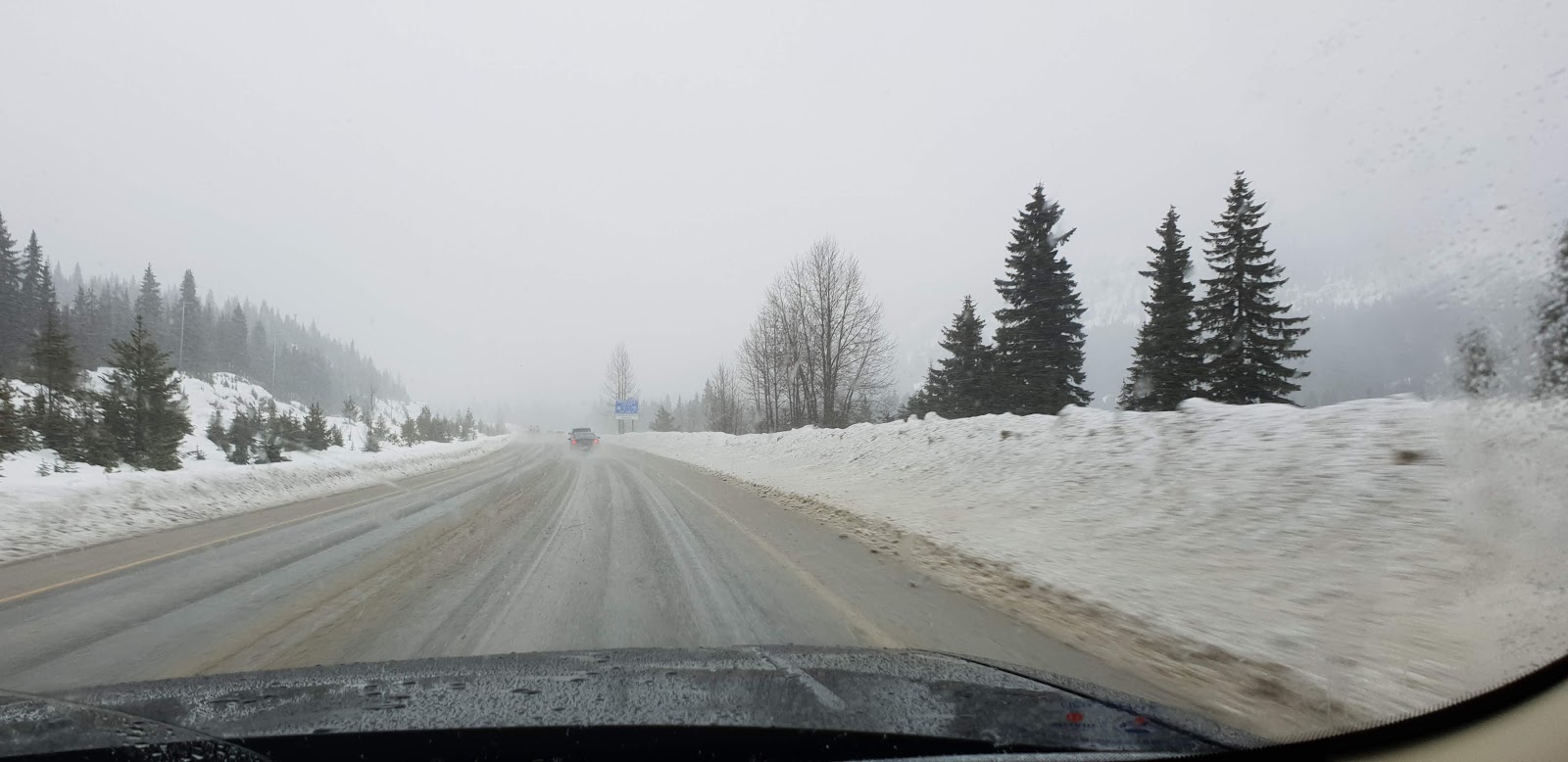
It rains all the way to the top of the mountain, progress hampered from time to time by water sprays from both vehicles and trucks.  The rain is relentless.  At the top of the mountain, the rain turns into snow and the road surface to slush.  It’s 0 degrees, but being the afternoon, I was not expecting it to turn to ice very quickly.

On the other side of the mountain, closer to Kamloops, there was sleet, then rain, then nothing, the last 100kms or so, in reasonably dry conditions.

Outside Kamloops, and in the town itself, there was evidence of snow recently cleared, and slushy roads.  Cars in various places were covered in snow, indicating the most recent falls had been the night before.

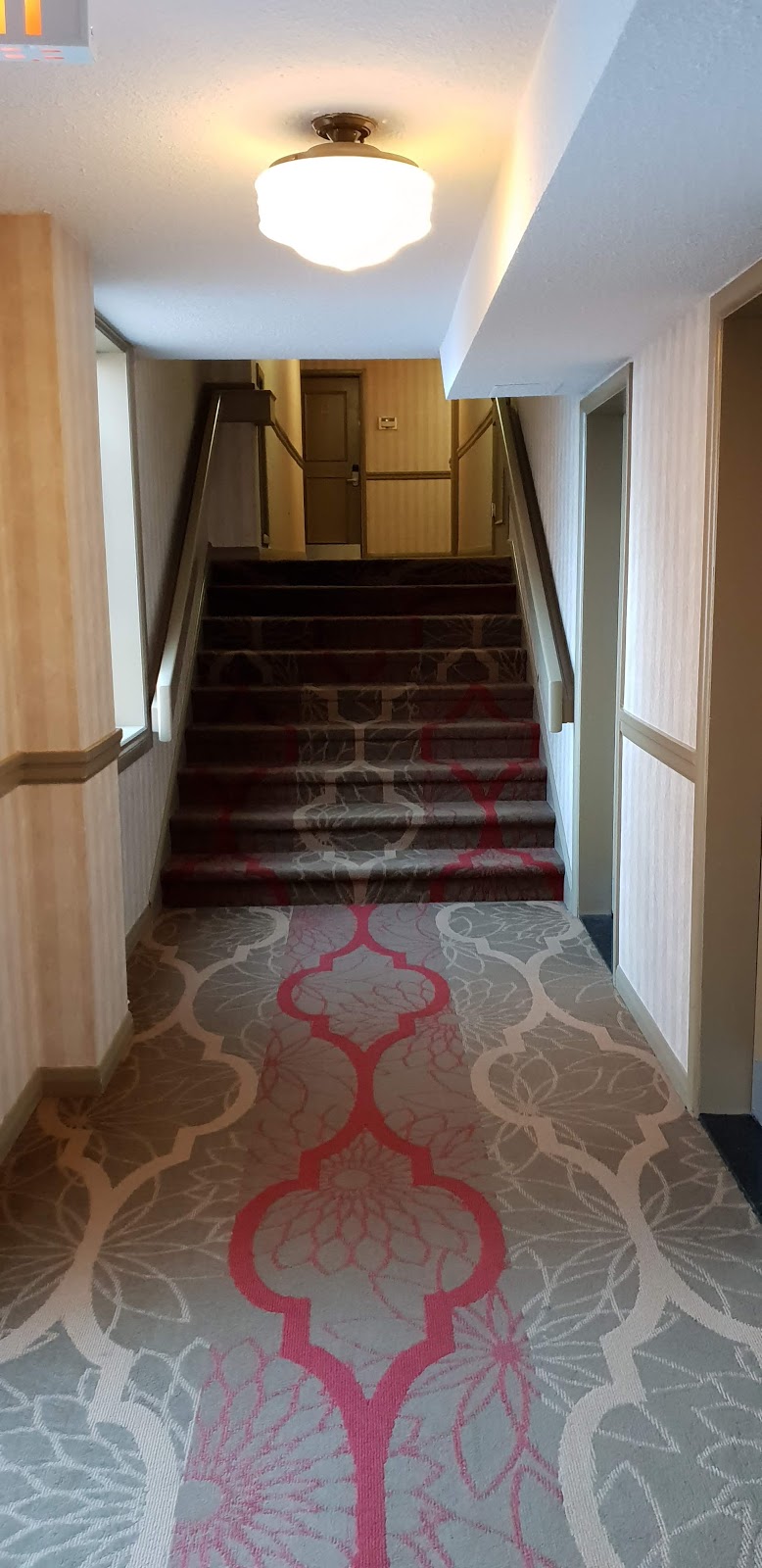
We’re staying at the Park Hotel, a heritage building, apparently built in the later 1920s.  In the style of the time, it is a little like a rabbit warren with passages turning off in a number of directions, and showing it is spread across a number of different buildings.

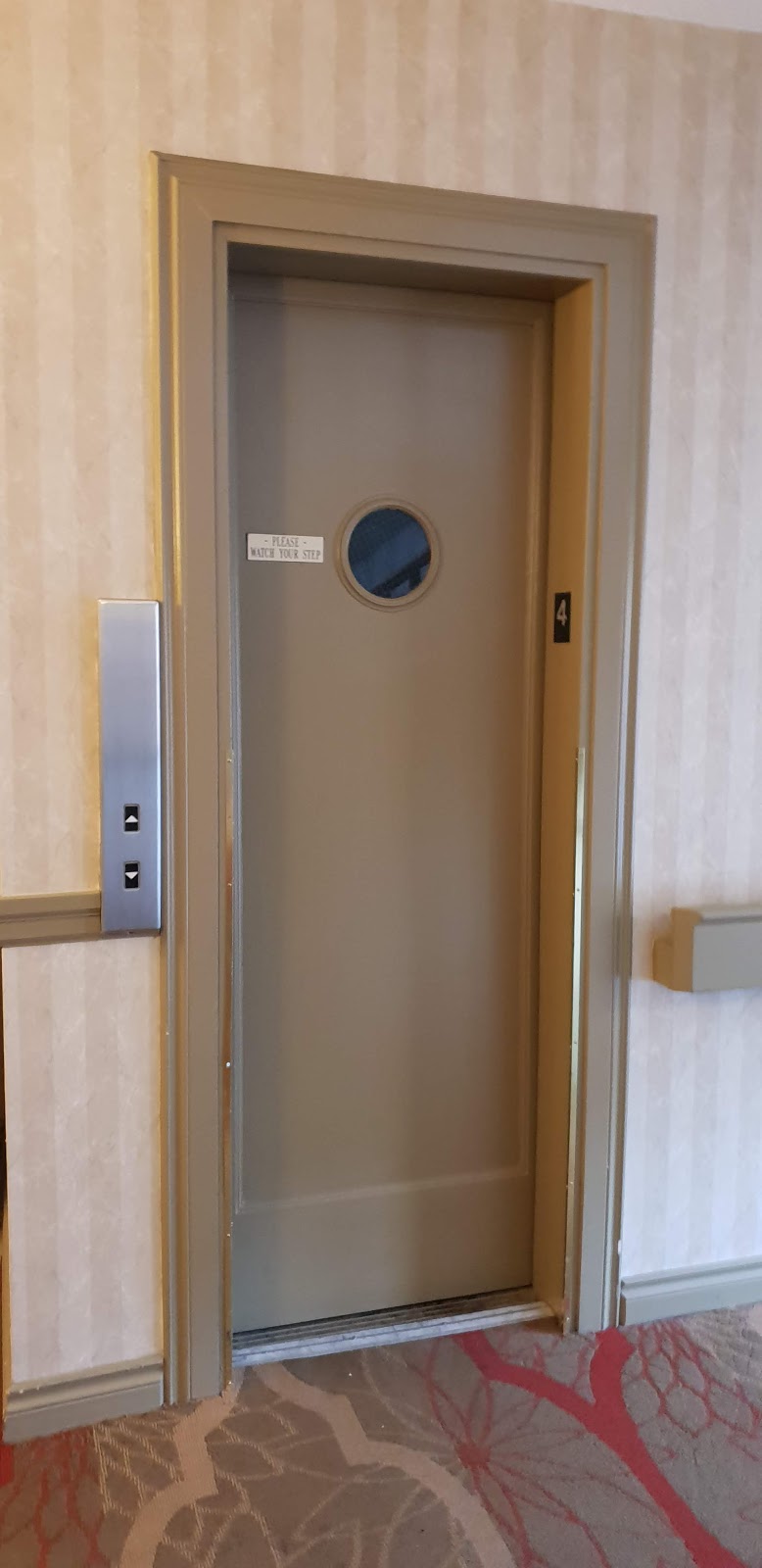
It has the original Otis elevator that can take a maximum of four passengers, and a sign on the wall that says “no horseplay inside the elevator” which is a rather interesting expression that only someone of my vintage would understand.  And, for those without a sense of humor, you definitely couldn’t fit a horse in it to play with.

The thing is, how do you find a balance between keeping the old world charm with modern-day expectations.  You can’t.  Some hotels try valiantly to get that balance.  Here, it is simply old world charm, which I guess we should be grateful for because sooner rather than later it’s going to disappear forever.

In my writer’s mind, given the importance of the railways, this was probably a thriving place for travelers, and once upon a time, there were a lot more hotels like this one.