A lot of writers, particularly those who write murder mysteries or conspiracies, used to be either law enforcement or journalists.
A lot of writers have a background in journalism like I have. Some work for major newspapers or did, and after the first bestseller retired to write more.
But reading newspaper accounts of events, no matter what the subject, somehow takes on the persona of a good story. It has to if it wants to engage the reader.
There are elements of truth, there are elements of conjecture, and all the while you have to wonder, can this all possibly be true?
What’s that old journalistic adage my editor once told me? Never let the truth get in the way of a good story.
My aspirations of a Pulitzer prize died right there.
Perhaps it’s true.
But for just one minute, let’s examine a possibility or two about the news. Does it depend on the journalist’s personal feelings, or if not, the view of the editorial staff, who sometimes rewrite a piece to suit a certain editorial slant?
Let’s say we don’t like the current President. Nothing that is written will be positive, though it will generally stick to the facts, and make them work towards a particular end.
Let’s say we like the current President, and what he’s doing. We will take the facts and write a glowing piece about all the good he is doing. There is no doubt that the story will ignore certain facts that might seem detrimental.
But that works for both sides of the fence. No one seems to want to sit on the fence.
I once watched a show called Braindead when alien ants from outer space came to earth and started eating parts of brains. It happened to be in Washington, it happened to eat politicians brains, and it exacerbated the animosity between the Democrats and the Republicans. It was very funny, but who knew it was dead right about the parties, and it’s leaders, brains half eaten or not.
They should air it again in this current political brinkmanship climate to show everyone just how Washington politics works, or in reality, doesn’t work.
Then there’s fake news. What is fake news exactly?
Using the wrong facts? Painting a white sheep black? Or just reporting one side of the story?
As a writer, I now view the newspapers as the number one resource for finding plots, conspiracies, and just plain oddities, mainly because the truth, if it is the truth, really is stranger than fiction.
**Please don’t assume that you have to, nor would I ever expect you to, read any or all of these books. You don’t.**
Everyone, it seems, will publish what they call the top 100 books that you should read. Some are voted on, some belong to the opinion of the editor of the book review section of a newspaper, and, as you know, there are a lot of newspapers, a lot of editors, and a lot of opinions.
I’m not a newspaper, I’m not an editor, but I have a list, based on personal experience, and many, many years of reading.
It’s in no particular order.
41. The Hound of the Baskervilles by Sir Arthur Conan Doyle, as well as a host of other Sherlock Holmes stories
42. The Secret Agent by Joseph Conrad, one of Conrad’s later political novels, set in London in 1886 and deals with anarchism and espionage. In those days spies were called anarchists.
43. The Ipcress File by Len Deighton, introducing us to Harry Palmer, who was personified by Michael Caine and led to Horse Under Water, and Funeral in Berlin. More of Len Deighton later on in the list
44. The Remorseful Day by Colin Dexter introducing the somewhat enigmatic detective, Morse, his first name not revealed for a long time but oddly, Endeavour. John Thaw brought him to life
45. Crime and Punishment by Fyodor Dostoevsky, hard to pronounce and even harder to read, but perhaps worth it in the end. By the time I read this I was wishing for a Russian writer had could use an economy of words
46. Dr. Zhivago by Boris Pasternak wasn’t it. A vast and lengthy dissertation on lost love, I felt very sad for Zhivago in the end. I saw a stage play of the same name, and I’m sorry, but it’s a few hours of my life I will never get back
47. Casino Royale, the first of the James Bond novels by Ian Fleming. I have to say these are among my favorite spy books. I must say I preferred the new James Bond in Casino Royale, though Sean Connery still rules!
48. The Day of the Jackal by Frederick Forsythe, a fascinating story about an assassin
49. Anything written by John Le Carre, but in particular, the George Smiley collection. Finally unmasking his nemesis the Russian spymaster made it all so satisfying.
50. The Bourne Identity by Robert Ludlam, inspiring a long series by both Ludlam and Eric Lustbader makes entertaining reading, but the first, the man who did not know who or what he really was, was excellent. Matt Damon didn’t harm his persona either.
51. Murder Must Advertise by Dorothy Sayers, whose detective is Lord Peter Whimsey, a 1933 mystery novel that’s eighth in the series
52. Gorky Park by Martin Cruz Smith. You have to admit that his Russian detective Arkady Renko is up against it when his investigation goes in a direction that uncovers corruption and dishonest in his superiors
53. The Way of All Flesh by Samuel Butler, a semi-autobiographical novel written between 1987 and 1884, and published in 1903. The story of the Pontifex family.
54. Howards End by E. M. Forster, first published in 1910, is an interesting insight into the behavior of the, and between the classes, with the Schlegels acting as the catalyst.
55. Washington Square by Henry James, originally published as a serial, and covers the conflict between daughter and father. I must say I prefer The Ambassadors to Washington Square.
56. Ulysses by James Joyce, a day in the life of an ordinary man, Leopold Bloom, why could it not be the 7th June rather than the 16th, for obvious reasons
57. The Go-Between by L. P. Hartley is a view of society at the end of the Victorian period through the eyes of a young boy. I read this while still at school and had no clue why, but later, when I read it again, I understood the meaning
58. Atonement by Ian McEwan, I saw the film and then read the book. Never a good idea. Basically, a young girl makes a bad mistake and tries to atone for it.
59. Gone With The Wind by Margaret Mitchell, the War and Peace of Americal novels, and as long by comparison. The only book written by Mitchell, and the second most read book by Americans. The film was interesting but awfully long.
60. The English Patient by Michael Ondaatje, with a man with severe burns and the effect he had on three others. Colin Firth is villain one day and hero the next, this time in the cinematic version, an out and out cad.
Every time I close my eyes, I see something different.
I’d like to think the cinema of my dreams is playing a double feature but it’s a bit like a comedy cartoon night on Fox.
But these dreams are nothing to laugh about.
Once again there’s a new installment of an old feature, and we’re back on the treasure hunt.
For a thug like Alex to actually have something that resembled a good idea, perhaps it was more the people he surrounded himself with that made him look clever.
Boggs had not mentioned anything about the people who owned the land before the Naval yard had been constructed. Perhaps he had maps dating back to then, or maybe he didn’t. Boggs didn’t exactly confide in me everything he knew.
Maybe he didn’t trust me.
But there was a new lead now, courtesy of Alex, and it was one that I was going to chase down and bring it to Boggs at the appropriate time.
I need to find information about the Ormiston family, and whether or not there were any descendants in the area. But first, I would have to go to the library and talk to the ‘old biddy’, Gwendoline Frobisher, Gwen to her friends. Fortunately, I knew her well from the days of studying in the library.
And on some of my free days, helped her out with cataloging and returning books to their shelf positions. She only had one helper then, and she was older the Gwen, and not a lot of help putting books back on the higher shelves.
The rest of my shift was uneventful, and I closed and locked the door at precisely 11 pm. On the way to where I left my bicycle, my cell phone rang. Boggs? He knew when I finished, and how punctual I was when leaving.
I looked at the screen. Private Number.
I was going to ignore it, but, in the end, curiosity got the better of me.
“Yes?”
“Smidge?”
Nadia. What was she calling me for at this hour of the night?
“I told you not to call me Smidge.”
“Sorry, a force of habit. It sort of suits you though.”
“Then I’m hanging up.”
I went to press the disconnect button, but I could hear her saying, ‘don’t do that, I have some news.”
I waited a few seconds before I answered, “What news.”
“Not the sort you talk of over the phone.”
But it is the sort of hook someone would use to lure you to a place where Vince could beat you up. She had done it before.
“Not if it’s a trap. Sorry, but too many bad memories of your treachery, Nadia.”
“It’s not like that, now. You know what I think of Vince these days.”
“I know how you’d like me to think you think of Vince, but that could be all show. You are, after all, a Cossatino, and you can’t change those spots.”
“I can, and I have. Promise. Meet me at the hotel.”
“Now?”
“It’s not as if anyone’s going to notice, and, if they do, you can guess what they’ll be thinking.”
I sighed. It was giving me a headache. “Half an hour,” I said, and disconnected the call.
Half of me was saying not to go, the other half was intrigued, not so much for the news, but visiting Nadia in the middle of the night. Many years ago, I used have dreams about Nadia, not ones that were spoken of out loud. Now I had the chance to fulfill one; not so sure.
Near to midnight, everyone should be in bed, everyone except those staying at the hotel. Lights we on in several of the rooms, and a customer was in the office.
I parked the bike near the office and walked quickly to her room, knocked on the door lightly, and braced myself for the ‘surprise’, Vince waiting for me.
She opened the door and I looked over her shoulder. It looked empty but there was a lot of space I couldn’t see from that position.
“There’s no one here.” She grabbed me by the shoulder and dragged me in, looked up and down the corridor, then closed the door.
I quickly checked the bathroom. Clothes hanging from the shower rail, a very messy room. My impression of her was shattered.
“You see anything interesting in there?”
I assumed she was referring to the underwear. There might have been a momentary stray thought, but it was not one I’d admit to.
And in her dressing gown, it was hard to suppress the shive down my spine.
I sat on the end of the unmade bed. An odd thought, didn’t she let the housemaids in to tidy up, or, had she spent all day in bed? Scrub those thoughts.
“What is this news?”
“What were you doing at the mall?”
Was that Nadia in the yellow? I glanced around her room and then my eyes rested for a second on a yellow jacked tossed in a corner on the floor. Damn.
“What mall? I tried to sound convincingly surprised.
“You know what mall. You were with Boggs. What were you two up to?”
“I thought you had news for me?”
“I have. Stay away from that place. Otherwise, you might get buried there. That’s the Benderby’s torture chamber, and where they bury the evidence of their crimes.”
“Those are only rumors.”
“Not according to Vince. He reckons he’s seen a body there.”
“Perhaps he was mistaking it for a dressed mannequin. Even I’ve seen that.”
“You’re a fool. Don’t keep following that Boggs around like his little lap dog. He’s eventually going to get you into a mess you can’t get out of. There’s a lot of his father in him. Doesn’t know when to let it go.”
“This coming from Vince or you, because it sure sounds like Vince trying to put us of the scent.”
“What do you think happened to that archaeologist they found on Rico’s boat?”
“Well, my first thought was the Benderby’s did for him. As far as I can tell, the Benderby’s got him to verify the provenance of the gold coins they found on the ocean bed.”
“You mean the two surfers?”
“The Benderby’s bought them off them.”
“You mean the Benderby’s paid them, then two days later they turn up in a dive hotel having overdosed on heroin and not a cent to their names? That event was not widely known because Benderby bought off the reporter for the local paper.
“If you know about it, why did the Cossatino’s make some noise?”
“Because it was their heroin.”
This was terrifying, to be caught between a turf war with either side willing to stitch up the other, for points, or for their silence. Boggs and I were two small fish in a very smelly pond, with no chance at outwitting these two.
It is sometimes quite trashy and that’s saying something!
Having been a journalist in a previous lifetime, and one that always believed that the truth mattered, it didn’t take long to realize that journalists should never let the truth get in the way of a good story.
Newspapers, and all other forms of media, will only write what they believe will sell, or what they think the public wants to read. The truth, sadly, is not the first thing on the reader’s mind, only that someone is to blame for something they have no control over, and it doesn’t matter who.
And the more outlandish the situation, the more the public will buy into it.
This, I guess, is why we like reading about celebrities and royalty, not for the good they might do, but the fact they stumble and make mistakes, and that somehow makes us feel better about ourselves.
Similarly, if the media can beat up a subject, like the corona-virus, and make it worse than it is, then people will lap up the continuing saga, as it relates to them, and will take one of two stances, that they believe the horror of it, and do as they’re asked, or disbelieve it because nothing can be that bad, and ignore it and the consequences of disobedience. knowing the government will not press too hard against the non-compliers simply because of democracy issues it will stir up.
That is, then the media will get a hold of this angle and push it, and people will start to think disobedience is a good thing, not a bad one.
So, our problems of trying to get a fair and balanced look at what the coronavirus is all about is nigh on impossible. We are continuously bombarded with both right and wrong information, and the trouble is, both sides are very plausibly supported by facts.
And that’s the next problem we have in reporting. We can get facts to prove anything we want. It’s called the use and abuse of statistics and was an interesting part of the journalism degree I studied for. We were told all about statistics, good and bad, and using them to prove the veracity of our piece.
I remember writing a piece for the tutor extolling the virtues of a particular person who was probably the worst human since Vlad the Impaler, using only the facts that suited my narrative. I also remember the bollocking he gave me for doing so but had to acknowledge that sometimes that would happen.
The integrity of reporting only went as far as the editor, and if the editor hated something, you had to hate it too. This is infamously covered in various texts where newspaper publishers pick sides and can influence elections, and governments. It still happens.
So, the bottom line is, when I’m reading an article in the media, I always take it with a grain of salt, and do my own fact-checking, remembering, of course, not just to fact check to prove the bias one way of the other, but then get a sense of balance.
We have state elections coming up where I live, but it does not sink to the personal sniping level as it does in the US, we haven’t sunk that low yet, but we haven’t got past the sniping about all the wrongs and failed promises of the government of the day, or the endless tirade against the opposition and how bad a job they did when they were previously in government.
You can see, no one is talking about what they’re going to do for us, no one is telling us what their policies are. It’s simply schoolyard tit for tat garbage speak. What happened to the town hall meeting, a long and winding speech encompassing the policies, what the government plans to do for its people in the next three years, and then genuinely answering questions?
Perhaps we should ban campaigning, and just get each party to write a book about what they intend to do, and keep them away from the papers, the TV, and any other form of media, in other words, don’t let them speak!
And don’t get me started about the drivel they speak in the parliament. Five-year-olds could do a better job.
Don’t get me wrong, I loved my brothers and sister, but I can now only take them in small doses.
You know how it is growing up, always fighting for your own space, having to live with their idiosyncrasies, getting blamed for stuff you never did.
I never got to have a room of my own, always sharing with the other middle brother, James, whereas the eldest brother had his own room, and by necessity, our youngest sister.
They too got the first-class education where James and I were shuffled off to trade school, which James always said was a hop, step and jump from prison.
Coincidentally, James and I were the first to leave home as soon as it was possible. WE had to earn a living and pay rent, whereas the other two were being nurtured through school, and life.
It was the school of hard knocks for us.
…
Over the years we all drifted in and out of each other’s lives. We also drifted, at one time or another all over the world, and later, all over the country.
Because of this, only seminal events brought us back together, and even then, those moments were few and fleeting, and not looked upon with fondness. We were not the typical family.
When the time came for each to marry, at varying times of our lives, each would be there at the event. Keeping up with each other was a task for social media, and there we learned of children, divorces, affairs, and disasters.
But there was one defining event that finally shook up our collective trees of life; the death of our parents. Whilst none of the children were particularly close, it seemed to fall upon Janine, the daughter, to look after them.
And, when they were killed unexpectedly in a car crash, it was she who delivered the bad news, and issue the invitation to return home for the funerals.
It was sad, yes, but not as much as it should be for a child. For me, I had spent years hating them for perceived wrongs perpetrated, not getting the same treatment as eldest and youngest siblings, not getting the financial support when requested, and not getting a visit, even if it was only once a year.
So, when I read about their deaths, it saddened me, but I hadn’t seen them for a half dozen years, and had almost forgotten they existed. Yes, I should have made more of an effort to go see them, introduce them to their grandchildren, but I didn’t.
…
It was a completely different situation with Sally’s parents. There were a close-knit family who, whilst also had the monetary and space constraints as we had, and with more members of the family to contend with, they seemed to make it work without fear or favouritism.
She had only recently met each of my siblings in person, simply because of the fact we were getting older, and reasons for coming together more urgent, well, for the others, anyway. And that Sally had put her foot down and demanded we make an effort to see them.
“So, you are going to the funeral, all of us this time I hope.” I had just shown her the missive sent by my sister, Janine, proclaiming the sad news, not being surprised yet again at the coldness that ran between the members of my family.
She had been disappointed at my indifference, even when I explained the circumstances, and how that coldness had begun and festered throughout our lives. For one who had never been in that situation, it was hard to explain, or understand. Not when comparing it to her own situation.
“If you want.” I was going to make the excuse that my work would not allow the time off, but that would only be because of me, not them. I had used it before, and Sally had realised eventually what I was doing. It wouldn’t work this time.
“We should. They were, after all, your parents, and like it or not, they did give you your start in life. I’ve no doubt they did the best they could.”
Sally always saw the best in people, though with my parents, they did leave her somewhat perplexed at times. The same went for Jeremy, the eldest brother, and his indifference. He was our father reincarnated, and his wife, Lucy, was very much like our mother, perpetually suffering from disdain.
“You had to be there,” was all I would say in my defence.
It was a statement I used often to explain away their indifference. I wanted to believe they had done the best they could, but they could have done better. I hesitate to use the word selfish, but they had been, putting their needs before us.
Even in death, I could still feel the resentment.
“Do you want me to make the arrangements?” She always did, and if she had not, perhaps she might never meet my parents, or my brothers and sister.
“That might be best. You know what I’m like.”
I didn’t hear her reply, but I knew what it would be. A frown and muttering under her breath. She knew what I was like, and still married me, much to the disdain of my eldest brother, Jeremy, who had said to her, a day before the wedding, she still had time to change her mind.
He hadn’t endeared himself that day, or any of the days since.
…
For Alison and Ben, the two children that were never going to be anything like my siblings, it was an adventure. We rarely travelled far from home for holidays. Preferring to spend it with Sally’s parents at their summer house, big enough to fit everyone, what I would have called a boarding house. It was near a lake and was the closest thing to a summer camp as I would get.
Going over in the plane, Sally had banished me to an aisle seat one row behind them. I suspect that was to give me some mental preparation time, but more likely to consider the lecture she’d given me at the airport about me being more proactive in being nice to my family.
It was time to stop playing the forgotten child routine, and to start behaving like I had a family and simply accept them despite their idiosyncrasies. She was right, of course, as she always was, and todays, of all days, it made me wonder what is was she saw in me.
Off the plane, the first surprise was waiting in arrivals. Sally. Holding a sign much like a chauffeur would. Apparently, she had arranged transport. The second surprise was Sally and Janine together, like they were old friends. I was guessing Sally and Janine had had long conversations over the funeral arrangements.
She also liked Janine, even though she lived in a different world. Janine had never married, had a job that paid squillions of dollars, and lived in a mansion, one my children described as a castle, it had so many rooms.
Then, after the hugs, and the smiles, she saw me, the wet blanket.
“Tom.”
“Janine.”
“You can give me a hug you know.”
I could feel Sally’s eyes burning a hole in me. Hug it was. It was a first, and oddly, rather than consider it was waste of time, it gave me a strange set of emotions.
Then the moment passed.
“You look well.”
“That you can thank Sally for. Left to my own devices, I’d probably be a basket case now.”
“Who’s to say you not, still.” Sally gave me the critical eye, and it was a warning shot across the bows. Behave or else.
We followed Janine out of the terminal building to a parking lot where limousines were parked. She had got us a stretched limousine. Wherever we were going, it was going to be in style.
Sally told me at some point that when she had suggested we stay in a hotel, Janine would not hear of it. She said she lived in what was tantamount to a mausoleum, and there was plenty of room for us. And the rest of the family.
It seemed that she had been very successful in inventing something that everyone needed, and, when she described it, it made sense. Holding the patent and licensing people to manufacture it had made her very wealthy indeed.
Somehow, I’d missed that aspect of her life, though my impression of her, with her education and cleverness, she earned squillions. I was practically right.
What was also explained to me, because I had remarked on how well Sally and Janine got along, and that couldn’t have developed in the last few days while arranging thw funeral visit, it transpired the two had met once of twice when Sally was over this side of the country for seminars, and the two regularly emailed each other.
No sense, Sally said, for her to shun my sister as I had.
Once it might had annoyed me that she would do something like that, but it made sense that Sally would want to know Janine, at the very least, better despite how I painted her. She may have tried with the other two, but I knew Jeremy would strike out the first time she spoke to him, and James was hard enough for anyone to find, let alone his family. I’d tried, and he had disappeared. Not even Janine knew, at that moment in time, where he was.
Jeremy, unfortunately, we would see later.
It was also apparent that once we reached the mausoleum, that I was supposed to go and have a chat with Janine, family stuff she said, and Sally was happy to move into, and unpack, then get the cook to make the children a meal.
…
We went into a room that Janine called her office.
It was a large wood panelled room with a lot of shelving and a huge number of books. My only remark, that she could not have read them all. It was a little churlish and elicited a grimace.
Janine was not going to put up with my nonsense and was well aware of my attitude from discussions with Sally. It led to her first statement, soon after we sat in very comfortable leather chairs, in front of a window that looked out over a rose garden.
I was counting staff by then, a housekeeper, a cook, a young woman who was there as a waitress, a maid who showed Sally and the children to their rooms upstairs, and outside two gardeners. It was no surprise then the limousine was hers, and the man who drove it, ger chauffeur.
She lived a very different lifestyle than I did.
“I can see that look on your face where you are judging me, and you shouldn’t. You might think you were badly done by, but I’ll let you into a secret, you got the better deal. Not that I’ll defend Jeremy, but in my case, I had a hell of a lot of expectation dumped on my shoulders. You got to swan off and live your life without a care in the world, and I can see you have made all the right decisions, and got everything I could only have hoped for. I have no husband, nor boyfriend, and any I did didn’t last long because my focus was on work and success, instead of happiness. So, yes I have a big house and a lot of money, and people running around doing my bidding, but I have no one to share it with, and no one to pass it onto.”
“Yet.” It was a noble speech, and I’m sure she felt the loneliness of it all. I was going to say she had a choice, just as I had, but somehow it didn’t seem appropriate.
Certainly, I didn’t feel the same way about her as I had before I came of this odyssey, and that in itself may for some be something of a revelation. That hug she had given me at the airport, and the feelings it conveys almost confused me, and most likely would have frightened me if I had not had Sally.
For some reason, now, it was going to be impossible to have the same feelings, or feelings of resentment, I once had.
“There are things you need to know, Tom. The first is that I am not long for this earth. I have about a year, two at the most, the news of which I received about an hour after the police called to tell my our parents had been killed in a car crash.”
“I’m sorry to hear that.”
It was bad news for anyone to learn, but on top of the news of our parents, I couldn’t imagine what that was like.
“The second is that our mother had been diagnosed with the same condition, about two years ago, and didn’t tell anyone. Maybe she thought she was protecting me from the possibility it would happen to me, but we both know she was selfish and inconsiderate at the best of times. Believe me when I tell you we had some incredible rows over the years. And no, I was not a daddy’s girl so I got no support or help in dealing with her truculence.”
I could just imagine our mother giving Janine hell. And in that same thought, how sad it was to have saddled Janine with all of that responsibility. I knew Jeremy hadn’t been any sort of help in regard to both parents, and James was not to be found. I really had no excuse, and I had to admit that some of my father’s selfishness had rubbed off on me too.
“You should have told me, or told Sally to tell me.”
“You would not have been in a receptive frame of mind, not then. But now, I can see you’ve turned a corner, just being here. You could have declined to come, I know now of the hurt our mother and father in particular had inflicted on both you and James, because in their declining years, they eventually turned on both Jeremy and I. Jeremy didn’t cope very well, and did what you did, just went away, leaving me to deal with it. I’m not blaming you, not do I blame you for leaving, I truly understand why. It’s just a pity we didn’t have conversation years ago, because now we’re going to miss on so much in the little time we do have.”
The pity of it was there was nothing I could do now to get that back. But going forward, I was not sure what I could do to make it up to her. And I said as much, and it sounded a lot better in my head than out loud.
“Well, there is something you can do. It’s a funny story, though I believe you will not get a laugh out of it. The third thing is that I am the executor of their wills. Against my advice, and probably something our mother was not fully cognisant of, was a desire for my father to take her on one last road trip. The doctors had decreed due to her worsening condition she would have to go into managed care. He took her to Las Vegas, of all places. The thing is the day they left, mother decided to play this jackpot poker machine, and won the jackpot. I didn’t discover this until the Casino rang me, though how they got my phone number is still a mystery, to tell they hadn’t cashed the check. They were on the road out of Vegas when a truck hit them head on. It wasn’t really an accident, according to the police. They said the truck driver said our father had driven straight at him. I have no reason to disbelieve him.
“He deliberately wanted them both to die?”
“Yes. He had said more than once that he didn’t want to live without her, so I think it was his plan to spend a few days together while she was still cognizant, and then end it. I have no doubt she knew what he was planning to do, and had agreed it was the best way to end the pain and suffering.”
It certainly sounded something he would do. They never regarded the feelings of anyone else in any of the decisions they made. I was going to make a comment, but it seemed moot. They were dead now, and they had gone out on their own terms.
“The truck driver?” I had to spare a thought for him, because they would not have.
“Relatively unharmed, just shaken. And the shock that someone would do that. I met him and apologised, but it seemed not enough recompense for the suffering they caused him. Anyway, I asked the police if they had found a check in the remnants of the car, but given the state of it, it was not surprising they didn’t so I asked the casino to cancel it and write a new one.”
She reached out and picked up a folder on the table between he chairs, and took out a slip of paper and handed it to me.
A check made out to our parents.
For eighty-seven million dollars, and change.
I looked at her, quite literally astonished. “This is ridiculous.”
“What it is, is a sign from the heavens that will give me an opportunity I might not have been granted otherwise. I want you to come home, and spend the last months of my life here with me, and make up for the time we have lost. I know both you and Sally have jobs back home, but that check, your share of it, will make the decision a little easier to make.”
“Does Sally know about this?”
“Only that I’m going to die sooner rather than later, and that she was waiting until you came here before talking to you about what to do. She said it would be better coming from me, not her, because of how things are in the family. I’ll be honest with you, Tom, I was prepared to come to you to plead my case before our parents did what they did because there’s no one else I would want to spend what precious little time I have left.”
I knew now why I’d felt such intense feelings earlier at the airport. It had been a sixth sense, that something was terribly wrong. And she was right, what time she had should be spent with family, those values I had come to terms with being with Sally. It was the right thing to do, but it was not wholly my decision. There were ramifications of uprooting our lives back home, including the sacrifices Sally would have to make.
“Have you told Jeremy?”
“God, no. He’d be a total ass about it, saying I was trying to steal the limelight and making it all about me. We can tell him when it’s too late for him to make any comment at all.”
“And James?”
“We’ll find him. I have resources available that you can only imagine exist.”
I believed her.
“Then I guess I should go and find Sally and see what she has to say about it. And I guess I should apologise for being such an ass all these years.”
“No need. In a way I envy you, always have.”
“You have no reason to. I never made anything of myself, not like you have.”
“You’re wrong if you think that. You have an amazing partner, two beautiful children, and you have provided for them, and look after them in a manner in which I can only dream about. It’s not about money, or possessions, or anything like what you see I have, because when it comes down to it, all that matters is the people around you. That, unfortunately, was the legacy our parents gave us and it was wrong.”
She stood, “Let us not dwell on the past, but brace ourselves for the impending crash landing of the one and only Jeremy. I have some very good champagne chilling at the bar, and we’re going to need fortification, if not Dutch courage before the monster arrives.”
There’s nothing more certain that a favourite web site you go to and use often, sooner or later starts charging a subscription ‘fee’.
I remember when the NANOWRIMO site had been updated, and the changes look good. At that moment the site was free, but you do get a lot of emails and requests to purchase products, which I think is a reasonable way to raise money for keeping the site free.
But, how long is this going to last before a ‘fee’ is introduced, and then a ‘fee’ to enter your book?
It’s the airline principle, once it was a flat charge for the ticket, now you pay for this tax, that tax, fuel tax, baggage tax, tax on the tax, and then if that’s not enough, a charge for the food and water. Soon it will be a charge for toilets, and then the air you breathe.
It’s inevitable, and once these charges start they don’t stop and only get higher with each passing year.
A lot of the sites I use are free. Some have since started to charge and have put up a firewall to stop you getting any free information.
I’m not a rich author, so sadly I have to discontinue using these sites.
Perhaps the problem is that the owner of the site has come up with a good idea, thousands of people sign up, and suddenly a small web site becomes a big one, and hosting costs suddenly go through the roof.
Like airlines, it’s the user that pays.
Often I see or get an email from, various people with what looks to be a useful site. Some start out by giving you a month free to have a look and use the facilities. In some cases they are quite good, in other, well, there’s a dozen others like it that are still free.
But, after a month, you have to pay. What gets me with some of them, they are asking somewhere between 50 and 100 US dollars a month, you heard that right, a month, which you can basically double that for me after the exchange rate and a dozen bank fees.
Sometimes there are different levels, but basically, if you look at the fine print, the lowest level set, which gives you very little, is set low deliberately. Say it’s 10 dollars a month. It’s no different to the free version except they probably don’t have annoying ads and advertise, what for many, is non-existent 24/7 help (via an email, no guarantee they look at it more than once a week, if at all). Money for jam for the site owner, as the saying goes.
Why can’t there be a more reasonable option?
But I get it. Everyone wants to get rich quick, it’s an objective that’s built into all of us, but it seems I missed the inoculation given the day after you’re born.
I also get it that these people worked hard on coming up with the web sites and facilities, and they deserve a reward for that hard work, but to me it would make more sense if they sold the service for 10 dollars or even 20 dollars a month if the systems were available and they worked. And flowing from that wouldn’t 20,000 sales at 20 dollars, be better than 2000 at a 100 dollars?
The same seems to go for the so-called decent web site hosts, like WordPress, Wix and GoDaddy. The free option is good but just for show and tell, but I’m sure they deliberately nobble it so it’s slow and kludgy just the sort of attributes that turn potential visitors off.
I thought if I paid a monthly charge for Wix, and reading the inclusions for what my site could do over the free one was very persuasive, so I signed up. The site was no better than it was before and half the options that were on the list weren’t available, and still aren’t. But I suspect if I paid them 100 plus dollars a month or more for their premium package I’d get it.
But, to pay for it I would have to be selling a million books a month, and I doubt, no matter how good my web site is, it wouldn’t attract that kind of business.
Not one of the basic packages, read affordable for me, has the ability to allow downloads after sales. You can’t even have a sales page where you can actually sell books to people like you were a bookshop. That’s in all of the premium packages, so they say, and that costs far too much.
GoDaddy were by far the worst, telling me if I signed up to the 60 dollars a month package I could have sales and downloads. I tried to add it to the web page, which I might add was as difficult to create as all hell, and when it didn’t work, rang up to ask why I couldn’t have downloading after sales and was met with silence.
No, that’s not available at the moment, I was told, and not likely in the future. What am I paying all this money for? I don’t have a GoDaddy site any more. I had a Wix site that I paid for, and I don’t have that any more. They don’t offer anything useful, and they too, make it virtually impossible to create a useful site, so it sits out there in the ether with disappointment written all over it.
Perhaps others have had better luck, or things have changed in the last few years but I won’t be going back.
Maybe one day someone might understand the needs of the majority who can afford to pay exorbitant monthly charges but just not as much as we are expected to, for very little in return.
For a story that was conceived during those long boring hours flying in a steel cocoon, striving to keep away the thoughts that the plane and everyone in it could just simply disappear as planes have in the past, it has come a long way.
Whilst I have always had a fascination with what happened during the second world war, not the battles or fighting, but in the more obscure events that took place, I decided to pen my own little sidebar to what was a long and bitter war.
And, so, it continues…
We gathered up what food there was to take with us. There were no weapons left behind. Leonardo had assumed correctly we would have used them if they’d been left there.
Carlo had changed slowly into an automaton, and I guess if I could read his mind, I’d know exactly what he was thinking. Enrico had attached himself to Carlo, and I knew Carlo would look after him.
When I said that the burials would have to wait, Carlo agreed.
We had a short discussion on what we would be doing next, and in the first instance, we would be going back to the other soldiers and the church. There, with both of our knowledge of the castle, its entrances, secret or otherwise, and the internal passageways which I knew Wallace and the others there were not too familiar with, we would formulate a plan to go in and pick them off one by one.
It seemed a good plan when we first talked about it, but on the way back to the church, and I had time to consider how it would work, it seemed we would only get an advantage once, and we would have to kill or capture as many as we could in the first raid.
Then it was going to be difficult.
Unless Carlo knew of more places we could enter the castle without being seen or heard.
I only knew of three.
And the first post we had to hit, and silence, the radio room.
My war had not been as start or as terrifying as most of those whom I’d known or worked with. My part was more selective, finding and eliminating spies, informers, and enemy cells on home territory.
Sometimes that would extend into enemy territory, particularly France where, as one who could speak French fluently, I found myself working with the resistance, using intelligence gathered by a network of spies we had, not only in France but in all parts of enemy territory. That also meant, sometimes, accompanying weapons and other supplies into enemy territory.
It hadn’t included anything like what I’d just seen back at the underground cavern.
I’d been told, often, about the enemy executing whole villages, and large groups as retaliation for resistance operations that killed German soldiers, and particularly officers, but I’d not seen it first-hand.
Now I had.
I’d been told, along with the others who had been at the training camp way back at the start of the war, that we would inevitably see atrocities. Those instructors, men who had survived the first war, were speaking from experience. We were told it would make us angry. It had. I had this immediate thought of doing as much damage as I could to the perpetrators of that massacre.
But we had also been told that we had to harness that anger, and use it to drive our actions, bot in a reckless manner, but with a measured calm and with planning. Blind rage, which had been predicted, would only get us killed.
I had left the cavern at the blind rage stage, but the walk to the church wore some of that off, and I began to piece together the seeds of a plan to get our revenge. We were only a small group, but even so, we could work more efficiently than those at the castle.
Leonardo was not going to tell Wallace that he hadn’t captured or killed me in his ambush, but it might make Wallace think that my ability to retaliate would be weakened. Leonardo would know that Carlo and I were still alive. He would not know about Blinky and his men.
It would be interesting to see if Wallace would commit any of his men to hunt us down, send Leonardo back out to finish the job, or just wait until Meyer turned up. His contact in Gaole would know about the castle’s change of allegiance, but he would not know that Martina was not going to be there to greet them when they arrived in the village.
That was several days away. We would have to be there, but it was going to be dangerous unless we found a way to neutralize the castle. So far, in my head, we’d neutralized the radio and got as far as the dungeons before meeting enemy resistance.
The same had happened in the next six scenarios, after playing out the last we had arrived back at the church.
Chiara was resting as comfortably as the Sergeant could make her.
He had made a more thorough assessment of her injuries, and aside for the severe beating, she had sustained a few cracked ribs and several broken fingers. The broken fingers were a surprise. The sergeant had reset them as best he could.
Other than that, she would recover physically. Mentally, he said, would be something else. She was lucky, he said, her torturer was an amateur, and Italian. Had it been the German Gestapo, she would be dead.
She was lucid and I told her we would make Leonardo pay for what he’d done. I thought it best not to tell her about what had happened back at the cavern. She had enough on her conscience without adding the senseless deaths of the villagers.
Then we had a meeting, where I asked Carlo to draw a plan of the castle and the places where we could breach their defenses and give us an element of surprise.
He had one that I hadn’t known about, one that might give us a fighting chance.
For the first time on this trip, we encounter problems with Chinese officialdom at the railway station, though we were warned that this might occur.
We had a major problem with the security staff when they pulled everyone over with aerosols and confiscated them. We lost styling mousse, others lost hair spray, and the men, their shaving cream. But, to her credit, the tour guide did warn us they were stricter here, but her suggestion to be angry they were taking our stuff was probably not the right thing to do.
As with previous train bookings, the Chinese method of placing people in seats didn’t quite manage to keep couples traveling together, together on the train. It was an odd peculiarity which few of the passengers understood, nor did they conform, swapping seat allocations.
This train ride did not seem the same as the last two and I don’t think we had the same type of high-speed train type that we had for the last two. The carriages were different, there was only one toilet per carriage, and I don’t think we were going as fast.
But aside from that, we had 753 kilometers to travel with six stops before ours, two of which were very large cities, and then our stop, about four and a half hours later. With two minutes this time, to get the baggage off the team managed it in 40 seconds, a new record.
After slight disorientation getting off the train, we locate our guide, easily ground by looking for the Trip-A-Deal flag. From there it’s a matter of getting into our respective groups and finding the bus.
As usual, the trip to the hotel was a long one, but we were traveling through a much brighter, and well lit, city.
As for our guide, we have him from now until the end of the tour. There are no more train rides, we will be taking the bus from city to city until we reach Shanghai. Good thing then that the bus is brand new, with that new car smell. Only issue, no USB charging point.
The Snowy Sea hotel.
It is finally a joy to get a room that is nothing short of great. It has a bathroom and thus privacy.
Everyone had to go find a supermarket to purchase replacements for the confiscated items. Luckily there was a huge supermarket just up from the hotel that had everything but the kitchen sink.
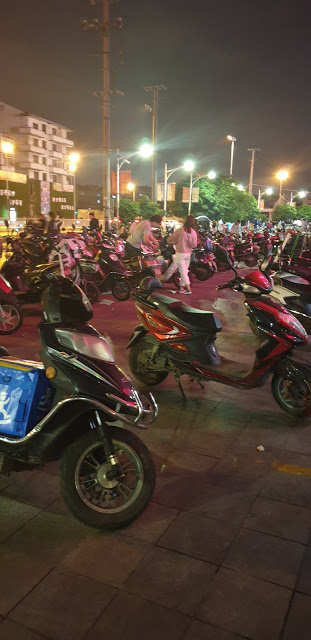
But, unlike where we live, the carpark is more of a scooter park!
It is also a small microcosm of Chinese life for the new more capitalistic oriented Chinese.
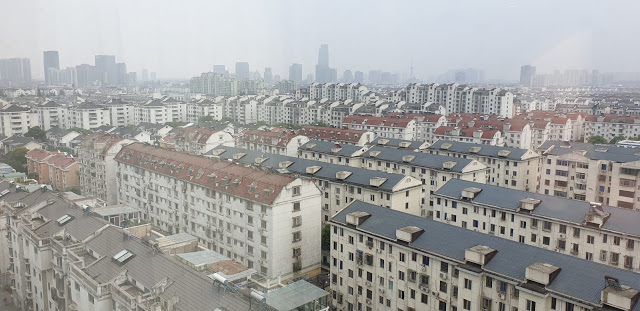
The next morning we get some idea of the scope of high-density living, though here, the buildings are not 30 stories tall, but still just as impressive.
These look like the medium density houses, but to the right of these are much larger buildings
The remarkable thing about this is those buildings stretch as far as the eye can see.
Watching the doors that lead to the consulting rooms is about as exciting as watching pigeons standing on a window ledge.
But…
When you have little else to do while waiting to see the doctor, it can take on new meaning, especially if you don’t want to be like 95% of the others waiting and be on their mobile phones.
What you basically have is a cross-section of people right in front of you, a virtual cornucopia of characters just waiting to stay in your next novel, of course with some minor adjustments. It’s the actions and traits I’m looking for, and since it is a hospital, there’s bound to be some good ones.
It’s a steady drip of patients getting called, and it seems like more are arriving than being seen, and those that are being called have arrived and barely got to sit down, whilst a steady core has been waiting, and waiting, and waiting…
Everyone reacts differently to waiting.
A lady arrives, walking tentatively into the waiting area. It’s reasonably full so the first thing she does is look for a spot where she doesn’t have to sit next to anyone else. I’m the same, nothing worse if you sit next to a talker, and getting their life history.
Or they are reading a broadsheet newspaper. It’s not the aroma of the ink that is annoying you.
Another sits, looking like they’re going to read; they brought a book with them but it sits on her lap. Is she far too worried to be able to concentrate? Or is there something else in the room that compels her attention?
The phone comes out, a quick scan, then it remains in hand. Is she expecting a call or text wishing her luck? It’s not the oncology clinic so she doesn’t have cancer. Hopefully. The fact she brought a book tells me she’s been here before and knows a 9:00 appointment is rarely on time.
As we are discovering.
A couple arrives, maybe a mother and daughter, maybe a patient and her support person. Both of them don’t look very well do it’s a toss-up who is there to see the doctor.
Next is a man who could easily pass as living on the street. It’s probably an injustice to say so, but his appearance is compelling, and I’m not the only one who thinks so.
He sits and the person next to him gets up, apparently looking for something, then moves subtly to another seat. Someone else nearby wrinkles her nose. Two others look in his direction and then whisper to each other. No guesses what the subject is.
More arrive, fewer seats, some are called, but everyone notices, and avoids, the man.
The sign of the door where the stream of patients are going, says no entry staff only, and periodically a staff member comes striding out either purposely or sedately, clutching a piece of all-important paper, the sign of someone who knows where they’re going, on an important mission. Names are being called from this door and various other sections of the room, requiring you to keep one ear open in all directions.
And, to be sure, if you have to go to the restroom, that’s when your name will be called.
It seems all hospitals are branches of the United Nations, medical staff, and particularly doctors, are recruited from all over the world, and it seems to be able to speak understandable English is not one of the mandatory requirements, and sometimes the person calling out the name has a little difficulty with the pronunciation.
Perhaps like the UN, we need interpreters. No, most of the names are recognizable until there is a foreign name that’s unpronounceable, or a person with English as a second language calls an English name. It makes what could be an interminable wait into something more interesting.
And then there are the people who have names that are completely at odds with their nationality. They are lucky enough to have the best of a number of cultures, and perhaps a deeper level of understanding where others do not. I’m reminded never to judge a book by it’s cover.
I start trying to figure out those indecipherable names and then move on to trying to match a name with its owner. I’m zero out fo four so far.
When there is a lull in arrivals and call-ups, there’s the doctor in consult room 2. He’s apparently the doctor with no patients and periodically he comes out to look in his pigeonhole, or just look over the patients waiting, and more importantly checking the door handle when not delivering printouts to the consulting room next door.
He’s a doctor with no patients, get my drift. Well, that joke fell very flat, so, fortunately, he comes out, a piece of paper in hand, and calls a name. His quiet period is over. Someone else will have to look at the door handle.
But we’re still waiting, waiting.
It’s been an hour and four minutes, and a little frustrating. Surely when you check-in they should give you an estimated waiting time, or better still how many patients there are before you.
I guess its time to join the rest and pick up the mobile phone.
The good news, I only got to type one word before my name was called. By a person who could pronounce it correctly.
The story below was the one that was supposed to be published under T, but the month got away from me and I was not able to get most of what I wanted to do done.
After all, it was the A to Z as well as NaNoWriMo for April, and the notion I could write 26 short stories and complete a 50,000 word novel at the same time…
What was I thinking?
Anyway, I had the bones of the story written, I just needed time to finish it. So, here it is, as will for the next few days, stories for U, V, W, X, Y and Z.
…
The email I received said:
“Go to Newark airport, go to the United booking desk and give them your name. Take proof of identity. Pack for five days, light.”
It was going to be, supposedly, a magical mystery tour. I read in a travel magazine, that a company offered five day inclusive trips to anywhere. You do not get the destination, just what to take. Then, just be prepared for anything.
I paid the money and waited, until last evening when the email came.
I was ready.
When I presented my credentials as requested, I found myself going to Venice, Italy, a place I had never been before.
When I looked it up, it said it took about 10 hours to get there with one stop in between. Enough time to read up on the many places to go and see, though according to the instructions, everything had been arranged in advance.
I could also take the time to brush up my schoolboy Italian.
When I got off the plane at Marco Polo airport, in Venice, it was mid-morning, but an hour or so was lost going through immigration and customs. A water taxi was waiting to take me to a hotel where I would receive further instructions. I was hoping it would on or overlooking the Grand Canal.
At the airport I wondered if there was going to be anyone else on this trip, or whether I would be doing it alone. I’d read sometimes likeminded people were put together for a shared experience.
We had to agree and then fill out an extensive profile so they could appropriately match people. Sometimes, people joined at different times along the way, you just never knew what was going to happen.
That random unpredictability was just what I needed having just gone through a breakup after a long period of peacefulness and stability, and frankly, I would not have chosen this type of tour if I had not.
It was a pleasant half hour or so winding our way through the canals, having paid the driver extra to take long route. I’d not been in Venice before, but I had read about it, and while some of the negative comments were true, it didn’t diminish the place in my eyes.
And the hotel, on its own island overlooking the main canal was stylish and elegant, and my room exactly where I’d hoped it would be. I think I spent the next hour just looking out at the city, and the boats going by, like a freeway or turnpike, a never-ending stream of traffic.
A knock on the door interrupted what might have been described as a reverie, by one of the concierge staff delivering an envelope with my name on it.
Perhaps more instructions.
“Tomorrow will be a free day in Venice. See attached suggested itinerary for ideas on what to do. Then, the following day you will be travelling from Venice to Florence by train departing Santa Maria Novella at 10:20 am.”
I looked at the list of suggested places to visit and a day would not be enough, but I could always come back. I’d always assumed this trip would give me some idea of what was on offer, and that if it was great, I could always come back.
A second reading of the instructions picked up something I’d almost missed. A dining party in the hotel where others like myself, with similar arrangements to mine might attend. It was underlined that it was not mandatory to attend, only if you wanted to.
The only provisor was that you do not talk about where you were going, only about yourselves, an opportunity to meet others and not dine alone. It was an interesting idea. All we had to do was give our name and the time of the booking.
I would think about it.
I arrived at the entrance to the restaurant at five minutes to eight, after a long deliberation on the merits of whether I wanted to see the other travellers.
At first, I thought what the point would be if you couldn’t talk about where you were going, but, after more thought, I wondered what it was that motivated those people who had also opted for a leap into the unknown.
These were not adventure holidays as such, just someone else planning the itinerary so you didn’t have to.
I gave the maitre’d my name and he escorted me to a table set for ten, of which four people were already seated. Were they expecting ten? Would anyone not turn up?
We exchanged greetings and I sat. Two men, two women, sitting together. My first thought, two couples, but I would not make any assumptions.
One of the women spoke first, “My name is Marina Delosa. I assume you are another intrepid traveller?”
“Ben Davis. I’m not so sure about the intrepid part, just lazy, I think, because I’m not very good at arranging my own travel.”
“I think you might say that applies to all of us,” she said.
The others introduced themselves as Angela and Harry Benson, and David Wilson.
“We were quite pleased they chose to start our tour in Italy. I have always wanted to visit Venice, so the travel Gods must be smiling on us,” Harry said.
“I must say I was surprised. I guess it’s one of the benefits of this type of travel, not knowing where you’re going to end up. I think my secret wish was to come here, too, or at least Italy. I think I have a relative or two that came from here.”
“That might be said for all of us,” Marina said. “One part Italian, one part Irish, and not quite sure what the other parts are.”
Another intrepid adventurer arrived at the table, another woman. She was older than the rest of us, but I would not think by more than ten years. She had the same look of trepidation I had felt before coming. And, at a guess, recently divorced, or separated.
“Anne Lebroski,” she said, leaving a seat between her and I. It was an interesting move. I had deliberately not tried to distance myself.
Only six of a possible ten arrived, and it turned out to be a very good evening. Whilst all of us had that battle within not to talk about where we were going, it seemed to force the issue of talking more about where we had been previously, and what we did with our lives.
And as quickly as it had begun it was over and everyone kept the conversation going until the elevator dropped us off, each to a different floor, as if we were deliberately being kept apart. Of course, it was simply my overactive imagination conjuring up different scenarios, perhaps in an effort to make a simple holiday seem more exciting
Suddenly, once back in my room, a great tiredness came over me and I barely made it into bed. Would we all run into each other the next morning over breakfast? It was a thought that kept me awake for all of a few minutes before slipping into an uneasy sleep.
When I woke up, I was confused and disorientated.
In those initial few seconds, and through the blurry eyes of just having woken, what I saw was unfamiliar.
I was definitely not in my room at home.
It took a few more seconds, in fact, almost a minute, before I realised that I was not at home. It was a hotel room, and quite unusual, light seeping through the thick curtains that covered what had to be a window.
Was in morning, afternoon, or evening? It had to be morning.
And, what was I doing in a hotel room?
When some of the fog had cleared away, I slipped out from under the sheet, and crossed over to the desk on the other side of the room. I pulled the curtain aside slightly and more light came in, splashing across the desk. On it was a piece of paper, a receipt, with the name Hilton Molino Stucky, Venice on it.
What was I doing in Venice?
I pulled the curtains further aside and looked out the window. It overlooked a body of water, and right then, a very large cruise liner was passing by. A very, very large cruise ship.
Then, behind me I heard a noise and turned.
There was someone else in the bed, a head appeared from under the sheet and looked over at me. A woman, messy blonde hair and a familiar face.
I didn’t remember coming to Venice or travelling with anyone. I was sorely tempted to say, “Who are you?” but stifled it. Instead, I asked, in what was a croaky voice, “What happened last night?”
The woman looked surprised. “You don’t remember?”
“To be honest, I’m having a hard time remembering where I am, let alone what I was doing?”
“Well, for starters, you were drinking copious quantities of champagne, which you well know you should not because of what it does to you.”
OK, that had a semblance of truth about it, not that I remember drinking champagne, but what it does to me. Exactly what was happening now. Last time, well, I couldn’t remember, but it wasn’t good.
Still, I didn’t know who this woman was, but I had enough sense to play along. The taste in my mouth reminded me of drinking too much wine, which was what I used to do.
“This much is true. When…” There I stopped, realising how it might sound.
Another look, not of surprise, but disdain perhaps?
“You don’t remember my arriving last night. Nor, I’m willing to bet, inviting me here. You rang two days ago, said you just arrived in Venice, and knowing I was on assignment in Rome, called me, asking if I wanted to come and see you, stay a day or two.”
It was not something I would have done, but for the simple reason I didn’t know anyone in Rome to call. But, oddly, she looked familiar. “Marina?” I said, almost under my breath.
The smile returned. “You do remember.”
“Barely, along with dinner the other night, with some other people. Tourists?”
“Yes. Two days ago, you said you’d asked some travel agents to pick your destination, and it ended up in Venice, along with several others. We’re supposed to be going to Florence this morning, but I was hesitant waking you in case you weren’t feeling well.”
Well, that part was true. I wasn’t. And that reference to Florence, it seemed likely. There was another piece of paper on the desk, an itinerary which said I was travelling to Florence by train. I looked at the clock beside the bed.
6:17 am.
I looked at the itinerary, and the train was at 11 am.
The itinerary had two names on it. Ben and Marina Davis. I knew I was Ben, but I didn’t remember anything about having a wife, or friend, named Marina. More of the fog had lifted in my brain, and every instinct was telling me to play along. I don’t know why that message popped into my head at that exact moment, but it did.
“We’ve got five hours before the train leaves. I suspect it might be a good idea to start getting ready. I’ll call down for coffee, and, bearing in mind I’ve lost all sense of orientation and not exactly sure of everything going around me, as you say I should not be drinking wine in copious quantities, I’ll toss you the phone so you can order whatever you want. Sorry, but for the moment, I’ve forgotten everything.”
Let her counter that, or also play along. Her expression told me she was thinking about what I said, but then shrugged. “You don’t remember asking me, do you?”
“I do remember something, and it involves you because you are very familiar to me, so don’t be too upset. I am glad you’re here, because I was simply dreading travelling in Italy by myself, and you are almost a native. There, I knew there was a perfectly good reason why you’re here.”
She didn’t look quite so sure. “I’ll be in the bathroom,” she said. “Coffee will be fine. I think I had too much to drink last night too.”
After she disappeared into the bathroom and closed the door, odd, I thought, for a woman who had slept in the same bed as I, I called down for coffee and croissants. By that time, I was feeling better, and the queasy stomach was subsiding.
Twenty minutes later there was a knock on the door.
Room service.
“Ben.”
I did remember the person outside the door, dressed as the room service waiter. “Alan.”
“They took the bait?”
“Obviously. Too much booze…”
“Slipped you a mickey. Be careful. These two don’t play by the rules. Luigi is downstairs pacing like a cat ready to pounce. Thin short guy in a cheap black suit, pink shirt and grey tie.” Alan shook his head. “No dress sense whatsoever.”
“I don’t remember much.”
“Nothing happened, don’t worry. Had eyes on you the whole time like we promised. Now, you’ve a train to catch. Just be careful.”
He brought the tray in and put it on the desk.
Marina chose that moment to open the door.
“Room service,” I said. “Coffee for two. There’s a croissant too if you want one.”
“Sir,” Alan muttered, and headed for the door, remembering at the last second to produce a form for me to sign.
Then he was gone.
Fog cleared, everything came back in a rush. She was still standing in the doorway, the only think between her and modest, a large white towel wrapped around her. Beautiful but deadly, Alan had said.




 Thrills, Spills, and just a dash of Romance