A long time ago when I spent time at a newspaper, I wondered what it was like to get to write what essentially was an opinion piece. Did it have to tow the newspaper owners’ point of view?
I was idealistic then. I believed in freedom of the press, and that cornerstone of democracy, freedom of speech.
I did not realize then that freedom of speech also meant the freedom to spread ‘plausible’ lies, dressed up to be the truth, to achieve a particular result. In just one instance, and editorial, and the editorial line of a newspaper had the opportunity to influence an election, favoring one party over another.
With age came wisdom? Perhaps it was more cynicism because now I tend not to believe anything I read in the papers, when I deign to buy a paper which isn’t often, or read online, or listen to on the television or radio.
What happened to factual reporting?
What happened to opinion pieces being labeled as such so that we know that it is not a representative opinion, just the columnists?
What we all tend to forget is that everyone makes mistakes. Whether they’re deliberate, or stupid, they happen, and they can cause a large number of casualties, or cost a lot of money.
What’s lost in all the screaming and yelling is the fact we should be looking for answers so that it doesn’t happen again, not blame every man and his dog, or those in opposition, for everything that is wrong in the world, and, quite likely, your own mistake.
What’s also lost is the truth.
In every ten tons of rubbish that are coming out of the media, so-called reported directly from the horse’s mouth, there are just a few grains of truth. That’s what we should be listening to.
But, drowned out in all the lies, half-truths, and outrageous statements that on the surface doesn’t make any sense, we get to a point where we no longer know what the truth is.
Or do we?
We all have one thing in spades, common sense.
Unfortunately, we sometimes suspend it, because we all have our biases and idiosyncrasies, and beliefs and these can sometimes get it not the way. Now is not the time to forget that common sense or the fact we should be using it to filter out what is not relevant and get to what is.
And what is relevant?
You.
You matter.
Your life matters.
The life of others, whether you like them or not, those lives also matter.
And when we all realize we are in this together, and then rise above the petty and stupid lies and fear-mongering that is being peddled, will the world, yes, the whole world, finally overcome the worst assault on it ever devised.
For a story that was conceived during those long boring hours flying in a steel cocoon, striving to keep away the thoughts that the plane and everyone in it could just simply disappear as planes have in the past, it has come a long way.
Whilst I have always had a fascination with what happened during the second world war, not the battles or fighting, but in the more obscure events that took place, I decided to pen my own little sidebar to what was a long and bitter war.
And, so, it continues…
…
Johannsen hadn’t signed up for this. He’d been in the room when Leonardo reported to Wallace, to tell him that the villagers had been neutralised, and he brought the ring leaders of the so-called resistance to the castle.
By his reckoning, Leonardo and his men had killed probably 20 or so people who had nothing to do with the war, other than try to live around the war going on in their backyard.
In fact, when he had arrived at the castle, the intention was to work with the locals and the resistance to facilitate the onward movement of prized defectors. Until Jackerby arrived, and the dynamic changed.
Johannsen hadn’t realised that Wallace was a double agent, not until it was too late.
The thing of it was, Wallace thought he was a double agent too, a belief Johannsen had taken extreme care not to dispel. And, where it was possible, he had tried to help those caught up in Wallace’s trap.
Wallace was already in situ at the castle when Johannsen arrived with another four men to join those already there, on order from London to vet the incoming defectors. Those four he had met at the plane, and he hadn’t realised they were not who they were supposed to be. By the time the four who had been replaced were found, it was too late to stop the mission.
That brought the complement to 10 including Wallace and himself. Then he received a message, one he assumed was from Thompson, advising the arrival of a further 5, Jackerby and four soldiers.
He soon discovered that those orders were false.
When Jackerby reported to Wallace, and the fact Wallace sent him out of the room, he stayed behind, hidden, to listen to the conversation. There he discovered he was in the midst of an enemy operation that had enlisted a number of double agents across Euprope from the German Army.
He then tried to warn Thompson in a coded message, but that had been substituted by Wallace with another, causing another lamb to be sent to the slaughter, Atherton. When Jackerby first arrived, he advised Wallace, not Johannsson, that Atherton was not one of them, so an attempt was made on,his life, but failed.
For a while that was the equivalent of throwing a cat among the pigeons.
By the time the paratroopers arrived, there was no effort to hide who they were or what they were doing. The castle was, for all intents and purposes, a Nazi stronghold, there to collect and execute defectors. All he had to do was play his part, and try not to rouse the suspicions of Jackerby, whom, it seemed, trusted no one.
Wallace wasn’t all that interested in being as suspicious as Jackerby, who had to be gestapo, or worse, one of the SS.
But luck was on Johansson side when he took a plan to Wallace that would essentially free Atherton, and then have Atherton lead them to the other resistance. It was also a master stroke to select Burke, a simple man who liked to think everything was his idea.
That Atherton had got away was no fault of his, but those charged with following him. Jackerby had tried to mess with him, but Wallace intervened, telling Jackerby that he had had missing people too and should be out there looking for them.
With any luck, Johansson thought, they would be dead, a likely result since none of them had come back yet. Now, all he could do was sit and wait for Atherton and whoever was left from the resistance to come and stop Wallace, and especially Jackerby.
Johansson knew that Atherton had a good working knowledge of the castle’s architecture, because on one occasion they had discussed archaeology. Johansson was not an archaeologist, but had worked with one and an assistant, before the war, at several digs.
He was hoping Atherton had a idea where there might be a secret entrance to the castle. It was old, and in his spare time, he had been pacing out room measurements, looking for nooks and crannies, and anything else that would be useful.
He had found a room full of swords, not exactly in fighting condition, but might be useful in a situation that called for a weapon. After all, he had taken a few sword fighting lessons at the university.
He had traversed several stone passageways, found two different passageways from the upstairs down to the radio room, and beyond that, where there was an exit or entrance, what in modern terminology would be called the tradesman’s entrance.
It was for all intents and purposes, a back door.
He had also gone around the whole perimeter of the outer castle wall, looking for holes. When he thought about it, leaving holes in the wall was asking for trouble because the idea was to keep people out, not to leave quickly and quietly in the middle of a siege.
And this castle had seen a few sieges in its time. More than once if he could travel back in time, he would have like to see what it was like 200 years ago, or more.
But there were only three entrances or exits that he knew of. There were no grates on the ground, or anywhere within 20 yards of the exterior wall, or conveniently hidden in the surrounding forests.
He was also sure there were hidden passageways inside the castle that must go somewhere, a result of checking internal measurements of rooms, and a few came up oddly short a few yards.
Still down in the dungeon on another of his subterfuges, the new arrivals guard had just appeared.
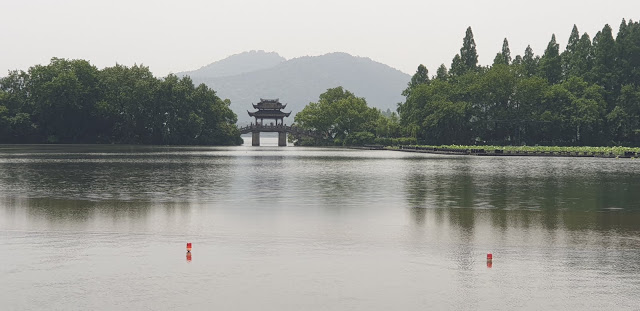
West Lake is a freshwater lake in Hangzhou, China. It is divided into five sections by three causeways. There are numerous temples, pagodas, gardens, and artificial islands within the lake.
Measuring 3.2 kilometers (2 miles) in length, 2.8 kilometers (1.7 miles) in width, and 2.3 meters (7.5 feet) in average depth, the lake spreads itself in an area totaling 6.5 square kilometers (2.5 square miles).
The earliest recorded name for West Lake was the “Wu Forest River”, but over time it changed to two distinct names. One is “Qiantang Lake”, due to the fact that Hangzhou was called “Qiantang” in ancient times. The other, “West Lake”, due to the lake being west of the city
It’s about to get busy, with a number of activities planned, and the warmth of the day is starting to make an impact.
The tour starts in the car park about a kilometer away, but the moment we left the car park we were getting a taste of the park walking along a tree-lined avenue.
When we cross the road, once again dicing with death with the silent assassins on motor scooters.
We are in the park proper, and it is magnificent, with flowers, mostly at the start hydrangeas and then any number of other trees and shrubs, some carved into other flower shapes like a lotus.
Then there was the lake and the backdrop of bridges and walkways.
.
And if you can tune out the background white noise the place would be great for serenity and relaxation.
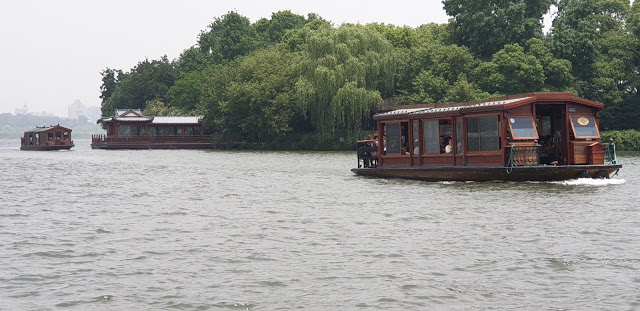
That, in fact, was how the boat ride panned out, about half an hour or more gliding across the lake in an almost silent boat, by an open window, with the air and the majestic scenery.
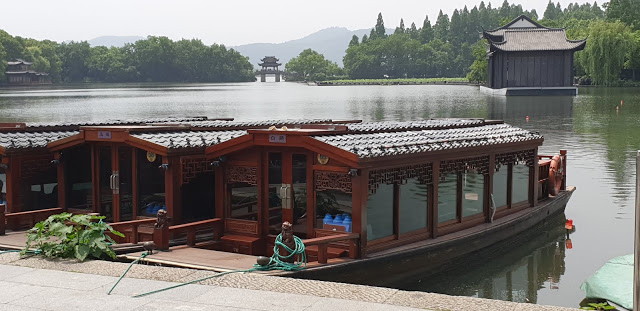
No, not that boat, which would be great to have lunch on while cruising, but the boat below:
Not quite in the same class, but all the same, very easy to tune out and soak it in.
It was peaceful, amazingly quiet, on a summery day
A pagoda in the hazy distance, an island we were about to circumnavigate.
Of all the legends, the most touching one is the love story between Bai Suzhen and Xu Xi’an. Bai Suzhen was a white snake spirit and Xu Xi’an was a mortal man.
They fell in love when they first met on a boat on the West Lake, and got married very soon after.
However, the evil monk Fa Hai attempted to separate the couple by imprisoning Xu Xi’an. Bai Suzhen fought against Fa Hai and tried her best to rescue her husband, but she failed and was imprisoned under the Leifeng Pagoda by the lake.
Years later the couple was rescued by Xiao Qing, the sister of Baisuzhen, and from then on, Bai Suzhen and Xu Xi’an lived together happily.
The retelling of the story varied between tour guides, and on the cruise boat, we had two. Our guide kept to the legend, the other tour guide had a different ending.
Suffice to say it had relevance to the two pagodas on the far side of the lake.
There was a cafe or restaurant on the island, but that was not our lunch destination.
Nor were the buildings further along from where we disembarked.
All in all the whole cruise took about 45 minutes and was an interesting break from the hectic nature of the tour.
Oh yes, and the boat captain had postcards for sale. We didn’t buy any.
Lunch
At the disembarkation point there was a mall that sold souvenirs and had a few ‘fast food’ shops, and a KFC, not exactly what we came to China for, but it seemed like the only place in town a food cautious Australian could eat at.
And when tried to get in the door, that’s where at least 3 busloads were, if they were not in the local Starbucks. Apparently, these were the places of first choice wherever we went.
The chicken supply by the time we got to the head of the line amounted to pieces at 22.5 RMB a piece and nuggets. Everything else had run out, and for me, there were only 5 pieces left. Good thing there were chips.
And Starbucks with coffee and cheesecake.
At least the setting for what could have been a picnic lunch was idyllic.
Can you actually say you know the exact moment a story is done, finished, and that’s it?
For me, the end never quite seems to be the end, that point where you finally draw a line in the sand and say, that’s it, I’m done, step away from the typewriter.
But are we ever satisfied the story is done, can we not make one more change, it’s just a little tweak, it won’t take long.
Please!
My editor tolerated three ‘minor’ changes.
Firstly, a change of name for a character
Secondly, consistency of word use, such as times and contractions
Thirdly, I wasn’t happy with the overall story, and it needed some more action. More writing, more editing, more prevaricating.
It took three weeks to sort out all of those issues, and last night I send the final draft to the Editor.
It’s like watching your child go to school on their first day. Not knowing what will happen but expecting everything will be fine.
This morning I sat in front of the computer, a blank sheet of paper on the screen. I know it’s not a matter of starting the next story from scratch; I have so many started and finished, sitting in the wings to be ‘tinkered with’.
Every time I close my eyes, I see something different.
I’d like to think the cinema of my dreams is playing a double feature but it’s a bit like a comedy cartoon night on Fox.
But these dreams are nothing to laugh about.
Once again there’s a new installment of an old feature, and we’re back on the treasure hunt.
The shrill ring tone of my phone woke me. And, for a moment I was in a state of panic because I’d woken in unfamiliar surroundings. Until my eyes cleared and I realized I was still at Nadia’s. And it was morning. What the…. The phone was still ringing, and Nadia, lying on the bed beside me rolled over and said, sleepily, “Are you going to answer that?” I picked up the phone off the bedside table and pressed the green button. I already knew it was Boggs. “Don’t you know what time it is?” It was nine, a respectable hour of the morning to call. It was just that I was tired. “Where are you?” I could lie, or I could tell the truth. I don’t think I should say at home because I suspect that was where Boggs was now. And my mother would be there, wondering what happened to me. “Out and about. Nice day for some exercise. Why?” “Your mother is not happy you didn’t come home. And I’m surprised. Where were you?” Good question. One that needed time to consider, time I didn’t have. “Surveillance. I’ve been watching Alex and his friends. It’s been a long night. What do you want?” “I was going to head down towards Kentville, check on the other river. We need to drive down there.” “Well, right now I’m busy, so it will have to wait until tomorrow morning. Sorry. I have a job to do, and then I have to get home before I go to work.” “What was Alex up to?” “Not over the phone. I’ll tell you when I see you. Come back home about lunchtime.” I could tell by the silence he wasn’t happy. “OK.” He hung up. I glared at the phone and put it back on the table, then turned to look at Nadia. First thing I noted, we were both still in the clothes we were wearing the previous night. “What happened?” “Nothing.” A momentary look of disappointment crossed her face. “You were tired and I told you to stay.” “Nothing can happen, or I’ll become Vince fodder.” “I wouldn’t tell him.” “He’d find out. He has walls as spies.” I looked around the room looking for potential spy cameras or bug locations. “He wouldn’t dare.” I climbed off the bed and smoothed out my clothes. It didn’t make much difference to the crumpled look. “At least it looks like I’ve been on an all-night surveillance assignment.” “What are you going to tell Boggs.” “Nothing. There’s nothing concrete to tell him yet, just that Alex is, like the rest of us, running around in circles. Nadia remained on the bed, and even though she looked as messy as I did, hers was a far more alluring messy. I could feel the pangs of a forbidden desire. Time to go. “Come back tonight. We can go on a voyage of discovery, see the mall as you’ve never seen it before.” “Sounds like a Discovery Channel documentary advert.” She sat up then stood and teased the knots out of her hair. It was the first time I’d seen it out. It gave her a whole new, softer look. “Is that a look of desire I see in your eyes, Smidge?” And the whole moment was shot to pieces. “Don’t call me that. I’ll see you tonight, though I’m not sure why.” I let myself out, after carefully checking to see if the way out was clear. The last thing I wanted, or needed, was to tangle with Vince. Or ending up letting the dream become reality.
It is sometimes quite trashy and that’s saying something!
Having been a journalist in a previous lifetime, and one that always believed that the truth mattered, it didn’t take long to realize that journalists should never let the truth get in the way of a good story.
Newspapers, and all other forms of media, will only write what they believe will sell, or what they think the public wants to read. The truth, sadly, is not the first thing on the reader’s mind, only that someone is to blame for something they have no control over, and it doesn’t matter who.
And the more outlandish the situation, the more the public will buy into it.
This, I guess, is why we like reading about celebrities and royalty, not for the good they might do, but the fact they stumble and make mistakes, and that somehow makes us feel better about ourselves.
Similarly, if the media can beat up a subject, like the corona-virus, and make it worse than it is, then people will lap up the continuing saga, as it relates to them, and will take one of two stances, that they believe the horror of it, and do as they’re asked, or disbelieve it because nothing can be that bad, and ignore it and the consequences of disobedience. knowing the government will not press too hard against the non-compliers simply because of democracy issues it will stir up.
That is, then the media will get a hold of this angle and push it, and people will start to think disobedience is a good thing, not a bad one.
So, our problems of trying to get a fair and balanced look at what the coronavirus is all about is nigh on impossible. We are continuously bombarded with both right and wrong information, and the trouble is, both sides are very plausibly supported by facts.
And that’s the next problem we have in reporting. We can get facts to prove anything we want. It’s called the use and abuse of statistics and was an interesting part of the journalism degree I studied for. We were told all about statistics, good and bad, and using them to prove the veracity of our piece.
I remember writing a piece for the tutor extolling the virtues of a particular person who was probably the worst human since Vlad the Impaler, using only the facts that suited my narrative. I also remember the bollocking he gave me for doing so but had to acknowledge that sometimes that would happen.
The integrity of reporting only went as far as the editor, and if the editor hated something, you had to hate it too. This is infamously covered in various texts where newspaper publishers pick sides and can influence elections, and governments. It still happens.
So, the bottom line is, when I’m reading an article in the media, I always take it with a grain of salt, and do my own fact-checking, remembering, of course, not just to fact check to prove the bias one way of the other, but then get a sense of balance.
We have state elections coming up where I live, but it does not sink to the personal sniping level as it does in the US, we haven’t sunk that low yet, but we haven’t got past the sniping about all the wrongs and failed promises of the government of the day, or the endless tirade against the opposition and how bad a job they did when they were previously in government.
You can see, no one is talking about what they’re going to do for us, no one is telling us what their policies are. It’s simply schoolyard tit for tat garbage speak. What happened to the town hall meeting, a long and winding speech encompassing the policies, what the government plans to do for its people in the next three years, and then genuinely answering questions?
Perhaps we should ban campaigning, and just get each party to write a book about what they intend to do, and keep them away from the papers, the TV, and any other form of media, in other words, don’t let them speak!
And don’t get me started about the drivel they speak in the parliament. Five-year-olds could do a better job.
For a story that was conceived during those long boring hours flying in a steel cocoon, striving to keep away the thoughts that the plane and everyone in it could just simply disappear as planes have in the past, it has come a long way.
Whilst I have always had a fascination with what happened during the second world war, not the battles or fighting, but in the more obscure events that took place, I decided to pen my own little sidebar to what was a long and bitter war.
And, so, it continues…
Jackerby came back and sat down. It was clear he was annoyed his lunch was interrupted.
“Atherton’s not among those Leonardo brought back.”
Johannsen silently breathed a sigh of relief. While he was still outside there was hope he would not get hurt. If he had the sense to keep his head down. Anyone else, Johannesen would not have cared.
“Who did Leonardo bring in?”
“Some woman called Martina, the one he says is in charge of the resistance. He said he raided their last stronghold, killed everyone except the three people he knew were in the resistance. They’re now in the dungeons.”
“We should be down there asking questions.” A pointed glare from Wallace carried the message, what are you doing here?
“No use. He nearly killed them, and it’ll take a while for them to recover.”
“To find out where Atherton is?”
“It seems that was the least of his concerns. Apparently, she apparently humiliated him so he was more interested in payback.”
“It wouldn’t be hard to humiliate a fool like him,” Johannsen muttered.
Wallace glared at him. “You should have more faith in our Italian friends, Richard.”
“My faith in him extends only to the fact he will drink the cellar dry.”
Wallace shrugged. “Once he’s served his purpose…” and left it at that. “Have you got onto London and asked them for further information on Mayer?”
“I think, by now, they would have tumbled to what’s going on here. Especially after I saw Atherton come out of the radio room just before Jackerby arrived. I asked the operator, and he gave me a coded message, but it’s not like any code I’ve seen.”
“And you’re telling me this now?”
“At least he didn’t smash it, which is what I would have done. We haven’t heard any more from High Command other than to say the traitor was thought to be heading for Innsbruck and coming over the mountains near the Brenner Pass. They’ve got people looking, but nothing as yet.”
“Now we’ve lost Carmichael, do we have a description of him?”
“Yes.”
“Good. At least something is happening.”
After lunch, Johannsson went down to the dungeon to check on the prisoners. Wallace had assigned their ‘welfare’ to him. It was a difficult assignment seeing they arrived both exhausted, weak, and then subjected to an initial interrogation that determined whether or not they got medicines or food.
Most were left to starve. Any women were sent to the soldier’s barracks, where they were out of his control. None had ever come back, and he was ordered not to go check on them.
All told, there were 12 still in cells, with three due to be executed later that day. All had worked in an armaments factory and had admitted to having information about the bombs that were being dropped over England.
Another six had yet to say what information they had, and had been subjected to severe torture, the handiwork of two of Jackerby’s men, and who Johannsen thought had been trained by the Gestapo. In fact, he believed they were Gestapo, and that Jackerby, though he didn’t have the uniform, was a ranking SS officer.
Not a man to cross. Leonardo would find that out soon enough.
The most recent three, the resistance fighters were put in separate cells next to each other. The guards had been told to listen to any conversations they had, and report. As yet, none of them had spoken.
Considering the condition they arrived in, that was no surprise.
He stood outside the cell holding the woman they called Martina.
The leader.
She hadn’t moved from the moment she had been dropped there.
A guard appeared beside him.
“Nothing yet?” Johansson asked him.
“I doubt they’ll speak again. If that’s what Leonardo does to his so-called countrymen; I’d hate to see what he does to his enemies.”
“You let me know if she says anything.”
The soldier nodded, then went back to his station.
The other two were men, one old, one younger. An odd group to be part of the resistance. The woman he could understand and was the key.
He now believed Atherton would come to rescue her. Like any good British soldier, his empathy would be his downfall.
I don’t think anyone can predict the future, not anymore, and definitely, now it is a distinct possibility that someone can create a virus that will in essence shut down the whole world, and quite possibly destroy it
This is patently clear after the recent troubles with COVID 19 and although a remedy has been found, it is not a perfect solution, or a means of eradicating it. It has shown that while we might be able to combat one version of it, it’s the mutations that will throw up questions about ever getting back to some sort of normal.
And that begs the question, what is, or was, normal?
It’s been a year or more, and I think we’ve forgotten. What we have discovered, though, is the disparate states of the various nations and ethnic groups, and how they have fared in the wake of the pandemic.
It has highlighted systemic problems the world over, problems that have always been there but simmering below the surface. Problems that could be resolved, but perhaps will not.
But as a first-world nation, we have not been immune to external forces, forces that have tried to break us while reeling from the ravaging of a virus that was brought here, and through no fault of our own.
But from the outset, we seem to have been in a different bubble here.
I will admit that I live in a country with about 26 million people whereas the United States has about 330 million, there is a significant difference in numbers, whereas the US is only 1.3 times larger in size.
All this means that the US has a much larger problem in containing the COVID 19 virus, and probably why, down here, we are having a lot more success in getting the infection rates under control.
One thing we have all learned in the last month or so is that lockdowns, such as those hated by, and rallied against in the US, do actually work when you have much less population to deal with. This is why the actions taken by smaller populated countries such as Australia and New Zealand have been so successful.
Yes, we have had outbreaks, but it has been proved these can be contained. We have rigidly been adhering to the science, and the advice of our medical specialists without political interference, to keep the infection rates down.
Yes, we have limited freedom, but nearly everyone, except those from overseas who came here as immigrants and refuse to accept any form of ‘control’, has adhered to the medical-based requests. Those that don’t, those that have railed against the rules, they are predominantly people who have come here from other countries.
I’m happy for anyone to come here and get away from whatever horrors they leave behind, but only on the condition they leave those horrors behind and try in some small way to assimilate with us, without having to give up their cultural and religious beliefs. When they use that as an excuse for their bad behavior, they should be sent home. Obviously, this country isn’t good enough for them.
We are an island, so it is much easier to guard our borders. No one can get into this country without going through quarantine, and that who try to lie their way in are promptly returned on the next plane out. We cannot leave without a valid reason, and if we do, when we come back, we have to spend a fortnight in quarantine, guarded by the defense force personnel.
For countries like the US, it is so much harder to maintain borders. There will be problems in the future with travelers coming from overseas, especially if the science behind the vaccines being touted doesn’t stand up to a very high standard. I suspect that anyone claiming to have a vaccine and using it as an excuse to re-enable overseas travel will find their pleas falling on deaf ears.
That’s because, as we are learning, vaccines are not infallible, there will be the transmission, and not everyone will be willing to have a vaccine, so even here, as anywhere else, we will not be rid of the scourge for a long time. Travel might be possible, but who will want to take a risk going to another country where it’s not completely under control?
I guess, at this time of our lives, our chance to see the rest of the world is over, and it’s time to tour our own country.
Whether we live long and prosper, well, that’s a story for another day.
It was not for the first time, but this time was significant because he had basically agreed in principle to vote for both sides.
And, when he realized what had happened, he had, depending on how you looked at it, been tricked.
Not good for someone who was well respected by both sides, and whose vote would count towards picking up those who were undecided.
That was just pointed out to him by Amy, his personnel assistant, the moment he arrived back in the office.
He leaned back in his chair and stared at a point just past her head, a copy of a painting by one of the old masters, still an object of beauty.
“So, when did Cheney change sides?” He asked, dragging his attention back to the problem in hand.
He suddenly realized what had happened, and it was a well thought out scheme. Cheney had always been on board with the Board’s recommendation until he accepted Kane’s invitation to come to a meeting that would attempt to explain why the board’s recommendation was wrong.
He should have been skeptical of Cheney’s sudden change of mind, and then of the discussions he had attended with Cheney’s allies, with the objective of changing their minds too. In fact, he had left with the impression he had persuaded them, saying, in essence, they should all vote against.
Seeing Cheney that morning with the leader of the group agreeing to vote for the motion, should have set off alarm bells. The phone call from Williams, the head of the group voting for the board’s recommendation, saying he was pleased that Kane had finally seen ‘the light’ as he called it, had been interesting, to say the least, especially when he mentioned in passing, how very much the board appreciated Kane’s confidence in them.
He had done no such thing.
Instead, Cheney had put him on the spot, and his words were now being taken out of context.
“This morning. I just got word from Ellie, who told me he had a breakfast meeting with Jacobs and Meadows. She said he came back looking very pleased with himself.”
Jacobs was the chairman of the board and Meadows was the CEO who was pushing the new plan, which would break up, and sell-off, or disband, the underperforming divisions of the company. By having Meadows in attendance, Jacobs could basically offer Cheney anything he wanted.
And top of his list was my division.
“Yes, and I think we can guess why. He wants this division. Of course, if they gave it to him, it would not be the magic bullet he thinks it will be. Nor would it line the shareholders, and therefore the board members pockets as it has in the past.”
“Is this situation the proverbial double-edged sword?”
“It depends. I doubt you could quit out of dissatisfaction with a crappy board decision. I doubt anyone could in the current financial climate. But you won’t have to worry. It might mean going back to the pool for a while if you don’t want to work with Cheney.”
“No problem there. Ellie had already told me my days are numbered.”
Understandable. Ellie and Amy had put themselves forward for the role of Jake’s personal assistant, and Ellie had tried very hard to convince him Amy was not suitable for a variety of reasons, none of which he found valid, and appointed her. Ellie was not one who forgot or forgave easily.
Although he didn’t like denigrating anyone, he had said more than once to Amy, both Ellie and Cheney suited each other. Neither cared who or what they destroyed to get what they wanted.
“Then it looks like you and I are heading for the scrap heap.”
“Sounds like an excuse for a long lunch.” She smiled. For a woman who was about to lose a dream job, she was in remarkably good spirits.
“Ask me again in an hour. I have a few things to do.”
“Call in some favors, maybe?”
People didn’t rise in a company over several decades without making friends, making enemies, and stumbling over information which may or may not be used depending on circumstances at the time. He had a few interesting tidbits in his arsenal, but whether he would use them or not wasn’t uppermost in his mind.
“We’ll have to see.”
Jake watched her leave, and, not for the first time, he wondered what life with her might be like. He had never married, but had, for a number of years had a more or less relationship with the Chairman’s daughter, before she broke it off. He suspected the Chairman had instigated it given the number of times she had tried to contact him since parting.
That door had closed. As for Amy, she had a husband who was a member of the armed services and had been killed in Afghanistan. She had weathered that event and finally come out the other side of some very dark days, some of which he had witnessed personally, and tried to help where he could. But was she up to dipping her foot into the dating thing. He wasn’t prepared to ask. Not yet.
He sighed and picked up the phone. It was time to call Jacobs. It was the day I knew he would be in his office, not at the factory site where we all were housed, but in the top floor of a prestigious building in the city, twenty miles away You could call it an ivory tower, but the board did oversee the functioning of seven different and diversified companies.
Some time ago they had called for ideas on how to integrate a lot of the similar processes of those diversified companies, but in the end, they had paid a ‘crony’ a million dollars for an unworkable plan, and it had not gone any further. Now, the conglomerate was bleeding cash, someone had come up with a new, knee jerk, plan.
Jacobs was surprised to hear from him.
“I was told,” he said, “everyone is now on board.”
“They probably are. It’s just that it is no longer a problem for me. You’ll have my resignation on your desk by close of business.”
That statement was met with silence. Stunned, or was it smug satisfaction. He had always viewed Kane as a thorn in his side.
“Is that really necessary?”
“I think you know why, and whatever the plan was, it has backfired. I don’t need the job, nor do I need the aggravation of scheming and plotting.”
“I think you’re making a mistake, but let’s be very clear about this, you leave, there’s no coming back. If I were you, I would consider my position very carefully.”
Interesting reaction. The only conclusion from his reaction was that the thorn was now removed.
I expected just such a reaction.
Now, for the next job. Kane went down to the factory floor and called in all the production managers. Like himself, he knew most of them didn’t really have to stay, some could retire, some could go into business by themselves, most could walk into another job, even a better job, the next day.
Kane left that meeting a half-hour later, telling them the decision to stay and work under Cheney, a man none of them liked, was their decision but he was moving on.
He called Amy, asked if she had sent his resignation letter, which she had, and to pick the restaurant for lunch, the more expensive the better, and that he would pick her up outside the front of the office block.
For Kane, it was the 107th day of what he called the rest of his life. He was woken by the sun streaming in through the window of his hotel room. He had reached Singapore and had been told that Raffles Hotel was the place to stay.
He agreed. Old but new, the place just reeked of nostalgia.
The figure beside him stirred, opened her eyes, and smiled.
“Good morning, Amy.”
“It is a good morning, isn’t it Kane?”
Over lunch that fateful day 107 days ago, he took the chance of asking her if she would be interested in dating him. Nothing heavy, no strings, he would understand if she thought it inappropriate.
She didn’t think it was inappropriate, just wanted to know why it had taken him so long.
The had got married in Rome, 42 days ago, in a quaint little church, and after a week, moved to Venice for the honeymoon. They hadn’t set a limit on how long it should be. There was no reason to go back.
Of course, just when it’s least expected, the phone would ring. His cell phone. It was the first time in months.
“Hello?”
He was surprised it was Jacobs. He’d followed the fortunes of the company he had abruptly left, as it tried to implement the plan that Cheney and his ‘friends of the board’ had voted for. One problem after another; in three months the stock value of the parent company had lost 90% of its value. As Kane had expected, every one of his management team resigned the day after, knowing full well, once Cheney was installed as manager, the transition would fail.
Now, faced with hostile shareholders, a corporate watchdog investigation, someone had to turn around the company’s fortunes or it would slide into liquidation before the week was out.
“It seems that we have serious problems implementing the restructure. We have made some mistakes, but I think if I could tell the receivers that we have a plan and you would be heading up a new management team, we could save the company and all of the employees.”
The 2,500 left. They should have left well alone, and the whole 8,000 that had been there the day Kane left would still be employed.
The Board and upper management would do well out of the company going under. The staff, well, they always lost.
“I’m sorry to hear that. Now, if you don’t mind, I have business to attend to. Goodbye.”
I turned the phone off and put it back on the bedside table.
“Who was that?”
“Someone from another lifetime. Now, where were we?”
A long time ago when I spent time at a newspaper, I wondered what it was like to get to write what essentially was an opinion piece. Did it have to tow the newspaper owners’ point of view?
I was idealistic then. I believed in freedom of the press, and that cornerstone of democracy, freedom of speech.
I did not realize then that freedom of speech also meant the freedom to spread ‘plausible’ lies, dressed up to be the truth, to achieve a particular result. In just one instance, and editorial, and the editorial line of a newspaper had the opportunity to influence an election, favoring one party over another.
With age came wisdom? Perhaps it was more cynicism because now I tend not to believe anything I read in the papers, when I deign to buy a paper which isn’t often, or read online, or listen to on the television or radio.
What happened to factual reporting?
What happened to opinion pieces being labeled as such so that we know that it is not a representative opinion, just the columnists?
What we all tend to forget is that everyone makes mistakes. Whether they’re deliberate, or stupid, they happen, and they can cause a large number of casualties, or cost a lot of money.
What’s lost in all the screaming and yelling is the fact we should be looking for answers so that it doesn’t happen again, not blame every man and his dog, or those in opposition, for everything that is wrong in the world, and, quite likely, your own mistake.
What’s also lost is the truth.
In every ten tons of rubbish that are coming out of the media, so-called reported directly from the horse’s mouth, there are just a few grains of truth. That’s what we should be listening to.
But, drowned out in all the lies, half-truths, and outrageous statements that on the surface doesn’t make any sense, we get to a point where we no longer know what the truth is.
Or do we?
We all have one thing in spades, common sense.
Unfortunately, we sometimes suspend it, because we all have our biases and idiosyncrasies, and beliefs and these can sometimes get it not the way. Now is not the time to forget that common sense or the fact we should be using it to filter out what is not relevant and get to what is.
And what is relevant?
You.
You matter.
Your life matters.
The life of others, whether you like them or not, those lives also matter.
And when we all realize we are in this together, and then rise above the petty and stupid lies and fear-mongering that is being peddled, will the world, yes, the whole world, finally overcome the worst assault on it ever devised.









 Thrills, Spills, and just a dash of Romance