This was one of the more interesting experiences for the grandchildren as they were, as all young girls are, interested in ballet.
We thoroughly enjoyed our visit which included some time watching ballet practice.
I could not convince anyone to take the elevator back down to the ground floor as it was suspected we might be ‘attacked’ by the ‘phantom’. Certainly, the elevator was very old and I think at the time it was being repaired.
Part of the Grand Staircase in Palais Garnier Opera de Paris
The ceiling above the main staircase. The ceiling above the staircase was painted by Isidore Pils to depict The Triumph of Apollo, The Enchantment of Music Deploying its Charms, Minerva Fighting Brutality Watched by the Gods of Olympus, and The City of Paris Receiving the Plan of the New Opéra.
The ceiling of Chagall at the Palais Garnier
On 23 September 1964, the new ceiling of the Opéra Garnier was inaugurated with great pomp. It was painted by Marc Chagall at the request of André Malraux
Amphitheatre and Orchestra Pit entrance
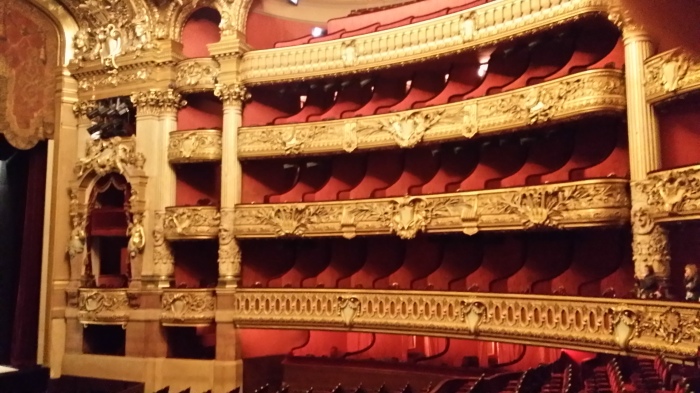
Interior, and doorways to boxes
Box seats in the auditorium
Ornate ceilings and columns
Seating inside the auditorium
The day we were leaving Paris, was the first night of the Bolshoi Ballet. My two granddaughters were greatly disappointed at missing out on the opportunity of a lifetime, to see the Bolshoi Ballet at the Paris Opera House.
50 photographs, 50 stories, of which there is one of the 50 below.
They all start with –
A picture paints … well, as many words as you like. For instance:
And, the story:
Have you ever watched your hopes and dreams simply just fly away?
Everything I thought I wanted and needed had just left in an aeroplane, and although I said I was not going to, i came to the airport to see the plane leave. Not the person on it, that would have been far too difficult and emotional, but perhaps it was symbolic, the end of one life and the start of another.
But no matter what I thought or felt, we had both come to the right decision. She needed the opportunity to spread her wings. It was probably not the best idea for her to apply for the job without telling me, but I understood her reasons.
She was in a rut. Though her job was a very good one, it was not as demanding as she had expected, particularly after the last promotion, but with it came resentment from others on her level, that she, the youngest of the group would get the position.
It was something that had been weighing down of her for the last three months, and if noticed it, the late nights, the moodiness, sometimes a flash of temper. I knew she had one, no one could have such red hair and not, but she had always kept it in check.
And, then there was us, together, and after seven years, it felt like we were going nowhere. Perhaps that was down to my lack of ambition, and though she never said it, lack of sophistication. It hadn’t been an issue, well, not until her last promotion, and the fact she had to entertain more, and frankly I felt like an embarrassment to her.
So, there it was, three days ago, the beginning of the weekend, and we had planned to go away for a few days and take stock. We both acknowledged we needed to talk, but it never seemed the right time.
It was then she said she had quit her job and found a new one. Starting the following Monday.
Ok, that took me by surprise, not so much that it something I sort of guessed might happen, but that she would just blurt it out.
I think that right then, at that moment, I could feel her frustration with everything around her.
What surprised her was my reaction. None.
I simply asked where who, and when.
A world-class newspaper, in New York, and she had to be there in a week.
A week.
It was all the time I had left with her.
I remember I just shrugged and asked if the planned weekend away was off.
She stood on the other side of the kitchen counter, hands around a cup of coffee she had just poured, and that one thing I remembered was the lone tear that ran down her cheek.
Is that all you want to know?
I did, yes, but we had lost that intimacy we used to have when she would have told me what was happening, and we would have brainstormed solutions. I might be a cabinet maker but I still had a brain, was what I overheard her tell a friend once.
There’s not much to ask, I said. You’ve been desperately unhappy and haven’t been able to hide it all that well, you have been under a lot of pressure trying to deal with a group of troglodytes, and you’ve been leaning on Bentley’s shoulder instead of mine, and I get it, he’s got more experience in that place, and the politics that go with it, and is still an ally.
Her immediate superior and instrumental in her getting the position, but unlike some men in his position he had not taken advantage of a situation like some men would. And even if she had made a move, which I doubted, that was not the sort of woman she was, he would have politely declined.
One of the very few happily married men in that organisation, so I heard.
So, she said, you’re not just a pretty face.
Par for the course for a cabinet maker whose university degree is in psychology. It doesn’t take rocket science to see what was happening to you. I just didn’t think it was my place to jump in unless you asked me, and when you didn’t, well, that told me everything I needed to know.
Yes, our relationship had a use by date, and it was in the next few days.
I was thinking, she said, that you might come with me, you can make cabinets anywhere.
I could, but I think the real problem wasn’t just the job. It was everything around her and going with her, that would just be a constant reminder of what had been holding her back. I didn’t want that for her and said so.
Then the only question left was, what do we do now?
Go shopping for suitcases. Bags to pack, and places to go.
Getting on the roller coaster is easy. On the beginning, it’s a slow easy ride, followed by the slow climb to the top. It’s much like some relationships, they start out easy, they require a little work to get to the next level, follows by the adrenaline rush when it all comes together.
What most people forget is that what comes down must go back up, and life is pretty much a roller coaster with highs and lows.
Our roller coaster had just come or of the final turn and we were braking so that it stops at the station.
There was no question of going with her to New York. Yes, I promised I’d come over and visit her, but that was a promise with crossed fingers behind my back. After a few months in t the new job the last thing shed want was a reminder of what she left behind. New friends new life.
We packed her bags, three out everything she didn’t want, a free trips to the op shop with stiff she knew others would like to have, and basically, by the time she was ready to go, there was nothing left of her in the apartment, or anywhere.
Her friends would be seeing her off at the airport, and that’s when I told her I was not coming, that moment the taxi arrived to take her away forever. I remember standing there, watching the taxi go. It was going to be, and was, as hard as it was to watch the plane leave.
So, there I was, finally staring at the blank sky, around me a dozen other plane spotters, a rather motley crew of plane enthusiasts.
Already that morning there’s been 6 different types of plane depart, and I could hear another winding up its engines for take-off.
People coming, people going.
Maybe I would go to New York in a couple of months, not to see her, but just see what the attraction was. Or maybe I would drop in, just to see how she was.
As one of my friends told me when I gave him the news, the future is never written in stone, and it’s about time you broadened your horizons.
This is not a treatise, but a tongue in cheek, discussion on how to write short stories. Suffice to say this is not the definitive way of doing it, just mine. It works for me – it might not work for you.
…
Now, there’s this thing called continuity, but it covers a whole range of writing sins, most of which I eventually get caught out. Films sometimes miss a few items, like back in the roman days, there are plane trails in the sky, in a 1920’s period piece, there’s a mobile phone sitting on a desk.
Like one minute the hero has a gun, and the next he’s fighting for his life with a knife, and, hey presto, there’s that gun again. The error might not be that big but you can’t pull out a weapon you don’t have or wasn’t there in the first place.
Similarly, the hero pulls out a mobile phone, but there’s only one problem, it’s 1980, and there are no mobile phones. Our problem might be that we are so used to doing and using certain things that we might forget, for a minute or two, that were not available in the past.
Then there’s places like hotels and restaurants, both of which change hands and close and reopen with a different owner like someone changes their socks. There’s no substitute for checking, on the internet of course, whether a Hilton Hotel was in 6th Avenue, New York, in 1920.
The answer is no. The first Hilton Hotel was in Waco in 1927. The New York Hilton opened in 1963.
The same goes for the fashion of the day.
I’m no fashion guru, but I have to rely on Google once again to fill in the gaps.
And my all-time favourite, getting the right make and model of car.
Oh, and just for good measure, back in the old days they used acoustic couplers to attach to phones via a serial port to dial-up not a server, but a BBS, Bulletin Board Service, at a rate of 300 baud, or a little while later, 1,200 baud.
There was no internet in general use. If you wanted to call the office when out, use a telephone box. Or carrier pigeon.
And the use of language, there’s a lot of stuff relevant today that was not used back then, and there was a lot of stuff back then that isn’t tolerated now. Some of it might be hard to get your head around.
It isn’t for me, because I can remember the 1970s and 1980s, but I’m not too sure about allowing some of what happened then to creep into my work.
So, you get the picture. Try to use the past as the past, or leave it in the past.
Unless it’s a book about time travel, then all bets are off.
With my attention elsewhere, I walked into a man who was hurrying in the opposite direction. He was a big man with a scar running down the left side of his face from eye socket to mouth, and who was also wearing a black shirt with a red tie.
That was all I remembered as my heart almost stopped.
He apologized as he stepped to one side, the same way I stepped, as I also muttered an apology.
I kept my eyes down. He was not the sort of man I wanted to recognize later in a lineup. I stepped to the other side and so did he. It was one of those situations. Finally getting out of sync, he kept going in his direction, and I towards the bus, which was now pulling away from the curb.
Getting my breath back, I just stood riveted to the spot watching it join the traffic. I looked back over my shoulder, but the man I’d run into had gone. I shrugged and looked at my watch. It would be a few minutes before the next bus arrived.
Wait, or walk? I could also go by subway, but it was a long walk to the station. What the hell, I needed the exercise.
At the first intersection, the ‘Walk’ sign had just flashed to ‘Don’t Walk’. I thought I’d save a few minutes by not waiting for the next green light. As I stepped onto the road, I heard the screeching of tires.
A yellow car stopped inches from me.
It was a high powered sports car, perhaps a Lamborghini. I knew what they looked like because Marcus Bartleby owned one, as did every other junior executive in the city with a rich father.
Everyone stopped to look at me, then the car. It was that sort of car. I could see the driver through the windscreen shaking his fist, and I could see he was yelling too, but I couldn’t hear him. I stepped back onto the sidewalk, and he drove on. The moment had passed and everyone went back to their business.
My heart rate hadn’t come down from the last encounter. Now it was approaching cardiac arrest, so I took a few minutes and several sets of lights to regain composure.
At the next intersection, I waited for the green light, and then a few seconds more, just to be sure. I was no longer in a hurry.
At the next, I heard what sounded like a gunshot. A few people looked around, worried expressions on their faces, but when it happened again, I saw it was an old car backfiring. I also saw another yellow car, much the same as the one before, stopped on the side of the road. I thought nothing of it, other than it was the second yellow car I’d seen.
At the next intersection, I realized I was subconsciously heading towards Harry’s new bar. It was somewhere on 6th Avenue, so I continued walking in what I thought was the right direction.
I don’t know why I looked behind me at the next intersection, but I did. There was another yellow car on the side of the road, not far from me. It, too, looked the same as the original Lamborghini, and I was starting to think it was not a coincidence.
Moments after crossing the road, I heard the roar of a sports car engine and saw the yellow car accelerate past me. As it passed by, I saw there were two people in it, and the blurry image of the passenger; a large man with a red tie.
Now my imagination was playing tricks.
It could not be the same man. He was going in a different direction.
In the few minutes I’d been standing on the pavement, it had started to snow; early for this time of year, and marking the start of what could be a long cold winter. I shuddered, and it was not necessarily because of the temperature.
I looked up and saw a neon light advertising a bar, coincidentally the one Harry had ‘found’ and, looking once in the direction of the departing yellow car, I decided to go in. I would have a few drinks and then leave by the back door if it had one.
Yes, I actually heard that answer given in a television interview, and thought, at the time, it was a quaint expression.
But in reality, this was a person for whom English was a second language, and that was, quite literally, their translation from their language to English.
Suffice to say, that person was not happy when lost the event she was participating in.
But that particular memory was triggered by another event.
Someone asked me how happy I was.
Happy is another of those words like good, thrown around like a rag doll, used without consequence, or regard for its true meaning.
“After everything that’s happened, you should be the happiest man alive!”
I’m happy.
I should be, to them.
A real friend might also say, “Are you sure, you don’t look happy.”
I hesitate but say, “Sure. I woke up with a headache,” or some other lame reason.
But, in reality, I’m not ‘happy’. Convention says that we should be happy if everything is going well. In my case, it is, to a certain extent, but it is what’s happening within that’s the problem. We say it because people expect it.
I find there is no use complaining because no one will listen, and definitely, no one likes serial complainers.
True.
But somewhere in all those complaints will be the truth, the one item that is bugging us.
It is a case of whether we are prepared to listen. Really listen.
Every time I close my eyes, I see something different.
I’d like to think the cinema of my dreams is playing a double feature but it’s a bit like a comedy cartoon night on Fox.
But these dreams are nothing to laugh about.
Once again there’s a new installment of an old feature, and we’re back on the treasure hunt.
—-
We took her car. It wasn’t a limousine of the sort I’d seen the other Cossatino’s driving around in, but a shabby old compact that had seen better days. Perhaps it was selected for its camouflage qualities, it fitted in with a lot of other old cars that the general population drove.
No one in this town could afford any better. Not unless you were a Cossatino or a Benderby. Alex, for instance, had been given a Porsche on his 18th birthday. By comparison, I was given a new, but second hand, bicycle.
She had parked in a back street some distance from the hotel, and the several times I checked, we were not being followed. She had noticed me looking over my shoulder a few times but hadn’t commented. Not until we had driven several miles.
“Alex has one of his mates following me,” I said by way of an explanation. “Alex seems to think I might lead them to the treasure, which is about as daft as it can get.”
“He’s clutching at straws. His old man had found out what he’s doing, not that he has told him he knows, and he’s going out of his way to distract Alex. Old man Benderby doesn’t think there is any treasure.”
“How do you know what the old man is doing?”
“Talks to my father. They might be sworn enemies, but that doesn’t mean they don’t talk. It amuses them to see Alex and Vince go head to head. It’s a waste of time trying to impress their respective fathers.”
“What about you?”
“I’m not trying to impress anyone. At the right time, I’m packing my bags and going back to Italy to live with the other branch of the family, the ones who are not interested in being master criminals. I just want to soak up the Tuscan sun and drink wine.”
“I’m sure your father would have something to say about that.”
“He has, but I’m not interested in using my ‘wiles’ as he calls them to get men to spill their secrets. I’ve seen what it’s done to my mother and my sisters. I’m not a criminal.”
Not now perhaps. But back in school, she used every asset to get what she wanted. It won over Alex, and a few others, particularly those who did her schoolwork for her. She had nearly every boy at school dangling on a puppet string.
I was lucky she never gave me a second look.
“Well, I’m sure you made a lot of boys happy.”
A sidelong glance told me that wasn’t the wisest of statements to make. Despite the fact it was true, I guess it was a time she’d rather forget.
I changed the subject. “So when you went away, I’m thinking you went over to Italy?”
“For a while. My father thought I was getting a little too close to Alex and sent me to what he thought would be purgatory. I loved it. Pity I had to come back.”
We’d reached a small area behind a row of shrubs that shielded us from being seen from the mall. Something else I’d noticed, it was a cloudy night, and off and on the moon would disappear behind a bank of scudding clouds, and then just before we arrived, the moon had completely disappeared.
When we got out of the car, the darkness closed in around us, and it took a minute or so for my eyes to adjust. The black clothes almost made us invisible.
I watched her as she wrapped her hair up into a bun and secure it with a band. Dragged back off her forehead, it made her look older. It also accentuated the fact she had carefully applied makeup, an odd thing to do when about to go running around in a very dirty place.
The parking spot was a long way from where Boggs and I had last gained entry, so did she have a different entry point.
“Ready?” she asked.
“As ever.”
She took off at a quick pace and I found myself almost jogging to keep up. She was very fit. I was not. We cut across another carpark, one of several surrounding the mall, this one giving some cover because originally there had been landscaping. It was now overgrown and out of control, and we could move through it and no one could see us.
Not that there was anyone else there.
We came out of the garden, crossed a road, and into an inset where there was a door.
The rusting sign on the door said that the outside should be kept clear as it was a fire exit.
The lock, from what I could see, looked reasonably clean, unlike patches of rust on the door itself, and around the edges of the lock.
“I presume you have a key?”
She pulled a keyring out of her pocket with several keys on it, selected one, and inserted it in the lock.
Nothing.
She tried the next key. Same result. She tried the last key.
It turned, and the door swung open. For a door that showed the rust it did, it moved easily and silently.
She stood to one side as I passed through, then she followed me in, closing the door behind us. A sign on the back said the door was not to be used, except for fire emergencies, and was alarmed. No power, no alarm.
“Don’t suppose I should ask where you got the key?”
“Best not.” She handed me a small torch and turned hers on. I followed suit. There was not a lot of light in front of us. It was, however, quite dark.
“Follow me,” she said, and we set off down a long narrow passage.
Just when there’s enough complication in the story, we could leave it there with the current three protagonists and see what happens.
But I like mayhem.
So rather than another customer, it’s time to add a complication; an off duty policeman, or more to the point, policewoman. A beat cop, if they still exist.
Her back story in a sentence or so:
It had been another long day at the office for Officer Margaret O’Donnell, or, out in the streets, coping with people who either didn’t know or didn’t care about the law.
People who couldn’t cross the road where there were crossings and lights to protect them, silly girls shoplifting on a dare, and boys who thought they were men and could walk on water.
The one they scraped of the road would never get to grow up, and his mother, well, she was not doing another call on a family to give them the bad news.
That was her day. So far.
What is she doing near the shop? She lives around the corner. Perhaps she knows the reputation of the shopkeeper or perhaps not. It’s not relevant, then, as it is a place she avoids.
Now, she may not have the option. She sees the shop is still open, past the usual closing time.
Let’s continue:
She came around the corner into the street where she lived and saw the lights were on in the corner store.
She looked at her watch and saw it was ten minutes to midnight. Long past closing time. She looked through the window but from the other side of the road and could only see three heads and little else.
Damn, she thought, I’m going to have to check it out. There were rumors, and she hoped they were not true.
Meanwhile, back in the shop how are the others faring?
The shopkeeper is in an invidious position, he can’t supply the kids with the drugs and get them out, not in front of the customer.
The fact the girl has a gun makes the situation almost impossible. What would happen if he suggests the customer leave? Without him, the situation would be simpler.
Alphonse had only a few moments to sum up the situation, and the sum of those deliberations was the remove the only problem, the customer.
He could still salvage this:
The shopkeeper changed his expression to one more placatory, and said quietly to the girl, ‘Look, this is not this chap’s problem.’ He nodded in the direction of the customer. ‘I’m sure he’d rather not be here, and you would glad of one less distraction.’
He could see she was wavering, she was not holding the gun so steadily, and the longer this dragged on, the more nervous and unpredictable she would become.
And in the longer game, the customer would sing his praises no matter what happened after he left.
The girl looked at Jack. The shopkeeper was right. If he wasn’t here this could be over. But there was another problem. It didn’t look like Simmo was in any shape to get away. In fact, this was looking more like a suicide mission.
She waved the gun in his direction. ‘Get out now, before I change my mind.’
As the gun turned to the shopkeeper, Jack wasn’t going to wait to be asked twice and started sidling towards the door.
What happens next?
And the story for this section, with a few minor changes:
It had been another long day at the office for Officer Margaret O’Donnell, or, out in the streets, coping with people who either didn’t know or didn’t care about the law.
People who couldn’t cross the road where there were crossings and lights to protect them, silly girls shoplifting on a dare, and boys who thought they were men and could walk on water.
The one they scraped of the road would never get to grow up, and his mother, well, she was not doing another call on a family to give them the bad news.
That was her day. So far. For now, she was glad to be getting home, putting her feet up, and forgetting about everything until the next morning when it would start all over again.
Coming around that last corner, the home stretch she called it, she was directly opposite the corner shop, usually closed at this hour of the night. It was not. The lights were still on.
She looked at her watch and saw it was ten minutes to midnight, and long past closing time. She looked through the window but from the other side of the road and could only see three heads and little else.
Damn, she thought, I’m going to have to check it out. There were rumors, and she hoped they were not true.
The shopkeeper changed his expression to one more placatory, and said quietly to the girl, ‘Look, this is not this chap’s problem.’ He nodded in the direction of the customer. ‘I’m sure he’d rather not be here, and you would glad of one less distraction.’
He could see she was wavering, she was not holding the gun so steadily, and the longer this dragged on, the more nervous and unpredictable she would become.
And in the longer game, the customer would sing his praises no matter what happened after he left.
The girl looked at Jack. The shopkeeper was right. If he wasn’t here this could be over. But there was another problem. It didn’t look like Simmo was in any shape to get away. In fact, this was looking more like a suicide mission.
She waved the gun in his direction. ‘Get out now, before I change my mind.’
As the gun turned to the shopkeeper, Jack wasn’t going to wait to be asked twice and started sidling towards the door.
I had once said that Grand Central Station, in New York, was large enough you could get lost in it. Especially if you were from out of town.
I know, I was from out of town, and though I didn’t quite get lost, back then I had to ask directions to go where I needed to.
It was also an awe-inspiring place, and whenever I had a spare moment, usually at lunchtime, I would go there and just soak in the atmosphere. It was large enough to make a list of places to visit, or find, or get a photograph from some of the more obscure places.
Today, I was just there to work off a temper. Things had gone badly at work, and even though I hadn’t done anything wrong, I still felt bad about it.
I came in the 42nd street entrance and went up to the balcony that overlooked the main concourse. A steady stream of people was coming and going, most purposefully, a few were loitering, and several police officers were attempting to move on a vagrant. It was not the first time.
But one person caught my eye, a young woman who had made a circuit of the hall, looked at nearly every destination board, and appeared to be confused. It was the same as I had felt when I first arrived.
Perhaps I could help.
The problem was, a man approaching a woman from out of left field would have a very creepy vibe to it, so it was probably best left alone.
After another half-hour of watching the world go by, I had finally got past the bad mood and headed back to work. I did a wide sweep of the main concourse, perhaps more for the exercise than anything else, and had reached the clock in the center of the concourse when someone turned suddenly, and I crashed into them.
Not badly, like ending up on the floor, but enough for a minor jolt. Of course, it was my fault because I was in another world at that particular moment.
“Oh, I am sorry.” A woman’s voice, very apologetic.
I was momentarily annoyed, then, when I saw who it was, it passed. It was the lost woman I’d seen earlier.
“No. Not your fault, but mine entirely. I have a habit of wandering around with my mind elsewhere.”
Was it fate that we should meet like this?
I noticed she was looking around, much the same as she had before.
“Can I help you?”
“Perhaps you can. There’s supposed to be a bar that dates back to the prohibition era here somewhere. Campbell’s Apartment, or something like that. I was going to ask…”
“Sure. It’s not that hard to find if you know where it is. I’ll take you.”
It made for a good story, especially when I related it to the grandchildren, because the punch line was, “and that’s how I met your grandmother.”
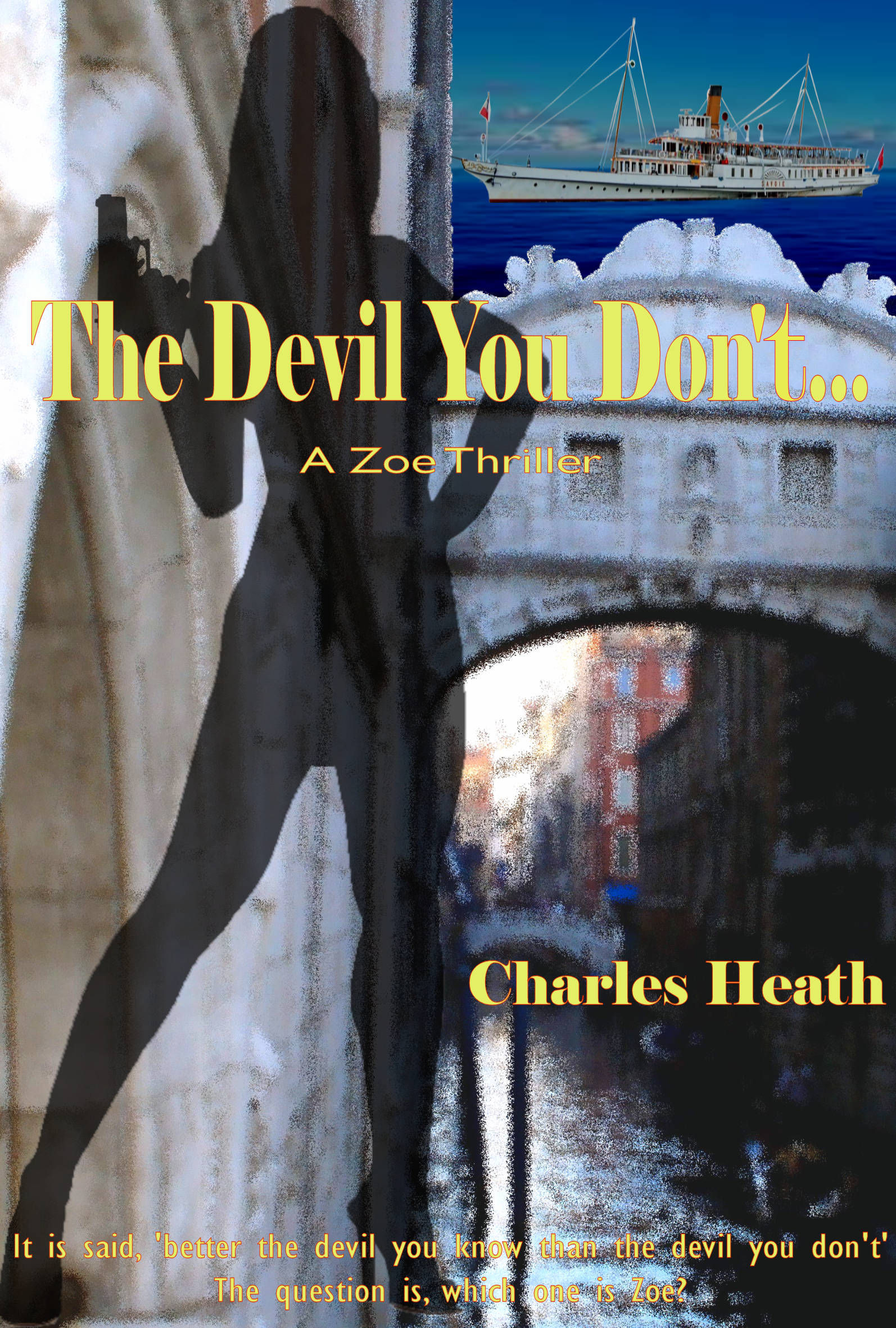
John Pennington’s life is in the doldrums. Looking for new opportunities, prevaricating about getting married, the only joy on the horizon was an upcoming visit to his grandmother in Sorrento, Italy.
Suddenly he is left at the check-in counter with a message on his phone telling him the marriage is off, and the relationship is over.
If only he hadn’t promised a friend he would do a favor for him in Rome.
At the first stop, Geneva, he has a chance encounter with Zoe, an intriguing woman who captures his imagination from the moment she boards the Savoire, and his life ventures into uncharted territory in more ways than one.
That ‘favor’ for his friend suddenly becomes a life-changing event, and when Zoe, the woman who he knows is too good to be true, reappears, danger and death follow.
Shot at, lied to, seduced, and drawn into a world where nothing is what it seems, John is dragged into an adrenaline-charged undertaking, where he may have been wiser to stay with the ‘devil you know’ rather than opt for the ‘devil you don’t’.
I used to like writing short stories, somewhere between two and five thousand words, but, in the end, it was too much hard work.
No chance of getting into stride with a location description, no real chance of giving a background to a character, it was simply a case of diving straight in.
But …
I’ve been thinking about writing a short story, starting it with a short succinct sentence that will set the tone.
Something like: “Jack was staring down the barrel of a gun”
What then?
Should he start analyzing what sort of gun it was, did it have a light trigger, was the person holding it shaking, a man or a woman, or a child?
Location, in a house, a disused factory, a shop, a petrol station, the side of the road.
So, where was Jack?
Something like: “He had gone down to the corner shop to get a pack of cigarettes.”
For himself or someone else? Is it day, is it night, or somewhere in between?
Something like: “He had to hustle because he knew the shopkeeper, Alphonse, liked to close at 11:00 pm sharp, and came through the door, the sound of the bell ringing loudly and the door bashed into it.”
So, Jack’s state of mind, he is in a hurry, careless coming through the door, not expecting anything out of the ordinary.
How would you react when you saw a gun, pointed at Alphonse until the sound of the door warning bell attracted the gunman’s attention?
Is it a gunman?
Something like: “It took a second, perhaps three, to sum up the situation. Young girl, about 16 or 17, scared, looking sideways at a man on the ground, Alphonse, and then Jack. A Luger, German, a relic of WW2, perhaps her father’s souvenir, now pointing at him.”
The punch line: Cigarettes can kill in more ways than one.
The revelation: The corner store also supplied the local drug addicts.
The revised start is now:
Jack was staring down the barrel of a gun.
He had gone down to the corner shop to get a pack of cigarettes.
He had to hustle because he knew the shopkeeper, Alphonse, liked to close at 11:00 pm sharp. His momentum propelled him through the door, causing the customer warning bell to ring loudly as the door bashed into it, and before the sound had died away, he knew he was in trouble.
It took a second, perhaps three, to sum up the situation.
Young girl, about 16 or 17, scared, looking sideways at a man on the ground, then Alphonse, and then Jack. He recognized the gun, a Luger, German, relic of WW2, perhaps her father’s souvenir, now pointing at him then Alphonse, then back to him.
Jack to another second or two to consider if he could disarm her. No, the distance was too great. He put his hands out where she could see them. No sudden movements, try to remain calm, his heart rate up to the point of cardiac arrest.
Pointing with the gun, she said, “Come in, close the door, and move towards the counter.”
Everything but her hand steady as a rock. The only telltale sign of stress, the bead of perspiration on her brow. It was 40 degrees Fahrenheit in the shop.
Jack shivered and then did as he was told. She was in an unpredictable category.
“What’s wrong with your friend?” Jack tried the friendly approach, as he took several slow steps sideways towards the counter.
The shopkeeper, Alphonse, seemed calmer than usual, or the exact opposite spoke instead, “I suspect he’s an addict, looking for a score. At the end of his tether, my guess, and came to the wrong place.”
Wrong time, wrong place, in more ways than one Jack thought, now realizing he had walked into a very dangerous situation. She didn’t look like a user. The boy on the ground, he did, and he looked like he was going through the beginnings of withdrawal.
“Simmo said you sell shit. You wanna live, ante up.” She was glaring at Alphonse.
The language was not her own, she had been to a better class of school, a good girl going through a bad boy phase.




 Thrills, Spills, and just a dash of Romance