Writing about writing a book – Day 5 continues – The complications of life

I hate it when other characters are drawn in, and without a proper introduction, the reader gets confused.

Well, let me tell you, the writer can get confused too.

The introduction of Jennifer cannot go without the introduction of Ellen Bill’s ex-wife, and we have talked a little about her background before.

She has a role, one that will have a major impact later on, but every now and then she is going to appear, adding to the backstory between her and Bill.  There is no real animosity between them, their parting amicable because both knew it was time to end.

Bill’s problems were brought about his military service, and her father has a part to play in the story, though I’m not sure how to weave this in yet.  But it’s not so much what Bill remembers of his service, but of what he has forgotten, or more to the point buried.

That will eventually rise to the surface.

However, at this time, it’s still at the part where the narrator has to introduce Jennifer.

There are three distinct stages to this relationship between the two most important characters, and as it happens it’s Ellen unknowingly that brings Bill and Jennifer together,


Then Ellen, my estranged, and sometimes difficult wife decided she wanted a divorce.  I had no objection, and that was most likely the problem.  Perhaps she had expected me to fight for her, but she had made it clear, many years before, that she was no longer interested in preserving the marriage and was only keeping it up until our two daughters were old enough to fend for themselves.

That time had come.

I found myself in a situation where I needed someone to talk to.  I was not one of those people who made friends easily, nor did I spend much time seeking the company of other women.  I had my work, and it had been enough.

But Ellen’s request for a divorce, for some reason, had shaken me, and the day I got the phone call, Jennifer has bustled into my office as she always did, dumping the pile of log file printouts on my desk, and instead of leaving, perhaps she had seen my look of dismay, or more to the point, utter shock, and stayed.

It caused a slight change in our relationship.


I’m still working on it, but there will be more.

Or fewer words perhaps, after all, it’s only meant to be a brief introduction.

See how simple things become complicated, very quickly.


© Charles Heath 2019

The Perils of Travelling: Every plane trip is different

Brisbane to Melbourne – First time flying after the pandemic

So, it’s the end of the restrictions induced by the pandemic, and against my better judgement, we’re travelling again.

The pandemic is not over, it’s just we’ve moved it to one side and trying our best to ignore it.  Try as we may, it ain’t going nowhere.

But we can’t all stay locked up forever.

It’s been over two years since we’ve been to Melbourne where our relatives are, and it’s going to be a two-and-a-half-hour flight, wearing masks, and hoping against hope there’s no one with Covid on the plane.

It’s a forlorn hope, by the way.

These days people have it but aren’t isolated because they can’t afford to.  All the government handouts are finished, making it impossible for people not to be working.

Of course, the country had a very high vaccination rate, and I’m covered, having just had a booster.  If comes died to susceptibility, and so far I’ve managed to avoid it, even with my better half working in an office where nearly everyone has had Covid at some time or other, and at a stage where it could be passed on 

Perhaps it’s just been blind luck.

Going on this plane will be a good test.

We decided to park the car for the six days in the long-term car park.  We were going to get dropped off but it was wet, raining very hard, and the roads were a nightmare, with ghastly traffic jams.

Our driver would have been out recently licence’s granddaughter and it would have been too much for her, even though she wouldn’t say no.

The walk from the car park was long but direct.  Sometimes it can be convoluted when having to park on the higher floors.  We’re on the ground, and it’s easy just to jump in the car and drive out.

Inside the terminal building, its masks on.  This place doesn’t recognise the end to mask restrictions, so the threat of covid I’d very real.  I hope they got that memo on the plane.

It would be pre-flight entertainment if they had to bodily drag a dissenter off kicking and screaming, or dies that only happen in America?

The food choices are still as appalling as they were before the pandemic, and I still don’t get why all the reasonably good choices are down one end, and, you guessed it, not the end we’re departing from.

I go for a walk, but an angry customer returning half-cooked food puts me off everything until I got a chicken schnitzel roll, which after I got it failed to show any sign of chicken, schnitzel or otherwise.

It did have ham, slightly dry around the edges, cheese, tomato, and lettuce, sad the roll itself was quite tasty, so a three out of ten for trying.

The price, like all airport food, nearly broke the bank.  But here’s the thing, they wouldn’t charge it if people didn’t pay it, so it’s everyone else’s fault!

Of course, we wouldn’t need to buy food, if you could call it that, before getting on the plane if the miserly airlines weren’t cutting costs, i.e. food, to make that extra buck to put in the CEO annual bonus.

Once, the meal options were quite good, but over time, these have got less and less and less, until now if you get a cookie, you’re lucky.

It will be interesting to see how further the standards have fallen, anywhere hearing sane said CEO wailing about not being able to fly during the pandemic, showing that he is more concerned about profits than passenger safety.

All while everyone else is citing the mantra, ‘your safety is our priority’.  I guess one day the message might come from the top down, but I won’t be holding my breath.

I read up on the safety procedures they implement in between flights so I’m expecting to get on a disinfectant-smelling plane with shiny clean surfaces.  It would be a huge improvement over that which prevailed before the pandemic where planes could be anything from apparently clean to don’t look below the surface.

Like I said, having not flown for so long, and the fact the pandemic is anything but dead and buried, there are so many things that could go wrong.

Meanwhile, we’re sitting in the gate lounge ticking off the minutes before boarding.  No matter what changes Covid had brought, that will be the same, people ignoring the seat road loading instructions and others pushing in as though the plane might leave without them if they didn’t.

Good News!

The incoming flight is here, 20 minutes before boarding time, so we’re going to be late leaving.

Or will they sacrifice the deep cleanse?

Stay tuned.

News flash…  9ur crew is coming in on another flight which is running late, no, just landed, so they have to finish up there, and come on over, go through pre-flight, and then we can board.

Yep, we’re going to be late leaving.  Who would have guessed?

Boarding as always is amusing but it’s made even more so by the constant reminder to keep our distance from other passengers, and if you can’t, and as you know sardines have nowhere to go, we should rely on the mask.

Wow.  These people seem to think masks will save us.  Sadly, they won’t, but they know that.  But it looks good and makes them feel better while cramming people into their small planes.

We were supposed to leave at 6:15 pm.  The late arrival of the operating aircraft and waiting for the crew from yet another late-arriving aircraft takes its toll.  

Good news though.  More time to clean the plane.  It looks clean, but there’s no tell-tale disinfectant aroma, so what did they do?

6:37 push back.  Overall, it’s not a bad result, pushing back 22 minutes late.  It’s time, they say, they can make up in the air.

They allow 2 hours and 20 minutes for the end-to-end departure and arrival from and at the gate.  The actual flying time, give or take, is 1 hour and 45 minutes, so we have 45 minutes for taxiing.

6:47 take off, so 1 hour 45 minutes added means we have a touch-down time of 8:32.  Our scheduled arrival time was 6:15 plus 2 hours and 20 minutes, so it would be 8:35.  Three minutes from touch-down to disembarking at the gate.

I don’t think so.

We’ll just have to wait and see.

I must have dozed off for a few minutes because the next thing that happens is food service, and it’s going to be arancini balls, which I like, so it sounds good.  But it’s airline food so it will be interesting

Something else that’s bordering me, the woman on the seat next to me gas a persistent cough.  Mask or no mask this is a problem, especially if she had Covid, and doesn’t know it yet.  Or it’s symptomatic or something else. 

I’m immuno-compromised so anything floating around in that tin can I’m likely to be susceptible to.  Time will tell if it’s serious.

Past that fear, the balls were delicious, all four of them, and a coke for a drink.  We’ve moved on from tea and coffee, and polite flight attendants, because they insisted, that we keep masks on till after they passed handing out the food.

It shows the staff have no faith in the company’s health directives, so they know each flight they’re dicing with death.

Scary thought. 

But, all’s well that ends well, and we make up the time and end up being 7 minutes late which is acceptable in anyone’s language.

8:37 on the runway with a bang, the pilot or co-pilot has not fully learned the subtle art of getting the plane on the ground at the end of a gentle drop from the sky. Those asleep are unceremoniously wakened, thinking the plane has crashed.

8:42 at the gate. It’s always a short time from landing to gate, the pilot wants to get an early night. It would not be the first time we are leaving the plane and the pilots are long gone. One of the advantages of being at the front of the plane!

My take on travelling by plane in the post-pandemic world, it’s too soon and vaccinated or not, we are all still susceptible to getting the virus and it is killing us.  I have to travel home yet, but I have to hope the lady in the next seat hasn’t hexed me.

Not after dodging it for so long by keeping myself safe, a proper distance between me and the rest of the world, and keeping away from those in isolation, because those few I could trust would stay in isolation.

For the rest of the world, when money is the driving object to disobey or flout the rules, they become a serious problem, one that nothing is going to overcome, and therefore we will quite feasibly never get rid of the virus.

Let’s hope the trip back is less traumatic.

An excerpt from “What Sets Us Apart”, a mystery with a twist

See excerpt from the story below, just a taste of what’s in store…

http://amzn.to/2Eryfth

whatsetscover

McCallister was old school, a man who would most likely fit in perfectly campaigning on the battlefields of Europe during the Second World War. He’d been like a fish out of water in the army, post-Falklands, and while he retired a hero, he still felt he’d more to give.

He’d applied and was accepted as head of a SWAT team, and, watching him now as he and his men disembarked from the truck in almost military precision, a look passed between Annette, the police liaison officer, and I that said she’d seen it all before. I know I had.

There was a one in four chance his team would be selected for this operation, and she had been hoping it would be one of the other three. While waiting for them to arrive she filled me in on the various teams. His was the least co-operative, and the more likely to make ad-hoc decisions rather than adhere to the plan, or any orders that may come from the officer in charge.

This, she said quite bluntly, was going to end badly.

I still had no idea why Prendergast instructed me to attend the scene of what looked to be a normal domestic operation, but as the nominated expert in the field in these types of situations, it was fairly clear he wasn’t taking any chances. It was always a matter of opinion between us, and generally I lost.

In this case, it was an anonymous report identifying what the authorities believed were explosives in one of the dockside sheds where explosives were not supposed to be.

The only reason why the report was given any credence was the man, while not identifying himself by name, said he’d been an explosive expert once and recognized the boxes. That could mean anything, but the Chief Constable was a cautious man.

With his men settled and preparing their weapons, McCallister came over to the command post, not much more than the SUV my liaison and I arrived in, with weapons, bulletproof vests, and rolls of tape to cordon off the area afterward. We both had coffee, steaming in the cold early morning air. Dawn was slowly approaching and although rain had been forecast it had yet to arrive.

A man by the name of Benson was in charge. He too had groaned when he saw McCallister.

“A fine morning for it.” McCallister was the only enthusiastic one here.

He didn’t say what ‘it’ was, but I thought it might eventually be mayhem.

“Let’s hope the rain stays away. It’s going to be difficult enough without it,” Benson said, rubbing his hands together. We had been waiting for the SWAT team to arrive, and another team to take up their position under the wharf, and who was in the final stages of securing their position.

While we were waiting we drew up the plan. I’d go in first to check on what we were dealing with, and what type of explosives. The SWAT team, in the meantime, were to ensure all the exits to the shed were covered. When I gave the signal, they were to enter and secure the building. We were not expecting anyone inside or out, and no movement had been detected in the last hour since our arrival and deployment.

“What’s the current situation?”

“I’ve got eyes on the building, and a team coming in from the waterside, underneath. Its slow progress, but they’re nearly there. Once they’re in place, we’re sending McKenzie in.”

He looked in my direction.

“With due respect sir, shouldn’t it be one of us?” McCallister glared at me with the contempt that only a decorated military officer could.

“No. I have orders from above, much higher than I care to argue with, so, McCallister, no gung-ho heroics for the moment. Just be ready to move on my command, and make sure you have three teams at the exit points, ready to secure the building.”

McCallister opened his mouth, no doubt to question those orders, but instead closed it again. “Yes sir,” he muttered and turned away heading back to his men.

“You’re not going to have much time before he storms the battlements,” Benson quietly said to me, a hint of exasperation in his tone. “I’m dreading the paperwork.”

It was exactly what my liaison officer said when she saw McCallister arriving.

The water team sent their ‘in position’ signal, and we were ready to go.

In the hour or so we’d been on site nothing had stirred, no arrivals, no departures, and no sign anyone was inside, but that didn’t mean we were alone. Nor did it mean I was going to walk in and see immediately what was going on. If it was a cache of explosives then it was possible the building was booby-trapped in any number of ways, there could be sentries or guards, and they had eyes on us, or it might be a false alarm.

I was hoping for the latter.

I put on the bulletproof vest, thinking it was a poor substitute for full battle armor against an exploding bomb, but we were still treating this as a ‘suspected’ case. I noticed my liaison officer was pulling on her bulletproof vest too.

“You don’t have to go. This is my party, not yours,” I said.

“The Chief Constable told me to stick to you like glue, sir.”

I looked at Benson. “Talk some sense into her please, this is not a kindergarten outing.”

He shrugged. Seeing McCallister had taken all the fight out of him. “Orders are orders. If that’s what the Chief Constable requested …”

Madness. I glared at her, and she gave me a wan smile. “Stay behind me then, and don’t do anything stupid.”

“Believe me, I won’t be.” She pulled out and checked her weapon, chambering the first round. It made a reassuring sound.

Suited up, weapons readied, a last sip of the coffee in a stomach that was already churning from nerves and tension, I looked at the target, one hundred yards distant and thought it was going to be the longest hundred yards I’d ever traversed. At least for this week.

A swirling mist rolled in and caused a slight change in plans.

Because the front of the buildings was constantly illuminated by large overhead arc lamps, my intention had been to approach the building from the rear where there was less light and more cover. Despite the lack of movement, if there were explosives in that building, there’d be ‘enemy’ surveillance somewhere, and, after making that assumption, I believed it was going to be easier and less noticeable to use the darkness as a cover.

It was a result of the consultation, and studying the plans of the warehouse, plans that showed three entrances, the main front hangar type doors, a side entrance for truck entry and exit and a small door in the rear, at the end of an internal passage leading to several offices. I also assumed it was the exit used when smokers needed a break. Our entry would be by the rear door or failing that, the side entrance where a door was built into the larger sliding doors. In both cases, the locks would not present a problem.

The change in the weather made the approach shorter, and given the density of the mist now turning into a fog, we were able to approach by the front, hugging the walls, and moving quickly while there was cover. I could feel the dampness of the mist and shivered more than once.

It was nerves more than the cold.

I could also feel rather than see the presence of Annette behind me, and once felt her breath on my neck when we stopped for a quick reconnaissance.

It was the same for McCallister’s men. I could feel them following us, quickly and quietly, and expected, if I turned around, to see him breathing down my neck too.

It added to the tension.

My plan was still to enter by the back door.

We slipped up the alley between the two sheds to the rear corner and stopped. I heard a noise coming from the rear of the building, and the light tap on the shoulder told me Annette had heard it too. I put my hand up to signal her to wait, and as a swirl of mist rolled in, I slipped around the corner heading towards where I’d last seen the glow of a cigarette.

The mist cleared, and we saw each other at the same time. He was a bearded man in battle fatigues, not the average dockside security guard.

He was quick, but my slight element of surprise was his undoing, and he was down and unconscious in less than a few seconds with barely a sound beyond the body hitting the ground. Zip ties secured his hands and legs, and tape his mouth. Annette joined me a minute after securing him.

A glance at the body then me, “I can see why they, whoever they are, sent you.”

She’d asked who I worked for, and I didn’t answer. It was best she didn’t know.

“Stay behind me,” I said, more urgency in my tone. If there was one, there’d be another.

Luck was with us so far. A man outside smoking meant no booby traps on the back door, and quite possibly there’d be none inside. But it indicated there were more men inside, and if so, it appeared they were very well trained. If that were the case, they would be formidable opponents.

The fear factor increased exponentially.

I slowly opened the door and looked in. A pale light shone from within the warehouse itself, one that was not bright enough to be detected from outside. None of the offices had lights on, so it was possible they were vacant. I realized then they had blacked out the windows. Why hadn’t someone checked this?

Once inside, the door closed behind us, progress was slow and careful. She remained directly behind me, gun ready to shoot anything that moved. I had a momentary thought for McCallister and his men, securing the perimeter.

At the end of the corridor, the extent of the warehouse stretched before us. The pale lighting made it seem like a vast empty cavern, except for a long trestle table along one side, and, behind it, stacks of wooden crates, some opened. It looked like a production line.

To get to the table from where we were was a ten-yard walk in the open. There was no cover. If we stuck to the walls, there was equally no cover and a longer walk.

We needed a distraction.

As if on cue, the two main entrances disintegrated into flying shrapnel accompanied by a deafening explosion that momentarily disoriented both Annette and I. Through the smoke and dust kicked up I saw three men appear from behind the wooden crates, each with what looked like machine guns, spraying bullets in the direction of the incoming SWAT members.

They never had a chance, cut down before they made ten steps into the building.

By the time I’d recovered, my head heavy, eyes watering and ears still ringing, I took several steps towards them, managing to take down two of the gunmen but not the third.

I heard a voice, Annette’s I think, yell out, “Oh, God, he’s got a trigger,” just before another explosion, though all I remember in that split second was a bright flash, the intense heat, something very heavy smashing into my chest knocking the wind out of me, and then the sensation of flying, just before I hit the wall.

I spent four weeks in an induced coma, three months being stitched back together and another six learning to do all those basic actions everyone took for granted. It was twelve months almost to the day when I was released from the hospital, physically, except for a few alterations required after being hit by shrapnel, looking the same as I always had.

But mentally? The document I’d signed on release said it all, ‘not fit for active duty; discharged’.

It was in the name of David Cheney. For all intents and purposes, Alistair McKenzie was killed in that warehouse, and for the first time ever, an agent left the Department, the first to retire alive.

I was not sure I liked the idea of making history.


© Charles Heath 2016-2020
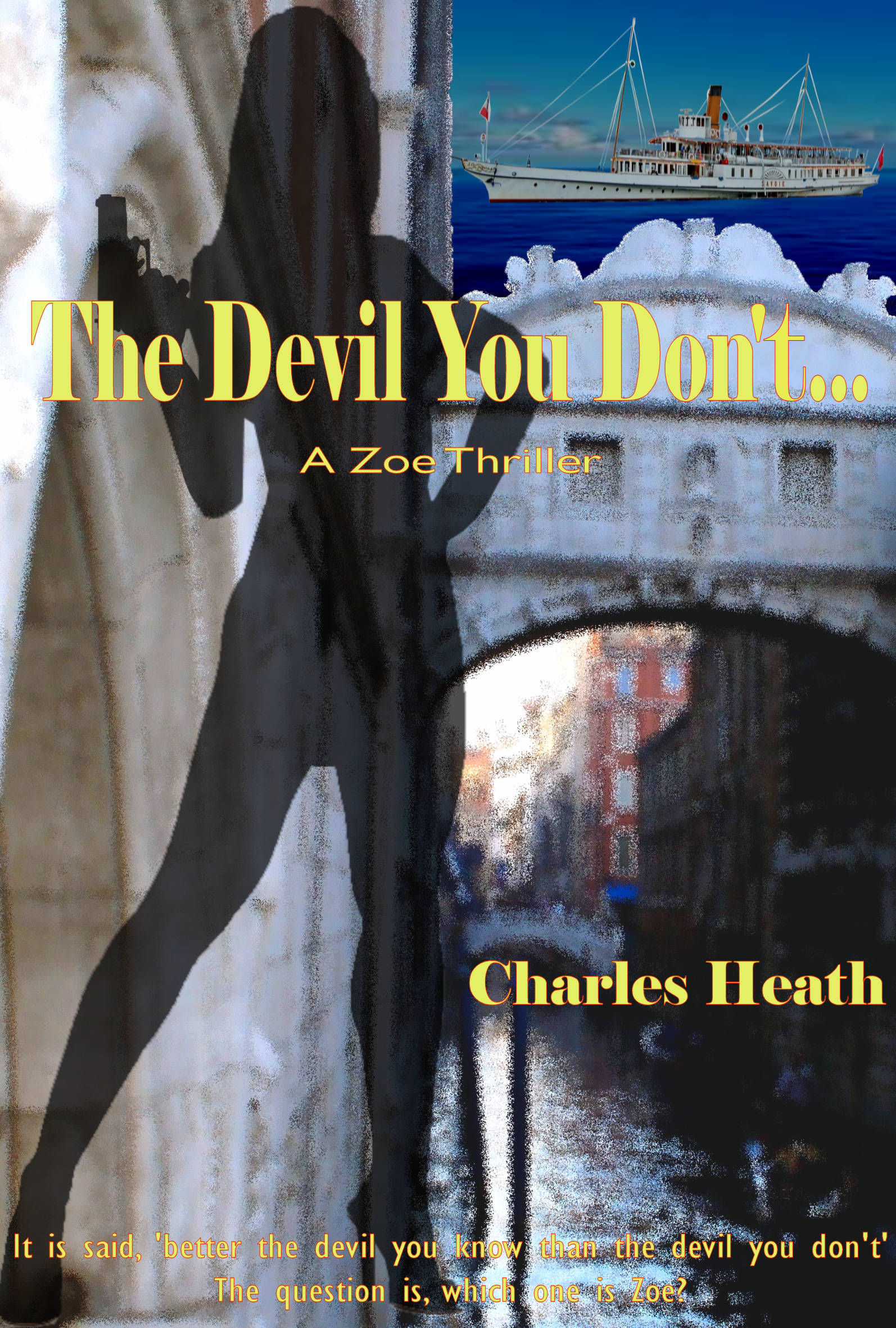
“The Devil You Don’t” – A beta readers view

It could be said that of all the women one could meet, whether contrived or by sheer luck, what are the odds it would turn out to be the woman who was being paid a very large sum to kill you.

John Pennington is a man who may be lucky in business, but not so lucky in love. He has just broken up with Phillipa Sternhaven, the woman he thought was the one, but relatives and circumstances, and perhaps because she was a ‘princess’, may also have contributed to the end result.

So, what do you do when you are heartbroken?

That is a story that slowly unfolds, from the first meeting with his nemesis on Lake Geneva, all the way to a hotel room in Sorrento, where he learns the shattering truth.

What should have been a high turns out to be something else entirely, and from that point every thing goes to hell in a handbasket.

He suddenly realises his so-called friend Sebastian has not exactly told him the truth about a small job he asked him to do, the woman he is falling in love with is not quite who she says she is, and he is caught in the middle of a war between two men who consider people becoming collateral damage as part of their business.

The story paints the characters cleverly displaying all their flaws and weaknesses. The locations add to the story at times taking me back down memory lane, especially to Venice where in those back streets I confess it’s not all that hard to get lost.

All in all a thoroughly entertaining story with, for once, a satisfying end.

Available on Amazon here: https://amzn.to/2Xyh1ow

In a word: Story

All of us writers know what this is, the sort of combination of words that all come together as a story.  A tale about anything whether it is true or just plain fiction.

A story can be long, or it can be short.  It could be a magazine or newspaper article, it could be what a child tells his or her mother or father when they get into trouble.

Come to think of it, I think that’s where I got an interest in writing stories because as a child I was always in trouble.

Of course, if you are telling certain types of stories,, then it’s bound to be a lie.  And made even worse if it is gossip!

That story might even be my interpretation of events, and as it happens, it’s possible no two stories are the same, especially if I and others had witnessed the same event.

This is not to be confused with the other version, storey, which is a single level in a building, one that might have thirty or more stories.

And, just to add to the confusion, living in Brisbane in Australia we have the Storey Bridge.

Writing about writing a book – Day 4

Of course, by this time, a lot has changed and what I had discussed before now needs a few changes, so I have made the necessary amendments where required to the narrative, but that doesn’t mean I won’t revisit it sometime in the future.


It was a late night last night, reading and rereading, considering plot lines, new characters, and demolishing a six-pack.

It’s debatable if it is helping the creative process.  It has left me with a slight headache.

I drag myself out of bed and look out the window.  Bright sunshine, blue sky, slight breeze.

11:00 am.  Half the day is gone.

My stomach rumbles, I need something to eat.  I stagger out to the kitchen and look in the fridge.  OK, too busy to go shopping, time to make time.  A writer has to eat!


Three hours have passed and it’s mid-afternoon.  A new plan is required.  I need to make sure I don’t waste the day and write a certain number of words, otherwise, this book will never get written.

Bed: midnight

Rise: 7:00 am, go for a run to clear the head

Breakfast: 8:00 am

Writing: 9:00 am to ??

Let’s just see if that works tomorrow.


I sit down and stare at the pad.

Plotting:  Our main character is an IT department manager, whose main responsibility from the start, and at that time, he was alone and not the manager of anything, was setting up and keeping the network running.  These were the early days of Ethernet, token ring, and 3-Com, in moving from mainframes to desktops and servers.

I remember it well, and my first client/server network was 3-Com and Ethernet.

In the story scenario, Bill literally is indispensable because the job he performs is single point sensitive, even though Benton refuses to act on employing another network engineer.  This is art imitating life because so many places have similar situations.

So the reason why Benton is calling Bill; there is a crisis.

Some accountant is found shot dead at his desk, novel but not unheard of.  I know a few accountants who deserve just that.

That’s not the problem though, it’s the fact the network is down, and Benton is almost hysterical (after he makes a promise to his superiors that he can’t keep!).  Nothing unusual there with the sort of person he is, and like many in similar situations.


Scribble, scribble …


Another five minutes, then the phone began its shrill insistence again.  Before it rang again, I’d moved it from the floor to the bed.  I counted the rings, to ten, and then picked up the receiver.

“Bill?  Don’t hang up.”  Almost pleading.

“Why?  You said I should go, away from work, away from the phones, away to recharge my batteries, I believe you said.”

“That was Friday.  This is Monday. You’re needed.  Richardson has been found shot dead by his desk.  All hell has broken loose!”  Benton rarely used adjectives, so I assumed when he said all hell had broken loose, it meant something had happened he couldn’t fix.  His flowery language and telegram style had momentarily distracted my attention from Richardson’s fate.

Harold Richardson was an accountant, rather stuffy, but good at his job.  I’d spoken to him probably twice in as many years, and he didn’t strike me as the sort who would kill himself.  So why did I think that?  Benton had only said he was shot.

Benton’s voice went up an octave, a sure sign he was going into meltdown.  “It’s a circus down here.  Jennifer is missing, Giles is not in yet, the network is down, and that bunch of nincompoops you call support staff are running around the office like headless chooks.”

It all came out in a nonstop sentence, followed by a gasp for air.  It gave me time to sift the facts.  Jennifer, the Assistant Manager, and responsible for data entry and accounts maintenance, was not there, which in itself was unusual, because she kept longer hours than me, Peter Giles, my youthful assistant, just out of university and still being beaten into shape was also not in, and that was usual, so it could only mean one thing.

The network was down.

It was my responsibility since I’d recommended it and then won the support of management over his objections, and following that it had become a point of continual contention, a petty war neither of us was going to win.

I tried to keep the joy out of my voice. 

He’d also vetoed my recommendation for an extra full-time network engineer as my alternative, and in doing so Benton had made my job become single point sensitive.  There was no one to replace me if anything went wrong.


Richardson has nothing to do with the plot, he just happened to be in the wrong place at the wrong time, but someone else further up the chain of command will be.  That’s something to look forward to, though I’ve yet to decide what happens.

As for Benton, he will linger around for a while, but has no real part to play, except perhaps as the comic light relief.  He will get a rude awakening at the end.

Try not to make it too technical, no one really wants to know about computer systems, just the machinations of the people who are creating the problems and why.


© Charles Heath 2016 – 2020

The first case of PI Walthenson – “A Case of Working With the Jones Brothers”

This case has everything, red herrings, jealous brothers, femme fatales, and at the heart of it all, greed.

See below for an excerpt from the book…

Coming soon!

PIWalthJones1

An excerpt from the book:

When Harry took the time to consider his position, a rather uncomfortable position at that, he concluded that he was somehow involved in another case that meant very little to him.

Not that it wasn’t important in some way he was yet to determine, it was just that his curiosity had got the better of him, and it had led to this: sitting in a chair, securely bound, waiting for someone one of his captors had called Doug.

It was not the name that worried him so much, it was the evil laugh that had come after the name was spoken.

Doug what? Doug the ‘destroyer’, Doug the ‘dangerous’, Doug the ‘deadly’; there was any number of sinister connotations, and perhaps that was the point of the laugh, to make it more frightening than it was.

But there was no doubt about one thing in his mind right then: he’d made a mistake. A very big. and costly, mistake. Just how big the cost, no doubt he would soon find out.

His mother, and his grandmother, the wisest person he had ever known, had once told him never to eavesdrop.

At the time he couldn’t help himself and instead of minding his own business, listening to a one-sided conversation which ended with a time and a place. The very nature of the person receiving the call was, at the very least, sinister, and, because of the cryptic conversation, there appeared to be, or at least to Harry, criminal activity involved.

For several days he had wrestled with the thought of whether he should go. Stay on the fringe, keep out of sight, observe and report to the police if it was a crime. Instead, he had willingly gone down the rabbit hole.

Now, sitting in an uncomfortable chair, several heat lamps hanging over his head, he was perspiring, and if perspiration could be used as a measure of fear, then Harry’s fear was at the highest level.

Another runnel of sweat rolled into his left eye, and, having his hands tied, literally, it made it impossible to clear it. The burning sensation momentarily took his mind off his predicament. He cursed and then shook his head trying to prevent a re-occurrence. It was to no avail.

Let the stinging sensation be a reminder of what was right and what was wrong.

It was obvious that it was the right place and the right time, but in considering his current perilous situation, it definitely was the wrong place to be, at the worst possible time.

It was meant to be his escape, an escape from the generations of lawyers, what were to Harry, dry, dusty men who had been in business since George Washington said to the first Walthenson to step foot on American soil, ‘Why don’t you become a lawyer?” when asked what he could do for the great man.

Or so it was handed down as lore, though Harry didn’t think Washington meant it literally, the Walthenson’s, then as now, were not shy of taking advice.

Except, of course, when it came to Harry.

He was, Harry’s father was prone to saying, the exception to every rule. Harry guessed his father was referring to the fact his son wanted to be a Private Detective rather than a dry, dusty lawyer. Just the clothes were enough to turn Harry off the profession.

So, with a little of the money Harry inherited from one of his aunts, he leased an office in Gramercy Park and had it renovated to look like the Sam Spade detective agency, you know the one, Spade and Archer, and The Maltese Falcon.

There’s a movie and a book by Dashiell Hammett if you’re interested.

So, there it was, painted on the opaque glass inset of the front door, ‘Harold Walthenson, Private Detective’.

There was enough money to hire an assistant, and it took a week before the right person came along, or, more to the point, didn’t just see his business plan as something sinister. Ellen, a tall cool woman in a long black dress, or so the words of a song in his head told him, fitted in perfectly.

She’d seen the movie, but she said with a grin, Harry was no Humphrey Bogart.

Of course not, he said, he didn’t smoke.

Three months on the job, and it had been a few calls, no ‘real’ cases, nothing but missing animals, and other miscellaneous items. What he really wanted was a missing person. Or perhaps a beguiling, sophisticated woman who was as deadly as she was charming, looking for an errant husband, perhaps one that she had already ‘dispatched’.

Or for a tall, dark and handsome foreigner who spoke in riddles and in heavily accented English, a spy, or perhaps an assassin, in town to take out the mayor. The man was such an imbecile Harry had considered doing it himself.

Now, in a back room of a disused warehouse, that wishful thinking might be just about to come to a very abrupt end, with none of the romanticized trappings of the business befalling him. No beguiling women, no sinister criminals, no stupid policemen.

Just a nasty little man whose only concern was how quickly or how slowly Harry’s end was going to be.

© Charles Heath 2019

The cinema of my dreams – Was it just another surveillance job – Episode 13

I’m back home and this story has been sitting on a back burner for a few months, waiting for some more to be written.

The trouble is, there are also other stories to write, and I’m not very good at prioritising.

But, here we are, a few minutes opened up and it didn’t take long to get back into the groove.

Am I working for anyone now?


So, there I was, walking along the street, hands in pockets, trying to look like my whole world hadn’t come crashing down on me when a car pulled over to the side of the road.

I may have been down in the dumps but not that far that I wasn’t still aware of what was going on around me, the training had been that good, so I hung back a little from the curb and waited to see if was me they were after, or just some lucky rich person being dropped off.

And ready to disappear into the crowd, not that there was one, but there were three exits available and within momentary reach if necessary.

I watched the rear window go down slowly then saw a familiar face.

Nobbin.

“Get in Mr Jackson.  We have more to talk about.”

I hesitated like anyone with the training I had would, as any person with common sense would too, I guess.

“It’s perfectly safe, I assure you.”  He sounded reassuring.

A glance into the car showed only him and the driver, who was getting out of the car.  I watched him come around to the curbside and put his hand on the door handle.

“Sir,” he said.

He opened the door.  Nobbin had moved to the other side.

I shrugged, then got in.  A thought: how many people had got into cars such as this, and were never seen again?”

It was not a statistic that reached any of the newspapers.  Only the end result, a body washed down the Thames, with no indication of who it was, or where they came from, and no identification, or means of identification available.

The door closed, the driver went back to the front of the car, and then gently eased the car out into the traffic.

“I’m sorry for the theatrics surrounding this meeting, but it is necessary.  I’m sure you were told of the need for secrecy in this matter, and I’m just reinforcing that.”

“Just who are you?  And, for that matter, those people back in that building?  Or, if it’s not too hard to wrap your head around, who the hell have I been working for?”

“Good questions, all.  At least now I can speak freely.  As you can, Mr Jackson.”

“Except I have no idea who’s side you’re on, I’m on, or anyone for that matter.  This is not what I signed up for.”

“Well, to put some perspective on your situation, Mr Jackson, you were not supposed to live to tell about it.  It was an operation that was created with one purpose in mind, to find an agent named

William O’Connor, and kill him.  And everyone in the team assigned to the task.”

“By Severin and Maury?  If so, why didn’t they kill me in the alley along with this O’Connor?”

“That is a mystery to all of us.”

“And those people back in the room.  Who the hell were they?”

“Operations.  Trying to find out how a sub-section could be created and function within their purview and not be detected.  That’s what it was, run by two agents who had been expelled a few months back, but who were clever enough to work around all of the safeguards, recruit four agents, and then go after the man who caused the end of their careers.”

“Simple, it seems.”

“Very.  And, if it had not been for you, we would never have known who or why.”

“Perhaps we should be thankful there was an explosion then, otherwise we’d all be dead.”

“Or not, because as far as I know, that was part of the operation, designed to take the target, you and the surveillance member behind you.  It only did a third the job.  It didn’t go off at the critical moment.  No one was seriously hurt, by the way.”

“The policeman?”

“Critical but stable.  He’ll survive.”

“The police who were accusing me of being the bomber?”

“Our people trying to delay you, so our man could get away.  Seems they trained you better than we expected.  Did O’Connor say anything to you?”

“There wasn’t much time before I found him, and Severin shot him.”

“Anything at all?”

“He knew who I was.”

“Then he knew the whole team, and who was running it.”

“He killed two of them.”

“In self-defence.  They were not only surveillance but also assassins.  Different training before they joined your group.”

I had thought there was something odd about them.

“Anything else,” he asked again.

“Yes.  He said to tell you he found something he should, and that the evidence is…  And that’s when he was shot.  He didn’t tell me where it was.”

“He didn’t have to.  We had set up three prearranged drop sites, so it must be in one of those.  Here’s my card.”

He handed me a white card with a name and a phone number.  The name was not Nobbin.

“If this Severin contacts you again, call me.  I am available any hour of the day or night on that number.”

“If he doesn’t?”

“Then you will hear from me in the not too distant future.  The fact you’re a survivor tells me you are resourceful and have the makings of a good agent, one I can use in my department.”

“And those others back at the office?”

“You won’t hear from them again.”

The car stopped outside an underground staircase.

“This is your stop, Mr Jackson.  Thank you for your co-operation.”

Perhaps my career wasn’t in tatters.  I got out of the car, and watched it leave before heading for the underground, his card safely tucked away in my pocket.


© Charles Heath 2019

Writing about writing a book – Day 5 continues – Those annoying people called characters

Whilst it is always an idea to sit down and write and keep going, not worrying too much about the narrative, there’s always the problem of ideas about characters, and relationships that come back and need to be addressed.

I have issues with Jennifer in that we will need to know something about her, and need a little backstory.

Jennifer is the second most important character in this novel and one that has more talents than what my main character, or anyone else for that matter, thinks she has.  Of course, that is deliberate on her part for a number of reasons that will be introduced at the appropriate time.

But, at the start, all we will have to work with, is the introduction provided by the narrator.

It may go something like this:


Jennifer Pennington Smythe was, as you might expect, very English, very reserved, and very private.  She was the definitive ‘don’t judge a book by its cover’, and I was guilty, at first, of suspecting she had once been a schoolmistress due to the severity of dress, demeanor, and expression.

HR had sent her to me when I’d requested an IT Specialist, though of what particular discipline it was never divulged, neither by HR nor by her.  She arrived one morning, told me she was to ‘help resolve our technical difficulties’, moved into an office that had been used as a storeroom, and worked hard to prove her worthiness in the role.

My first attempt at conversation was rebuffed, the second met with a very cold stare.  Everyone, including me, learned very quickly that any other topic of conversation than work would be ignored.  At the time it suited me, there was trouble in paradise and I didn’t want anything more on my plate to deal with.


So, what is this trouble?

There are three distinct stages of this relationship between the two most important characters, and it is the actions of one of the protagonists that brings them together.  This particular protagonist, of course, is the main character’s wife, a woman that is on the periphery for the period the novel covers, but a little background will be needed at some point before we reach this part of the narrative.

This now means that I will have to put together a back story for Bill and his ex-wife Ellen, not too much yet but enough to explain the next part of the evolving relationship between Bill and Jennifer.


I’m sure this topic is going to raise it’s head again and again…

“Echoes From The Past”, a past buried, but not deep enough


What happens when your past finally catches up with you?

Christmas is just around the corner, a time to be with family. For Will Mason, an orphan since he was fourteen, it is a time for reflection on what his life could have been, and what it could be.

Until a chance encounter brings back to life the reasons for his twenty years of self-imposed exile from a life only normal people could have. From that moment Will’s life slowly starts to unravel and it’s obvious to him it’s time to move on.

This time, however, there is more at stake.

Will has broken his number one rule, don’t get involved.

With his nemesis, Eddie Jamieson, suddenly within reach, and a blossoming relationship with an office colleague, Maria, about to change everything, Will has to make a choice. Quietly leave, or finally, make a stand.

But as Will soon discovers, when other people are involved there is going to be terrible consequences no matter what choice he makes.

https://amzn.to/2CYKxu4

newechocover5rs