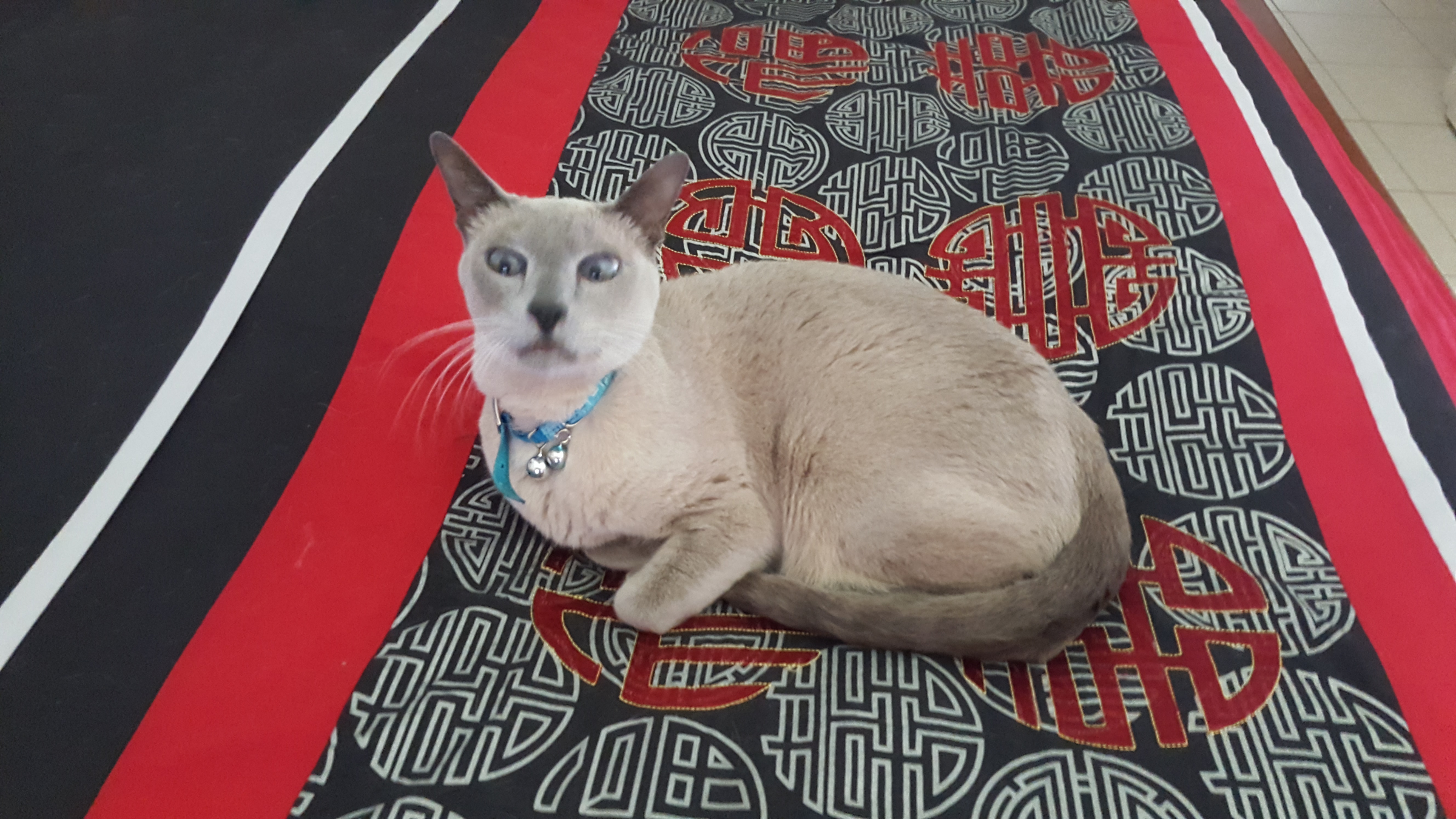
Memories of the conversations with my cat – 7

As some may be aware, but many not, Chester, my faithful writing assistant, mice catcher, and general pain in the neck, passed away some months ago.

Recently I was running a series based on his adventures, under the title of Past Conversations with my cat.

For those who have not had the chance to read about all of his exploits I will run the series again from Episode 1

These are the memories of our time together…

20160917_075236-1

This is Chester.  He’s been caught almost red-handed climbing the curtains.

Of course, he is all innocence, because the evidence is circumstantial.  He was sitting on the window ledge looking out, thinking ‘if only I could get out there’.

Now he’s thinking how much trouble he’s in and whether it will be his least favorite cat food for dinner.

No, I’m not that mean.

Not unless I catch him red-handed.

‘Sunday in New York’ – A beta reader’s view

I’m not a fan of romance novels but …

There was something about this one that resonated with me.

This is a novel about a world generally ruled by perception, and how people perceive what they see, what they are told, and what they want to believe.

I’ve been guilty of it myself as I’m sure we all have at one time or another.

For the main characters Harry and Alison there are other issues driving their relationship.

For Alison, it is a loss of self-worth through losing her job and from losing her mother and, in a sense, her sister.

For Harry, it is the fact he has a beautiful and desirable wife, and his belief she is the object of other men’s desires, and one in particular, his immediate superior.

Between observation, the less than honest motives of his friends, a lot of jumping to conclusions based on very little fact, and you have the basis of one very interesting story.

When it all comes to a head, Alison finds herself in a desperate situation, she realises only the truth will save their marriage.

But is it all the truth?

What would we do in similar circumstances?

Rarely does a book have me so enthralled that I could not put it down until I knew the result. They might be considered two people who should have known better, but as is often the case, they had to get past what they both thought was the truth.

And the moral of this story, if it could be said there is one, nothing is ever what it seems.

Available on Amazon here: amzn.to/2H7ALs8

The cinema of my dreams – I always wanted to write a war story – Episode 30

For a story that was conceived during those long boring hours flying in a steel cocoon, striving to keep away the thoughts that the plane and everyone in it could just simply disappear as planes have in the past, it has come a long way.

Whilst I have always had a fascination with what happened during the second world war, not the battles or fighting, but in the more obscure events that took place, I decided to pen my own little sidebar to what was a long and bitter war.

And, so, it continues…


It was a good plan.

Wallace, once he discovered his search team had gone missing would send another group to find them, and we would dispatch them in the same manner.

Each foray would reduce his group at the castle until it became, for us, a manageable size.  Currently, it was 35, with four already killed.  There was also the Leonardo factor, and his men, according to Martina, numbered seven.

If I was Wallace, who would realize once he discovered the body on the road to Chiara’s, that sending his own men out to be picked off was a bad idea, would eventually send Leonardo and his men as the first foray to resolve the problem.  

That, of course, would present the same problem as Wallace’s men, there would be deadly retribution.  The villages had all hated Leonardo, and he had dislike them for not selecting him as the local head of the resistance.  That had fallen to Martina, a more popular person, and one more capable.

It seemed to me, from what she had told me, Leonardo was more a mercenary, one who would work for the highest bidder, and that was the sort of man Wallace would have no trouble employing.

Martina was right to round up the villagers to keep them safe

But, for Carlo and I, we needed to pre-emp their strike, and the safest assumption was that they would return to Chiara’s, looking for her, and for answers.  

There was some discussion as to who would be in the attack group, and I agreed that the more we had the better chances we had of beating them, but in the end, we also needed people with the villagers, just in case the worst-case scenario happened, Leonardo knew of the underground wine storage facility and came there instead.

As far as Martina was concerned, he didn’t.  Very few people knew of its existence. 

In the end, it was decided that Carlo and I should go.  He had no doubt he could take Leonardo’s seven by himself, and I didn’t doubt him, so I went along just in case he needed some help.

I took the distant ground with the sniper rifle, and when I saw them, I was not to hesitate to shoot them.  Carlo would be closer and clean up what I missed.  We had enough ammunition to take out at least twenty.

And that’s where we were, from dusk until the following morning, waiting for the search team to arrive.  It did not occur to Carlo, or me, that there was a possibility they might not come, or that Leonardo might have something else in mind.


Alone, in the dark, and surrounded by what could only be described as an eerie stillness, it was hard to imagine that a deadly war was being waged.

In this part of the world, it was not so intense, that according to our intelligence, the Germans were getting stretched very thin on the ground, and were withdrawing soldiers from the extremities of Europe to bolster the fighting closer to home, and the imminent attack in France by the allies.

Of course, there was no way the Germans could know where and when, even I didn’t know that, but it was coming.  It seemed odd to me, by way of contrast, that the Germans high command had basically wasted a formidable and hitherto undetected group of double agents to rescue a rocket scientist which, in my mind, was hardly going to save or lose the war for them.

Perhaps that’s why it had not been up to me, and I hoped that our people knew exactly what they were doing.  Those that had been filtering through the castle were not exactly the sort of people Thompson had been expecting to defect, but once he learned of Meyer’s desire to leave, that assessment had changed.

It also caused a reassessment of the operation at the castle, which led to the discovery people were not making it beyond that point and became the reason for my mission.  The fact I’d been attacked before I reached my objective was coincidental, but it didn’t take long to realize why.

From that to here had been the proverbial hop, step, and jump.

I had not anticipated having to join the resistance, not be involved in becoming a guerrilla.

Not had I expected a dog for a companion.  Jack was lying on the ground next to me, and it looked like he was getting a well-earned rest.

Then he heard something, and lifted his head, ears pricked up.

Then I heard it.

The sound of an airplane passing overhead, but some distance away.

It was not the clearest night so all we could do was hear it, not see it.  A patrol?  A plane that had lost its way.  It was a bit south of where the action was, or where I’d expect the Germans to have either fighters or bombers.

Perhaps the allies then, but late at night surrounded by darkness, there would be little to see.

A minute later, nothing.

Jack put his head down, and I was struggling to keep my eyes open.  Something had better happen soon, or I would miss it.

© Charles Heath 2020

The cinema of my dreams – I always wanted to write a war story – Episode 29

For a story that was conceived during those long boring hours flying in a steel cocoon, striving to keep away the thoughts that the plane and everyone in it could just simply disappear as planes have in the past, it has come a long way.

Whilst I have always had a fascination with what happened during the second world war, not the battles or fighting, but in the more obscure events that took place, I decided to pen my own little sidebar to what was a long and bitter war.

And, so, it continues…


They reached a point a few kilometers from what was known as Brenner Pass at four in the morning, having navigated their way through patchy snow, icy roads, and bitter cold.

Progress at times was slow and the roads were difficult, the driver, at times, nearly losing control of the car.

The checkpoint appeared almost when they were on top of it, one that hadn’t been marked on the map, so they had not been prepared for it. Too late to turn back, they had to stop.

Once again the soldier that came out of the hut beside the boom was an army Unteroffizier who was more concerned about the cold than those in the car.

The Standartenfuhrer once again explained the nature of their business, and again the sentry went back to his hut and made a call.

While he was there the driver was checking the number of other soldiers were in attendance and had pulled his weapon out from under the seat and had it ready to use.

The Standartenfuhrer had done the same, also having checked the extent of the staffing of the post.

Then the driver said, “This looks like one of several. I think we may have walked into a hornet’s nest. The Brenner Pass is very important to the Germans for supplies from Germany to its soldiers in Italy.”

“You think our luck has finally run out?”

They had both seen the guard change expression, from the languid guard worrying more about the cold than a lone car at night, to a soldier who looked like he was about to attend a Nazi rally.

“I think they’ve finally discovered that our friend Mayer is missing.”

“Which means we’re about to get a small platoon of soldiers down on us. OK. You keep them off as long as you can so Mayer and I can get into the woods.”

The Standartenfuhrer turned to Mayer. “This is it, then end of the line for driving. We’re about to get a lot of unwanted visitors.”

He thrust the folder of plans into Mayer’s hands along with a coat.

“Let’s go.”

“Where?” Mayer was almost panic-stricken. The situation was deteriorating with each passing second. He, like the others, could see six men jogging towards them.

Their only advantage was the lack of illumination.

The driver said, “See you on the other side.”

The Standartenfuhrer leaned over, opened the door, and said, forcefully, “Get out, now.”

Mayer tumbled out almost slipping on the icy surface, and the sudden cold hitting him hard.

The Standartenfuher was right behind him, closing the door, and then literally dragging him off the side of the road and towards the tree line about 50 meters away, just barely visible again the dark sky. Thankfully there was no moon peeking through the clouds.
But light snow just began to fall, and it would hide them behind an artificial white wall.

They made it to the edge of the forest just as the soldiers reached the car.

Mayer turned to look and could see the sentry now with a torch, probably checking the car which was now barely visible to them. He had seen three people before, now there was only one.

No time to see the inevitable, the Standartenfuhrer dragged him away with, “We have to go before they bring out the dogs.”

Further into the trees, and moving as quickly as they could through the trees and undergrowth, and at times slipping and sliding on both snow and ice, it was five minutes before they heard six shots in rapid succession, followed by the sound of a machine gun.

“Let’s hope he killed at least six of them before he died.”

The problem was, Mayer thought, there was probably another hundred others waiting to take their place.


Mayer had come totally unprepared for the snow, and the cold. At least he had a coat.

Another problem was that he was hungry and that only added to his discomfort. And now they had no means of transport, it was going to take a lot longer to get to Florence, or anywhere for that matter.

An hour passed as they worked their way steadily through the trees, and cover. The dreaded dogs had not been unleashed on them, but they had to assume that someone at the border checkpoint would raise the alarm that there were fugitives in the area, and probably wait until morning before looking for them,

They could calculate how far they had walked and sent in search teams from there.

Or not.

Four hours after they’d left the car, they stumbled upon a cabin. It was not much, having been abandoned quite some time ago and left for the forest to reclaim, but it was shelter and a place to rest. It was not long before first light, and then they could assess their situation.

It was also time for the Standartenfuhrer to give Mayer all the information he needed once he got to Gaiole because at some point they were going to have to split up and Mayer would have to go alone.

Just when he thought it couldn’t get any worse.


© Charles Heath 2020

The cinema of my dreams – I always wanted to write a war story – Episode 28

For a story that was conceived during those long boring hours flying in a steel cocoon, striving to keep away the thoughts that the plane and everyone in it could just simply disappear as planes have in the past, it has come a long way.

Whilst I have always had a fascination with what happened during the second world war, not the battles or fighting, but in the more obscure events that took place, I decided to pen my own little sidebar to what was a long and bitter war.

And, so, it continues…


By the time they reached the outskirts of Munich, what the Standartenfuhrer considered their biggest hurdle, it was quite dark and almost impossible to see where they were going.

The whole city seemed to have disappeared so effectively was the blackout.  

But there was one benefit, there was little or no traffic on the roads, which lessened the chance of running into another car or truck.

And it was time to refill the tank with two more petrol cans, leaving two remaining.  Filling up now, the Standartenfuhrer said, would get them to Innsbruck.

He sounded confident, but Mayer got the distinct impression it was mostly that he was putting on a brave face.  There had been one instance, the checkpoint before Munich where he nearly lost his nerve.  For the first time, there had been SS guards at the checkpoint, and which had been entirely unexpected.

An SS officer of the same rank had been summoned and he had requested their written orders.  They had paperwork, but Mayer wasn’t sure if it related to their current situation, further confirming his belief this had been a very carefully planned operation to get him out of Germany, and that there was a more pressing reason why.  It definitely had something to do with the V2’s, but had their intelligence services found out about something else, something he didn’t know about?

Given the level of risk to the two men with him, and that at every turn there was a possibility of capture or death, given the level of planning and the run so far, one he would have never thought of trying on his own, he didn’t have a very high level of confidence that they would get away with it.

Those in the SS were not fools, trusted no one, believed nothing they were told, and disregarded anything written on paper.  Check, double-check, then check again.  Take nothing as read.  The document he’d been given on what made a first-class SS officer in the eyes of the Reich, was fundamentally not him, nor most of the German population.

The officer at this checkpoint reminded him of the one who had shot the shooting in the hotel, and for at least ten tense minutes, during which time the other two had conferred quietly in English, one suggestion they cut and run.

That would have invited a hail of machine-gun fire that none of them would survive.

Both looked visibly relieved when he returned, having obviously called the name of the officer who had signed the order.  The only explanation he had for this was that the level of discontent among officers Military of SS must be greater than he thought.


They managed to cross over into Austria without any problems, the route they had taken, a series of back roads and tracks which had been given to them.  Once again, Mayer was surprised that so many people could be working against their own country, but, of what he’d seen, conditions were harsh no matter which part of Germany they were in.

The war was not going the way the German people were being told, and it was hard to see any resolution of the conflict any time soon.

Perhaps everyone in the high command was hoping the new V2 rockets were going to change the country’s fortunes in the war.  If they were, they were going to be bitterly disappointed.  What they needed was the jet-propelled fighters and bombers, something that remarkably had not been implemented years earlier, and would have given them air superiority.

He’d worked on those early jet engines and they were remarkable, and faster than anything the British or the Americans had.  It was hard to comprehend why high command had not pushed forward the new jet-propelled planes that Belin had finally decided to implement.  

And just when the trio had agreed that everything would work out about 100 kilometers from Innsbruck, on the road to the Italian border crossing, they took the wrong route.  It was a mistake brought on by tiredness, and a momentary lapse in concentration.

A checkpoint where there shouldn’t be one.

© Charles Heath 2020

Sayings: Flogging a dead horse

This wouldn’t be so apt if it didn’t bring back a raft of bad memories, those days I used to go to the races, and back all of the wrong horses.

I had a knack, you see, of picking horses that fell over, or came dead last.

Perhaps that’s another of those sayings, dead last, with a very obvious meaning.  Dead!  Last!

But…

In the modern vernacular, flogging a dead horse is like spending further time on something in which the outcome is already classed as a complete waste of time.

However…

Back in the old days, the dead horse referred to the first month’s wages when working aboard a ship, usually paid for before you stepped on board the ship.  At the end of the first month, the theoretical dead horse was tossed overboard symbolically, and thereafter you were paid.

It still didn’t make sense to me that someone would tell me I was flogging a dead horse, until I realized, one day, the lesson to be learned was never to get paid in advance.


The cinema of my dreams – I always wanted to write a war story – Episode 27

For a story that was conceived during those long boring hours flying in a steel cocoon, striving to keep away the thoughts that the plane and everyone in it could just simply disappear as planes have in the past, it has come a long way.

Whilst I have always had a fascination with what happened during the second world war, not the battles or fighting, but in the more obscure events that took place, I decided to pen my own little sidebar to what was a long and bitter war.

And, so, it continues…

Rolf Mayer had only ever wanted to design and build rockets for exploration of space.

Somewhere between the germination of that desire, and where he was right now, in the back of a black Mercedes SS staff car heading south towards Nuremberg something had gone horribly wrong.

Back at Nordhausen, he may have been terrified most of the time from the demands of the Reich, and the horrors of how the Reich was achieving its goals, he was, at least, safe.

Now he was a traitor, with stolen plans, with two Britisher spies, heading for Italy and from there to, well it hadn’t quite been specified where he might end up, but he assumed it would be England.

As yet they had not asked him whether he had the answer to stop this new weapon, and, if he really thought about it, there wasn’t an answer.  Perhaps, with a sense of irony, he could say that in kidnapping him, they might not fix the gyro guidance system which caused a lot of the rockets to go off course and miss their intended targets, but still, a large number would still reach their destination with devasting effect.

As for stopping it, he doubted it could be done.  They were fired from mobile positions, there were no static launching sites so the enemy couldn’t bomb those sites, not could they stop the production of them because it was underground.  A lot of lessons had been learned since Pennemunde.

And that brought another thought to mind.  Who was the enemy now, if he was willing to go with these spies?  He was German, and he loved his country, but seeing what he had seen, it was hard to balance that patriotism with the means to achieve their goals.  Perhaps the blame lay with the Fuhrer, but no one ever spoke of what they really thought, only of their undying allegiance to the mother country and its heroic leader.

No doubt, when he reached his final destination he was going to hear a lot of things that may or may not be true about Reich and its leadership.

Mayer noticed the Standartenfuhrer had a map and at various times they would stop the car and consult the map, an older touring map that predated the war.

Listening to their conversations he had learned that the car had a 50-liter tank that was full at the start of their journey.  From Nordhausen to Weimar had been 120 kilometers and had used about 18 liters of petrol.  From that, he deduced that the car would go about 300 kilometers per tankful.  This means they would need more petrol before they reached Nurnberg.

It was one thing to say they were going to take care of the details but getting one of the most heavily rationed commodities in Germany, or anywhere within the sphere of the Reich was nigh on impossible.  He knew this simply because his superiors at the Nordhausen site couldn’t get any petrol for their vehicles.

At this stage of the war, a war they were continually told they were winning, there seemed precious little of anything still available or not rationed, especially food.  Because they were SS they fared reasonably well, but the others not so much, making him feel guilty that he was not going hungry like everyone else.

In fact, he was feeling hungry now, and he didn’t remember seeing any food in the car.

Some distances from Bayreuth, after passing through another checkpoint, they stopped a further 10 kilometers up the rood, in a layby that sheltered them from any other traffic, not that there had been anything other than army convoys.  Several ties there had been airplanes overhead, either coming or going in small groups, perhaps training runs, so perhaps there was a Luftwaffe station nearby

Outside there was another consultation of the map and then the driver headed towards the rear of the car and opened the trunk.  The Standartenfuhrer opened the door.  “You can get out and stretch your legs.”

Mayer climbed out and found just how stiff and sore he was, and it hadn’t been a very long drive, but the roads were not as good as they once were, before the war.

Then he noticed the driver lugging a large can to the petrol cap, opened it, put a funnel in and with some assistance, started refilling the tank.  When he walked towards the rear of the car he saw six such cans in the trunk.  They had come prepared, and given the nature of how they had collected him, he realized that he had been targeted, which meant someone inside the Nordhausen complex was an agent working for British Intelligence.

They emptied two of the tanks into the car, replaced the cans back in the trunk.

The Standartenfuhrer called him over to show him the map.

It had a line roughly drawn from Nordhausen down to Florence, and notes on the side in red, the most pertinent being the distance by road, if they could take the direct route, which now he knew the circumstances, they could not, was about 1,150 kilometers.

Even in the best of circumstances that would take about three days, maybe more.  And there was certainly not enough fuel in the rear truck to go the whole distance.

The Standartenfuhrer ran his finger down the line, “This is the intended route we decided on, though not exactly sticking to the main roads.  WE do not anticipate problems in Germany, but once we cross into Austria and onto Innsbruck there might be a few problems.  We’re not quite sure what to expect at the border.”

“There is no border, not as far as the Reich and the Fuehrer is concerned.”

“Let’s hope you’re right.  But I think it’s about time we had a talk about what happened if anything happens to the two of us.  We’re not planning to get captured, or killed if it’s possible but there’s a lot of risks involved in an operation like this.”

“You expect me to go on alone?”

“Yes.  With the plans and drawings.  You have to get to a town called Gaiole in Chianti which is about 70 kilometers south of Florence.  There you will need to find a man named Luigi Fosini, who will take care of the rest of your journey.  There is a code you will need to give him, but we’ll talk about that later.  All you need, for now, is the destination.”

Discussion over, the got back in the car and continued on their way.

Then he realized he’d forgotten to ask about food, but judging by the dark expressions they wore, he decided to wait a little longer.

© Charles Heath 2020

I’m not perfect…

I was told a long time ago I wasn’t perfect, and it didn’t bother me. Then.

But it’s true. I don’t always get it right, sometimes I get annoyed and say things in the heat of the moment that perhaps shouldn’t be said, and sometimes I can be ‘difficult’.

I’ll be the first in line to say my blog isn’t perfect, in fact sometimes it bothers me some of the bits and pieces that go up because I doubt if they’re interesting, at the time, to anyone but me.

Perhaps it’s because I chose to be a writer.

It’s a hard slog at the best of times. Getting ideas, carving out time to write, having to live a normal life as distinct from that of living in a garret, on your own, writing that next great Nobel prize for literature, or is it a Pulitzer?

I don’t get that, I don’t have that, and I don’t want that.

For those of us living on that ‘edge’ of finding time to write, maintain a blog, keep up with social media, do the daily chores and watch some television, something has to give.

So, I’m not getting any writing done if I’m working on the blog, or I’m on social media. If I’m doing the blog, something else has to be sacrificed.

Mostly it’s my blog. My blog is about writing stuff, visiting places that have been or will be used in stories, and once, a recalcitrant cat who sadly has passed on. It also has running episodic stories, usually four different at a time.

It also had about 2,000 past posts. When I don’t get the time to do my blog, which has been mostly for the last three months off and on, I sometimes repackage or repeat past posts, just to keep it ticking over, much like a scoreboard.

It is also a tool for advertising my books and stories, and what’s coming (if only I stopped using social media) and these are repeated every four or five days. It’d the equivalent of advertising because I can’t afford other advertising. If this is an annoyance, I’m sorry.

And just so everyone knows, I will always keep writing, not because I want to become the next James Patterson, though it would be nice, I write because I want to, and it pleases me when someone reads something I write, and they like it. It is the greatest compliment of all, and I believe in encouragement. It’s why I spend a lot of that social media time highlighting other writers so they can build a following.

After all, we are all in the same boat, it would just be nice if we were all rowing in the same direction.

Memories of the conversations with my cat – 3

As some may be aware, but many not, Chester, my faithful writing assistant, mice catcher, and general pain in the neck, passed away some months ago.

Recently I was running a series based on his adventures, under the title of Past Conversations with my cat.

For those who have not had the chance to read about all of his exploits I will run the series again from Episode 1

These are the memories of our time together…

20160902_123201

This is Chester.  Back on the bed.

Another argument lost, another smug ‘I’ve got the better of you, again’ look.

Time to move on, pick a battle I think I can win.

Food.  There’s the old wives tale, that cats love fish, and it’s true to a certain extent.

Chester doesn’t believe fish live in cans or plastic packets, despite how it’s dressed up.  Fresh fish, he’s into it, but there always seems to be a measured reluctance to eat something out of a can.

I think he regards us humans with disdain when our food comes out of a can or packet.

He refuses to eat the leftovers!

Then there’s chicken, or its more expensive neighbor, turkey.

He loves turkey.

I’m sure he’d eat quail and spatchcock too, but no, he’s a cat, and cats have to get used to eating chicken.  We’ve had this discussion, one too many times.

And just for good measure, I told him if he thinks he’s coming to Italy with us, he’d better get used to the idea of eating pasta.

Of course, always with the last word, he said, quite nonchalantly, ‘then you’d better call me Garfield’.

Grrrrrrr.

The cinema of my dreams – I always wanted to write a war story – Episode 26

For a story that was conceived during those long boring hours flying in a steel cocoon, striving to keep away the thoughts that the plane and everyone in it could just simply disappear as planes have in the past, it has come a long way.

Whilst I have always had a fascination with what happened during the second world war, not the battles or fighting, but in the more obscure events that took place, I decided to pen my own little sidebar to what was a long and bitter war.

And, so, it continues…


Mayer realized something was terribly wrong when they reached the outskirts of Weimar and passed through the checkpoint on the outskirts of the city.

It was the sixth such checkpoint and each time the Standartenfuhrer told the sentries that they were escorting a valuable prisoner, and being mere German Army soldiers, most of the Obergefreiter rank, and not willing to argue with an SS Colonel.

Then he remembered there was a large Government building in the city and assumed that was where they were talking to him.

Except they were either lost or taking the long way to get there because they were taking back streets.  When he asked why, he was told to be quiet, or they would silence him.

When they reached the outskirts of the city on the other side, still heading south, he knew something else was going on.  It was then he started to think that these men might not necessarily be Nazi’s.  After all, there had to be other people who were sickened by the atrocities that were going on, particularly to the labor from the camps.

He understood the need for labor, just not the way his superiors went about getting it.

They passed through the next checkpoint without any questions and soon caught up to a convoy of trucks with what looked like prisoners in the back.

It was the first time he had seen either of the two officers look worried.

Then a soldier on a motorcycle turned around and came back to check on the vehicle and its occupants.  He flagged them to the side of the road, got off his bike and there was no mistaking the itchy trigger finger on the gun he was loosely holding.

In front of their car, the last truck in the convoy turned a corner and disappeared.

“Where are you going?” the motorcyclist asked.

Mayer noticed he was not army but SS of a lower rank Scharfuhrer, and though of a lower rank, there was still the superiority of just being SS.

The Standartenfuhrer looked the soldier up and down and then opened the door to the car and got out.  He took two steps towards the cyclist.

“Do you know who you are addressing Scharfuhrer, what is your name?  I will take this insubordination to your superior officer.”

Mayer had seen similar men in his unit back at Nordhausen, including one, when in a hotel having lunch heard one of a group of army soldiers being rowdy.  He singled the loudest of them, told him to be less noisy and the soldier laughed at him.

The next thing he remembered was the other solders carrying their dead leader out of the hotel.  The Standartenfuhrer had shot him, on the same charge, insubordination.  Would this Standartenfuhrer do the same?

He had learned that day the SS, especially the higher-ranked officers, didn’t tolerate anything, and as one, he was expected to do the same.

“Sir.  It is my job to ask questions, as you are fully aware.  I was given orders, and I obey those orders.”  Suddenly the man was less confident.

“I understand that.  It is of no concern to you where we are going, only that it is on urgent and classified Reich business.  It is of no concern to anyone but the Oberfuhrer I report to, and I will have to report to him on why I was delayed.  You name Scharfuhrer?”

“I have no wish to delay you, sir.”  He saluted, got back on his motorcycle and left, speeding up to catch up to the rest of the convoy.

The Standartenfuhrer got back in the car.

“That was close,” the driver said.  In English.

Mayer was proficient in English as his father had told him that it would stand him in good stead one day.  He just omitted to tell anyone he worked with, or when he was recruited.  They had asked, and he thought it wisest to say no.

Now, these two men were speaking English.  It was not unknown for SS officers to speak English, as well as several other languages like Dutch, French and Italian. He had a little French, and less Italian.

“Who are you?” Mayer asked again but sticking to German.

The Standartenfuhrer glared at his driver.

“This is the point where it depends on how you answer the next question whether we execute you here, or we continue.  Bear in mind that if you tell us a lie, you will be shot.”  The Standartenfuhrer also spoke in German.

The English Mayer decided was to correct to be from an Englishman, only a German who had learned it as a second language, and definitely as an SS officer.  Perhaps these two were charged with interrogating English prisoners, though that didn’t explain why they had taken him.

All of a sudden, he had a very bad feeling about this kidnapping.  It was a kidnapping, and these men were taking him to a different location, perhaps to torture him.  He had heard rumors, but since it came from a fellow SS officer, he considered it to be true.

“The question?” he stammered, nerves getting the better of him.

“Do you want to get out of Germany?”

What?  IT wasn’t [possible that anyone could know that.  He’d only admitted that sentiment to one person, and he knew he could trust them not to tell anyone.  OR could he?

And, was this a trick question.  If he answered no, it meant they could charge him with crimes against the Reich for having the blueprints of the V2 rocket?  And if he said yes, would they execute him here on the side of the road?

There was no answer that wouldn’t see him shot.

So better to say he was fed up with the conditions he’d been working under, get shot, and never return.

“Yes.”  Of course, there was a pertinent question to add to that reply, “How did you know?”

“You had the plans and specifications outside the bunker.  An executable offense.  I believe you do not like the idea of the German High Command using these rockets as weapons.”

“Most of us on the project do not, but we have to do as we are told.  For obvious reasons.”

“So far so good,” the Standartenfuhrer switched back to English.  “We know you speak English, in fact we know quite a lot about you.  As you’ve obviously guessed, we are not going to and interrogation site, but further south to Italy where there is an escape route set up by the resistance.”

“Who do you work for?”

“OSS.  We are probably worse off than you in that if we get caught, we will be shot as spies.  But, so far we’ve had good luck, except for that nosy motorcyclist.  I expect he will not keep his mouth shut and report us.”

“You won’t get that far.  With petrol rationing, this car is going to run out long before we get to the border.”

“Don’t you worry about the details.  That’s our job.  You just sit back, do as we ask, and everything should be alright.  Very few people question an SS officer of my rank.” 

He looked at his driver. 

“Now, let’s get the hell out of here before that nosy fool comes back with reinforcements.”


© Charles Heath 2020