“Trouble in Store” – Short stories my way: Actions have consequences

It’s time for the policewoman to arrive.

There is such a thing as pure dumb luck.

If she did not walk through the door when she did then Jack would have walked away.

From the policewoman’s perspective:


She crossed the street from the corner instead of remaining on the same side of the street as she did every other night.  When she reached the other sidewalk, she was about 20 yards from the nearest window of the store.

As she crossed, she got a better view of the three people in the store and noticed the woman, or girl, was acting oddly as if she had something in her hand, and, from time to time looked down beside her.

A yard or two from the window she stopped, took a deep breath, and then moved slowly, getting a better view of the scene with each step.

Then she saw the gun in the girl’s hand, and the two men, the shopkeeper and a customer facing her, hands up.

It was a convenience store robbery in progress.

She reached for her radio, but it wasn’t there.  She was off duty.  Instead, she withdrew, and called the station on her mobile phone, and reported the robbery.  The officer at the end of the phone said a car would be there in five minutes.

In five minutes there could be dead bodies.

She had to do something, and reached into her bag and pulled out a gun.  Not her service weapon, but one she carried in case of personal danger.


Guns are dangerous weapons in the hands of professional and amateur alike.  You would expect a professional who has trained to use a gun to not have a problem but consider what might happen in exceptional circumstances.

People freeze under pressure.  Alternately, some shoot first and ask questions later.

We have an edgy and frightened girl with a loaded gun, one bullet or thirteen in a magazine, it doesn’t matter.  It only takes one bullet to kill someone.

Then there’s the trigger pressure, light or heavy, the recoil after the shot and whether it causes the bullet to go into or above the intended target, especially if the person has never used a gun.

The policewoman, with training, will need two hands to take the shot, but in getting into the shop she will need one to open the door, and then be briefly distracted before using that hand to steady the other.

It will take a lifetime, even if it is only a few seconds.

Actions have consequences:


The policewoman crouched below the window shelf line so the girl wouldn’t see her, and made it to the door before straightening.  She was in dark clothes so the chances were the girl would not see her against the dark street backdrop.

Her hand was on the door handle about to push it inwards when she could feel in being yanked hard from the other side, and the momentum and surprise of it caused her to lose balance and crash into the man who was trying to get out.

What the hell…

A second or two later both were on the floor in a tangled mess, her gun hand caught underneath her, and a glance in the direction of the girl with the gun told her the situation had gone from bad to worse.

The girl had swung the gun around and aimed it at her and squeezed the trigger twice.

The two bangs in the small room were almost deafening and definitely disorientating.

Behind her, the glass door disintegrated when the bullet hit it.

Neither she nor the man beside her had been hit.

Yet.

She felt a kick in the back and the tickling of glass then broke free as the man she’d run into rolled out of the way.

Quickly on her feet, she saw the girl had gone, and wasted precious seconds getting up off the floor, then out the door to find she had disappeared.

She could hear a siren in the distance.  They’d find her.


If the policewoman had not picked that precise moment to enter the shop, maybe the man would have got away.

Maybe.

If he’d been aware of the fact he was allowed to leave.

He was lucky not to be shot.

Yet there were two shots, and we know at least one of them broke the door’s glass panel.


Next – the epilog

© Charles Heath 2016-2020

The cinema of my dreams – Was it just another surveillance job – Episode 52

This story is now on the list to be finished so over the new few weeks, expect a new episode every few days.

The reason why new episodes have been sporadic, there are also other stories to write, and I’m not very good at prioritizing.

But, here we are, a few minutes opened up and it didn’t take long to get back into the groove.

Things are about to get complicated…


We took the elevator down to one of the basement levels, and then along a long poorly lit passageway which in my estimation had taken us to another building.

It would not have surprised me if it had been part of a large underground complex used in the second world war, safe from the overhead bombing raids.  Certainly, a lot of the fittings and paintwork looked very, very old, and I could imagine armed soldiers stationed along the length of the corridor each in his own little cutaway.

At the end, the building was a lot more modern and bright.

There was a large open space, and we headed towards one of the corners where the walls had wallpaper scenic views that if you didn’t know it was a photograph, it could almost be mistaken for a view overlooking the Thames.

It made that corner space more liveable.

There were two desks, more computers, and another girl who appeared like she had been waiting for us.

“I was told you wanted to view CCTV for the day of the recent street bombing.”

If the girl knew what I was looking for, then Monica would already have seen it and most likely had it analyzed by a team of experts.  If it wasn’t for the fact I wanted to see it myself, I might have just gone to her for the official report.

“Yes.”

I sat down beside her, and Joanne remained standing, behind us.

“OK.  There are seven cameras in that location, five of which were working at the time.  There is one across the road from the café, and it provided a good view of the actual explosion.”

She brought it up on the screen and ran it from shortly before O’Connell passed the front.  Then he came into view, walking as though he was purposefully going from one place to the next, almost stopping to look sideways into the café.  A prolonged moment looking through the window told me he had seen the reporter.

We could not see the reporter from our viewpoint.

But it was clear that O’Connell had seen something else because his pace quickened.

Then the explosion happened, and he was caught up in the aftermath, as was I as I had just entered the frame, following diligently.  My effort to look nonchalant, and not following O’Connell was not very good.  If this was a training tape on what not to do, that was me.

Watching it was horrifying, watching myself being blown a short distance across the pavement, followed by rubble.  Watching a dozen other people suffering far worse injuries were far worse.

I saw myself getting gingerly up off the ground, then seeing two men running past in the opposite direction, one of whom was McConnell.  I hadn’t realized at the time it was him.  Then we disappeared out of frame.

“Is there a camera farther along?”

She checked the list, picked a site, and brought up the feed for that timeframe, and just in from on the left-hand side was me, pinned to the ground by two men, and a street policeman, covered in dust walking up to us.

A discussion ensued, then the two men got in the car and drove off.

McConnell then suddenly reappeared from the right-hand side of the frame, walking past me and the policeman now on the ground.

Where had he come from?  How did he manage to get back to the bomb site, if that was where he had gone?

“Can we go back to the bomb site from where we left off before?”

A few seconds before the footage recommenced.

A minute, perhaps a little longer passed as those who had survived were trying to get up, McConnell reappeared from an alley two shops along from café, almost untouched by the blast, and crossed the road.

A few seconds later another person came out of the alley and followed him.

“Can you focus on that person who came out of the alley?”

She stopped the feed, zoomed in, and then cleaned up the blurry image until it showed a woman’s face.

“Who is she?”

She brought up the comments that went with the footage.  It had been already reviewed previously, as part of the investigation into the bombing. 

“They couldn’t formally identify her.”

“Anyone hazard a guess?”

“No.  She’s still a person of interest though.”

I gave the girl a piece of paper with a list of seven of the scientists from the laboratory.  “See if you can find wives of the male scientists.”

Joanne had been intrigued the whole time we had watched the event unfolding.

“That was you caught up in the explosion, wasn’t it?”

The pictures had been grainy and indistinct, so all I looked like was an anonymous blob.  Monica had obviously not told her of my involvement.

“Yes.  And McConnell.  I suspect McConnell did get the hand-off, but not from the journalist.  The journalist was in the café with the wife of the scientist who stole the information, though it would only be speculation to assume they were together, or whether she was there to sell the information, and give it to McConnell.”

“Anna Jacovich, wife of Erich Jacovich.  Microbiologist,” the girl said.

McConnell had lied.

© Charles Heath 2020-2022

“Trouble in Store” – Short stories my way: Point of view

If this story was being written the first person the only perspective or point of view would be that of the narrator.

Since we need to have a number of perspectives it is better done in the third person so we can change between characters and try to understand their motivation.

We might look at the first-person perspective for each of the characters later.

The second of the protagonists is the girl with the gun.  How did she get it?  How did the situation deteriorate so quickly?   What is she going to do?

This is a short story and we need to know something about her, so we have to get to the heat of the matter quickly, so let’s start with:

Her mother said she would never amount to anything, and here she was, with a broken drug addict coming apart because she had been cut off from her money, dragged into coming to this shop to leverage drugs from his dealer at the end of a gun.  It was her fault, Jerry said and made her feel responsible, much the same as her parents and everyone else in her life.

One of life’s losers or just a victim?  This theme can go in any direction.

Then a moment to reflect on why she was here:

Why had she agreed to go with Jerry?  At that moment when she picked up the gun off the floor, she realized it was not out of responsibility or fault, it was out of fear.

That gives us the why; he had obviously tried to make her feel responsible and when that failed, he threatened her.  But now there’s a bigger issue, the gun and a situation spiraling out of control.  The thing is, she has the gun and the power to walk away or make matters worse.

The problem was, she has outed the shopkeeper as a dealer in front of someone who had not known.  That now made him a victim as much as she was.

She looked at the two men facing her, a shopkeeper who was a dealer and a customer scared shitless.  As much as she was.  Her gun hand was shaking.

The scene is set, something has to give.

Time for the shopkeeper to weigh in.

“I have no idea what you are talking about.  Please, put the gun down before someone gets hurt.”

It’s a typical response from a man who realizes he’s in trouble and is trying to make time while he thinks of how to rescue himself from a potentially dangerous situation.

Time to change the perspective again and explore the shopkeeper.

If only Jack hadn’t come in when he did.  He would have the gun, called the police, and brazened his way out of trouble.  Who would the police believe a pair of addicts or a respectable shopkeeper?

Now he had to deal with the fallout, especially if the girl started talking.


Next, actions have consequences, building the tension.


This section rewritten, moving from Jack as the narrator to the girl, and then to the shopkeeper:


Annalisa looked at the two men facing her, a shopkeeper who, despite his protestations, was a dealer and a customer scared shitless.

The poor bastard was not the only one.  This was meant to be simple, arrive at the shop just before closing, force the shopkeeper to hand over the shit, and leave.  Simple.

Except …

The shopkeeper told them to get out.  Simmo started ranting waving the gun around, then collapsed.  A race for the gun which spilled out of his hand, she won.

He was getting the stuff when the customer burst into the shop.

Shit, shit, shit, shit, she thought.

Why had she agreed to go with Jerry?  It was her fault, Jerry had said, and he made her feel responsible for his problems, much the same as her parents and everyone else in her life.

Her mother said she would never amount to anything, and here she was, with a drug addict coming apart because she had been cut off from her money, dragged into coming to this shop to pick up his score from his dealer at the end of a gun.

She heard a strange sound come from beside her and looked down.  Simmo was getting worse, like he had a fever, and was moaning.

The shopkeeper saw an opportunity.  “Listen to me, young lady, I have no idea what you are talking about.  Please, put the gun down before someone gets hurt.  Your friend needs medical help and I can call an ambulance.”

The girl switched her attention back to him.  “Shut up, let me think.  Shit.”

The storekeeper glanced over at the customer.  He’s been in once or twice, probably lived in the neighborhood, but looked the sort who’d prefer to be anywhere but in his shop.  More so now.  If only he hadn’t burst in when he did.  He would have the gun, called the police, and brazened his way out of trouble.  Who would the police believe a pair of addicts or a respectable shopkeeper?

Now he had to deal with the fallout, especially if the girl started talking.


© Charles Heath 2016 – 2020


Oh, what a war! A review of 1917

It is hard to comprehend the scale and the effect the war to end all wars had on the men and women who fought in it.

Certainly, in the European sector, it was a nightmare in the trenches.

We Australians are no strangers to wars and have answered the call, first from the mother country, England, from the Boar war, through to world war two, and latterly the USA as a post-war ally.

But this is not about us.

This is about two ordinary men, two soldiers who are given a job, some think impossible.

They have to go over the top, through no man’s land, through enemy-held territory, ie, behind enemy lines, to warn another group of soldiers not to attack the front line in their sector, as it is a well-disguised trap the Germans have set.  What was it called, a strategic withdrawal by the Germans?

From the moment they went over the top, and out into the bleakest of landscapes, we spend all of the time waiting for something bad to happen.

And it does.

And your heart is literally in your mouth the whole time, just waiting for the next setback.

There are moments where the unrelenting suspense is broken by poignancy, revealing the depth of comradeship needed just to survive, and in an instant, how quickly that can disappear.

Then there is the scenes of a French town in ruins, and some who are barely existing there.  How could they with endless bombardment by a merciless enemy?  It shows the difference between the British and the Germans, one merciful, but often paying a very dear price for being so, and the other merciless in the extreme.

And then we reach an almost surreal end, where it felt like I’d been holding my breath for nearly two hours, and, at the same time, it didn’t feel all that long since it started.

It was an uplifting end after fighting against insurmountable odds.  If only half of what we saw was true then it’s surprising any man or woman came back from that war sane.

I give it a well deserved 5 stars.


“Trouble in Store” – Short stories my way: Setting the scene

I used to like writing short stories, somewhere between two and five thousand words, but, in the end, it was too much hard work.

No chance of getting into stride with a location description, no real chance of giving a background to a character, it was simply a case of diving straight in.

But …

I’ve been thinking about writing a short story, starting it with a short succinct sentence that will set the tone.

Something like:  “Jack was staring down the barrel of a gun”

What then?

Should he start analyzing what sort of gun it was, did it have a light trigger, was the person holding it shaking, a man or a woman, or a child?

Location, in a house, a disused factory, a shop, a petrol station, the side of the road.

So, where was Jack?

Something like:  “He had gone down to the corner shop to get a pack of cigarettes.”

For himself or someone else?  Is it day, is it night, or somewhere in between?

Something like:  “He had to hustle because he knew the shopkeeper, Alphonse, liked to close at 11:00 pm sharp, and came through the door, the sound of the bell ringing loudly and the door bashed into it.”

So, Jack’s state of mind, he is in a hurry, careless coming through the door, not expecting anything out of the ordinary.

How would you react when you saw a gun, pointed at Alphonse until the sound of the door warning bell attracted the gunman’s attention?

Is it a gunman?

Something like:  “It took a second, perhaps three, to sum up the situation.  Young girl, about 16 or 17, scared, looking sideways at a man on the ground, Alphonse, and then Jack.  A Luger, German, a relic of WW2, perhaps her father’s souvenir, now pointing at him.”

The punch line:  Cigarettes can kill in more ways than one.

The revelation:  The corner store also supplied the local drug addicts.

The revised start is now:

Jack was staring down the barrel of a gun.

He had gone down to the corner shop to get a pack of cigarettes.

He had to hustle because he knew the shopkeeper, Alphonse, liked to close at 11:00 pm sharp.  His momentum propelled him through the door, causing the customer warning bell to ring loudly as the door bashed into it, and before the sound had died away, he knew he was in trouble.

It took a second, perhaps three, to sum up the situation. 

Young girl, about 16 or 17, scared, looking sideways at a man on the ground, then Alphonse, and then Jack.  He recognized the gun, a Luger, German, relic of WW2, perhaps her father’s souvenir, now pointing at him then Alphonse, then back to him.

Jack to another second or two to consider if he could disarm her.  No, the distance was too great.  He put his hands out where she could see them.  No sudden movements, try to remain calm, his heart rate up to the point of cardiac arrest.

Pointing with the gun, she said, “Come in, close the door, and move towards the counter.”

Everything but her hand steady as a rock.  The only telltale sign of stress, the bead of perspiration on her brow.  It was 40 degrees Fahrenheit in the shop.

Jack shivered and then did as he was told.  She was in an unpredictable category.

“What’s wrong with your friend?”  Jack tried the friendly approach, as he took several slow steps sideways towards the counter.

The shopkeeper, Alphonse, seemed calmer than usual, or the exact opposite spoke instead, “I suspect he’s an addict, looking for a score.  At the end of his tether, my guess, and came to the wrong place.” 

Wrong time, wrong place, in more ways than one Jack thought, now realizing he had walked into a very dangerous situation.  She didn’t look like a user.  The boy on the ground, he did, and he looked like he was going through the beginnings of withdrawal.

 “Simmo said you sell shit.  You wanna live, ante up.”  She was glaring at Alphonse. 

The language was not her own, she had been to a better class of school, a good girl going through a bad boy phase.

Nest time, point of view.

© Charles Heath 2016-2021

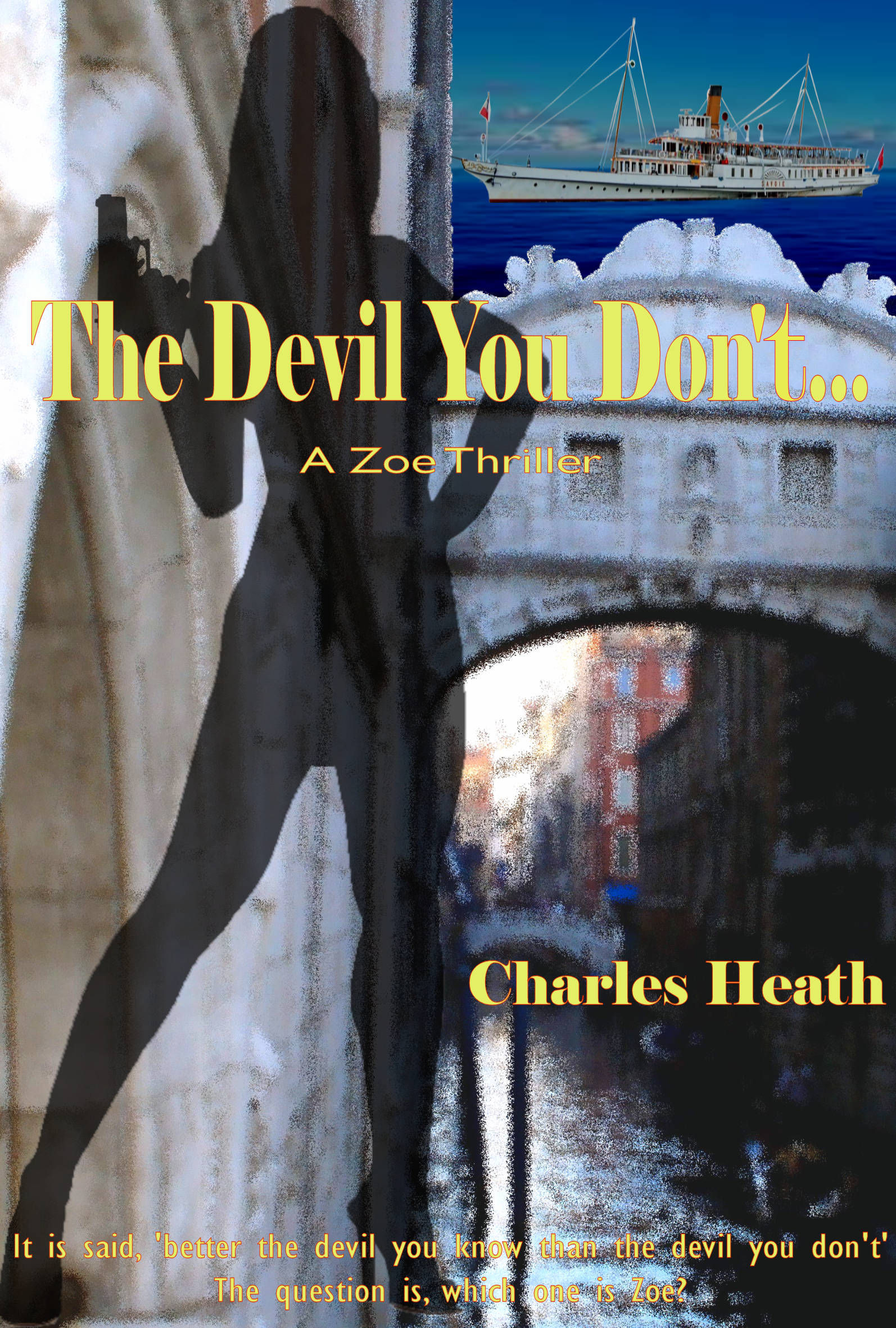
An excerpt from “The Devil You Don’t”

Available on Amazon Kindle here:  https://amzn.to/2Xyh1ow

By the time I returned to the Savoie, the rain had finally stopped, and there was a streak of blue sky to offer some hope the day would improve.

The ship was not crowded, the possibility of bad weather perhaps holding back potential passengers.  Of those I saw, a number of them would be aboard for the lunch by Phillippe Chevrier.  I thought about it, but the Concierge had told me about several restaurants in Yvoire and had given me a hand-drawn map of the village.  I think he came from the area because he spoke with the pride and knowledge of a resident.

I was looking down from the upper deck observing the last of the boarding passengers when I saw a woman, notable for her red coat and matching shoes, making a last-minute dash to get on board just before the gangway was removed.  In fact, her ungainly manner of boarding had also captured a few of the other passenger’s attention.  Now they would have something else to talk about, other than the possibility of further rain.

I saw her smile at the deckhand, but he did not smile back.  He was not impressed with her bravado, perhaps because of possible injury.  He looked at her ticket then nodded dismissively, and went back to his duties in getting the ship underway.  I was going to check the departure time, but I, like the other passengers, had my attention diverted to the woman in red.

From what I could see there was something about her.  It struck me when the light caught her as she turned to look down the deck, giving me a perfect profile.  I was going to say she looked foreign, but here, as in almost anywhere in Europe, that described just about everyone.  Perhaps I was just comparing her to Phillipa, so definitively British, whereas this woman was very definitely not.

She was perhaps in her 30’s, slim or perhaps the word I’d use was lissom, and had the look and manner of a model.  I say that because Phillipa had dragged me to most of the showings, whether in Milan, Rome, New York, London, or Paris.  The clothes were familiar, and in the back of my mind, I had a feeling I’d seen her before.

Or perhaps, to me, all models looked the same.

She looked up in my direction, and before I could divert my eyes, she locked on.  I could feel her gaze boring into me, and then it was gone as if she had been looking straight through me.  I remained out on deck as the ship got underway, watching her disappear inside the cabin.  My curiosity was piqued, so I decided to keep an eye out for her.

I could feel the coolness of the air as the ship picked up speed, not that it was going to be very fast.  With stops, the trip would take nearly two hours to get to my destination.  It would turn back almost immediately, but I was going to stay until the evening when it returned at about half eight.  It would give me enough time to sample the local fare, and take a tour of the medieval village.

Few other passengers ventured out on the deck, most staying inside or going to lunch.  After a short time, I came back down to the main deck and headed forward.  I wanted to clear my head by concentrating on the movement of the vessel through the water, breathing in the crisp, clean air, and let the peacefulness of the surroundings envelope me.

It didn’t work.

I knew it wouldn’t be long before I started thinking about why things hadn’t worked, and what part I played in it.  And the usual question that came to mind when something didn’t work out.  What was wrong with me?

I usually blamed it on my upbringing.

I had one of those so-called privileged lives, a nanny till I was old enough to go to boarding school, then sent to the best schools in the land.  There I learned everything I needed to be the son of a Duke, or, as my father called it in one of his lighter moments, nobility in waiting.

Had this been five or six hundred years ago, I would need to have sword and jousting skills, or if it had been a few hundred years later a keen military mind.  If nothing else I could ride a horse, and go on hunts, or did until they became not the thing to do.

I learned six languages, and everything I needed to become a diplomat in the far-flung British Empire, except the Empire had become the Commonwealth, and then, when no-one was looking, Britain’s influence in the world finally disappeared.  I was a man without a cause, without a vocation, and no place to go.

Computers were the new vogue and I had an aptitude for programming.  I guess that went hand in hand with mathematics, which although I hated the subject, I excelled in.  Both I and another noble outcast used to toss ideas around in school, but when it came to the end of our education, he chose to enter the public service, and I took a few of those ideas we had mulled over and turned them into a company.

About a year ago, I was made an offer I couldn’t refuse.  There were so many zeroes on the end of it I just said yes, put the money into a very grateful bank, and was still trying to come to terms with it.

Sadly, I still had no idea what I was going to do with the rest of my life.  My parents had asked me to come back home and help manage the estate, and I did for a few weeks.  It was as long as it took for my parents to drive me insane.

Back in the city, I spent a few months looking for a mundane job, but there were very few that suited the qualifications I had, and the rest, I think I intimidated the interviewer simply because of who I was.  In that time I’d also featured on the cover of the Economist, and through my well-meaning accountant, started involving myself with various charities, earning the title ‘philanthropist’.

And despite all of this exposure, even making one of those ubiquitous ‘eligible bachelor’ lists, I still could not find ‘the one’, the woman I wanted to spend the rest of my life with.  Phillipa seemed to fit the bill, but in time she proved to be a troubled soul with ‘Daddy’ issues.  I knew that in building a relationship compromise was necessary, but with her, in the end, everything was a compromise and what had happened was always going to be the end result.

It was perhaps a by-product of the whole nobility thing.  There was a certain expectation I had to fulfill, to my peers, contemporaries, parents and family, and those who either liked or hated what it represented.  The problem was, I didn’t feel like I belonged.  Not like my friend from schooldays, and now obscure acquaintance, Sebastian.  He had been elevated to his Dukedom early when his father died when he was in his twenties.  He had managed to fade from the limelight and was rarely mentioned either in the papers or the gossip columns.  He was one of the lucky ones.

I had managed to keep a similarly low profile until I met Phillipa.  From that moment, my obscurity disappeared.  It was, I could see now, part of a plan put in place by Phillipa’s father, a man who hogged the limelight with his daughter, to raise the profile of the family name and through it their businesses.  He was nothing if not the consummate self-advertisement.

Perhaps I was supposed to be the last piece of the puzzle, the attachment to the establishment, that link with a class of people he would not normally get in the front door.  There was nothing refined about him or his family, and more than once I’d noticed my contemporaries cringe at the mention of his name, or any reference of my association with him.

Yet could I truthfully say I really wanted to go back to the obscurity I had before Phillipa?  For all her faults, there were times when she had been fun to be with, particularly when I first met her when she had a certain air of unpredictability.  That had slowly disappeared as she became part of her father’s plan for the future.  She just failed to see how much he was using her.

Or perhaps, over time, I had become cynical.

I thought about calling her.  It was one of those moments of weakness when I felt alone, more alone than usual.

I diverted my attention back to my surroundings and the shoreline.  Out of the corner of my eye, I could see the woman in the red coat, making a move.  The red coat was like a beacon, a sort of fire engine red.  It was not the sort of coat most of the women I knew would wear, but on her, it looked terrific.  In fact, her sublime beauty was the one other attribute that was distinctly noticeable, along with the fact her hair was short, rather than long, and jet black.

I had to wrench my attention away from her.

A few minutes later several other passengers came out of the cabin for a walk around the deck, perhaps to get some exercise, perhaps checking up on me, or perhaps I was being paranoid.  I waited till they passed on their way forward, and I turned and headed aft.

I watched the wake sluicing out from under the stern for a few minutes, before retracing my steps to the front of the ship and there I stood against the railing, watching the bow carve its way through the water.  It was almost mesmerizing.  There, I emptied my mind of thoughts about Phillipa, and thoughts about the woman in the red coat.

Until a female voice behind me said, “Having a bad day?”

I started, caught by surprise, and slowly turned.  The woman in the red coat had somehow got very close me without my realizing it.  How did she do that?  I was so surprised I couldn’t answer immediately.

“I do hope you are not contemplating jumping.  I hear the water is very cold.”

Closer up, I could see what I’d missed when I saw her on the main deck.  There was a slight hint of Chinese, or Oriental, in her particularly around the eyes, and of her hair which was jet black.  An ancestor twice or more removed had left their mark, not in a dominant way, but more subtle, and easily missed except from a very short distance away, like now.

Other than that, she was quite possibly Eastern European, perhaps Russian, though that covered a lot of territory.  The incongruity of it was that she spoke with an American accent, and fluent enough for me to believe English was her first language.

Usually, I could ‘read’ people, but she was a clean slate.  Her expression was one of amusement, but with cold eyes.  My first thought, then, was to be careful.

“No.  Not yet.”  I coughed to clear my throat because I could hardly speak.  And blushed, because that was what I did when confronted by a woman, beautiful or otherwise.

The amusement gave way to a hint of a smile that brightened her demeanor as a little warmth reached her eyes.  “So that’s a maybe.  Should I change into my lifesaving gear, just in case?”

It conjured up a rather interesting image in my mind until I reluctantly dismissed it.

“Perhaps I should move away from the edge,” I said, moving sideways until I was back on the main deck, a few feet further away.  Her eyes had followed me, and when I stopped she turned to face me again.  She did not move closer.

I realized then she had removed her beret and it was in her left side coat pocket.  “Thanks for your concern …?”

“Zoe.”

“Thanks for your concern, Zoe.  By the way, my name is John.”

She smiled again, perhaps in an attempt to put me at ease.  “I saw you earlier, you looked so sad, I thought …”

“I might throw myself overboard?”

“An idiotic notion I admit, but it is better to be safe than sorry.”

Then she tilted her head to one side then the other, looking intently at me.  “You seem to be familiar.  Do I know you?”

I tried to think of where I may have seen her before, but all I could remember was what I’d thought earlier when I first saw her; she was a model and had been at one of the showings.  If she was, it would be more likely she would remember Phillipa, not me.  Phillipa always had to sit in the front row.

“Probably not.”  I also didn’t mention the fact she may have seen my picture in the society pages of several tabloid newspapers because she didn’t look the sort of woman who needed a daily dose of the comings and goings, and, more often than not, scandal associated with so-called celebrities.

She gave me a look, one that told me she had just realized who I was.  “Yes, I remember now.  You made the front cover of the Economist.  You sold your company for a small fortune.”

Of course.  She was not the first who had recognized me from that cover.  It had raised my profile considerably, but not the Sternhaven’s.  That article had not mentioned Phillipa or her family.  I suspect Grandmother had something to do with that, and it was, now I thought about it, another nail in the coffin that was my relationship with Phillipa.

“I wouldn’t say it was a fortune, small or otherwise, just fortunate.”  Each time, I found myself playing down the wealth aspect of the business deal.

“Perhaps then, as the journalist wrote, you were lucky.  It is not, I think, a good time for internet-based companies.”

The latter statement was an interesting fact, one she read in the Financial Times which had made that exact comment recently.

“But I am boring you.”  She smiled again.  “I should be minding my own business and leaving you to your thoughts.  I am sorry.”

She turned to leave and took a few steps towards the main cabin.

“You’re not boring me,” I said, thinking I was letting my paranoia get the better of me.  It had been Sebastian on learning of my good fortune, who had warned me against ‘a certain element here and abroad’ whose sole aim would be to separate me from my money.  He was not very subtle when he described their methods.

But I knew he was right.  I should have let her walk away.

She stopped and turned around.  “You seem nothing like the man I read about in the Economist.”

A sudden and awful thought popped into my head.  Those words were part of a very familiar opening gambit.  “Are you a reporter?”

I was not sure if she looked surprised, or amused.  “Do I look like one?”

I silently cursed myself for speaking before thinking, and then immediately ignored my own admonishment.  “People rarely look like what they are.”

I saw the subtle shake of the head and expected her to take her leave.  Instead she astonished me.

“I fear we have got off on the wrong foot.  To be honest, I’m not usually this forward, but you seemed like you needed cheering up when probably the opposite is true.  Aside from the fact this excursion was probably a bad idea.  And,” she added with a little shrug, “perhaps I talk too much.”

I was not sure what I thought of her after that extraordinary admission. It was not something I would do, but it was an interesting way to approach someone and have them ignoring their natural instinct.  I would let Sebastian whisper in my ear for a little longer and see where this was going.

“Oddly enough, I was thinking the same thing.  I was supposed to be traveling with my prospective bride.  I think you can imagine how that turned out.”

“She’s not here?”

“No.”

“She’s in the cabin?”  Her eyes strayed in that direction for a moment then came back to me.  She seemed surprised I might be traveling with someone.

“No.  She is back in England, and the wedding is off.  So is the relationship.  She dumped me by text.”

OK, why was I sharing this humiliating piece of information with her?  I still couldn’t be sure she was not a reporter.

She motioned to an empty seat, back from the edge.  No walking the plank today.  She moved towards it and sat down.  She showed no signs of being cold, nor interested in the breeze upsetting her hair.  Phillipa would be having a tantrum about now, being kept outside, and freaking out over what the breeze might be doing to her appearance.

I wondered, if only for a few seconds if she used this approach with anyone else.  I guess I was a little different, a seemingly rich businessman alone on a ferry on Lake Geneva, contemplating the way his life had gone so completely off track.

She watched as I sat at the other end of the bench, leaving about a yard between us.  After I leaned back and made myself as comfortable as I could, she said, “I have also experienced something similar, though not by text message.  It is difficult, the first few days.”

“I saw it coming.”

“I did not.”  She frowned, a sort of lifeless expression taking over, perhaps brought on by the memory of what had happened to her.  “But it is done, and I moved on.  Was she the love of your life?”

OK, that was unexpected.

When I didn’t answer, she said, “I am sorry.  Sometimes I ask personal questions without realizing what I’m doing.  It is none of my business.”  She shivered.  “Perhaps we should go back inside.”

She stood, and held out her hand.  Should I take it and be drawn into her web?  I thought of Sebastian.  What would he do in this situation?

I took her hand in mine and let her pull me gently to my feet.  “Wise choice,” she said, looking up at the sky.

It just started to rain.

© Charles Heath 2015-2020
newdevilcvr6

An excerpt from “Betrayal” – a work in progress

It could have been anywhere in the world, she thought, but it wasn’t.  It was in a city where if anything were to go wrong…

She sighed and came away from the window and looked around the room.  It was quite large and expensively furnished.  It was one of several she had been visiting in the last three months.

Quite elegant too, as the hotel had its origins dating back to before the revolution in 1917.  At least, currently, there would not be a team of KGB agents somewhere in the basement monitoring everything that happened in the room.

There was no such thing as the KGB anymore, though there was an FSB, but such organisations were of no interest to her.

She was here to meet with Vladimir.

She smiled to herself when she thought of him, such an interesting man whose command of English was as good as her command of Russian, though she had not told him of that ability.

All he knew of her was that she was American, worked in the Embassy as a clerk, nothing important, whose life both at work and at home was boring.  Not that she had blurted that out the first tie she met, or even the second.

That first time, at a function in the Embassy, was a chance meeting, a catching of his eye as he looked around the room, looking, as he had told her later, for someone who might not be as boring as the function itself.

It was a celebration, honouring one of the Embassy officials on his service in Moscow, and the fact he was returning home after 10 years.  She had been there once, and still hadn’t met all the staff.

They had talked, Vladimir knew a great deal about England, having been stationed there for a year or two, and had politely asked questions about where she lived, her family, and of course what her role was, all questions she fended off with an air of disinterested interest.

It fascinated him, as she knew it would, a sort of mental sparring as one would do with swords if this was a fencing match.

They had said they might or might not meet again when the party was over, but she suspected there would be another opportunity.  She knew the signs of a man who was interested in her, and Vladimir was interested.

The second time came in the form of an invitation to an art gallery, and a viewing of the works of a prominent Russian artist, an invitation she politely declined.  After all, invitations issued to Embassy staff held all sorts of connotations, or so she was told by the Security officer when she told him.

Then, it went quiet for a month.  There was a party at the American embassy and along with several other staff members, she was invited.  She had not expected to meet Vladimir, but it was a pleasant surprise when she saw him, on the other side of the room, talking to several military men.

A pleasant afternoon ensued.

And it was no surprise that they kept running into each other at the various events on the diplomatic schedule.

By the fifth meeting, they were like old friends.  She had broached the subject of being involved in a plutonic relationship with him with the head of security at the embassy.  Normally for a member of her rank, it would not be allowed, but in this instance it was.

She did not work in any sensitive areas, and, as the security officer had said, she might just happen upon something that might be useful.  In that regard, she was to keep her eyes and ears open and file a report each time she met him.

After that discussion, she got the impression her superiors considered Vladimir more than just a casual visitor on the diplomatic circuit.  She also formed the impression that he might consider her an ‘asset’, a word that had been used at the meeting with security and the ambassador.

It was where the word ‘spy’ popped into her head and sent a tingle down her spine.  She was not a spy, but the thought of it, well, it would be fascinating to see what happened.

A Russian friend.  That’s what she would call him.

And over time, that relationship blossomed, until, after a visit to the ballet, late and snowing, he invited her to his apartment not far from the ballet venue.  It was like treading on thin ice, but after champagne and an introduction to caviar, she felt like a giddy schoolgirl.

Even so, she had made him promise that he remain on his best behaviour.  It could have been very easy to fall under the spell of a perfect evening, but he promised, showed her to a separate bedroom, and after a brief kiss, their first, she did not see him until the next morning.

So, it began.

It was an interesting report she filed after that encounter, one where she had expected to be reprimanded.

She wasn’t.

It wasn’t until six weeks had passed when he asked her if she would like to take a trip to the country.  It would involve staying in a hotel, that they would have separate rooms.  When she reported the invitation, no objection was raised, only a caution; keep her wits about her.

Perhaps, she had thought, they were looking forward to a more extensive report.  After all, her reports on the places, and the people, and the conversations she overheard, were no doubt entertaining reading for some.

But this visit was where the nature of the relationship changed, and it was one that she did not immediately report.  She had realised at some point before the weekend away, that she had feelings for him, and it was not that he was pushing her in that direction or manipulating her in any way.

It was just one of those moments where, after a grand dinner, a lot of champagne, and delightful company, things happen.  Standing at the door to her room, a lingering kiss, not intentional on her part, and it just happened.

And for not one moment did she believe she had been compromised, but for some reason she had not reported that subtle change in the relationship to the powers that be, and so far, no one had any inkling.

She took off her coat and placed it carefully of the back of one of the ornate chairs in the room.  She stopped for a moment to look at a framed photograph on the wall, one representing Red Square.

Then, after a minute or two, she went to the mini bar and took out the bottle of champagne that had been left there for them, a treat arranged by Vladimir for each encounter.

There were two champagne flutes set aside on the bar, next to a bowl of fruit.  She picked up the apple and thought how Eve must have felt in the garden of Eden, and the temptation.

Later perhaps, after…

She smiled at the thought and put the apple back.

A glance at her watch told her it was time for his arrival.  It was if anything, the one trait she didn’t like, and that was his punctuality.  A glance at the clock on the room wall was a minute slow.

The doorbell to the room rang, right on the appointed time.

She put the bottle down and walked over to the door.

A smile on her face, she opened the door.

It was not Vladimir.  It was her worst nightmare.

© Charles Heath 2020

Those moments of depression are seeping into my writing

Nothing I write makes any sense, it doesn’t fit, it doesn’t progress the story, they are just words on a piece of paper.  Perhaps it’s those moments of despair that are holding me back, those thoughts that begin to swirl in your head when the dream you had in your head becomes very different from what happens in reality.

And this is the problem, there are so many people out there that say, ‘dare to dream’, or ‘today its a dream tomorrow it is reality’.

Is it?

For some, those with the state of mind, the drive, and the confidence to pull it off, it might be, but for the rest of us, and that’s a lot of people trying to head down that same path f success, it’s a lot harder.

And you can bet those seminar or conference speakers have pocked the thousands of dollars they got for the gig, and have moved on to the next group of … well, let’s not give them a name.

I wish I could stand up in front of 200 budding authors and tell them, in the same bright breezy manner that they are on the way to success, just follow the ten proven steps, but I can’t.  I know how hard that road is.

Like starting a farm, you don’t just walk onto the land, say you’re going to be a farmer, and magically everything happens.  It doesn’t.  It’s bloody hard work, and a lot of it, with heartbreak, and setbacks, and sometimes even a disaster.

It’s the same with writing.

You don’t sit at the typewriter, in front of a notebook, or computer screen, and it all just comes together.  It doesn’t.

For some, it might, but for the rest of us, it’s a long hard road, just to get some form of recognition.  And even then, like in the movies, fame can be fleeting, gone in the blink of an eye.

You have to produce, trying to produce creates pressure, pressure creates depression, and well. you get the picture, it’s a bit like the cycle of life.

OK, whinge over.

Time to get back to work.


Does every writer suffer from this dilemma?

If I get a headache I can take paracetamol

If I have a sore back I can take ipBrufen.

If I can’t put words on paper … what is there I can take?

It affects us all at some point, but it’s not necessarily that old demon writer’s block.

What is writer’s block anyway?  Is it some existential disease that doesn’t really exist, yet something we can blame where we can’t write?

So, it’s down to looking for reasons, and logically looking at what is the underlying cause of the problem.  We should be asking ourselves questions, like

Are we constantly distracted from writing?

Plan or no plan, subconsciously it doesn’t feel right, that the next scene, plotline or character interaction does follow, is contrived, is just plain wrong?

Usually, for me, it only takes two questions and the answer pops up.

I’ve written myself into the proverbial corner, and there’s no logical way to go forward.

What does that mean?

Well, that is covered by a third possible outcome from answering the questions.

I have to go back and do some major re-writes of earlier work, make sure there are the appropriate hooks and maybe even change the direction, even if just a little.

That, in itself, in the back of your mind, knowing what has to be done, and putting off the inevitable, is another reason why this project isn’t moving forward.

Two aspirin can’t solve this.

Nothing can.

Perhaps we should rename writer’s block to writer’s dilemma.

Searching for locations: We’ve just arrived in Beijing International Airport, China

Instead of making a grand entrance, arriving in style and being greeted by important dignitaries, we are slinking in via an airplane, late at night. It’s hardly the entrance I’d envisaged. At 9:56 the plane touches down on the runway.  Outside the plane, it is dark and gloomy and from what I could see, it had been raining.  That could, of course, simply be condensation.

Once on the ground, everyone was frantically gathering together everything from seat pockets and sending pillows and blankets to the floor.  A few were turning their mobile phones back on, and checking for a signal, and, perhaps, looking for messages sent to them during the last 12 hours. Or perhaps they were just suffering from mobile phone deprivation.

It took 10 minutes for the plane to arrive at the gate. That’s when everyone moves into overdrive, unbuckling belts, some before the seatbelt sign goes off, and are first out of their seats and into the overhead lockers.  Most are not taking care that their luggage may have moved, but fortunately, no bags fall out onto someone’s head. The flight had been relatively turbulent free.

When as many people and bags have squeezed into that impossibly small aisle space, we wait for the door to open, and then the privileged few business and first-class passengers to depart before we can begin to leave. As we are somewhere near the middle of the plane, our wait will not be as long as it usually is.  This time we avoided being at the back of the plane.  Perhaps that privilege awaits us on the return trip.

Once off the plane, it is a matter of following the signs, some of which are not as clear as they could be.  It’s why it took another 30 odd minutes to get through immigration, but that was not necessarily without a few hiccups along the way. We got sidetracked at the fingerprint machines, which seemed to have a problem if your fingers were not straight, not in the center of the glass, and then if it was generally cranky, which ours were, continue to tell you to try again, and again, and again, and again…That took 10 to 15 minutes before we joined an incredibly long queue of other arrivals,

A glance at the time, and suddenly it’s nearly an hour from the moment we left the plane.

And…

That’s when we got to the immigration officer, and it became apparent we were going to have to do the fingerprints yet again.  Fortunately this time, it didn’t take as long.  Once that done, we collected our bags, cleared customs by putting our bags through a huge x-ray machine, and it was off to find our tour guide.


We found several tour guides with their trip-a-deal flags waiting for us to come out of the arrivals hall.  It wasn’t a difficult process in the end.  We were in the blue group.  Other people we had met on the plane were in the red group or the yellow group.  The tour guide found, or as it turned out she found us, it was simply a matter of waiting for the rest of the group, of which there were eventually 28.Gathered together we were told we would be taking the bags to one place and then ourselves to the bus in another.  A glance in the direction of the bus park, there were a lot of busses.

Here’s a thought, imagine being told your bus is the white one with blue writing on the side.

Yes, yours is, and 25 others because all of the tourist coaches are the same.  An early reminder, so that you do not get lost, or, God forbid, get on the wrong bus, for the three days in Beijing, is to get the last five numbers of the bus registration plate and commit them to memory.  It’s important.  Failing that, the guide’s name is in the front passenger window.

Also, don’t be alarmed if your baggage goes in one direction, and you go in another. In a rather peculiar set up the bags are taken to the hotel by what the guide called the baggage porter.  It is an opportunity to see how baggage handlers treat your luggage; much better than the airlines it appears.


That said, if you’re staying at the Beijing Friendship Hotel, be prepared for a long drive from the airport.  It took us nearly an hour, and bear in mind that it was very late on a Sunday night.

Climbing out of the bus after what seemed a convoluted drive through a park with buildings, we arrive at the building that will be our hotel for the next three days.  From the outside, it looks quite good, and once inside the foyer, that first impression is good.  Lots of space, marble, and glass.  If you are not already exhausted by the time you arrive, the next task is to get your room key, find your bags, get to your room, and try to get to be ready the next morning at a reasonable hour.

Sorry, that boat has sailed.

We were lucky, we were told, that our plane arrived on time, and we still arrived at the hotel at 12:52.  Imagine if the incoming plane is late.

This was taken the following morning.  It didn’t look half as bland late at night.

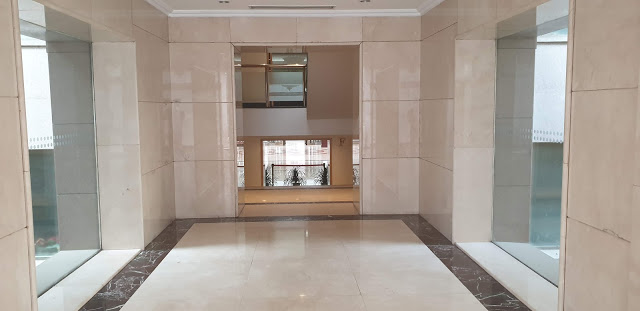
This is the back entrance to Building No 4 but is quite representative of the whole foyer, made completely of marble and glass.  It all looked very impressive under the artificial lights, but not so much in the cold hard light of early morning.

This the foyer of the floor our room was on.  Marble with interesting carpet designs.  Those first impressions of it being a plush hotel were slowly dissipating as we got nearer and nearer to the room.  From the elevator, it was a long, long walk.

So…Did I tell you about the bathroom in our room?

The shower and the toilet both share the same space with no divide and the shower curtain doesn’t reach to the floor.  Water pressure is phenomenal.  Having a shower floods the whole shower plus toilet area so when you go to the toilet you’re basically underwater.

Don’t leave your book or magazine on the floor or it will end up a watery mess.

And the water pressure is so hard that it could cut you in half.  Only a small turn of the tap is required to get that tingling sensation going.

It’s after 1:30 before we finally get to sleep.

As for the bed, well, that’s a whole other story.