An excerpt from “Betrayal” – a work in progress

It could have been anywhere in the world, she thought, but it wasn’t.  It was in a city where if anything were to go wrong…

She sighed and came away from the window and looked around the room.  It was quite large and expensively furnished.  It was one of several she had been visiting in the last three months.

Quite elegant too, as the hotel had its origins dating back to before the revolution in 1917.  At least, currently, there would not be a team of KGB agents somewhere in the basement monitoring everything that happened in the room.

There was no such thing as the KGB anymore, though there was an FSB, but such organisations were of no interest to her.

She was here to meet with Vladimir.

She smiled to herself when she thought of him, such an interesting man whose command of English was as good as her command of Russian, though she had not told him of that ability.

All her knew of her was that she was American, worked in the Embassy as a clerk, nothing important, who life both at work and at home was boring.  Not that she had blurted that out the first tie she met, or even the second.

That first time, at a function in the Embassy, was a chance meeting, a catching of his eye as he looked around the room, looking, as he had told her later, for someone who might not be as boring as the function itself.

It was a celebration, honouring one of the Embassy officials on his service in Moscow, and the fact he was returning home after 10 years.  She had been there one, and still hadn’t met all the staff.

They had talked, Vladimir knew a great deal about England, having been stationed there for a year or two, and had politely asked questions about where she lived, her family, and of course what her role was, all questions she fended off with an air of disinterested interest.

It fascinated him, as she knew it would, a sort of mental sparring as one would do with swords, if this was a fencing match.

They had said they might or might not meet again when the party was over, but she suspected there would be another opportunity.  She knew the signs of a man who was interested in her, and Vladimir was interested.

The second time came in the form of an invitation to an art gallery, and a viewing of the works of a prominent Russian artist, an invitation she politely declined.  After all, invitations issued to Embassy staff held all sorts of connotations, or so she was told by the Security officer when she told him.

Then, it went quiet for a month.  There was a party at the American embassy and along with several other staff members, she was invited.  She had not expected to meet Vladimir, but it was a pleasant surprise when she saw him, on the other side of the room, talking to several military men.

A pleasant afternoon ensued.

And it was no surprise that they kept running into each other at the various events on the diplomatic schedule.

By the fifth meeting, they were like old friends.  She had broached the subject of being involved in a plutonic relationship with him with the head of security at the embassy.  Normally for a member of her rank it would not be allowed, but in this instance it was.

She did not work in any sensitive areas, and, as the security officer had said, she might just happen upon something that might be useful.  In that regard, she was to keep her eyes and ears open, and file a report each time she met him.

After that discussion she got the impression her superiors considered Vladimir more than just a casual visitor on the diplomatic circuit.  She also formed the impression the he might consider her an ‘asset’, a word that had been used at the meeting with security and the ambassador.

It was where the word ‘spy’ popped into her head and sent a tingle down her spine.  She was not a spy, but the thought of it, well, it would be fascinating to see what happened.

A Russian friend.  That’s what she would call him.

And over time, that relationship blossomed, until, after a visit to the ballet, late and snowing, he invited her to his apartment not far from the ballet venue.  It was like treading on thin ice, but after champagne and an introduction to caviar, she felt like a giddy schoolgirl.

Even so, she had made him promise that he remain on his best behaviour.  It could have been very easy to fall under the spell of a perfect evening, but he promised, showed her to a separate bedroom, and after a brief kiss, their first, she did not see him until the next morning.

So, it began.

It was an interesting report she filed after that encounter, one where she had expected to be reprimanded.

She wasn’t.

It wasn’t until six weeks had passed when he asked her if she would like to take a trip to the country.  It would involve staying in a hotel, that they would have separate rooms.  When she reported the invitation, no objection was raised, only a caution; keep her wits about her.

Perhaps, she had thought, they were looking forward to a more extensive report.  After all, her reports on the places, and the people, and the conversations she overheard, were no doubt entertaining reading for some.

But this visit was where the nature of the relationship changed, and it was one that she did not immediately report.  She had realised at some point before the weekend away, that she had feelings for him, and it was not that he was pushing her in that direction or manipulating her in any way.

It was just one of those moments where, after a grand dinner, a lot of champagne, and delightful company, things happen.  Standing at the door to her room, a lingering kiss, not intentional on her part, and it just happened.

And for not one moment did she believe she had been compromised, but for some reason she had not reported that subtle change in the relationship to the powers that be, and so far, no one had any inkling.

She took off her coat and placed it carefully of the back of one of the ornate chairs in the room.  She stopped for a moment to look at a framed photograph on the wall, one representing Red Square.

Then, after a minute or two, she went to the mini bar and took out the bottle of champagne that had been left there for them, a treat arranged by Vladimir for each encounter.

There were two champagne flutes set aside on the bar, next to a bowl of fruit.  She picked up the apple and thought how Eve must have felt in the garden of Eden, and the temptation.

Later perhaps, after…

She smiled at the thought and put the apple back.

A glance at her watch told her it was time for his arrival.  It was if anything, the one trait she didn’t like, and that was his punctuality.  A glance at the clock on the room wall was a minute slow.

The doorbell to the room rang, right on the appointed time.

She put the bottle down and walked over to the door.

A smile on her face, she opened the door.

It was not Vladimir.  It was her worst nightmare.

© Charles Heath 2020

In a word: Ghost

Have you seen one?  I haven’t.  Yet.

I’ve stayed in a few places where ghosts were purported to be roaming the passages at night, but apparently not the night I was staying.

And that’s something else that I have a problem with, why is it ghosts only come out at night, or is that just the perception I have hot from reading up on the subject.

Maybe my view of ghosts is somewhat stilted, after all, I think my first introduction to ghosts was watching The Centerville Ghost, a movie I saw on t.v. when I was very young.

You have to admit Hollywood’s perception of ghosts is quite interesting.


But…

Do you think they are real?  Do I think they are real?

I think I would have to be presented with some fairly solid evidence they exist, but perhaps not to the point of meeting one.

There are, it seems countless examples of ethereal forces, you know, wind blowing where there’s no wind or draught outside, room temperatures dropping for no apparent reason, knocking, rattling of chains, strange noises like low moaning.


And yet…

There are hotels you can stay in such as the Chelsea Hotel in New York, where it’s possible to run into Sid Vicious.

Sorry, not staying there any time soon.

Then there’s the Hollywood Roosevelt Hotel in Los Angeles where it’s possible to run into Marylin Monroe, who lived in room 229.

That could be an interesting encounter.

Another is the Westin St Francis in San Francisco where the actress Virginia Rappe died while attending a party held in Fatty Arbuckle’s room, Arbuckle’s room, who was later accused of assaulting and murdering her, and whose career tanked after the incident.

Her ghost is seen moving about the hotel tearing her hair out.  It seems all of the spectral activity occurs on the 12th floor.


Good to know if I decide to stay there.  I wonder if they have a 13th floor?

Perhaps in too old to be running the gamut of paranormal experiences, the old heart is not as strong as it used to be.

An excerpt from “If Only” – a work in progress

Investigation of crimes don’t always go according to plan, nor does the perpetrator get either found or punished.

That was particularly true in my case.  The murderer was very careful in not leaving any evidence behind, to the extent that the police could not rules out whether it was a male or a  female.

At one stage the police thought I had murdered my own wife though how I could be on a train at the time of the murder was beyond me.  I had witnesses and a cast-iron alibi.

The officer in charge was Detective Inspector Gabrielle Walters.  She came to me on the day after the murder seeking answers to the usual questions when was the last time you saw your wife, did you argue, the neighbors reckon there were heated discussions the day before.

Routine was the word she used.

Her Sargeant was a surly piece of work whose intention was to get answers or, more likely, a confession by any or all means possible.  I could sense the raging violence within him.  Fortunately, common sense prevailed.

Over the course of the next few weeks, once I’d been cleared of committing the crime, Gabrielle made a point of keeping me informed of the progress.

After three months the updates were more sporadic, and when, for lack of progress, it became a cold case, communication ceased.

But it was not the last I saw of Gabrielle.

The shock of finding Vanessa was more devastating than the fact she was now gone, and those images lived on in the same nightmare that came to visit me every night when I closed my eyes.

For months I was barely functioning, to the extent I had all but lost my job, and quite a few friends, particularly those who were more attached to Vanessa rather than me.

They didn’t understand how it could affect me so much, and since it had not happened to them, my tart replies of ‘you wouldn’t understand’ were met with equally short retorts.  Some questioned my sanity, even, for a time, so did I.

No one, it seemed, could understand what it was like, no one except Gabrielle.

She was by her own admission, damaged goods, having been the victim of a similar incident, a boyfriend who turned out to be a very bad boy.  Her story varied only in she had been made to witness his execution.  Her nightmare, in reliving that moment in time, was how she was still alive and, to this day, had no idea why she’d been spared.

It was a story she told me one night, some months after the investigation had been scaled down.  I was still looking for the bottom of a bottle and an emotional mess.  Perhaps it struck a resonance with her; she’d been there and managed to come out the other side.

What happened become our secret, a once-only night together that meant a great deal to me, and by mutual agreement, it was not spoken of again.  It was as if she knew exactly what was required to set me on the path to recovery.

And it had.

Since then we saw each about once a month in a cafe.   I had been surprised to hear from her again shortly after that eventful night when she called to set it up, ostensibly for her to provide me with any updates on the case, but perhaps we had, after that unspoken night, formed a closer bond than either of us wanted to admit.

We generally talked for hours over wine, then dinner and coffee.  It took a while for me to realize that all she had was her work, personal relationships were nigh on impossible in a job that left little or no spare time for anything else.

She’d always said that if I had any questions or problems about the case, or if there was anything that might come to me that might be relevant, even after all this time, all I had to do was call her.

I wondered if this text message was in that category.  I was certain it would interest the police and I had no doubt they could trace the message’s origin, but there was that tiny degree of doubt, whether or not I could trust her to tell me what the message meant.

I reached for the phone then put it back down again.  I’d think about it and decide tomorrow.

© Charles Heath 2018-2020

Back on the starship…

Well, we were off to an illustrious start until the dulcet tomes of the Chief Engineer rang through the bridge, uttering those fateful words, “the warp coil has had a catastrophic failure”.

This was et with alternately, the Chief Engineer is prone to hyperbole, to ‘they just don’t make warp coils like they used to’.

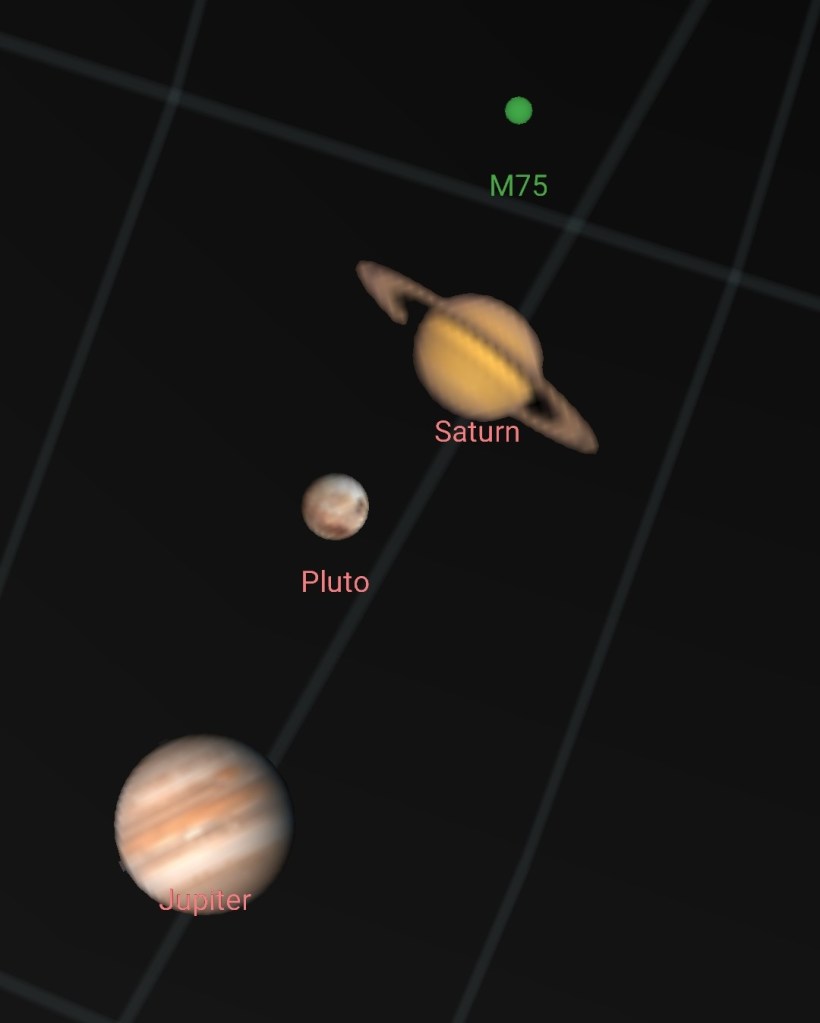
Looking at the screen, we can see the planets taunting us :

I was curious about M75, but the helmsman, a rather taciturn chap who seemed to resent the fact he was assigned to this ship, just shrugged and said, “it’s something, somewhere, but not of much interest,” then went back to his console, probably in the middle of a solitaire game.

If this was Star Trek we’d be ejecting the warp coil by now, but in the space dock, that didn’t seem to me to be a viable option.

“How long before we can get this bucket of bolts moving,” I ask the Chief.

“I’m going as fast as I can.”

Yes, words ripped right out of the script of a Star Trek episode, I thought. A sad case of life imitating art.

A strange whistling sound emanated from the speakers, then the whoosh of the elevator just before the doors opened. OK, new ship, squeaky doors, an item to be put on the ‘look at’ list after the shakedown cruise.

It’s the Captain.

“Why are we still in dock, Number One.” For a moment there, I thought I was talking to John Luc Picard.

“Faulty warp coil. You know how it goes, save a billion by sub contracting to the Chinese.”

The Captain doesn’t appreciate my sardonic humour, or my apparent disparagement of the Chinese manufacturing sector. Maybe that’s because he is of Chinese descent. “I’ll be in my quarters. Let me know when we’re about to leave.”

He doesn’t wait for acknowledgement, and disappears through another squeaky door. More repairs.

The Chief’s voice comes over the speakers. “I can give you impulse speed, warp speed will take a little longer.”

“Doesn’t that refer to miracles over the impossible,” I ask.

“Perhaps. I need a specific spanner, and the replicators are down. So, now we have to fix them, before moving on. Might take a while.”

I look around the crew, seeing their expectant faces drop with disappointment.

Outer space was going to have to wait a little longer.

© Charles Heath 2020

“Strangers We’ve Become”, a sequel to “What Sets Us Apart”

Stranger’s We’ve Become, a sequel to What Sets Us Apart.

The blurb:

Is she or isn’t she, that is the question!

Susan has returned to David, but he is having difficulty dealing with the changes. Her time in captivity has changed her markedly, so much so that David decides to give her some time and space to re-adjust back into normal life.

But doubts about whether he chose the real Susan remain.

In the meantime, David has to deal with Susan’s new security chief, the discovery of her rebuilding a palace in Russia, evidence of an affair, and several attempts on his life. And, once again, David is drawn into another of Predergast’s games, one that could ultimately prove fatal.

From being reunited with the enigmatic Alisha, a strange visit to Susan’s country estate, to Russia and back, to a rescue mission in Nigeria, David soon discovers those whom he thought he could trust each has their own agenda, one that apparently doesn’t include him.

The Cover:

strangerscover9

Coming soon


In a word: Brevity

Now, brevity is something that I have not been able to fully wrap my head around.

The dictionary explains Brevity as

‘concise and exact use of words in writing and speech’

So…

I remember working with a writer a long time ago who explained certain authors styles, and for James A Michener of Hawaii fame, he said Michener wrote sentences instead of words, paragraphs instead of sentences, pages instead of paragraphs and chapters instead of pages.

It was a little harsh considering I’d just read the book and had liked it, despite its length and the time it took.

But some time later I realized he was not criticizing Michener, but trying to tell me, in his, what I came to discover, interesting way, that I should strive to write more compactly.

I then came across a book by Brian Callison which was exactly that, the concise version, a story that fitted into about 200 pages.

That too was a good book and it took me a day to read it, and by his use of that economy of words, it read quickly.

Of course, I have tried over the years to emulate both styles, and to a certain degree, failing, because I think I have created my own style which is somewhere in between.

Still, when editing, it is always in the back of my mind that I should be

Using words instead of sentences

Using sentences instead of paragraphs

Using paragraphs instead of pages, and

Using pages instead of chapters.

The chapters, he said, with an air of amusement, will always take care of themselves.


An excerpt from “Echoes from the Past”

Available on Amazon Kindle here:  https://amzn.to/2CYKxu4


With my attention elsewhere, I walked into a man who was hurrying in the opposite direction.  He was a big man with a scar running down the left side of his face from eye socket to mouth, and who was also wearing a black shirt with a red tie.

That was all I remembered as my heart almost stopped.

He apologized as he stepped to one side, the same way I stepped, as I also muttered an apology.

I kept my eyes down.  He was not the sort of man I wanted to recognize later in a lineup.  I stepped to the other side and so did he.  It was one of those situations.  Finally getting out of sync, he kept going in his direction, and I towards the bus, which was now pulling away from the curb.

Getting my breath back, I just stood riveted to the spot watching it join the traffic.  I looked back over my shoulder, but the man I’d run into had gone.  I shrugged and looked at my watch.  It would be a few minutes before the next bus arrived.

Wait, or walk?  I could also go by subway, but it was a long walk to the station.  What the hell, I needed the exercise.

At the first intersection, the ‘Walk’ sign had just flashed to ‘Don’t Walk’.  I thought I’d save a few minutes by not waiting for the next green light.  As I stepped onto the road, I heard the screeching of tires.

A yellow car stopped inches from me.

It was a high powered sports car, perhaps a Lamborghini.  I knew what they looked like because Marcus Bartleby owned one, as did every other junior executive in the city with a rich father.

Everyone stopped to look at me, then the car.  It was that sort of car.  I could see the driver through the windscreen shaking his fist, and I could see he was yelling too, but I couldn’t hear him.  I stepped back onto the sidewalk, and he drove on.  The moment had passed and everyone went back to their business.

My heart rate hadn’t come down from the last encounter.   Now it was approaching cardiac arrest, so I took a few minutes and several sets of lights to regain composure.

At the next intersection, I waited for the green light, and then a few seconds more, just to be sure.  I was no longer in a hurry.

At the next, I heard what sounded like a gunshot.  A few people looked around, worried expressions on their faces, but when it happened again, I saw it was an old car backfiring.  I also saw another yellow car, much the same as the one before, stopped on the side of the road.  I thought nothing of it, other than it was the second yellow car I’d seen.

At the next intersection, I realized I was subconsciously heading towards Harry’s new bar.   It was somewhere on 6th Avenue, so I continued walking in what I thought was the right direction.

I don’t know why I looked behind me at the next intersection, but I did.  There was another yellow car on the side of the road, not far from me.  It, too, looked the same as the original Lamborghini, and I was starting to think it was not a coincidence.

Moments after crossing the road, I heard the roar of a sports car engine and saw the yellow car accelerate past me.  As it passed by, I saw there were two people in it, and the blurry image of the passenger; a large man with a red tie.

Now my imagination was playing tricks.

It could not be the same man.  He was going in a different direction.

In the few minutes I’d been standing on the pavement, it had started to snow; early for this time of year, and marking the start of what could be a long cold winter.  I shuddered, and it was not necessarily because of the temperature.

I looked up and saw a neon light advertising a bar, coincidentally the one Harry had ‘found’ and, looking once in the direction of the departing yellow car, I decided to go in.  I would have a few drinks and then leave by the back door if it had one.

Just in case.


© Charles Heath 2015-2020

newechocover5rs

“Chance Encounter”, A short story

The afternoon rush hour jammed the exit roads, particularly those to the beach.  Nearly everyone was heading for relief from the heat wave, now in its tenth consecutive day.  What had started out a novelty was now just tiresome, with no forecast respite.

A light breeze tried to fan away the afternoon heat, but it had little impact.  The temperature was still hovering in the high 30’s when Bill left the office at 6:30 that evening.

On the road it was little better, and hotter in the car than out.  There was no point running the air conditioner in those conditions, as both he and many others had discovered.  The stop-start traffic made it worse, and people who had already suffered enough were close to breaking point.

Once again, the traffic stopped, and tempers frayed to the point of blowing horns and yelling forlorn abuse at some unseen driver or cause.  It was a no-win situation, and to Bill, a waste of time and energy.  His time and energy, he thought, was best directed at analysis.  Yet how different had the afternoon been to what was currently happening?

In charge of the Customer Service centre for the area’s electricity supplier, it had been difficult to say the least.  That afternoon had seen the highest consumption of electricity since the heat wave began, since time immemorial for that matter, and had started to affect the functionality of the grid, with the first failures occurring. 

It had been predicted, but was not expected quite this early, and as parts of the city were beginning to feel the effect of temporary blackouts, his, and his staff’s work had begun to receive the full effect of the community’s contempt and hatred. 

The traffic disaster was not a patch on the abuse both he and members of his staff had received that afternoon, and he instinctively knew it was not going to improve.

Normally he would stay on and help the incoming supervisor.  This time, someone else could handle the problems.  Doing the usual Friday afternoon desk clean up, he’d found the invitation to Wally’s stag party and as best man, he was obligated to go.  One of the other and more compelling reasons was to see which of his colleagues would make a fool of themselves.

It didn’t take long to get home and change into what he considered proper party attire.  He smiled at the thought of being an anachronism from a bygone age, and of what others thought of him.  He was too old to change.

Before leaving, he lingered over several glasses of champagne, and strawberries, trying to get into the mood.  At the same time, he surveyed the ravages of middle management pressures.  Just a year in the job had aged him five, and a tinges of grey beginning to appear at the sides.

A wave of tiredness came over him.  The thought of staying home and immersing himself in classical music and another bottle of champagne crossed his mind, but he said he would go.  Wally was one of the few he could call a true friend.  He would go, but not stay long.

As usual, he was late.

Groups had spilled out onto the front veranda, and onto the front lawn.  He knew most of the partygoers by sight, if not by name.  Acquaintances, not friends.  Not the sort of people he usually mingled with.  He exchanged greetings, accepted drinks, and tried to maintain appearances.

It didn’t take long to realise it was a mistake.  The carnival atmosphere and good cheer all around him made him feel melancholier, as a wave of loneliness closed around him like the night air.

He knew only too well what the problem was but had no idea how to deal with it.  Neither his upbringing, nor experience was of any use.  It would require outside help; the sort Wally had already offered.  Just when would he do something about it, if at all?  If the truth were known, Bill was too frightened of the consequences, of getting hurt.  Perhaps a few more drinks…

Making his way through the crowded rooms towards the back of the house, he felt the deadening effect of the alcohol beginning to fight off the empty feeling within.

He made desultory conversation with a secretary he knew was high on the dating list for most junior executives, deriving some pleasure in the thought she talked to him, then to another young lady who worked his shift, whom he thought both intelligent and charming, and whose behaviour didn’t shatter his assumptions as some others had.

As the night wore on. it became evident few had noticed his arrival, even fewer his sudden disappearance to the back veranda, overlooking the ocean.  He had seen Wally on one occasion when he was trying to drink about 10 gallons of beer in one attempt and thought it wise not to interrupt.

It was, he thought, all part of the game, to drink so much he would forget how it was when he was single, though Bill doubted he could do it in a single night.  Bill could hardly wait till the wedding the next afternoon.

He looked back momentarily at the apparent abandon of the other guests, hearing the muted murmur of endless conversations, and loud music.  Everyone was having a good time, as it should be.

The gentle, soothing, lapping of the tide on the beach beckoned him.  He put his empty glass on a ledge and went quietly down the stairs onto the sand.  A refreshing, cool breeze rolled in with the tide, immediately improving his mood.

At the water’s edge, he paused momentarily to soak in the calming atmosphere, then put his hands in his pockets and headed for the pier.  A leisurely stroll there and back would be sufficient break to enable him to endure the rest of the evening.  Yes, he would stay, if only to see that Wally didn’t overindulge.  After all, some duties did fall on the incumbent best man.

Occasionally he kicked the sand with the toe of his shoe, once for a thoroughly detestable human relations consultant, and another for a particularly annoying assistant.  It scuffed the high polish, but he didn’t care.  This was a time where near impeccable would be good enough.

He was alone, and in more ways than one, he thought, but it was more by design than by accident.  He had recently been involved in a relationship that was doomed before it began.  Work had always pushed that side of his life into second place because he let it.

Now, having thought about it rationally for the first time, he realised it was time to place less importance on work, and more to giving any sort of relationship a chance.

Wally had offered to find him someone, but knowing Wally as he did, Bill had declined.  Of course, to Wally ‘no’ really meant go ahead anyway.  While at the party, he had surveyed those he thought Wally might have invited as potential matches, some voluptuous, some half-naked, some painted, some all three.

There was no doubting their intent, and he had seen the same in the singles bars when on the town with Wally when they had nothing better to do with a Friday night.  Yet, none of those he’d seen, then or now, matched his criteria.  Were his standards set too high?  Wally never said it, but the fact he didn’t said more than if he had said it out loud.

Bill sighed.  Perhaps he was too set in his ways and unable to change.

Adjoining the pier was the old amusement centre, burnt down several years before.  It was the reason for the closing of the beach, and its recent exclusivity to those nearby backing onto the beach.  All that remained was the scorched concrete floor and parts of the walls.  It was these remains he had just gone under.

Beneath them, the sounds of the sea and the night were more pronounced, creating an eerie, sinister feeling.  The smell of the burnt timber still hung in the air, despite the intervening years.

“Hi!”  A feminine voice came out from the shadows, behind one of the pylons nearby.

He started violently, not expecting anyone else.  It took a moment to collect his thoughts, then turn to see who she was. 

“Oh,” was all he could say to the now visible girl’s outline etched against the distant city lights.

Both came out the other side together into the half-light, leaving the gloom behind.  She began, “I hope I didn’t scare you back there?”

“Only half to death.”  He brushed the non-existent wrinkles out of his dinner suit, more a reflex action, then put his hands back in his pockets, composure regained.

“I’m awfully sorry.  I didn’t mean to.”

He was a little angry, and turning to her, said quietly, “Then what was….” He stopped suddenly, surprised at what he saw.  Tall, well proportioned, dressed in expensive eveningwear, much the same as he was.  He instantly realised she could almost pass as an exact replica of Venus except for the untidyish, waist length hair.

“I don’t know.  I guess I wanted to talk to someone, you were handy, so I just said ‘hi’.”  Her tone was apprehensive, with a slight tremor in it. 

She smiled nervously, yet in a way, he noticed it totally changed her appearance, and his heart missed a beat.

“Oh,” he said again, subconsciously feeling she had put him in his place.  He shook his head and looked again, disbelieving what he saw.

“I hope you don’t mind?”

“Don’t mind what?”  He’d lost track of the conversation, and realised he was quickly moving towards looking and sounding like a gibbering idiot.  It was, he realised, just like every other time when faced with a beautiful woman.

“Me talking to you.”

He took a deep breath and tried to remain calm.  He could feel a runnel of sweat slide down the side of his face, “No.  Not really.  It’s just the diversion I need”.  He looked at the sand, the sea, then her.  “I have a feeling I’ve seen you before.” 

He moved on, and so did she, both in unison.

“Staring at you from the pages of magazines?”

“I guess so.  What did you do?  Rob a bank?  Divorce a Prince, or millionaire?”

“As if.  Nothing quite as exotic, or exciting, I’m afraid.  Just draped in clothes or plastered in make-up.  Boring huh?”

“No.  Not really.”

“You’re a bit hard up for new lines?”

He shrugged.  It was difficult talking to this woman, and, lacking in confidence, he was starting to feel a little embarrassed.

She changed the subject.  “Do you live here?”

“No….”

“Don’t say it, not really!” she interrupted.

He sighed, trying to regain composure.  “OK.  I was at a party.”

“Aha.  Now we’re getting somewhere.”  Then she gave him a curious look.  “Was?”  Then, after he didn’t answer, “How come you’re not with the others, having a good time?”

“Perhaps I’m not cut out to ‘have a good time’.  Actually, I thought I’d take a time out from the frenetic pace and get some fresh air.”

“And now the fresh air had lost its appeal?”

“I didn’t say that.”  Did that come out sounding flustered?  It was how he felt inside.  He was going to have to try harder if he was to keep her interest.  “It’s beginning to get interesting.  And I still can’t place where I’ve seen you before.”  He shook his head.  “No matter.  What brings you here?”

“Someone told me about this place a long time ago.  I thought I’d come and check it out.”

He turned and headed back, deciding the diversion had exceeded the time limit he’d set, and it had now become an elongated absence.  She did the same.

“And what do you think?” he asked.

“About what?”

This conversation would sound very strange if anyone else was nearby listening to them.  Luckily, there wasn’t.  “This place.”

“Very peaceful, secluded, interesting, as you said.”

“Interesting in what way?”  Damn, had he asked that already?

“Well …”  She shrugged, then asked, “Do you always walk around with your hands in your pockets?”

Simple answer, yes.  “Can’t think of where else to put them.” 

What did it have to do with her anyway?  And, in that instant, he realised that it he who was the problem here, not her.

“What if you were to hold a girl’s hand?”

“I don’t know of any who would want me to.”

“Would you like to hold mine?”

“Why?  Is it going to run away?”

She smiled.  “More than likely.”

He stopped.  She stopped.  He surveyed her with a critical eye.

“Aha.  The eye that asks, ‘Who is the disreputable and outrageous person who dares to ask such a thing?’

He smiled and took her hand in his.  It was soft and warm, and sent a slight tingle up his spine.

“I talk too much. Don’t I?” she asked suddenly, after they started walking again.

“No.”

She sighed.  “Here we go again.”

On the other side of the pier there was an old car park, no longer used.  Along the beach front was a long, low stone wall, and they headed towards it.  Once there, they sat down to watch darkness finally settle in, the last of the sun’s rays melting in a glorious display of reds, oranges, and yellows.

Without speaking, they were content to listen to the waves, feel the cooling breeze, and watch the sea glisten in the moonlight. 

Nothing happened for an indeterminable length of time, during which he nearly forgot she was there.  He suddenly snapped out of it when he heard a match rasping.

He turned to see her trying to light a cigarette, but her hand was shaking so much, the match went out.  She tried again, but the same thing happened.  She savagely threw the cigarette away and pounded her hand on the cement as though it was something she hated.

He took a pack of cigarettes and a lighter out of his coat pocket and offered her one.

“No.  It’s reason enough to try to give it up,” she said quietly.

He returned the items to his pocket and took her hand in his, looked carefully at it, then kissed it.  “Trying to dent cement is not wise unless you are superman or Supergirl.  I know.  I tried once and broke three fingers.  Fortunately, nothing is broken.”

She moved closer.  “Thanks.”

“For what?”

“Making me feel silly.”

“But … I didn’t mean to … I mean …”

She leaned towards him and kissed his lips.  “Hush.”

He held her hand up and looked at it, rather than her, trying to get a grip on his emotions, and saying, a good dead steadier than he felt, “I need a third hand.  Do you think I could have it?”

“With pleasure.  It’s apparently no good to me anymore.”

“Why?”

“Shakes too much.”

“Perhaps I could use it to massage my face.”  He gently moved her hand down the side of his face and again felt a tingle up his spine.  Again, he kissed it gently where she had hit it, not knowing why, just that it seemed like the right thing to do.

“Perhaps not.  Seems to me you have a case of bad nerves.  These are familiar symptoms.  You need a rest, perhaps a holiday, and complete relaxation.  That will be a five-dollar consultation fee.”

She smiled.  “Will you stop it.”

“Why?  It makes you smile.”

“Your right, of course.  I need a rest.  The last six months have been horrible, working day and night, and a failed relationship on top of it.”  She sighed.  “I feel sleepy.”  She leaned against him, putting her arms around him for balance.

“Hey, no.  You can’t do that.”  He fended her off gently.  “I’ve got a party to get back to, and by now I think I should be missed.  God knows what Wally will think.”

He stood and she rolled sideways.  “Oh, come on.”  He looked up towards the sky.  “Why did you make some women like this for,” he muttered.  Then he put his arms around her and lifted her to her feet.  She leaned back against him and he could feel how warm and soft she was.  It was a battle just to make sure he kept his hands in the right places, and she wasn’t making it easy for him.

He held her up then moved around to the front and caught her just as she began to fall forward.  It was exasperating, and yet amusing.  He let her go and she began to fall down, so he caught her again.

She was smiling.

“Beware the smile on the face of the tiger,” he muttered.  His face was level with hers and just then an idea came to him.  He kissed her forehead, nose, chin, then finally her lips, and she came to life.

It was just what she was hoping would happen.  Instead of surprising her, she surprised him by responding in kind; leaving him with a feeling he’d never experienced before.  And a heart rate that was off the chart.

“Now, if only you’d tried that earlier,” she said.

He looked her straight in the eye.  “Just who are you?”

“Me.”

“Does ‘me’ have a name?”

“Do you want ‘me’ to have name?”

“Yes.”

“Claire.”

“Then you may call me Bill.  Do you often pick up strange lonely men on secluded beaches?”

“No.”

“Infuse life into otherwise dead souls?”

“No.”

“Just happened to be the one thing I needed right now?”

She smiled; a smile that made his heart do double somersaults.

“Perhaps a yes.”

“Can I see you again?  I have to see you again.”

“Have to?”

“Like to, then.”

“Perhaps.”

“When?”

“Soon, perhaps sooner than you think.  Do you have to go back?”

“Yes.  If I don’t, Wally will be mad at me.”  He pulled out a notebook and pencil he always carried with him.  “Where do you live?”

She told him.

“If I come by Sunday may I take you out, a drive, somewhere up the coast.  Fresh sea air, total relaxation.”

“Part of the therapy I’m paying five dollars for?”

He brushed a few strands of hair out of her eyes, feeling her warm soft skin under his hand, then kissed her.  “Until the next time.” 

She smiled again. “Until the next time.”

He turned and headed back to the party, not looking back.

No one noticed his absence; despite the fact over an hour had lapsed.  He resumed his place on the veranda, new drink in hand looking vacantly towards the pier, wondering if he would see her again, if she were just a figment of his imagination.  It was just too good to be true.

“Ah, Bill.  I thought I would find you here.  Thinking about a walk.  No, I see you’ve already been.”  Wally sounded sober and looked it.  Perhaps this was all just a dream.

He looked down.  His shoes still had sand on them.  He looked at Wally and smiled.  “Fresh air.  Contemplating the human condition.  You know what I’m like at parties.”

“Better than you think.  What did you think of her?”

“Her?”

“The so-called blind date.  I didn’t think a formal introduction would work.”

Bill shrugged.  “Very nice, but a little…”

Wally smiled the same unique smile of hers.

“Your sister?”

Wally nodded.  “Take exceptionally good care of her my friend.  She’s very vulnerable at the moment, and I couldn’t think of anyone better to look after her.”  He held up his glass.  “Cheers.”

© Charles Heath 2020

“The Things We Do For Love” – Coming soon

Is love the metaphorical equivalent to ‘walking the plank’; a dive into uncharted waters?

For Henry the only romance he was interested in was a life at sea, and when away from it, he strived to find sanctuary from his family and perhaps life itself.  It takes him to a small village by the sea, s place he never expected to find another just like him, Michelle, whom he soon discovers is as mysterious as she is beautiful.

Henry had long since given up the notion of finding romance, and Michelle couldn’t get involved for reasons she could never explain, but in the end both acknowledge that something happened the moment they first met.  

Plans were made, plans were revised, and hopes were shattered.

A chance encounter causes Michelle’s past to catch up with her, and whatever hope she had of having a normal life with Henry, or anyone else, is gone.  To keep him alive she has to destroy her blossoming relationship, an act that breaks her heart and shatters his.

But can love conquer all?

It takes a few words of encouragement from an unlikely source to send Henry and his friend Radly on an odyssey into the darkest corners of the red light district in a race against time to find and rescue the woman he finally realizes is the love of his life.

The cover, at the moment, looks like this:

lovecoverfinal1

I’ve been reading a lot

And at times wish I hadn’t.

Having been a journalist in a previous lifetime, and one that always believed that the truth mattered, it didn’t take long to realise that journalists should never let the truth get in the way of a good story.

Newspapers, and all other forms of media, will only write what they believe will sell, or what they think the public wants to read. The truth, sadly, is not the first thing on the readers mind, only that someone is to blame for something they have no control over, and it doesn’t matter who.

And the more outlandish the situation, the more the public will buy into it.

This, I guess, is why we like reading about celebrities and royalty, not for the good they might do, but the fact they stumble and make mistakes, and that somehow makes us feel better about ourselves.

Similarly, if the media can beat up a subject, like the corona-virus, and make it worse that it is, then people will lap up the continuing saga, as it relates to them, and will take one of two stances, that they believe the horror of it, and do as they’re asked, or disbelieve it because nothing can be that bad, and ignore it and the consequences of disobedience. knowing the government will not press too hard against the non compliers simply because of domocracy issues it will stir up.

That is, then the media will get a hold of this angle and push it, and people will start to think disobedience is a good thing not a bad.

So, our problems of trying to get a fair and balanced look at what the coronavirus is all about is nigh on impossible. We are continuously bombarded with both right and wrong information, and the trouble is, both sides are very plausibly supported by facts.

And that’s the next problem we have in reporting. We can get facts to prove anything we want. It;s called the use and abuse of statistics, and was an interest part of the journalism degree I studied for. We were told all about statistics, good and bad, and using them to prove the veracity of our piece.

I remember writing a piece for the tutor extolling the virtues of a particular person who was probably the worst human since Vlad the Impaler, using only the facts that suited my narrative. I also remember the bollocking he gave me for doing so, but had to acknowledge that sometimes that would happen.

Integrity of reporting only went as far as the editor, and if the editor hated something, you had to hate it too. This is infamously covered in various texts where newspaper publishers pick sides, and can influence elections, and governments. It still happens.

So, the bottom line is, when I;m reading an article in the media, I always take it with a grain of salt, and do my own fact checking, remembering, of course, not just to fact check to prove the bias one way of the other, but the get a sense of balance.

We have state elections coming up where I live, but it does not sink to the personal sniping level as it does in the US, we haven’t sunk that low yet, but we haven;t got past the sniping about all the wrongs and failed promises of the govern,ment of the day, or the endless tirade against the opposition and how bad a job they did whenb they were previously in government.

You can see, no one is talking about what they’re going to do for us, no one is telling us what their policies are. It’s simply schoolyard tit for tat garbage speak. What happened to the town hall meeting, a long and winding speech encompassing the policies, what the government plans to do for its people in the next three years, and then genuinely answer questions?

Perhaps we should ban campaigning, and just get each party to write a book about what they intend to do, and keep them away from the papers, the TV, and any other form of media, in other words, don’t let them speak!

And don’t get me started about the drivel they speak in the parliament. Five year olds could do a better job.

OK, rant over.