The story behind the story: A Case of Working With the Jones Brothers

To write a private detective serial has always been one of the items at the top of my to-do list, though trying to write novels and a serial, as well as a blog, and maintain a social media presence, well, you get the idea.

But I made it happen, from a bunch of episodes I wrote a long, long time ago, used these to start it, and then continue on, then as now, never having much of an idea where it was going to end up, or how long it would take to tell the story.

That, I think is the joy of ad hoc writing, even you, as the author, have as much idea of where it’s going as the reader does.

It’s basically been in the mill since 1990, and although I finished it last year, it looks like the beginning to end will have taken exactly 30 years.  Had you asked me 30 years ago if I’d ever get it finished, the answer would be maybe?

My private detective, Harry Walthenson

I’d like to say he’s from that great literary mold of Sam Spade, or Mickey Spillane, or Phillip Marlow, but he’s not.

But, I’ve watched Humphrey Bogart play Sam Spade with much interest, and modeled Harry and his office on it.  Similarly, I’ve watched Robert Micham play Phillip Marlow with great panache, if not detachment, and added a bit of him to the mix.

Other characters come into play, and all of them, no matter what period they’re from, always seem larger than life.  I’m not above stealing a little of Mary Astor, Peter Lorre or Sidney Greenstreet, to breathe life into beguiling women and dangerous men alike.

Then there’s the title, like

The Case of the Unintentional Mummy – this has so many meanings in so many contexts, though I image back in Hollywood in the ’30s and ’40s, this would be excellent fodder for Abbott and Costello

The Case of the Three-Legged Dog – Yes, I suspect there may be a few real-life dogs with three legs, but this plot would involve something more sinister.  And if made out of plaster, yes, they’re always something else inside.

But for mine, to begin with, it was “The Case of the …”, because I had no idea what the case was going to be about, well, I did, but not specifically.

Then I liked the idea of calling it “The Case of the Brother’s Revenge” because I began to have a notion there was a brother no one knew about, but that’s stuff for other stories, not mine, so then went the way of the others.

Now it’s called ‘A Case of Working With the Jones Brothers’, finished the first three drafts, and at the editor for the last.

I have high hopes of publishing it in early 2021.  It even has a cover.

PIWalthJones1

Searching for locations: Florence, Italy

Apologies now if I have misspelled any street, piazza or any other names.

The first time we arrived in Florence was by train, from Innsbruck in Austria.  We had been booked into the Hotel Brunelleschi, based on the fact it was built over part of a 12th-century monastery, it was conveniently located, and was a luxury hotel.

We took a taxi, not knowing how far it was, and found it tucked away in a street, via Sant’elisabetta, not far from Florence’s cathedral, the Duomo.  The taxi barely fitted through the streets.  First impressions, it was old, second impression, the room we were given was amazing, with a view over the main street, and wafting up from a food shop below, the aroma of newly baked waffles.  We had to have one.

Words cannot describe how amazing it was to wake up that first morning and look out at the bright sunshine and blue sky.  We were in for a hot day, but that wasn’t going to deter the tourist in us.  Of course, after we had a great breakfast.  I particularly liked the crispy bacon.

The first place on the list to visit was the Piazza del Duomo, where the cathedral is located, and the Porta del Paradiso.  We went into the church, and also did a side trip down into the crypt.  We did not climb to the top of Brunelleschi’s cupola.  We tried the pizza, and hearing that the gelato was very expensive in the main part of the city, ventured further afield and found a gelato vendor that was inexpensive.  As the day was very hot it was a welcome relief.

The Ponte Vecchio, the bridge that crosses the Arno.  We walked to the bridge, taking in the views up and down the river before crossing to the other side, then back towards the Piazza Santa Croce.  On our most recent visit there was a football competition, Calcio Fiorentino, in progress that had taken over the whole Piazza, and during the day there was a parade where all the teams and others dressed in the historic clothing dating back to the 15th century.

The Galleria dell’Accademia was also high on the list of places to visit, and we left the hotel early as we had heard the queues are long to get in.  They were right.  We were at the end of a very, very long queue stretching back to Via delgi Alfani.  We were in the queue for about an hour and a half and it didn’t seem to move very quickly.

Then some people passing by said that we could go to the Museo Di San Marco, and purchase tickets to enter the gallery at a particular time.  We had also read or heard something similar, and, taking a risk we left the queue and went in search.  We found it at the Piazza San Marco, purchased tickets for 13:30 and had time to have lunch before turning up at the entrance for our timeslot, and sure enough, with others who had also purchased tickets, we went in.

Just out of curiosity I went back to the queue to see when the people in front of us were, and they still had an hour before gaining admission.

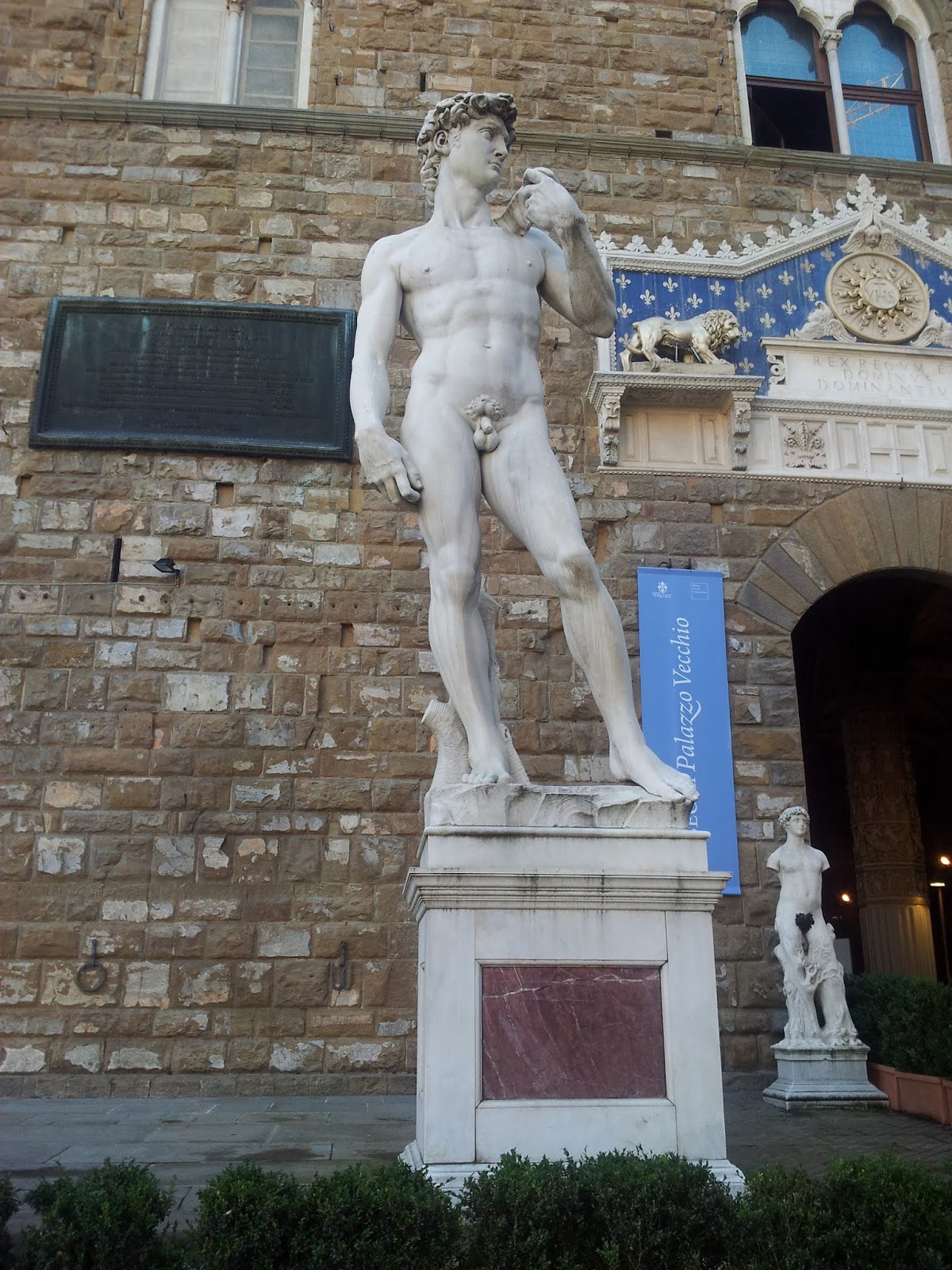
We saw everything that was recommended, including the famous statue of David, though I had a lot of trouble taking a photo when people kept walking in front.

The Piazza Della Signoria has a large number of statues, including another of David, the Marzocco, the symbol of Florence, Il Perseo, the fountain of Neptune, Poseidon, Perseus with the head of Medusa, and a hall of statues adjacent to the Palazzo Vecchio.

Florence is old, the roads are cobbled and narrow, and there are many trails one can follow and discover something new at the end of every twist and turn.

I have to go back, other than the fact I need a new wallet and belt made from Italian leather.  My wife loves the purses and handbags, also leather, though the scarves have only recently been added to her list of most wanted items.

But, in reality, I want to simply soak up the atmosphere, relax, eat the pasta and drink the endless supply of Moretti’s.

The story behind the story – Echoes from the Past

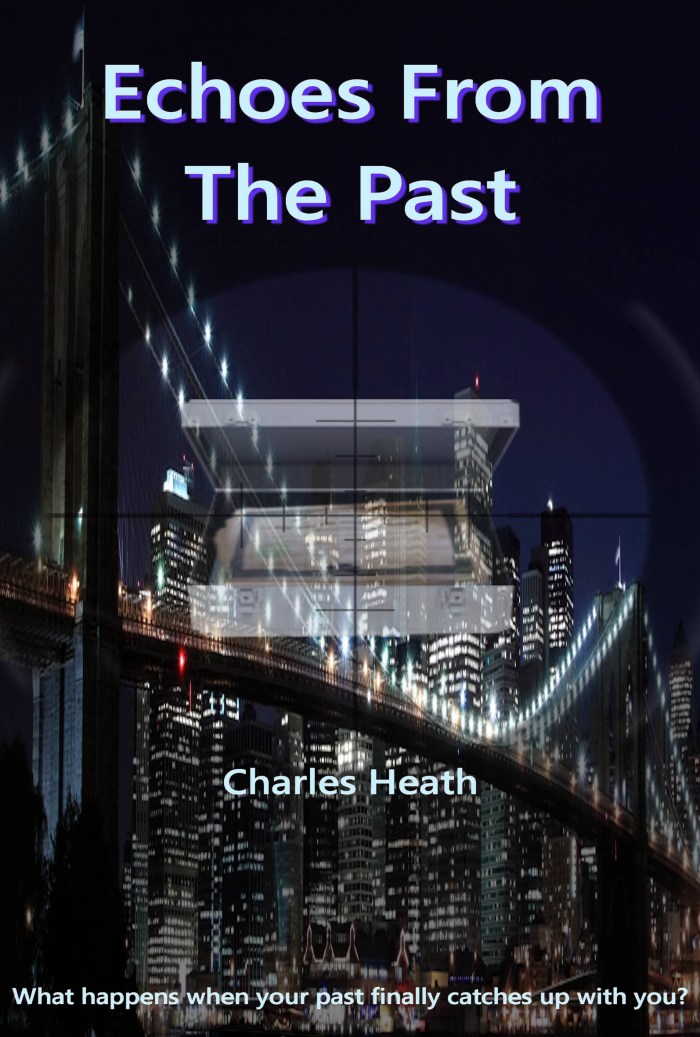
The novel ‘Echoes from the past’ started out as a short story I wrote about 30 years ago, titled ‘The birthday’.

My idea was to take a normal person out of their comfort zone and led on a short but very frightening journey to a place where a surprise birthday party had been arranged.

Thus the very large man with a scar and a red tie was created.

So was the friend with the limousine who worked as a pilot.

So were the two women, Wendy and Angelina, who were Flight Attendants that the pilot friend asked to join the conspiracy.

I was going to rework the short story, then about ten pages long, into something a little more.

And like all re-writes, especially those I have anything to do with, it turned into a novel.

There was motivation.  I had told some colleagues at the place where I worked at the time that I liked writing, and they wanted a sample.  I was going to give them the re-worked short story.  Instead, I gave them ‘Echoes from the past’

Originally it was not set anywhere in particular.

But when considering a location, I had, at the time, recently been to New York in December, and visited Brooklyn and Queens, as well as a lot of New York itself.  We were there for New Years, and it was an experience I’ll never forget.

One evening we were out late, and finished up in Brooklyn Heights, near the waterfront, and there was rain and snow, it was cold and wet, and there were apartment buildings shimmering in the street light, and I thought, this is the place where my main character will live.

It had a very spooky atmosphere, the sort where ghosts would not be unexpected.  I felt more than one shiver go up and down my spine in the few minutes I was there.

I had taken notes, as I always do, of everywhere we went so I had a ready supply of locations I could use, changing the names in some cases.

Fifth Avenue near the Rockefeller center is amazing at first light, and late at night with the Seasonal decorations and lights.

The original main character was a shy and man of few friends, hence not expecting the surprise party.  I enhanced that shyness into purposely lonely because of an issue from his past that leaves him always looking over his shoulder and ready to move on at the slightest hint of trouble.  No friends, no relationships, just a very low profile.

Then I thought, what if he breaks the cardinal rule, and begins a relationship?

But it is also as much an exploration of a damaged soul, as it is the search for a normal life, without having any idea what normal was, and how the understanding of one person can sometimes make all the difference in what we may think or feel.

And, of course, I wanted a happy ending.

Except for the bad guys.


Get it here:  https://amzn.to/2CYKxu4

newechocover5rs


Memories of the conversations with my cat – 7

As some may be aware, but many not, Chester, my faithful writing assistant, mice catcher, and general pain in the neck, passed away some months ago.

Recently I was running a series based on his adventures, under the title of Past Conversations with my cat.

For those who have not had the chance to read about all of his exploits I will run the series again from Episode 1

These are the memories of our time together…

20160917_075236-1

This is Chester.  He’s been caught almost red-handed climbing the curtains.

Of course, he is all innocence, because the evidence is circumstantial.  He was sitting on the window ledge looking out, thinking ‘if only I could get out there’.

Now he’s thinking how much trouble he’s in and whether it will be his least favorite cat food for dinner.

No, I’m not that mean.

Not unless I catch him red-handed.

An excerpt from “The Devil You Don’t”

Available on Amazon Kindle here:  https://amzn.to/2Xyh1ow


By the time I returned to the Savoie, the rain had finally stopped, and there was a streak of blue sky to offer some hope the day would improve.

The ship was not crowded, the possibility of bad weather perhaps holding back potential passengers.  Of those I saw, a number of them would be aboard for the lunch by Phillippe Chevrier.  I thought about it, but the Concierge had told me about several restaurants in Yvoire and had given me a hand-drawn map of the village.  I think he came from the area because he spoke with the pride and knowledge of a resident.

I was looking down from the upper deck observing the last of the boarding passengers when I saw a woman, notable for her red coat and matching shoes, making a last-minute dash to get on board just before the gangway was removed.  In fact, her ungainly manner of boarding had also captured a few of the other passenger’s attention.  Now they would have something else to talk about, other than the possibility of further rain.

I saw her smile at the deckhand, but he did not smile back.  He was not impressed with her bravado, perhaps because of possible injury.  He looked at her ticket then nodded dismissively, and went back to his duties in getting the ship underway.  I was going to check the departure time, but I, like the other passengers, had my attention diverted to the woman in red.

From what I could see there was something about her.  It struck me when the light caught her as she turned to look down the deck, giving me a perfect profile.  I was going to say she looked foreign, but here, as in almost anywhere in Europe, that described just about everyone.  Perhaps I was just comparing her to Phillipa, so definitively British, whereas this woman was very definitely not.

She was perhaps in her 30’s, slim or perhaps the word I’d use was lissom, and had the look and manner of a model.  I say that because Phillipa had dragged me to most of the showings, whether in Milan, Rome, New York, London, or Paris.  The clothes were familiar, and in the back of my mind, I had a feeling I’d seen her before.

Or perhaps, to me, all models looked the same.

She looked up in my direction, and before I could divert my eyes, she locked on.  I could feel her gaze boring into me, and then it was gone as if she had been looking straight through me.  I remained out on deck as the ship got underway, watching her disappear inside the cabin.  My curiosity was piqued, so I decided to keep an eye out for her.

I could feel the coolness of the air as the ship picked up speed, not that it was going to be very fast.  With stops, the trip would take nearly two hours to get to my destination.  It would turn back almost immediately, but I was going to stay until the evening when it returned at about half eight.  It would give me enough time to sample the local fare, and take a tour of the medieval village.

Few other passengers ventured out on the deck, most staying inside or going to lunch.  After a short time, I came back down to the main deck and headed forward.  I wanted to clear my head by concentrating on the movement of the vessel through the water, breathing in the crisp, clean air, and let the peacefulness of the surroundings envelope me.

It didn’t work.

I knew it wouldn’t be long before I started thinking about why things hadn’t worked, and what part I played in it.  And the usual question that came to mind when something didn’t work out.  What was wrong with me?

I usually blamed it on my upbringing.

I had one of those so-called privileged lives, a nanny till I was old enough to go to boarding school, then sent to the best schools in the land.  There I learned everything I needed to be the son of a Duke, or, as my father called it in one of his lighter moments, nobility in waiting.

Had this been five or six hundred years ago, I would need to have sword and jousting skills, or if it had been a few hundred years later a keen military mind.  If nothing else I could ride a horse, and go on hunts, or did until they became not the thing to do.

I learned six languages, and everything I needed to become a diplomat in the far-flung British Empire, except the Empire had become the Commonwealth, and then, when no-one was looking, Britain’s influence in the world finally disappeared.  I was a man without a cause, without a vocation, and no place to go.

Computers were the new vogue and I had an aptitude for programming.  I guess that went hand in hand with mathematics, which although I hated the subject, I excelled in.  Both I and another noble outcast used to toss ideas around in school, but when it came to the end of our education, he chose to enter the public service, and I took a few of those ideas we had mulled over and turned them into a company.

About a year ago, I was made an offer I couldn’t refuse.  There were so many zeroes on the end of it I just said yes, put the money into a very grateful bank, and was still trying to come to terms with it.

Sadly, I still had no idea what I was going to do with the rest of my life.  My parents had asked me to come back home and help manage the estate, and I did for a few weeks.  It was as long as it took for my parents to drive me insane.

Back in the city, I spent a few months looking for a mundane job, but there were very few that suited the qualifications I had, and the rest, I think I intimidated the interviewer simply because of who I was.  In that time I’d also featured on the cover of the Economist, and through my well-meaning accountant, started involving myself with various charities, earning the title ‘philanthropist’.

And despite all of this exposure, even making one of those ubiquitous ‘eligible bachelor’ lists, I still could not find ‘the one’, the woman I wanted to spend the rest of my life with.  Phillipa seemed to fit the bill, but in time she proved to be a troubled soul with ‘Daddy’ issues.  I knew that in building a relationship compromise was necessary, but with her, in the end, everything was a compromise and what had happened was always going to be the end result.

It was perhaps a by-product of the whole nobility thing.  There was a certain expectation I had to fulfill, to my peers, contemporaries, parents and family, and those who either liked or hated what it represented.  The problem was, I didn’t feel like I belonged.  Not like my friend from schooldays, and now obscure acquaintance, Sebastian.  He had been elevated to his Dukedom early when his father died when he was in his twenties.  He had managed to fade from the limelight and was rarely mentioned either in the papers or the gossip columns.  He was one of the lucky ones.

I had managed to keep a similarly low profile until I met Phillipa.  From that moment, my obscurity disappeared.  It was, I could see now, part of a plan put in place by Phillipa’s father, a man who hogged the limelight with his daughter, to raise the profile of the family name and through it their businesses.  He was nothing if not the consummate self-advertisement.

Perhaps I was supposed to be the last piece of the puzzle, the attachment to the establishment, that link with a class of people he would not normally get in the front door.  There was nothing refined about him or his family, and more than once I’d noticed my contemporaries cringe at the mention of his name, or any reference of my association with him.

Yet could I truthfully say I really wanted to go back to the obscurity I had before Phillipa?  For all her faults, there were times when she had been fun to be with, particularly when I first met her when she had a certain air of unpredictability.  That had slowly disappeared as she became part of her father’s plan for the future.  She just failed to see how much he was using her.

Or perhaps, over time, I had become cynical.

I thought about calling her.  It was one of those moments of weakness when I felt alone, more alone than usual.

I diverted my attention back to my surroundings and the shoreline.  Out of the corner of my eye, I could see the woman in the red coat, making a move.  The red coat was like a beacon, a sort of fire engine red.  It was not the sort of coat most of the women I knew would wear, but on her, it looked terrific.  In fact, her sublime beauty was the one other attribute that was distinctly noticeable, along with the fact her hair was short, rather than long, and jet black.

I had to wrench my attention away from her.

A few minutes later several other passengers came out of the cabin for a walk around the deck, perhaps to get some exercise, perhaps checking up on me, or perhaps I was being paranoid.  I waited till they passed on their way forward, and I turned and headed aft.

I watched the wake sluicing out from under the stern for a few minutes, before retracing my steps to the front of the ship and there I stood against the railing, watching the bow carve its way through the water.  It was almost mesmerizing.  There, I emptied my mind of thoughts about Phillipa, and thoughts about the woman in the red coat.

Until a female voice behind me said, “Having a bad day?”

I started, caught by surprise, and slowly turned.  The woman in the red coat had somehow got very close me without my realizing it.  How did she do that?  I was so surprised I couldn’t answer immediately.

“I do hope you are not contemplating jumping.  I hear the water is very cold.”

Closer up, I could see what I’d missed when I saw her on the main deck.  There was a slight hint of Chinese, or Oriental, in her particularly around the eyes, and of her hair which was jet black.  An ancestor twice or more removed had left their mark, not in a dominant way, but more subtle, and easily missed except from a very short distance away, like now.

Other than that, she was quite possibly Eastern European, perhaps Russian, though that covered a lot of territory.  The incongruity of it was that she spoke with an American accent, and fluent enough for me to believe English was her first language.

Usually, I could ‘read’ people, but she was a clean slate.  Her expression was one of amusement, but with cold eyes.  My first thought, then, was to be careful.

“No.  Not yet.”  I coughed to clear my throat because I could hardly speak.  And blushed, because that was what I did when confronted by a woman, beautiful or otherwise.

The amusement gave way to a hint of a smile that brightened her demeanor as a little warmth reached her eyes.  “So that’s a maybe.  Should I change into my lifesaving gear, just in case?”

It conjured up a rather interesting image in my mind until I reluctantly dismissed it.

“Perhaps I should move away from the edge,” I said, moving sideways until I was back on the main deck, a few feet further away.  Her eyes had followed me, and when I stopped she turned to face me again.  She did not move closer.

I realized then she had removed her beret and it was in her left side coat pocket.  “Thanks for your concern …?”

“Zoe.”

“Thanks for your concern, Zoe.  By the way, my name is John.”

She smiled again, perhaps in an attempt to put me at ease.  “I saw you earlier, you looked so sad, I thought …”

“I might throw myself overboard?”

“An idiotic notion I admit, but it is better to be safe than sorry.”

Then she tilted her head to one side then the other, looking intently at me.  “You seem to be familiar.  Do I know you?”

I tried to think of where I may have seen her before, but all I could remember was what I’d thought earlier when I first saw her; she was a model and had been at one of the showings.  If she was, it would be more likely she would remember Phillipa, not me.  Phillipa always had to sit in the front row.

“Probably not.”  I also didn’t mention the fact she may have seen my picture in the society pages of several tabloid newspapers because she didn’t look the sort of woman who needed a daily dose of the comings and goings, and, more often than not, scandal associated with so-called celebrities.

She gave me a look, one that told me she had just realized who I was.  “Yes, I remember now.  You made the front cover of the Economist.  You sold your company for a small fortune.”

Of course.  She was not the first who had recognized me from that cover.  It had raised my profile considerably, but not the Sternhaven’s.  That article had not mentioned Phillipa or her family.  I suspect Grandmother had something to do with that, and it was, now I thought about it, another nail in the coffin that was my relationship with Phillipa.

“I wouldn’t say it was a fortune, small or otherwise, just fortunate.”  Each time, I found myself playing down the wealth aspect of the business deal.

“Perhaps then, as the journalist wrote, you were lucky.  It is not, I think, a good time for internet-based companies.”

The latter statement was an interesting fact, one she read in the Financial Times which had made that exact comment recently.

“But I am boring you.”  She smiled again.  “I should be minding my own business and leaving you to your thoughts.  I am sorry.”

She turned to leave and took a few steps towards the main cabin.

“You’re not boring me,” I said, thinking I was letting my paranoia get the better of me.  It had been Sebastian on learning of my good fortune, who had warned me against ‘a certain element here and abroad’ whose sole aim would be to separate me from my money.  He was not very subtle when he described their methods.

But I knew he was right.  I should have let her walk away.

She stopped and turned around.  “You seem nothing like the man I read about in the Economist.”

A sudden and awful thought popped into my head.  Those words were part of a very familiar opening gambit.  “Are you a reporter?”

I was not sure if she looked surprised, or amused.  “Do I look like one?”

I silently cursed myself for speaking before thinking, and then immediately ignored my own admonishment.  “People rarely look like what they are.”

I saw the subtle shake of the head and expected her to take her leave.  Instead she astonished me.

“I fear we have got off on the wrong foot.  To be honest, I’m not usually this forward, but you seemed like you needed cheering up when probably the opposite is true.  Aside from the fact this excursion was probably a bad idea.  And,” she added with a little shrug, “perhaps I talk too much.”

I was not sure what I thought of her after that extraordinary admission. It was not something I would do, but it was an interesting way to approach someone and have them ignoring their natural instinct.  I would let Sebastian whisper in my ear for a little longer and see where this was going.

“Oddly enough, I was thinking the same thing.  I was supposed to be traveling with my prospective bride.  I think you can imagine how that turned out.”

“She’s not here?”

“No.”

“She’s in the cabin?”  Her eyes strayed in that direction for a moment then came back to me.  She seemed surprised I might be traveling with someone.

“No.  She is back in England, and the wedding is off.  So is the relationship.  She dumped me by text.”

OK, why was I sharing this humiliating piece of information with her?  I still couldn’t be sure she was not a reporter.

She motioned to an empty seat, back from the edge.  No walking the plank today.  She moved towards it and sat down.  She showed no signs of being cold, nor interested in the breeze upsetting her hair.  Phillipa would be having a tantrum about now, being kept outside, and freaking out over what the breeze might be doing to her appearance.

I wondered, if only for a few seconds if she used this approach with anyone else.  I guess I was a little different, a seemingly rich businessman alone on a ferry on Lake Geneva, contemplating the way his life had gone so completely off track.

She watched as I sat at the other end of the bench, leaving about a yard between us.  After I leaned back and made myself as comfortable as I could, she said, “I have also experienced something similar, though not by text message.  It is difficult, the first few days.”

“I saw it coming.”

“I did not.”  She frowned, a sort of lifeless expression taking over, perhaps brought on by the memory of what had happened to her.  “But it is done, and I moved on.  Was she the love of your life?”

OK, that was unexpected.

When I didn’t answer, she said, “I am sorry.  Sometimes I ask personal questions without realizing what I’m doing.  It is none of my business.”  She shivered.  “Perhaps we should go back inside.”

She stood, and held out her hand.  Should I take it and be drawn into her web?  I thought of Sebastian.  What would he do in this situation?

I took her hand in mine and let her pull me gently to my feet.  “Wise choice,” she said, looking up at the sky.

It just started to rain.


© Charles Heath 2015-2020

newdevilcvr6

In a word: Great

Or is it grate?

Is it possible to mix the two up?  I don’t think so.

Great usually means: everything is great, or good, or excellent, whatever degree of goodness you want to put to it.

It could also mean something else, like:  Well, you were a great help! when in fact you want to say how useless they were.

Large or little.

Like all creatures great and small,  Why not say big or small.  Big doesn’t quite have the same effect.

Of course, you could be a great person, well, what I really mean is distinguished.  Besides, great could mean way above average, too.  Or grand, or impressive, the list goes on.

And haven’t we all, at some time had a great-aunt.  No not the good one, the ‘great’ one, denoting her seniority, not necessarily how nice she is.


As for the other grate, we can build a fire in it.

Or add an ‘un’ in front and ‘ful’ at the end, to denote what parents sometimes think of their children

Or get a block of cheese and ‘grate’ it into small shreds.

Or speak in a voice that grates on your nerves, possibly by that great-aunt.

“One Last Look”, nothing is what it seems

A single event can have enormous consequences.

A single event driven by fate, after Ben told his wife Charlotte he would be late home one night, he left early, and by chance discovers his wife having dinner in their favourite restaurant with another man.

A single event where it could be said Ben was in the wrong place at the wrong time.

Who was this man? Why was she having dinner with him?

A simple truth to explain the single event was all Ben required. Instead, Charlotte told him a lie.

A single event that forces Ben to question everything he thought he knew about his wife, and the people who are around her.

After a near-death experience and forced retirement into a world he is unfamiliar with, Ben finds himself once again drawn back into that life of lies, violence, and intrigue.

From London to a small village in Tuscany, little by little Ben discovers who the woman he married is, and the real reason why fate had brought them together.

It is available on Amazon here: http://amzn.to/2CqUBcz

When I should be sleeping…

My mind will not rest.

Down here, it is winter, and the last few days have been rather cold, well, it is winter after all, but tonight it is particularly cold.

So, as I can’t sleep, I’m lying on the couch staring at the ceiling, otherwise known as the cinema of my dreams.

Where am I?

Well, it has to be someplace other than here, of course.


I’d seen the Trevi Fountain in the movies, but, until now, it just seemed like any other fountain, only larger.

In reality, it was much more than that, and, so it seemed, it was also that for many other people.  Mid-afternoon on a warm sunny day, they were all standing in awe.

Perhaps some were making a wish, and I saw several toss coins in.  There would be a lot of money in there and I couldn’t help but think about what sort of job it would be to retrieve it.

Odd too, I thought, if they hadn’t, how many old and rare coins might be somewhere on the floor.  Of course, I only thought of the aesthetic value rather than the practicality of the water system that the Romans had built long before such feats of engineering were being contemplated.

No, I was here on holiday. 

After years of traveling to a great many places for my job, one that never really gave me any time for sightseeing, I’d decided it was time to indulge in a little tourism.

Before this, I’d been to the colosseum, the old ruins, the Spanish Steps, and the Parthenon.  This was going to wrap up the afternoon.

“So, are you here on business or pleasure?”

I turned to see Giuseppe, a man I’d had a rather complicated relationship with in the past, and one who is not told I was coming.

But, the fact he was here was no surprise.

It was however surprising that he could sneak up on me.  It showed I was slipping, or, more than likely, I was more susceptible to being distracted.

“I am but a humble tourist.  I’m sorry but you have been following me for nothing.”

“Why is it I find that difficult to believe?”

Maybe because of what I used to do, but it was not something I would openly admit.  And the only reason he was standing there was that someone else had made a mistake, and required a bit of diplomacy to smooth the waters.

Unfortunately, that had destroyed my invisibility in Italy, and probably most of Europe, and these days I spent most of my time in semi-retirement driving a desk.  Not entirely put out to pasture.

“As difficult as it might be, having your cover blown makes it impossible to continue, verified by the fact you’re here now.  Was it a red flag on my name, or facial recognition?”

“Just remember, we’re watching you.”

A last shake of his head, he walked over to a car parked a host distance away, got in, and drove off.  I had no doubt he was not the only one who had been watching me.

“It seems you were right.”

Another voice, This time a woman, and expected.  Carla had been waiting in the coffee shop for Giuseppe or someone like him to make an appearance.

“They were not exactly hiding the fact they had me under surveillance.”

She handed me the coffee with a smile.

“That means we can have some fun, does it not?”

That had been the plan.  I knew if I entered Italy using the identity I used the last time, it would put them on alert, and prompt a reaction.

“It still doesn’t mean they won’t suspect something is afoot.”

“And since when did you start doubting yourself?”

Since my last operation fell apart because I made one simple mistake that no agent would have made in a million years.  But, I had, and it basically ended two careers.

The other person had just handed me the coffee, and unaccountable seemed less angry with me than she should be.

“You of all people should know the answer to that.”

She sighed and took my hand in hers.  “What I do know is that there’s a very clever operation afoot and you’re the one who planned it.  And far from being on the sidelines, we have a new and very important role to play.  And speaking of play, it’s time you and I got into our roles.  Oh, and just for the record, I still love you and I know how you feel about me, and before I brought you coffee I made a wish.”

So had I, and it had been answered.


It was another of those dreams that might lead somewhere.  We’ll just have to wait and see.

© Charles Heath 2020


“Sunday in New York”, it’s a bumpy road to love

“Sunday in New York” is ultimately a story about trust, and what happens when a marriage is stretched to its limits.

When Harry Steele attends a lunch with his manager, Barclay, to discuss a promotion that any junior executive would accept in a heartbeat, it is the fact his wife, Alison, who previously professed her reservations about Barclay, also agreed to attend, that casts a small element of doubt in his mind.

From that moment, his life, in the company, in deciding what to do, his marriage, his very life, spirals out of control.

There is no one big factor that can prove Harry’s worst fears, that his marriage is over, just a number of small, interconnecting events, when piled on top of each other, points to a cataclysmic end to everything he had believed in.

Trust is lost firstly in his best friend and mentor, Andy, who only hints of impending disaster, Sasha, a woman whom he saved, and who appears to have motives of her own, and then in his wife, Alison, as he discovered piece by piece damning evidence she is about to leave him for another man.

Can we trust what we see with our eyes or trust what we hear?

Haven’t we all jumped to conclusions at least once in our lives?

Can Alison, a woman whose self-belief and confidence is about to be put to the ultimate test, find a way of proving their relationship is as strong as it has ever been?

As they say in the classics, read on!

Purchase:

http://tinyurl.com/Amazon-SundayInNewYork

The fourth attempt, let’s look at the location

Equally important is the location.  Dark and brooding characters need dark and brooding locations.  It’s undeniable that there’s evil everywhere, we just have to look for it.

Of course, that’s not what I do, but …

I have been in a few tight corners, with some possibly dark and brooding characters where my heart rate has increased exponentially, and was saved by quick thinking, and a desire not to hang around and see what happens (for the purposes of a writable experience – no,, I’m not that stupid).

As the story stands, we move form a small staff room, or rest room, and then we move out to the car park of … what?  It’s not exactly clear where it is, only that Graham is leaving work to go home.

Whether it’s clear or not, Graham is a security guard, part of a team that work on an industrial estate where there’s a number of factories and office blocks. 

Some of those buildings are empty, for a variety of reasons, so a back story for this might be created so that I can convey a clearer picture of not only the bricks and mortar, but what it’s like there.

Ergo the first descriptive line, steeping outside into the epicentre of the south pole.  There is snow everywhere, which meant it was falling while he was inside at work, but now, the moment he leaves, it’s stopped.  Cold, then, and clear.

So it begins…

Now, as a secondary theme, it might not be obvious the owners are lax in the hiring of security staff to watch over their assets, staff that are relatively dubious in character, which might, in turn, mean that the notion of using cut-price security might mean something else is going on.

Are the empty factories empty?  Or have they been repurposed, and the guards are not sure what their guarding?  Do they want to know?  A job is a job, and in this situation, either from a hint from the employer, or the words of an old hand, and it doesn’t pay to poke a nose in where it’s not wanted.

So, as you can see, when starting the story I didn’t give proper thought to the background story, the fact that I could weave another or several storylines intertwined with what will be the master plotline.

What is the master plotline?

I have an idea or two, but let’s not get to ahead of ourselves.

Let’s stitch together a scenario or two for the back story and see where it takes us.  Remember that this was more or less part of the storyline originally in my mind but may not have been articulated in what I wrote at the time.

Basically, then, we’re dealing with a large industrial site on the outskirts of a city in decline.  Everyone can relate to the problematic times we’re in now, but this was written at the height of the last global financial meltdown about fifteen year ago, which caused a deep recession.

Within that framework a lot of businesses and people went to the wall.  Graham, and others, lost a decent paying job, as well as his house, having finally got on the property ladder, only to find he couldn’t pay for it.

At the time he was not alone in that respect.  And lenders were not immune either, so there’s the possibility of one or two industrial park owners not exactly being legit in some of their business dealings, not after taking heavy hits financially.

In that scenario, there’s always the possibility of insurance fraud as a means of cutting losses, hence the need for security that might be asked to look the other way.

Another possibility could be that empty buildings and enterprising men, or women, fit the category of ‘the devil finds work for idle hands’. 

Or someone who recognises an opportunity to make some money.  That particular scenario opens the door to a plethora of ideas.

© Charles Heath 2020