Do you do any armchair travelling?

Once upon a time…

It was impossible to travel to any destination you would like to go to in the world.

Except perhaps if you had a travel guide, a book about a particular place, or watch a geographical documentary, which was limited to one person’s point of view.

Now, with the internet it’s possible to go anywhere, read up on any place, and even see what it looks like.

I have been along many a street in several towns or cities, over 12,000 miles away, as if I was actually there.

I can construct a path from one part of a city to another, and know exactly what there will be along the way.

The thing is, I can be thoroughly at home in a place I’ve never been to, and this is invaluable for writers.

And travellers.

I can’t tell you how many times I’ve researched my way around a city long before I got there, and then know exactly where to go and what to do, even how much it costs.

It’s why I’ve never been lost in New York, London, Paris, or any of the cities, and it was particularly invaluable in Philadelphia when we only had an afternoon to see the sights.

Now, whenever I have a part of a story to write, I hit the internet.

In a story im currently writing, I’m flying from Djoubuti to an airstrip in Northern Uganda, where I’ll be leading a team along a river that is the defacto border between Uganda and the Democratic Republic of the Congo, to a possible plantation that was once an airfield.

Or that might change, but in this particular case I know exactly what the terrain is like where the river is navigable, and where I need to go and how long it will take.

Certain you would have to agree that’s better than having to go there in person and run the risk of being killed or worse.

“Echoes From The Past”, buried, but not deep enough

On special, now only $0.99 for the next few weeks.


What happens when your past finally catches up with you?

Christmas is just around the corner, a time to be with family. For Will Mason, an orphan since he was fourteen, it is a time for reflection on what his life could have been, and what it could be.

Until a chance encounter brings back to life the reasons for his twenty years of self-imposed exile from a life only normal people could have. From that moment Will’s life slowly starts to unravel and it’s obvious to him it’s time to move on.

This time, however, there is more at stake.

Will has broken his number one rule, don’t get involved.

With his nemesis, Eddie Jamieson, suddenly within reach, and a blossoming relationship with an office colleague, Maria, about to change everything, Will has to make a choice. Quietly leave, or finally, make a stand.

But as Will soon discovers, when other people are involved there is going to be terrible consequences no matter what choice he makes.

https://amzn.to/2CYKxu4

newechocover5rs

In a word: Zip

Which, unfortunately, I do not have a lot of in my step.

At last, we have reached the end of the alphabet because I’m running out of zip to write these blogs.

So…

Zip is the sing, the energy, the spring we have in our step, that usually gets us from a to b quickly.  Without this zest, we would need to take a bus, train, or cab.

Then comes the variations like …

Zip code, we all have one of these, though in some countries it is called a postcode.

Zip it up, meaning do not speak, especially if you’re about to spill a secret.

A zip, which is a part of some types of clothing, usually in trousers, jeans, and skirts to name a few.  Some dresses have long zips, some short, all seem to get tangled at one time or another, or, in the most embarrassing of situations, split.

Then there is a colloquial use of the word zip, meaning nothing, zilch, zero, in other words, a basis for of z words.

And that’s about as much zeal I’m going to show for writing this blog, and I’m going to close the book on it.

Thank you, and goodnight.

“The Devil You Don’t”, be careful what you wish for

Now only $0.99 for a short time at https://amzn.to/2Xyh1ow

John Pennington’s life is in the doldrums. Looking for new opportunities, prevaricating about getting married, the only joy on the horizon was an upcoming visit to his grandmother in Sorrento, Italy.

Suddenly he is left at the check-in counter with a message on his phone telling him the marriage is off, and the relationship is over.

If only he hadn’t promised a friend he would do a favour for him in Rome.

At the first stop, Geneva, he has a chance encounter with Zoe, an intriguing woman who captures his imagination from the moment she boards the Savoire, and his life ventures into uncharted territory in more ways than one.

That ‘favour’ for his friend suddenly becomes a life-changing event, and when Zoe, the woman who he knows is too good to be true, reappears, danger and death follows.

Shot at, lied to, seduced, and drawn into a world where nothing is what it seems, John is dragged into an adrenaline-charged undertaking, where he may have been wiser to stay with the ‘devil you know’ rather than opt for the ‘devil you don’t’.

newdevilcvr3

“Trouble in Store” – Short stories my way:  Editing becomes re-writing (5)

I have reworked the first part of the story with a few new elements about the characters and changed a few of the details of how the characters finish up in the shop before the policewoman makes her entrance.

This is part of the new first section is the one that involves the Jack, the girl, and the shopkeeper


Jack exchanged a look with the shopkeeper, who in return gave him a slight shrug as if to say he had no idea what this was about.

He could see the girl was not strung out on drugs; if she was it would be a good bet both would be shot or dead by now.  She was just the unfortunate partner of a boy who was on drugs and had found herself in a dangerous position.

Beth, his wife, had told him she didn’t like nor trust the shopkeeper and that her friend in the same apartment block had told her he had been seen selling drugs to youths who hung around just before he closed.  She had warned him it would not be safe, but he had ignored her.

It was a bit late to tell her she was right.

He took a half step towards the door, judging the distance and time it would take to open the door and get out.

Too far, and he would be too slow, his reward for running; a bullet in the back.

Perhaps another half step when she wasn’t looking.


The shopkeeper changed his expression to one more placatory, and said quietly to the girl, “Look, this is not this chap’s problem.”  He nodded in the direction of the customer.  “I’m sure he’d rather not be here, and you would glad of one less distraction.”

He could see she was wavering.  She was not holding the gun so steadily, and the longer this dragged on, the more nervous and unpredictable she would become.

And in the longer game, the customer would sing his praises no matter what happened if he could get him out of the shop alive and well.

This could still be a win-win situation.


The girl looked at Jack.  The shopkeeper was right.  If he wasn’t here this could be over. 

But there was another problem.  It didn’t look like Simmo was in any shape to getaway.  In fact, this was looking more like a suicide mission.

She waved the gun in his direction.  ‘Get out now, before I change my mind.’

As the gun turned to the shopkeeper, Jack wasn’t going to wait to be asked twice and started sidling towards the door.


© Charles Heath 2016-2020

A Long Day’s Journey into Night

That was the name of a play, the script of which I once took out of a library, but never got around to reading it.

It sparked a momentary interest in Eugene O’Neill’s work, but I found it a little hard to understand.  Of course, back then, when I knew little about anything, it was basically a mystery.

It did fuel a brief dalliance with books with a deeper meaning for a short time, one of which was Alan Sillitoe’s Saturday Night and Sunday Morning, but more intriguing of his works was called The Loneliness of the Long-Distance Runner.

While it could be said the literal meaning of that title was rather true, having done a little long-distance running mostly in the final years of school, and realizing it was a lonely sport, it was probably the first time I discovered allegory.

But aside from all that, it led to a foray into more salacious books such as The Postman Always Rings Twice.

And, don’t get me started on D H Lawrence’s Lady Chatterley’s Lover.

However, I’m doing my usual digression, so back to the point…

Taking it in the literal sense, you can do a long day’s work, not get finished by the time you are supposed to go home, and then decide to burn the midnight oil, i.e., work on into the night.

And some days, you know the ones, where time literally drags, and it feels like forever before it’s time to go home, sometimes in darkness, for a variety of reasons, not just the obvious!

Other times, like when reading a good book, you pick it up in the morning, and the next thing you know, it’s night, and the day is gone.  That was a ‘journey’ but a pleasant one.  Long ago, that used to happen to me a lot.

Now, I hardly get time to read, let alone write, and for some strange reason, retirement is much harder than being at work.

Perhaps I should have taken those time management courses when they were offered.

In a word: High or is it hie

When the boss says jump, the question is usually ‘how high’.

Not that it’s possible for many of us with a challenging centre of gravity to get much elevation.

High generally means height, how far something rises above ground level, is above our heads.

That plane flies very high in the sky.

Then there’s another meaning, increased intensity, such as a high temperature, a high fever, but my favourite is, a high dudgeon.

I’m still to get a definition on what a dudgeon is.

We have secondary schools here that we call high schools. Make of that what you will

And in the idiomatic world, flying high means we are very happy, and when were left high and dry then not so much. Unless it related to a ship, in which case a lot of people would be unhappy.

We can use high just about everywhere, high hopes, high ceilings, feelings that run high, a high chair for toddlers of course, high speed which may cause s crash and land you in a high security prison.

This is not to be confused with just plain hi which is a universal greeting.

But there is another, hie, which has a more obscure meaning, to hasten or go quickly.

“Trouble in Store” – Short stories my way:  Editing becomes re-writing (4)

I’ve been looking at the role of the [policewoman, and her interaction with the shop’s participants.

I’m still working on whether she needs more or less of an introduction, but, for the time being, this is what I’m going with:


It had been another long day at the office for Officer Margaret O’Donnell, or, out in the streets, coping with people who either didn’t know or didn’t care about the law.

People who couldn’t cross the road where there were crossings and lights to protect them, silly girls shoplifting on a dare, and boys who thought they were men and could walk on water.

The one they scraped of the road would never get to grow up, and his mother, well, she was not doing another call on a family to give them the bad news.

That was her day.

So far.

At the end of the day, she was glad to be getting home, putting her feet up, and forgetting about everything until the next morning when it would start all over again.

Coming around that last corner, the home stretch she called it, she was directly opposite the corner shop, usually closed at this hour of the night.  It was not.  The lights were still on.

She looked at her watch and saw it was ten minutes to midnight, and long past closing time.  She looked through the window, but from the other side of the road, she could only see three heads and little else.

Damn, she thought, I’m going to have to check it out. 

She was aware of the rumors, from her co-residents and also her colleagues down at the station, rumors she hoped were not true.


© Charles Heath 2016-2020

Conversations with my cat – 87

20160903_163858

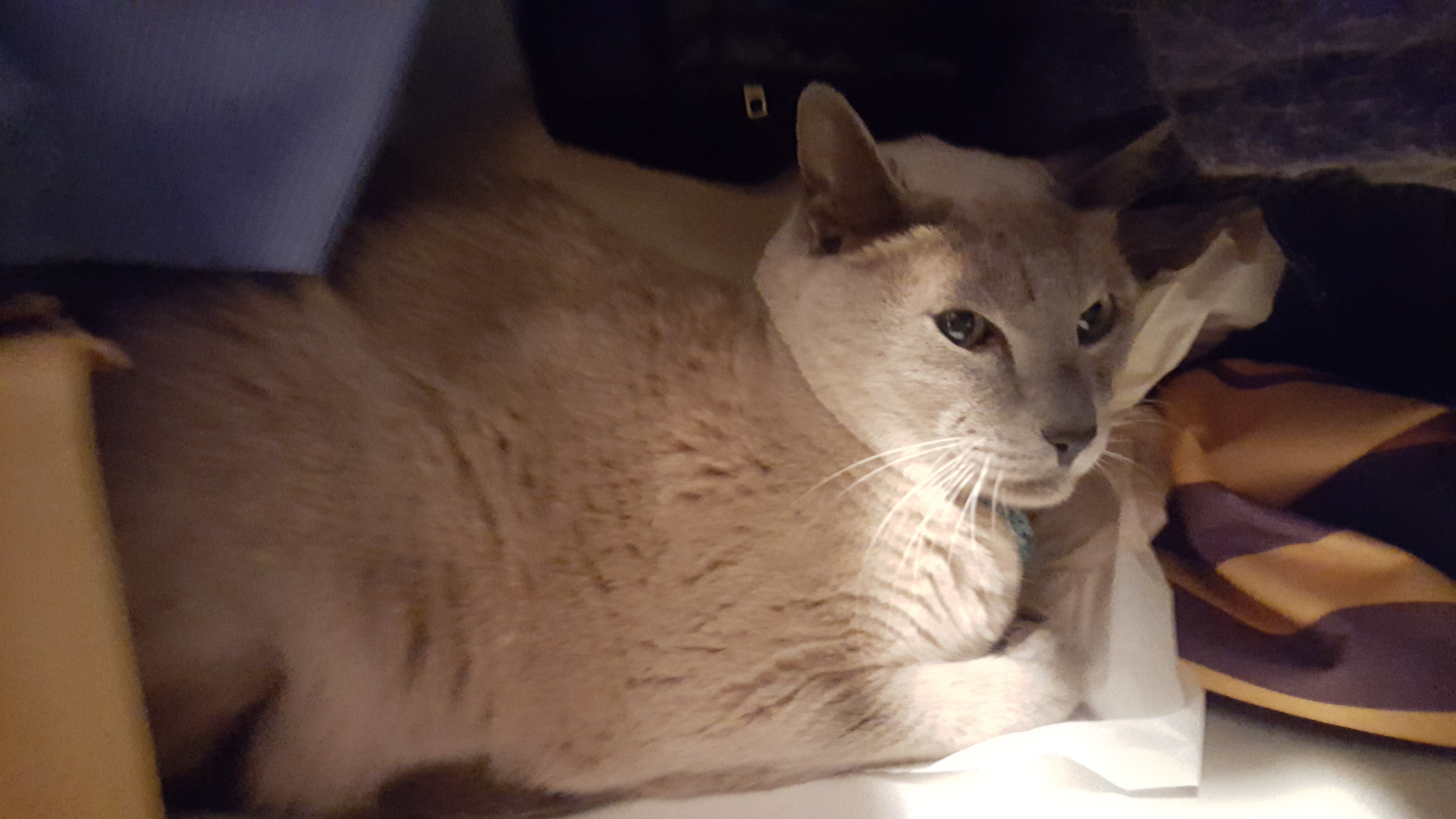
This is Chester.  He was looking very benign before he left.

Now I can’t find him.

Anywhere.

He’s in none of the usual hiding spots.

He’s not hiding under any of the beds.

He’s not hiding in any of the cupboards.

I’m worried.


He’s planning something.  It might be my demise.  I’m still trying to figure out what he could gain from my death.  Not having to listen to me reading chapters of my books?

That, to him, might be a blessing.

I found a magazine on the floor open at an article entitled, ‘Ways to check if your spouse is trying to kill you’.

It’s got me doubly worried now.

I saw him on the kitchen bench near my coffee cup.

How hard could it be for him to dip his paw into some poison or other and then put it in my coffee cup?

That expressionless expression gives him away.

It’s what he’s not saying that’s telling me everything.

Behind that bland face, there’s the heart of a plotter, plotting something bigger than blowing up parliament by Guy Faulks.

I’m going to keep a very close eye on him.  Very, very close.

When I find where he’s hiding.

“The Price of Fame”, A Short Story

I looked at the invitation, a feeling of dread coming over me.  It was not entirely unexpected but like a great many things that had suddenly come into my life, it caused equal measures of fear and excitement.

The gold edging and the perfect script displaying my name in the exact centre of the envelope made it almost unique.  Very few people ever received such an invitation.

I held it in my hand for a longer than necessary, then put it down on the desk carefully, as if it would explode if I dropped it.

My first instinct, driven by fear, was not to accept.

But, fear or not, there was no question of me not attending.  Circumstances had painted me into a corner; I’d agreed to go a long time ago when I thought there was no chance it would come to pass.

Way back then, I had been compared to the aspiring painter in an attic having to die before I made any sort of impression.  In those days people thought it amusing.  I thought it was amusing.  Kirsty, in particular, had thought it was as impossible as I had.

Now it was not amusing.  Not even remotely.


My life was once quiet, peaceful, sedate, even boring.  That didn’t mean I lacked imagination, it was just not out on display for everyone to see.  Inspired by reading endless books, I had the capacity to transport myself into another world, divorced from reality, where my boring existence became whatever I wanted it to be.

It was also instrumental in bringing Kirsty into my life.  In reality, I thought she’d never take a second look at me, let alone a first.  So I pretended to be someone else.  Original, witty, charming, underneath more scared than I’d ever known.

And yet she knew, she’d always known and didn’t care.

As we spent more time together, she discovered I liked to write, not finish anything, just start, write a hundred pages, then lose interest.  Like everything I did.  Start, and never finish.

Why not?  It would never be published.  It would never succeed.

So she bribed me.  If I didn’t finish my first book and send it away, I couldn’t marry her.  It didn’t matter if it was rejected, all I had to do was finish a book, and send it.

The thought of marrying her had not entered my mind, because I hadn’t thought she would.  Incentive enough, I picked out one of the unfinished manuscripts and humoured her.  She read bits of it, not saying a word.  Sometimes she’d put a note or two on the manuscript, her equivalent to sweet nothings, and with it I gained inner confidence in my own ability, not only to write but in many other aspects of my life.

When it was finished, it was Kirsty who sent it off.  She read it, packaged it, addressed it, and sent it before I had a chance to change her mind.  Once gone, I heaved a huge sigh of relief.  It was done. That was, as far as I was concerned, the end of it.


It was not possible that one letter could change a person’s life so dramatically.  I came home to the all-knowing smile, and mischievous whimsicality that had always suggested trouble.

Trouble indeed!

My book was accepted.  With a cheque called an advance.  For more money than I knew what to do with.

This was followed not long after by publication.  And a dramatic change to my life, one I didn’t want.  To become a public person, to face an enormous number of people, people I didn’t know.

I went back to being scared.


Kirsty smiled at me and told me how wonderful I looked in my monkey suit.  Why couldn’t I go in jeans and a dress shirt?  All the best actors in Hollywood did it.

“This is not Hollywood.  You’re not an actor.”  It was a simple, practical, answer.

The hell I wasn’t.  I could act sick, dying, fake a heart attack, anything.  “What am I going to say?”

“You could talk about books.”  Quiet, efficient, oozing the confidence I didn’t feel.

She didn’t fuss.  She took it in her stride.  She dressed in her usual simple elegance, in a manner that made me love to be seen with her.  I couldn’t tie my tie, so she did it for me.  She straightened my jacket because I couldn’t do that either.  Nerves.  Can’t live with them, can’t live without them.  Or was that a reference to wives, or mistresses, or something else?

The palms of my hands were sweating.  Meatball hands, I thought, the sort of palms that betrayed the pretenders.  Me, I was the pretender.  My neck felt too large for the shirt.  Beads of sweat formed on my brow.  Where was a sponge when you needed one?

“I can’t do this.”

“You can.”

We hadn’t even left the hotel yet.

“How long before the execution.”

She looked at me with her whimsical smile.  “Long enough for me to give you a hard time.”


I lost count of the number of times I had to go to the bathroom, for one thing, or another.  Nerves I said.  Perhaps a dozen Valium or something similar.  Did I have any?  Had she hidden them?  Why did she keep smiling?

In the car, I looked at my watch at least a dozen times.  I couldn’t breathe.  It was too hot, too cold.  She held my hand, and it served best to stop the trembling that had set in.  Why did I agree to this?  Why?

We were greeted by the Events Manager, who was polite and genuinely interested.  He took us inside where he introduced the interviewer, another woman who oozed confidence and charm, who went over the format and generally tried to set me at ease.

I didn’t let Kirsty’s hand go.  Not yet.  She was my lifeline, the umbilical cord.  When it was severed, I knew I was going to die.

Bathroom?  Where was the bathroom?  Hell, five minutes to go, and I felt like passing out.  No, Kirsty couldn’t come in.  Comb my hair.  Straighten my tie, no it was straight.  Maybe I could hide in here?  I looked around.  No, maybe not.

Time.

The cue man was standing beside me, hand gently on my back.  He knew the score.  He knew I would turn and run the first chance I got.  Kirsty was on the other side, smiling.  Did she know too?

Then the announcement, my cue to walk on.

The gentle shove, the bright lights, the deafening applause, the seemingly endless walk to the chair, dear God, would I make it without tripping over?

How many times had I made this trip?  I stood, facing the audience, waved, then sat.  It was the fifteenth.  You’d think I’d learned by now.

There was nothing to it.


© Charles Heath 2016-2019