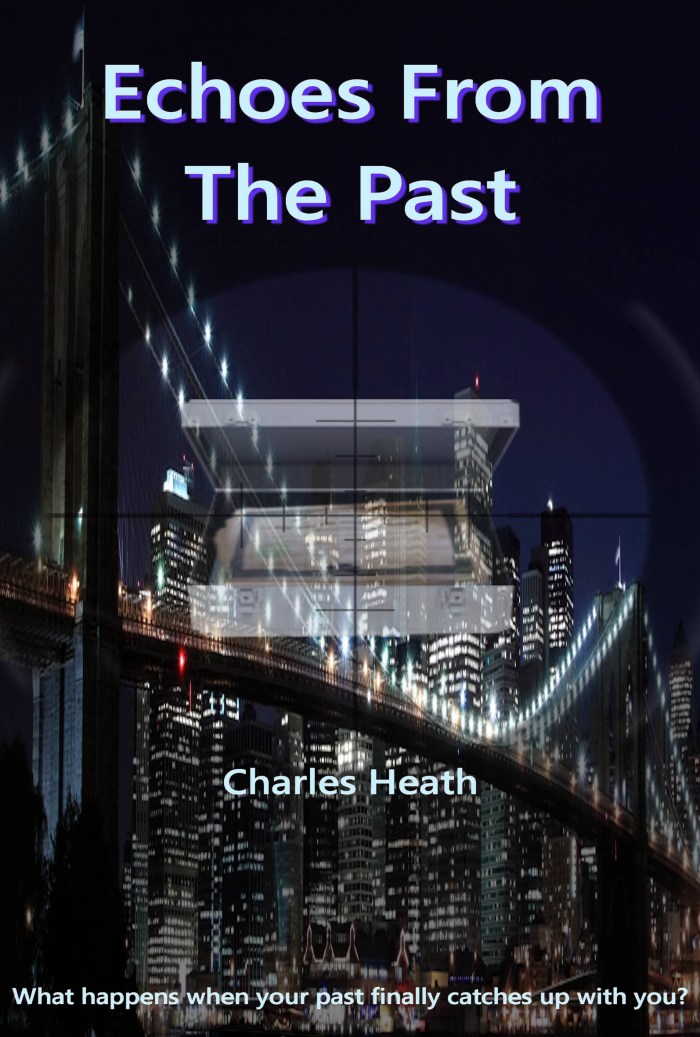
Two novels are on special for $0.99 for the next two weeks.
They are

for “Echoes from the Past” go to

for “The Devil You Don’t” go to
Two novels are on special for $0.99 for the next two weeks.
They are

for “Echoes from the Past” go to

for “The Devil You Don’t” go to
I wandered back to my villa.
It was in darkness. I was sure I had left several lights on, especially over the door so I could see to unlock it.
I looked up and saw the globe was broken.
Instant alert.
I went to the first hiding spot for the gun, and it wasn’t there. I went to the backup and it wasn’t there either. Someone had found my carefully hidden stash of weapons and removed them.
Who?
There were four hiding spots and all were empty. Someone had removed the weapons. That could only mean one possibility.
I had a visitor, not necessarily here for a social call.
But, of course, being the well-trained agent I’d once been and not one to be caught unawares, I crossed over to my neighbor and relieved him of a weapon that, if found, would require a lot of explaining.
Suitably armed, it was time to return the surprise.
There were three entrances to the villa, the front door, the back door, and a rather strange escape hatch. One of the more interesting attractions of the villa I’d rented was its heritage. It was built in the late 1700s, by a man who was, by all accounts, a thief. It had a hidden underground room which had been in the past a vault but was now a wine cellar, and it had an escape hatch by which the man could come and go undetected, particularly if there was a mob outside the door baying for his blood.
It now gave me the means to enter the villa without my visitors being alerted, unless, of course, they were near the vicinity of the doorway inside the villa, but that possibility was unlikely. It was not where anyone could anticipate or expect a doorway to be.
The secret entrance was at the rear of the villa behind a large copse, two camouflaged wooden doors built into the ground. I move aside some of the branches that covered them and lifted one side. After I’d discovered the doors and rusty hinges, I’d oiled and cleaned them, and cleared the passageway of cobwebs and fallen rocks. It had a mildew smell, but nothing would get rid of that. I’d left torches at either end so I could see.
I closed the door after me, and went quietly down the steps, enveloped in darkness till I switched on the torch. I traversed the short passage which turned ninety degrees about halfway to the door at the other end. I carried the key to this door on the keyring, found it and opened the door. It too had been oiled and swung open soundlessly.
I stepped in the darkness and closed the door.
I was on the lower level under the kitchen, now the wine cellar, the ‘door’ doubling as a set of shelves which had very little on them, less to fall and alert anyone in the villa.
Silence, an eerie silence.
I took the steps up to the kitchen, stopping when my head was level with the floor, checking to see if anyone was waiting. There wasn’t. It seemed to me to be an unlikely spot for an ambush.
I’d already considered the possibility of someone coming after me, especially because it had been Bespalov I’d killed, and I was sure he had friends, all equally as mad as he was. Equally, I’d also considered it nigh on impossible for anyone to find out it was me who killed him because the only people who knew that were Prendergast, Alisha, a few others in the Department, and Susan.
That raised the question of who told them where I was.
If I was the man I used to be, my first suspect would be Susan. The departure this morning, and now this was too coincidental. But I was not that man.
Or was I?
I reached the start of the passageway that led from the kitchen to the front door and peered into the semi-darkness. My eyes had got used to the dark, and it was no longer an inky void. Fragments of light leaked in around the door from outside and through the edge of the window curtains where they didn’t fit properly. A bone of contention upstairs in the morning, when first light shone and invariably woke me up hours before I wanted to.
Still nothing.
I took a moment to consider how I would approach the visitor’s job. I would get a plan of the villa in my head, all entrances, where a target could be led to or attacked where there would be no escape.
Coming in the front door. If I was not expecting anything, I’d just open the door and walk-in. One shot would be all that was required.
Contract complete.
I sidled quietly up the passage staying close to the wall, edging closer to the front door. There was an alcove where the shooter could be waiting. It was an ideal spot to wait.
Crunch.
I stepped on some nutshells.
Not my nutshells.
I felt it before I heard it. The bullet with my name on it.
And how the shooter missed, from point-blank range, and hit me in the arm, I had no idea. I fired off two shots before a second shot from the shooter went wide and hit the door with a loud thwack.
I saw a red dot wavering as it honed in on me and I fell to the floor, stretching out, looking up where the origin of the light was coming and pulled the trigger three times, evenly spaced, and a second later I heard the sound of a body falling down the stairs and stopping at the bottom, not very far from me.
Two assassins.
I’d not expected that.
The assassin by the door was dead, a lucky shot on my part. The second was still breathing.
I checked the body for any weapons and found a second gun and two knives. Armed to the teeth!
I pulled off the balaclava; a man, early thirties, definitely Italian. I was expecting a Russian.
I slapped his face, waking him up. Blood was leaking from several slashes on his face when his head had hit the stairs on the way down. The awkward angle of his arms and legs told me there were broken bones, probably a lot worse internally. He was not long for this earth.
“Who employed you?”
He looked at me with dead eyes, a pursed mouth, perhaps a smile. “Not today my friend. You have made a very bad enemy.” He coughed and blood poured out of his mouth. “There will be more …”
Friends of Bespalov, no doubt.
I would have to leave. Two unexplainable bodies, I’d have a hard time explaining my way out of this mess. I dragged the two bodies into the lounge, clearing the passageway just in case someone had heard anything.
Just in case anyone was outside at the time, I sat in the dark, at the foot of the stairs, and tried to breathe normally. I was trying not to connect dots that led back to Susan, but the coincidence was worrying me.
A half-hour passed and I hadn’t moved. Deep in thought, I’d forgotten about being shot, unaware that blood was running down my arm and dripping onto the floor.
Until I heard a knock on my front door.
Two thoughts, it was either the police, alerted by the neighbors, or it was the second wave, though why would they be knocking on the door?
I stood, and immediately felt a stabbing pain in my arm. I took out a handkerchief and turned it into a makeshift tourniquet, then wrapped a kitchen towel around the wound.
If it was the police, this was going to be a difficult situation. Holding the gun behind my back, I opened the door a fraction and looked out.
No police, just Maria. I hoped she was not part of the next ‘wave’.
“You left your phone behind on the table. I thought you might be looking for it.” She held it out in front of her.
When I didn’t open the door any further, she looked at me quizzically, and then asked, “Is anything wrong?”
I was going to thank her for returning the phone, but I heard her breathe in sharply, and add, breathlessly, “You’re bleeding.”
I looked at my arm and realized it was visible through the door, and not only that, the towel was soaked in blood.
“You need to go away now.”
Should I tell her the truth? It was probably too late, and if she was any sort of law-abiding citizen she would go straight to the police.
She showed no signs of leaving, just an unnerving curiosity. “What happened?”
I ran through several explanations, but none seemed plausible. I went with the truth. “My past caught up with me.”
“You need someone to fix that before you pass out from blood loss. It doesn’t look good.”
“I can fix it. You need to leave. It is not safe to be here with me.”
The pain in my arm was not getting any better, and the blood was starting to run down my arm again as the tourniquet loosened. She was right, I needed it fixed sooner rather than later.
I opened the door and let her in. It was a mistake, a huge mistake, and I would have to deal with the consequences. Once inside, she turned on the light and saw the pool of blood just inside the door and the trail leading to the lounge. She followed the trail and turned into the lounge, turned on the light, and no doubt saw the two dead men.
I expected her to scream. She didn’t.
She gave me a good hard look, perhaps trying to see if I was dangerous. Killing people wasn’t something you looked the other way about. She would have to go to the police.
“What happened here?”
“I came home from the cafe and two men were waiting for me. I used to work for the Government, but no longer. I suspect these men were here to repay a debt. I was lucky.”
“Not so much, looking at your arm.”
She came closer and inspected it.
“Sit down.”
She found another towel and wrapped it around the wound, retightening the tourniquet to stem the bleeding.
“Do you have medical supplies?”
I nodded. “Upstairs.” I had a medical kit, and on the road, I usually made my own running repairs. Another old habit I hadn’t quite shaken off yet.
She went upstairs, rummaged, and then came back. I wondered briefly what she would think of the unmade bed though I was not sure why it might interest her.
She helped me remove my shirt, and then cleaned the wound. Fortunately, she didn’t have to remove a bullet. It was a clean wound but it would require stitches.
When she’d finished she said, “Your friend said one day this might happen.”
No prizes for guessing who that friend was, and it didn’t please me that she had involved Maria.
“Alisha?”
“She didn’t tell me her name, but I think she cares a lot about you. She said trouble has a way of finding you, gave me a phone and said to call her if something like this happened.”
“That was wrong of her to do that.”
“Perhaps, perhaps not. Will you call her?”
“Yes. I can’t stay here now. You should go now. Hopefully, by the time I leave in the morning, no one will ever know what happened here, especially you.”
She smiled. “As you say, I was never here.”
© Charles Heath 2018-2020
My phone, being smart and all, has been creating a notification that tells me I have some memories stored on it for this day a year ago, or two years, or many years.
The pictures it is showing are of our trip to China last year.
Not much chance of going back, and, back then, neither of us could imagine that everything that has happened in the last six months could happen.
But, it did.
And one of the effects of those events is no more overseas travel
No more travel of any sort at the moment with the travel restrictions in place. We can’t even fly to another state. Come to that, we might not have an airline to fly on.
Travel, of course, is the main escape, where we can get away from our daily lives, and go somewhere quite different from where we live and experience a different world. The people, the food, the sights.
What is probably more significant is that we might not be able to go away again, if there is no cure for the virus. No one will want to risk catching it in another country, simply because of the medical expenses, the chances are that travel insurance will not cover you for the Coronavirus.
And no cover, no travel, even if you are able to.
So, it means that any travel we will be doing, when we can, will be in our own country. We can do this without a vaccine because we have so few active cases, and the measures we have is stopping it in its tracks.
So too for New Zealand, and we may be able to travel there.
One day.
Until then, my smartphone is going to keep sending me gentle reminders of what it was like in another lifetime.
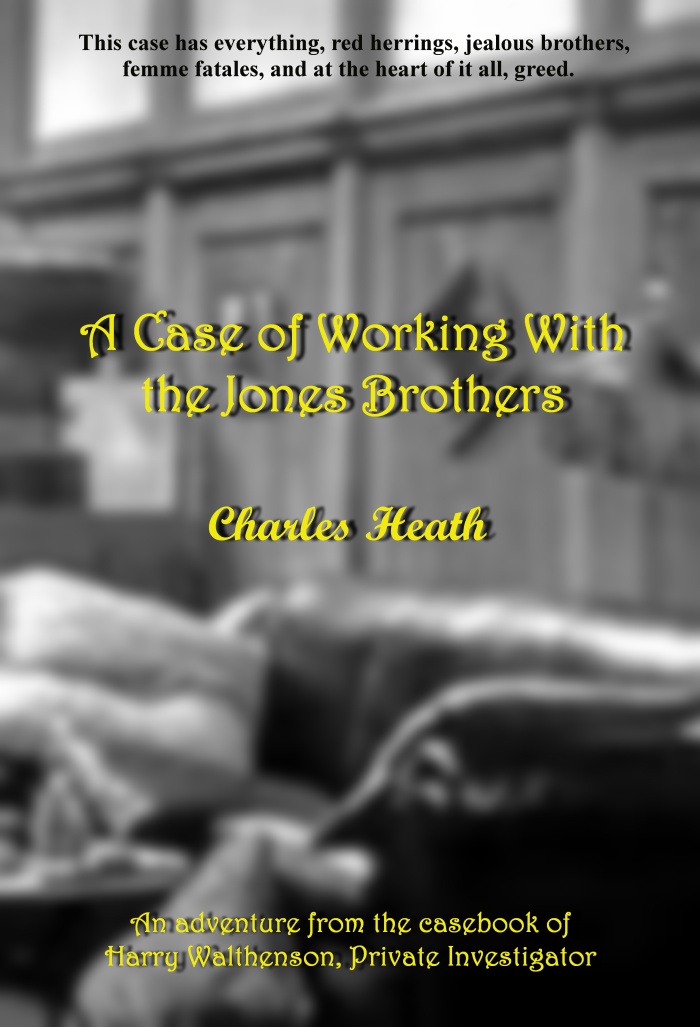
To write a private detective serial has always been one of the items at the top of my to-do list, though trying to write novels and a serial, as well as a blog, and maintain a social media presence, well, you get the idea.
But I made it happen, from a bunch of episodes I wrote a long, long time ago, used these to start it, and then continue on, then as now, never having much of an idea where it was going to end up, or how long it would take to tell the story.
That, I think is the joy of ad hoc writing, even you, as the author, have as much idea of where it’s going as the reader does.
It’s basically been in the mill since 1990, and although I finished it last year, it looks like the beginning to end will have taken exactly 30 years. Had you asked me 30 years ago if I’d ever get it finished, the answer would be maybe?
My private detective, Harry Walthenson
I’d like to say he’s from that great literary mold of Sam Spade, or Mickey Spillane, or Phillip Marlow, but he’s not.
But, I’ve watched Humphrey Bogart play Sam Spade with much interest, and modeled Harry and his office on it. Similarly, I’ve watched Robert Micham play Phillip Marlow with great panache, if not detachment, and added a bit of him to the mix.
Other characters come into play, and all of them, no matter what period they’re from, always seem larger than life. I’m not above stealing a little of Mary Astor, Peter Lorre or Sidney Greenstreet, to breathe life into beguiling women and dangerous men alike.
Then there’s the title, like
The Case of the Unintentional Mummy – this has so many meanings in so many contexts, though I image back in Hollywood in the ’30s and ’40s, this would be excellent fodder for Abbott and Costello
The Case of the Three-Legged Dog – Yes, I suspect there may be a few real-life dogs with three legs, but this plot would involve something more sinister. And if made out of plaster, yes, they’re always something else inside.
But for mine, to begin with, it was “The Case of the …”, because I had no idea what the case was going to be about, well, I did, but not specifically.
Then I liked the idea of calling it “The Case of the Brother’s Revenge” because I began to have a notion there was a brother no one knew about, but that’s stuff for other stories, not mine, so then went the way of the others.
Now it’s called ‘A Case of Working With the Jones Brothers’, finished the first three drafts, and at the editor for the last.
I have high hopes of publishing it in May 2020. It even has a cover.

There is a saying, if God wanted us to fly then he would have given us wings.
Unfortunately, he didn’t, so we do not get to know what it’s like to be in flight,
Unless…
We take an aeroplane, which usually has a flight number such as QF607, or in conversation, ‘I’ll be taking the 6 o’clock flight’.
If someone runs away, then we say they have taken flight.
If we roll back a few years, say about 80, to World War 2, flight tales on a whole new meaning.
It refers to a group of planes, in one case a number of spitfires, or,
The man in charge, a flight lieutenant, also colloquially known as ‘flight’.
This is not be confused with the word flite which has several very obscure meanings,
First, it means to quarrel or argue, or engage in a debate, and
Second, to make a complaint.
But one that sticks in my my mind is Flyte, from Brideshead Revisited. they were a very interesting family.
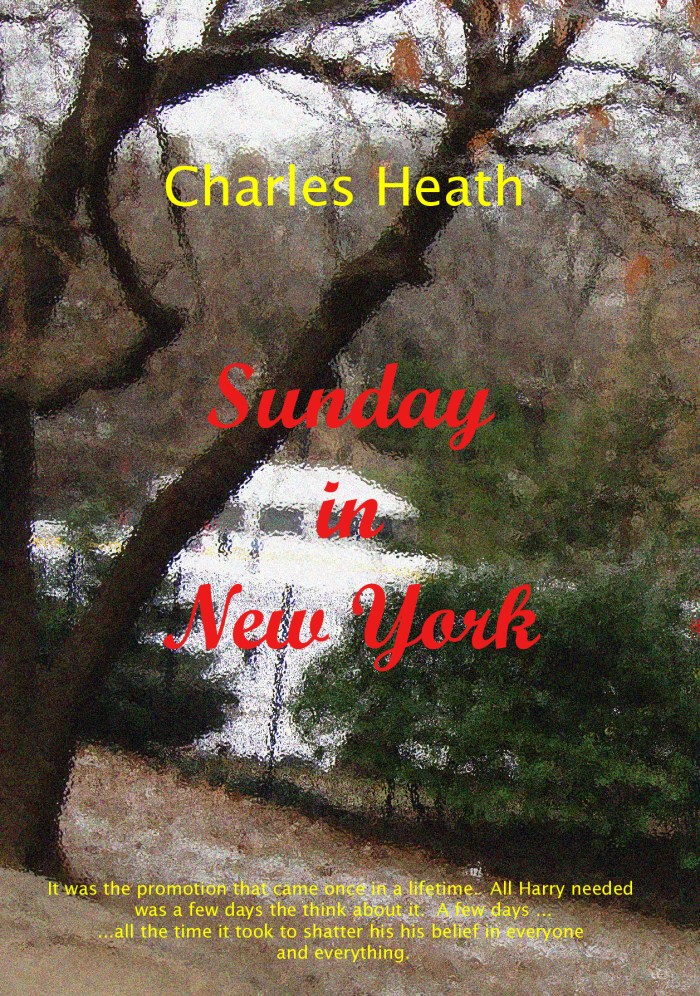
“Sunday in New York” is ultimately a story about trust, and what happens when a marriage is stretched to its limits.
When Harry Steele attends a lunch with his manager, Barclay, to discuss a promotion that any junior executive would accept in a heartbeat, it is the fact his wife, Alison, who previously professed her reservations about Barclay, also agreed to attend, that casts a small element of doubt in his mind.
From that moment, his life, in the company, in deciding what to do, his marriage, his very life, spirals out of control.
There is no one big factor that can prove Harry’s worst fears, that his marriage is over, just a number of small, interconnecting events, when piled on top of each other, points to a cataclysmic end to everything he had believed in.
Trust is lost firstly in his best friend and mentor, Andy, who only hints of impending disaster, Sasha, a woman whom he saved, and who appears to have motives of her own, and then in his wife, Alison, as he discovered piece by piece damning evidence she is about to leave him for another man.
Can we trust what we see with our eyes or trust what we hear?
Haven’t we all jumped to conclusions at least once in our lives?
Can Alison, a woman whose self-belief and confidence is about to be put to the ultimate test, find a way of proving their relationship is as strong as it has ever been?
As they say in the classics, read on!
Purchase:
http://tinyurl.com/Amazon-SundayInNewYork

I wanted to write a bit about how my day was going, and then I got angry. It was a slow fuse because most of what I was angry about I’d been reading this morning.
And, yes, it’s about COVID 19, it’s about political leaders, those in power and those in opposition.
Listing to our opposition leader, briefly before I turned him off to watch a rerun of McHale’s Navy, it annoyed me that he had no answers to offer, only criticism.
Unfortunately, he’s not alone in the world.
Political leaders tended to blame everyone else for a pandemic that was not prepared for, totally unexpected and looking like it’s going to be a huge disaster, not just here but everywhere.
Oh, God, I’m back on my soapbox.
Forgive me.
I’ll shut up about it now.
It’s cold today, about 14 degrees Celsius, when it’s usually 27 degrees Celsius. The sun is letting us down, and I suppose I should be grateful that we are not suffering from an ice age.
To be honest, I was seriously considering lighting the log fire. Instead, we have reverse cycle air-conditioning, which is probably, in the long run, cheaper.
Have you seen how much it costs to buy wood?
But…
That could have made it difficult to write.
Not to come up with inspiration, but literally write, because my office is colder than a chiller room. My beer in storage out here is colder than it is in the fridge. Well, that sounded better in my head than on paper, but you get what I mean.
So, instead of writing, we sat down and binge-watched Sweet Magnolias, a light-hearted series from Netflix, and is of the same vein as Chesapeake Shores, etc, and more the sort of program I’d expect from Hallmark.
It was good. It hooked me.
Three sets of lives intertwined in a largeish town in middle America perhaps. I heard Charleston mentions so perhaps it was in South Carolina.
The good thing about it? Not one mention of COVID 19.
Just good old-fashioned heartache, and trials and tribulations of trying to live your life, bumping up against the obstacles life throws up at you.
The town was called serenity, so there’s a pun in there somewhere.
It’s going to be warmer tomorrow so maybe I’ll get some writing done then.
Is love the metaphorical equivalent to ‘walking the plank’; a dive into uncharted waters?
For Henry the only romance he was interested in was a life at sea, and when away from it, he strived to find sanctuary from his family and perhaps life itself. It takes him to a small village by the sea, s place he never expected to find another just like him, Michelle, whom he soon discovers is as mysterious as she is beautiful.
Henry had long since given up the notion of finding romance, and Michelle couldn’t get involved for reasons she could never explain, but in the end both acknowledge that something happened the moment they first met.
Plans were made, plans were revised, and hopes were shattered.
A chance encounter causes Michelle’s past to catch up with her, and whatever hope she had of having a normal life with Henry, or anyone else, is gone. To keep him alive she has to destroy her blossoming relationship, an act that breaks her heart and shatters his.
But can love conquer all?
It takes a few words of encouragement from an unlikely source to send Henry and his friend Radly on an odyssey into the darkest corners of the red light district in a race against time to find and rescue the woman he finally realizes is the love of his life.
The cover, at the moment, looks like this:
Some call time off from work whether it is for a day, a few days, and couple of weeks, or maybe longer, a holiday.
Or leave, leave of absence, annual leave, or long service leave.
Others may call it vacation.
It depends on what part of the world you live in.
But the end result is the same, you do not go to work, so you stay home and do all those things that have mounted up, you drive up, and for some reason it is always up, to the cabin, for a little hunting shooting a fishing, or you get on a planr or a ship and try to get as far away from home and work as possible.
That’s called going overseas. It seems if there is an ocean between w there you go and where you live, no one will be able to disturb you.
Sorry, I bet you didn’t leave that mobile phone or iPad home did you?
But, of course there are a few other obscure references to the word holiday.
For instance,
It can be a day set aside to commemorate an event or a person, a day when you are not expected to work, e.g. Memorial Day, Christmas Day, Good Friday. In Britain they used to be called Bank Holidays.
It can be a specified period that you may be excused from completing a task, or doing something such as getting a one year tax exemption, which maifh also be called a one year tax holiday.
Yes, now that is an obscure reference, particularly when no tax department would ever grant anyone an exemption of any sort.
I always wanted to write an editorial.
A long time ago when I spent time at a newspaper, I wondered what it was like to get to write what essentially was an opinion piece. Did it have to tow the newspaper owners’ point of view?
I was idealistic then. I believed in freedom of the press, and that cornerstone of democracy, freedom of speech.
I did not realize then that freedom of speech also meant the freedom to spread ‘plausible’ lies, dressed up to be the truth, to achieve a particular result. In just one instance, and editorial, and the editorial line of a newspaper had the opportunity to influence an election, favoring one party over another.
With age came wisdom? Perhaps it was more cynicism because now I tend not to believe anything I read in the papers, when I deign to buy a paper which isn’t often, or read online, or listen to on the television or radio.
What happened to factual reporting?
What happened to opinion pieces being labeled as such so that we know that it is not a representative opinion, just the columnists?
What we all tend to forget is that everyone makes mistakes. Whether they’re deliberate, or stupid, they happen, and they can cause a large number of casualties, or cost a lot of money.
What’s lost in all the screaming and yelling is the fact we should be looking for answers so that it doesn’t happen again, not blame every man and his dog, or those in opposition, for everything that is wrong in the world, and, quite likely, your own mistake.
What’s also lost is the truth.
In every ten tons of rubbish that are coming out of the media, so-called reported directly from the horse’s mouth, there are just a few grains of truth. That’s what we should be listening to.
But, drowned out in all the lies, half-truths, and outrageous statements that on the surface doesn’t make any sense, we get to a point where we no longer know what the truth is.
Or do we?
We all have one thing in spades, common sense.
Unfortunately, we sometimes suspend it, because we all have our biases and idiosyncrasies, and beliefs and these can sometimes get it not the way. Now is not the time to forget that common sense or the fact we should be using it to filter out what is not relevant and get to what is.
And what is relevant?
You.
You matter.
Your life matters.
The life of others, whether you like them or not, those lives also matter.
And when we all realize we are in this together, and then rise above the petty and stupid lies and fear-mongering that is being peddled, will the world, yes, the whole world, finally overcome the worst assault on it ever devised.