I am constantly reminded of how curious grandchildren can be when they are not asking you what it was like to live with dinosaurs!
The second eldest who is a rather clever 15-year-old considers it interesting that I’m a writer, and having just met a ‘real’ author who came to visit them at school, asked me a few questions, some of which sounded like those that had been asked of my ‘real’ counterpart.
Like, “how old were you when you first wrote a story, and what was that story about?”
I didn’t think it was when I was at school, but sometime after that, and after a lot of reading. Perhaps it had been one of those moments when a light bulb goes on in your head, and I said to myself, I can write these stories too.
Of course, that wasn’t an answer, so she asked again, when did I start writing?
That required a little thought, and there were several triggers that gave me a date, where I lived at the time, the fact I used my mother’s old portable typewriter, and the fact I had not been long out of school. I was, in fact, about 17. It was 45 years ago; I’ll let you do the math!
What was it about; that I couldn’t tell her, but I said I had rescued a lot of old scribbling of mine and put them in a box to look at later when I had the time.
I guess that time had arrived.
And, yes, there was the book, the individually typed pages, some with corrections, unfinished.
The pages were brown with age.
The story, well, I read the first few pages, and it seems I’d started down the thriller path then, the story so far, an agent comes ashore from a trawler to a bleak and isolated village, perhaps on the Scottish coast.
Then there was the inevitable next question; “What was the first story you read that put you on the path to wanting to become a writer”.
That was easy, Alistair Maclean’s HMS Ulysses. I showed her a copy of the book.
That led to, “but this is about the British Royal Navy in World War 2…”
Perhaps I didn’t answer that correctly, it was after reading about a dozen of his novels, most of which were precursors to the modern-day thriller, perhaps more along the lines of action adventures.
The next question, understandably; “What was the first book you ever finished?”
That was The Starburst Conspiracy, the manuscript of which was in the box along with another completed novel, and quite a few short stories.
Back in those days, I remembered that I had sent some of my stories off to various publishers, and had entered a number of short story competitions, all to no avail. And for a number of years, until I because to old, used to write and enter a novel in the Vogel novel competition but never made it to the shortlist.
It’s probably why I gave up writing for a number of years, until I worked for an interesting company who had a rich history of phosphate mining in the Pacific and being given permission to look into the archives, began writing what could only be described a saga, and by the time I’d left, it was over 1200 closely typed pages long.
I showed the bulky manuscript to her, but by this time her interest had moved to something else.
For me, however, it seemed there was a lot of unfinished business.
Every time I close my eyes, I see something different.
I’d like to think the cinema of my dreams is playing a double feature but it’s a bit like a comedy cartoon night on Fox.
But these dreams are nothing to laugh about.
Once again there’s a new installment of an old feature, and we’re back on the treasure hunt.
—
Here’s the thing. Should I tell Boggs about the Ormiston’s?
Should I tell him that there was more than one lake?
Should I wait until I’d looked at the information that had been stored away? From the way Gwen was talking, no one had looked at Ormiston’s papers since the day they were deposited in the library, except perhaps Gwen herself.
And it helped that Gwen would not give any meaningful assistance to Alex Benderby or any of his cohorts. It seemed all she had given them was the briefest outline of the Ormiston story. She obviously didn’t mention that Ormiston had left anything behind.
Two tasks that I added to a list were, firstly, to start looking at old newspaper archives in the area for anything on Ormiston’s fruitless searches for the treasure, and find out, if possible, whether he works with a map of any sort. Nadia had mentioned the possibility of the pirate captain keeping a journal. Had he seen it, even owned it one time?
There was also the impression that Boggs’ father was not the only one involved with searching for the treasure. He had a map and it looked quite old. Was it possible it had been handed down from father to son, and just to take it a little further, had Ormiston and Boggs’ grandfather been rivals or cohorts? Indeed, a question for Boggs when I saw him.
Secondly, I would have to go around the various churches in the county and see what I could find about Ormiston’s relations. I would not be the only one, Alex would have people out there now doing just that. Whilst that information would be available at the County’s capital, but I knew from experience when I was looking into my own family’s history, getting information out of them was costly and time-consuming.
That was for my own family. Looking for someone else would, no doubt, be might in impossible, considering privacy regulations. There was more chance of gleaning information from tombstones in church graveyards the getting it from the local government.
It was a thought consuming exercise, considering everything after just a short talk with Gwen, and, about to cross a road to retrieve my bicycle, two things happened. The first, I was nearly run over and had only a blaring horn scaring me half to death as a timely warning, and second, the chance sighting of what looked like a man following me. He thought he’d managed to duck out of the way quick enough, but he hadn’t. It was the red check shirt that gave him away. Perhaps if he had been dressed more conservatively, I might have missed him.
I should have remembered that Alex wanted both me and Boggs followed.
Now he would know I went to the library, and if anyone asked, I hoped Gwen would not give away what we had been talking about.
It brought up another moment, one that sent a shudder through me. Had he seen me come and go to Nadia? I hadn’t seen anyone, and I was careful in both coming and going.
Now I would have to be even more careful.
As I checked before crossing the road towards the bicycle rack, I saw the man again, not exactly trying to hide the fact he was following me. At least I now had an advantage.
I delayed the arrival home until I knew my mother would have left for work. I’d worry about explaining myself to her later.
Boggs was waiting for me, sitting on the front steps to the house, absorbed by a new game on his phone. He looked up as I dropped my bike on the ground. I’d need it soon to go to work, and it was easier just to leave it outside the front door.
He had as combative look on his face, the sort he wore when things weren’t going his way. I was not sure if there was anything more I could have done for him. For a few years now, I had tried to be the best friend I could, and in the circumstances, I tried to be there for him. It was not as if I didn’t share his situation also being without a father, but the way in which we lost him was not the same as Boggs.
Perhaps in the last few days, or weeks, I’d changed a little, getting a job, whereas Boggs had no interest in doing so, and interacting with more and different people. Even just being with Nadia, even though it was a very bad idea, made a difference.
It was time that Boggs grew up and started taking some responsibility. It was just a case of I not wanting to be the one to tell him. So, in the meantime, I would just have to tolerate his attitude.
“What was more important than going to check on the other river.”
He decided to tackle me head-on. The truth is I forgot we were supposed to be going there this morning. It would not have happened if I hadn’t stayed with Nadia, but I wasn’t going to be able to use her as an excuse.
I decided to be nice and deflect his implied criticism. “Hello, and how are you?”
“Yada, yada. Now that you have a job, we have only a few hours every day to get stuff done. I could do this on my own, but I thought you would like to be included. In fact, you said that you needed something to liven up what was a very dull existence.”
I had, but that was before I got the job.
“Maybe you should try and get a job too. I’m sure that the treasure is not likely to be going anywhere.”
“You can’t be sure that Benderby or the Cossatino’s are not hot on the trail right now. Unless you saw something last night to the contrary.”
I was hoping he wouldn’t bring that up. No such luck. “Alex is going around in circles, and I’m not sure what the Cossatino’s think because they originally came up with the idea of selling fake maps which means they have no real idea where it is, a fact you told me.”
“Be that as it may for the Cossatino’s, but Alex is no fool.”
“Alex is a fool, Boggs. He was a fool as school, and just little more than a thug in a suit now. And like the people he hangs out with, and like Vince, if you look closely, they all lack the acumen of their fathers, and they are not necessarily running point for their families, I suspect neither Alex nor Vince had told their respective fathers of what they’re up to.”
That mollified him a little, but he was still looking combative.
“We still should be concentrating our efforts.”
“Well in that respect I have been doing some digging. What do you know about a man called Ormiston?”
“Sunday in New York” is ultimately a story about trust, and what happens when a marriage is stretched to its limits.
When Harry Steele attends a lunch with his manager, Barclay, to discuss a promotion that any junior executive would accept in a heartbeat, it is the fact his wife, Alison, who previously professed her reservations about Barclay, also agreed to attend, that casts a small element of doubt in his mind.
From that moment, his life, in the company, in deciding what to do, his marriage, his very life, spirals out of control.
There is no one big factor that can prove Harry’s worst fears, that his marriage is over, just a number of small, interconnecting events, when piled on top of each other, points to a cataclysmic end to everything he had believed in.
Trust is lost firstly in his best friend and mentor, Andy, who only hints of impending disaster, Sasha, a woman whom he saved, and who appears to have motives of her own, and then in his wife, Alison, as he discovered piece by piece damning evidence she is about to leave him for another man.
Can we trust what we see with our eyes or trust what we hear?
Haven’t we all jumped to conclusions at least once in our lives?
Can Alison, a woman whose self-belief and confidence is about to be put to the ultimate test, find a way of proving their relationship is as strong as it has ever been?
When it came to holidays, I preferred to get as far away from everyone as possible.
I saw my parents, and sister who lived with them, every week on Sunday, for lunch and cross-examination of why I was not married with children yet.
Explaining I was only 27 was not a reason because, “your brother married at 21 and he’s got three children, a great job, his own house..” and in and on it went.
And I saw my brother every other Saturday just to tell him that I was Ok. He was considerate in one sense, it was just the matchmaking wife always inviting what she considered suitable women for me.
That fortnight off work was an oasis in a desert full of well-meaning people.
I’d tried dating several girls at work, but they never got past the family inquisition. If I had been in their shoes I’d just say it was all too much too. The lesson I learned there was to never take a girlfriend home.
But, for now, I was footloose and fancy-free. The most recent girl I’d met had decided to return home, no it was nothing I’d done wrong, but I guess it was. Perhaps asking to go with me to Hawaii was a bit too forward too soon. Another lesson learned.
I think I’d probably get it right by the time I was fifty.
So here I was, a history buff, looking to further my knowledge of the events surrounding Pearl Harbour. I’d read a great many history books on the subject, and now, it was a matter of going there, and getting a feel for the place.
More than once I had lamented the fact I could not go back in time and live through the event. I had mentioned this once to a friend, and he asked if I was stark staring mad.
Of course, he was right. Who would want to be in the middle of such a violent attack, especially when it came largely by surprise?
Since my work required mt to fly a lot I had sufficient frequent flyer points to upgrade to first class. I was hoping after flying coach for so long, I’d notice the difference.
Certainly, the initial service after being shown my seat, and the champagne soon after as a welcome onboard, set the tone.
When the door closed, and everyone was on board, only half the seats in first class were taken. A glance at those who were fellow travelers showed an interesting cross-section. A husband and wife who definitely upgraded from coach like me, but were a little m less refined. An executive and his personal assistant, who, judging by the way she looked after him, there was more to that relationship, a woman in her sixties, definitely born to money, and casting somewhat distasteful stares at the upgrade couple, and a woman about my age, who looked very unhappy.
I managed to fit in another glass of champagne before the plane reached the runway.
Then, with a roar of the engines, we were off.
Halfway through the 13-hour flight, I found it impossible to sleep, even with the luxury first-class provided me. I just couldn’t sleep on planes. Instead, I sat up, found a book of crosswords, one of three or four I always had with me and usually got to solve one or two puzzles.
It was quiet and still except for the noise of the air rushing past outside the plane. In that almost soundless atmosphere, I thought I could detect any changes in engine speed or the gentle movement of a change of course. The ride was quite smooth, except for some turbulence and the pilot took us up another 2,000 feet to escape it. We’d been slowly coming back down over the last hour. I’d been monitoring it on the flight path screen. It might be a larger screen, but watching movies was, to me, boring, except in a cinema.
“Can’t sleep either?”
It was the soft voice of the girl from two seats across. She had several revolutions of the plane, exercising I heard her explain to the cabin crew because she couldn’t sit down for long periods.
“Not on planes, no. Trains, yes, ships yes.”
“Crossword fanatic?”
I saw her glance down towards the book. “Not really. This has been floating around for about 10 years, and I drag it out as a last resort.”
“I try reading. It doesn’t help. Where are you going, if you don’t mind me asking?”
“Oahu. Doing the whole Pearl Harbor history experience. And just laze around for a few days before going back to work.”
“New York?”
“Yonkers, upstate. Are you from New York?”
“My family is. I work in San Francisco, come over once a year, but this year I got sick of them early, so I just jumped on the first plane out that had a first-class berth. It was this one. I’ll let you get back to your crossword.”
I was going to say it wasn’t a problem, but she had gone back to her seat. A moment later our cabin attendant, Lucy, came over to deliver a glass of champagne, then came over to me. I hadn’t seen the second glass on the tray. “Miranda thought you might like a glass too.”
I looked over to nod a thankyou, but she was looking out the window. There wasn’t much to see as it was dark and most of the passengers had the shades down.
Then, just as Lucy turned to leave, the plane hit more turbulence. A second, maybe two, later the seatbelt sign went on, just as the co-pilot came on the speaker system to advise all cabin crew to sit down and belt up.
A minute later what sounded like a large bang, one I would have said was an engine exploding, made everyone jump in their seats, to be quickly followed by a sudden jerk to the right that was almost instantly corrected, but that was not the worst of it, equally suddenly the plane started to descend. Very quickly.
At the same moment, the masks dropped down from overhead, I grabbed it and fumbled putting it on, realizing that panic was setting in. It took a minute, but then it didn’t seem like there was any air flowing through it.
Not that any of that mattered. Starved of oxygen, I could feel myself losing consciousness. A minute or so later, I think the plane had started to level off, and a look at the flight path showed we were down to 10,000 feet, in the middle of the ocean. My last thought, how long we would survive if we ditched.
I felt a hand on my shoulder shaking me.
“Sir, sir, are you alright?”
I opened my eyes and blinked several times. I had to be in the middle of a nightmare.
The first thing I noticed was the engine noise, it was very loud, the loudness that came from propeller engines. The second, I was no longer on an Airbus A330. This was more like a Boeing 314, a flying boat. The third, the man shaking me awake was a steward in a white coat, with PanAm on it.
Where the hell was I. No, when the hell was I. What the hell had happened?
“Sir, there’s a message for you.” He handed me a folded sheet of paper. “The captain asked me to tell you we’ll be landing in an hour, and that you, we all, should be prepared. It’s a mess.”
“What is?”
“Pearl Harbour. It was attacked yesterday morning by the Japs. Bastards came in and practically blew everything up.”
All of a sudden there was a roaring sound outside the plane, followed by what had to be the chatter of a machine gun, followed by the sound of bullets hitting the fuselage. One minute the steward was standing next to me, the next he was a bloody heap on the floor. Above my head was a line of bullet holes. More machine gun chatter, then an explosion, followed by a cry behind me of, “got the zero.”
I got out of the seat and went to the steward, staring at me with lifeless eyes. A quick check for a pulse told me he was dead. When I looked behind me there were a dozen or so military men, army, and navy. Two sailors came up and gently maneuvered the steward towards the rear of the aircraft. He had been the only casualty. Turning back towards my seat I caught a reflection of myself in the window, that of a Lieutenant in the Navy. How, and why was I here, now?
I remembered the note the steward had given me, sat down, and unfolded it.
The receipt date was 3:00 pm on 8th December 1941. It was addressed to me, that is, a man with my exact name. Orders to report to an Admiral who would reassign me, the ship I was being sent to had been sunk, and likely not to see service again.
We’d been in the air at the time of the attack, and I guessed news would have been sent to the plane, just in case it was not safe to land. Perhaps they hadn’t counted on try Japanese Zero fighters hanging around for just such a flight as ours.
Whatever the reason I was here, however it had happened, I would have to make the most of it.
Only then did I remember what I had once said, ‘if only I could go back’.
Once again I felt a hand on my shoulder, and a voice, this time of a woman, gently shaking me awake.
“We’re arriving in Honolulu in about 40 minutes. You need to prepare for landing.”
At the same time, I heard a change in the engines as we began to descend. I looked around. More familiar surroundings, back on the A330, the quiet hum of jet engines, and the sight of familiar faces.
“Did something happen to the plane or was I imagining it?”
“Just a lightning strike. We had to go down for a bit, but these planes are designed to handle just about anything. You slept through it, the best thing to do in situations like that.”
OK. It had to be a dream. That’s all I could put it down to. Except for one small detail. My grandfather’s name was the same as mine, he was in the Navy during World War 2, and he had been sent out to Pearl Harbour and was en-route when it happened. But there was only one slight difference. He had been killed when the lone zero had struck, not the steward.
McCallister was old school, a man who would most likely fit in perfectly campaigning on the battlefields of Europe during the Second World War. He’d been like a fish out of water in the army, post-Falklands, and while he retired a hero, he still felt he’d more to give.
He’d applied and was accepted as head of a SWAT team, and, watching him now as he and his men disembarked from the truck in almost military precision, a look passed between Annette, the police liaison officer, and I that said she’d seen it all before. I know I had.
There was a one in four chance his team would be selected for this operation, and she had been hoping it would be one of the other three. While waiting for them to arrive she filled me in on the various teams. His was the least co-operative, and the more likely to make ad-hoc decisions rather than adhere to the plan, or any orders that may come from the officer in charge.
This, she said quite bluntly, was going to end badly.
I still had no idea why Prendergast instructed me to attend the scene of what looked to be a normal domestic operation, but as the nominated expert in the field in these types of situations, it was fairly clear he wasn’t taking any chances. It was always a matter of opinion between us, and generally I lost.
In this case, it was an anonymous report identifying what the authorities believed were explosives in one of the dockside sheds where explosives were not supposed to be.
The only reason why the report was given any credence was the man, while not identifying himself by name, said he’d been an explosive expert once and recognized the boxes. That could mean anything, but the Chief Constable was a cautious man.
With his men settled and preparing their weapons, McCallister came over to the command post, not much more than the SUV my liaison and I arrived in, with weapons, bulletproof vests, and rolls of tape to cordon off the area afterward. We both had coffee, steaming in the cold early morning air. Dawn was slowly approaching and although rain had been forecast it had yet to arrive.
A man by the name of Benson was in charge. He too had groaned when he saw McCallister.
“A fine morning for it.” McCallister was the only enthusiastic one here.
He didn’t say what ‘it’ was, but I thought it might eventually be mayhem.
“Let’s hope the rain stays away. It’s going to be difficult enough without it,” Benson said, rubbing his hands together. We had been waiting for the SWAT team to arrive, and another team to take up their position under the wharf, and who was in the final stages of securing their position.
While we were waiting we drew up the plan. I’d go in first to check on what we were dealing with, and what type of explosives. The SWAT team, in the meantime, were to ensure all the exits to the shed were covered. When I gave the signal, they were to enter and secure the building. We were not expecting anyone inside or out, and no movement had been detected in the last hour since our arrival and deployment.
“What’s the current situation?”
“I’ve got eyes on the building, and a team coming in from the waterside, underneath. Its slow progress, but they’re nearly there. Once they’re in place, we’re sending McKenzie in.”
He looked in my direction.
“With due respect sir, shouldn’t it be one of us?” McCallister glared at me with the contempt that only a decorated military officer could.
“No. I have orders from above, much higher than I care to argue with, so, McCallister, no gung-ho heroics for the moment. Just be ready to move on my command, and make sure you have three teams at the exit points, ready to secure the building.”
McCallister opened his mouth, no doubt to question those orders, but instead closed it again. “Yes sir,” he muttered and turned away heading back to his men.
“You’re not going to have much time before he storms the battlements,” Benson quietly said to me, a hint of exasperation in his tone. “I’m dreading the paperwork.”
It was exactly what my liaison officer said when she saw McCallister arriving.
The water team sent their ‘in position’ signal, and we were ready to go.
In the hour or so we’d been on site nothing had stirred, no arrivals, no departures, and no sign anyone was inside, but that didn’t mean we were alone. Nor did it mean I was going to walk in and see immediately what was going on. If it was a cache of explosives then it was possible the building was booby-trapped in any number of ways, there could be sentries or guards, and they had eyes on us, or it might be a false alarm.
I was hoping for the latter.
I put on the bulletproof vest, thinking it was a poor substitute for full battle armor against an exploding bomb, but we were still treating this as a ‘suspected’ case. I noticed my liaison officer was pulling on her bulletproof vest too.
“You don’t have to go. This is my party, not yours,” I said.
“The Chief Constable told me to stick to you like glue, sir.”
I looked at Benson. “Talk some sense into her please, this is not a kindergarten outing.”
He shrugged. Seeing McCallister had taken all the fight out of him. “Orders are orders. If that’s what the Chief Constable requested …”
Madness. I glared at her, and she gave me a wan smile. “Stay behind me then, and don’t do anything stupid.”
“Believe me, I won’t be.” She pulled out and checked her weapon, chambering the first round. It made a reassuring sound.
Suited up, weapons readied, a last sip of the coffee in a stomach that was already churning from nerves and tension, I looked at the target, one hundred yards distant and thought it was going to be the longest hundred yards I’d ever traversed. At least for this week.
A swirling mist rolled in and caused a slight change in plans.
Because the front of the buildings was constantly illuminated by large overhead arc lamps, my intention had been to approach the building from the rear where there was less light and more cover. Despite the lack of movement, if there were explosives in that building, there’d be ‘enemy’ surveillance somewhere, and, after making that assumption, I believed it was going to be easier and less noticeable to use the darkness as a cover.
It was a result of the consultation, and studying the plans of the warehouse, plans that showed three entrances, the main front hangar type doors, a side entrance for truck entry and exit and a small door in the rear, at the end of an internal passage leading to several offices. I also assumed it was the exit used when smokers needed a break. Our entry would be by the rear door or failing that, the side entrance where a door was built into the larger sliding doors. In both cases, the locks would not present a problem.
The change in the weather made the approach shorter, and given the density of the mist now turning into a fog, we were able to approach by the front, hugging the walls, and moving quickly while there was cover. I could feel the dampness of the mist and shivered more than once.
It was nerves more than the cold.
I could also feel rather than see the presence of Annette behind me, and once felt her breath on my neck when we stopped for a quick reconnaissance.
It was the same for McCallister’s men. I could feel them following us, quickly and quietly, and expected, if I turned around, to see him breathing down my neck too.
It added to the tension.
My plan was still to enter by the back door.
We slipped up the alley between the two sheds to the rear corner and stopped. I heard a noise coming from the rear of the building, and the light tap on the shoulder told me Annette had heard it too. I put my hand up to signal her to wait, and as a swirl of mist rolled in, I slipped around the corner heading towards where I’d last seen the glow of a cigarette.
The mist cleared, and we saw each other at the same time. He was a bearded man in battle fatigues, not the average dockside security guard.
He was quick, but my slight element of surprise was his undoing, and he was down and unconscious in less than a few seconds with barely a sound beyond the body hitting the ground. Zip ties secured his hands and legs, and tape his mouth. Annette joined me a minute after securing him.
A glance at the body then me, “I can see why they, whoever they are, sent you.”
She’d asked who I worked for, and I didn’t answer. It was best she didn’t know.
“Stay behind me,” I said, more urgency in my tone. If there was one, there’d be another.
Luck was with us so far. A man outside smoking meant no booby traps on the back door, and quite possibly there’d be none inside. But it indicated there were more men inside, and if so, it appeared they were very well trained. If that were the case, they would be formidable opponents.
The fear factor increased exponentially.
I slowly opened the door and looked in. A pale light shone from within the warehouse itself, one that was not bright enough to be detected from outside. None of the offices had lights on, so it was possible they were vacant. I realized then they had blacked out the windows. Why hadn’t someone checked this?
Once inside, the door closed behind us, progress was slow and careful. She remained directly behind me, gun ready to shoot anything that moved. I had a momentary thought for McCallister and his men, securing the perimeter.
At the end of the corridor, the extent of the warehouse stretched before us. The pale lighting made it seem like a vast empty cavern, except for a long trestle table along one side, and, behind it, stacks of wooden crates, some opened. It looked like a production line.
To get to the table from where we were was a ten-yard walk in the open. There was no cover. If we stuck to the walls, there was equally no cover and a longer walk.
We needed a distraction.
As if on cue, the two main entrances disintegrated into flying shrapnel accompanied by a deafening explosion that momentarily disoriented both Annette and I. Through the smoke and dust kicked up I saw three men appear from behind the wooden crates, each with what looked like machine guns, spraying bullets in the direction of the incoming SWAT members.
They never had a chance, cut down before they made ten steps into the building.
By the time I’d recovered, my head heavy, eyes watering and ears still ringing, I took several steps towards them, managing to take down two of the gunmen but not the third.
I heard a voice, Annette’s I think, yell out, “Oh, God, he’s got a trigger,” just before another explosion, though all I remember in that split second was a bright flash, the intense heat, something very heavy smashing into my chest knocking the wind out of me, and then the sensation of flying, just before I hit the wall.
I spent four weeks in an induced coma, three months being stitched back together and another six learning to do all those basic actions everyone took for granted. It was twelve months almost to the day when I was released from the hospital, physically, except for a few alterations required after being hit by shrapnel, looking the same as I always had.
But mentally? The document I’d signed on release said it all, ‘not fit for active duty; discharged’.
It was in the name of David Cheney. For all intents and purposes, Alistair McKenzie was killed in that warehouse, and for the first time ever, an agent left the Department, the first to retire alive.
I was not sure I liked the idea of making history.
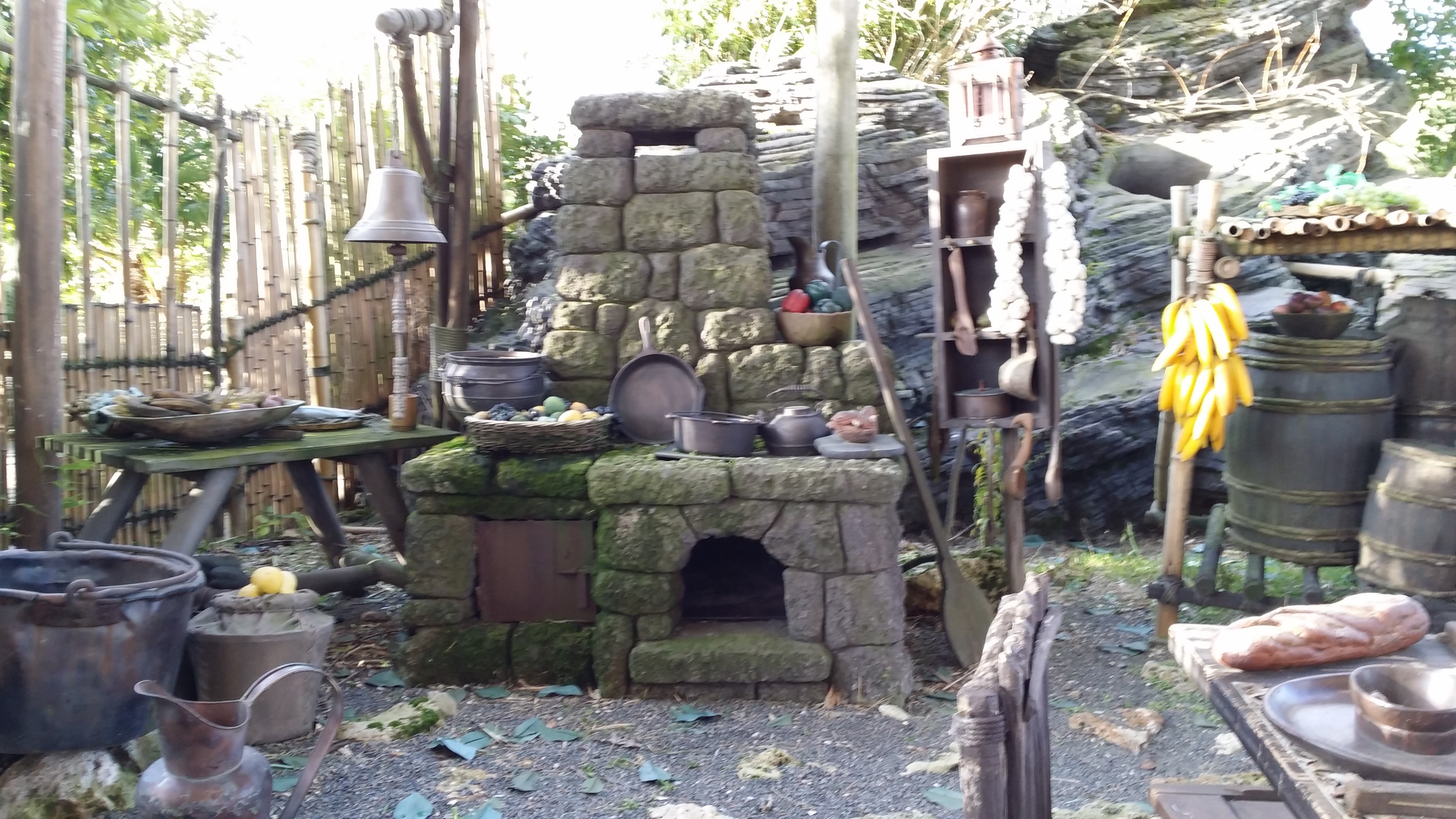
Whilst I found this tree house to be interesting, it seems to be far from practical because there was little to keep the wind and rain out, though I suppose, in the book, that might not be such a problem.
Be that as it may, and if it was relatively waterproof, then the furnishings would probably survive, and one had to also assume that much of the furnishings, such as the writing desk below, would have washed up as debris from the shipwreck.
The stove and oven would have to be built by hand, and it is ‘remarkable’ such well-fitting stones were available. It doesn’t look like it’s been used for a while judging by the amount of gree on it. Perhaps it is not in a waterproof area.
The dining table and the shelf in the background have that rough-hewn look about them
A bit of man-made equipment here for drawing water from the stream
And though not made in the era of electricity, there is an opportunity to use the water wheel to do more than it appears to be doing
And tucked away in a corner the all-important study where one can read, or play a little music on the organ. One could say, for the period, one had all the comforts of home.
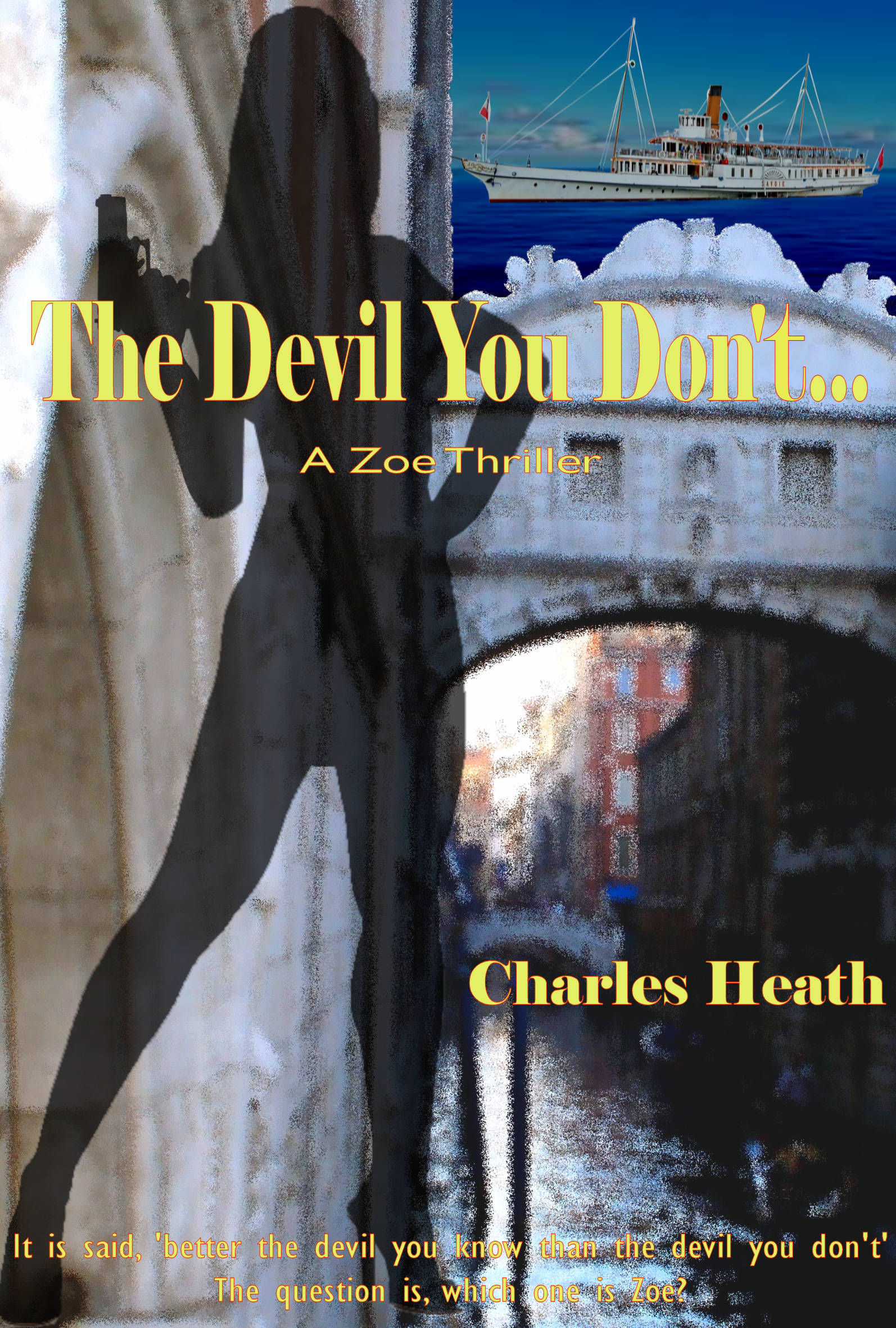
It could be said that of all the women one could meet, whether contrived or by sheer luck, what are the odds it would turn out to be the woman who was being paid a very large sum to kill you.
John Pennington is a man who may be lucky in business, but not so lucky in love. He has just broken up with Phillipa Sternhaven, the woman he thought was the one, but relatives and circumstances, and perhaps because she was a ‘princess’, may also have contributed to the end result.
So, what do you do when you are heartbroken?
That is a story that slowly unfolds, from the first meeting with his nemesis on Lake Geneva, all the way to a hotel room in Sorrento, where he learns the shattering truth.
What should have been a high turns out to be something else entirely, and from that point every thing goes to hell in a handbasket.
He suddenly realises his so-called friend Sebastian has not exactly told him the truth about a small job he asked him to do, the woman he is falling in love with is not quite who she says she is, and he is caught in the middle of a war between two men who consider people becoming collateral damage as part of their business.
The story paints the characters cleverly displaying all their flaws and weaknesses. The locations add to the story at times taking me back down memory lane, especially to Venice where in those back streets I confess it’s not all that hard to get lost.
All in all a thoroughly entertaining story with, for once, a satisfying end.
This is not a treatise, but a tongue in cheek, discussion on how to write short stories. Suffice to say this is not the definitive way of doing it, just mine. It works for me – it might not work for you.
…
You’ve got the place, now you want the who.
My main characters are quite often me.
Not the real me, because I’m boring. No, those characters are what I would like to be, that imaginary superhuman that can do everything.
Until, of course, reality sets in, and the bullets start flying. When that happens, we should be looking to run or at the very least get under cover, not walk into a hail of bullets, with a huge grin, staring down the enemy.
Hang on, that never happens except in superman comics.
What’s really needed here is a little vulnerability, a little humility and a lot of understanding, qualities at times I don’t have.
So, in order to create a more believable character, I start dragging traits from others I’ve met, or know, or really don’t want to know.
In a writer’s environment, there are a plethora of people out there that you can draw on for inspiration. I once spent and afternoon at a railway station just observing people. Even now, I make observations, some of which are true, and others, wildly off course.
I once tried to convince my other half that I could pick people’s traits, and we sat at a café outside a church in Venice. I was lucky, I got more than 75% correct.
Other characters in my stories I have met along the way.
Like a piano player in a restaurant. It was not so much the playing was bad, it was the way he managed to draw people into his orbit and keep them there. The man has charisma, but sadly no talent for the instrument.
Like an aunt I met only twice in a lifetime, and who left a lasting impression. Severe, angry looking, speaking a language I didn’t understand, even though it was English. It was where I learned we came from England, and she was the closest thing I came to as an example of nineteenth-century prim and proper. And, no, she didn’t have a sense of humour or time for silly little boys.
Like one of my bosses, a man of indeterminate age, but it had to be over 100, or so it seemed to my sixteen-year-old brain, who spoke and dressed impeccably, and yes, he did once say that I would be the death of him.
I can only hope I wasn’t.
Like a Captain of a ship I once met, a man who didn’t seem to have time for the minions, and a man who reeked authority and respect. I’ve always wanted to be like him, but unfortunately, it was not in the genes.
Those are only a few, there are thousands of others over the years, a built-in library, if you will, of characters waiting to be taken off the shelf and used where necessary or appropriate. We all have one of these banks.
How often do we make a judgment call simply on what we see?
I knew what I saw, and it looked exactly like a situation that, if you asked any ten others who witnessed it, they would agree with me.
And then there would always be one that wouldn’t.
The prosecution had made a very good case, the defense counsel had woven a brilliant tale from start to finish, and he delivered in an almost persuading tone, with the subliminal message, the defendant was not guilty.
I felt sorry for the prosecution because his delivery had been halting, filled with ums and ers and in the end, everyone, from the judge down, wanted it to end.
As for the jury, it was an odd assortment of characters, a lawyer, a builder, a plumber, a housewife, two sales staff, two clerks, a janitor, two retirees, and a motor mechanic. I thought it would be the lawyer who would be the problem.
The trial had lasted 22 days, and over that time I noticed that groups would form, and discuss aspects of the case, each of the groups forming a different opinion. Sometimes, the dynamics of the groups changed as more evidence and testimony was revealed.
But, I think on those first few days, opinions were made, and judgment was passed.
In my opinion, based on looking at the defendant, it could be said that she didn’t look like a murderer, nor did she seem capable of committing such a heinous act. Having said that, as a throwaway first assumption, the lawyer nixed it in a second. Knowing something of how these trials worked, he said there would have been a lot of careful grooming, dress down, but not to drab, look demure, not aggressive, and speak in a modulated tone, like everyday conversation.
In other words, he was basically telling us she was giving an academy award performance.
I certainly looked at her in a different light after that, but the fact remained, for some of us, that initial assessment said not guilty.
A few days before we had to deliberate, a very damning piece of video was tendered and we all watched as the defendant was shown talking to her alleged accomplice, the victim’s current girlfriend, and passing an enveloped which the defense claimed was the payoff for helping her dispose of her husband.
It seemed odd to me that someone had known she would be in that bar, perfectly placed under the CCTV camera, both women so easily recognizable. Of course, the woman in question could not be found, and the inference was that she might also be one of the defendant’s victims.
Several people were called by the defense to assert a line of defense that the husband was a cruel man, who had treated his wife very badly indeed, to the extent her best friend remarked that she had turned up for work on several occasions with the results of what looked like a beating, and another, an ER nurse, had confirmed the defendant had visited the hospital on several occasions with lacerations consistent with what was considered spousal abuse.
Those photographs were quite confronting, but a question had to be asked, why had she not gone to the police with that evidence and let them deal with the husband.
The fact she hadn’t was one weakness in her defense. The thing there was why the defense introduced such testimony because, to me, it confused the issue by pushing the jury into thinking she had killed him, but in mitigating circumstances. Was she looking for a verdict of justifiable homicide?
From day two, after the lawyer had told us about how lawyers schooled their clients, I watched her carefully, when sitting beside her lawyer, or when on the stand. There were interesting actions she made when certain events occurred, like brushing a stray lock of hair back behind her ear, like teasing it out with a slight shake of the head, in a subtle but obvious show of displeasure. Like smoothing out the invisible wrinkles in her clothes, perfectly fitting and obviously made for her, but understated in a sense that she would stand out in a crown but not ostentatiously so. It was almost a ritual when she came in at the start, and when she took the stand, preparing herself.
Perfectionist, maybe. Or trying to convey a certain picture. Certainly, in the early days before the trial began, the media had a field day with the case, whipped into an even bigger frenzy when the police finally arrested the wife for the murder of her husband. Almost all of them said he had it coming, with page after page of revelations about a man who could not have done half the things he was accused of.
The trial by newspaper done, I suspect it was hard to find 12 unbiased men and women who could be trusted to make the right decision. I knew 100 would be jurors had been called up.
Now, in the jury room for the third day, trying to reach a verdict, it was the lawyer trying to wrap it up. He had a job to go back to. So did everyone else, for that matter.
“So, in essence, we are all agreed, that she is not guilty.”
It had been an interesting change in his position on the morning of day three of our deliberation. Before that, he wanted to hang her from the nearest yardarm. Interestingly enough, that morning, after he had given us his reasons for changing his mind, it would have been unanimous, and over.
The thing is, I didn’t like the way he changed sides so easily or for the reasons he spoke of.
So, in that vote, I changed my decision to guilty, and watch a group of people who had been friendly suddenly become enemies.
But at that moment, that other ten didn’t interest me, it was the expression on the lawyer’s face. He hadn’t expected the vote to go that way. It was like he had been goading everyone into voting not guilty and weathering the storm because of his stance. Had it been staged, had we been led down this path, and then all of a sudden, the verdict he wanted being reached?
I had to find out.
I watched the eleven raise their hands to vote not guilty. I did not. And immediately felt the looks of every one of those eleven on me.
“Why?” he asked.
By this time he had taken the lead, and the others had let him. Now I suspect they would let him do the talking.
“You’ve got it all wrong. The reasons are the same. There are two sides to that tale you came up with this morning. The problem I have is from being adamant she was guilty, and as you said, without a shadow of a doubt, now all of a sudden you’re having doubts.”
“So, you don’t think she’s guilty, you’re just voting that way because you suspect my motives?”
“What I think is irrelevant right now. You need to convince me that you truly think she’s not guilty. What is it you saw, or heard, or know that changed your mind. It certainly had nothing to do with that so-called video in the bar being staged. It has nothing to do with the fact they can’t find that woman so they can either verify or dispel the accusations being made she was an accomplice. It had nothing to do with the fact you think she might have been goaded into it and was left with no other option. In that case, it might well be a case of manslaughter rather than murder. Is that what you’re trying to suggest?”
“I think given the evidence, or lack of concrete evidence against her, she is not guilty.”
“But given everything you have said, it seems to me you think she had some crime to answer for.”
“Hasn’t she suffered enough?”
“That might well be the case, but it doesn’t give you an excuse to murder., and there’s certainly no forensic evidence that she was defending herself against an attack at the time. She should have taken her case to the police and have it investigated. She chose not to, for reasons that were never fully explained.”
“And didn’t we hear that the husband had links to various police that might have made such an investigation a waste of time. This was a woman trapped in a bad situation with no way out.”
It was a long way from where we, as jurors, were at the beginning of our deliberations. The first vote at the end of the first day was four voted not guilty and eight voted guilty. In the following days, a lot of arguments changed the decisions of those seven to vote not guilty, when they believed, in their own minds the defendant was guilty.
In my mind, the first instinct was usually correct. Over time that decision was only changed because of expediency, not necessarily for the right reasons. My first instinct was that she was, in fact, not guilty for all the reasons the lawyer cited.
“Look,” he said. “We’ve been here for three days. It’s an open and shut case. Let’s vote.”
We did with the same result. Eleven for not guilty and one against.
A hung jury. I wasn’t going to be moved on my position, and so it went back to the court. It was declared a mistrial and the defendant was returned to custody and a new trial was to be scheduled.
I was reading the paper’s version of events, and speculation on the result. Several of the jurors had featured in the discussion, but none were willing to talk about the result or who was responsible for the hung jury, only that one juror had not agreed with the majority. In some states, it was argued, it only required a majority, but in this and other states, quite rightly, it needed a unanimous decision to confer the death sentence.
Justice, it seemed to the writer of the piece, had prevailed.
They also believed that the plight of women trapped in marriages to violent men was a matter that should be looked at and that such women should be treated better in the eyes of the law. It was not a position that I disagreed with. What I disagreed with was the notion of jury tampering.
It was, apparently, the fifth time that a case such as this had a similar track record, that the deliberations of the jury had swung from an initial guilty verdict to not guilty at the hands of a single juror. In each of the five cases, the circumstances were similar, the wife had endured violence by her husband, and then, in odd circumstances, the husband had finished up dead.
Someone had discerned a pattern, and this had been a test case. In each of the other four cases, a not guilty verdict had been handed down by a jury that had also started with a majority guilty verdict, only to be worn down by a single juror with an agenda. To get the defendant a not guilty verdict.
My job was to find out which juror it was that was there to change minds. Then it was a case of finding links between him and four other jurors who were equally instrumental in obtaining a not guilty verdict. In each of the five cases, there was irrefutable evidence that the defendant was, in fact, guilty of the charge, and the expectation was the legal system would prosecute them.
And then, in each of the cases, a weak prosecutor was selected, and a particular juror was selected by that prosecutor. From there, the trail led back to a particular assistant District Attorney who had overseen each of the five cases. The fact was, justice was not served, and four out of the five defendants had escaped justice.
I hated it when I was younger, namely because my brothers always cheated, and that had been carried through to adulthood.
Now, I just avoided them.
It left me wondering how I managed to paint myself into a corner, and agree to do the one thing I assiduously avoided.
You could chalk it up to being persuaded by a pretty girl. Yes, I am the typical male, a sucker for a pretty face and a little flattery.
It would not have happened if I’d just gone home, instead of being asked to go and ‘just have one drink’ on the way home from work. I used to, once upon a time, before I got sick. But, perhaps it was a combination of cabin fever, and the monastic existence I’d adopted since that saw the one visit a chink of light at the end of a very long tunnel.
Whatever the reason, had I not gone, I would not have met Nancy. I’d seen her before, off and on, at work, and had noted, probably with a degree of disdain that where she was, was the most noise. You know, the one who talks loudest in the elevator, or the one who was the center of attention at a dining table.
And yet, underneath that, if or when anyone got close enough, there was something else. Something that fascinated me. But, having become reclusive had made me more reticent, and even though I was sitting at the same table, almost within arm’s length, I was too shy to strike up a conversation.
Until it was time to go home. I had moved out of the way so she could get out, and as she passed me she said, “You’ve been very quiet, Brian isn’t it?”
“Yes. And I know it’s rather lame but I don’t have as extensive knowledge of sports, which I guess I should. Ask me about old movies, and I’m your guy. Anyway, I pride myself on being a good listener.”
“Old movies eh. I’ll keep that in mind.” A smile, she went to leave, and then turned. “Look. I have this thing I have to go to, and I don’t want to go by myself. It’s not a date or anything like that, I just need someone to come with me. You might even find the people interesting.”
“I’m sure there’s someone else here more qualified than I am.” It was lame and I was floundering. It was not every day a girl asks you to go out with her. Even if it was, to a certain degree, and unflattering invitation.
“They all seem to have something else to do. Look, here’s my phone number,” she handed me a piece of paper with her cell number scrawled on it, “Call me if you change your mind. It’s not going to be as bad as you think.”
I should not have picked up the phone. I definitely should not have called her number. And I knew I was going to live to regret telling her I would go to her ‘thing’.
Before I walked out the door I looked at myself in the mirror. It seemed to be telling me, ‘you are a fool, Brian’, and I agreed. This had disaster written all over it. I hadn’t been out for a long time, and if anything, those few hours last evening were a sign I was not ready to face the world. Not after being so long away from it.
A lot had changed in the fifteen months I’d been in a coma. It was a miracle, the doctors said, that I came out of it with very little damage. I’d lost a chunk of memories, particularly surrounding the accident, and perhaps, I’d been told, that was a good thing. Cameron, the guy I worked with had summed up the change in a few short words, ‘you’ve gone from being the biggest dead shit in the world to something that resembles a human being’. I didn’t remember that person, though others did.
Maybe she remembered who I was, and, if she did, that didn’t explain why she asked me. The person Cameron described was not a person I would want to be with, so I guess the answer to my rhetorical question would soon be revealed.
Nancy was bright, talkative, and, at times, over the top. She was the loudest in the room and the center of attention. I wondered if the old Brian had been like that because if he was, I wouldn’t like him. It begged the question, why did I agree to go with her?
Curiosity? Maybe. That I might find some people who knew the old Brian? I certainly hoped not.
I had barely got out of the car to go and knock on her door when she came out, a small gym bag on her shoulder, dressed casually. I had to admit, in the morning sun and surrounded by an idyllic setting, she looked almost like an angel. She jumped in the car and all but slammed the door shut.
“You’re early.”
I looked at my watch, then the clock on the car’s dash. Both said the same, Eight a.m. exactly. “You did say eight a.m. and not p.m.” I couldn’t remember what she said, not right then.
“I mean most guys who come to collect me are always late.”
“Then I guess, by inference, I not like most guys.”
She smiled, one of those impish smiles I’d come to recognize from anther woman I’d dated somewhere in a distinct past, and who was trouble. I did, for some strange remember the night we spent in jail, though I couldn’t remember why, except the impish smile.
“I suspect you’re not. Cam said you were different.”
“Cam did, did he?” The mentioning of his name raised a red flag in the back of my mind. Cameron was not above playing complex pranks and I was beginning to see indications that this might be one. I would have to be careful.
“Not in a bad way, I mean. He had nothing but good things to say about you, though I had the feeling there was something he wasn’t saying. You’re not an ax murderer or anything like that?”
“Shouldn’t you have done some more research before asking me along?” I had also heard from another source, actually, a chap named, rather aptly, Jones, who was also at the party. He had left earlier but was still in the carpark, apparently his car parked next to mine, smoking a cigarette. A suspicious man might say he was waiting for me.
He had some ‘sage’ advice. “You want to be careful when you’re with Nancy. She’s not what she seems.”
I asked him to elucidate, but, cigarette finished, he stubbed it out rather violently under his blood, and left. He looked angry, sounded angry, and it was an angry warning. Perhaps he was a current or, more likely, ex-boyfriend. That ‘advice’ only added to the intrigue value.
Someone else, when he asked them about Nancy, had told him she was ‘brilliant’ with computers. Was that in programming, or hacking, or simply data entry? He only knew she had helped the web site programmers when the company had built its intranet. Computers and I never got on, and I was the only one who got a weekly visit from the IT help desk, just in case.
“I did. Do you remember anything from those fifteen months?”
“Like what?”
“They say that when you’re in a coma you can still hear people, you know, that sort of stuff.”
I thought about it for a minute. I wasn’t one of those lucky ones, though I did have one of those out of body experiences, where I suspect I’d nearly died. Just not my time, I’d thought, later.
“I’d like to meet the people who have that ubiquitous title of ‘they’. They have a lot of opinions, most of which are about the unknown.”
“So would I, to be honest. All you ever get to do is read about them. So, are you ready?”
“For what?”
“A weekend away. It will be fun if you want it to be.”
“Otherwise?”
“It’ll be fun. You have my promise.”
“And where is this ‘fun’ going to be?”
“Rhode Island. A friend of my parents, son is having a party and a few side events. There’s about 40 of us, so there’s no shortage of interesting if sometimes eclectic people. I’ll put the address in the GPS.”
Rhode Island, the other home of the New York rich, as well as others, and I hoped it was the others we were going to see. The host was the son of possible millionaires, so that was an interesting description for me to mull on. Would he be an ex? It seemed to me that Rhode Islanders would be less likely to mingle with the paupers, and if they did it would be for their own amusement.
There was a memory on the back of his mind, that popped up, albeit briefly when she mentioned the destination. The fact it didn’t want to come to the surface told me it was a bad memory. One from ‘old’ Brians days.
Nancy’s beauty, manner, and the fact she was clever might just win over the son of a millionaire, an heir to a fortune, whereas it would intimidate a lesser man. As for me, I was a means to an end, so it didn’t matter what I thought, other than it was better than staying home.
It was the house with all the cars parked out front. Multi stories, with towers that no doubt overlooked the ocean, and extensive gardens that seemed to be shared, that blocked the sightlines from the street front to that invisible ocean. I was will to be, once on the other side, the never-ending sound of the sea might be heard.
In winter, this would be bleak. In summer, well, what was the saying, anyone who is anyone would be here. Well, the sons and daughter thereof, perhaps.
I had expected the moment I parked the car she would be out, and gone, like a proverbial schoolgirl dying to get back to school after the holidays. She was not. She stood there, at the front of the car, and looked at the scene before us. To me, it was just a building, with trees, shrubs, and grass around it. To others, it was a portal into another world, one that would never be available to that 95% of the rest of the world. It was a phrase that popped into my mind, again, randomly, that said, the top 5% of any country held as much if not more of the wealth belongs to the other 95%.
I came up beside her and looked in the same direction, at one of the towers.
“Having a Rapunzel moment?” I hoped she had some memory of fairytales or it would seem an odd comment.
“I used to have long hair once. But, the last time I was here, I can’t remember. My mother’s hair was always long, some sort of hangover from hippy days, you know, the 1970s. She was here once. The stories she used to tell me about the houses, and the people she used to know. I’m ready. Are you?”
It was like a walk through the park, getting to the front door. There was a driveway, but there must have been a rule, no cars on the property. Or perhaps the front gate was locked and the owner had thrown away the key.
Or, more than likely, the butler, standing at the front door, welcoming guests, had it in his pocket. He was a tall, severe-looking man, with a military bearing. I somehow knew he was more than just the average butler.
Nancy gave him our names, and in return, he gave us a sheet of paper. The rules and the room number where we would be staying the night. I had thought that we would be given separate rooms, but that wasn’t the case, and it didn’t seem to worry Nancy that I would be staying with her. The only other words he said were, “The rotunda, 11 a.m.”
The room overlooked the ocean, today more or less a millpond, and a number of yachts were out making the most of the weather. There was a pier at the end of the property, and, yes, a reasonably large boat attached to it. There was also a view of a croquet lawn, the rotunda beside the rose garden. On the other side was a large pond, and seats where, no doubt on days when people like us were impinging on their solitude, they sat and contemplated how to make more money.
I didn’t realize I was that cynical.
The room had two beds, and it’s own bathroom. She had thrown her bag on one, checked out the bathroom, then dashed past saying, “I’ll see you at the rotunda.”
I followed her down about a half-hour later, descending the stairs at a more leisurely pace, looking at the paintings on the wall as I did. Forbears, and landscapes that were from around here. The one with the lighthouse was of particular interest. It brought another memory to the surface. I’d been there before, sometime in the distant past, and it was significant.
The Butler was standing at the bottom of the stairs, having stopped there when he saw me descending.
“It’s nice to see you again, Master Brian.”
“Not Master Brian, anymore, Jeffery. Sadly, I had to grow up.”
“We all do, sooner or later. Pity we can’t say the same for Chester.”
“Where is he?”
“You need to ask. I hope you’re up for a little X marks the spot.”
I groaned. Chester and his treasure hunts.
My last memory of that he had hidden a fluffy bunny stuffed with money. It was the weekend I had the crash the result I was told of too much booze, too much alcohol, too much of everything. I was just glad the girl I had brought up with me had left with another chap, a decision, I told her when she visited me in hospital, was probably the wisest thing she would ever do.
I just shook my head.
“Even if you don’t think so Brian, we have missed you.”
Another look around, I sighed, then went outside. My doctor had been right. Coming back had stirred up the mush in my brain, those thoughts, feelings, and memories of who I was, and what I was. And who I would never be again.
Nancy was waiting by the rotunda, talking to a more youthful version of myself, Chester. It was an awful name, one that our mother must have come up with in one of her drug-fuelled dreams, and he had taken a ribbing at school, and a willing participant in many a fight.
Chester looked surprised to see me, no, that wasn’t surprise, but shock.
“I thought you said you would never come back.”
Nancy looked from him, then to me, then back again.
“I’m not here, Chester. It’s just Nancy and Brian, here for the treasure hunt. And this time there better be more than a hundred dollars in that stuffed animal.”
Chester looked confused for a moment, then smiled he brand of childish smile, that of a child that would probably never grow up, the result of what I did to him, and would spend the rest of my life trying to earn forgiveness for.
“OK.”
“What was that about?” she asked.
“Long story. Remind me to tell you one day, if you stick around that long.”
In the background, I could hear Jeffery calling the treasure hunt participants together.









 Thrills, Spills, and just a dash of Romance